Chasing the Fire Summary, Characters and Themes
Chasing the Fire by Paisley Hope is a contemporary small-town romance about an unexpected pregnancy, emotional healing, and the kind of love that grows through trust rather than easy promises. The story follows Olivia Sutton, a lonely woman who feels left behind by everyone else’s milestones, and Asher Reed, a guarded fire chief with a dangerous past he has worked hard to escape.
After a kitchen fire brings them closer, their attraction turns into a complicated future neither of them planned. Warm, protective, and emotionally intense, Chasing the Fire explores family, fear, second chances, and the courage it takes to choose love. It’s the 5th book in the Silver Pines Ranch series.
Summary
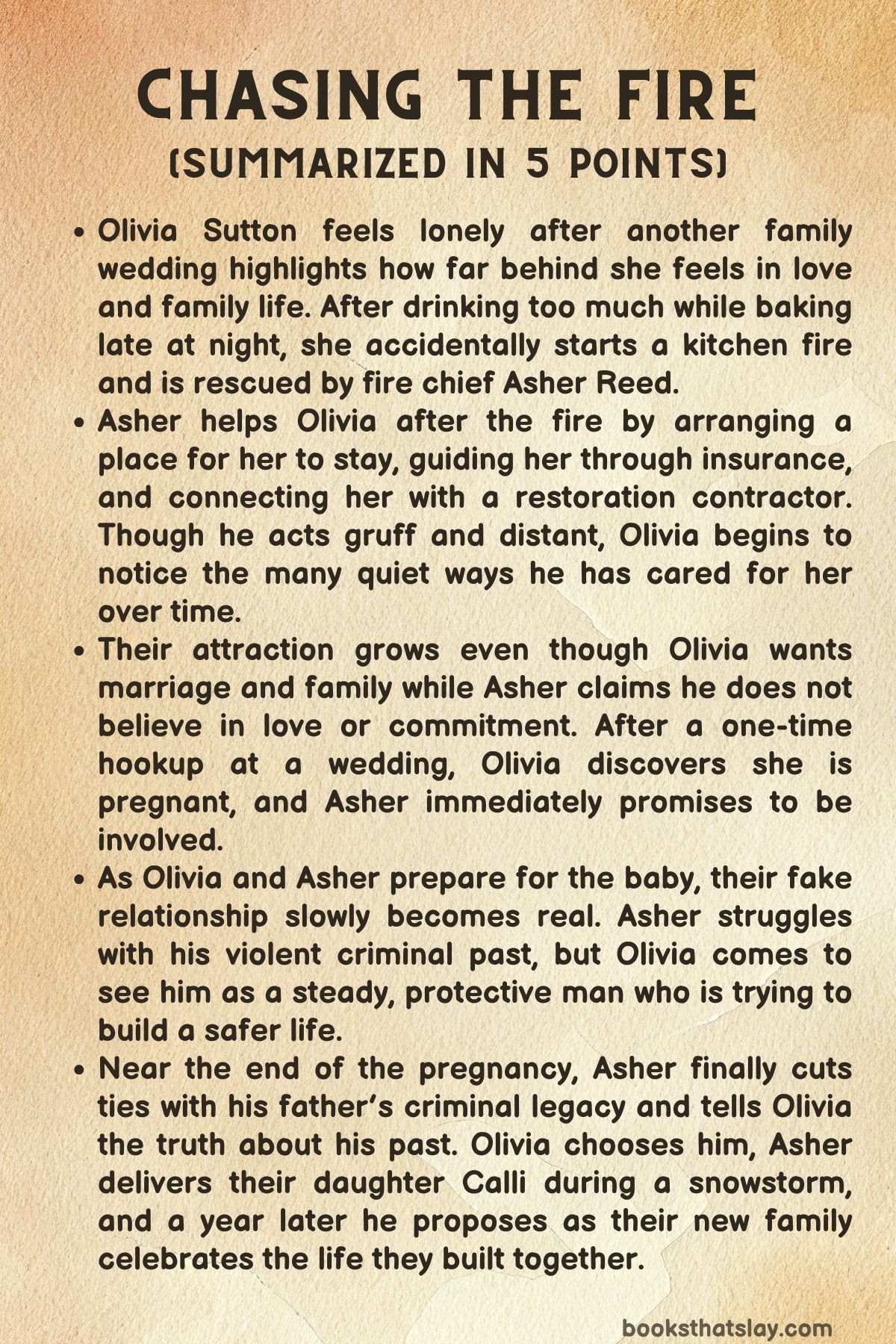
Olivia Sutton is struggling with loneliness when the story begins. Another family wedding has left her feeling painfully aware that everyone around her seems to be moving forward into marriage, babies, and settled lives while she remains alone.
Her sadness is made worse by the recent death of her beloved cat, Biscuit, whose absence has made her house feel emptier than ever. One night, after drinking too much wine and trying to comfort herself by baking banana bread, Olivia becomes distracted and accidentally starts a fire in her kitchen.
The Laurel Creek Fire Department responds, and Fire Chief Asher Reed is the one who takes charge. He is intimidating, direct, and not especially gentle with his criticism, but he is also competent and protective.
He treats Olivia for smoke exposure and makes sure she has somewhere safe to go. Rather than letting her stay alone or check into a motel, he arranges for her to stay in a cabin at Silver Pines Ranch.
This first major interaction shows the shape of their relationship: Asher may sound harsh, but his actions are steady and caring.
As Olivia deals with the aftermath of the fire, she learns that her historic house will need a complicated restoration. The damage is not something that can be fixed quickly, and she has to face insurance claims, repairs, and the stress of being displaced from her home.
Asher steps in again, helping her understand the process and connecting her with a contractor who knows how to restore older homes. Olivia notices that, beneath his gruff exterior, Asher has been looking out for her quietly for a long time.
He has cleared snow from her car, left coffee for her after late nights, and watched over her in small ways she had not fully understood before.
Their attraction becomes harder to ignore. Olivia is open about wanting a real future: marriage, children, a stable home, and someone who chooses her completely.
Asher, however, insists that he does not believe in love or marriage. He keeps emotional distance and seems determined to convince both Olivia and himself that he cannot offer the life she wants.
Even so, the pull between them continues to grow.
At Ginger and Cole’s wedding, the tension finally breaks. Olivia and Asher give in to their attraction and share a one-time hookup.
They both try to treat it as something casual and temporary, but it changes everything. Olivia later finds out that she is pregnant.
The discovery forces both of them to face a future neither expected.
When Olivia tells Asher about the pregnancy, he is shocked, but he does not run. He immediately promises to be involved and makes it clear that he will support her and the baby.
This commitment begins to shift their relationship from attraction and argument into something deeper. They start attending appointments together and learning how to move through the practical side of becoming parents.
Though the situation is uncertain, Asher’s reliability begins to matter more than his words about not believing in love.
The fake relationship begins when Olivia tells her parents about the pregnancy. Her father assumes that she and Asher are in love, and Olivia panics.
Instead of correcting him, she says yes. Asher goes along with the lie, and what starts as a cover story gradually becomes closer to the truth.
As Olivia’s house continues to be repaired, Asher moves her into his home. Living together changes the rhythm between them.
They share meals, daily routines, fears, and quiet moments that make it increasingly difficult to pretend their bond is only about the baby.
Asher’s resistance comes from a painful past. He was born into a violent Irish crime family in New York.
His father, James Donovan, abused his mother and raised Asher in a world of violence, control, and criminal expectation. Asher was trained for a life he never truly wanted, and as a young man he went to prison.
Eventually, he escaped that old world, remade himself, became a firefighter, and built a quieter life in Laurel Creek. But he still carries fear and shame from who he used to be and what his family represents.
Because of that history, Asher believes love makes people vulnerable. He fears that if he fully loves Olivia and their child, he may bring danger to them.
He thinks distance is protection, even though everything he does proves he already cares deeply. Olivia begins to see past the image of the dangerous bad boy she once thought he might be.
Instead, she sees a man who protects, provides, shows up, and builds safety around the people he loves.
Their bond grows throughout Olivia’s pregnancy. Asher supports her through medical appointments, worries, and emotional changes.
He also takes on the restoration of her kitchen in a deeply personal way. He builds her cabinets himself, putting time, care, and skill into making the damaged space whole again.
One of his most meaningful gestures comes when he salvages pages from Olivia’s ruined family cookbook and frames them for her. The gift shows that he understands what the fire took from her and that he wants to preserve the parts of her past that matter most.
Olivia realizes she has fallen in love with him. The feeling is not based only on attraction or the baby.
It comes from watching Asher choose her again and again through action. She sees how he softens around her, how seriously he takes fatherhood, and how hard he is trying to become the kind of man who can stay.
Asher, in turn, slowly begins to accept that tenderness and family are not impossible for him. The life he once thought he could never have starts to feel real.
Near the end of Olivia’s pregnancy, Asher’s past comes back in a direct way. His uncle Peter appears at his property, bringing the criminal world Asher escaped right to his doorstep.
Peter needs Asher to sign papers giving up any claim to his father’s empire after James Donovan’s death. The encounter forces Asher to tell Olivia the full truth about his family, his old life, and the danger he has feared.
Olivia is shaken by what she learns, but she listens. After understanding the whole story, she chooses Asher, not the shadow of his past.
Asher signs the papers, cutting his final legal tie to the Donovan empire. This act is important because it shows that he is done living under the weight of that world.
He is not only rejecting the criminal legacy; he is choosing the family he is building with Olivia and their baby. It marks a turning point for him, allowing him to step more fully into the future he had been afraid to want.
Soon after, Olivia goes into labor early during a snowstorm. The weather makes it difficult for help to arrive, and the ambulance is delayed.
In an intense and emotional moment, Asher delivers their daughter at home. Their baby girl is named Calli.
Her birth brings together everything Asher feared and everything he wanted: love, responsibility, danger, devotion, and family. Instead of breaking under the pressure, he rises to it.
One month later, Olivia and Asher are happy together as new parents. Their relationship has moved far beyond the accidental fire, the fake romance, and the fear that once held them back.
They have created a real home with their daughter, built through patience, honesty, and the choice to stay.
The story closes with Calli’s first birthday at Silver Pines, surrounded by friends and family. The celebration shows how fully Olivia, Asher, and Calli have become part of a larger loving community.
During this happy gathering, Asher proposes to Olivia. She accepts, and the life that began with a kitchen fire, an unexpected pregnancy, and a man afraid of love becomes the stable, chosen family Olivia always wanted and Asher never believed he deserved.
Characters
The characters in Chasing the Fire are shaped by loneliness, fear, grief, love, and the difficult process of choosing a safer, more honest life. The story uses Olivia and Asher’s unexpected relationship to explore how people who feel emotionally stuck can still build something meaningful when they are willing to face pain instead of hiding from it.
In Chasing the Fire, even the supporting characters help show the importance of family, community, protection, and second chances.
Olivia Sutton
Olivia Sutton is the emotional center of the book, and her character is defined by longing, vulnerability, and a deep desire to belong. At the beginning, she feels left behind by the people around her because so many friends and family members are getting married, having children, or moving into settled lives while she remains alone.
Her grief over Biscuit’s death adds another layer to this loneliness, showing that her sadness is not only romantic but also connected to loss, routine, and the absence of daily companionship. The kitchen fire becomes an outward symbol of her inner chaos: she is overwhelmed, careless in a moment of pain, and desperate for comfort, but the accident also forces her life to change in ways she never expected.
Olivia’s greatest strength is her emotional openness. She wants marriage, children, family, and stability, and although those desires make her feel exposed, they also give her character sincerity.
She is not pretending to be detached or fearless. Her panic when her father assumes she and Asher are in love shows how badly she wants that kind of life, but also how frightened she is of wanting it with someone who may not be able to give it to her.
Through the pregnancy and her growing bond with Asher, Olivia becomes more confident in trusting what she sees rather than what she fears. She gradually realizes that Asher is not simply a dangerous or temporary mistake, but someone who has been quietly protecting and caring for her long before their relationship becomes official.
Olivia’s development is especially important because she learns to balance hope with courage. She does not ignore Asher’s past once it comes to light, but she also does not reduce him to it.
Her choice to stay with him after hearing the truth about his family shows maturity and emotional depth. By the end of the story, Olivia has moved from feeling abandoned and behind in life to becoming a mother, partner, and part of a loving family.
Her journey is not about being rescued by Asher alone; it is about recognizing her own worth, accepting unexpected love, and allowing herself to build the life she has always wanted in a way she never planned.
Asher Reed
Asher Reed is one of the most intense and emotionally guarded figures in the book. As fire chief, he appears controlled, intimidating, and practical, but beneath that disciplined exterior is a man shaped by violence, fear, and survival.
His past with James Donovan and the criminal world he escaped explains his resistance to love and marriage. Asher does not reject romance because he is careless or selfish; he rejects it because he associates attachment with danger.
He believes that loving someone gives the past a way to hurt them, and this fear becomes the central conflict of his character.
Asher’s actions often reveal more than his words. Although he criticizes Olivia’s accident-prone habits and insists he does not believe in romantic love, he repeatedly protects her in quiet, practical ways.
Clearing snow off her car, leaving coffee for her, helping with insurance, arranging a safe place for her to stay, and renovating her kitchen all show that his love is present long before he can name it. His care is not loud or sentimental at first; it is shown through work, attention, and responsibility.
This makes his character especially compelling because the gap between what he says and what he does reveals his emotional struggle.
His transformation comes through accepting that love does not have to repeat the violence of his past. Olivia and their baby force him to confront the idea that family can be chosen, gentle, and protective rather than brutal and controlling.
His decision to sign away any claim to his father’s empire is deeply symbolic because it marks his final break from the life that shaped his fear. Delivering Calli during the snowstorm also brings his character full circle: the man who once believed he was made for danger becomes the person who brings his daughter safely into the world.
By the end, Asher is no longer only a protector hiding behind emotional walls; he becomes a partner and father who is willing to claim love openly.
Calli
Calli is physically present only near the end of the book, but her importance begins long before her birth. From the moment Olivia discovers she is pregnant, Calli changes the direction of both Olivia and Asher’s lives.
She turns their connection from a supposedly casual event into something lasting and unavoidable. For Olivia, the pregnancy brings fear but also the possibility of the family she has always wanted.
For Asher, Calli becomes the living proof that he cannot remain emotionally distant forever.
Calli represents hope, renewal, and the future. Her arrival forces Asher to imagine himself not as the son of James Donovan or the product of a violent past, but as a father capable of tenderness and protection.
She also gives Olivia a new sense of belonging, not because motherhood solves all of her problems, but because it becomes part of the stable life she has been longing for. Her birth during the snowstorm creates a powerful emotional moment because danger, fear, love, and trust all come together at once.
Asher delivering her at home shows how far he has come and how deeply connected the new family has become.
By the first birthday celebration, Calli also becomes a symbol of community. She is not only Olivia and Asher’s daughter; she is surrounded by friends, family, and the peaceful life Asher once believed he could never have.
Her presence helps complete the emotional arc of the story, showing that the unexpected consequences of one impulsive night have grown into love, family, and commitment.
Biscuit
Biscuit, Olivia’s cat, is not present as an active character during most of the book, but Biscuit’s death has a meaningful effect on Olivia’s emotional state. Biscuit represents companionship, comfort, and the quiet routines that made Olivia’s lonely life feel less empty.
Olivia’s grief over Biscuit shows that her sadness is not shallow or exaggerated. She is mourning a genuine bond, and that grief contributes to the vulnerable state she is in when the kitchen fire happens.
Biscuit’s role also helps explain Olivia’s need for warmth and connection. The loss leaves a space in her life, and the fire occurs during a moment when she is trying to soothe herself through baking and wine.
In that sense, Biscuit’s absence indirectly sets the story in motion. The character’s importance lies in what Biscuit meant to Olivia: love, familiarity, and a sense of being needed.
This makes Olivia’s later journey toward family and motherhood feel even more emotionally connected, because she moves from grieving a lost source of companionship to building a larger and more permanent circle of love.
James Donovan
James Donovan is the dark force behind Asher’s past, even though he is not present in the main emotional life of the story. As Asher’s father, he represents violence, control, inherited trauma, and the criminal world Asher fought to escape.
His abuse of Asher’s mother and his attempt to shape Asher into someone brutal reveal the kind of family system Asher came from. James is important because he explains why Asher fears love, marriage, and family.
To Asher, family was not originally a place of safety; it was a place of fear and domination.
James’s influence continues even after his death because Asher still carries the emotional consequences of being raised by him. The fear that Olivia and the baby could be exposed to danger comes from James’s world and the power it once had over Asher’s life.
This makes James a character whose presence is felt through trauma rather than direct action. He functions as the embodiment of everything Asher does not want to become.
When Asher finally gives up any claim to James’s empire, it is more than a legal decision. It is a rejection of inheritance, violence, and identity based on fear.
James Donovan’s role in the book is therefore essential because Asher’s growth depends on breaking free from the shadow of his father and proving that he can create a family defined by love rather than harm.
Peter
Peter, Asher’s uncle, serves as the messenger from Asher’s old life and becomes the person who forces hidden truths into the open. His arrival at Asher’s property disrupts the fragile peace Asher has built with Olivia.
Until Peter appears, Asher’s past remains something he fears but has not fully shared. Peter’s presence makes it impossible for Asher to keep that part of himself separate from Olivia and their future child.
Peter is not only a reminder of the criminal family Asher escaped; he is also a catalyst for honesty. By asking Asher to sign away any claim to James Donovan’s empire, Peter brings Asher to a decisive moment.
Asher must choose whether to remain connected to the power and danger of his father’s world or fully sever himself from it. This makes Peter important even if he is not emotionally central for long.
He creates the situation that allows Asher to make his break final.
Peter also affects Olivia’s understanding of Asher. His appearance reveals that Asher’s fear has a real source, not just emotional avoidance.
Once Olivia learns the truth, she has to decide whether she can accept Asher with his past included. In this way, Peter helps move the relationship from partial intimacy to full honesty.
Olivia’s Father
Olivia’s father plays a smaller but important role because he represents family expectation and the emotional pressure Olivia feels around love and commitment. When he assumes Olivia and Asher are in love, Olivia panics and agrees, creating the fake relationship that later becomes real.
His assumption reveals how deeply Olivia wants to be seen as settled and loved, especially by her family. It also exposes her insecurity about being behind everyone else in life.
He is not presented as cruel or hostile; instead, his role comes from ordinary parental concern and expectation. This makes the moment more believable because Olivia is not reacting to a villain, but to the weight of wanting her life to look secure in her father’s eyes.
His presence pushes Olivia and Asher into a situation where they must spend more time together and act like a couple, which allows their real feelings to develop.
Through Olivia’s father, the book also shows how family can unintentionally create pressure. His assumption becomes a turning point, but it also helps reveal Olivia’s longing for love and belonging.
He matters because he reflects the kind of stable family world Olivia wants to enter, even if she initially tries to reach it through a lie.
Olivia’s Parents
Olivia’s parents represent the family structure that Olivia still cares about and wants to be honest with, even when she is frightened. Telling them about the pregnancy is a major emotional step for her because it makes the situation real outside of her private world with Asher.
Their presence reminds the reader that Olivia is not isolated from family, but she still feels emotionally alone because her life has not followed the path she expected.
They also help highlight the contrast between Olivia and Asher. Olivia comes from a world where family expectations, weddings, and parental reactions matter.
Asher comes from a world where family means violence, danger, and escape. Because of this contrast, Olivia’s parents help show how different Olivia and Asher’s emotional histories are.
Their relationship requires both of them to understand that family means something very different to each of them.
Although Olivia’s parents are supporting characters, they help shape the emotional stakes of the pregnancy and the fake relationship. Their role is not only to react to Olivia’s choices, but to reveal how much Olivia wants acceptance, stability, and a future that feels secure.
Ginger
Ginger is important because her wedding becomes the setting where Olivia and Asher’s tension finally turns into action. Although she is not developed as deeply as Olivia or Asher, her role in the story is connected to the theme of comparison.
Her marriage reminds Olivia of what she does not yet have and intensifies Olivia’s feeling that everyone around her is moving forward while she is standing still.
Ginger’s wedding also functions as a social mirror for Olivia. Weddings are supposed to be joyful, but for Olivia, they bring loneliness and longing to the surface.
This does not mean Olivia resents Ginger; rather, Ginger’s happiness makes Olivia more aware of her own unmet desires. The event becomes a turning point because Olivia and Asher’s attraction can no longer remain hidden under banter, frustration, or denial.
As a supporting character, Ginger helps create the emotional environment that pushes the main relationship forward. Her role shows how other people’s milestones can affect someone who feels left behind, even when those milestones are celebrated with love.
Cole
Cole’s role is closely tied to Ginger, especially because their wedding becomes a major turning point in Olivia and Asher’s relationship. Like Ginger, he represents the settled romantic future that Olivia longs for.
His marriage places Olivia in direct contact with the kind of commitment she wants but does not yet have, which deepens her emotional vulnerability.
Cole is not central because of his individual conflict, but because of what his wedding symbolizes. He is part of the world of couples, families, and public commitment that surrounds Olivia.
That world makes her feel both hopeful and painfully aware of her own loneliness. His presence also helps create the social setting in which Olivia and Asher stop circling around their attraction and finally act on it.
As a supporting figure, Cole contributes to the book’s larger contrast between established love and unexpected love. His relationship with Ginger appears formal and celebrated, while Olivia and Asher’s begins in confusion, denial, and fear.
This contrast makes Olivia and Asher’s eventual commitment feel less traditional but still deeply meaningful.
Themes
Loneliness and the Fear of Being Left Behind
In Chasing the Fire, Olivia’s loneliness is not shown as simple sadness, but as a deep fear that life is moving forward for everyone except her. Family weddings, pregnancies, and settled relationships make her feel as though she has missed some invisible deadline for happiness.
Her grief over Biscuit adds to this emptiness because the loss removes one of the few steady comforts in her daily life. The kitchen fire becomes an outward expression of her emotional state: distracted, overwhelmed, and trying to cope in private until everything breaks at once.
Her journey shows how loneliness can make a person doubt their own worth, especially when they compare their life to others. Yet the story also suggests that belonging does not always arrive in the expected order.
Olivia does not find connection through a perfect plan, but through an accident, an unwanted disruption, and a relationship that first seems uncertain. Her healing begins when she allows herself to be cared for without seeing it as weakness.
Love as Safety, Action, and Responsibility
Love in the story is built less through grand declarations and more through repeated acts of care. Asher’s feelings appear long before he is willing to name them: clearing snow, leaving coffee, arranging shelter, helping with insurance, renovating Olivia’s kitchen, and preparing for the baby.
These actions matter because they show that love can exist even when a person is afraid of the word itself. Asher claims he does not believe in romance or marriage, but his behavior consistently proves that he already understands devotion.
Olivia gradually learns to trust the difference between empty charm and dependable care. Their relationship develops through responsibility, especially after the pregnancy, when Asher chooses involvement instead of distance.
The theme becomes stronger because love is not presented as effortless. It requires showing up during fear, confusion, and practical difficulty.
By the end, love is not only passion between them; it is the safe home, repaired kitchen, protected family, and steady future they create together.
Escaping the Past and Choosing a New Identity
Asher’s past follows him as a source of shame, fear, and self-punishment. His history with a violent crime family teaches him to associate love with danger and loyalty with control.
Because of this, he believes that keeping emotional distance is a way to protect Olivia and their child. His life in Laurel Creek as a firefighter is already a rejection of the world he came from, but the story shows that changing one’s surroundings is not the same as fully accepting a new self.
Asher has built a better life, yet he still sees himself through the violence and mistakes of his past. The arrival of his uncle forces him to face that old identity directly rather than hiding from it.
Signing away any claim to his father’s criminal legacy is more than a legal decision; it is a symbolic break from fear, inheritance, and guilt. His growth lies in understanding that he is not doomed to repeat what shaped him.
Family, Home, and the Life Built from Ruins
The damaged house becomes a powerful symbol of Olivia’s changing life. At first, the fire seems like pure loss, destroying the comfort and history attached to her home.
Yet the restoration process turns that loss into a chance for renewal. Asher’s work on the kitchen is meaningful because he is not simply fixing walls and cabinets; he is helping Olivia rebuild the place where memory, family, and future meet.
The framed pages from her ruined family cookbook deepen this idea, showing that not everything broken has to be discarded. Some things can be preserved differently and still carry love.
The pregnancy also expands the meaning of home. Home is no longer just Olivia’s historic house or Asher’s property, but the emotional space they create for Calli.
Their family forms through accidents, fear, repairs, honesty, and commitment. By the ending, home is shown as something made through care, not perfection, and family becomes the proof that new beginnings can grow from damage.