Chasing The Wild Summary, Characters and Themes
Chasing The Wild by Elliott Rose is a contemporary romance set in the rugged isolation of Montana’s mountain country, where love and survival collide against the backdrop of snowstorms, betrayal, and redemption. The novel follows Layla Birch, a determined veterinary student, and Colton Wilder, a stoic ranch owner, as their paths cross under unlikely circumstances.
What begins as a simple errand to return an ex-boyfriend’s belongings spirals into a story of danger, emotional healing, and forbidden love. Through vivid settings and emotionally complex characters, the book explores the thin line between duty and desire, and how trust can grow in the most unexpected places.
Summary
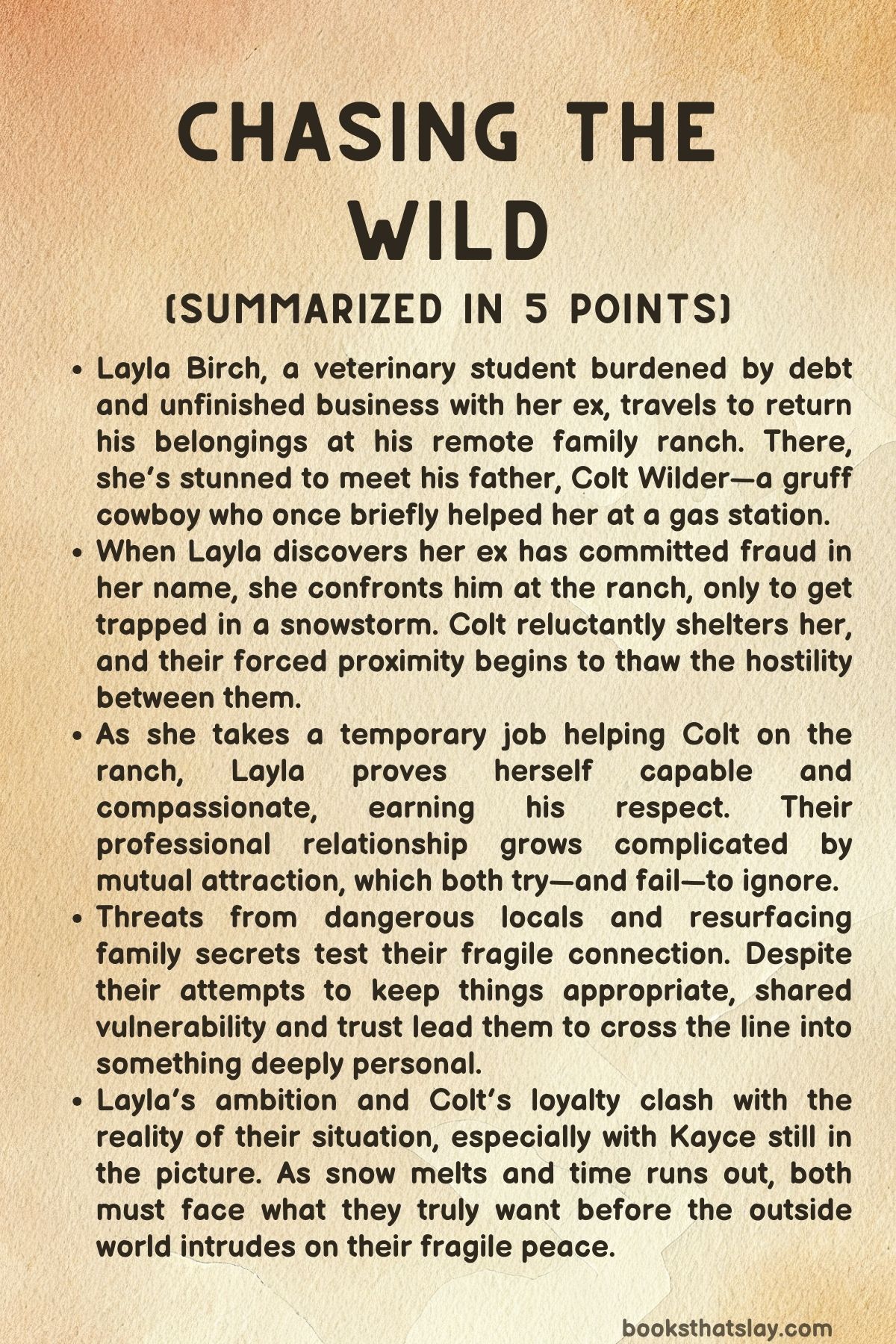
Layla Birch, a hardworking veterinary student in her mid-twenties, is preparing to move for her next placement when she realizes her unreliable ex-boyfriend, Kayce Wilder, has left boxes of his belongings at her home. Unable to reach him by phone, she decides to drive to his address in the remote town of Crimson Ridge, Montana, to return his things.
Along the way, her card is declined at a gas station, and an aggressive cashier accuses her of theft. A rugged stranger steps in to pay for her gas without hesitation—his quiet authority and rugged charm leave her rattled.
They exchange a few charged words before she leaves, unaware that their paths will cross again.
When Layla stops at a café to confirm Kayce’s address, the waitress’s smirk hints that Layla isn’t the first woman looking for him. Following the directions, Layla drives up Devil’s Peak Road and reaches a breathtaking ranch property, expecting a rundown cabin but instead finding a modern mountain estate.
The man who opens the door is the same cowboy from the gas station—shirtless, fresh from the shower, and clearly displeased to see her. He’s Colton Wilder, Kayce’s father.
Moments later, Kayce appears, drunk and careless, introducing Layla as his girlfriend. Layla hastily corrects him, tension crackling between all three.
Kayce’s irresponsibility disgusts Colton, and Layla, realizing how deeply she misjudged her ex, leaves after handing over the boxes.
Months later, Layla’s life is upended when she learns someone took out a $2,500 loan in her name—using Kayce’s old address at Devil’s Peak Ranch. Furious and desperate, she drives back to confront him, but Colton tells her Kayce is gone.
As a snowstorm descends, her car breaks down, forcing her to trek back to the ranch through the freezing wind. Colton takes her in, and when panic overtakes her, he steadies her with quiet patience.
Learning of her financial trouble, he unexpectedly offers to pay off the debt himself until Kayce repays it. When Layla reveals she needs eight weeks of veterinary work experience to graduate, Colton offers her a temporary job on the ranch.
Working for Colton proves both demanding and rewarding. Layla adapts quickly, impressing him with her compassion for the animals and determination to learn.
Their days are filled with ranch work and unspoken tension, each drawn to the other but unwilling to acknowledge it. Layla sees Colton’s strength and loneliness beneath his gruff exterior, while he admires her capability and resolve.
When a local troublemaker, Henrik Pierson, harasses Layla, Colton’s fierce defense of her leaves them both shaken. That night, the simmering attraction between them surfaces during a quiet encounter in the dark, though Colton forces himself to stop before crossing a line.
As the weeks pass, they grow closer through shared work and moments of vulnerability. Colton reveals painful memories of his abusive grandfather and his struggle to rebuild the family ranch, while Layla shares her worries about her mother’s neglect and her aunt’s illness.
When a violent incident leaves several cattle injured, Layla helps Colton treat the wounds, proving her courage under pressure. Their teamwork deepens their bond, and the emotional intimacy between them becomes undeniable.
However, when Kayce’s voice crackles over the radio, jealousy and guilt crash over Colton, and the fragile balance between them fractures.
Despite the tension, they can’t stay apart. One night, after mutual confessions of longing, they finally give in to their desire.
Their relationship, both physical and emotional, blossoms in the seclusion of the snowbound ranch. Days blur together in warmth and passion, though both know their time is running out.
When Layla nearly steps into a hidden bear trap, the danger around the ranch becomes real again. Security footage reveals the Pierson brothers trespassing, confirming Colton’s suspicions that they’re behind the recent damage and threats.
He refuses to report them, bound by a complicated history involving his family’s past misdeeds.
Layla’s growing fear for Colton’s safety mirrors her dread of leaving him. Their connection has evolved beyond physical attraction into something profound, yet both know it can’t easily survive the world outside the mountain.
When the storm clears and roads reopen, reality intrudes. A local woman named Chy confronts Layla, threatening to expose her relationship with Colton and destroy his reputation unless she disappears quietly.
Layla, terrified of causing harm to the man she loves, leaves at dawn after writing a note. Though heartbroken, Colton lets her go, urging her to pursue her future and assuring her she’s stronger than she believes.
Only later does Layla discover he secretly paid for her car repairs, proving he cared long before they were lovers.
Months later, Layla has completed her placements and is close to graduating, though she still aches for Colton. While working at a rodeo, she runs into Kayce, who has matured and seeks forgiveness.
He tells her that Colt made him repay the stolen money and reveals that Chy’s baby was not his; she and the Pierson brothers had conspired to manipulate Colt into losing the ranch. The brothers were arrested, and the threat to the Wilder family ended.
Kayce encourages Layla to reach out to his father, hinting that Colt has been miserable since she left.
On graduation day, as Layla walks the stage, she spots Colton standing under an oak tree, holding a bouquet of wildflowers from Devil’s Peak. He tells her he learned how to use social media just to find her.
Overwhelmed, Layla embraces him as he confesses that he loves her and wants to follow her wherever she goes. Their reunion is emotional and sincere, grounded in mutual respect and love that has endured months apart.
They promise to build a life together, no longer constrained by the mountain or by guilt.
In the epilogue, the two drive back toward Crimson Ridge, finally at peace. Colt jokes about getting rid of his phone, but Layla teases him about reasons to keep it.
They pull off on a quiet forest road, reaffirming their love in the place where everything began. Their story closes not with an ending, but with a beginning—two people who found each other amid wilderness and storms, choosing to chase the wild together.
Characters
Layla Birch
Layla Birch, the central character of Chasing The Wild, is portrayed as a determined and compassionate young woman navigating the demanding world of veterinary studies while carrying the weight of emotional and financial hardship. Her journey from a stressed, overworked student to a confident and self-assured individual mirrors her internal growth and the forging of her identity amidst chaos.
Layla’s character is grounded in resilience; her interactions reveal a quiet strength, one forged through hardship rather than inherited ease. She is empathetic and nurturing—traits that make her a natural caregiver to both animals and people—but she also struggles with boundaries, particularly when it comes to those she loves.
Her relationship with Kayce exposes her vulnerability and her tendency to give too much of herself, while her growing connection with Colton becomes a turning point where she learns that love can be both tender and empowering. Throughout the novel, Layla is defined by her courage: confronting betrayal, facing physical dangers on the ranch, and ultimately standing up for her future.
Her compassion does not make her weak; instead, it becomes the foundation of her strength and the bridge between her tumultuous past and the life she builds with Colt.
Colton “Colt” Wilder
Colton Wilder, the rugged patriarch of Devil’s Peak Ranch, embodies the archetype of the wounded cowboy—strong, self-reliant, yet scarred by years of loss and guilt. In Chasing The Wild, Colt is a man caught between the harshness of the wilderness and the emotional wilderness within himself.
He has rebuilt his life from the wreckage of a violent family legacy and carries the burden of protecting both his land and his estranged son. His brusque demeanor hides a deep capacity for tenderness, one that emerges slowly through his interactions with Layla.
Colt’s attraction to her begins as a forbidden desire but transforms into something far deeper: a longing for connection and redemption. Through Layla, he confronts his fears of vulnerability and his self-imposed isolation.
His moral compass, though occasionally clouded by passion, is rooted in honor and responsibility. Colt’s evolution—from a man driven by guilt and restraint to one capable of love and openness—is one of the novel’s most compelling arcs.
By the end, he stands as both Layla’s equal and her protector, symbolizing the healing power of emotional honesty and the courage it takes to start anew.
Kayce Wilder
Kayce Wilder serves as the catalyst for much of the conflict in Chasing The Wild, embodying recklessness and immaturity in stark contrast to both his father and Layla. Initially charming but deeply unreliable, Kayce represents the kind of person who takes without understanding the cost of his actions.
His relationship with Layla is emblematic of her younger, more naive self—a phase of her life defined by misplaced trust and yearning for affection. Kayce’s fraudulent use of Layla’s identity and money underscores his moral weakness and inability to take responsibility.
Yet, by the novel’s conclusion, he experiences a measure of redemption. His apology to Layla and acknowledgment of his father’s pain reveal glimmers of self-awareness and growth.
Kayce’s character functions as both a mirror and a foil—reflecting what Layla must overcome and what Colt has worked to rise above. Through Kayce, the story explores generational patterns of failure and the painful, necessary steps toward accountability.
Sage
Sage, Layla’s best friend, represents the grounding influence in Layla’s otherwise chaotic life. Though her presence is limited compared to other central characters, she provides emotional balance and moral clarity.
In Chasing The Wild, Sage functions as both confidante and truth-teller, often offering the kind of insight Layla cannot see for herself. Her practicality and humor contrast with Layla’s emotional intensity, giving readers a lens through which to see Layla’s decisions more clearly.
When Sage reappears during Layla’s graduation, she anchors the story’s ending in warmth and friendship, reminding both Layla and Colt that love does not have to exist in isolation. Sage’s character symbolizes the enduring value of female friendship and emotional support, acting as the voice of stability amid passion and uncertainty.
Chy
Chy is the embodiment of manipulation and deceit in Chasing The Wild, a woman driven by envy, insecurity, and greed. Her actions—spreading rumors, exploiting relationships, and attempting to blackmail Layla—expose the darker side of small-town dynamics and the destructive potential of jealousy.
Yet, beneath her malice lies a tragic undertone; Chy is a product of the same toxic environment that scarred Colt and Kayce, shaped by desperation and the need for validation. Her entanglement with the Pierson brothers and her fabricated paternity claim highlight her willingness to use lies as weapons.
Chy’s downfall is not just a narrative resolution but also a thematic statement: deceit corrodes everything it touches, and in contrast to Layla’s honesty and courage, Chy’s bitterness leads only to isolation.
Henrik Pierson and the Pierson Brothers
The Pierson brothers, particularly Henrik, serve as antagonists who bring external tension and danger into the insulated world of Devil’s Peak Ranch. In Chasing The Wild, they represent the human manifestation of the wild’s threat—lawless, predatory, and driven by greed.
Henrik’s harassment of Layla and the brothers’ acts of sabotage against Colt’s property evoke the sense of unease that pervades the mountain setting. Their enmity with Colt stems from a long, poisonous family feud tied to land, pride, and betrayal, creating a multi-generational conflict that mirrors the emotional scars within the Wilder family.
Through them, the novel explores the theme of inherited violence and the struggle to break free from cycles of vengeance. The Piersons’ eventual downfall underscores the victory of integrity and love over brutality and corruption.
Aunt Evaline
Aunt Evaline, though a minor character in terms of presence, holds profound emotional significance in Chasing The Wild. As Layla’s ailing aunt suffering from dementia, she represents both the fragility of the past and Layla’s deep sense of duty.
Evaline’s condition propels much of Layla’s motivation to succeed academically and financially, adding weight to her decisions and sacrifices. Through Evaline, the story reveals Layla’s compassionate nature and her fear of abandonment—a fear that parallels Colt’s emotional wounds.
While Evaline’s role is quiet, her influence lingers throughout the narrative, symbolizing the kind of love that demands selflessness and endurance, shaping Layla into the woman capable of both surviving and choosing love on her own terms.
Themes
Redemption and Moral Reckoning
In Chasing The Wild, redemption functions as both a private and relational pursuit, embodied most powerfully in Colt Wilder. His life is marked by inherited guilt and the scars of past cruelty, particularly from his grandfather, whose violence and greed poisoned the family’s legacy.
Colt’s ranch, Devil’s Peak, becomes a physical manifestation of that moral weight—a place he must both protect and purify. Every decision he makes, from the quiet repair of fences to his unexpected generosity toward Layla, is an act of penance.
His relationship with her represents a form of moral reckoning rather than mere desire. Layla enters his world burdened by betrayal and financial deceit, while Colt bears the shame of lineage and his failures as a father.
Their connection, though initially forbidden, becomes a channel through which both characters reclaim agency over their pain. Redemption here is not achieved through confession or forgiveness but through endurance and integrity—Colt pays her debt without condition, and Layla earns her place at the ranch through hard, honest work.
When the truth about the Pierson brothers and Chy’s schemes surfaces, Colt’s long efforts to right his family’s wrongs come full circle. The story thus frames redemption not as absolution from others but as a constant, lived choice—to rebuild, to protect, and to love despite the past’s weight.
Isolation and Human Connection
The novel situates its emotional and physical conflicts in the remote Montana wilderness, turning isolation into both a danger and a crucible for transformation. The mountains strip the characters of pretense.
Layla, cut off by blizzards and distance, is forced to confront her deepest fears—loneliness, inadequacy, and the longing to be seen beyond usefulness. Colt, equally alone despite his commanding presence, finds that isolation has hardened him, making him mistake control for safety.
Their time together on the ranch redefines solitude from a shield into an opportunity for connection. The physical environment mirrors their emotional states: the vast silence of Devil’s Peak both traps and frees them.
Snowstorms close off escape routes but also bring them closer in mutual dependency, revealing that vulnerability is not weakness but the foundation of intimacy. When the storm subsides and the road reopens, their separation underscores the fragility of human bonds formed in isolation.
Yet by the end, Colt’s decision to cross miles to attend Layla’s graduation transforms isolation into devotion—proof that genuine connection can survive even the harshest distances.
Power, Gender, and Control
Power in Chasing The Wild operates through the intersecting forces of gender, class, and physical dominance. Layla’s journey from a panicked, financially cornered student to a capable ranch hand reflects her reclaiming of control in a world that often dismisses or exploits women’s labor.
Her encounters with men like Henrik Pierson and even Kayce expose how male entitlement manifests through manipulation or coercion. Colt, though powerful in stature and authority, disrupts this pattern by learning restraint.
His attraction to Layla is shadowed by awareness of his position—older, wealthier, her employer, and her ex’s father. The novel complicates desire by forcing both characters to navigate power with consent and mutual respect.
Their first sexual encounter, marked by explicit verbal consent, transforms the dynamic from potential exploitation to equal exchange. Layla’s competence on the ranch gradually disarms Colt’s instinct to protect through control, and instead he begins to treat her as a partner, not a subordinate.
Power, once weaponized in their lives, becomes something to be shared. The book thus reimagines control not as domination but as the capacity to choose honesty over fear.
Family Legacy and Inherited Trauma
Both Layla and Colt are products of fractured families, carrying emotional debts far heavier than financial ones. Colt’s abusive upbringing under his grandfather leaves him in a perpetual struggle to undo generational harm, while Layla’s childhood shaped by neglect and caretaking of her ailing aunt teaches her responsibility without support.
The novel suggests that family legacy is both curse and compass—it determines their fears but also their capacity for empathy. Colt’s relationship with Kayce is strained by guilt and resentment, a mirror to the cycle of neglect that raised him.
Layla’s instinct to nurture, often at her own expense, echoes the patterns of survival learned in dysfunction. When they meet, their attraction becomes a collision of histories, but through each other they find the possibility of rewriting their inherited narratives.
Colt’s eventual reconciliation with Kayce, catalyzed by honesty and shared suffering, represents a rupture in the chain of generational pain. Similarly, Layla’s graduation and newfound confidence signal liberation from the roles imposed by her past.
The story portrays healing as a generational act—one that begins when individuals refuse to repeat the silence and cruelty they were born into.
Love, Desire, and the Boundaries of Morality
The love story at the heart of Chasing The Wild challenges the boundaries of social morality. Layla and Colt’s connection defies convention not only because of their age gap but also because of Colt’s paternal link to Kayce.
What might have been reduced to scandal or taboo is instead framed as an exploration of emotional truth. Their bond grows from necessity and mutual respect rather than impulsive lust, and the novel treats their intimacy with an unflinching honesty that resists romantic idealization.
The ethical tension—between loyalty, propriety, and personal fulfillment—drives much of the narrative’s emotional force. Colt’s internal conflict, oscillating between desire and guilt, mirrors society’s broader discomfort with unconventional love.
Yet the novel ultimately argues that morality divorced from empathy becomes hollow. The sincerity of their affection, the care they show each other in vulnerability, and their willingness to sacrifice comfort for honesty make their relationship not a moral failing but a redemptive act.
By the end, love is no longer forbidden but redefined—a force that demands courage, accountability, and forgiveness, both of oneself and of the world that judges too easily.