Cinder House Summary, Characters and Themes
Cinder House by Freya Marske is a dark, fairy-tale reimagining of Cinderella where the “glass slipper” story is told from inside a haunted home. Ella dies in her father’s magically aware house and wakes bound to it as a ghost, trapped under the rule of an abusive stepfamily.
Years later, a sly fairy offers her a dangerous bargain: three nights of borrowed life in exchange for help with a theft. Those three nights place Ella at the center of a royal betrothal festival, a cursed prince, and a scholar-princess with secrets of her own, as Ella fights for agency, revenge, and a new kind of future.
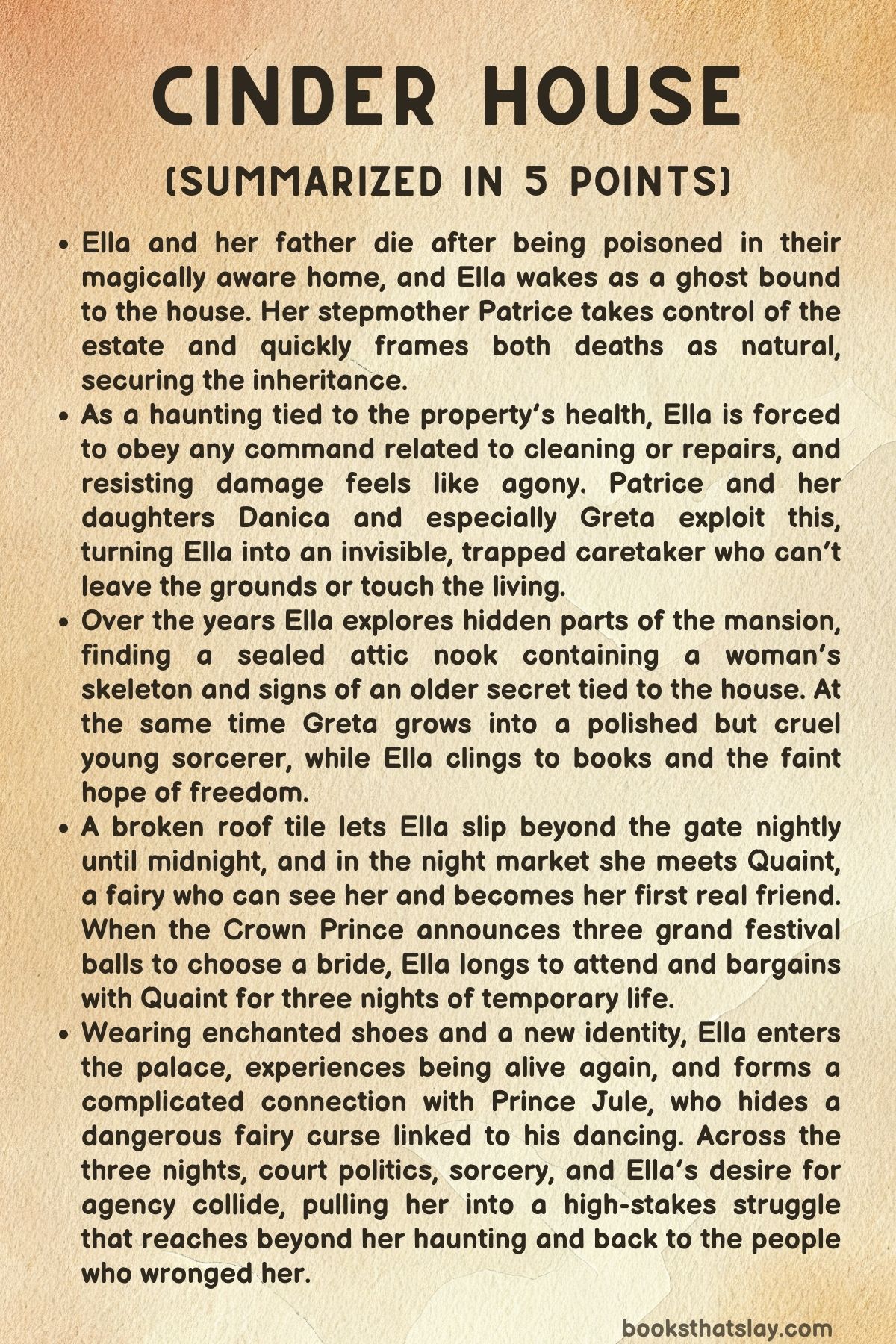
Summary
Ella and her father share tea in their sentient, magic-tuned home, and both are poisoned. Ella staggers onto the stairs as the house shrieks in alarm; she falls, strikes her head, and dies only minutes after her father.
Her stepmother Patrice swiftly hides the evidence by carpeting the steps before the funerals, then performs public grief beside her daughters, Danica and Greta. With no will left behind, Patrice claims Ella’s fall was an accident and her husband died of sorrow.
She inherits the estate.
Ella wakes as a ghost anchored to the house. For weeks she drifts through rooms and objects until she can present herself in the form she died in: sixteen, wearing a lavender dress.
Patrice sees her first and, rather than fearing her, treats her as property. Ella learns a brutal rule of haunting: any command tied to the house’s condition is absolute.
If Patrice orders her to clean a shattered teacup or fix a drafty window, Ella must comply. If she tries to resist, the neglect burns inside her until she yields.
She cannot strike Patrice or touch any living person, and when she tries to flee, an invisible boundary snaps her back. Outsiders cannot perceive her at all.
With their new servant secured, Patrice dismisses the maid. Danica and Greta discover the limits of Ella’s obedience and take turns exploiting her.
They order endless repairs and cleaning, turning her compulsion into entertainment until Patrice forbids the game—not out of kindness, but to keep the household running smoothly. Ella figures out she can refuse tasks unrelated to the structure itself, such as cooking, sewing, or personal errands.
Greta answers this loophole with cruelty. When Ella refuses something, Greta harms the house instead, smashing glass or carving wood so that Ella feels the damage as agony.
She learns to control Ella through threats to the walls and floors, and even scatters lentils through rooms just to force Ella into hours of cleanup.
Nights are Ella’s only freedom. After chores, she explores hidden corners of the property and sometimes dissolves into the house’s senses to escape her loneliness.
During one such fade she wakes in a sealed attic nook and finds a woman’s skeleton laid on a stained rug, wearing a heart pendant and surrounded by dried lavender. The space feels like a secret the house has carried for a long time.
Ella speaks to the bones, hoping for another spirit, but hears nothing. She keeps the discovery to herself, returning to the nook as a private tether to someone who suffered before her.
Years pass. Patrice grows richer, measured and unsentimental.
Danica becomes mild, sometimes complicit, sometimes ashamed. Greta turns into a polished, vicious young woman who collects rare butterflies from admirers and kills them for display.
Ella notices Greta’s talent for sorcery when she burns butterflies in midair; Patrice has arranged her lessons in secret. Ella herself remains locked in her lavender dress, though she senses a slow drift of time in her ghostly body.
She orders books through merchants who never realize who is paying, and studies anything that might explain her condition.
One winter midnight, Ella tosses a loose roof tile in frustration. Instead of falling back inside her boundary, it lands in the street and pulls her after it.
She finds herself outside the gate, still unseen and barely able to touch the world except for the tile she holds. She walks the city in stunned joy until, at midnight, an unseen tether yanks her back to the seventh stair where she died.
Keeping the tile, she repeats the escape night after night, always reclaimed by the house at the same hour.
On these walks she meets Quaint, a fairy stallholder at the night market who can see and speak with her. Quaint tests her with small bargains, but their talk becomes Ella’s first real friendship in years.
Encouraged, Ella begins writing to distant scholars about ghosts and house-magic, disguising her identity.
News arrives that Crown Prince Jule will host three festival balls to choose a bride. Greta sees a crown within reach.
Patrice outfits both daughters for the event, and the household buzzes with plans. Ella, thrilled at the thought of the palace and of seeing life beyond her walls, confides to Quaint that she wants to attend unseen.
Quaint offers a deal: escort the fairy into the house so Quaint can take items no fairy can remove alone, and in return Ella will receive temporary solidity to attend the balls. Ella knows bargains bite, but she agrees.
While Patrice and the daughters are away, Ella slips Quaint inside. Quaint steals personal items from Greta—hair, jewelry, a cup—because a sorcerer’s belongings are powerful.
Then Quaint gathers a map of Ella’s bond to the house using the roof tile, links of living memory and hearth ash, Ella’s old comb, and finally a mirror shard that must belong to the home. Ella weakens as she breaks her own wall mirror to supply it.
Quaint completes the spell and returns with willow-heartwood shoes inlaid with mirror fragments, plus a gown and cloak. While wearing the shoes, Ella will be fully alive for three nights, but the midnight pull will still apply.
On the first night Ella dons the shoes and becomes living again, transformed in appearance. She enters the palace as “Lady Ember,” dazzled by light, music, food, and touch she has not felt in six years.
She watches more than she dances, briefly colliding with a dark-eyed woman in black—Princess Nadya of Cajar. Later, in a quiet courtyard, Ella meets a stranger who turns out to be Prince Jule in disguise.
He confides that the courtship festival is a performance; he is expected to marry Nadya for alliance. He also reveals his fairy “gift”: as a child an evil fairy blessed him to dance so beautifully that anyone who sees him falls in love.
The blessing curdled into a curse, pushing observers into dangerous obsession. Jule now binds himself in braces to prevent true dancing and fears what his body can do to others.
Midnight strikes, and Ella vanishes mid-conversation, back to her haunted stair.
On the second night she returns to the palace determined to see him again. Jule misreads her disappearance as fear or manipulation and reacts coldly.
In the courtyard she tells him the truth: she is a ghost borrowing life, and she must fade at midnight. The honesty changes everything.
Ella suggests his curse might not affect someone already dead. Trusting her, Jule removes his braces and dances freely for her.
She watches untouched, then joins him. Their shared relief and hunger for the moment ends in a heated kiss and intimacy.
Princess Nadya interrupts, recognizing Ella’s dead nature through magic, and warns that Ella is in a fragile position. Ella flees once more as midnight takes her.
At home, tensions boil. Greta’s magic flares during a fight with Danica and burns Patrice’s arm.
Ella confronts Patrice directly about the murders. Patrice admits she poisoned her husband because he was dangerous, and that Ella died because she was collateral in securing the estate.
Ella reels, goes to the hidden skeleton, and takes the heart pendant chain, trying to kindle the anger she buried for years.
On the third night, while the betrothal is being finalized, Ella senses active sorcery in the ballroom. Nadya’s attendant, glassy-eyed, moves toward Jule with a knife.
Ella rushes forward and throws herself between them. The blade hits her; her blood turns to ash, exposing her as dead.
Jule tries to protect her with a warding ring, but it cannot help. Nadya unleashes fierce magic, ripping the compulsion from the attendant and proving he was a pawn.
Ella weakens because her solidity depends on the shoes far from her home. Jule pulls them off, and she snaps back into ghost form, dragged home, seeing Greta’s shocked recognition as she’s taken.
Ella decides to stop hiding. When the family returns, she sits in Patrice’s chair as if she owns the room.
Greta tries to strike her, and her hand passes through. Furious, Greta demands to know how Ella interfered at the palace.
Ella admits she made a bargain for three nights of life. Patrice accuses her of scheming to steal the prince.
Ella insists she only wanted to feel alive once more.
Greta reveals the truth: she staged the attack herself. The knife was meant to make Jule swoon so she could “save” him dramatically, frame Nadya, and force a match.
Ella’s intervention ruined everything. Danica, disgusted, leaves the house for good.
Patrice reprimands Greta only for risking exposure. Greta retaliates by blasting the chair apart, shredding Ella’s spirit, then wrecking the house all night with tools.
Because Ella is bound to the home’s condition, every blow tears through her. By morning the interior is ruined, and Ella is left hollow but steady in her belief that saving Jule was worth it.
Near noon, Jule arrives at the door with Nadya, guards, and attendants, carrying the mirrored shoes. They’ve searched the city to find the woman who saved him.
Greta tries to seize the moment by offering to try on the shoes and casting an illusion of Ella in the willow gown, claiming she was the savior. Nadya coolly points out that such a precise imitation implies close knowledge.
Jule’s suspicion grows as he questions who else lives there.
Nadya then produces a stamped letter and reveals she has corresponded for months with “Ella” at this address. She introduces herself fully as Nadya Odetta Mazamire si-Cajar, a scholar of magic, and states plainly that Ella is a ghost.
Ella strains to show herself. Nadya meets her gaze through the air, and Jule bows toward the spot where Ella stands, promising her any reward.
Greta screams no and lashes out in the most lethal way possible: she sets the house itself on magical fire, knowing a ghost without her anchor cannot survive.
The blaze races through walls and pipes, burning from within. Ella and the house scream together; she floods rooms through every tap, but cannot smother sorcery born of spite.
Nadya duels Greta in a sharp burst of violence and knocks her unconscious. Jule orders everyone out and calls royal sorcerers, but the home continues to collapse.
Nadya explains that a haunting is tied to the place of death and asks Ella to show her anchor. Ella drops a silver vase on the seventh stair.
Jule and a guard rip up the carpet and pry out the blood-stained board beneath. Nadya holds the board with her hair-magic to keep Ella tethered while the house dies.
To save Ella, Nadya urges her to choose a new anchor. Ella senses a faint trace of her own blood left on the palace ballroom floor from the stabbing.
Nadya mixes hearth ash into the stain and reminds her that a ghost is a grudge, a refusal to let something go. Ella understands that the palace bears rage at the attack on its prince, and that her devotion to Jule fits that fury.
She leaps, and the palace accepts her.
Ella wakes as the ghost of the royal palace, immense and alive with layered emotion. Only Jule, Nadya, and the king and queen can see her.
They thank her and offer her a place as long as she wants. Realizing Ella can overhear conversations across the grounds, the court recruits her as a discreet intelligence officer, and she asks in return for education in languages, history, politics, and economics.
Jule vouches for her loyalty.
Nadya and Jule marry soon after. Jule’s curse still makes public dancing dangerous, but Ella purchases enchanted silk-and-spiderweb ropes from Quaint that can restrain Nadya’s magic safely.
On their wedding night, Nadya is bound playfully so she cannot cast, and Jule dances without harming her. Ella cannot feel touch, yet through the palace she shares the warmth of their life and the trust between them.
In time the palace becomes a true home for Ella. She repairs and renovates willingly rather than under threat, studies with tutors, helps Nadya’s scholarship, and accompanies Jule to theatre and ballet.
Fairies can visit her now, and Quaint remains a frequent friend. Patrice is left behind, Danica starts a life elsewhere, and Greta is imprisoned for her crimes.
Ella never regains her old heartbeat, but she gains purpose, companionship, and a future shaped by choice—haunting a palace that respects her instead of a house that chained her.
Characters
Ella
Ella is the emotional and moral center of Cinder House—a young woman whose story begins with murder and ends with an unusual reclamation of agency. In life she is dutiful and loving, but in death she becomes something sharper: a ghost bound to her childhood home and forced into servitude.
The haunting rules are not just plot mechanics; they externalize her trauma. Every command tied to the house’s upkeep turns her grief and helplessness into physical compulsion, making her an unwilling caretaker of the very place that witnessed her betrayal.
Yet Ella’s spirit is stubborn. She tests boundaries, learns the distinction between what she must do and what she can refuse, and slowly builds a private inner life through exploration, reading, and nightly escapes.
Her discovery of the hidden skeleton hints at a deep instinct for truth and solidarity with the silenced, even when she cannot yet act on it.
As the narrative progresses, Ella’s arc is defined by the tension between invisibility and selfhood. She starts as a voiceless presence, denied recognition by the living, but she refuses to let that be her final state.
Her bargain with Quaint is both desperate and daring—a leap toward sensation, risk, and choice. At the palace she experiences life as novelty and ache: food tastes miraculous, touch is dizzying, and the possibility of being seen is almost painful.
Her relationship with Jule pulls her further into agency; she stops being a passive observer and instead becomes someone who can change another person’s fate. The third-ball sacrifice is the culmination of her growth: she chooses danger knowingly, not out of obedience but out of love and conviction.
In the end, Ella does not return to life, but she does escape captivity. By transferring her anchor to the palace, she transforms haunting from punishment into vocation.
Her new existence is bittersweet—she cannot feel touch or reclaim her lost youth—yet it is also purposeful, communal, and self-authored. Ella ends as someone who has converted a grudge into a life’s work, and a prison into a home.
Patrice
Patrice is the primary architect of Ella’s suffering, but she is not written as a simple caricature of cruelty. She is pragmatic to the bone, a woman who sees survival and security as moral imperatives that justify ruthless action.
Her poisoning of Ella and her husband is framed in her own mind as necessity, not malice: she believes Ella’s father was dangerous, and that the house and future require a decisive hand. This self-justification is key to her character.
Patrice performs grief convincingly in public, carpets over blood literally and metaphorically, and then reshapes the household into a system where she benefits from Ella’s forced labor. She treats the ghost like property because, to her, everything in the house is property, including people if they can be controlled.
What makes Patrice chilling is her steadiness. She does not explode with sadism like Greta; instead she is coldly managerial.
Even when Greta’s actions spiral into violent sabotage, Patrice’s anger is rooted in risk management rather than conscience. She embodies a kind of domesticated tyranny—quiet, reasonable-sounding, and utterly dehumanizing.
Yet her power is also limited by her worldview. Patrice cannot imagine a moral order beyond control and inheritance, so she fails to foresee Ella’s growing autonomy, or the political and magical reckoning that arrives with Jule and Nadya.
By the end, Patrice is left outside the new world Ella builds, not through dramatic punishment but through irrelevance. Her exile is narratively fitting: a woman who reduced love to utility is denied access to the community formed by love, loyalty, and hard-won trust.
Greta
Greta is the most overtly antagonistic figure, a character whose charm, ambition, and cruelty knit together into something dangerously volatile. She grows from a spiteful stepsister into a poised young sorceress who uses beauty and performance as tools for domination.
Her early cruelty toward Ella is almost playful, but it evolves into a studied method of control: she learns that harming the house causes Ella unbearable pain, and she weaponizes that loophole with escalating ingenuity. The lentils, the carved frame, the smashed windows—these acts reveal Greta’s blend of sadism and creativity, a mind that enjoys engineering suffering.
Her butterfly hobby underlines this trait perfectly: she courts admirers, collects their gifts, and destroys them for display, turning living things into trophies.
Greta’s sorcery is an extension of her personality: spectacular, hungry, and ethically unmoored. Unlike Nadya’s disciplined scholarship or Quaint’s transactional magic, Greta’s power is rooted in entitlement.
She believes she deserves the prince, the palace, the admiration that comes with spectacle, and she is willing to manufacture a crisis to seize it. Her assassination plot is the clearest window into her psyche.
It is not merely an attempt to win Jule; it is a fantasy of being the radiant savior at the story’s center, even at the cost of an innocent man’s life and political chaos. When that fantasy collapses, she does not reflect or retreat—she burns the house itself to destroy Ella, showing that if she cannot own a narrative, she will scorch the stage.
Greta’s downfall feels inevitable because she cannot conceive of love or ambition without conquest. Her imprisonment is not a sudden twist but the natural endpoint of a life lived as if other people are props.
Danica
Danica is the quiet counterpoint to Greta, occupying a gray lane between complicity and conscience. As a child she participates in Ella’s exploitation, treating commands as a game and taking advantage of Ella’s inability to refuse.
But unlike Greta, Danica’s cruelty is not driven by appetite for domination; it seems rooted in insecurity and the desire to belong in the family hierarchy Patrice has built. Over time she becomes timid and wary, suggesting a growing awareness that what is happening in the house is wrong, even if she cannot name it openly.
Her dalliance with the horse trader and her lighter, more ordinary romantic interest show a capacity for life beyond power games, which makes her discomfort with Greta’s extremity believable.
Danica’s decisive moment arrives after Greta confesses the assassination plot. Her disgust is immediate and unperformative, and her departure from the house is a moral severing.
It is not framed as heroic transformation so much as a refusal to stay in a system that has finally revealed its true depth of rot. Danica does not redeem herself in grand gestures toward Ella, but her exit matters because it breaks the illusion of family unity that has enabled Patrice and Greta.
She is the character who demonstrates that leaving can be a form of integrity, even if it comes late and without fanfare.
Crown Prince Jule
Jule is introduced as the story’s romantic axis, but his function is richer than that. He is a young man trapped by a fairy “gift” that is actually a curse: his dancing compels love so intensely it becomes lethal.
This curse shapes him into someone cautious, lonely, and half-hidden inside his own life. Publicly he performs the dutiful prince at a festival meant to display him as a prize, yet privately he is terrified of what his body does to others.
The braces he wears to restrict movement symbolize not only magical containment but also self-denial; Jule has learned to fear his own joy. His confession to Ella in the courtyard reveals a deep exhaustion and a longing to be seen as a person rather than a weapon or spectacle.
Ella becomes his rare safe witness. Her ghostly nature liberates him from the curse’s consequences, creating a space where he can dance without destroying someone.
That safety evolves into intimacy, but their bond is not merely romantic—it is also mutual recognition between two people trapped by magic they did not choose. Jule’s character grows through trust: he begins skeptical and wounded by abandonment, then reaches a point where he will literally remove Ella’s shoes to save her life, even though it means losing her presence.
After Ella becomes the palace ghost, Jule shifts again—toward partnership and ethical adulthood. He advocates for her role in the court, invites her into the machinery of power, and allows the palace to become a shared home rather than a gilded cage.
His marriage to Nadya is political, but his continued tenderness toward Ella shows that he is learning to live with complicated love rather than fleeing it. Jule ends as a prince who has reclaimed dance as something truthful instead of catastrophic, and who reshapes authority around care.
Princess Nadya Odetta Mazamire si-Cajar
Nadya begins as a figure of cool distance, the presumed bride whose poise makes Greta seethe and the court gossip. But her real identity overturns that surface impression: she is a scholar-mage, disciplined, perceptive, and quietly formidable.
Her correspondence with Ella before ever meeting her shows intellectual curiosity and an openness to the strange; she does not recoil from the idea of a ghost, but treats it as a reality to understand. Nadya’s magic is described as precise and deeply embodied, and her ability to recognize Ella’s nature at the ball underscores both her skill and her alertness to hidden truths.
She is not sentimental, but she is fair, and her warning to Ella in the courtyard reads less like threat and more like ethical caution.
In the climax, Nadya becomes the narrative’s stabilizing force. She diagnoses the political situation, detects forced compulsion on her attendant, and reacts with swift, controlled power.
Her duel with Greta is brief but decisive, emphasizing that Nadya’s strength comes from training and clarity rather than theatrical aggression. Just as important is her relationship with Jule.
She enters the betrothal as duty, but she is not naïve about his curse and does not expect romance to be effortless. Her willingness to be bound by enchanted ropes on her wedding night so Jule can dance safely is a striking gesture of consent and partnership; she chooses vulnerability to give him freedom.
After marriage, her collaboration with Ella in scholarship and palace life suggests a triadic household based not on rivalry but on mutual respect. Nadya ends as someone who wields power without needing to dominate, and whose scholarship becomes a bridge between worlds rather than a tower.
Quaint
Quaint is the story’s fairy catalyst and its embodiment of magic-as-transaction. She enters Ella’s life not as a rescuer but as a bargainer, immediately positioning friendship and aid inside the logic of exchange.
Yet Quaint is not cold; her small attempts at bargains and playful conversation signal a personality that enjoys the dance of negotiation. She is also the first being in years who can truly see Ella, making her presence emotionally lifesaving even before any deal is struck.
The bargain to grant solidity is risky for Ella, but Quaint is careful with the terms and transparent about costs, which distinguishes her from the human antagonists.
Quaint’s theft of Greta’s sorcerous ingredients shows her opportunism and her sharp understanding of magical ecology. She is neither moral nor immoral by human standards; she is practical in the fairy way, treating power like a material with rules.
At the same time, she consistently behaves as a friend once trust forms. She delivers not only tools but also companionship, returning to the palace later without coercion.
The enchanted shoes and later the silk-and-spiderweb ropes display her creativity and craftsmanship, reinforcing her identity as someone who thrives in liminal spaces—between markets and courts, between the living and the dead. Quaint ultimately represents an alternative to Patrice’s and Greta’s control: a world where bargains can be dangerous, yes, but also chosen, mutual, and even sustaining.
Scholar Mazamire
Scholar Mazamire functions less as a present actor and more as an intellectual lifeline for Ella. Through their correspondence, Mazamire represents the outside world’s possibility of understanding haunting, magic, and grief.
Ella’s decision to write under concealment highlights her loneliness and her cautious hope for connection. Mazamire’s role gains retrospective weight when Nadya reveals herself as Nadya Odetta Mazamire si-Cajar, implying that the “scholar” persona was Nadya’s scholarly channel all along.
In that sense, Scholar Mazamire is a bridge identity: the voice that reaches Ella before politics or romance complicate the relationship. The character’s importance lies in the way knowledge becomes rescue.
Ella’s survival is not only emotional but epistemic—she lives long enough to be saved because she sought understanding. Mazamire, therefore, stands for the story’s faith that scholarship and curiosity can have real, protective power in a world of curses and ghosts.
Themes
Haunting as Bondage and the Fight for Autonomy
Ella’s death doesn’t end her relationship with home; it converts it into a captivity that is both literal and psychological. As a ghost fused to the house, her agency is reduced to whatever the living allow her, and the mechanism of control is chillingly mundane: chores.
The rule that she must obey any command tied to the house’s condition turns maintenance into a leash. Dirt or damage causes her pain until she fixes it, so every order Danica, Greta, and Patrice give is backed by the physical coercion of her own nature.
The house, once a place of belonging, becomes an instrument of forced labor. This reframes haunting away from spooky spectacle and into something closer to indenture, where the dead are trapped by obligations never freely chosen.
Greta’s cruelty intensifies this theme because she learns to weaponize the bond itself. When Ella resists commands outside house-care, Greta punishes her by harming the structure—smashing windows, carving frames, scattering lentils that become endless tasks.
The threat is not “do what I say” but “suffer through your own bond,” which is a disturbing echo of abusive dynamics in living households.
Yet the same bond that enslaves Ella also carries the seed of her independence. Her nightly escapes, made possible by the roof tile slipping past the boundary, show her probing the edges of confinement and discovering loopholes in the rules set over her.
Bargaining with Quaint is another risky bid for self-direction; she accepts an unequal deal because even temporary embodiment is worth the cost. Her autonomy grows not only through movement but through knowledge—letters to scholars, secret reading, learning what her condition means.
By the time she faces Patrice and Greta in the parlour, she is no longer the obedient presence they shaped. Even in defeat, when Greta tears apart the house and Ella suffers with it, Ella’s inner stance changes: she frames her actions as choice, sacrifice, and protection of Jule rather than as another forced service.
The final shift—choosing a new anchor in the palace—completes her reclaiming of self. She cannot stop being a ghost, but she can decide where, why, and for whom she haunts.
The theme insists that freedom is not the absence of constraint; it is the hard-won right to set the terms of your own existence inside constraint.
Home as Memory, Identity, and Power
The house in Cinder House is not a neutral setting; it behaves like a living archive that holds history, emotion, and authority. Its shriek at the moment of poisonings signals that it recognizes violence and wrongness even if the living try to disguise it.
Patrice can carpet stairs and stage grief, but the house remembers the blood beneath. For Ella, haunting means becoming part of that memory system.
She does not just wander the halls; she feels the house’s sensations, dissolves into them, and learns its hidden pockets. The sealed attic nook with a skeleton and lavender-strewn rug makes the point sharp: buildings keep secrets longer than people do.
Ella’s repeated visits to the bones show how home can be both comfort and steady accusation, pulling her toward truths her family buried.
At the same time, whoever controls the house controls the story. Patrice inherits by denying murder, rewriting reality through legal ownership and social persuasion.
Her power is reinforced precisely because Ella left no will, no official narrative to counter Patrice’s. The stepsisters then extend that control into daily life by treating Ella as an invisible utility of the property.
In their hands, “home” is a resource to exploit—a means of wealth and dominance. Even Greta’s later fire attack is rooted in this logic: to destroy Ella, she targets the place that defines her.
The house is identity for a ghost, so burning it is like burning her name out of the world.
The palace becomes a second version of this theme, but with a reversal of meaning. Ella’s leap to a new anchor is not an escape from home; it is a redefinition of home.
She chooses a place that holds a fresh grudge and purpose aligned with her own, turning haunting into vocation rather than punishment. The palace accepts her because it too has emotional weight: anger at the attempt on its prince, urgency to protect sovereignty, and need for watchful care.
Her old habit of keeping rooms ordered becomes valuable rather than degrading. In the palace she is not a hidden maid; she is an intelligence officer, a guardian, a witness.
The theme argues that home is not just where you are trapped or where you were born. It is where your identity is acknowledged and where your labor and presence have meaning.
Buildings in this story are moral and political actors: they remember crimes, sustain resentments, and confer status based on how inhabitants honor or violate them. Through Ella’s movement from house to palace, the book shows home as something you can lose, be harmed by, and still transform into a chosen source of selfhood and power.
Abuse, Complicity, and the Moral Cost of Survival
The family dynamic after Ella’s death is built on layered harm that ranges from calculated murder to everyday cruelty, and the story refuses to let any character hide behind a single motive. Patrice’s decision to poison her husband and stepdaughter is framed by her as survival: she claims her husband was dangerous and that she killed for security and the house.
That justification is uncomfortable because it gestures at real vulnerability while still being murder. The theme sits in that tension—how people use fear and practicality to excuse choices that destroy others.
Patrice’s performance of grief, her quick carpeting of the stairs, and her insistence on accidental death are not only cover-ups but assertions of moral authority: she decides what truth the world will accept.
Danica and Greta represent different shapes of complicity. Danica is timid, sometimes cruel, and often swept along by Greta’s lead.
Her order-giving becomes a game, suggesting how easily cruelty can be normalized when the victim is invisible and the environment rewards it. She doesn’t orchestrate violence, but she benefits from it and participates until the costs become undeniable.
Her eventual departure is not a triumph of goodness so much as a refusal to keep absorbing Greta’s escalating brutality. The theme highlights that stepping away can be both liberation and confession: Danica leaves because she recognizes rot in the house and in herself.
Greta is the clearest portrait of abuse as appetite. Her charm in public, her butterfly-killing hobby, and her sorcery lessons show a personality that enjoys control and display.
She discovers Ella’s weakness and uses it systematically, refining threats into routines and turning pain into obedience. Later, her assassination plot against Jule is the same instinct on a larger stage: manipulate a body, stage heroism, frame a rival, claim prize.
Her willingness to burn the house in front of royalty underlines how far entitlement can go when someone sees others as tools. Yet even Greta is not isolated from Patrice’s influence.
Patrice scolds her only for risk, not for harm, teaching that outcomes matter more than ethics. Abuse becomes inherited practice, passed down as strategy.
Against this backdrop, Ella’s arc shows the cost of surviving abuse. She endures years of servitude, loneliness, and degradation that shape her into someone cautious, desperate for sensation, and hungry for kindness.
Her bargain with Quaint, her secrecy with Jule, even her temptation to help steal from Greta’s room are all influenced by long-term harm. The theme is not about purity versus villainy; it is about how violence breeds warped choices in everyone it touches.
In the end, accountability still arrives—Greta imprisoned, Patrice excluded, Danica gone—but the story makes clear that “justice” cannot undo what survival under abuse has already carved into the living and the dead.
Desire for Life, Bodily Experience, and What Remains After Death
Ella’s yearning is not abstract nostalgia; it is rooted in the ache of being unable to feel. As a ghost, she can see and think, but her world is deprived of touch, taste, warmth, and the easy friction of being alive.
The fairy shoes are potent because they restore the body in full detail—weight on the floor, food on the tongue, hair that moves, a pulse that reacts. Her first night at the palace emphasizes how overwhelming the return of sensation is.
She eats, listens, watches, and takes in splendor not as superficial luxury but as proof she still exists in a form that can be perceived. The theme treats physicality as identity: to feel is to be recognized by yourself.
This desire also drives her toward intimacy with Jule, but the story complicates that intimacy through the limits of her state. Their dance and kiss on the second night carry urgency because her embodiment is temporary.
She experiences desire in a body that will disappear at midnight, giving every touch the pressure of an ending. Jule’s curse adds another angle: his body, too, is dangerous and restricted.
He binds himself with braces, avoids public dancing, and lives in fear of harming others with beauty that compels obsession. Their connection is partly possible because she is not fully alive and might be safe from the curse.
So embodiment here has two meanings at once: it is what Ella longs for, and what Jule distrusts in himself. Their relationship forms in the space between those meanings, where dance becomes communication, trust, and mutual risk.
After the fire, the theme shifts from “getting life back” to “deciding what of life can persist without a body.” Ella cannot return to breathing and aging, but she refuses to collapse into emptiness. In the palace she finds other forms of presence: companionship with Quaint, intellectual study, purposeful labor, and a kind of sensory communion through the building she haunts.
Her inability to feel touch does not prevent closeness; it reshapes it. The wedding-night scene where Jule dances for Nadya while Ella witnesses through the palace makes that clear.
She is included in desire as observer, confidante, and emotional participant, even without physical experience. The theme suggests that life is not only flesh-and-blood sensation.
It is also attention, learning, loyalty, humor, and chosen connection.
By balancing Ella’s sharp hunger to be alive with her eventual acceptance of a different mode of being, the book argues for continuity rather than restoration. What remains after death is not a pale echo; it can be a new kind of self, built from memory, desire, and deliberate purpose.
Ella’s story insists that longing for the body is natural, but meaning does not have to end when the body does.
Magic, Bargain, and the Ethics of Power
Magic in this story is not just a spectacle of spells; it is a system of exchange and influence that mirrors social power. Quaint’s bargain with Ella is an early, clear example.
Ella wants embodiment and access to the balls; Quaint wants entry to the house and items tied to sorcery. The deal is unequal by design because fairy bargains rely on leverage, and Ella knows it.
Still, she accepts, showing how desperation can make consent complicated. Payment is not money but pieces of self and home: a mirror shard that weakens her substance, a tile that maps her bond, ashes that tie death to the hearth.
The theme here is that power always extracts something real. Even “good” magic comes with cost, and the cost is often identity.
Jule’s curse extends the theme into politics and personal ethics. A fairy gift at birth becomes a lifelong hazard that strips him of choice.
His dancing, which should be joy, turns into a weapon that harms onlookers through obsession. The moral weight is not on the fairy alone; it lands on Jule’s daily decisions to restrain himself, protect others, and seek solutions that might never come.
His hope that Nadya’s sorcery could resist the curse is both romantic and political: marriage is alliance, but also an attempt at safety. Magic thus becomes entangled with duty, statecraft, and bodily autonomy.
Greta’s sorcery offers the starkest view of power without ethics. She treats magic as entitlement—burning butterflies for amusement, attacking Ella to enforce obedience, and planning a palace plot that uses an innocent man as a puppet.
Her spells are flashy, but their emotional core is domination. Patrice’s quiet approval, focused on outcomes, shows how social ambition can feed magical cruelty.
Nadya, in contrast, uses magic with restraint and scholarship. She corresponds with Ella, recognizes ghosts as real persons, and duels Greta not to display superiority but to stop a lethal act.
Her magic is tied to responsibility, history, and care for others.
The theme ultimately argues that magic is a moral amplifier rather than a moral replacement. It gives people more reach, but not better judgment.
Bargains, blessings, and spells all reveal what characters value and what they are willing to trade away. Ella learns to navigate this world by becoming literate in its rules—letters to scholars, careful wording with Quaint, trusting Nadya’s knowledge.
Her final role in the palace uses power ethically: she listens, repairs, protects, and takes payment not as exploitation but as recognition of labor. Magic, then, is a language of power that can imprison, corrupt, or sustain community depending on the heart behind it.