City of Gods and Monsters Summary, Characters and Themes
City of Gods and Monsters by Kayla Edwards is a dark urban fantasy that combines danger, romance, and mystery against the backdrop of Angelthene, a city where humans live under the shadow of powerful immortals. At its heart is Loren Calla, a human whose seemingly ordinary life unravels when she is targeted by forces far greater than she ever imagined.
Entangled with Darien Cassel, a feared Darkslayer, Loren must navigate treacherous politics, hidden societies, and the haunting mystery of her own past. With secrets buried deep in the city’s history, the story explores survival, power, and the pull of forbidden bonds. It’s the 1st book in the House of Devils series.
Summary
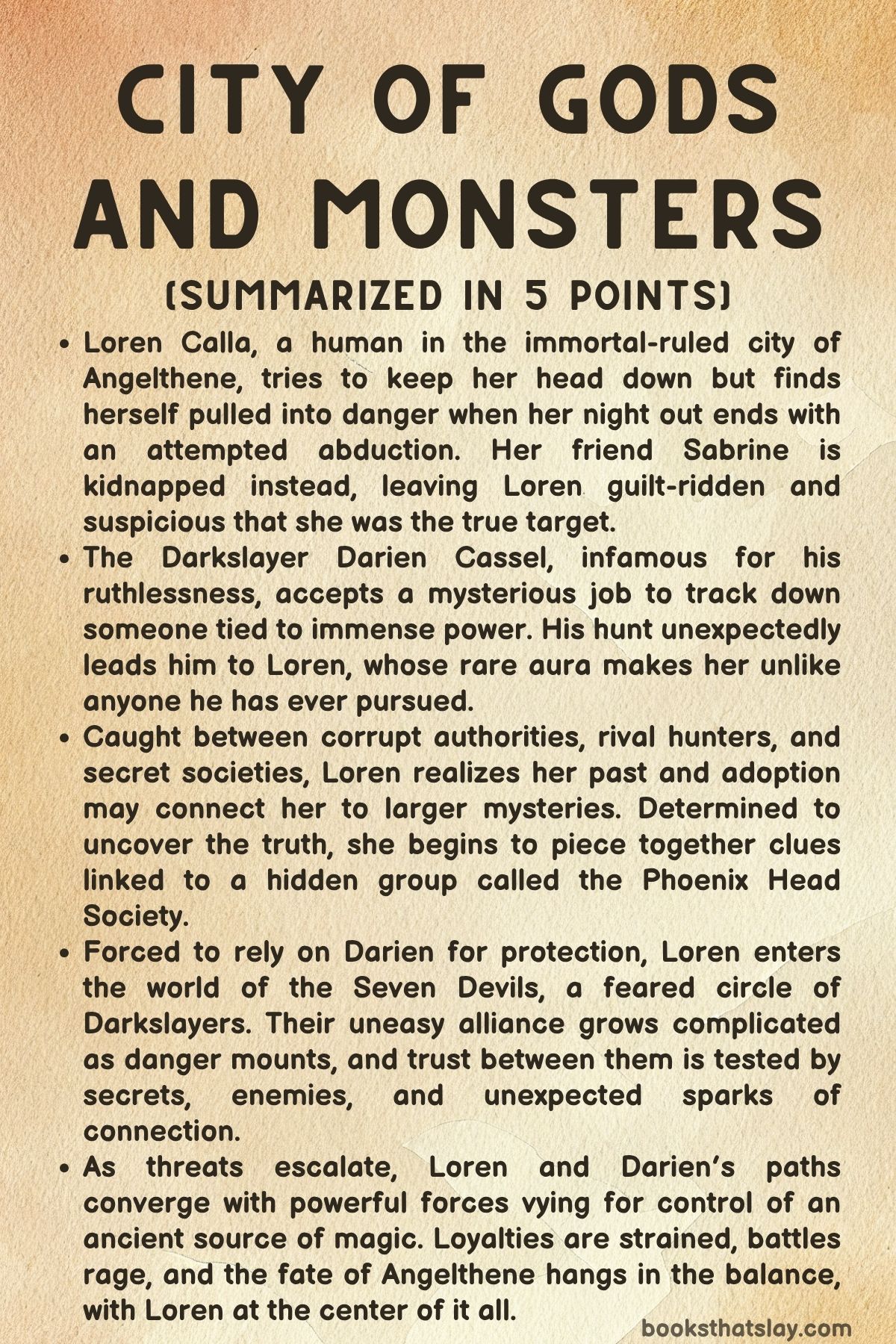
Loren Calla, a human in the immortal-dominated city of Angelthene, lives cautiously in a world where witches, vampires, demons, and other supernatural beings hold power. One night, her witch sister Dallas and their friend Sabrine drag her to a nightclub.
A confrontation with a werewolf nearly turns violent before they leave, only to face greater danger on their walk home. A warlock and a hellseher—an agent of the Darkslayers—attempt to kidnap Loren, revealing she is their true target.
When police sirens interrupt, they instead abduct Sabrine, leaving Loren devastated and guilty.
Elsewhere, Darien Cassel, leader of the Seven Devils—a notorious Darkslayer circle—takes on a new assignment to locate an orphan left at the Temple of the Scarlet Star. The payment offered is unusually high, hinting at the target’s immense value.
Darien never questions his clients’ motives, but this job unsettles him.
At the police station, Loren insists that the kidnappers were after her, not Sabrine, especially after noticing the phoenix tattoo on the hellseher. No one believes her, and she is left feeling powerless.
Soon after, she and Dallas begin classes at Angelthene Academy. During orientation, Loren learns of the Old Hall and a defunct Phoenix Head Society, which she connects to the tattoo.
Convinced the society is tied to her past and Sabrine’s abduction, she vows to investigate.
As Loren struggles with her grief, Darien shadows her through the city. He is struck by her unusual aura—radiant and rare—unlike anything he has encountered.
When other pursuers attempt to seize her, Darien intervenes, killing them and revealing himself. Though initially terrified, Loren realizes he may be her only chance at survival.
Darien admits he was hired to capture her but offers protection instead. Wary but desperate, Loren agrees.
Darien takes her to Hell’s Gate, the Seven Devils’ heavily guarded stronghold. There, Loren faces hostility from his companions but also glimpses another side of Darien.
He protects her fiercely, tends to her when her blood sugar drops, and begins to reveal fragments of his own pain. Despite his reputation, Loren senses humanity beneath his hardened exterior.
His twin sister Ivyana extends her friendship, further easing Loren into this strange new life.
Meanwhile, the conflict in Angelthene deepens. A series of brutal murders and rituals tied to the Blood Stave and the Arcanum Well threaten to destabilize the balance of power.
The Well, a source of immense magical energy, becomes the central focus of alliances and betrayals. Darien and Loren are drawn into the hunt for answers, working with reluctant allies from rival factions.
Their connection strengthens as they investigate cryptic scrolls, confront their enemies, and uncover dangerous truths. Darien struggles with his growing attachment to Loren, convinced his violent nature makes him unworthy, while Loren finds herself both afraid of and drawn to him.
Their bond faces trials of jealousy, miscommunication, and danger, yet moments of tenderness show their feelings are undeniable. Darien teaches Loren how to defend herself, and she begins to uncover hidden strength within.
Their relationship is tested when a risky mission at the Devil’s Advocate nightclub forces them to act as lovers to draw out their target. What begins as a ruse nearly turns real, igniting passion neither can ignore.
The stakes rise as revelations about Loren’s past emerge. Evidence points to her being connected to the Phoenix Head Society, and her ancestry may tie her to the origins of the Well itself.
When chaos erupts across the city, the Well’s energy threatens to destroy everything. Demons run rampant, immortals collapse under its waves, and destruction looms.
In the final confrontation, Loren climbs the Control Tower to battle Calanthe, a powerful vampire, and succeeds in deploying the antidote to save the city from demonic corruption. Yet the Well’s explosion remains inevitable.
Darien reaches her in time but sacrifices himself by transferring his armor to her, shielding her as the blast tears through Angelthene. Loren survives the devastation but finds Darien dead in the ruins.
Desperate, she realizes she carries her father’s legacy as the vessel of the Well. She channels its power to revive Darien, though the city remains in ashes.
Refusing to accept defeat, Loren invokes a wish her father purchased from Tempus, the god of Time. Time rewinds, allowing her to contain the Well’s explosion and restore Angelthene.
The city and its people are saved, though some losses remain permanent. Exhausted, Loren collapses but awakens at Hell’s Gate, alive and safe with Darien.
They confess their love, finding solace in each other despite the uncertainties that linger.
As Angelthene rebuilds, life resumes at the Academy. Loren, Dallas, and Sabrine move forward, though shadows remain.
Political intrigues stir, old enemies may yet return, and Loren’s true power remains unresolved. In the epilogue, she meets her long-lost father, Erasmus, orchestrated by the same rabbit-masked messenger who hired Darien.
Their reunion hints at deeper mysteries still to come. Darien, watching the waves with time ticking on his watch, understands their journey is far from over.
Characters
Characters
In City of Gods and Monsters, the characters are shaped by fear, loyalty, hidden identity, supernatural power, and the dangerous politics of Angelthene. The story places human vulnerability beside immortal violence, making each major character important not only for what they do, but for what they reveal about trust, survival, family, and power.
Loren Calla
Loren Calla is the emotional center of the book and one of its most important figures because her apparent weakness hides extraordinary significance. At the beginning, she seems like an ordinary human girl trying to survive in a city filled with immortal and magical beings.
Her diabetes, fear, lack of supernatural defenses, and dependence on others make her appear fragile in a world that often dismisses humans as powerless. However, the book slowly reveals that Loren’s vulnerability is not the same as helplessness.
She repeatedly acts with courage even when she is terrified, whether she is running from Darkslayers, searching for Sabrine, standing up to Calanthe, or climbing the Control Tower while the city collapses around her.
Loren’s character is deeply connected to abandonment and belonging. She was found as a baby at a Scarlet Star temple and raised by guardians who never truly loved her, which leaves her with a lasting sense of emotional insecurity.
Dallas is the one person from her old life who gives her genuine family-like love, while Darien becomes the person who sees her worth before the rest of the city understands it. Loren’s growth comes from learning that she is not simply someone to be protected.
She becomes someone who protects others, makes difficult choices, and ultimately carries the true Arcanum Well within herself. Her ability to revive Darien and reverse disaster shows that her identity has always been far greater than the world allowed her to believe.
Darien Cassel
Darien Cassel is one of the most morally complex characters in the book because he is both dangerous and deeply wounded. As a pure-blooded hellseher and leader of the Seven Devils, he is feared for his power, violence, and reputation.
He begins as a bounty hunter willing to accept a job to track Loren, but his decisions soon show that he is not ruled only by money or cruelty. Once he realizes that Loren is being hunted by multiple enemies, he chooses protection over profit.
This choice becomes the foundation of his emotional transformation.
Darien’s character is shaped by trauma, especially the abuse he suffered from his father and the loss of his mother. His ability to read auras and his skill in violence make him powerful, but they also isolate him.
He fears becoming like his father and hurting the people he loves, which explains why he sometimes pushes Loren away even when he clearly cares for her. His tenderness appears most strongly in private moments, such as feeding Loren when she is ill, staying with her after she is drugged, and sacrificing himself to save her during the explosion.
Darien’s love is protective, intense, and self-punishing, but through Loren he begins to believe that he can be more than the monster his past tried to create.
Dallas Bright
Dallas Bright is Loren’s adoptive sister and one of the most important emotional anchors in the story. She is a powerful young witch, confident in her magic and fiercely protective of Loren.
Her first major role is to defend Loren from Jerome at the club, showing that Dallas is quick to confront anyone who humiliates or threatens her sister. She acts boldly, sometimes recklessly, and her strength often comes from instinctive loyalty rather than careful planning.
Dallas also represents Loren’s connection to ordinary family life before the danger surrounding the Phoenix Head Society becomes unavoidable. Although Dallas loves Loren deeply, she sometimes struggles to understand the full seriousness of Loren’s situation, especially when Loren connects the phoenix tattoo to Sabrine’s kidnapping.
This creates tension between them, not because Dallas does not care, but because she is frightened of losing Loren to a world of violence, secrets, and Darien’s influence. Her participation in the final battle shows her bravery and proves that she is not merely Loren’s sister in name; she is someone willing to risk herself for the people she loves.
Sabrine Van Arsdell
Sabrine Van Arsdell is a crucial character because her kidnapping drives much of the early conflict. She begins as Loren and Dallas’s friend, part of their attempt to enjoy one final night before academy life begins.
However, she becomes a victim of the larger conspiracy when the Darkslayers seize her by mistake, believing they are advancing the hunt for Loren. This mistaken abduction gives the story a strong emotional urgency because Loren’s search for answers is not abstract; it is tied to saving someone she knows and cares about.
Sabrine’s character also reveals the brutality of the forces operating in Angelthene. Her disappearance exposes how easily young women can be targeted, hidden, and used by powerful groups.
Later, when it becomes clear that she was taken because Loren was the intended target, Sabrine’s role becomes even more tragic. She suffers because of a secret connected to Loren’s bloodline and the Arcanum Well, even though she has no control over that danger.
Her survival and involvement in the final fight show resilience, and her return helps restore the emotional bond among the girls after fear and violence have torn their lives apart.
Calanthe
Calanthe is one of the book’s most politically dangerous and morally ambiguous figures. She first presents herself as an ally who wants to stop the Phoenix Head Society, find the missing girls, and keep the Arcanum Well hidden.
Her use of evidence, such as the photographs of Penny Thompson and the disappearance of Lenora Aldonold, makes her seem practical and serious. She understands the scale of the threat and knows how to speak in terms of strategy, power, and necessity.
However, Calanthe’s later actions reveal that her motives are not as pure as she wants others to believe. Her attack on Loren at the Control Tower shows her willingness to seize power even when the city is collapsing.
She is dangerous because she can sound reasonable while pursuing her own advantage. As a vampire and a political player, she embodies the kind of immortal authority that treats people as pieces in a larger game.
Her fall from the tower is significant because Loren, the human girl Calanthe underestimates, becomes the one who resists her and prevents her from controlling the antidote.
Maximus
Maximus is one of the Seven Devils and serves as a stabilizing presence within Darien’s dangerous circle. Unlike Lace, who greets Loren with open hostility, Maximus is polite and controlled when Loren first arrives at Hell’s Gate.
His behavior helps show that the Seven Devils are not all the same, even though they share a violent reputation. He is loyal to Darien, but he also has enough emotional awareness to recognize the seriousness of the dangers around them.
Maximus’s importance grows because he often witnesses Darien’s darker choices and understands the cost of them. During the Blackgate Manor trap, Max realizes that Darien has deliberately led Randal and his men to their deaths.
This moment shows Maximus as someone capable of understanding strategy, fear, and consequence. He is not simply a follower; he observes Darien closely and understands the emotional weight behind his leader’s decisions.
His presence helps reveal Darien’s complexity because Maximus sees both the ruthless planner and the broken man behind the violence.
Ivyana
Ivyana, Darien’s twin sister, brings warmth and emotional insight into Hell’s Gate. She welcomes Loren kindly when others treat her with suspicion or contempt, making her an important contrast to the harsher members of the Seven Devils.
Ivyana’s kindness matters because Loren enters Hell’s Gate frightened, hungry, and emotionally overwhelmed. By accepting Loren, Ivyana helps make the manor feel less like a prison and more like a place where Loren might eventually belong.
Ivyana also understands Darien in a way few others do. She recognizes that his attempts to push Loren away come from fear rather than indifference.
Her confrontation with him reveals her emotional intelligence and her protective love for her brother. She knows the damage their father caused and understands Darien’s terror of repeating that cruelty.
Through Ivyana, the book shows that Darien’s family bonds are not only built on violence and command, but also on grief, loyalty, and the hope that he can heal.
Logan
Logan is a significant figure because he represents loyalty complicated by divided judgment. He works closely with Darien and the others, but he does not always agree with Darien’s decisions.
His hesitation before agreeing to Calanthe’s alliance shows that he is cautious and aware of the risks involved in cooperating with vampires. He is not impulsive; he weighs danger, politics, and loyalty before acting.
Logan’s decision to inform Calanthe about the events at the Devil’s Advocate creates tension with Darien. This choice shows that Logan is willing to act independently when he believes broader strategy requires it, even if it angers his leader.
He is loyal, but not blindly obedient. That makes him valuable and frustrating at the same time.
His character adds complexity to the Seven Devils because their group is not a simple hierarchy; it contains disagreements, competing instincts, and different ideas about how to survive.
Tanner
Tanner is one of the more practical and technically useful members of Darien’s circle. His ability to cut wards and restore power makes him essential during key moments of the story.
At the Devil’s Advocate, Loren’s role depends on Tanner successfully disabling the protections, showing that his skills are central to the group’s operations. He works in the background, but his actions often determine whether a plan succeeds or fails.
Tanner’s importance becomes even clearer during the Kalendae disaster. When the city loses power, his ability to restore it gives the others a chance to continue fighting and distributing the antidote.
He represents the kind of character whose contribution is not always emotional or dramatic, but absolutely necessary. In a story filled with supernatural strength, Tanner’s usefulness lies in precision, timing, and technical competence.
Travis
Travis is part of the Seven Devils and initially appears distant toward Loren. His coldness reflects the suspicion many immortals or magic-born characters feel toward humans, especially one suddenly brought into Hell’s Gate under Darien’s protection.
Travis does not immediately offer Loren warmth or trust, which helps establish the hostile environment she enters after leaving behind her old life.
Although Travis is not as openly cruel as Lace, his distance still matters because it contributes to Loren’s feeling of isolation. He represents the guarded culture of the Seven Devils, where trust is earned slowly and outsiders are treated as risks.
Over time, his presence within the group reinforces the idea that Darien’s household is not naturally safe or gentle. It becomes safer for Loren only because Darien insists that she be protected.
Lace
Lace is one of the clearest examples of prejudice within Hell’s Gate. Her hostility toward Loren is immediate and vicious, especially when she insults her as “half-life filth” and uses a knife to frighten her.
Lace sees Loren as lesser because Loren is human, and her behavior exposes the cruelty that humans face in Angelthene. Through Lace, the book shows that danger does not only come from enemies outside the house; it also exists in the attitudes of those who are supposed to be allies.
Lace’s role is important because she forces Darien to publicly define Loren’s place under his protection. When Darien threatens to throw Lace out for disobeying him, he makes it clear that Loren is not to be mistreated.
Lace therefore becomes a catalyst for Darien’s protective side. Her cruelty also deepens the reader’s understanding of Loren’s courage, because Loren has to endure not only supernatural threats but also humiliation and contempt from people who think she has no value.
Mortifer
Mortifer, the biting house-Hob at Hell’s Gate, adds both danger and strange charm to the story. He is not a major political figure or warrior, but his presence helps define the atmosphere of Darien’s home.
Hell’s Gate is not a normal refuge; even its household creature is sharp, unpredictable, and slightly threatening. Mortifer makes the manor feel alive with supernatural oddity.
His most meaningful moment comes when he wakes Loren by throwing ice chips at her to warn her that Darien is leaving during a Surge. This act shows that Mortifer is not merely a nuisance.
He recognizes danger and helps Loren intervene at a crucial moment. Because of his warning, Loren reaches Darien and calms him, revealing something extraordinary about her connection to his darkness.
Mortifer therefore plays a small but important role in one of the story’s most intimate turning points.
Jerome
Jerome is a minor but important early character because he introduces the everyday cruelty Loren faces in Angelthene. As a werewolf who humiliates Loren at Her Infernal Majesty after she refuses to dance, he shows how easily power can become entitlement.
His decision to dump beer over her is not only rude; it is an act of public degradation meant to punish her for saying no.
Jerome’s role helps establish the social danger of the city before the larger conspiracy fully appears. The moment also reveals Dallas’s protective nature, because she immediately threatens him with her Focus.
Although Jerome disappears quickly from the main action, he helps set the tone of a world where Loren’s humanity and vulnerability make her an easy target for those who feel stronger than she is.
Benjamin
Benjamin is a graverobber whose role connects Loren’s mysterious ancestry to the wider hunt for her. He is morally questionable, dealing in bones, information, and hidden knowledge, but he is also useful because he understands parts of the underworld that others cannot easily access.
His involvement with the ancestral bone powder proves that the search for Loren is organized, expensive, and connected to powerful people.
Benjamin’s character exists in a gray area. He is not innocent, because he was also trying to profit from finding Loren, but he is not presented as the greatest threat either.
Once Darien confronts him, Benjamin becomes a source of leads rather than a direct enemy. His information about Cain, Dresden, Tyson Geller, and the Devil’s Advocate helps push the investigation forward.
He represents the shady networks beneath Angelthene’s formal power structures.
Baylor
Baylor is the dangerous operator of the Devil’s Advocate, a nightclub linked to criminal deals and predatory behavior. His importance comes from the way he controls access to hidden rooms, illegal activity, and information.
The plan to use Loren to attract him shows that he is both powerful and vulnerable to manipulation. He is used to being the predator in his environment, but Loren and the Seven Devils turn that expectation against him.
Baylor also represents the sexualized danger Loren faces as a human woman in immortal spaces. The mission at his club requires her to place herself in a deeply uncomfortable and risky position.
Although she successfully sedates him, the situation around her quickly becomes dangerous when her protection is stolen. Baylor’s character helps make the Devil’s Advocate feel like a place where glamour, exploitation, and criminal power are tied together.
Valary
Valary is one of Darien’s former lovers and functions as a source of jealousy, danger, and emotional complication. Her theft of Loren’s Avertera talisman is not a small act of spite; it directly exposes Loren to drugging and attack.
Through Valary, the book shows how Darien’s past can endanger Loren in the present. She understands enough about Darien to hurt him indirectly, and she chooses to do so by targeting the person he is trying to protect.
Valary’s taunting also forces Darien and Loren’s unresolved feelings into sharper focus. Loren’s vulnerability without the talisman shows how dependent she is on protection, while Darien’s reaction shows how deeply he cares for her despite his attempts to deny it.
Valary is not simply a romantic rival; she is a reminder that Darien’s life before Loren was filled with dangerous attachments and people willing to weaponize intimacy.
Jessa
Jessa is a woman from Darien’s past whose presence creates emotional conflict between Darien and Loren. When Darien openly discusses plans with her, Loren feels hurt and excluded.
This moment matters because it reveals Loren’s growing feelings for Darien and Darien’s own fear of emotional honesty. Rather than openly admitting what he feels, he uses Jessa to create distance and provoke jealousy.
Jessa’s role is therefore less about her own actions and more about what she exposes in Darien and Loren. She becomes part of Darien’s attempt to control his emotions by hurting Loren before he can be hurt himself.
This makes her important to the romantic tension in the story, because her presence pushes Darien to admit that he was trying to push Loren away. Through Jessa, the book reveals how fear can make people behave cruelly even when they are in love.
Randal
Randal is a major antagonist connected to the replica Arcanum Well and the catastrophic danger that threatens Angelthene. He is ruthless, ambitious, and willing to force Loren’s aura into the Well, an act that triggers disastrous consequences.
His pursuit of power shows how dangerous the Arcanum Well becomes in the hands of someone who sees magic as a tool to control rather than a force to understand.
Randal’s death at Blackgate Manor is one of the darkest examples of Darien’s ruthlessness. Darien leads him and his men into a place where an ancient demon feeds on fear, knowing they will be destroyed.
Randal’s end feels fitting because his own hunger for control brings him into a trap built from terror. His role in activating the replica Well ensures that even after his death, his actions continue to threaten the entire city.
Arthur
Arthur is important because he brings knowledge, courage, and sacrifice into the effort to stop the replica Arcanum Well. He agrees to help dismantle the Well’s reactor chamber despite the danger, showing that he is willing to risk himself for the city.
His role is practical and heroic, especially because the Well becomes fused to the earth and the anima mundi, making the task nearly impossible.
Arthur also matters because of the protective onyx armor ring. Darien uses that ring to save Loren during the explosion, which makes Arthur indirectly central to Loren’s survival.
Even though Arthur cannot successfully dismantle the Well, his presence and resources shape the outcome of the climax. He represents the kind of ally whose courage does not guarantee success, but whose contribution still becomes essential.
Christa
Christa plays a crucial warning role when she reveals that Randal’s replica Well has become a bomb. Her arrival shifts the situation from dangerous to catastrophic, because she explains that the Well has activated destructive magic and released mutated demons into the city.
This makes her a messenger of truth at a moment when the characters need to understand the scale of the disaster.
Christa’s importance lies in her knowledge and timing. Without her warning, the group would not fully grasp the urgency of the threat or the need to distribute Doctor Atlas’s antidote through the Control Tower’s forcefield system.
She is not the central fighter in the climax, but she helps turn confusion into strategy. Her character shows that survival depends not only on warriors, but also on people who understand what is happening quickly enough to act.
Doctor Atlas
Doctor Atlas is significant because his antidote becomes the city’s best hope against the mutated demons. Although he is not shown as prominently as Loren or Darien, his scientific or medical contribution is crucial to the survival of Angelthene.
The antidote represents reasoned problem-solving in the middle of supernatural chaos.
His role also highlights one of the book’s central ideas: power alone cannot save the city. Darien’s strength, Dallas’s magic, and the fighters’ weapons are not enough to reverse the transformations.
The antidote provides a different kind of salvation, one rooted in knowledge, preparation, and healing. Doctor Atlas therefore stands for the importance of intellect and medicine in a world dominated by violence and magic.
Hanli
Hanli appears as one of the allies who helps during the rooftop defense against the demons. Her role places her among the characters willing to risk themselves while the Kalendae celebrations collapse into horror.
By standing with Loren, Dallas, Sabrine, and others, she becomes part of the collective resistance that tries to protect civilians from the spreading transformations.
Hanli’s importance comes from her participation in the wider community of fighters and allies. She shows that the final battle is not won by one person alone, even though Loren performs the most decisive act.
Characters like Hanli help create the sense that Angelthene’s survival requires many people working together under terrifying conditions.
Dominic
Dominic is important during the final crisis because he attempts to fly the antidote up the Control Tower. His effort shows courage and urgency, even though the Well’s waves incapacitate magic-born people and knock him down.
His failure is not a weakness of character; it reveals how powerful and unfair the Well’s influence has become.
Dominic’s fall also sets up Loren’s heroic action. Because he cannot complete the task, Loren, who is less affected than the magic-born characters, must retrieve the antidote and climb the tower herself.
Dominic therefore helps show why Loren’s humanity matters. What makes her seem weaker for much of the story becomes the reason she can act when others cannot.
Singer
Singer plays a key supporting role during Loren’s confrontation with Calanthe at the Control Tower. With Singer’s help, Loren is able to wound Calanthe using a hidden silver stake.
This moment is important because it prevents Calanthe from taking the antidote and allows Loren to continue her climb.
Singer’s role shows the importance of hidden assistance and trust during the climax. Loren’s victory over Calanthe is not based only on personal courage, but also on support from allies who help her survive impossible odds.
Singer may not dominate the story, but their contribution matters at the exact moment when failure would doom the city.
Headmaster Langdon
Headmaster Langdon is a tragic figure whose final act reveals the psychological and spiritual horror of the crisis. In the tunnels, Darien hears him praying over a headset before he kills himself.
This moment shows how deeply the disaster breaks even figures of authority. Langdon’s death is not presented as heroic triumph, but as a sign of despair.
His character also reflects the collapse of institutional safety. As a headmaster, he is associated with education, order, and leadership, yet the events surrounding the Well overwhelm those structures completely.
His prayer before death adds a grim spiritual weight to the scene, suggesting that the city’s crisis is not only physical but existential.
Erasmus Sophronia
Erasmus Sophronia is one of the most important hidden figures in Loren’s life. As Loren’s father, he represents the truth behind her abandonment, her bloodline, and the true Arcanum Well inside her.
For most of the book, Loren believes herself to be an unwanted orphan, but Erasmus’s existence changes the emotional meaning of her past. His survival and search for her suggest that her separation from her birth family was not simple rejection.
Erasmus also connects Loren to a much larger magical inheritance. The Well inside her comes through him, making her central to the forces that others are trying to find, replicate, or control.
His reunion with Loren at Jade Beach gives the story an emotional resolution beyond romance. Loren gains not only Darien’s love but also a living link to her origins.
Erasmus represents identity recovered after years of uncertainty.
Taega Bright
Taega Bright is one of Loren’s guardians and part of the wealthy household that raised her after she was found as a baby. Her role is important because she represents the emotional coldness of Loren’s upbringing.
Although Loren had material comfort, she did not receive true parental love from Taega. This contrast helps explain why Loren is sensitive to abandonment and why Dallas’s love means so much to her.
Taega’s character also shows that rescue does not always equal belonging. Taking Loren in gave her a home, but not necessarily a family.
Through Taega, the book explores how emotional neglect can exist even in a privileged environment. Loren’s pain does not come from poverty or physical danger alone; it also comes from being tolerated rather than cherished.
Roark
Roark is Loren’s guardian and the person who took her in after she was found at the Scarlet Star temple. His decision appears to be connected to signs from the gods rather than simple affection.
This makes his relationship with Loren complicated, because he gives her a place in his household but does not provide the love she needs. He treats her origin as meaningful, yet he does not truly nurture her as a daughter.
Roark’s role deepens Loren’s feelings of being an object of mystery rather than a loved child. His actions place her in the Bright household, where she gains Dallas but also experiences emotional distance.
He is important less because of what he does in the present and more because of how his choices shape Loren’s sense of identity, gratitude, and rejection.
Professor Phipps
Professor Phipps is a minor but useful character because he provides information that helps Loren connect the Phoenix Head Society to the kidnapping. During the academy orientation, his explanation of the Old Hall and its history with a human social group gives Loren a clue that others dismiss.
He does not intend to launch Loren’s investigation, but his knowledge becomes important.
His role shows how history survives inside institutions, even when people no longer take it seriously. The Old Hall and the Phoenix Head Society seem like background information to him, but to Loren they become evidence.
Professor Phipps therefore represents the accidental guide, someone whose ordinary explanation opens the door to a dangerous truth.
Casen Martel
Casen Martel is important because his call to Darien pushes the story toward the Devil’s Advocate. By telling Darien to come at Witching Hour and bring Loren, he becomes a link between the investigation and one of the book’s most dangerous locations.
His message suggests that people connected to the underworld know Loren’s importance and are willing to draw her into risky spaces.
Casen’s role is not emotionally intimate, but it is structurally significant. He helps move the characters from research and protection into infiltration and confrontation.
Through him, the story widens from Hell’s Gate and the academy into the criminal networks surrounding the Blood Potion deal and the Phoenix Head Society.
Lenora Aldonold
Lenora Aldonold is Calanthe’s missing Second, and her disappearance gives Calanthe’s alliance proposal emotional and political weight. Because Lenora is close to Calanthe’s power structure, her absence proves that the threat is reaching even influential figures.
The missing girls are not only random victims; the conspiracy is bold enough to touch vampire leadership.
Lenora’s role also helps make Calanthe’s motives appear believable at first. By revealing that her own Second is missing, Calanthe presents herself as personally invested rather than merely politically interested.
Lenora therefore becomes part of the reason Darien and Logan consider cooperation, even though trusting Calanthe remains dangerous.
Penny Thompson
Penny Thompson is a tragic symbol of the Phoenix Head Society’s violence. As a human girl found dead in Vampire Territory, her body displayed with magic shaped like wings of flame, she represents the horror behind the investigation.
Her death makes the threat concrete and visually cruel, proving that the missing girls may face fates worse than disappearance.
Penny’s character is important even though she is not alive in the main action. She stands for the victims who cannot speak for themselves.
Her death strengthens the urgency of finding Sabrine and stopping the group searching for the Arcanum Well. Through Penny, the book shows the cost of allowing powerful conspiracies to operate in secrecy.
Chrysantha Sands
Chrysantha Sands is another missing girl whose disappearance expands the scope of the danger. Her name appears during the candlelight vigil, placing her alongside Sabrine as part of a pattern.
She helps show that the kidnappings are not isolated incidents but part of a larger and more disturbing series of crimes.
Chrysantha’s role matters because public grief begins to gather around the missing girls. The vigil shows that the community is aware of the losses, even if the authorities and powerful groups do not respond effectively.
Like Penny, Chrysantha represents the human cost of the conspiracy and the fear spreading through Angelthene.
Jack
Jack is one of the allies who accompanies Darien, Loren, Maximus, and Tanner to Dusk Hollow cemetery to meet Benjamin. His presence places him within Darien’s trusted circle, someone brought into dangerous situations where supernatural threats like barrow wights can appear.
Even when he is not at the emotional center of the story, he contributes to the group’s strength.
Jack’s role helps build the sense that Darien does not operate alone. The Seven Devils function as a network of fighters and specialists, and Jack is part of that collective force.
His presence during the cemetery mission reinforces the danger of the investigation and the need for backup in a city where even gathering information can turn deadly.
Cain
Cain is an off-page but important figure connected to the hunt for Loren. Benjamin identifies Cain’s man Dresden as someone involved in hiring him to locate the ancestral bone powder.
This makes Cain part of the hidden chain of power behind the bounty and the attempt to track Loren through her bloodline.
Cain’s importance comes from mystery and influence. He does not need to appear directly to shape the plot, because his reach is felt through intermediaries and paid searches.
He represents the larger network of people who understand that Loren is valuable before she understands why. His connection to the hunt adds another layer to the dangerous forces surrounding her.
Dresden
Dresden is Cain’s man and serves as a link between Benjamin and the larger conspiracy surrounding Loren’s ancestry. His involvement shows that the search for Loren is not random.
People with money, influence, and specific knowledge are using others to obtain the materials needed to track her.
Dresden’s role is important because he helps reveal how organized the hunt has become. He is part of a chain that turns ancient bloodline clues into practical pursuit.
Even if he is not explored deeply as a person, his actions help expose the machinery behind the bounty on Loren.
Tyson Geller
Tyson Geller of the Reapers is named as one of the leads Benjamin gives Darien. His mention suggests that the search for Loren intersects with other dangerous groups in Angelthene.
As a Reaper, Tyson is associated with a darker and more threatening underworld presence.
His role is significant because he expands the map of possible enemies and connections. Loren’s danger is not limited to one attacker or one group.
Tyson’s name implies that multiple factions may know pieces of the truth or be involved in the hunt for the Arcanum Well. He helps create the sense of a city full of hidden networks.
Mordred and Penelope
Mordred and Penelope, the witch twins who run the apothecary where Loren works, represent Loren’s connection to ordinary responsibility amid supernatural chaos. Their shop gives Loren a workplace, routine, and a small degree of independence.
Even as powerful figures hunt her, she still has shifts, obligations, and people she must call when her life is disrupted.
Their role also grounds the story in the practical magic of Angelthene. The apothecary is not just a workplace; it is part of the city’s magical culture.
Mordred and Penelope help show that not all magic in the story is tied to violence or conspiracy. Some of it exists in daily labor, healing, ingredients, and community life.
Ghost
Ghost is Dallas’s Familiar Spirit and an extension of her magical identity. When Dallas summons Ghost during the attack, it shows that Dallas is not simply a student with ordinary talent; she has real magical power and a bond with a supernatural companion.
Ghost’s presence adds to Dallas’s image as a protective witch.
Ghost also reflects Dallas’s instinct to defend. When the girls are threatened, Dallas turns not only to spells but to the deeper resources of her magic.
Even though Ghost cannot prevent Sabrine’s kidnapping, the summoning shows Dallas’s courage and desperation. Ghost helps emphasize that the girls fight back, even when they are outmatched.
The Imperator
The Imperator is a shadowy threat whose influence remains troubling even after the immediate crisis is resolved. The character’s importance lies in the sense of unfinished danger.
Loren worries that Calanthe and the Imperator may still be threats, which prevents the ending from feeling completely safe.
As a figure of power, the Imperator represents the larger political and supernatural forces still operating beyond Loren’s direct understanding. The story resolves Darien’s death, the explosion, and Loren’s reunion with Erasmus, but the Imperator reminds readers that Angelthene’s power struggles are not over.
This character helps keep the world dangerous and open-ended.
Tempus the Liar
Tempus the Liar is connected to the sundial and the wish Loren uses to reverse time and protect the city. Although not developed like a conventional character, Tempus has major symbolic importance.
The name itself suggests deception, fate, and the dangerous uncertainty of bargains involving time.
The sundial associated with Tempus becomes the place where Loren performs one of her most extraordinary acts. Her father’s purchased wish allows her to undo catastrophe while preserving what matters most.
Tempus therefore represents the strange and mythic forces that exist above ordinary magic, forces that can alter destiny but are surrounded by mystery.
Themes
Power and Oppression
In City of Gods and Monsters, power is portrayed as a currency that determines survival, belonging, and identity. The city of Angelthene is dominated by immortals—witches, vampires, werewolves, and warlocks—who exert authority over humans, often relegating them to second-class status.
Loren’s struggles highlight the precarious existence of mortals in a society built on hierarchies of blood and magic. Even her attempt to live quietly is disrupted when she becomes the target of forces far beyond her control, showing that in such a world, humans cannot escape the weight of oppression.
The Darkslayers, with their mercenary brutality, further reflect the imbalance of power: they decide life and death while cloaked in mystery and fear. Darien himself embodies the paradox of power—capable of immense violence yet imprisoned by grief and the scars of his past.
The kidnapping of Sabrine is not simply a personal tragedy but a symbolic reminder that those without influence are easily taken, discarded, or sacrificed in a system structured around dominance. Power here is not only political but also deeply personal, shaping relationships, trust, and self-worth.
Loren’s eventual realization that she carries something extraordinary within her challenges this oppressive framework, offering the possibility that those who seem powerless may in fact be the fulcrum upon which great change balances.
Identity and Belonging
Loren’s journey is marked by uncertainty over who she truly is and where she fits within Angelthene’s fractured society. As an orphan raised without knowledge of her origins, she exists in a liminal space between the mundane and the extraordinary.
Her adoption, the whispers of the Phoenix Society, and her eventual revelation as the vessel of the Well all underscore a central tension: identity is not merely inherited but discovered through choices and trials. Her longing for acceptance is complicated by her status as a human in a world that devalues her kind, leaving her desperate for a sense of home.
The House of Salt at the academy, Darien’s Hell’s Gate, and even the streets of Angelthene become mirrors of this search, each offering fragments of belonging but never without danger. Darien himself shares this struggle, seeing himself as unworthy despite his role as leader of the Seven Devils.
Their connection stems from mutual recognition of this fractured identity: both are outsiders, feared or dismissed, yet both carry within them a capacity for defiance and loyalty that transcends their labels. By the end, Loren’s acceptance of her role as the Well and her reunion with her father Erasmus begin to resolve her yearning, though not without raising new questions about where she belongs in a world that has repeatedly tried to erase her.
Sacrifice and Survival
The narrative is steeped in acts of sacrifice, both large and intimate, that test the resilience of its characters. Loren’s guilt over Sabrine’s abduction reveals the cost of survival—her friend is taken in her stead, a wound that shapes her choices throughout.
Darien’s role as protector embodies sacrifice at a more visceral level, most dramatically when he transfers the Fleet armor to Loren during the Well’s explosion, surrendering his own safety for her survival. This moment crystallizes the theme: survival in Angelthene often demands unbearable choices, where saving one person means risking or losing another.
Even the city itself becomes a canvas for sacrifice when Loren invokes Tempus to reverse time, restoring lives but erasing parts of her own victories and forcing her to live with uncertainty about what remains undone. Sacrifice is also emotional, as characters must surrender trust, pride, or even desire to protect one another.
For Darien, survival is not just about enduring battles but about confronting his own demons of grief and self-loathing. Loren’s journey from fragile human to empowered vessel underscores that survival often requires transformation, and that true sacrifice may demand not only pain but a redefinition of self.
Love and Redemption
Amid the violence and uncertainty of Angelthene, love emerges as both salvation and a dangerous vulnerability. The slow-burning connection between Loren and Darien is layered with distrust, attraction, and unspoken longing.
Darien, scarred by violence and convinced of his own unworthiness, resists intimacy for fear of harming Loren, yet her persistence dismantles his walls piece by piece. Their relationship provides moments of tenderness that contrast starkly with the brutality surrounding them—sharing meals, teaching her to fight, or protecting her from his own allies.
Love becomes a force of redemption, offering Darien a path out of the cycle of blood and grief, and giving Loren the strength to embrace her destiny. Their bond also redefines the meaning of protection: it is not only about shielding one another from danger but about affirming each other’s value in a world determined to strip it away.
Redemption in the novel is not limited to romance; it extends to figures like Mortifer, who chooses loyalty after being freed, or even Ivyana, who tempers her brother’s darkness with compassion. Yet it is through Loren and Darien’s relationship that redemption finds its fullest expression, proving that love can heal not by erasing scars but by making them bearable.
Fate and Free Will
The tension between destiny and choice pervades City of Gods and Monsters, culminating in the revelation that Loren herself is the vessel of the Well. From the moment she is targeted, her life appears orchestrated by forces beyond her control—her adoption, the Phoenix Society’s secrets, the staggering bounty placed upon her.
Yet the novel continually raises the question of agency: how much of her path is predetermined, and how much does she carve for herself through defiance? The intervention of Tempus the Liar, the god of Time, epitomizes this theme.
Loren’s invocation of the wish reverses the destruction of Angelthene, but it also robs her of certainty, erasing parts of her struggle and making her wonder what remains true. Fate here is not benevolent but capricious, demanding courage in the face of uncertainty.
Darien too is ensnared by this tension, bound by his past as a Darkslayer yet choosing to protect Loren even against his contract. The interplay of fate and free will underscores that while divine or magical powers shape the world, true meaning emerges from the choices characters make within those constraints.
Loren’s survival, her protection of others, and her final embrace of love reveal that destiny may set the stage, but free will determines the legacy.