Claire Darling Summary, Characters and Themes | Callie Kazumi
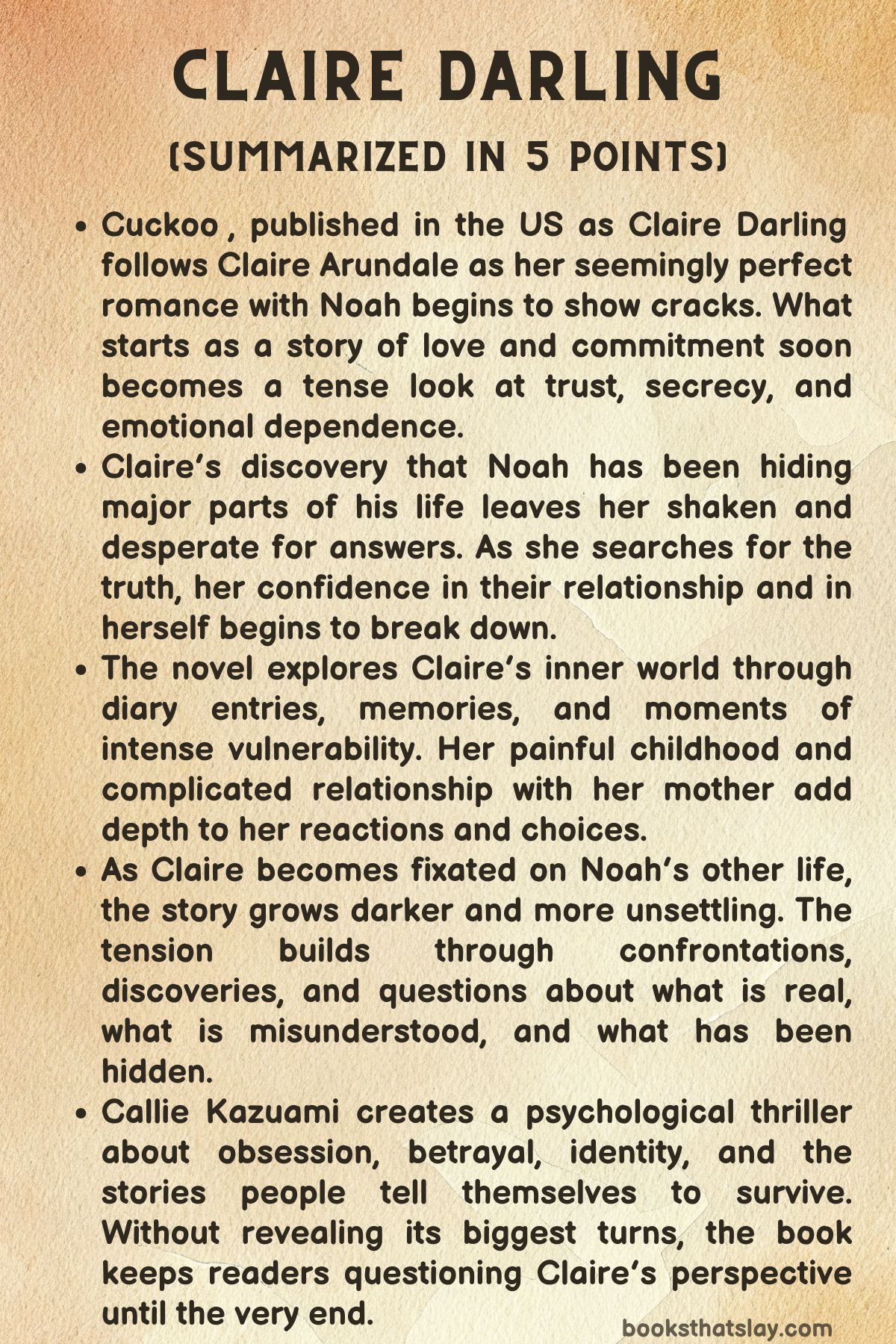
Claire, Darling (published internationally as Cuckoo and in the US as Claire, Darling) by Callie Kazumi is a psychological thriller about love, obsession, deception, and the dangerous stories people tell themselves when reality becomes unbearable. The book follows Claire Arundale, a woman who believes she has built a perfect life with Noah Coors, complete with romance, engagement, and a shared future.
When she discovers that Noah has hidden parts of his life from her, her world begins to fracture. What first appears to be a story of betrayal slowly turns into something darker, as Claire’s memories, diary entries, and version of events become harder to trust.
Summary
Claire Arundale begins her story through diary entries, marking the first anniversary of her relationship with Noah Coors on 18 September 2025. To her, the date is full of romance and promise, even though it also carries painful memories from the previous year.
She prepares a special dinner for Noah, complete with steak, prosecco, and his favourite Jaffa Cakes. Noah gives her chocolates and calls her “my Claire,” a phrase that makes her feel loved and chosen.
Claire sees him as the person who rescued her from loneliness and helped her build a better life. He encouraged her to apply for a PR job she now enjoys, supported her ambitions, and made her believe in a future that includes marriage and lasting happiness.
The next day at work, Claire shares details of the anniversary with her colleague and friend Sukhi. She explains that Noah has been very busy, so she plans to surprise him at his office with lunch.
Sukhi goes with her, and Claire is proud to visit Noah’s grand workplace in the City. But the visit turns unsettling almost immediately.
The receptionist cannot find any record of Noah working there. Claire insists there must be an error, but another employee confirms that Noah left the company months earlier, in February.
Claire is stunned. Every day, Noah has left home as though he were going to work, and she cannot understand why he would lie about something so large.
Sukhi helps Claire get away from the office and brings her home. Claire searches the flat, then goes around Clapham looking for Noah.
She checks places he likes, including a coffee shop and a fitness class, but finds no trace of him. He does not answer calls or texts.
Back at home, Claire drinks and searches for clues. She finds a drawer filled with Noah’s origami love notes, reminders of the tenderness she believes they shared.
These small pieces of affection make his deception feel even more impossible.
Sukhi then finds Noah’s Facebook profile, which Claire cannot access because he has blocked her. The profile reveals that he now works at Alliance & Gordon.
It also shows another side of his life: social events, friends, and a glamorous blonde woman. Claire becomes determined to find out what is happening.
She emails Noah at his new job, calls the office, and eventually goes there in person. When she finally sees him, his reaction is cold and alarming.
He tells her to go home, stop calling, and leave the matter alone. His anger and fear convince her that he is hiding something serious.
Claire and Sukhi continue watching his online activity. They discover that Noah is at a bar called Ballards, and the two women rush there.
Claire sees Noah kissing the blonde woman. Humiliated and furious, she throws her engagement ring at him and declares the relationship over.
When the blonde woman says Noah is not engaged to Claire, Claire snaps and throws a glass before leaving in distress.
Claire creates a fake Facebook account and learns that the woman is Lilah Andersson. Lilah appears to be everything Claire is not: wealthy, polished, beautiful, and secure.
She is Swedish, lives in Chelsea, and seems to have been part of Noah’s life long before Claire ever met him. Claire is shaken by the possibility that she may not be Noah’s true partner at all.
Instead, she may have been the other woman. This idea unsettles her deeply, but it also fuels her need to investigate.
Claire tracks Lilah through social media, visits Noah’s gym, and eventually finds Lilah’s Chelsea townhouse. She sees Noah’s car outside and later watches through the window as Noah and Lilah move around together in ordinary domestic ease.
The sight wounds her. She compares herself to Lilah constantly, drinks more, and becomes consumed by the question of what Noah and Lilah have been hiding.
As Claire’s obsession grows, memories of her childhood return. Her mother, Trina, was controlling, cruel, and emotionally abusive.
She isolated Claire, humiliated her, and used fear to keep power over her. Claire eventually escaped at eighteen after a violent confrontation, but the damage remains.
Her need to be loved, chosen, and protected is tied to years of rejection and control.
Claire’s behaviour becomes increasingly reckless. She goes to Lilah’s office under false pretences and searches her desk.
There, she finds an employment contract with the maternity leave section marked, making her think Lilah may be pregnant. She also finds a printed photograph of herself taken from an old Facebook holiday picture.
This discovery terrifies her because it suggests Lilah knows who she is and has known for some time.
Claire later goes to Lilah’s house early one Saturday morning, choosing a time when she believes Noah will be away on his long run. Before approaching the house, she watches Noah retrieve a hidden burner phone from the boot of his car and make a secret call.
He apologises to someone and says he needs to wrap things up first. The call adds another layer of confusion to Noah’s double life.
At Lilah’s door, Claire demands answers. Lilah recognises her and tries to shut her out, but Claire persuades her to talk.
Inside, Claire accuses Lilah of stealing Noah. Lilah insists Claire does not understand the situation.
Claire mentions the burner phone, and Lilah seems already aware of it and upset by it. Claire also confronts her about the photograph from Lilah’s office.
Lilah explains that she printed it so colleagues would know not to let Claire in. She says she received the photo when Claire first met Noah.
Claire then accuses Lilah of being pregnant, but Lilah denies it. She admits, however, that she and Noah are trying for a baby.
That admission destroys Claire’s control. She throws boiling tea at Lilah, grabs her, and rages that Lilah does not deserve Noah’s child.
Claire’s first version of events suggests that she pushed Lilah away and Lilah accidentally hit her head on the marble mantelpiece. Lilah dies.
As police sirens approach, Noah texts Lilah angrily, furious that she let Claire into the house.
Eight months later, Claire is on remand and awaiting trial. She writes to Sukhi from prison while her barrister, Grosvenor, prepares a defence.
The prosecution wants a murder conviction, while the defence argues manslaughter based on loss of control. Medical evidence shows Lilah died from a skull injury and had a bruise shaped like a palm.
Grosvenor challenges the evidence by suggesting the fatal injury could have come from a fall and that Lilah’s anaemia made bruising easier.
Several witnesses give evidence. A childhood bully describes Claire as strange and aggressive, though her own credibility is weakened.
Sukhi speaks in Claire’s favour, describing her as kind, hardworking, and devastated by Noah’s lies. A neighbour says Claire entered Lilah’s house calmly.
A receptionist from Noah’s office describes Claire trying to see him and being removed by security, but also reveals that Noah had several women. Another woman confirms she had an affair with Noah through his burner phone, unaware of Claire or Lilah.
Noah’s friend admits Noah repeatedly cheated on Lilah.
Then the case changes completely. Evidence from Morrisons shows that Claire worked there when she first met Noah and followed him after a brief encounter.
Noah testifies that Claire was never his girlfriend. According to him, she stalked him, invented their romance, edited herself into photographs, created false memories, and harassed him and Lilah.
A psychiatrist diagnoses Claire with severe delusional disorder and erotomania. Claire’s diary entries, once presented as intimate truth, are revealed as delusions contradicted by evidence.
Claire is found mentally unfit for trial and sent to Elmswood Psychiatric Hospital under diminished responsibility. She seems to accept treatment, discuss her abusive mother, and maintain contact with Sukhi.
But the ending reveals the truth beneath her performance. Claire is secretly not taking her medication and is only pretending to recover.
She admits she did not kill Lilah by accident. She deliberately held Lilah and smashed her skull into the mantelpiece.
Still fixated on Noah, Claire believes he is waiting for her and promises that she is coming home.
Characters
Claire Arundale
Claire Arundale is the central and most psychologically layered character in Cuckoo. At first, she appears to be a deeply romantic, emotionally devoted woman who has built her identity around her relationship with Noah Coors.
Her diary entries present her as affectionate, hopeful, and almost painfully sincere, especially in the way she treasures small gestures such as chocolates, pet names, love notes, and memories of domestic happiness. However, the book gradually reveals that Claire’s understanding of reality is deeply unstable.
What initially seems like betrayal by Noah becomes something far more disturbing: Claire has constructed an entire relationship, engagement, and shared life from delusion, obsession, and emotional need.
Claire’s character is shaped by trauma, loneliness, and a desperate hunger to be loved. Her abusive childhood with Trina leaves her emotionally damaged, making her especially vulnerable to fantasy, rejection, and fixation.
Her mother’s cruelty teaches her that love is bound up with control, humiliation, fear, and emotional manipulation. This background does not excuse Claire’s actions, but it helps explain why she clings so intensely to the imagined relationship with Noah.
To Claire, Noah is not simply a man she desires; he becomes proof that she is lovable, chosen, and safe. When that fantasy is threatened by Lilah, Claire experiences it not as disappointment but as a collapse of her entire emotional world.
What makes Claire especially compelling is the gap between how she sees herself and what she actually does. In her own account, she is heartbroken, deceived, and pushed beyond endurance.
She sees herself as the wronged woman, the fiancée, the victim of Noah and Lilah’s betrayal. Yet the later evidence exposes her as a stalker who invented intimacy where none existed.
The final revelation that she deliberately killed Lilah shows that Claire is not merely confused or fragile; she is capable of calculated violence while still presenting herself as pitiable. Her refusal to take medication and her continued belief that Noah is waiting for her confirm that her obsession survives every exposure of the truth.
Claire is tragic, frightening, and morally disturbing because she is both a damaged person and a dangerous one.
Noah Coors
Noah Coors is one of the most deceptive and morally slippery figures in the book. Through Claire’s diary, he initially appears charming, loving, attentive, and supportive.
He is presented as the ideal partner who encourages Claire professionally, understands her emotionally, and gives her the affectionate stability she has always lacked. This image, however, is gradually dismantled.
Even before Claire’s delusions are revealed, Noah appears secretive, cowardly, and dishonest. He hides his work situation, uses a burner phone, maintains multiple relationships, and repeatedly cheats on Lilah.
His behaviour creates a world of secrecy that makes Claire’s suspicions seem believable for much of the story.
Noah’s role becomes more complicated once the truth about Claire emerges. He is not the romantic partner Claire imagines him to be, but he is also not innocent in a broader moral sense.
Evidence from Maggie, Madeline, and Harry shows that Noah habitually lies to women and uses charm to sustain affairs. His relationship with Lilah is itself marked by betrayal, and his hidden phone suggests a pattern of manipulation and compartmentalised living.
This makes him a morally ambiguous character: he is Claire’s victim in one sense, because she stalks and obsesses over him, but he is also a serial deceiver whose selfish behaviour damages those around him.
Noah’s emotional weakness lies in his refusal to confront problems honestly. When Claire approaches him, he reacts with panic and anger rather than clarity.
His priority is not truth but containment. He wants Claire to disappear, Lilah to remain protected from scandal, and his carefully divided life to continue.
His charm masks cowardice, and his attractiveness to others seems rooted in performance rather than emotional sincerity. In Claire, Darling, Noah functions as both the object of Claire’s delusion and an example of how selfish dishonesty can create chaos, even when it is not the same as Claire’s violence.
Lilah Andersson
Lilah Andersson is initially presented through Claire’s jealous imagination as the perfect rival: beautiful, wealthy, glamorous, elegant, and socially superior. Claire sees her as everything she herself is not.
Lilah’s Chelsea townhouse, polished appearance, professional life, and apparent closeness with Noah all intensify Claire’s feelings of inadequacy. For much of the story, Lilah exists in Claire’s mind less as a full person and more as an obstacle, someone who has stolen the life Claire believes belongs to her.
As the truth develops, Lilah becomes a much more sympathetic figure. She is not the intruder in Claire’s relationship; she is Noah’s long-term partner and one of the people most threatened by Claire’s stalking.
Her fear when Claire arrives at her home shows that she already understands Claire as dangerous. The photograph in her office, which Claire interprets as sinister, is actually a protective measure.
Lilah’s actions are not those of a schemer but of someone trying to defend herself and her life from an unstable stranger.
Lilah’s tragedy lies in how little control she has over the forces closing in on her. She is betrayed by Noah’s repeated infidelity and then targeted by Claire’s delusional jealousy.
Her desire to have a child with Noah makes her especially vulnerable in Claire’s eyes, because Claire sees motherhood and domestic intimacy as prizes that Lilah does not deserve. Lilah’s death is horrifying because it is not caused by a mutual romantic rivalry, as Claire imagines, but by Claire’s refusal to accept reality.
Lilah represents the real life that Claire tries to invade, replace, and finally destroy.
Sukhi
Sukhi is Claire’s colleague and one of the most important sympathetic characters in the story. She is loyal, practical, and emotionally generous, standing by Claire during the apparent discovery of Noah’s deception.
She accompanies Claire to Noah’s office, helps her get home, investigates online, and later testifies in her defence. Her support shows that Claire is capable of appearing kind, vulnerable, and believable to people around her.
Sukhi does not see Claire as a monster; she sees a friend in distress.
Sukhi’s importance lies in the contrast between her perception of Claire and the truth revealed later. She believes Claire is heartbroken and wronged, which mirrors the reader’s early position.
Her testimony supports the version of Claire that seems loving, hardworking, and devastated. This makes Sukhi a human anchor in the book, because she reflects how convincing Claire’s emotional performance can be.
Claire’s delusions are not obviously absurd to those who care about her; they are wrapped in enough pain and detail to seem real.
At the same time, Sukhi is also a figure of emotional innocence. She wants to help, but she does not understand the scale of Claire’s instability.
Her kindness is sincere, yet it becomes part of the machinery that allows Claire to continue investigating Noah and Lilah. By maintaining contact with Claire after she is sent to hospital, Sukhi also reveals her compassion and perhaps her inability to fully let go of the friend she thought she knew.
She represents ordinary loyalty placed under extraordinary strain.
Trina
Trina, Claire’s mother, is one of the most destructive influences in Claire’s life. Although she is not present in the main action, her emotional power over Claire is immense.
She is controlling, abusive, humiliating, and isolating, shaping Claire’s understanding of herself from childhood. Trina’s abuse leaves Claire with deep wounds around love, trust, identity, and autonomy.
The book suggests that Claire’s later delusions cannot be separated from the psychological damage caused by her mother.
Trina’s cruelty is especially damaging because it traps Claire in a distorted emotional world. Claire grows up with a mother who uses fear and manipulation instead of care, making love feel unstable and conditional.
Even Trina’s illness and death are emotionally complicated for Claire. When Trina says she has cancer, Claire doubts her because manipulation has been so common in their relationship.
Later, when the illness proves real, Claire is left with guilt, rage, grief, and confusion. Her visit to the grave captures this conflict: she does not know whether she mourns her mother or hates her.
Trina functions as the origin point of Claire’s emotional fracture. She does not directly cause Claire’s crimes, but she helps create the psychological conditions in which Claire’s obsession can grow.
Claire’s desperate need to be chosen by Noah can be read as a response to never having been safely loved by her mother. Trina remains a haunting presence because her abuse continues to shape Claire’s behaviour long after her death.
Grosvenor
Grosvenor, Claire’s barrister, is a controlled and strategic character who brings legal order to the chaos of Claire’s story. His role is not emotional but structural: he reframes Claire’s actions in the language of criminal responsibility, mental state, and legal defence.
He prepares Claire for a difficult trial, challenges prosecution evidence, and works to reduce the moral and legal severity of her crime from murder to manslaughter or diminished responsibility.
Grosvenor is important because he exposes how truth is constructed in court. He does not need to prove Claire innocent in a simple sense; instead, he must create doubt, weaken evidence, and present Claire as mentally disturbed rather than fully responsible.
His questioning of medical evidence, witnesses, and timelines shows skill and precision. He understands that Claire’s case depends not only on what happened but on how her mind can be interpreted.
Although Grosvenor is not personally intimate with Claire, he becomes one of the people who helps reveal her condition to the reader. Through his legal strategy and his engagement with expert testimony, the book shifts from Claire’s emotional narrative to an external assessment of her delusions.
He represents the formal system trying to make sense of a crime born from obsession, trauma, and distorted reality.
Dr Jessica Pye
Dr Jessica Pye is crucial because she provides the psychiatric explanation that changes the reader’s understanding of Claire. Her diagnosis of severe delusional disorder and erotomania explains how Claire could invent a romantic relationship, engagement, holiday, and shared life with Noah despite evidence to the contrary.
Dr Pye’s role is to translate Claire’s behaviour from apparent heartbreak into mental illness.
Her testimony is one of the major turning points in the book because it gives clinical structure to what previously seemed like mystery, betrayal, or unreliable memory. Claire’s diary entries, which once appeared emotionally sincere, are reinterpreted as symptoms of delusion.
Dr Pye does not erase Claire’s responsibility, but she makes it clear that Claire’s mind has not been functioning normally. This creates a difficult moral tension: Claire is ill, but she has also caused deliberate harm.
Dr Pye represents professional insight and rational diagnosis. She sees Claire not through friendship, romance, or fear, but through psychiatric evidence.
Her role helps the book examine the boundary between madness and guilt. The final revelation complicates her diagnosis further, because Claire may be delusional, but she is also capable of concealment, manipulation, and deliberate violence.
Laura Thorpe
Laura Thorpe is Claire’s childhood bully and a witness who helps establish Claire’s troubled past. She portrays Claire as strange and aggressive, attempting to frame her as someone who has always been unstable or threatening.
Her testimony is damaging because it suggests a long-standing pattern of abnormal behaviour. However, Grosvenor’s questioning exposes Laura’s own flaws and troubled history, weakening her authority.
Laura’s role is significant because she shows how childhood cruelty follows Claire into adulthood. She is part of the social world that rejected and humiliated Claire, adding to Claire’s sense of alienation.
Even though Laura’s testimony may contain some truth, it is tainted by her history as a bully. This makes her morally unreliable, not because everything she says is false, but because her perspective is shaped by contempt.
Laura also reflects the book’s interest in perception. To some people, Claire has always appeared strange; to others, she appears kind and vulnerable.
Laura’s presence reminds the reader that identity is often built from conflicting testimonies. Claire is not one simple thing, and Laura’s version of her is only one fragment of the larger picture.
Madeline Choi
Madeline Choi is one of the women connected to Noah through his burner phone. Her testimony confirms that Noah has been living dishonestly and conducting affairs behind Lilah’s back.
Madeline is not deeply developed, but she is important because she proves that Noah’s duplicity is real, even if Claire’s relationship with him is not. Through her, the book prevents Noah from becoming a simple innocent victim.
Madeline’s character also expands the pattern of Noah’s behaviour. She is another woman drawn into his secretive world, unaware of Lilah and Claire.
Her involvement shows that Noah’s charm depends on concealment. He allows different women to believe different versions of reality, which makes Claire’s confusion more plausible in the early stages of the story.
Madeline is a minor character, but her function is powerful. She confirms that deception exists around Noah, even though Claire’s central belief is false.
This complexity makes the story more unsettling because the truth is not clean. Claire is delusional, but Noah is still deceitful; Lilah is innocent, but her relationship is already damaged; Madeline is not responsible for Claire’s actions, but her testimony exposes the moral rot surrounding Noah.
Harry
Harry is Noah’s friend and another witness who confirms Noah’s pattern of cheating. His role is brief but important because he gives an insider’s view of Noah’s behaviour.
As a friend, Harry’s admission carries weight: Noah’s infidelity is not speculation or jealousy, but something known within his social circle.
Harry helps deepen the reader’s understanding of Noah as someone who repeatedly betrays Lilah. His testimony undercuts any attempt to present Noah as entirely honourable.
At the same time, Harry’s role also shows how male friendship can enable bad behaviour through silence or casual acceptance. He knows Noah cheats, yet this knowledge seems to have existed around Noah without stopping him.
In the broader structure of the book, Harry’s testimony reinforces one of the central tensions: Claire’s imagined relationship is false, but the world she observes is still full of lies. Harry helps reveal that Noah’s life really is secretive and morally compromised, even if Claire has misunderstood her place in it.
Maggie
Maggie, the receptionist at Noah’s workplace, provides an outside view of Claire’s attempts to reach Noah. She describes Claire visiting the office and being removed by security, which supports the image of Claire as intrusive and unstable.
However, Maggie also reveals that Noah had several women, making her testimony damaging to Noah as well as Claire.
Maggie’s character is important because she stands at the boundary between private deception and public exposure. As a receptionist, she sees fragments of behaviour that others try to hide: visits, confrontations, awkward encounters, and patterns of women connected to Noah.
Her perspective is practical and observational rather than emotional.
Through Maggie, the book shows how Claire’s behaviour appears to outsiders once stripped of her romantic interpretation. What Claire sees as a desperate attempt to confront her fiancé looks, from another angle, like harassment.
Maggie helps shift the story from Claire’s internal reality to the public reality witnessed by others.
Mr Donahue
Mr Donahue is the older colleague at Pulitzer Haas who confirms that Noah left the company months earlier. His role is small, but he triggers one of the first major cracks in Claire’s understanding of her life.
Until his confirmation, Claire can believe that the receptionist has made a mistake. Once Mr Donahue speaks, the deception becomes undeniable within Claire’s version of events.
Mr Donahue represents institutional fact. He is not emotionally involved and has no reason to lie to Claire.
His calm confirmation contrasts with Claire’s panic and disbelief. In that moment, he becomes the voice of reality intruding into Claire’s constructed world.
Although he disappears quickly from the story, his function is crucial. He begins the chain of investigation that leads Claire toward Noah, Lilah, and ultimately violence.
He does not know the full meaning of what he reveals, but his words destabilise Claire’s fantasy.
Joseph Miles
Joseph Miles from Morrisons is a key witness because he provides evidence about how Claire first encountered Noah. His CCTV evidence shows that Claire worked at Morrisons when she first met Noah and followed him after a brief professional interaction.
This directly contradicts Claire’s romantic version of their beginning and helps expose the invented nature of the relationship.
Joseph is not personally important to Claire, but his evidence is devastating. He represents objective proof, the kind of factual record that Claire’s diary cannot overcome.
Through him, the story moves from emotional narration to documented reality. His testimony helps reveal that what Claire experienced as destiny or romance was actually the beginning of stalking.
His role also shows how ordinary details can become crucial in reconstructing truth. A workplace, a brief encounter, and a piece of CCTV footage become the foundation for dismantling Claire’s entire imagined history with Noah.
Themes
Deception and the Collapse of Trust
Deception controls the emotional movement of Claire, Darling, because Claire’s life is built on things she believes to be secure but that gradually become unstable. At first, Noah appears loving, attentive, and dependable, and Claire treats his gestures as proof that she is finally valued.
The discovery that he has left his job months earlier breaks more than one lie; it damages Claire’s faith in her own judgment. Every later discovery makes the truth harder to grasp: the blocked Facebook profile, the hidden office, Lilah, the burner phone, and the secret affairs.
Yet the later revelation changes the meaning of deception completely. Claire has not simply been lied to by Noah; her own mind has created an entire romance that did not exist.
This makes deception psychological as well as social. The story shows trust becoming dangerous when it is based on need rather than truth.
Claire’s longing for love makes illusion feel safer than reality, until reality becomes something she must attack.
Obsession and Possession
Claire’s attachment to Noah becomes less like love and more like possession. Her behaviour grows from confusion into surveillance, then into invasion.
She checks his workplace, searches social media, follows clues, visits gyms and offices, studies Lilah’s life, and watches through windows. These actions show how obsession narrows her world until every detail becomes connected to Noah.
Lilah is not simply seen as another woman; she becomes the barrier between Claire and the life Claire believes is hers. This is why Claire compares herself to Lilah so intensely.
Lilah’s beauty, wealth, home, and possible future child all threaten Claire’s imagined place. The violence that follows is not sudden in an emotional sense; it grows from Claire’s belief that Noah belongs to her and that Lilah has stolen him.
Claire, Darling presents obsession as a force that turns love into entitlement. Claire does not want mutual affection; she wants confirmation of a fantasy, even if that fantasy requires destruction.
Trauma and the Need for Control
Claire’s childhood with her mother explains much of her emotional hunger, though it does not excuse her violence. Her mother’s cruelty, isolation, humiliation, and control leave Claire desperate for safety and affection.
Noah becomes important because he seems to offer the opposite of her childhood: praise, belonging, encouragement, and emotional certainty. This makes him less a normal partner in Claire’s mind and more a symbol of rescue.
When that imagined rescue appears threatened, Claire reacts as though her entire identity is being taken away. Her memories of her mother’s illness and death also show unresolved guilt and anger.
She cannot clearly separate grief from rage, or love from resentment. This emotional confusion shapes how she responds to Lilah.
Claire’s need for control comes from years of feeling powerless, but once she gains control, it becomes dangerous. The story suggests that untreated trauma can distort the present, making old fears return in new forms and causing Claire to fight enemies partly created by memory.
Unreliable Reality and Mental Illness
Reality in the story is unstable because the reader first receives events through Claire’s diary and perspective. Her account seems emotional but believable: a betrayed fiancée discovering a double life.
The later trial forces a complete re-reading of everything. Evidence from witnesses, CCTV, medical testimony, and psychiatric diagnosis shows that Claire’s romance with Noah was a delusion.
The diary, once treated as intimate truth, becomes proof of how deeply her mind has replaced reality with fantasy. This makes the theme of mental illness central, but not simple.
Claire’s delusional disorder explains how she could believe in an engagement, a shared home, and a future that never existed. At the same time, the epilogue complicates sympathy because Claire admits she knows more than she has revealed and that Lilah’s death was intentional.
The story refuses to make Claire only a victim of illness or only a villain. Instead, it presents a frightening space where pain, delusion, denial, and responsibility exist together.