Cleopatra and Frankenstein Summary, Characters and Themes
Cleopatra and Frankenstein by Coco Mellors is a contemporary novel that explores the complexities of love, friendship, and self-destruction in New York City. At its heart is the impulsive marriage between Cleo, a young British painter seeking stability, and Frank, an older advertising executive with a chaotic streak.
Through their relationship, Mellors portrays the messy intersections of intimacy, ambition, and vulnerability. The book introduces a chorus of secondary characters—friends, siblings, and lovers—whose own struggles mirror and clash with Cleo and Frank’s lives. The story spans passion, betrayal, despair, and tentative renewal, offering an unflinching yet humane portrait of people trying to find connection in a fractured world.
Summary
The novel opens on New Year’s Eve in Tribeca, where Cleo, a 24-year-old artist from Britain, meets Frank, a man nearly two decades older, in a freight elevator. Their chance encounter turns into an all-night walk across Manhattan, filled with cigarettes, arguments, and confessions.
Cleo, facing the expiration of her visa, resists attachment, while Frank insists he already feels connected. They end the night with a symbolic jump into the new year together.
Six months later, they marry in a brief City Hall ceremony witnessed only by a hot dog vendor. A celebration dinner hosted by Frank’s friend Santiago introduces Cleo more deeply to Frank’s world, including his half-sister Zoe and Cleo’s confidant Quentin.
The evening is raucous, ending with intimacy, gifts, and fireworks.
The story then expands to other characters. Quentin, struggling with loneliness after Cleo’s marriage, faces a violent breakup with his partner Johnny.
He searches for escape in drugs and underground parties, where he begins a complicated connection with Alex, a young man who blurs the line between intimacy and exploitation. Quentin’s arc highlights his oscillation between fantasy and despair.
Meanwhile, Frank’s demanding advertising career and drinking habits weigh on him. When Zoe suffers a seizure, his protectiveness resurfaces.
Cleo helps soothe Zoe, momentarily bridging the tension between them. Yet Zoe continues to wrestle with financial strain, identity, and resentment toward Cleo.
Their relationship shifts after a night of shared drinking and honesty, where Zoe admits her hostility and finds comfort in Cleo’s presence.
Cleo’s past resurfaces when she meets her estranged father Peter and his wife Miriam. The lunch brims with neglect and dismissiveness, deepening Cleo’s wounds.
Frank tries to support her but is quietly amused by Miriam’s pretensions, leaving Cleo feeling unseen once again.
As Frank enjoys professional success, temptation emerges in the form of Eleanor, a colleague with whom he shares a flirtatious bond. Cleo, meanwhile, begins an affair with Anders, Frank’s friend.
Their time together is passionate yet unstable, shadowed by guilt and Anders’s inability to commit. Cleo’s suspicions of Frank’s attraction to Eleanor add to her turmoil.
The marriage begins to unravel. Frank’s drinking and absences leave Cleo isolated.
Their arguments become infamous among neighbors, and Cleo spirals into self-harm and despair. In a haunting moment, she attempts suicide in their apartment, overwhelmed by pain and memories of her mother.
She survives but is hospitalized, where Santiago visits, offering comfort drawn from his own losses.
The narrative shifts briefly to Los Angeles, where Anders has relocated. Santiago visits and senses unresolved tensions about Cleo’s collapse and Anders’s betrayal.
The contrasts between professional glamour and personal ruin grow sharper.
In later chapters, a new narrator appears, caring for her dying father in a New Jersey hospital. She balances grief, family conflict, and small moments of absurdity.
Jacky, Frank’s assistant, visits and urges her to reach out to Frank, revealing Cleo has moved to Italy. After her father’s death, the narrator receives a condolence email from Frank.
They reconnect, and slowly, a new relationship forms. Frank, now sober, begins dating her with cautious tenderness, building a quieter life together.
Encouraged by the narrator, Frank visits Cleo in Rome to resolve their marriage. He finds her changed—grounded, focused on her art, and calmer than before.
They share memories, acknowledge their failures, and recognize the necessity of divorce. Cleo shows Frank her latest work, installations that capture life and renewal.
In one moment, Frank breaks down, confronted by both grief and release. They part with mutual understanding, each wishing the other well in new chapters of their lives.
The book closes with Frank returning to the narrator, ready to move forward. Cleo remains in Italy, pursuing her art and a new sense of peace.
Through their journeys, the novel captures the fragile balance between destruction and renewal, portraying love not as salvation but as an imperfect attempt to connect, sometimes fleeting, sometimes transformative.
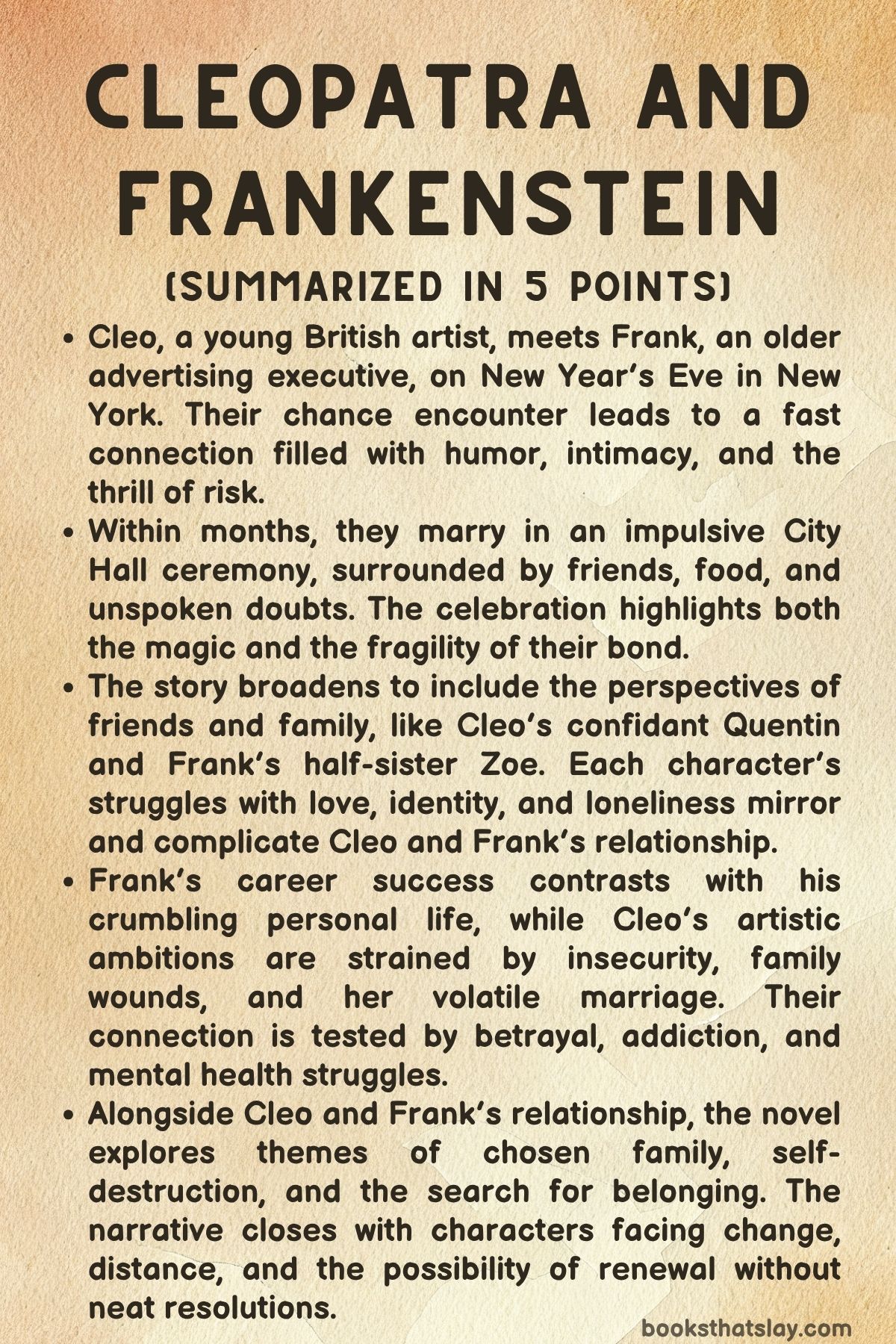
Characters
Cleo
Cleo is the vibrant yet fragile center of Cleopatra and Frankenstein. At twenty-four, she is a painter from Britain trying to carve out a life in New York, her art often intertwined with her personal struggles.
Cleo is defined by her longing for belonging and her battle with instability—her visa problems mirror her emotional insecurity, and her passion for art often collides with her deep-rooted self-doubt. She is capable of great charm and intimacy, as shown in her immediate connection with Frank, but she is also prone to self-sabotage and despair, culminating in her suicide attempt.
Cleo’s relationships are fraught with contradictions: she relies on Frank yet resents his dominance, she draws close to Quentin yet distances herself when her marriage shifts her loyalties, and she oscillates between tenderness and hostility with Zoe. Cleo embodies the turbulence of youth, her artistry serving both as an outlet and a burden, and her story reveals a woman torn between survival, love, and self-destruction.
Frank
Frank, in his late thirties or early forties, is the charismatic yet conflicted figure around whom Cleo’s life begins to orbit. A successful advertising executive, Frank exudes confidence and stability on the surface, but beneath lies an undercurrent of insecurity, addiction, and a longing for connection.
His impulsive decision to marry Cleo speaks to his hunger for intimacy and reinvention, even as his career demands a ruthlessness that corrodes his relationships. Frank is protective of his half-sister Zoe and tender with Cleo in her most vulnerable moments, yet he is also reckless—drawn to Eleanor, caught in the intoxication of success, and unable to curb his destructive drinking.
His vow to Cleo, about darkness creating light, reveals a man who recognizes his flaws but struggles to overcome them. By the end, Frank’s journey with Eleanor and his reconciliation with Cleo in Italy highlight a man seeking redemption and genuine love, even as he confronts the wreckage of his choices.
Quentin
Quentin is Cleo’s closest friend, a sensitive, flamboyant character whose life oscillates between longing for fantasy and an inability to face reality. His Polish heritage and struggles with identity fuel his sense of alienation, while his involvement in the underground sexual scene illustrates his restless search for escape and affirmation.
Quentin’s relationships are unstable—his breakup with Johnny is violent and humiliating, his affair with Alex leaves him feeling fragile and used, and even his bond with Cleo becomes strained after her marriage. He hides behind costumes, drugs, and performance, but beneath his flamboyance lies deep loneliness.
Quentin represents the fragility of those who chase beauty and fantasy to numb their pain, and his arc paints a portrait of someone simultaneously yearning for connection and terrified of true vulnerability.
Zoe
Zoe, Frank’s much younger half-sister, embodies both defiance and fragility. Prone to seizures, she lives with constant uncertainty, which amplifies her need for independence and rebellion.
Financial struggles and a sense of being overshadowed by others push her to explore questionable avenues of survival, such as entertaining the idea of sugar babying. Her relationship with Cleo evolves from sharp hostility to surprising tenderness, most notably in the fire escape scene where they share vulnerabilities and end the night sleeping side by side.
Zoe’s relationship with Frank is complicated; while he is protective, she resents dependence on him, revealing her fear of being pitied or controlled. Throughout the novel, Zoe struggles to carve out her own identity amid illness, dependency, and emotional turbulence, making her both one of the most antagonistic and sympathetic figures in the story.
Anders
Anders, Frank’s old friend, drifts into Cleo’s life with both charm and recklessness. A chef by profession, he is a man of appetites—alcohol, women, and experiences—and his impulsive drunken purchase of Cleo’s painting leads to their dangerous affair.
His relationship with Cleo is intoxicating and intimate, yet when she seeks stability, he panics, unable to commit. Anders is torn between his bond with Frank and his desire for Cleo, creating a triangle of betrayal that unsettles him deeply.
His later move to Los Angeles reflects both escape and ambition, but even in his new glamorous life, Cleo haunts him. Anders represents the destructive pull of desire unchecked by responsibility, his charm undermined by cowardice when true commitment is demanded.
Santiago
Santiago, the celebrated chef and Frank’s confidant, provides a counterbalance of wisdom and grief. Having lost his wife Lila, he carries the scars of love and mortality, which shape his gentle but firm approach to supporting Cleo during her darkest moments.
Santiago embodies steadiness and empathy; his attempts to comfort Cleo with food and memory contrast starkly with the chaos of her marriage and her friends’ reckless choices. Yet Santiago, too, wrestles with unease, particularly when observing Anders’s betrayal and confronting his own insecurities.
His role in the novel is that of the quiet anchor, reminding others—and the reader—of the inevitability of loss and the fragile beauty of human bonds.
Eleanor
Eleanor emerges first as a professional presence in Frank’s advertising world and later as his partner after Cleo. She is observant, reflective, and grounded, particularly in the sections where she narrates her father’s illness and death.
Eleanor’s voice brings a shift in tone, offering a more contemplative, almost diaristic perspective compared to the earlier, tumultuous chapters. Her relationship with Frank begins with subtle flirtation and grows into a steady bond marked by his sobriety and her cautious optimism.
Unlike Cleo, Eleanor represents a quieter, more grounded form of intimacy, one rooted in patience and mutual care rather than volatility. Her encouragement for Frank to reconnect with Cleo in Italy shows her emotional maturity and her understanding of the importance of closure.
Eleanor ultimately embodies the possibility of renewal, offering Frank—and the narrative—a sense of forward momentum after so much destruction.
Themes
Love and Dependency
In Cleopatra and Frankenstein, love is rarely portrayed as a steady or uncomplicated force. Instead, it is presented as something volatile, shaped as much by need and vulnerability as by desire.
Cleo and Frank’s relationship begins with chance intimacy, an impulsive marriage, and a belief in connection as salvation. Yet as their lives unfold, their union reveals how love can shift into dependency, with each partner turning to the other to fill personal voids.
Cleo, facing uncertainty in her career and immigration status, clings to Frank’s stability, while Frank, weathered by age and professional stress, seeks Cleo’s youth and emotional openness as a form of renewal. Love here is not merely romantic idealism but a negotiation of power, fear, and longing.
Their tenderness often coexists with toxicity, illustrating how affection can slide into resentment when both partners rely on each other to compensate for unhealed wounds. The novel complicates the notion of love as pure comfort by showing how it also magnifies insecurities and mirrors the darkest parts of oneself.
Love becomes a paradox—both a source of light and an accelerant for destruction—forcing each character to reckon with the cost of placing salvation in another person’s hands.
Identity and Self-Destruction
The novel repeatedly circles around characters who wrestle with fractured identities and turn toward destructive outlets in an attempt to cope. Cleo’s artistry, her struggles with belonging as a British transplant, and her familial neglect intertwine with her descent into self-harm.
Quentin, unable to reconcile his sexuality and his yearning for fantasy, seeks escape through drugs, sex, and risky encounters that blur the line between liberation and self-erasure. Frank, outwardly successful in business, sabotages himself through alcohol, infidelity, and unchecked temper, all of which expose the hollowness beneath his professional triumphs.
These patterns reflect how fragile identities often manifest in cycles of excess, addiction, or destructive intimacy. The narrative does not present self-destruction as mere weakness but as a symptom of unresolved pain, a coping mechanism for loneliness and alienation.
Each act of harm—whether Cleo cutting herself, Quentin chasing a dangerous high, or Frank’s betrayals—underscores how fragile selfhood becomes when it is defined by external validation rather than internal grounding. In showing this, the book suggests that destruction can be a distorted attempt at transformation, even if it leaves scars that demand acknowledgment before healing can occur.
Family and Absence
Family is less a haven than a source of absence, neglect, and uneasy reconciliation. Cleo’s father embodies cold indifference, prioritizing his new family and leaving her perpetually unseen.
Her relationship with Frank is shaped by this gap, as she both resents paternal abandonment and longs for a protector. Zoe, Frank’s younger sister, likewise struggles with illness, financial strain, and dependence on her brother, highlighting how family ties can both nurture and suffocate.
The characters’ chosen families—friends, lovers, and temporary companions—often replace biological ties, though these bonds, too, are fraught with betrayal and fragility. The novel repeatedly asks what family truly provides: unconditional support, or a mirror of unresolved grievances?
In moments of tenderness, such as Cleo and Zoe’s fire escape confessions or Santiago’s quiet care for Cleo in the hospital, the possibility of family as a refuge flickers. Yet more often, family functions as a wound, shaping how characters seek intimacy and connection elsewhere.
This theme underscores how the lack of reliable parental and sibling love reverberates through adult relationships, leaving characters yearning for belonging in unstable places.
The Search for Belonging
At its core, the novel is about outsiders struggling to carve a place for themselves in a world that often feels indifferent or hostile. Cleo, as an immigrant artist, embodies the uncertainty of forging a career and identity in New York, where her visa, financial insecurity, and fractured relationships leave her vulnerable.
Quentin searches for belonging through sexuality and subculture, chasing both connection and performance in spaces where he can briefly suspend his alienation. Zoe, perpetually in the shadow of her health struggles and economic precarity, seeks inclusion through fleeting bonds, whether with roommates, Cleo, or Frank.
Even Frank, who appears rooted in success, reveals how belonging can be undermined by guilt, aging, and the gnawing sense that achievement does not equal acceptance. The characters’ search is not only external but also internal, as they seek to reconcile fractured selves with the lives they are trying to build.
Belonging is portrayed as provisional, something momentarily achieved through intimacy or art but always threatened by the instability of human connection. The theme underscores the tension between individuality and community, suggesting that true belonging requires confronting personal fractures rather than masking them through relationships or excess.
Healing and Transformation
Despite its persistent darkness, the book also lingers on the possibility of repair. Healing is not offered as a neat resolution but as an ongoing, fragile process shaped by acknowledgment of pain.
Cleo’s survival after her suicide attempt does not erase her suffering but opens a space where she can imagine new forms of expression, as seen in her art institute work in Italy. Frank’s journey through sobriety and his ability to build a new relationship after his collapse with Cleo reveal how self-awareness can guide change, even if imperfectly.
The motif of kintsugi—mending broken pottery with gold—frames the novel’s view of healing: cracks remain visible, but they become part of a redefined beauty. Relationships, too, reflect this tension, as moments of reconciliation often carry the weight of betrayal and absence.
The characters’ transformations do not erase their scars but integrate them into new selves, suggesting that wholeness is not about purity but about embracing imperfection. Healing here is not guaranteed; it is an act of endurance, a willingness to continue even when the past remains present.