Colin Gets Promoted and Dooms the World Summary, Characters and Themes
Colin Gets Promoted and Dooms the World by Mark Waddell is a darkly funny corporate fantasy-horror novel set in a New York megacorp that literally runs on human suffering. It follows Colin, an anxious, underpaid data analyst who just wants job security and respect.
In desperation, he makes a forbidden supernatural deal that gives him a promotion to the thirteenth floor, where executives bargain with eldritch forces. As Colin climbs the ladder, he unleashes an ancient world-eating entity, risks the lives of his friends, and discovers he might be uniquely positioned to either save humanity or turn the apocalypse into a career opportunity.
Summary
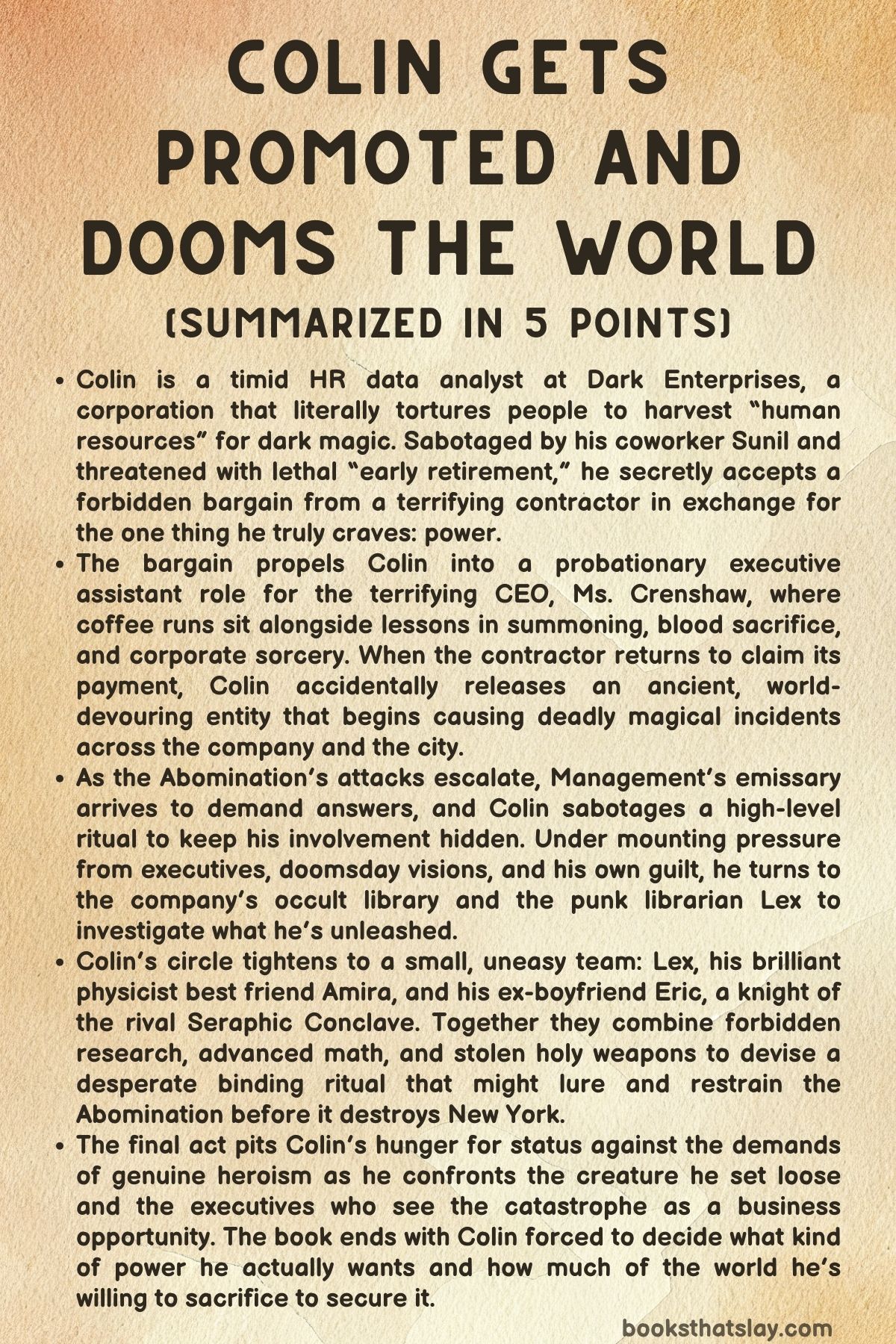
Colin is a timid, underappreciated data analyst in Human Resources at Dark Enterprises, a magical conglomerate that harvests human emotions as literal resources. After repeated report “errors” and missed deadlines, his supervisor Ms. Kettering threatens him with “early retirement,” which at this company means being handed over to the Firing Squad and taken away in a lethal van.
Colin knows the mistakes aren’t his fault: his coworker Sunil has been sabotaging his work ever since Colin rejected his sexual advances in a bathroom.
The HR floor is next to extraction suites where employees harvest grief, fear, and pain from captives. Colin walks past a soldier forced to cry into vials and a woman terrified by snakes while her screams are absorbed into devices that power the company’s magic.
Dark Enterprises uses this harvested suffering to cast large-scale spells, such as delaying climate disaster for clients who can afford the fees.
Desperate to save his job, Colin bypasses Sunil and sends a perfect report directly to Ms. Kettering. She forwards it back to Sunil for review, and Sunil alters it, inserts fake mistakes, and publicly humiliates Colin by copying her on his “corrections.” Colin’s reputation sinks further, and his execution feels inevitable.
At home, Colin lives with his best friend and roommate Amira, a brilliant physicist who believes he works at a bank. Bound by a blood non-disclosure agreement and a lifetime noncompete, he cannot reveal the truth about Dark Enterprises.
Amira worries about the secrecy, strange stains, and teeth in his laundry, and urges him to quit, but Colin insists he is trapped. Over drinks with Amira’s friend Jenn, a new Lockheed Martin hire, Colin listens to their debate over ethics versus survival and feels small and invisible.
On a work errand to the Transportation floor, Colin takes the stairwell, risking the building’s Stairmonster to save time. There he meets a terrifying contractor: a tall figure in a dried-blood-colored suit with a head of chained darkness.
In a stalled elevator, the being senses that Colin is marked for death and offers him a black business card. Bleed on it, say the words, and it will grant his heart’s desire in exchange for one favor later.
Colin knows taking gifts from contractors is strictly forbidden, but he keeps the card.
At home, he discusses a hypothetical magical bargain with Amira, who insists such deals always go wrong, especially if used to escape death. Alone, Colin realizes that more than survival or revenge, what he wants is power: status on the thirteenth floor with the executives and real authority over others.
When he spots a man who appears to be part of the Firing Squad watching his building, panic wins. Colin cuts his finger, bleeds on the card, and recites the invocation.
The chained-shadow contractor emerges from under his bed. Colin demands a promotion to the thirteenth floor.
The entity agrees and promises to return later to claim its favor. The next day, Colin arrives at work expecting the wards to kill him for breaking the rules, but he survives.
Ms. Kettering informs him that the CEO, Ms. Crenshaw, has summoned him to the thirteenth floor.
In Ms. Crenshaw’s office, Colin learns he isn’t being fired but is being considered as her executive assistant. When she asks what he would do to Sunil, Colin outlines a cruel revenge scenario, and she is impressed by his willingness to hurt others for advancement.
Asked what he truly wants, he replies: power. She sends him to sign extensive waivers in blood, then explains what the assistant position entails: scheduling, yes, but also training in dark magic, torture, and ritual sacrifices, with a small chance of eventual promotion and many ways to die painfully.
Colin accepts and receives a massive crimson-bound policy manual he must master before he can “ascend.”
On his first day in the new role, Ms. Crenshaw has him running errands, including delivering a sealed envelope to Personnel. In the elevator, the lights flicker and the contractor appears again.
It tells Colin it is time to pay his side of the bargain. Instead of killing him, it anoints him with corrupted “holy oil” and instructs him to paint a chained metal disc with blood while reciting strange words.
The disc glows, the metaphysical chains break, and the entity announces it is free and will devour the world, saving Colin for last. It vanishes as the elevator restarts, leaving behind blood and the now-unbound disc.
On the same elevator, several employees vanish in a bloody “incursion.” Ms. Crenshaw and Security suspect a powerful enemy or Abomination is involved. Colin realizes his promotion may already have cost lives.
He develops a routine on the thirteenth floor but is plagued by guilt and fear. Barney Samuels, a centuries-old founding partner who treats demonic contracts like normal business, recruits Colin for “Blood Sacrifice Thursday.” Colin witnesses a controlled, legalistic ritual blood sacrifice that keeps ancient Old Ones satisfied so they do not destroy humanity.
Barney explains that Management made a pact with these beings in antiquity, trading worship and sacrifices for power. Modern Dark Enterprises has streamlined the process but must still feed Them regularly.
He hints that someone caused the recent incursion and that Management will punish those responsible. Inspired by Barney’s power and apparent immortality, Colin decides to use his new position before anyone links him to the freed entity.
He returns to HR and engineers revenge on three of his long-time tormentors, luring them into escorting visitors from the hellish Stygian Maw. As the delegation departs, Colin shoves two bullies into the closing gateway, consigning them to eternal torment.
Ms. Crenshaw later confronts him about their disappearance. When he admits what he did, she warns him not to damage productivity with too much “culling” but clearly approves of his ruthlessness.
Determined to understand the metal disc and what he has freed, Colin visits the Repository, Dark Enterprises’ huge occult library. With help from Lex, a punk librarian fascinated by cursed texts, he learns the disc is a Sumerian binding created by Management millennia ago to imprison some unknown entity.
It has been damaged with blood, which removed crucial sigils and unbound the prisoner. Lex warns him nothing good ever comes of tampering with Management’s bindings.
Colin’s own recruitment had involved torturing a bound interview subject until he nearly killed him, impressing Ms. Samantha Price, the recruiter. He now understands that Dark Enterprises selected him specifically for his willingness to harm others when pushed.
Ms. Crenshaw confirms this, telling him her philosophy is to keep increasing pressure until he either breaks or proves worthy of the board.
When Management sends an emissary—a smiling woman in black—to investigate the growing magical disruptions and vanishings, Colin helps prepare a complex ritual in the Lower Sanctum. The emissary appears, questions the executives about the uncontrolled incursion, and warns that if they fail, Management may replace them and destroy New York in the process.
She then senses a familiar trace, the mark of the freed Abomination, and begins scanning everyone present. Afraid she will recognize the connection on him, Colin kicks over the anchoring bowl, breaking the ritual and banishing her abruptly.
The executives are furious but say little. Colin knows he has just traded one danger for another.
As punishment, Ms. Crenshaw sends him on unpleasant cleanup duties and makes clear he has one chance left to secure promotion to middle management. Meanwhile, the city grows emptier and stranger as disappearances increase.
In the Repository, Colin and Lex attempt divination using an extremely powerful Ouija board built from the remains of a dead medium. They ask about the entity from the elevator.
The spirits spell out that it is hungry, an Abomination, and everywhere. The medium’s voice screams for help before the board shatters and the artifact is destroyed, suggesting the Abomination has just devoured her soul.
Lex is horrified and realizes Colin is involved in something far beyond normal corporate horror. When Colin admits he is trying to fix a mistake without providing full details, Lex cuts ties, too afraid to continue.
Outside, Sunil appears and hints he is working on his own dangerous scheme with another employee to bring in a new, powerful investor for Dark Enterprises, suggesting Colin’s position is unstable.
As the crisis reaches its peak, Colin reconnects with Eric, his ex-boyfriend, who secretly belongs to the Seraphic Conclave, a rival order that hunts entities like the one Colin freed. Eric reveals he has stolen a secret Conclave weapon, the Black Blade, which once killed an Abomination.
Manhattan is collapsing under attacks from The-One-Who-Hungers, the creature Colin unbound. Colin, Eric, Lex, and Amira regroup at Dark Enterprises under emergency lockdown.
Inside the building, they hide in the Repository’s Obsolete section and research a binding ritual to imprison the Abomination again. Lex translates ancient texts, Amira handles the complex geometry, and Colin experiments with spells, learning the dangerous Grasp of the Endless Void and reading a book on Abominations.
He discovers a crucial secret: Management baked a fail-safe into the original bindings. Any freed Abomination is tethered to the person who released it; if that person dies before Management cuts the link, the Abomination becomes trapped in that world permanently.
Colin keeps this information to himself.
They decide not to trust Dark Enterprises’ executives. Instead of handing over the Black Blade, Colin plans to use it himself, saving the world and boosting his bargaining power inside the company.
He gathers additional tools, including a volatile Sunfire orb from Supplies and a scalpel from HR. Lex produces a golden chain that lets two people share thoughts.
Amira agrees to link with Lex during the ritual so they can combine translation and math.
They set up a binding circle in the lobby to lure the Abomination away from the rooftop ritual the board is attempting. Colin uses a golden disc from Eric to summon him and his Conclave partners, Corrine and Ivan, into the building.
Amira and Lex begin the ritual, but it does not attract the entity at first. The Abomination is busy slaughtering the executive board on the roof.
To force its attention, Colin uses his mystical connection from the original bargain. He calls the entity through the blood-marked business card and the hidden tether between them.
The building falls silent as The-One-Who-Hungers arrives, badly damaged but still terrifying. Colin informs it that if he dies, it will be trapped on Earth forever, unable to return to the Outer Darkness or be properly harvested by Management.
This truth explains the escalating destruction: the creature has been trying to pressure Management into severing the link by making itself too costly to ignore.
When it attempts to leave and finish killing the board, Colin puts the scalpel to his own neck and begins to cut. The Abomination teleports to stop him, grabbing his wrist and stepping into the ritual’s focus.
Amira and Lex intensify the chant; blue flames rise. Eric, Ivan, and Corrine attack from three sides.
The battle is brutal: Ivan is killed, Lex is nearly crushed, and the Abomination repeatedly tears itself free of the binding flames.
Colin uses the Grasp of the Endless Void to compress the entity into a dense bead of darkness and moves to stab it with the Black Blade. The bead explodes, throwing everyone, chipping the knife, and allowing the Abomination to re-form as a giant cloud of shadow.
It seizes Eric and tortures him, while Ms. Crenshaw and a few surviving executives watch helplessly. Colin realizes that Management planned to let the Abomination ravage New York, then harvest its essence for even greater power.
With few options left, Colin rolls the Sunfire orb beneath the shadow mass and speaks its command word. A column of white fire roars up, injuring the creature badly and freeing Eric.
Lex and Amira unleash the full power of the binding, transforming the ancient seal into a web of silver threads that wrap the cloud in a complex prison. The Abomination strains and begins to tear free.
Knowing this is the last chance, Colin grabs the chipped Black Blade and charges through the creature’s tendrils, protected by wards Eric had placed on him earlier. He drives the knife into the heart of the shadow.
The darkness drags him inside; there is pain and disorientation, then nothing.
Colin wakes later in the lobby. Eric explains that after Colin vanished into the Abomination, it screamed and collapsed into the Blade, which now contains it.
Lex and Amira survived and, having shared minds through the ritual, have become a couple. The Abomination is bound, but the millions of people it devoured do not return.
The public blames a vague terrorist event; Dark Enterprises hides the truth.
Soon afterward, Colin and Eric meet in a quiet park, both healed by Conclave magic. Eric reveals he has quit the Conclave, unwilling to be merely a tool.
He offers Colin the Black Blade, knowing it holds the Abomination and remains incredibly dangerous. Colin admits he loves Eric but refuses to leave Dark Enterprises or seek redemption.
He wants to rise to the very top and control the world’s systems, using the Blade as leverage if necessary. Eric, conflicted but loyal, agrees to stay with him and see where that path leads.
Two days later, Colin walks into Ms. Crenshaw’s office in a sharp suit. She is interviewing his replacement and listing his many policy violations, preparing to have him killed.
Colin counters by citing an obscure clause in the dense policy manual: any rule-breaking that preserves Dark Enterprises or advances its goals and market share is automatically excused. He argues that freeing and then defeating the Abomination strengthened the company, removed weak employees, and gave Management the Abomination’s essence to exploit.
He reveals that he holds the Black Blade and threatens to shatter it if she moves against him, destroying Management’s new prize. Ms. Crenshaw notes that he would die instantly, but he points out he is now protected by powerful Conclave wards.
He then states his terms: promotion to middle management for himself, promotion for Lex, amnesty for Amira, and that Dark Enterprises leave Eric alone. Impressed by his audacity and recognizing his leverage, Ms. Crenshaw accepts.
Colin hands over the Blade and secures his future.
As he goes to fetch the terrified candidate waiting outside, one thing remains clear: Colin has saved the world, but he has no intention of stepping away from the very system that nearly destroyed it. Instead, he plans to rule it from the inside, one promotion at a time.
Characters
Colin
Colin is the nervous, underappreciated data analyst who becomes the ruthless middle manager at the heart of Colin Gets Promoted and Dooms the World. At the beginning, he is anxious, conflict-avoidant, and desperately eager to be seen as competent and useful in a system designed to grind him down.
He endures harassment from Sunil, intimidation from Ms. Kettering, and a job that literally weaponizes human suffering, and he tells himself that loyalty and hard work will keep him safe. Underneath that meek exterior, though, lies a deep vein of resentment, humiliation, and hunger: not just to survive, but to matter, to be powerful enough that no one can ever make him feel small again.
When the chained-shadow contractor offers a bargain, Colin does not just ask to live; he asks for a promotion to the thirteenth floor and, later, openly admits that what he truly wants is power.
Colin’s arc traces how quickly victimhood can slide into cruelty once he gets a taste of control. His revenge on Andrea and Gerald, pushing them into the Stygian Maw, is a turning point: he feels no remorse, only satisfaction and a sense that the universe has finally balanced the scales in his favor.
He rationalizes each escalating horror as justified: freeing the Abomination was an accident; using it as leverage is strategic; sacrificing colleagues is good for quotas. Even when he risks his life to rebind The-One-Who-Hungers, he does it with a calculated eye on future promotion and company advantage, not out of selfless heroism.
By the end, Colin is still recognizably the same anxious, queer guy who rides the subway and frets about blind dates, but he has embraced a philosophy in which morality is secondary to agency and advancement. He will save the world if he can own it afterward.
That willingness to weaponize his own trauma, to use love for Eric and friendship with Amira as anchors rather than brakes, makes him a deeply unsettling protagonist: not a redeemed hero, but an ambitious survivor who has decided that being a monster is better than being prey.
Ms. Crenshaw
Ms. Crenshaw, the CEO of Dark Enterprises, is the cool, terrifying embodiment of corporate evil running through Colin Gets Promoted and Dooms the World. On the surface she is the ultimate high-functioning executive: immaculate, controlled, hyper-competent, and focused on calendars, coffee orders, and performance metrics.
Beneath that veneer, she is a high priestess of Management, comfortable with torture, human sacrifice, and apocalyptic risk as long as the company’s market share and mandates are being served. Her philosophy of testing to failure sums up her worldview: she will push Colin until he either breaks or becomes board material, and either outcome is acceptable as long as the experiment yields useful data.
She treats human beings like A/B tests and disposables, including herself; when Management’s emissary hints that the entire board might be replaced, Crenshaw’s fear manifests as frantic promises of improved containment, not moral horror.
Yet Crenshaw is not stupidly villainous; she is genuinely strategic and, in a perverse way, an honest mentor. She rewards Colin’s clever sadism, tolerates his deviations when they serve the company, and even implicitly approves his coup against his bullies as long as quotas are preserved.
When Colin confronts her at the end with policy language and the Black Blade, she does not lash out blindly; she reads the leverage correctly and negotiates, conceding power to him while trying to keep control of the bigger picture. She recognizes in him the same willingness to sacrifice others for an outcome and respects that ruthless clarity.
Crenshaw functions as both Colin’s aspirational figure and his mirror: she shows him what long-term success in this system looks like, and she is both impressed and faintly alarmed that he has managed to turn Management’s own legalistic rules against her. The result is a relationship that feels less like boss-and-employee and more like predator-and-rising predator, circling one another with grudging admiration.
Amira
Amira is Colin’s best friend, roommate, and one of the strongest emotional anchors in Colin Gets Promoted and Dooms the World. A brilliant physicist, she represents rational science in a setting dominated by blood pacts and eldritch contracts.
From early on, she knows something is catastrophically wrong with Colin’s job: she notices the bloodstains, the loose teeth, and the secrecy, and she pushes him to leave, not because she is naive but because she still believes life should be more than just survival under a monstrous employer. At first, Colin’s blood NDA keeps her on the edges of the real story, but she continues to show up as his confidante, sounding board, and gentle challenger, asking him why he insists on staying in a place that clearly harms him.
Once she is drawn fully into the occult reality, Amira adapts with a combination of scientific rigor and ferocious loyalty. She helps translate multidimensional geometry into something usable, locks her mind to Lex with the golden chain, and sustains the binding ritual when Lex falters.
Her willingness to step into a ritual that might kill her is driven not by abstract duty but by love: for Colin, for Lex, and for the world that is collapsing around them. At the same time, she does not become a moral scold.
She knows Colin is crossing lines, and she knows he will not seek redemption, but she refuses to abandon him; she chooses instead to mitigate the damage and build her own life within the chaos. Her budding relationship with Lex at the end, born from shared trauma and shared intellect, underscores that she is not simply a sidekick.
She is a survivor in her own right, using her gifts to push back the dark rather than to pretend it does not exist.
Eric
Eric begins as the handsome yoga guy Amira wants to set Colin up with and is later revealed as a knight of the Seraphic Conclave, a holy warrior order that is supposedly opposed to entities like The-One-Who-Hungers. In Colin Gets Promoted and Dooms the World, he is the closest thing to a traditional fantasy hero, complete with flaming golden sword, command over other agents, and a mission to destroy an Abomination.
But the book complicates him by putting him in love with someone who is not even trying to be good. Eric genuinely cares for Colin’s safety and emotional wellbeing; he flirts, reassures, and advocates for him even when the Conclave sees Colin as a problem or a useful pawn.
He is painfully aware of Colin’s moral drift and of Dark Enterprises’ grotesque nature, yet he keeps coming back, choosing relationship over rigid doctrine.
His decisive break with the Conclave reveals how much Colin has influenced him. By stealing the Black Blade, cooperating with Dark employees, and later quitting the order entirely, Eric rejects the Manichean worldview in which anything short of total obedience is treason.
He recognizes that the Conclave also treats people as expendable weapons and that their supposed righteousness does not outweigh their cruelty. Eric’s willingness to put his life on the line in the lobby battle and to give Colin the Blade afterward, knowing how dangerous it is, shows a kind of radical trust: he accepts that Colin may use it for power, but still believes in him enough to hand over the only thing that can contain the Abomination.
In the final park conversation, Eric and Colin choose each other while openly acknowledging their moral differences, making Eric a figure of complicated grace rather than a spotless savior.
Lex
Lex, the punky, nonbinary librarian in the Repository, is one of the most vibrant side characters in Colin Gets Promoted and Dooms the World. They enter the story as a gleeful connoisseur of cursed artifacts, recruited after posting photos of a real infernal grimoire online, and approach the company’s horrors with equal parts fascination and gallows humor.
They help Colin decipher the sigils on the disc and trace its origins back to ancient Sumerian binding magic, and they understand more than most employees about how dangerous Management truly is. Lex’s attitude is not fearlessness so much as a kind of fatalistic thrill-seeking: they love weirdness, but they are not blind to the risks, and they repeatedly warn Colin that tampering with Management’s seals is asking for catastrophe.
Their relationship with Colin adds emotional texture to the narrative. At first, Lex treats him as a nerdy co-conspirator, someone who shares their curiosity and will appreciate their expertise.
When the Ouija session with Elsabeth Brünner goes horribly wrong and the Abomination annihilates a powerful divination artifact from beyond the grave, Lex realizes that Colin has been withholding crucial information about what he unleashed. Their fear curdles into fury, and they pull back, accusing him of dragging them into something apocalyptic without consent.
This break matters because it proves Lex is not just comic relief; they have boundaries and a strong sense of self-preservation. Later, however, they choose to come back, risking their life in the binding ritual and building a deep mental and emotional bond with Amira.
Their promotion to middle management at Colin’s demand suggests they are now entangled in the power structure they once approached with skeptical irony, raising the unsettling question of whether their curiosity will be corrupted by the same forces that shaped Colin.
Sunil
Sunil is one of the most personal antagonists in Colin Gets Promoted and Dooms the World, and he embodies workplace abuse at the most human level. He begins as Ms. Kettering’s assistant, weaponizing his position to sexually harass Colin and then sabotage his reports when Colin refuses him.
His tampering nearly gets Colin executed; he uses company systems, office politics, and faux concern to undermine Colin’s credibility with a chilling casualness. In a world full of cosmic horrors, Sunil’s cruelty is almost ordinary, which makes it sting even more.
He represents the kind of everyday predator who flourishes in environments where power is opaque and complaints are punishable, and he knows exactly how protected he is under Ms. Kettering’s blind eye.
As the story progresses, Sunil reveals his own ambitions, aligning with Tamsin to court a mysterious new investor for Dark Enterprises. He frames himself as the one who really understands how to play the game, taunting Colin that his time on the thirteenth floor is almost over and that his very soul might be used as a bargaining chip.
Yet when true danger appears, Sunil is quick to talk about running. He has cunning, but no courage; he is happy to profit from other people’s pain as long as he feels safe, and he folds at the first hint of existential risk.
This contrast makes him an effective foil for Colin. Both are marginalized employees operating under ruthless management, but where Colin is willing to risk everything for power, Sunil clings to petty sabotage and opportunistic schemes, never daring to step into the line of fire.
The narrative punishes him not with a spectacular death but with ongoing insignificance, underlining that small-minded malice is despised even by a company built on horror.
Ms. Kettering
Ms. Kettering is Colin’s original supervisor in Human Resources and later revealed as a board member, and she represents the mid-level bureaucratic cruelty that makes Dark Enterprises function. She delivers threats of early retirement with chilly professionalism, never raising her voice but making it very clear that a single week of poor performance will end in a lethal van ride.
She does not need to lay hands on anyone; the system does that for her, and she is perfectly at ease with how it works. When Sunil sabotages Colin, she never seriously considers the possibility that he might be innocent; her default assumption is that workers are guilty and replaceable, and she uses that to keep them terrified and compliant.
Her refusal to challenge Sunil’s behavior makes her complicit in his harassment, aligning her with institutional misogyny and homophobia even if she never expresses those views directly.
Her eventual destruction by an incursion outside the building is significant. For Colin, it is both a grim satisfaction and a warning: even the people who seem secure in the hierarchy can be snuffed out in an instant when playing with forces they do not fully control.
Management treats her death as a data point in their risk assessment, and Ms. Crenshaw uses it to remind everyone how high the stakes are. Ms. Kettering never gets a redemption moment; she dies as she lived, part of a system that eats its own employees, and her absence opens space for Colin’s rise.
In that sense, she is less a person than a portrait of what happens to those who devote themselves wholly to enforcing a monstrous status quo.
Barney Samuels
Barney Samuels, the jovial founding partner who looks like an immortal Mr. Monopoly, is one of the most chillingly charismatic figures in Colin Gets Promoted and Dooms the World. He projects warmth, humor, and avuncular charm, casually securing impossible restaurant reservations and calling Colin by friendly diminutives.
At the same time, he orchestrates blood sacrifice rituals, explains that weekly offerings are needed to keep the Old Ones from annihilating humanity, and reminisces about a centuries-long relationship with Management as if he were talking about a particularly demanding client. For Barney, the world-ending threat is not a moral crisis but a compliance requirement; you feed the gods, or you lose your franchise.
His attitude normalizes horror by wrapping it in grandfatherly cheer.
Barney’s role in Colin’s development is subtle but crucial. He introduces Colin to the deeper history of Dark Enterprises, explaining that the company’s success rests on ancient pacts with cosmic beings, and he presents this as a kind of grand legacy.
When Colin sees how comfortable Barney is with sacrificing volunteers, bending legal rules, and treating blood as a recurring operational expense, he glimpses a model of power that is both alluring and terrifying. Barney becomes a vision of what Colin might one day be: effectively immortal, embedded in Management’s good graces, and sincerely convinced that the atrocities committed are necessary public service.
This makes Barney a thematic bridge between personal ambition and systemic evil, illustrating how a pleasant personality and unquestioned loyalty can turn even apocalyptic horror into just another Thursday.
Ms. Samantha Price
Ms. Samantha Price is the recruiter who brought Colin into Dark Enterprises, and her methods reveal a great deal about how the company identifies potential talent. Rather than conducting a conventional interview, she straps a privileged man named William into a chair and hands Colin the controls to a torture device.
She has done her research, using William’s Grindr rejection of Colin to stoke existing resentment and coax out his latent cruelty. When Colin escalates the shocks to maximum, effectively electrocuting William in a fit of vindicated rage, Price is delighted; to her, this is proof of the ruthlessness and emotional vulnerability that Dark Enterprises can harness.
She is not concerned with skills or experience so much as with moral pliability and a capacity for violence when given permission.
Price’s presence, though limited, shadows Colin’s entire trajectory. Ms. Crenshaw later confirms that Price recognized in him someone willing to realize his ambitions regardless of others, putting him on the fast track to the thirteenth floor.
In that sense, Price is a talent scout for evil, specializing in spotting people whose wounds can be turned into weapons. Her brand of recruitment suggests that the company actively cultivates traumatised, angry individuals, knowing they can be shaped into loyal instruments of Management.
Through her, the book shows how corporate structures can transform personal pain into institutional brutality under the guise of opportunity.
Ivan, and Corrine
The Seraphic Conclave is the nominally holy counterpart to Dark Enterprises, but in practice it mirrors many of the same problems under a different symbol set. It deploys Hands like Ivan and Corrine, who ambush Colin and Amira in earlier encounters and treat Eric with rigid military deference.
Their mission is to destroy Abominations and other threats, yet their methods involve ambush, torture, and force, with little concern for collateral damage. Ivan and Corrine initially see Colin as an enemy or at best a liability; they attack, capture, and threaten rather than attempt dialogue.
When Eric asserts his authority and orders them to cooperate with Dark’s employees, their obedience is absolute, but their sour resentment makes clear they view this alliance as an affront to their purity.
In the lobby battle, Ivan dies when the Abomination punches through his chest, and Corrine survives to continue fighting. Their fates underscore how expendable the Conclave considers its operatives: they are literally weapons, not people whose lives matter beyond their utility.
Eric’s decision to leave the Conclave is partly a rejection of this attitude; he no longer wants to be a golden sword pointed at targets without regard for nuance or human cost. The Conclave thus functions as an indictment of institutions that claim moral superiority while replicating the same dehumanizing practices as their enemies.
Jenn
Jenn, Amira’s old friend, appears relatively early but plays an important thematic role in Colin Gets Promoted and Dooms the World. She is heading to a high-paying job at Lockheed Martin, a real-world defense contractor, and her conversations with Amira about ethics and survival foreshadow the central questions of the book.
Jenn argues that sometimes you have to compromise your ideals to live comfortably in an unforgiving world, while Amira pushes back, worrying about complicity. Colin, listening to them argue, feels invisible and expendable, caught between their positions.
Jenn’s choice to take the job is a grounded, non-supernatural version of the same decision Colin makes later: to work for a morally dubious entity in exchange for security and opportunity.
Jenn’s presence also highlights how the horror of Dark Enterprises is an exaggerated version of real corporate and military-industrial abuses. Sweatshop scandals, exploitative labor, and weapons contracts already exist without monsters or Old Ones.
Jenn’s pragmatic stance makes Colin’s later embrace of Dark’s power more understandable; he is not stepping into a totally alien logic but extending a familiar one to its extreme. Her character anchors the narrative in recognizable moral debates, showing that the slide into complicity often begins with very human, very relatable rationalizations.
Leslie
Leslie, the actressy volunteer at Blood Sacrifice Thursday, offers a darkly comic look at how people can be seduced into participating in horror. She is not a captive; she has signed up to donate blood in a ritual that looks disturbingly like a human sacrifice.
She performs her role with theatrical flair, enjoying the attention and the drama, and she seems less concerned with the danger than with the experience and whatever perks Dark Enterprises offers in return. Leslie treats the event like a gig, a performance that will boost her profile or at least give her a story to tell, demonstrating how the company can recruit willing participants in its rituals by packaging them as glamorous or meaningful.
Her presence underscores Barney’s point that the Old Ones demand traditional rituals even if the company has modernized in other areas, and it illustrates how readily human beings will step into that tradition when enticed. Leslie is not in charge; she is still being used.
But her eager complicity complicates the moral landscape, showing that not everyone at the altar is there purely as a victim. Some are there because they have been convinced that bleeding for the system is an opportunity.
Ms. Yamada
Ms. Yamada, another executive who joins Crenshaw and Samuels during the Management ritual, represents the silent, competent leadership tier within Dark Enterprises. She does not have the flamboyant personality of Barney or the commanding presence of Crenshaw, but her inclusion among the key decision-makers signals that she is deeply embedded in Management’s trust.
She participates in the high-level ritual, accepts the emissary’s threats, and shares responsibility for containing the Abomination and protecting the company from mundane scrutiny. Her relative lack of individual flair makes her an effective symbol of the many executives who uphold monstrous systems without drawing attention to themselves, quietly translating Management’s will into policy and action.
Tamsin
Tamsin is mentioned as Sunil’s ally in leveraging the company’s access to unlimited human resources after Kettering’s death. She works in a position that gives her access to those resources and sees in that access an opportunity to impress Management by landing a powerful new investor.
While she never takes center stage, her collaborative scheming with Sunil captures the way mid-level employees at Dark Enterprises compete for recognition by offering increasingly disturbing ideas. Tamsin’s willingness to throw Colin’s soul in as a possible signing bonus, at least rhetorically, shows how thoroughly she has internalized the idea that people are currency.
She is a shadowy echo of Colin’s ambition, without his narrative spotlight or his ultimate leverage.
Ivan and Corrine
Ivan and Corrine, Hands of the Seraphic Conclave, initially appear as antagonists who attack Colin and Eric in an earlier confrontation. They embody zealotry and professional violence, acting on orders without much visible doubt.
When Eric asserts his higher rank and compels their obedience, their frustration is palpable; they do not want to be working alongside Dark’s employees, whom they see as corrupt. In the binding scene, however, both fight bravely against the Abomination.
Ivan dies in a brutal, immediate way, his chest punched through, while Corrine survives to keep battling. Their storylines emphasize the Conclave’s instrumental view of its warriors and the fact that bravery and fanaticism often come as a package deal.
They are both dangerous and tragic, tools shaped by an institution that treats martyrdom as a job requirement.
William
William, the restrained man in Colin’s recruitment interview, is a relatively minor character whose suffering reveals a great deal about Colin and Ms. Price. He is a privileged, dismissive man who once rejected Colin on Grindr, and Price uses that personal history to push Colin into torturing him.
In the chair, William is stripped of his social power; he is reduced to a victim of an experiment designed to test Colin’s moral limits. His arrogance and previous rejection make it easier for Colin to rationalize his cruelty, but they do not justify it.
William’s death is an early instance of Colin translating his humiliation and desire for validation into violence once given institutional permission. He never learns why this is happening to him, and the story never returns to his family or friends, underlining how completely Dark Enterprises is able to erase inconvenient lives.
Elsabeth Brünner
Elsabeth Brünner, the dead medium whose remains form the powerful Ouija board in the Repository, is never seen in life, yet she leaves a strong impression. Her voice emerges during Colin and Lex’s séance, begging in German for help and warning that something is coming.
When the Abomination notices the attempt at divination, the planchette shatters and the board snaps, implying that Elsabeth’s soul, already trapped in a permanent state of service, has just been destroyed utterly. Her fate illustrates the cruelty of Management’s tools: even in death, gifted individuals are bound into company property, and their lingering consciousness can still be consumed by greater horrors.
Elsabeth’s final cries turn what could have been a quirky occult gizmo into a genuine tragedy, underlining the costs of meddling with powers beyond any individual’s control.
Themes
Corporate Capitalism and Institutionalized Evil
Dark Enterprises operates as a literalization of corporate capitalism taken to its most grotesque extreme, turning ordinary office culture into an engine for cosmic predation. The company’s very name signals that its business model is not simply morally gray but fundamentally malign, yet the structure of promotions, performance reviews, and quotas makes this normalized.
“Human resources” becomes horrifyingly literal: grief, terror, and physical pain are harvested like commodities, packed into vials and boxes, and sold as magical fuel for clients who want things like delayed climate catastrophe or disposable workforces. The familiar language of HR, remediation teams, early retirement, and noncompete clauses hides state-sanctioned execution squads, ritual torture, and binding blood contracts.
The joke, of course, is that none of this is entirely alien to real-world capitalism; the book magnifies workplace exploitation into blood magic and soul-rending as a way of showing how corporations already extract time, health, and dignity for profit.
Within this framework, management is almost mythological: executives are semi-immortal, backed by eldritch patrons, and still obsessed with metrics, market share, and board reviews. The weekly blood rituals are conducted “efficiently” to reduce legal risk, emphasizing that even sacrifices are subject to compliance and brand management.
The emissary from Management discusses mass disappearances in the same tone one might use for a disappointing quarterly report, and the ultimate apocalypse is framed as a failure of containment rather than a moral catastrophe. Even the Abomination becomes an asset to be harnessed and harvested, its devastation recast as a potential resource for Management’s power.
Colin Gets Promoted and Dooms the World uses this exaggerated corporate horror to argue that institutions can become so focused on growth and survival that any atrocity becomes acceptable if it serves the balance sheet. The organization is less a group of bad individuals than a self-sustaining system that rewards cruelty, punishes conscience, and defines morality entirely in terms of “advancing Dark Enterprises’ mandates and market share.”
Ambition, Power, and the Seduction of Advancement
Colin’s journey from anxious data analyst to ruthless middle manager traces how ambition can metastasize under the right incentives. At the outset he wants something very modest: to avoid being executed for “early retirement” and to clear his name after Sunil sabotages his work.
Yet when the contractor’s card reveals the truth of his desire, what surfaces is not safety but power: status, respect, and a place on the thirteenth floor. That recognition is crucial—Colin does not trip and accidentally fall into corruption; he discovers that he has always wanted to be the one making decisions instead of the one suffering under them.
The promotion he bargains for becomes the first step in a series of choices where every meaningful action strengthens his position in exchange for a little more of his humanity.
Once on the thirteenth floor, Colin quickly learns that advancement requires not just competence but a capacity for calculated brutality. Ms. Crenshaw tests him by asking what he would do to Sunil; his vindictive fantasy impresses her precisely because it reveals his appetite for dominance.
Later, he engineers the eternal torment of Andrea and Gerald in the Stygian Maw and experiences not guilt but satisfaction. The text tracks the way he reframes these acts as righteous: his bullies “deserve” hell, the weak deserve to be culled, and his own survival and rise justify any collateral damage.
This culminates in his final negotiation with Ms. Crenshaw, where he uses a trapped Abomination as leverage not only to save his friends but to secure a promotion and permanent place in the system that caused the disaster. He has literally doomed the world once already, and after helping save it, he consciously chooses not to seek redemption or leave Dark; instead, he vows to “own this world.” Colin Gets Promoted and Dooms the World suggests that in a hierarchy built on violence, ambition easily fuses with resentment and fear into a drive for power that feels like liberation from victimhood but actually locks a person deeper inside the very structure that harmed them.
Exploitation, Suffering, and the Commodification of Humanity
From the earliest scenes of the extraction suites, human suffering is treated as raw material, processed and packaged like any other commodity. A grieving ex-soldier is forced to cry into vials, a woman’s terror is harvested as she is menaced by snakes, and Leslie offers blood in a ritualized “donation” that looks theatrical but still exists to appease unknowable entities.
The company’s euphemistic language—“human resources,” “remediation,” “early retirement”—masks the fact that what is being shaved off of people is pain, fear, and ultimately life itself. This mirrors sweatshop scandals in Colin’s world, which Dark eagerly leverages to sell “disposable” replacement labor, showing a continuum between mundane exploitation and supernatural extraction.
The horror lies not only in the acts but in their normalization: employees gossip about deadly contracts, cursed elevators, and sacrifice quotas the way real-world workers might complain about overtime.
The Abomination deepens this theme by scaling the exploitation up to a planetary level. When Colin frees The-One-Who-Hungers, it begins devouring people across the globe, turning millions into fuel for its hunger.
Yet Management views this less as a moral emergency than as a logistical problem and potential asset. The plan is to let the entity feed on New York and then harvest its condensed power, treating an entire city as expendable biomass in pursuit of a more potent resource.
Even the Conclave’s holy weapon, the Black Blade, becomes a portable prison for a cosmic predator, an object of strategic value passed between institutions that both claim moral purpose yet accept staggering costs. Colin himself is simultaneously exploited and exploiter: he is bound by blood NDA and noncompete clauses, marked for death by his employer, and yet he willingly binds interns, clients, and enemies into systems of suffering once he has the authority to do so.
Colin Gets Promoted and Dooms the World presents a world where every relationship flows through extraction: emotional, physical, spiritual, or cosmic. People are reduced to inputs—tears, screams, blood, souls—and the truly powerful measure success not in lives preserved but in how efficiently that suffering can be converted into influence and survival.
Identity, Queerness, and the Desire to Be Seen
Colin’s queer identity shapes his experience long before magic enters the picture, and the novel treats his sexuality as central to his longing to be recognized and valued. The harassment from Sunil originates in a rejected sexual advance; when Colin refuses, Sunil weaponizes workplace power and homophobia, sabotaging his reports and effectively trying to erase his professional existence.
Later, the recruitment scene with Ms. Price shows another form of weaponized desire: she uses William’s Grindr rejection to provoke Colin’s rage and humiliation, pushing him to torture this privileged man to the brink of death. The company identifies in Colin a potent mixture of wounded pride, yearning to be wanted, and capacity for violence, and sees it as the perfect fuel for executive track advancement.
His queerness is not an incidental detail but entangled with how he is manipulated and how he understands himself as someone who has been overlooked, mocked, and belittled.
Eric, the knight of the Seraphic Conclave, offers a counterpoint: a love interest who embodies a different form of duty and power. Eric’s devotion to his faith and his role as a weapon of the Conclave initially put him at odds with Colin’s moral flexibility, yet he is also the one who believes in Colin’s capacity for change and risks everything to help him.
Their relationship dramatizes competing visions of what it means to be a queer man in a hostile world: Eric seeks to reconcile love with service and righteousness, while Colin prioritizes autonomy and control, even if it means aligning with an evil corporation. The final scene, where Colin openly refuses redemption and Eric chooses to stand beside him anyway, rejects simple narratives of queer purity or victimhood.
Queer characters here are not symbolic innocents; they are ambitious, flawed, loving, hurt, and dangerous. Colin Gets Promoted and Dooms the World treats the desire to be seen—in romance, in career, in power—as a core emotional engine.
Colin’s promotion, his bargain with the contractor, his reckless heroism, and his ruthless negotiation with Ms. Crenshaw all arise from the same wound: a lifelong sense of invisibility and disposability that he is determined to overturn, even if the price is monstrous.
Complicity, Ethics, and Moral Rationalization
The narrative constantly returns to the question of what it means to be complicit in evil and how people talk themselves into believing they are justified. At first, Colin attempts to draw a line: he tells Amira he believes in the company, insists his hands are relatively clean, and tries to frame his work as ordinary office labor, even while he literally walks past torture chambers.
As he climbs the ladder, however, he uses the same rationalizations he once might have condemned. When he feeds Andrea and Gerald to the Stygian Maw, his reasoning hinges on their cruelty toward him and the idea that Dark Enterprises will function more efficiently without them.
When he frees the Abomination, he initially tells himself that the contractor’s warning might be figurative, trying to shrink an apocalyptic threat down to a personal escape from death.
Other characters serve as mirrors in this ethical fog. Ms. Crenshaw openly embraces “testing to failure,” casting lethal trials as necessary for identifying true leadership.
Barney Samuels describes centuries of blood sacrifice as tradition and necessity; the Old Ones must be appeased so civilization survives, so what choice does anyone really have? The Conclave likewise deploys extreme violence, confident that their divine mandate absolves them.
Even Lex, who sees the dangers most clearly, is willing to work at Dark and handle cursed grimoires in exchange for the thrill of “weird shit” and the stability of a well-paid role. The world encourages a view where participation in horror is either inevitable or heroic, depending on who is doing the branding.
Colin’s final argument to Ms. Crenshaw formalizes this logic into policy. By citing the buried clause that absolves any rule-breaking which benefits Dark, he turns moral questions into a simple compliance heuristic: did the company advance?
If yes, the act is not just excused but retroactively correct. In that moment he becomes not just complicit but an architect of the narrative that justifies everything.
Colin Gets Promoted and Dooms the World does not let him off the hook; it shows how a frightened, marginalized person can become a willing collaborator and then a leader in a structure built on atrocity, all while telling himself he is protecting his loved ones and doing what is necessary.
Knowledge, Secrecy, and the Politics of Information
Information in Dark Enterprises is both a weapon and a currency, tightly controlled and dangerous to handle. From Colin’s blood-bound NDA and lifelong noncompete, it is clear that simply knowing what the company does is enough to merit execution if he tries to leave.
The thirteenth floor’s crimson policy tome, the Repository’s endless shelves, and the forbidden grimoires all emphasize how much knowledge is available only to those with access and the nerve to use it. Colin’s entire arc hinges on what he learns and what he chooses to conceal.
When he discovers that the Abomination is mystically tethered to the person who freed it, he immediately tears out the relevant page and hides the information from everyone, including Ms. Crenshaw, Eric, and Lex. This secret allows him to manipulate the entity during the final battle and later gives him leverage over Dark’s leadership, but it also puts his allies at far greater risk.
Divination failures highlight how knowledge itself has limits and costs. Oracles die of catastrophic strokes when they try to peer at the incursion; Elsabeth Brünner is annihilated in the spirit realm when the Abomination notices her Ouija board.
Every attempt to understand the threat leaves bodies behind, reinforcing the idea that some truths are literally lethal. The emissary from Management arrives primarily to interrogate the executives about what they know: disappearances, incursions, traces of forbidden power.
Her threat to replace the board is not just about results but about control over information flows and narrative. Meanwhile, everyday employees are kept in the dark through compartmentalization, euphemism, and intimidation; they may suspect rituals and sacrifices, but the full scope of the company’s cosmic entanglements is hidden behind classifications like “executive use only.”
Against this backdrop, Lex and Amira represent a more open, collaborative approach to knowledge. They combine physics, translation, and occult scholarship to reconstruct the original binding ritual and teach others how to execute it.
Their mind-link in the final battle becomes both literal and symbolic fusion of disciplines and perspectives. Yet even this alliance is undermined by secrets, as Lex senses that Colin is not sharing everything.
Colin Gets Promoted and Dooms the World portrays knowledge as something that can save the world or doom it depending not just on who possesses it, but on how they hoard or share it. The politics of secrecy—what is buried in policy manuals, what is erased from tablets, what is confined to forbidden stacks—shapes power as much as any spell.
Love, Friendship, and Found Family in a Hostile World
Amid blood rituals and apocalyptic threats, the relationships between Colin, Amira, Lex, and Eric provide an emotional core that complicates the book’s cynicism. Amira starts as the friend who sees more than Colin wants to admit: she notices the bloodstains, the loose teeth, the secrecy, and urges him to quit the job that is clearly killing him.
Their shared apartment is one of the few spaces that feels like a home, where they eat Thai food, tease each other about blind dates, and talk about physics and work. Even when she learns the truth about Dark and sees Colin at his worst, she continues to stand beside him, eventually risking her life in the binding ritual and linking minds with Lex.
Her faith in him is not blind, but it is tenacious, grounded in years of shared life and mutual care.
Lex enters as an eccentric librarian who loves cursed texts and ends up deeply entwined with the group. Their dynamic with Colin oscillates between fascination, exasperation, and fear, especially after the Ouija disaster and the destruction of Elsabeth’s board.
Despite this, Lex returns to help design the final ritual and agrees to the risky mind-link with Amira, a step that leads not only to their survival but to a new romantic bond. Their queer relationship grows out of shared intellectual passion and shared trauma, and it becomes a hopeful counterpoint to the loveless hierarchy of Dark Enterprises.
Eric’s bond with Colin operates on yet another axis: what starts as a fraught ex relationship, complicated by ideological war between Dark and the Conclave, evolves into a partnership where both men admit genuine love while acknowledging that their moral paths diverge.
The closing chapters show all three relationships under strain but not broken. Eric chooses to leave the Conclave rather than remain an unquestioning weapon, yet he does not demand that Colin abandon Dark; instead, he agrees to attempt a life with someone who intends to climb an evil corporate ladder.
Amira and Lex, now a couple, share both the exhilaration and the nightmares of surviving the Abomination. These connections do not purify Colin or redeem the institution, but they ensure that the story is not simply about solitary ambition.
Colin Gets Promoted and Dooms the World suggests that even in the heart of a predatory system, people build families of choice that sustain them, complicate their decisions, and occasionally pull the world back from the brink.
Agency, Destiny, and the Illusion of Control
Colin’s choices drive the plot, yet the book repeatedly questions how much control he truly has. When the contractor offers the black business card, the moment feels like a radical assertion of agency: Colin refuses passive execution and grasps for a promotion that would otherwise be impossible.
But the card, the entity, and the entire system of contractors are part of Dark’s broader ecosystem; even this act of rebellion happens within structures designed by eldritch Management. Later, he learns that Management itself created the binding that kept the Abomination chained and the fail-safe that tethers it to its liberator.
In other words, the very “choice” that sets the catastrophe in motion was anticipated by higher powers, who built in mechanisms to profit from it.
During the final confrontation, Colin appears to seize control of his fate. He exploits the mystical link, threatens suicide to force the Abomination’s hand, uses the Sunfire orb at the perfect moment, and personally stabs the creature with the Black Blade, effectively deciding the outcome of the world-ending crisis.
Yet the aftermath reveals that Management still gains: they acquire a safely bottled cosmic horror whose essence can be harvested, and they retain a newly empowered and ruthlessly loyal middle manager who has proven he will bend reality itself rather than be subordinated. Colin’s boldest exercise of agency becomes another data point in their “testing to failure” philosophy.
Even his final triumph—blackmailing Ms. Crenshaw—rests on a policy clause they wrote and a weapon forged by the Conclave, both legacies of older, larger forces.
Despite this, the book does not entirely dismiss individual choice. Eric’s decision to quit the Conclave, Lex’s decision to keep helping Colin after learning how dangerous he is, and Amira’s decision to stay in his life are not orchestrated by Management or cosmic contracts.
These actions create real constraints on what the powerful can do: Crenshaw has to concede because Colin has allies and leverage, not just because the script demands it. Colin Gets Promoted and Dooms the World ultimately portrays agency as something partial and contested.
People operate within systems and structures they did not build, under gods and corporations that can erase cities, but they still choose how to respond. The tragedy is that Colin, given several genuine chances to walk away or redefine his life, repeatedly chooses to tighten his own chains in exchange for a seat closer to the top, convinced that control inside a monstrous system is better than vulnerability outside it.