Come What May Summary, Characters and Themes
Come What May by Corinne Michaels is a contemporary romance set between fast-paced New York and a close-knit Virginia town. It follows Tessa Rivers, a young publicist desperate to prove herself at her boutique PR firm, when a sudden assignment sends her to Ember Falls to manage a high-stakes client crisis.
What begins as a career break quickly turns messy: Tessa’s first night in town leads to a hookup with a charming stranger who turns out to be the very client she’s been sent to save. From there, work, reputation, and desire collide as the ranch’s problems deepen and Tessa’s personal life gets pulled into the blast radius. It’s the 4th book in the Ember Falls series.
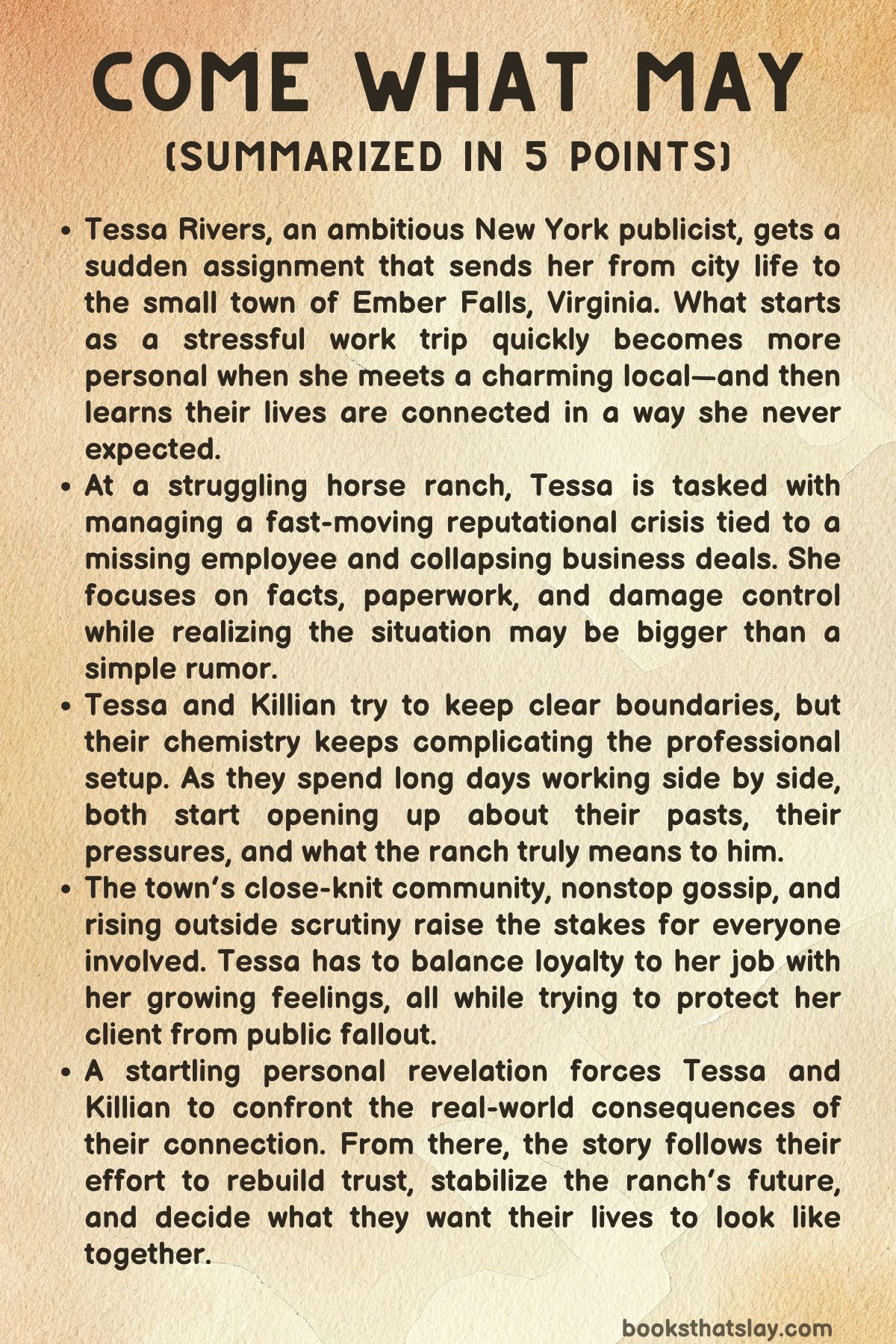
Summary
Tessa Rivers starts her morning in New York trying to talk herself into confidence, even as her life feels cramped—literally, in her small apartment, and emotionally, in the way her family’s expectations still tug at her. Her roommate Brianna, busy preparing for fashion week, jokes about Tessa’s overthinking and promises to fit her in for a haircut.
At Anchor Light Corporate, the boutique PR firm where Tessa works, she’s proud to be on a team she admires and hungry for a chance to do more than support from the sidelines.
That chance seems to appear when the office learns a major client needs emergency help in Ember Falls, Virginia. Brynlee, one of the firm’s co-owners, is technically on maternity leave but calls in because the situation is urgent.
Senior publicist Aarabelle volunteers to go immediately. Tessa offers too, hoping to be trusted with real responsibility, but Brynlee decides Tessa should stay in New York to keep things running.
Tessa hides her disappointment and helps Aarabelle prep—organizing materials, arranging travel, and finding lodging in a town with limited options.
Then everything changes in seconds. As Aarabelle heads out, a bicyclist crashes into her on the sidewalk.
Aarabelle goes down hard, suffers a concussion, and breaks her leg badly enough to require surgery. Thea, the other co-owner, calls Tessa with a new plan: Aarabelle is out, and Tessa has to get to Virginia now and take the assignment herself.
Tessa is shocked, nervous, and thrilled all at once. She rushes home, packs, flies to Virginia, rents a car, and drives hours into Ember Falls, trying to rehearse professionalism while her stomach flips with the pressure.
Her arrival is not glamorous. The only place she can secure quickly is a rented room above a cluttered antique store run by Mrs. Thornberry.
The room is musty, shabby, and uncomfortable, and the whole experience makes Tessa feel out of place. She heads to a local bar and grill for food and a moment to breathe.
There she meets Max, the bartender, and fields a stream of guilt-heavy texts from her mother back in Indiana, implying Tessa is selfish for not being closer and more available. Tessa responds carefully, but the old mix of obligation and resentment follows her even across state lines.
That night, a man in a cowboy hat sits near her and the conversation turns easy. He’s confident without being pushy, playful without prying.
He says his name is Killian, mentions Boston “sometimes,” and talks about spending more time in town because of his farm. Tessa, who hasn’t really dated in years, is thrown off by how quickly she wants him.
One drink becomes flirting, flirting becomes a choice, and she follows his truck to a large ranch and a grand farmhouse. The night ends with them in bed together, and for a few hours Tessa forgets every burden she carried into town.
Morning brings reality back fast. Killian feeds her and keeps things casual, but Tessa’s guard snaps up when she worries he might be married.
She confronts him; he insists he’s single and even offers his phone to prove it. Reassured, she stays a bit longer—until Brynlee calls with details about the crisis.
Tessa finally gets the address and contact number for her client, Mr. Thorn, who claims his business is collapsing and needs immediate damage control.
Tessa rushes to leave, and Killian asks to see her again. They agree to meet later at the bar at seven.
Still buzzing from the night before and trying to refocus, she types the client’s address into her GPS—only for the device to announce she has arrived while she’s still standing at Killian’s house. The truth lands like a punch: Killian is Mr. Thorn.
Tessa blurts out who she is, terrified she has ruined her career. Killian is stunned too; he expected Aarabelle and only then learns about the accident that sent Tessa instead.
After a tense pause, they decide the only way through is forward. Killian tells her to reset, go back to her lodging, and return ready to work.
When Tessa comes back, Killian outlines the crisis. His star trainer, Travis, vanished about a week ago.
Travis’s living space looks as if he never existed there, and since his disappearance the ranch has been bleeding business: horse sales are canceled, training contracts evaporate, and boarded horses are pulled out. Killian has also received a threatening note warning him to “get your house in order” before a damaging story breaks.
Tessa insists they can’t put out a statement until they understand what story might be coming. She starts gathering documents, asking pointed questions, and mapping out what Travis controlled.
The more she hears, the clearer it becomes that someone wants Killian panicked and publicly off-balance.
Killian offers Tessa a room in his house instead of the antique-store rental. Tessa argues it’s inappropriate given their hookup and the client relationship, and she pushes for clarity about billing and boundaries.
Killian bristles, but he also recognizes she’s trying to protect both of them. Tessa moves into the guest room anyway, telling herself the decision is practical, not personal—despite how quickly her thoughts return to the man down the hall.
They work long hours reviewing ranch operations, canceled deals, and Travis’s role. A reporter starts sniffing around, which confirms Tessa’s fear that a public accusation is forming.
One night, while researching, Tessa reads about Killian’s past: a former pro football player whose career ended with an injury, who then built a real estate investment firm with his best friend Nathaniel. She notices how little personal information is attached to his public image, and she catches herself wanting him again.
As they dig deeper, Tessa spots inconsistencies in paperwork—bills of sale with signatures that don’t match Killian’s and prices that look altered. Killian admits the signatures aren’t his.
They identify a growing stack of suspicious documents, and the situation shifts from “missing employee” to something that could become criminal. Between late-night work sessions and quiet talks outside under the stars, the attraction keeps returning, and it’s getting harder to treat as a one-time mistake.
Killian shows Tessa the ranch and the horses that matter most to him. He explains his bond with horses began through his sister Alicia.
They grew up with little money in Colorado, and a ranch owner once gave Alicia a chance to care for a horse she loved. When Alicia later developed cancer, Killian bought her a horse—Midnight—and eventually bought the ranch so she could live her dream without worrying about costs.
The ranch is not just a business; it’s tied to grief, loyalty, and a promise he made to someone he couldn’t save.
Tessa, in turn, reveals that horses once helped her survive her own painful chapter involving her father and a healing program built around equine therapy. Their shared connection to the animals creates a different kind of closeness—one rooted in honesty rather than heat.
Still, the heat is there. They keep slipping: a kiss in the kitchen after a goofy moment, another kiss after time with friends in town, and then a real date that makes the situation feel less like a secret and more like a choice.
Killian takes her to a rustic restaurant run by Auntie Marge, where the whole town seems to know they’re together before they’ve even said it out loud. After dinner, he surprises her with a drive-in-style movie setup on a barn wall, complete with snacks and blankets.
He plays Rudy, admitting it mattered to his father and still gets to him. Tessa realizes she isn’t just attracted to Killian; she’s starting to care in a way that scares her.
She texts her best friend Meredith afterward and admits she thinks she might be falling in love.
To stabilize the ranch’s reputation, Tessa helps organize a rodeo-style event to bring the community onto the property and counter the rumors. The day is a success: the stands fill, vendors show up, and potential buyers see the ranch’s strength firsthand.
A buyer named Drake makes serious offers, and Killian sells multiple horses, finally breathing again. Even Hazel, a local business owner, compliments Tessa’s competence and hints she’d hire her if Tessa ever stayed in Ember Falls.
After the rodeo, Tessa and Killian finally give in fully, crossing from tension into commitment. In the aftermath, Killian asks her to stay longer—not only to finish the work, but because he wants her there.
They trade small personal details, and then Killian drops a truth that changes everything: he has a daughter he didn’t know about until a DNA test connected them. Her name is Meredith.
Tessa’s world tilts. Meredith is her best friend—Meredith Scarpello—the person she’s been confiding in about her feelings and her sex life.
Tessa panics, disgusted by the accidental betrayal and furious with herself for not knowing. She tells Killian they can’t continue and that they have to tell Meredith the truth.
Killian, overwhelmed and defensive, suggests they don’t have to say anything because he isn’t close with Meredith. Tessa refuses.
The argument leaves both of them wrecked, and Killian walks out, later drinking too much at a bar while his friends try to keep him from spiraling alone.
Then the ranch crisis explodes into something worse. Killian is arrested and held for days, facing accusations that his farm was part of a money-laundering scheme using horse purchases and sales.
In court, a stand-in attorney explains the government’s theory: forged or questionable documents tie Killian to illegal transactions. Killian insists he’s innocent and says Travis handled much of the business activity.
Tessa shows up to support him, standing beside Meredith, both of them shaken.
The next day, everything flips again. A new confession and coordinated arrests lead the prosecutor to drop all charges against Killian.
The real scheme is exposed: Nathaniel, Killian’s long-time business partner, is the ringleader. He used real estate deals and then shifted laundering to horse sales because it drew less attention.
Travis arranged buyers and auctions, and paperwork was forged or manipulated to make Killian look responsible. Travis fled when he got scared, but later confessed and named names, which is what finally cleared Killian.
Killian walks out free, and Tessa runs to him. They hold on like people who just survived something they didn’t think they would.
At home, Killian explains the full story to Tessa, Meredith, and Jake. The truth is brutal—especially the betrayal by Nathaniel—but it also gives them a path forward.
Meredith, after processing the shock and the mess, makes a decision: she won’t block Tessa’s happiness. She tells Tessa she wants her to be with someone who values her, and she offers a careful blessing for Tessa and Killian to try.
She tells Killian much the same, making it clear she expects him to treat Tessa well. The three of them agree to keep building a relationship as adults, even if it’s awkward at first.
Tessa returns to New York to deal with work consequences. She admits to Brynlee and Thea that she crossed a professional line by becoming involved with a client, even if it started before she knew who he was.
She asks to work remotely from Ember Falls, and the firm agrees to a three-month trial with clear expectations. Killian, determined to rebuild his life without the poisoned partnership, sells his stake in the real estate business and starts planning a new purpose for the ranch: a kids’ camp and foundation connected to Tessa’s dream, giving her something lasting of her own there too.
Killian later confronts Nathaniel in prison. Nathaniel admits he got tangled with organized crime through business deals and shifted strategies when scrutiny increased.
Killian refuses reconciliation, choosing distance and a clean break.
In the months that follow, the ranch recovers. Nine months later, one of Killian’s horses qualifies for the Kentucky Derby after a strong showing in a key race, with Tessa, Meredith, and Jake there to celebrate.
At the Derby, Killian proposes to Tessa, and she says yes. Later, they marry, launch the Hope + Mane Foundation and camp, and build a shared life rooted in the place that nearly destroyed them.
When Tessa becomes pregnant, she pushes herself too hard, goes into early labor, and delivers their son Nico by C-section after complications. In the hospital, Tessa and Killian hold their baby and choose, again, the same thing they’ve chosen since Ember Falls: honesty, family, and staying in the fight together.
Characters
Tessa Rivers
Tessa Rivers is the emotional and narrative anchor of Come What May, a young woman who outwardly tries to project optimism and competence while privately carrying years of anxiety, self-doubt, and family-bred guilt. Her early attempts at mirror affirmations and her careful professionalism at Anchor Light Corporate show someone who has learned to survive by managing impressions, anticipating problems, and trying to be “useful” before anyone can accuse her of being selfish.
What makes Tessa compelling is that her ambition is sincere but tangled with fear: she wants responsibility and recognition, yet she’s terrified that one mistake will confirm every harsh thing she’s internalized about herself. Ember Falls becomes the pressure cooker that exposes both sides of her—her sharp instincts and work ethic, and her tendency to catastrophize, over-apologize, and shoulder blame that isn’t hers.
The romance intensifies that conflict because Killian represents something she wants desperately—care, stability, desire, chosen family—while also embodying professional danger and the risk of being judged. Her growth is not about becoming fearless; it’s about learning that love and success aren’t things she must earn by self-sacrifice, and that her needs can coexist with her responsibilities.
By the end, her choice to build a life in Ember Falls while maintaining her career reflects a more integrated identity: not a woman escaping her past, but one using it—especially her history with horses and healing—to build something purposeful and lasting.
Killian Thorn
Killian Thorn is introduced as controlled power and quiet charisma, a man whose presence pulls attention even when he says little. Beneath the confident exterior is someone shaped by scarcity, grief, and the burden of responsibility, and his wealth doesn’t erase the way he still thinks like someone who once had to fight for everything.
His ranch is not merely a business but a monument to love and loss—built for Alicia and anchored in the promise that she would have beauty, dignity, and freedom even while sick. That origin makes Killian’s crisis more than financial; it is existential, because the ranch collapsing feels like failing the person he built it for and failing the version of himself that believed he could protect what mattered.
The scandal forces him to confront how trust can be weaponized against him: he delegated, believed in his partner, and assumed loyalty where greed was growing. At the same time, his relationship with Tessa reveals a softer, yearning side that he’s kept disciplined for years.
His “rules” about sex, dates, and boundaries aren’t just gentlemanly habits; they’re a system of self-control designed to prevent emotional chaos. Tessa disrupts that system because she makes him want more than distraction—she makes him want a future.
When he admits he has a daughter and the fallout detonates, his instinct is to contain the damage, but his deeper arc is learning to stop hiding from complicated truths. His eventual decision to cut ties with Nathaniel, protect his ranch through transparency, and choose love openly marks his transformation from a man trying to hold everything together alone into someone willing to rebuild in partnership—emotionally, ethically, and practically.
Brianna
Brianna functions as Tessa’s early stabilizer and emotional counterweight, the roommate who notices Tessa’s spirals and refuses to let them define her day. Her teasing isn’t cruelty; it’s intimacy, a shorthand that says, “I see you, and you’re safe with me.” Brianna’s career in fashion, her confidence, and her forward momentum provide a contrast to Tessa’s stalled romantic life and heavy sense of duty, which highlights how Tessa has been living in survival mode rather than possibility.
Even though Brianna appears early, her importance lingers because she represents the version of “home” Tessa has built for herself—chosen, supportive, and rooted in friendship rather than obligation. She’s also a quiet reminder that Tessa is allowed to prioritize herself: Brianna treats self-care like haircuts and confidence like normal things, which subtly underscores how abnormal Tessa’s guilt-driven upbringing has been.
Brynlee
Brynlee is a leader whose management style mixes care with pragmatism, and her maternity leave status makes her early decision-making feel both strained and revealing. She is protective of the firm’s reputation and her staff, and the initial choice to send Aarabelle instead of Tessa shows the calculus of experience, risk, and client expectations rather than any dismissal of Tessa’s talent.
Yet Brynlee’s later reliance on Tessa—handing her the crisis under pressure—demonstrates that Brynlee recognizes Tessa’s capability even if she didn’t initially want to expose her to a high-stakes mess. What makes Brynlee significant is that she becomes the institutional voice of consequence: she represents rules, optics, and professional boundaries, and therefore becomes the measuring stick for how far Tessa has crossed lines.
At the same time, Brynlee’s willingness to support Tessa’s remote-work trial suggests she values growth over punishment, reinforcing a theme that accountability can coexist with compassion.
Thea
Thea operates as the firm’s crisis brain in motion—decisive, solution-oriented, and willing to pivot instantly when reality collapses a plan. Her call to Tessa after Aarabelle’s accident is the story’s professional turning point because it forces Tessa into a role she craved but didn’t fully believe she deserved.
Thea’s presence also reinforces what the work demands: speed, composure, and the ability to hold multiple stakes at once. She doesn’t romanticize the job or coddle Tessa; she trusts her with it, and that trust becomes a kind of initiation.
In the broader character web, Thea functions like a stern catalyst: she doesn’t drive the romance, but she drives the circumstances that make the romance impossible to ignore and impossible to treat casually.
Aarabelle
Aarabelle is positioned as the competent senior figure Tessa both admires and envies, and her immediate willingness to volunteer for the trip shows a confidence and readiness that Tessa wants for herself. Her accident is more than plot logistics; it symbolizes how quickly life can knock out the “safe” plan and force the less obvious person into the spotlight.
Aarabelle’s role also exposes Tessa’s temperament: instead of resenting her, Tessa helps her prepare thoroughly, which illustrates Tessa’s professionalism and generosity even when disappointed. After the accident, Aarabelle becomes a shadow presence over Tessa’s assignment—proof that Tessa is only there because the universe intervened, which feeds Tessa’s imposter syndrome and makes her desperate to overperform.
Mrs. Thornberry
Mrs. Thornberry provides Tessa’s first tactile experience of Ember Falls as inconvenient, cramped, and unglamorous—a place that cannot be controlled or smoothed over with New York efficiency. The shabby room above the antique store is not just uncomfortable; it becomes an external reflection of Tessa’s fear that she doesn’t belong and that this assignment will be a mess.
Mrs. Thornberry’s cluttered space and limited lodging options ground the setting in small-town constraint, which matters because Tessa’s entire arc involves moving from a world of constant striving and scarcity of emotional safety into a community that is nosy, intertwined, and ultimately supportive. Even as a minor figure, Mrs. Thornberry represents the town’s blunt practicality: there is what there is, and you adapt.
Max
Max, the bartender, serves as Tessa’s first low-stakes connection in Ember Falls, a friendly face who gives her a place to sit still when everything is spinning. His role is important because it establishes the bar as a social hub where information, gossip, and belonging circulate.
Max’s easy conversation also highlights how unfamiliar uncomplicated kindness is to Tessa; she’s so used to relationships that demand something from her—family guilt, workplace pressure—that simple friendliness feels like a relief. Through Max, the story signals that Ember Falls will watch, talk, and remember, which becomes crucial once Tessa and Killian’s entanglement begins to leak into town awareness.
Tessa’s Mother
Tessa’s mother is one of the strongest sources of psychological tension in the story, largely because her influence is conveyed through guilt-laden messages rather than physical presence. She represents a family system where love is conditional and obligation is weaponized, where a child’s independence is framed as betrayal.
The emotional potency of her character lies in how effectively she triggers Tessa’s reflexive compliance: Tessa responds politely even when it hurts, because she has been trained to manage her mother’s feelings as though they are her responsibility. This dynamic clarifies why Tessa struggles with boundaries in every sphere—work, romance, self-care—because she was taught that saying no makes her bad.
Her mother’s pressure also explains why financial security matters so intensely to Tessa; it’s not merely ambition, it’s survival, and the fear of being trapped by family need.
Nathaniel Richmond
Nathaniel is the story’s most damaging kind of antagonist: not a stranger, but a trusted partner whose betrayal is intimate, strategic, and plausibly deniable until the truth lands. As Killian’s best friend and business partner, Nathaniel occupies the position of “chosen brother,” which makes his role in the laundering scheme emotionally devastating beyond the legal threat.
He embodies the corrupting seduction of scale—bigger deals, bigger money, bigger risk—and the way proximity to organized crime can begin as compromise and end as destruction. Nathaniel’s manipulation is especially cruel because it leverages Killian’s trust and uses the ranch as both laundering vehicle and scapegoat trap, attempting to make Killian the face of a crime Killian didn’t design.
When Killian confronts him later, Nathaniel’s admissions clarify a theme the story keeps returning to: the worst betrayals are often rationalized as inevitabilities, and the survivor must choose self-respect over nostalgia.
Travis Brown
Travis is the missing piece whose absence becomes louder than presence, functioning as both mystery and mechanism. His disappearance triggers the client flight, the canceled deals, and the panic that makes the ranch vulnerable to rumor, and the later revelations show that his vanishing act was not random but tied to fear and complicity.
Travis represents the person who lives close to wrongdoing long enough that it becomes normal—until it becomes terrifying. His forged documents and involvement in the scheme make him culpable, but his eventual confession complicates him: he is not only predator but also pawn, someone who made choices and then tried to run from consequences.
Narratively, Travis is the hinge between romantic tension and true stakes; without him, Killian and Tessa might simply be a forbidden workplace romance, but with him, they are fighting a collapsing world where love must coexist with threat, investigation, and public scrutiny.
Miles
Miles is part of Killian’s social scaffolding, a friend who can joke and tease but also knows when to get serious. His significance lies in how he helps Killian reality-check his panic and shame after sleeping with Tessa, emphasizing consent while still warning him about gossip and reputational fallout.
He represents the kind of male friendship the story values: affectionate, honest, and protective without being controlling. Miles also functions as a connector—someone with access to resources like security contacts—showing that Killian is not completely alone even when he feels cornered.
Everett
Everett is the bold, loud loyalty of the friend group, the kind of person who turns support into action and action into noise the whole town can hear. His suggestion to host a rodeo is both practical and symbolic: it’s community as reputation management, proof through visibility rather than defensive statements.
Everett also embodies the way friends can see love before the lovers admit it, using humor and relentless teasing to push Killian toward honesty. Underneath the jokes, he’s a stabilizing force who believes in Killian’s integrity and refuses to let the ranch be defined by rumor.
Hazel
Hazel is the small-town heart with sharp perception, someone who reads people quickly and refuses to let them self-destruct in silence. She becomes important at multiple levels: as a business owner connected to community life, as a friend who invites Tessa into local social space, and as the person who intercepts Killian at his lowest point and prevents isolation from turning into collapse.
Hazel’s strength is in her refusal to romanticize suffering; she brings water, calls for help, and tells the truth plainly. She also functions as a mirror to Tessa’s potential future: Hazel is a woman rooted in Ember Falls, building something of her own, which makes her interest in hiring Tessa feel like more than flattery—it’s a glimpse of belonging.
Penelope
Penelope contributes to the social ecosystem that surrounds Killian and gradually absorbs Tessa, and her connections matter because they widen the world beyond the ranch crisis. Through her, the story shows the town’s interwoven relationships—how quickly news travels and how community can feel both comforting and invasive.
Penelope’s presence in the women’s group also reinforces a crucial shift for Tessa: she starts as an outsider on assignment, but becomes someone invited, included, and watched with a kind of protective curiosity.
Violet
Violet functions as part of the chorus that normalizes joy and friendship, bringing playful commentary that contrasts with the heaviness of secrets, scandal, and Tessa’s family guilt. Her role in the friend-group dynamic strengthens the theme that community in Ember Falls is participatory: people will tease you, test you, and then show up for you.
Violet’s trust in Tessa, even expressed through jokes, helps make the town feel like a place Tessa could actually live rather than merely survive.
Ainsley
Ainsley’s role is quieter but still meaningful as one more thread in the community net that catches Tessa. She helps create an environment where Tessa can be seen as a person rather than only a professional, and where the romance doesn’t exist in a vacuum but within a living social world.
That matters because the stakes around gossip and reputation are only powerful if the social world feels real, and Ainsley contributes to that realism by being part of the everyday fabric of friendships and gatherings.
Auntie Marge
Auntie Marge is a vivid embodiment of Ember Falls intimacy: she knows everyone, she has opinions, and she treats romance like a communal event. Her presence transforms Tessa’s first real date into a ritual of belonging—chair pulled out, cheek pinched, rules enforced by a woman who has probably watched half the town grow up.
Marge also reinforces a key contrast between Tessa’s past and her possible future: where Tessa’s mother uses emotional pressure to control, Marge uses nosy affection to nurture. The result is that Tessa’s experience of being “handled” shifts from guilt and obligation into warmth and care.
Meredith Scarpello
Meredith is the emotional detonator of the story’s most painful twist because she sits at the intersection of Tessa’s safest bond and her most dangerous love. As Tessa’s best friend, Meredith is the person Tessa confides in, the one who encourages her to risk happiness even if it could hurt, which makes the revelation of paternity feel like betrayal in stereo—Tessa feels she has betrayed Meredith, and also feels betrayed by reality itself.
Meredith’s character gains depth through her response: instead of turning into a simple obstacle, she processes the shock and ultimately chooses agency, refusing to control others’ lives even when she has every reason to. Her decision to give her blessing is not naïve; it is an act of emotional maturity that acknowledges complexity—her father’s flaws, Tessa’s sincerity, and her own right to define what family means.
Meredith also becomes the bridge that makes the future plausible: without her acceptance, Tessa and Killian could have love but not peace. With it, their relationship can evolve into a real family structure rather than a secret.
Jake
Jake is a supporting stabilizer in the later stages, present during the fallout and resolution as part of the tight circle around Meredith and Killian. His importance is less about plot-driving choices and more about what he represents: grounded companionship and continuity while identities are reconfigured.
As the world becomes legally and emotionally chaotic, Jake’s presence signals that not everyone is spiraling; some people simply stay, witness, and help hold the room steady while others figure out who they are to each other.
Alicia
Alicia is absent in the present timeline but powerfully alive in motivation, functioning as the story’s emotional origin point for the ranch and for Killian’s capacity to love with devotion. Her illness and dream give the ranch its sacredness; it is not just land and horses but a promise fulfilled, a refuge created to protect her joy when life was shrinking.
Alicia’s impact is also thematic: she demonstrates how horses in this story are tied to healing and identity, which later aligns with Tessa’s own equine therapy history. In that way, Alicia is a quiet connective force between the two leads, linking their values before they ever admit they share them.
Anthony DeCarolis
Anthony DeCarolis represents competence under pressure and the arrival of structured power when chaos peaks. His presence shifts the tone from rumor and panic into legal strategy and formal exoneration, and that matters because it gives Killian’s innocence institutional confirmation rather than relying only on belief and love.
He also acts as a boundary figure: unlike the town friends who respond emotionally, DeCarolis responds procedurally, ensuring Killian’s release is secured correctly and reinforcing that survival sometimes depends on expertise and systems, not just loyalty.
David Turner
David Turner serves as the stopgap voice of blunt reality at the worst moment, the person who articulates what the authorities think happened and forces Killian to confront the severity of the charges. His role is tense and pragmatic, emphasizing that innocence alone doesn’t guarantee safety when the narrative around you is already written by others.
By questioning what Killian told investigators and summarizing the government’s theory, he becomes the character who translates fear into facts, which helps the story pivot into the legal unraveling that ultimately exposes Nathaniel and clears Killian.
Themes
Reinvention Under Pressure
Tessa Rivers arrives in Ember Falls carrying the energy of someone who has spent years trying to become “more” than the version of herself her circumstances expect. In Come What May, the turning point is not a carefully planned career milestone; it is an emergency, a sudden substitution, and a town that feels too small for the scale of what she wants.
That forced relocation creates a pressure cooker where reinvention stops being motivational talk and becomes a daily, uncomfortable practice. Tessa has to perform competence immediately—represent a firm’s reputation, stabilize a client’s collapsing business, and earn credibility in an unfamiliar environment.
The cramped New York apartment and her failed mirror affirmations are not just a cute detail; they show a person whose confidence has been theoretical, private, and fragile. Ember Falls demands confidence that can survive public scrutiny and real consequences.
What makes this reinvention meaningful is how it tests both identity and capability at the same time. Tessa is not simply learning a new job assignment; she is learning what her professionalism looks like when nobody is there to buffer her, and when her decisions can influence livelihoods, community relationships, and the survival of a ranch tied to grief and legacy.
Reinvention also shows up in Killian’s arc. His life after football injury is already a reinvention—real estate success, ranch ownership, building stability from a past that included poverty and loss.
But the crisis exposes that reinvention can be threatened by other people’s choices. When his partner’s crimes turn him into a suspect, the life he built becomes something he might lose overnight.
Both characters are forced to rebuild a sense of self on new terms: Tessa as someone who can lead, not just assist; Killian as someone who must redefine trust, loyalty, and purpose after betrayal. Reinvention here is not a slogan—it is survival, and it requires uncomfortable honesty, decisive action, and the willingness to change what once felt fixed.
Professional Boundaries and the Cost of Blurred Lines
The relationship between Tessa and Killian begins before either understands the professional connection between them, which makes the boundary problem feel both accidental and unavoidable. Once the truth lands—Killian is the client—everything becomes ethically loaded.
The story keeps returning to how quickly a private choice can become a professional risk, and how reputation is not only something a publicist manages for others but also something she must protect for herself. Tessa’s immediate panic is not melodrama; it reflects how people in high-accountability jobs are trained to anticipate consequences before the world confirms them.
Her insistence on billing clarity, policies, and distance after moving into his house shows someone trying to build guardrails after the crash already happened.
What deepens this theme is that “boundaries” are not portrayed as cold rules; they are tied to dignity, safety, and self-respect. Tessa worries about being reduced to gossip, being seen as opportunistic, or being blamed for outcomes she cannot fully control.
Killian, meanwhile, worries about power imbalance and public perception, even though the initial encounter was mutual. The town’s social ecosystem amplifies everything.
Friends tease, rumors spread, and a single night becomes a narrative other people want to own. At the same time, the crisis makes emotional distance almost impossible: they work long hours, share vulnerable backstories, and rely on each other to think clearly when the ranch is bleeding money and a scandal is forming.
The cost of blurred lines becomes painfully real when the Meredith revelation happens. In one moment, what was already complicated becomes morally explosive, and Tessa’s instinct is to stop, tell the truth, and accept fallout.
That response highlights that boundaries are not just about avoiding consequences—they are about refusing to build happiness on deception. The book treats blurred lines as a high-stakes test of character: when attraction is strong and circumstances push closeness, the question becomes whether love can form without self-betrayal and without eroding professional integrity.
Family Obligation, Emotional Guilt, and Choosing a Life
Tessa’s relationship with her mother is a steady background force that explains why “supporting the family” is not just a practical concern but an emotional trap. The guilt-laden messages from Indiana show a dynamic where love is tangled with accusation: leaving is framed as abandonment, independence is treated as betrayal, and Tessa is expected to carry needs that are not hers alone.
This pressure shapes her choices in subtle ways. It adds urgency to keeping her job, heightens her fear of failure, and makes her feel responsible for outcomes beyond her control.
Even when she is succeeding—handling a client crisis, organizing events, creating strategy—there is a voice in her life insisting it is never enough, and that her primary duty is to return and serve.
Killian’s family theme runs on a parallel track, but with different emotional textures. His devotion to Alicia’s dream turns the ranch into something sacred, not merely profitable.
The ranch is his promise kept, a memorial expressed through caretaking and investment. Then Meredith enters as a surprise and flips the meaning of “family” from chosen responsibility to biological reality.
Killian learns he has a daughter he did not raise, and the truth is both gift and grief: he gains connection but also has to confront time lost and decisions made without full knowledge. The Meredith twist forces the theme into its sharpest form: family can be a source of love, but also a source of complicated loyalties that threaten romance and identity.
The resolution—Meredith giving her blessing—matters because it shows a healthier model of family: not control through guilt, but support through honesty. Ultimately, the theme argues for choosing a life rather than inheriting one.
Tessa is not rejecting family; she is redefining what devotion looks like when it includes her own happiness and future. That is why her move, her work arrangement, and the foundation/camp plan are more than plot outcomes—they represent a deliberate decision to build a life that is not governed by guilt, secrecy, or obligation alone.
Trust, Betrayal, and the Fragility of Reputation
The ranch crisis begins as a mystery about a missing trainer and canceled sales, but it quickly reveals how trust operates as currency. Killian trusted Travis to manage key business dealings.
He trusted Nathaniel as a best friend and partner. He trusted the structure he built to protect him.
When those trusts fail, the damage is immediate: clients pull out, buyers disappear, a reporter hunts for a story, and a threatening note signals that someone wants him destabilized. The story captures how reputation can collapse before facts are known.
People act on fear and rumor because waiting feels risky. For someone with a public profile—former athlete, successful businessman, ranch owner—reputation is both asset and vulnerability.
Tessa’s role as a publicist makes this theme personal rather than abstract. She is trained to anticipate narratives, yet she cannot control the truth.
Her decision not to issue a statement until they know more shows a realistic understanding that premature messaging can trap you in a lie or expose ignorance. As evidence of forged signatures appears, trust becomes forensic: they must look at documents, patterns, motives, and timelines.
The betrayal reaches its peak when law enforcement arrests Killian for alleged money laundering. Even though he insists on innocence, the world’s first response is suspicion.
The humiliation of custody, the fear of losing everything, and the shock of seeing how quickly the state can define you highlight just how fragile reputation is when institutions and headlines get involved.
The later reveal—Nathaniel as ringleader, Travis as facilitator—sharpens the emotional cost of betrayal. This is not a distant villain; it is a close relationship weaponized.
Killian’s confrontation in prison underscores that betrayal is not only about money or crime, but about being treated as expendable. Trust also has a rebuilding arc.
Tessa stays, believes him, fights for him, and refuses to let rumor become identity. That loyalty does not erase the damage, but it offers a counterpoint: trust can be broken by proximity, yet it can also be rebuilt through consistent truth-telling and action.
In the end, the theme suggests that reputation is fragile, but character is the deeper foundation—because when reputation is attacked, only character can hold long enough for truth to catch up.
Healing Through Horses, Place, and Purpose
Horses are not decorative in Come What May; they function as an emotional language that both leads and translates healing. Killian’s bond to Midnight and the ranch’s origin story in Alicia’s illness makes the ranch a living grief ritual—care, continuity, love expressed through stewardship.
The crisis threatens that healing space, turning it from refuge to battlefield. Tessa’s connection is different but complementary: her history with equine therapy is rooted in a turbulent past involving her father, where horses offered stability when human relationships did not.
That detail gives her competence and empathy that go beyond PR tactics. She is not only managing optics; she understands why the ranch matters in a bodily, emotional way.
Place is part of the healing mechanism too. New York represents ambition and constant self-measurement, while Ember Falls introduces slower rhythms, community presence, and the possibility that a person can be known as more than their job title.
The friendships around Ultimate Frisbee, the communal teasing, Auntie Marge’s knowing warmth—these are not filler scenes; they show an environment where connection is normalized. For someone like Tessa, who has been made to feel responsible for others’ needs, community becomes a different kind of support system: one that offers care without demanding self-erasure.
For Killian, place becomes the arena where he confronts loss and betrayal without running. The ranch is where he must stand and be seen, even when the story about him is ugly.
Purpose completes the healing arc. The creation of Hope + Mane Foundation and the kids’ camp is not just a romantic gesture; it is a transformation of private healing into public good.
Tessa’s dream gains a physical home, and Killian’s resources gain a mission that honors Alicia while also building something new. Healing is shown as active work: deciding what to build after crisis, choosing honesty after mistakes, and letting love turn into service rather than escape.
Even the epilogue milestones—Derby qualification, engagement, marriage, parenthood—carry the same message: healing is not a straight line, and joy does not cancel difficulty. It coexists with it, grounded in place, purpose, and the steady choice to keep building.