Conform by Ariel Sullivan Summary, Characters and Themes
Conform by Ariel Sullivan is a dystopian sci-fi story about power, control, and the cost of saying no. In a stratified city above and below the clouds, people are sorted as Elite, Minor Defects, and Major Defects, ruled by an all-seeing council called the Illum.
Emeline, a 27-year-old Minor Defect whose different-colored eyes mark her as flawed, works underground erasing humanity’s past. When she is suddenly approved to become the Mate of an Illum heir, she’s pushed into a world of glittering privilege, quiet terror, and a growing rebellion led by a mysterious figure known as the Reaper.
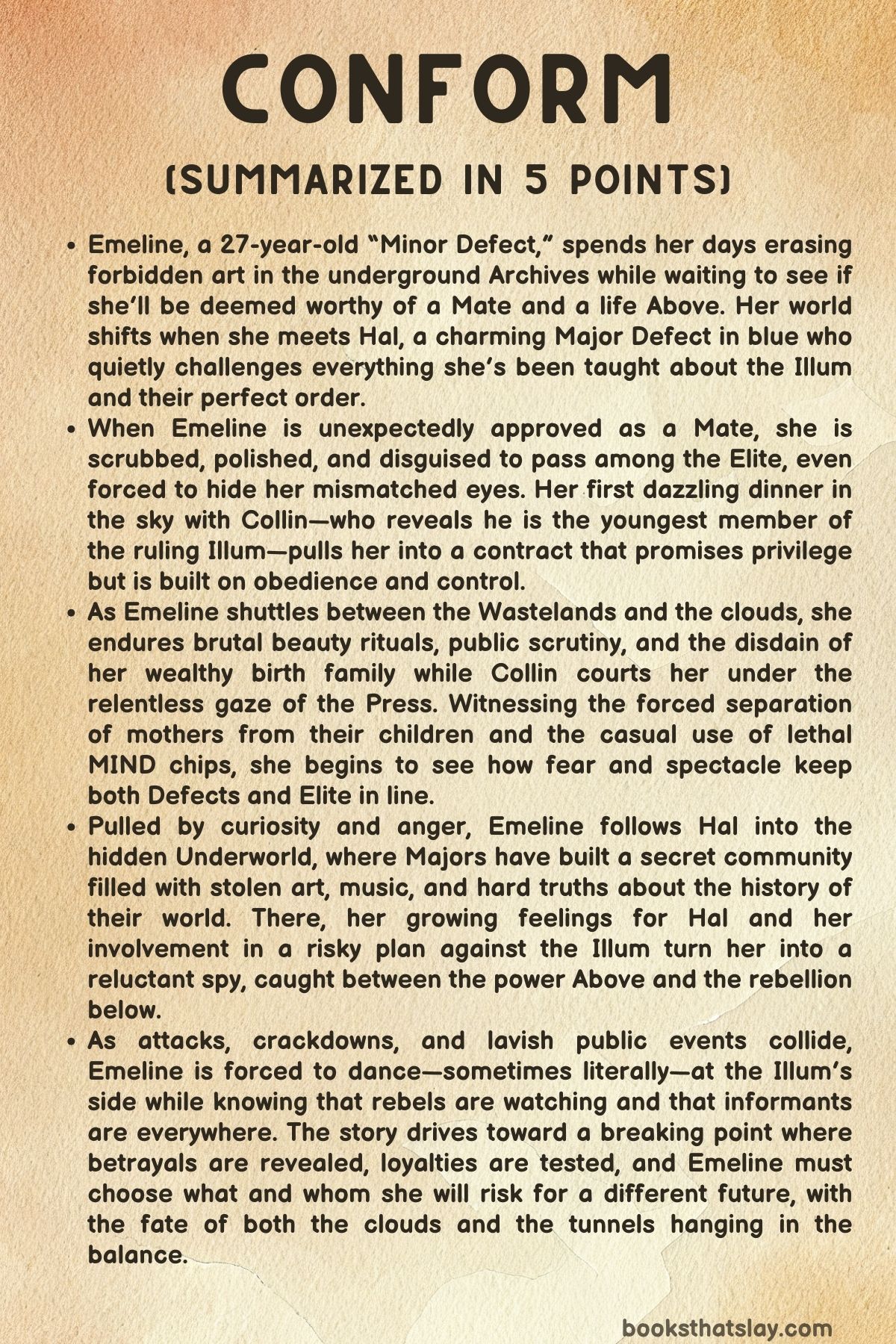
Summary
Emeline, designated F13463233, spends her days in the underground Archives deleting ancient art on the Illum’s orders. While erasing pieces like the Mona Lisa and At Eternity’s Gate, she quietly questions why images of grief, love, and protest are targeted.
One day, a Major Defect in blue, Hal, appears in her doorway. He is supposed to be dangerous, yet he is curious and kind, and he challenges her blind trust in the Illum.
Emeline is unsettled by him, but she cannot deny her fascination.
Soon after, Emeline receives the message that she has been “Approved” for procreation and assigned a Mate. Swept Above the clouds in a private Pod, she is taken to a gleaming preparation suite and turned over to Rose and Violet, the Starlings.
They scour, wax, polish, and paint her into a flawless doll, then hide her heterochromia behind a painful lens that makes both eyes brown. In a golden gown, she finally looks like an Elite, though underneath she is terrified.
Her first meeting with her Mate takes place in a cloud-top Garden restaurant overflowing with flowers. Her Mate, Collin, is handsome and surprisingly gentle.
He asks her to call him by name, encourages her to enjoy the food, and refuses to mock her defect or her past. When a sneering Elite, Edward, insults her, Collin shuts him down.
Then he reveals the biggest shock: he is not just Elite, but the youngest member of the Illum itself. He has been pressured to take a Mate and personally chose Emeline from an extensive list.
He discusses a Procreation Contract, a carefully timed Courting Phase, cohabitation, and constant scrutiny from the Press. Emeline returns Below with her head spinning and her wrist band glowing “pending.”
Back in the Wastelands, Emeline’s best friend Lo, another Minor Defect, helps her scrub off the glamour. Lo admits she has been meeting Becca, a rejected Minor sentenced to blue, hoping to learn how not to fail.
The next day, Emeline returns to work to find her desk covered in flowers from Collin. Hal is lounging in her chair with Collin’s note, teasing her.
When an official delivers the Procreation Contract, Emeline is ready to sign without reading, convinced she has no real choice. Hal grabs it, reads the harsh terms about infertility, fetal loss, and punishment, and calls her brainwashed.
Stung but desperate, Emeline signs anyway.
Days pass with no word from Collin. Emeline keeps the contact lens in until her eye is swollen and half closed.
When Hal returns, he forces her to remove it and openly admires her mismatched eyes. Together they review the art marked for destruction, and Emeline realizes anything that shows strong feeling or alternative lives is being erased.
Hal is impressed by her insight. Not long after, another message comes: her contract is approved, and she must return Above for more grooming and another meeting.
On the way through the Capitol, Emeline is jostled by color-drenched Elite forced to use ground-level entrances due to rebel attacks. She collides with a man who shares her features and realizes he is her Elite brother Phillip.
He rejects her in front of the others, who mock her exposed defect. Shaken, she retreats to the Starlings, who gossip about the growing rebellion and the Elite Force that crushes it.
Violet hints that she is tired of being powerless and suspects Emeline might feel the same, but warns such thoughts are dangerous.
Emeline is taken to Collin’s glass Sphere in the sky, where he explains more of the hierarchy and mentions Tabitha, the long-ruling Illum leader. A hologram instructor will train Emeline in Elite manners and dance so their public Courting looks flawless.
During high tea, he quietly breaks etiquette to give her dessert first, saying her needs are his. Later, he kisses her in front of the Sphere, staking a public claim.
They soon cross paths with her birth family. Her parents and brothers, once ashamed of her defect, now have to bow to her new status as Collin’s Mate.
Collin assures Emeline they will regret their cruelty.
Emeline’s training intensifies. Her MIND chip feeds supplements and etiquette lessons directly into her life.
Other Defects whisper about the gold glow on her wrist. Hal keeps visiting, calling her “Moonlight” and showing that Majors collect discarded Elite knowledge.
Emeline admits she wants to understand what is truly happening, and Hal tells her she will need to come down to the Underworld.
Before she can decide, Emeline witnesses a brutal scene outside the Sanctuary: Elite Force soldiers storm in and tear young children from their mothers’ arms. It is “the Parting,” when Sanctuary offspring are forcibly sent to the Academy.
One mother is beaten unconscious as she clings to her son. Emeline is stopped when she tries to intervene.
At her next prep session, Rose confesses she lost her own child that way. Violet again hints at rebellion.
Emeline realizes she does not just want survival; she wants power.
Collin brings Emeline to a formal Elite dinner. A projection of Tabitha praises a captured rebel sympathizer: the ground-level worker who once whistled to disperse a suspicious huddle near Emeline.
Emeline is horrified when Tabitha credits her as an ally and Collin calmly orders the man’s elimination. The toxin embedded in his MIND kills him in agony while the Elite go back to their meals.
Emeline sees that Collin’s claim that he does not believe in killing Minors was a lie or a half-truth. She tells him he chose wrong when he chose her.
Realizing the rebels must be warned, Emeline climbs down from the bridge to a hidden river entrance. A woman named Bri yanks her inside and knocks her out with a scrambling cuff.
Emeline wakes in the Underworld among Bri, Barrett, Kane, Gerald, and Hal. They argue about touching Collin’s Mate, but Hal defends her.
Emeline sees tunnels full of music and salvaged art and learns that humans once lived underground together before the current hierarchy formed. In a side tunnel, Hal gives her a knife and one cuff to disrupt her MIND if the Illum come.
When she asks if he is the Reaper, he refuses to answer directly. The tension between them breaks into a fierce kiss before he sends her back Above, promising to come for her if needed.
The rebels plan a major strike. With Gerald’s help, Emeline crawls through maintenance tunnels and attaches a modified “black hole” device to the core that powers the chips, temporarily disrupting tracking and control.
The Reaper’s forces attack a supplement building; when the grid starts to reboot, Emeline is rushed back to safety. From Above she sees the ground level in flames, horrified at the scale of destruction and unsure whether she enabled it.
Collin, returning soot-streaked in Elite Force armor, pulls Emeline from a bathtub where she is drifting toward unconsciousness, crushed by guilt over Hal and the ruined streets. He admits he still fights for the Illum on the ground.
They talk about how close they are to open war. He asks her to stay the night.
Numb, she agrees.
Soon a grand ball is announced. Emeline is dressed in a sheer, crystal gown that makes her feel exposed.
Rose quietly begs her not to betray them, revealing she loves Violet and that freedom without her would be meaningless. At the ball, Nora hints that the Reaper might not be the man everyone assumes but could easily be a woman tired of being a vessel.
On the dance floor, Emeline is rotated through partners. Collin accuses her of being a spy whose very life depends on that role.
Gregory urges her to find him later when she confesses she has messed up. Collin draws her close and warns there is no way out.
Chaos erupts when Elite Force soldiers drag in one of their own. The helmet comes off.
It is Hal. From a balcony above the ballroom, Emeline is forced to stand beside Collin and the Illum as Tabitha announces that the Reaper has been captured.
She publicly credits Emeline’s loyalty and Collin’s leadership, promotes Emeline to full Elite status, and declares that Hal’s eventual execution will be thanks to Emeline. Hal is beaten and cuffed, his wrist forcibly re-chipped, and dragged away, his gaze fixed on her.
In a Pod to the Capitol, Collin demands to know the truth about her connection to the Reaper. Emeline throws his own complicity in his face.
At the Capitol, Tabitha, spattered in blood, reports that some rebels escaped but that children have been seized through the secret entrance Emeline discovered. She praises another, unnamed informant who first revealed the Reaper’s identity.
Collin is sent away to arrange Emeline’s move into his quarters. Tabitha leads Emeline alone into an ornate tearoom.
There, amid Emeline’s favorite tea and gold-dusted chocolates, Tabitha calmly explains that Emeline has been a test all along. She was scheduled for termination once her chip was removed, but the Reaper begged for her life.
That emotional reaction convinced Tabitha that a woman had disrupted the rebellion. Now Tabitha plans a cruel game: to see whether Emeline or the Reaper loves more.
If Emeline betrays the Illum, Hal dies. If she serves the Illum but tries to help the rebels, he dies.
Emeline is to become the perfect symbol and tool.
Tabitha lays out the Illum’s philosophy using a chocolate pyramid: those at the bottom hold up the top, and balance is maintained by mixing fear with carefully rationed hope. Emeline, a visible Defect raised to the clouds, gives hope to Minors and a warning to Elite that they are replaceable.
Tabitha adds another cut: Lo has secretly been feeding the Illum information in exchange for advancement and cohabitation rights, betraying Emeline without realizing the full consequences. Meanwhile, while the ball provided distraction, Elite Force units raided the ground level to seize hidden offspring.
The children will be indoctrinated and used as hostages against Majors and Defects.
As Emeline’s head swims, she realizes the tea is drugged. Tabitha calls her by her old designation, F13463233, and notes that real free will is her deepest defect.
She drags Emeline down by the hair, promising to break both her and the Reaper. Emeline collapses into darkness, dimly hearing voices say they have her and that it will be okay, though she no longer believes anything can be.
In the epilogue, Hal sits in a stone cell with his wrists cuffed. From his thoughts we learn he truly is the Reaper.
Emeline was supposed to be a tool, but watching her courage and pain split something inside him. Even as he prepares for torture, he takes comfort in what they achieved: the grid has been subtly altered, supplements redirected to those in need, and there are still loyal agents in the clouds the Illum have not detected.
This is not a minor uprising but the opening act of a revolution meant to shatter the system completely. When footsteps approach and a woman addresses him as Reaper, asking if he is ready to talk, he lets the mask of rebellion cover his feelings.
Whatever comes next, he chooses to face it as the Reaper, burying the man who loves Emeline deep inside.
Characters
Emeline
Emeline is the emotional and moral center of Conform, a character pulled between obedience and defiance, love and manipulation, survival and conscience. Branded a “Minor Defect” and reduced to F13463233, she begins the story as someone who has internalized the Illum’s dehumanizing language about herself; she calls herself a “vessel” and assumes she has no real choices.
Her heterochromia is both literal mark and metaphor: she is born to see more than one side of things, and the Illum’s entire system depends on people never doing that. Her job in the Archives, deleting art from the old world, is another symbol of how she has been weaponized against her own humanity.
Even before she consciously rebels, she lingers over paintings like the Mona Lisa and At Eternity’s Gate, drawn to ambiguity, emotion, and mystery. That quiet attraction to feeling and history is the first crack in her conditioning.
Across the story, Emeline’s arc is about awakening to the reality that she is not just a defective cog but a powerful fulcrum. Initially, she accepts the Procreation Contract with Collin almost blindly, convinced a Minor Defect has no choice except compliance or elimination.
Hal’s anger over the contract and his insistence that she has been brainwashed do not instantly convert her, but they seed doubt. Every encounter that follows tugs at a different fault line in her worldview: watching children ripped from their mothers in the Parting, seeing how the Elite treat her as both fascination and contamination, learning that her own parents discarded her, and discovering that rebellion exists in the tunnels beneath.
Each experience intensifies a deep sense of outrage that she struggles to reconcile with her need to stay alive.
Emeline’s relationships complicate her journey. Collin offers her safety, status, and moments of genuine tenderness, yet he also participates in violence and manipulation, and she must constantly question which version of him is real.
Hal sees the humanity and beauty in the very trait she was taught to hate, and their connection gives her a vision of a different kind of life, one built on freedom rather than permission. Lo represents friendship and shared vulnerability among Defects, which makes Lo’s later betrayal especially devastating.
Through all of this, Emeline’s defining trait is not perfection but contradiction: she makes compromises, freezes in moments of horror, and only gradually assumes active agency, such as when she goes to the Underworld, helps sabotage the grid, and chooses to risk everything to warn others. By the time Tabitha drugs her, Emeline has become exactly what the Illum both feared and needed her to be: a woman who refuses to fully belong to any side, whose free will cannot be permanently erased, and whose love and guilt make her both dangerous and manipulable.
Hal / The Reaper
Hal operates on two intertwined levels: as the charming, blue-clad Major Defect who teases Emeline in the Archives, and as the Reaper, a revolutionary leader determined to dismantle the Illum’s entire system. As Hal, he is playful, irreverent, and disarming.
He appears where he should not be, speaks to a Minor like an equal, and calls her “Moonlight,” a nickname that reframes her difference as something luminous rather than shameful. His attraction to Emeline begins as curiosity about a Defect who thinks about art and emotion, but it evolves into a bond that breaks his own rules.
Even before his identity is confirmed, his behavior reveals a man who refuses to accept the hierarchy as natural or inevitable.
As the Reaper, Hal is strategic, secretive, and willing to embrace morally gray tactics in pursuit of a revolution. He orchestrates attacks that risk civilian lives, redirects supplements to the oppressed, and plants agents in the clouds.
To many, he is a mythic figure, a symbol of terror and hope. The tension between Hal the man and the Reaper the symbol explodes once he becomes emotionally entangled with Emeline.
He breaks his own operating procedures: staying behind during the attack to protect her, revealing parts of his world in the Underworld, and allowing her close enough to kiss him. These choices make him vulnerable, and Tabitha later exploits that vulnerability, confirming that his love for Emeline derailed elements of his plan.
Hal’s final perspective in the epilogue shows the core of his character. Even captured, bleeding, and facing torture, he chooses to reassert the Reaper persona, burying his love for Emeline because he believes the larger cause matters more than his happiness or even his life.
His calm acceptance of what is coming, combined with the knowledge that he has already turned the grid into a weapon and rerouted resources, positions him as a long-game strategist. Hal’s dual identity mirrors Emeline’s own duality: both are torn between intimate feeling and systemic struggle, and both are used by the Illum even as they try to undo that control.
Ultimately, Hal embodies the painful cost of resistance, showing that revolution is not abstract but deeply personal, rooted in love, grief, and sacrifice.
Collin
Collin is one of the most morally ambiguous figures in Conform, moving constantly between protector and oppressor. Introduced as Emeline’s proposed Mate, he appears at first as the dream version of an Elite partner: handsome, attentive, self-deprecating, and unusually kind to a Minor Defect.
He challenges her internalized self-hatred, defends her publicly against men like Edward, and quietly breaks etiquette to let her eat dessert first. These gestures build a sense of intimacy and suggest he is different from the others, an ally within the system.
His revelation that he is Illum rather than Elite complicates this image further. He claims to have been pressured into taking a Mate and implies he will use his power to shield her from tests and rejection.
Yet Collin is still a loyal instrument of Illum control. He negotiates contracts that tie Emeline’s body and future to reproductive performance, commands the lethal activation of an alleged sympathizer’s MIND, and remains deeply enmeshed in the surveillance and punishment mechanisms of the regime.
His previous claim that he does not believe in killing Minors is exposed as either a lie or a self-delusion when he calmly orders a man’s elimination and then tries to patch things over with apologies. Collin often presents himself as trapped too, a man who “wishes for a way out” and feels used by the Illum, but he rarely refuses their orders.
This tension makes him both tragic and infuriating: he understands the cruelty of the system yet continues to serve it.
Collin’s relationship with Emeline is therefore built on a foundation of contradiction. He genuinely cares for her in moments, shielding her from stares, adjusting her gown, kissing her with visible emotion, and reacting with shock when she agrees to stay the night.
But he also expects obedience, tells her that her rule-breaking ends now, and insists her life exists because of her role as a spy in service of Illum goals. At the ball, he orders her to maintain her performance even as Hal is dragged away in chains, prioritizing optics over her anguish.
Collin embodies the seductive face of power: the man who offers comfort and love while reinforcing a structure that constantly threatens those same things. He is both victim and perpetrator, a product of Illum conditioning who chooses complicity more often than resistance.
Lo (Lola)
Lo begins as Emeline’s closest friend and confidante among the Minors, a lively counterpart who provides emotional support, practical contraband, and a sense of shared struggle. She brushes and braids Emeline’s hair, sneaks her stimulant drinks from Major contacts, and jokes about Becca’s warnings even as she quietly fears becoming like her.
Lo’s personal trauma, particularly the revelation that she has been parted from her own offspring, adds depth to her initially light, chatty demeanor. She has already endured one of the most brutal aspects of Illum control and prefers not to revisit it, which explains both her hunger for any upward mobility and her reluctance to confront the system head-on.
Her relationship with Emeline is built on intimacy and envy in equal measure. Lo shares in Emeline’s excitement and fear about mating, encourages her to see Collin’s interest as a possible route to better treatment for all Defects, and later appears radiant in the clouds, dancing with Gregory as if she has finally escaped the gray sameness below.
But the revelation that Lo has been feeding information to the Illum in exchange for favors and advancement reframes her entire arc. She has not simply been passive; she has actively traded secrets and loyalty for the chance to live Above and secure cohabitation rights.
To Emeline, this feels like a deep betrayal, especially since Lo’s rise is built partly on Emeline’s own struggles and vulnerabilities.
Lo represents a very human kind of survival strategy: adapting to the rules, playing the system, and accepting morally compromised bargains when the alternative seems like unending suffering. Unlike Hal’s open rebellion or Emeline’s evolving defiance, Lo chooses collaboration wrapped in the language of opportunity and necessity.
Her complicity underscores one of the book’s central themes: that oppressive systems do not endure solely through brute force, but through the small, desperate choices of people who have been hurt enough to accept almost any bargain for a slightly safer life.
Tabitha
Tabitha, the Illum leader, is the architect and embodiment of systemic control in Conform. She appears first as a distant holographic presence, delivering polished speeches to Elites and presenting executions and punishments as necessary steps for stability.
Over time, her true nature emerges: she is coldly intelligent, ruthlessly pragmatic, and genuinely fascinated by human psychology. Tabitha does not simply enforce rules; she designs elaborate tests and roles to manipulate everyone beneath her, from Elites to Majors to Minors.
Emeline’s entire journey from Archives worker to public symbol turns out to be one such experiment.
Her conversation with Emeline in the tearoom reveals how deeply she understands people and power. Using something as simple as a chocolate pyramid, she explains the hierarchy and how fear alone is insufficient; people must also be fed hope to keep them compliant.
Emeline’s rise as a visibly defective success story is part of that strategy, a carefully crafted narrative to make Minors believe upward mobility is possible and to remind Elites they are replaceable. Tabitha’s delight in the emotional and moral conflicts she has engineered, particularly between Emeline and Hal, shows that she views human attachment as a set of levers to be pulled rather than something sacred.
Tabitha’s cruelty is intimate as well as systemic. She drugging Emeline’s tea, yanking her head back by her hair, and describing how she “persuaded” Hal with bloodshed are personal acts of domination.
She relishes revealing that Emeline’s supposed free will has been studied for years, that every failed obedience test at the Academy made her more intriguing, not more disposable. By framing the coming struggle as a game to see who loves more, the Reaper or Emeline, she turns their deepest feelings into entertainment and strategy.
Tabitha’s power lies in her ability to make rebellion itself part of her design, forcing her opponents to fight on a board she controls. She is the clearest personification of a regime that weaponizes love, hope, and even individuality to sustain its own rule.
Nora
Nora occupies a liminal space between privilege and exploitation, loyalty and doubt. As Collin’s long-term assistant and a woman who has spent her entire adult life under contracts, she is both more experienced than Emeline and deeply wounded by the system.
She has three offspring and was first Mated at seventeen, a fact that horrifies Emeline and exposes how early the Illum begins using women’s bodies as resources. Nora presents herself as a supportive older sister figure, greeting Emeline warmly, offering friendship, sharing candid details about contracts, and later comforting her after the dinner where a man is executed at their feet.
Nora’s emotional world is shaped by her love for Gregory and her fierce devotion to her daughter, Arabella. Her affair with Gregory is a dangerous act of rebellion against the rigid rules governing Elite relationships, and she knows that if the Illum chooses to punish her, Arabella will suffer.
This fear drives her heartbreaking decision to pull away from Gregory, even though the connection between them is clearly mutual and intense. Her sacrifice highlights a theme that runs throughout Conform: those with the least direct power often shoulder the most painful ethical choices.
Over time, Nora’s conversations with Emeline reveal a complicated stance toward the Reaper and the Illum. She criticizes rebellion that sacrifices civilians, yet admits that evil grows when no one confronts it and suggests that the Reaper sometimes has the right idea.
Her observation that the Reaper could just as easily be a woman hints at a broader understanding of resistance than the propaganda allows. Nora is not a revolutionary in the tunnels, but she is also not a mindless supporter of Illum power.
She lives in the gray zone where most people under authoritarian control actually exist: trying to protect the few they love, making compromises, doubting in private, and occasionally letting slip a truth that could get them killed.
Gregory
Gregory is at once an Elite rule-breaker, a romantic figure, and a tragic example of how even those near the top of the pyramid are constrained. Initially, he appears at a distance, an Elite man whose fate is used as a warning sign when he is forced to wear dark blue as a public humiliation.
His association with Emeline, Nora, and later Lo reveals a man who moves between worlds more fluidly than most Elite, but who pays a steep price for it. Gregory’s anger when Phillip mentions Nora’s offspring shows that his feelings for her are deep and possessive, yet he ultimately respects Nora’s decision to end things to protect her daughter.
Despite his cynicism, Gregory is not entirely hardened. When Emeline panics at the ball and confesses that she has “messed up,” he does not betray her; he tells her to find him after the dance, signaling that he is willing to help even though he does not fully understand what she has done.
His advice to Emeline to care about no one is both defensive and self-revealing. He has clearly tried to adopt that philosophy himself, but his overwhelming, unnameable love for Nora undermines it.
Gregory’s connection with Lo at the ball and Lo’s earlier messages about him as a potential Mate suggest he is drawn to women who exist near the edges of the hierarchy, women who remind him of what the system suppresses.
Gregory symbolizes the cost of partial privilege. As an Elite, he has more freedom and comfort than Minors and Majors, but his relationships and emotions are still heavily policed.
The Illum uses his wardrobe and public placement as tools for intimidation, turning him into a living warning to others. His inability to fully protect Nora or Emeline, and his resignation to the rules even as he breaks them in private, underscore how incomplete Elite power really is in a world where the Illum holds ultimate authority.
Rose and Violet
Rose and Violet, the Starlings, represent both complicity and quiet resistance from within the aesthetics of power. They are tasked with transforming women like Emeline into acceptable public companions for Elite and Illum men, using painful scrubbing, waxing, makeup, and luxurious gowns to smooth away visible “defects.” At first, they seem like shallow, sharp-tongued dressers whose focus is on appearances, arguing over colors and styles while ignoring Emeline’s discomfort.
However, as the story unfolds, richer layers emerge.
Violet in particular reveals a consciousness of injustice. She mentions that visual defects like Emeline’s have been bred out, speaks disillusionedly about being powerless, and hints at rebellion more than once.
Her tone suggests she has weighed the risks of open resistance and found them terrifying, yet cannot entirely silence her own questions. Rose’s pain runs along a different vein.
She has lost a child to the Parting, and the memory of never seeing that offspring again haunts her. The fact that she continues to prepare other women to play their roles in the same system that took her child shows how survival sometimes requires people to participate in their own oppression.
Their love for each other is the most tender aspect of their characterization. When Rose begs Emeline not to betray them and confesses that freedom is meaningless without Violet, the stakes of their quiet subversion become clear.
They might not be planting bombs or hacking grids, but they are risking their lives simply by caring about each other and entertaining thoughts of rebellion. Rose and Violet illuminate how gendered labor in Conform is weaponized: women are enlisted to polish and present other women in ways that serve male and Illum power, yet even within this role, scraps of solidarity, grief, and resistance survive.
Gerald
Gerald is a quiet but pivotal figure in the rebellion’s technical backbone. He appears as a somewhat anxious, rule-aware presence, but his actions reveal deep commitment to the Reaper’s cause.
When Emeline and Gerald race through the tunnels to deploy the modified black cube, he becomes her guide, giving precise instructions, trusting her with a dangerous task, and activating the device that temporarily drops the grid. His careful planning and engineering skills are essential to creating the window of opportunity the rebels need.
Gerald’s loyalty is nuanced. He respects the Reaper’s authority but is willing to adjust plans, as shown when he modifies the black hole to interfere more extensively with tracking.
His willingness to leave Emeline alone in a dangerous chute while he monitors the operation suggests a pragmatic streak: he balances concern with trust in her resilience. When someone approaches afterward, he hides, letting Emeline step forward, another small sign that he understands the politics of who can be seen where.
Gerald personifies the countless people in a resistance movement who are not at the center of legends but make victory possible. He does not have Hal’s charisma or Emeline’s symbolic status, yet without him, the grid sabotage and resource reallocation would likely fail.
His belief in the cause, combined with his behind-the-scenes competence, highlights how revolutions depend on both visible heroes and unseen technicians.
Bri, Barrett, and Kane
Bri, Barrett, and Kane represent the hardened, suspicious edge of the Underworld movement. When Emeline first reaches the hidden opening, Bri immediately knocks her out and later handcuffs her with devices that scramble her MIND.
This aggression reflects both the danger of their world and their fear of infiltration. Bri is not impressed by Emeline’s Elite connections or her suffering; she sees only risk in associating with Collin’s Mate.
Her willingness to defy the Reaper’s order not to touch Emeline shows a fierce independence and a strong instinct for security.
Barrett and Kane add to the sense of a contentious but committed rebel cell. They argue about whether it was wise to bring Emeline in, worry about breaking orders, and constantly weigh the danger of Illum retaliation.
Kane’s interruption of Emeline and Hal’s intimate moment underscores his focus on priorities: they cannot afford distractions when her MIND could reactivate at any moment and expose them. Collectively, these three show that rebellion is not romantic unity but a mess of conflicting personalities, suspicion, and calculated risks.
Their interactions with Emeline also expand the reader’s sense of the Underworld as a community. It is not just Hal’s personal playground; it is a network of people with their own histories, relationships, and stakes.
Bri’s toughness, Barrett’s partial absence during critical moments, and Kane’s watchfulness suggest a group constantly on the edge of disaster, holding together through shared purpose rather than trust alone.
Becca
Becca is a haunting warning of what happens when the system rejects a Defect. Cast down to blue after being rejected as a Mate, she becomes a shadow presence in Lo’s stories, someone who lurks near the river and trades contraband stimulants.
To the Minors, she is both resource and cautionary tale. Lo secretly meets her to gather information about what went wrong in Becca’s contract, hoping to avoid the same fate.
This dynamic underscores how knowledge is weaponized in Conform; those at the bottom must seek out discarded individuals like Becca to learn what the official curriculum omits.
Although Becca never steps fully into the narrative foreground, her existence shapes Lo’s and Emeline’s fears. Lo’s anxiety that Emeline might already have ended up like Becca when she oversleeps shows how swiftly a woman’s status can change from potential Mate to discarded Major.
Becca thus personifies the limbo between life and elimination, someone who survived rejection but now lives with permanent stigma and diminished options. She is a glimpse of the life Emeline and Lo dread but cannot entirely escape, emphasizing the fragility of their positions.
Edward
Edward is a grotesque caricature of Elite entitlement and cruelty, serving as a foil to both Collin and Gregory. At Emeline and Collin’s first dinner, he openly leers at her, mocks Collin for taking a Defect as a Mate, and treats her presence as a perverse curiosity.
His vulgarity exposes how many Elite view Minors: as exotic toys or status symbols rather than full people. Collin’s public humiliation of him is a key moment in which Collin appears heroic, but it also reveals that men like Edward only respect power above them, not humanity.
At later gatherings, Edward continues to embody the worst instincts of his class. His toast to their “peculiar mating” at the formal dinner is not only an insult to Emeline but a challenge to Illum authority, cloaked as social wit.
His existence shows that even within a heavily controlled environment, prejudice and cruelty flourish when they serve the hierarchy’s interests. Edward is a reminder that the Illum’s rigid structure does not eliminate bigotry; it weaponizes it.
Vincent
Vincent is a subtler symbol of opportunistic betrayal. He approaches Emeline at the ball with smug hints about having provided valuable information to the Illum, positioning himself as someone who trades secrets for favor.
Although his specific actions are not fully detailed, his self-satisfaction and timing suggest he may have helped expose elements of the rebellion or the Reaper’s network. Vincent is not driven by ideology so much as self-interest, aligning himself with whichever side offers the best personal advantage.
His presence reinforces the idea that the Illum’s power rests not only on fear but on a steady supply of informants willing to sell out others for status. Vincent reflects Lo’s path in a more polished, Elite form: both choose collaboration, but where Lo’s actions are rooted in trauma and survival, Vincent’s seem rooted in ambition and vanity.
He is one of many who ensure that resistance is always fighting not just the Illum, but also the people who benefit from currying their favor.
William
William is a minor but telling figure in the Elite social ecosystem. During the ball, he refers to Emeline as the Illum’s sparkling jewel while they dance, framing her less as a person and more as an ornament of the regime.
His compliment is simultaneously flattering and dehumanizing, mirroring how the Illum has constructed Emeline’s public persona. William’s comment underscores how thoroughly propaganda has penetrated Elite thinking; they repeat the Illum’s narratives without questioning what those narratives cost the people involved.
He also serves as a contrast to characters like Gregory and Nora, who see and struggle with the system’s cruelty. William seems content to drift along within the roles assigned to him, accepting Emeline’s transformation as proof that the Illum’s world is orderly, just, and perhaps even benevolent.
His casual words thus highlight how everyday complicity helps sustain oppressive structures.
Rajesh
Rajesh appears briefly as an object of Violet’s concern after the tunnel attack and fire. Violet’s anxious questions about his fate hint that he is either a loved one or a close ally among the rebels or ground-level workers.
Though the narrative provides few details, his mention deepens Violet’s characterization, showing that she has personal stakes in the unrest beyond abstract ideals. Rajesh becomes a symbol of all the unnamed individuals whose lives hang in the balance whenever the Illum and the Reaper clash.
His existence also reminds the reader that the cost of both Illum violence and rebellion is borne by many people we never see. For every Hal or Emeline with a central role, there are figures like Rajesh whose losses are felt in quiet, private grief.
Including him in Violet’s worries underscores that the world of Conform is crowded with stories that could be told but are not, emphasizing the scale of the conflict.
Themes
Power, Control, and Authoritarian Rule
From the opening pages of Conform, power is not just a social structure but a total environment that shapes bodies, memories, and even thoughts. The Illum sit at the apex of a rigid hierarchy, but their true dominance comes from how completely they orchestrate every layer beneath them.
Emeline’s entire life has been curated by this system: she is numbered, classified as a Minor Defect, confined to the Archives, and given a job that literally erases the past. The control is at once physical and psychological.
The MIND chip in every citizen’s wrist tracks movement, regulates nutrition, and carries built-in toxins that can be triggered without warning, as seen in the horrifying elimination of the supposed sympathizer at the Elite dinner. Collin’s quiet reveal that all MINDs contain hemotoxins turns each body into a potential execution site, a reminder that the Illum’s power is absolute and ever-present.
Tabitha’s rule exemplifies the cold logic of this regime: she treats lives as pieces in a strategic game, using Emeline as a test case to refine methods of control over both Elite and Defects. Even rebellion is anticipated and folded into this apparatus; the Reaper’s actions and the Underworld’s resistance are met with sophisticated countermeasures like maps of tunnel weaknesses and coordinated raids on children.
Surveillance, public trials, mandatory balls, engineered “hope” in the form of upward mobility, and the weaponization of love all feed into a system that maintains obedience not just through fear, but through the careful manipulation of desire, status, and narrative.
Identity, Defectiveness, and Self-Worth
Identity in Conform is imposed before it is discovered. Emeline’s sense of self begins as a label—Minor Defect F13463233—long before she claims her own name.
Her heterochromia, a simple physical variation, becomes the core justification for her dehumanization, shaping how she is treated by family, society, and even herself. The Starlings’ clinical inspection of her body, calling her eye a “visual defect” and immediately masking it with a lens, crystallizes a world where any deviation from an engineered norm is grounds for exclusion.
Emeline’s journey is, in part, a battle between the identity assigned to her and the person she slowly sees in the mirror without the lens. Hal’s reaction to her mismatched eyes—seeing them as beautiful rather than defective—offers a counter-narrative, challenging the internalized contempt planted by her parents and the Academy.
Yet the hierarchy’s categories are not just about physical traits; Collin’s comment that he is neither Elite nor Defect but Illum reveals another layer of identity built on power and responsibility. Gregory’s fall to blue and Nora’s life as a perpetual contract-bearer show how quickly one’s status can be altered by the Illum’s decisions, underscoring that identity here is conditional, revocable, and transactional.
Emeline’s shift from being called by her number to being addressed by name by an Elite functionary, then being elevated as a symbol of “Defective success,” shows how the regime rebrands individuals when it is convenient. Her struggle to believe she is more than a vessel, more than a defect, runs parallel to her realization that the labels she has accepted are tools of control rather than truth.
Bodily Autonomy, Reproduction, and the Politics of the Body
The human body in Conform is state property long before it can be considered personal. Emeline’s approval status, displayed as a single word—“Approved”—signals that her value lies primarily in her fertility and breeding potential.
Her procreation contract with Collin is framed as an opportunity, but every clause and condition exposes how little autonomy she actually has. Hal’s outraged reading of the contract, calling out the brutal terms around infertility and fetal loss, reveals that the cost of “failure” is borne almost entirely by the Minor Mate, not the Illum partner.
Nora’s life story makes this system even more chilling: Mated at seventeen, three offspring already, her body has been used as a biological resource for years under the guise of duty and honor. The Parting at the Sanctuary—where children are ripped from their mothers’ arms and transported to the Academy—shows how reproductive control extends beyond conception and pregnancy into the severing of maternal bonds.
When Emeline witnesses a woman beaten unconscious for holding onto her son, the message is unmistakable: the state decides not only who may reproduce, but also when love must end. Fertility supplements, the hologram Frida’s constant adjustments to Emeline’s body chemistry, and the obsession with timing cycles underline how reproduction is a monitored project rather than an intimate choice.
Even the gowns emphasize the body as display and commodity, exposing Emeline’s form while highlighting the glowing shackle on her wrist. The Illum’s policies convert motherhood into a tool of governance and transform both male and female bodies into sites where obedience is inscribed, measured, and enforced.
Memory, Art, and Historical Erasure
The opening setting of Conform in the Ancient Art Archives establishes memory as contested territory. Emeline’s task is not neutral curation; it is active deletion of humanity’s cultural heritage.
As she studies the Mona Lisa and At Eternity’s Gate, she is drawn to their emotional depth, sensing something vital in the expressions that she is instructed to erase. These works offer a glimpse of a world where sorrow, mystery, and individuality were allowed to exist openly.
The Illum’s decision to destroy art that depicts people and strong emotion fits Emeline’s growing theory: if citizens are never exposed to images of grief, love, rebellion, or tenderness, they will not imagine alternative ways of living. The contrast between the sterile, holographic art she is allowed to see briefly and the living, salvaged pieces in the Underworld drives this point home.
Underground, paintings and music are preserved as acts of resistance; they keep alive the memory that people once had agency, complexity, and unsanctioned feelings. The fact that Major Defects like Hal can read foreign titles and gather knowledge from discarded Elite goods shows a secondary layer of memory existing in secret, beyond the Illum’s curated history.
Erasing art becomes a way to erase questions, and Emeline’s growing discomfort with each deletion mirrors her awakening to the violence of historical omission. By the time she realizes that entire narratives—about the Last War, about how people were forced underground, about the rise of the Illum—have been replaced by sanitized Academy lectures, the stakes of her job become clear.
What she destroys is not just beauty; it is the evidence that life could be different, that pain and joy have meaning beyond productivity and obedience.
Surveillance, Technology, and Free Will
Technology in Conform is designed less as a convenience and more as a leash. The MIND chip is the central symbol of this: a device that tracks location, delivers tailored nutrients, monitors health, stores travel orders, and, at a moment’s notice, can execute its host.
Emeline’s daily life is scheduled and evaluated by automated reports from the MIND, turning her existence into a string of metrics. The Pods that transport her are likewise instruments of surveillance; when she steps into one, voices announce her status, clear other passengers, and redirect her automatically, emphasizing that she cannot move through the city unseen or unclassified.
The hemotoxin built into each chip strips any illusion of free will: even an act of rebellion at the Elite dinner ends not with a messy struggle but with a triggered internal poison. Hal’s eventual capture includes forcible re-chipping, demonstrating how the Illum reassert control physically when it is threatened.
Against this machinery, Gerald’s modified “black holes” and the rebellion’s grid interference show another side of technology: tools that disrupt tracking, create blind spots in surveillance, and momentarily restore anonymity. Emeline’s chipped and unchipped states mark two different modes of existence: one in which she is constantly legible to the system, and another where danger and freedom exist in equal measure.
Frida, the holographic instructor, extends surveillance into the domestic sphere, reading Emeline’s health data live, adjusting supplements, and pushing etiquette lessons that equate polished manners with non-defective minds. Even the drugged tea Tabitha serves is a blend of biochemical control and psychological manipulation.
Free will becomes not a natural condition but a rare and fragile possibility that must be carved out from under a network designed to anticipate, read, and override human choice.
Love, Attachment, and Betrayal
Relationships in Conform are never purely personal; they are always entangled with power, duty, and survival. Emeline’s connections with Collin and Hal form the emotional core of the story, but each bond is shaped by betrayal and conflicting loyalties.
Collin’s initial kindness at the Garden—his concern for her comfort, his refusal to reject her, his willingness to bend etiquette for her—makes him appear like a safe harbor in a brutal world. He sends flowers, deflects insults, and publicly claims her as his Mate, even humiliating Edward to defend her dignity.
Yet this tenderness coexists with his deep entrenchment in Illum power: he orders an execution without hesitation, participates in Elite Force operations, and allows Emeline to be used as a spy and symbol. When he tells her he often wishes for a way out, the confession is complicated by the fact that he continues to enforce the very system he regrets.
Hal, by contrast, begins as a dangerous unknown—a Major Defect in blue who teases and provokes—but gradually becomes a confidant, a mirror, and finally a lover. His admiration for her true eyes, his willingness to challenge her indoctrination, and his risk-filled kiss in the Underworld offer a love rooted in recognition rather than elevation.
Yet even that bond is marred by secrecy; Hal withholds the full truth of his role as the Reaper, and his attack on the supplement building leads to casualties that devastate Emeline. Around them, other relationships echo this pattern: Nora and Gregory’s forbidden, recurring affair; Lo’s decision to trade information to climb the hierarchy; Tabitha’s twisted game of testing who loves more, the Reaper or Emeline.
Love becomes both strength and vulnerability, a force that prompts sacrifice but also exposes people to manipulation. Betrayal in this world is not only treachery; it is often the by-product of people trying to survive within structures designed to turn affection into leverage.
Motherhood, Children, and Generational Control
Few images in Conform are as harrowing as the Parting at the Sanctuary. The sight of Elite Force soldiers ripping toddlers from their mothers’ arms, beating a woman who refuses to let go of her son, and loading crying children into Pods lays bare how thoroughly the Illum control the next generation.
Motherhood here is tolerated only so long as it serves state needs. Once offspring reach a certain age, the bond is severed under the guise of education and advancement at the Academy.
Emeline’s horror at this event is compounded by the revelation that her friend Lo has already endured such a loss, refusing to talk about it because the pain is too deep. Rose’s confession that she never saw her child again after their Parting shows the lasting trauma carried by Sanctuary women.
Nora’s situation adds another angle: as someone who has borne multiple offspring under contract, she experiences motherhood as a cycle of duty and separation, with even her daughter Arabella used as a threat to control her behavior. The Illum’s later raids, using secret entrances to seize hidden offspring below while the ball distracts everyone above, escalate this generational control into outright hostage-taking.
Children become living guarantees of obedience for Majors and Defects; their safety is contingent on adults’ compliance. The fact that offspring are hidden underground at all suggests that some parents and rebels still resist, trying to shield their children from the indoctrination machine.
Throughout the story, Emeline’s reactions to these events push her from passive witness to someone committed to changing the world that would inflict such wounds. In this system, the family is not a sanctuary but a battlefield where the state and its subjects struggle over who owns the future.
Performance, Spectacle, and Propaganda
Public life in Conform is staged for effect, with the Illum treating society as an audience to be managed. Balls, banquets, and formal teas are not mere social events; they are carefully curated performances that reinforce hierarchy, loyalty, and fear.
Emeline’s transformation for these occasions—the brutal scrubbing, waxing, elaborate gowns, and precise makeup—turns her into a living showpiece. Her gold band, glowing shackle, and crystal-covered dress broadcast her new status, making her a walking advertisement for the possibility of advancement for Defects.
Collin and Emeline’s dance at the ball, especially when accompanied by Emeline’s favorite song, becomes a stage for Tabitha’s political theater. In front of the Elite, Collin confronts her as a spy, yet keeps her in motion, maintaining the illusion of romance and elegance even as he delivers veiled threats.
The sudden halt of music and the unmasking of Hal as the captured Reaper turn the ballroom into a courtroom and execution hall. Tabitha’s balcony speech, granting Emeline full Elite status while crediting her with Hal’s capture, weaponizes narrative: Emeline is held up as proof that loyalty leads to reward, while Hal is displayed as a cautionary example of rebellion’s fate.
Press coverage of Emeline’s early departure from events, or of her relationship with Collin, adds another layer of spectacle, ensuring that private moments never remain fully private. Tabitha’s chocolate pyramid metaphor in the tearoom reveals the intention behind this constant performance: the Illum need to balance terror with carefully rationed hope, using symbols like Emeline’s “success” to keep both Elite and Defects invested in the system.
Spectacle becomes a means of writing and rewriting reality, shaping not only what people see but what they believe is possible.
Class, Hierarchy, and Revolution
The world of Conform is defined by layers: Illum at the top, Elite beneath them, Minors and Majors below, and the Underworld beneath it all. Each level is separated by clothing colors, access to air and light, and proximity to the clouds.
Emeline’s journey from the Wastelands to the glittering spheres above makes these divisions visible; she moves through Pods that literally pass the different sectors, seeing where Majors in blue live compared to Elite towers. Her heterochromia, a small biological variation, is enough to push her from Elite family into Defect status, proving how arbitrary and cruel the hierarchy is.
The Majors’ world, particularly the Underworld, challenges the Illum’s narrative that those below are lesser. Underground, Emeline finds music, art, and community, learning that all humans once lived below after the Last War, and that the current hierarchy is a later invention.
Hal’s revolution seeks to overturn not just the Illum but the entire structure that keeps people separated and complicit. His agents in the clouds, redirecting supplements and altering the grid, show that resistance crosses class lines.
Lo’s rapid ascent into Elite spaces after her dealings with the Illum demonstrates that upward movement is possible, but only as long as it reinforces the existing order. The Illum’s strategy relies on making both Elite and Defects afraid of replacement: Defects are offered rare promotions like Emeline’s, while Elite are reminded their privileges are granted, not innate.
Revolution in this context is not simply protest; it is a direct challenge to the idea that some lives are worth more than others. Hal’s final reflections, choosing to face interrogation as the Reaper, confirm his commitment to dismantling the pyramid entirely, not just reshuffling who gets to stand closer to the top.
Moral Ambiguity and the Cost of Resistance
Throughout Conform, moral clarity remains elusive. The Illum are obviously oppressive, yet the methods used to fight them are far from clean.
Hal’s role as the Reaper embodies this tension. To Emeline, he is both the man who admires her true eyes, shares music and stolen moments underground, and the leader whose attack on the supplement building leaves civilians trapped and burning.
Violet’s assertion that civilian deaths are a necessary by-product of freedom clashes sharply with Emeline’s horror, forcing readers to confront the age-old question of whether the ends can justify the means. Even Gerald, a seemingly quiet figure, secretly modifies black holes and works for the rebellion from within Illum structures, blurring the line between collaborator and saboteur.
Collin himself is morally divided: he defends Emeline, shows flashes of conscience, and confesses regret, yet continues to order deaths, enforce discipline, and remain loyal to Tabitha’s regime. Lo, long framed as a supportive friend, is revealed to have traded secrets for advancement, making her both victim of the system and participant in its harm.
Emeline stands in the middle of these contradictions. She wants power after witnessing the Parting, but recoils when she realizes what power in this world demands.
Her choice to warn the Underworld, to participate in disabling the grid, and to accept risky meetings with Hal makes her complicit in rebellion even as she argues against sacrifices that target innocents. Tabitha’s twisted game—pitting the Reaper’s love against Emeline’s, assigning them roles in a deadly contest—drives home how thoroughly the system exploits moral complexity to keep people off-balance.
In the end, resistance in Conform is shown as necessary and dangerous, noble in intention yet always carrying the risk of becoming another instrument of cruelty if its leaders lose sight of the individual lives at stake.