Contrapposto by Dave Eggers Summary, Characters and Themes
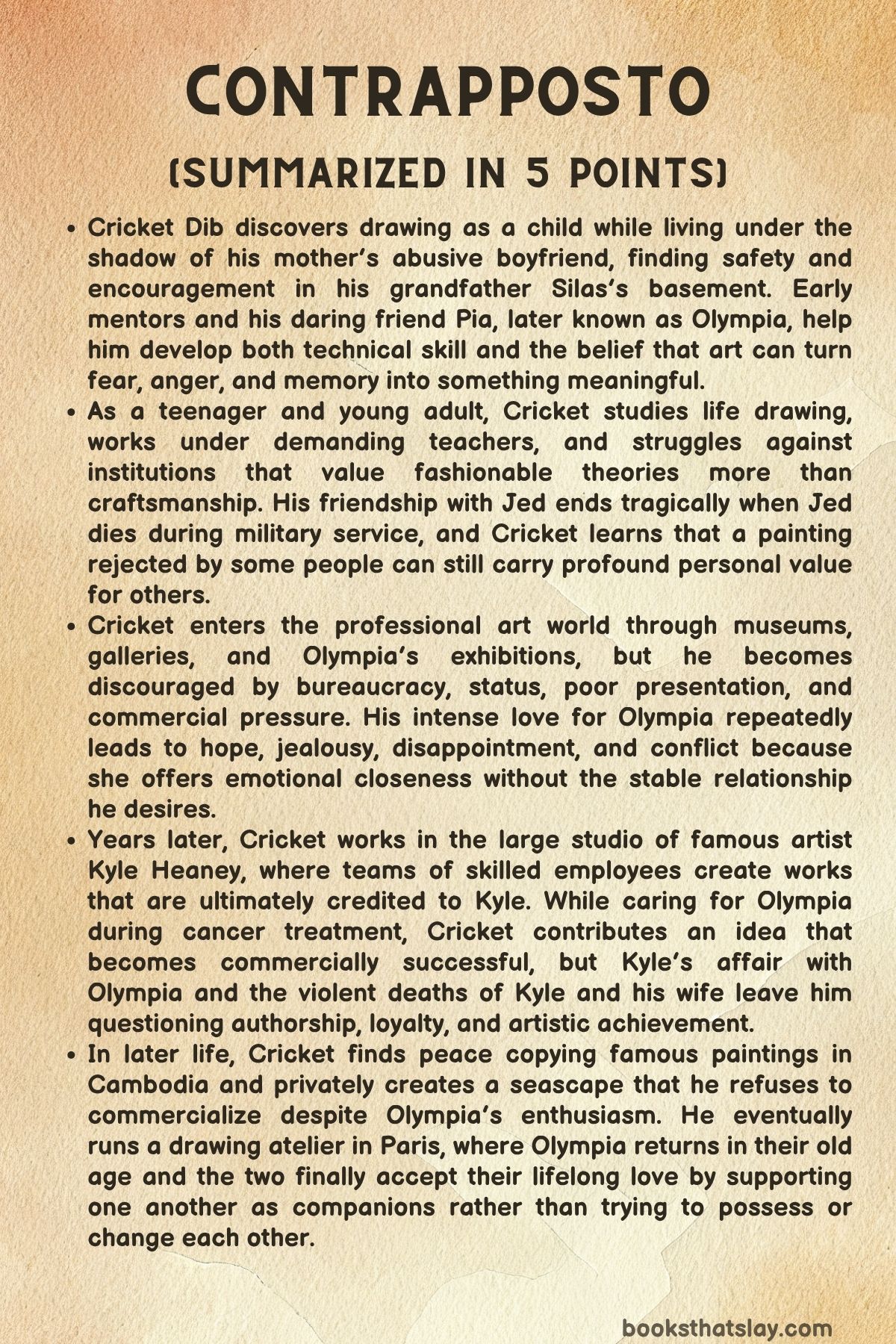
Contrapposto by Dave Eggers is a literary coming-of-age novel that follows an artist across more than six decades of ambition, disappointment, friendship, love, and creative work.
Through Cricket Dib’s changing relationship with drawing and painting, Dave Eggers examines the difference between artistic skill, commercial success, institutional approval, and private satisfaction. Cricket repeatedly enters new artistic communities, only to discover that each has its own compromises and hierarchies. His lifelong connection with Olympia gives the story emotional continuity, while his teachers, friends, employers, and models shape his understanding of beauty. The novel ultimately asks whether making art can remain meaningful when recognition, money, and reputation are removed.
Summary
Ten-year-old Rob Dib finds safety in the basement room of his grandfather Silas, a quiet space filled with plants, records, old books, discarded objects, and spiderwebs. Silas encourages the boy’s habit of drawing and introduces him to Manet, teaching him that careful observation can transform ordinary details into something ordered and beautiful.
The boy begins calling himself Cricket because he wants an identity separate from the one used by Robert, his mother June’s abusive boyfriend. Robert represents fear, unpredictability, and humiliation, while Silas gives Cricket the language to understand that cruelty belongs to the outside world and does not have to control the worlds he creates on paper.
Silas’s death leaves Cricket without his safest adult companion. He becomes lonelier and more inward, relying on drawing to preserve the sense of control and attention that his grandfather helped him develop.
Cricket’s life changes when he meets Pia, an older girl with golden eyes and a fearless manner. She recruits him to cover a new playground with vulgar rhymes written in elaborate lettering, and Cricket becomes fascinated by the contradiction between offensive words and beautiful craftsmanship.
The vandalism also begins his lifelong attachment to Pia, who treats art as an act of freedom, provocation, and rebellion. She recognizes Cricket’s talent before he fully understands it himself, but she also establishes an emotional pattern in which she draws him close without giving him the security he wants.
Romanian sisters Oana and Madelena provide Cricket with his first serious artistic education. Oana teaches him observation, scale, charcoal, watercolor, and disciplined practice, while Madelena offers emotional protection during a frightening episode involving Robert.
Pia persuades Cricket to enter a community art contest, but they reject the expected still life and paint a dead weasel whose face resembles Robert. The technically accomplished but viciously personal image wins first prize, publicly humiliates Robert, and gives Cricket his first experience of using art to answer power.
By fifteen, Cricket is working at the Whistlestop café under Jed Shipski, a charismatic and unpredictable young man, and Roulin, the thoughtful manager who provides steadier guidance. Robert has disappeared after stealing June’s savings, Oana and Madelena have moved away, and Pia’s letters have gradually stopped arriving.
During a lunch break, Cricket hides in a library and reads about the apprenticeship system of the Old Masters. Learning that many artists began formal training at twelve makes him fear that he has wasted crucial years and will never become as skilled as the painters he admires.
He enrolls in a life-drawing course at the Chicago Academy of Art, where Agnes Winter demands discipline, accuracy, and sustained attention. Drawing the nude model Rex teaches Cricket that talent alone cannot replace practice and that the human body must be understood through proportion, structure, weight, and repeated study.
Jed later introduces Cricket to a strange young woman calling herself Camus, who turns out to be Pia. She now calls herself Olympia and has returned with wider cultural knowledge, greater confidence, and the same ability to direct Cricket’s emotional life.
Olympia organizes an exhibition of Cricket’s figure drawings and imagines an artistic movement called PanYouth. She also offers him sexual intimacy while refusing the committed relationship he desires, leaving him divided between gratitude for her encouragement and pain over her unwillingness to belong to him.
When officials censor Cricket’s drawings, Olympia leads a protest that turns the controversy into a public event. Their adolescence reaches a violent moment when she drunkenly crashes through a glass door after being mocked by her musician boyfriend, revealing the self-destructive side of her theatrical courage.
At sixteen, Cricket begins to accept that art may not make him exceptional. Its value may instead lie in preserving what he has genuinely seen, felt, and experienced, even when the result receives no lasting recognition.
Olympia leaves for Bard, Jed attends a state university through ROTC, and Cricket remains in Indiana, working while attempting to teach himself painting. After financial scandal damages Olympia’s family, she transfers to Jed’s university and persuades Cricket to enroll there as well.
Cricket soon discovers that the art department values theories, statements, and fashionable concepts more than technical ability. His disappointment becomes anger when professors cruelly dismiss Sharon, a highly skilled student whose work does not conform to the department’s preferred ideas.
Retired professor Marcus Carpenter interrupts the criticism and defends beauty, craftsmanship, and visual pleasure. Cricket follows him to an informal atelier surrounded by cornfields, where Carpenter teaches drawing, underpainting, color, canvas preparation, composition, and the physical construction of a painting.
Cricket also joins Carpenter’s sign-painting business and brings Jed into the work. Carpenter forces both young men to distinguish art from craft, arguing that strong technique must serve an original idea rather than becoming an empty display of skill.
As the Gulf War approaches, Jed’s National Guard unit is activated. Carpenter urges him to flee to Canada, but Jed goes to war partly because he wants the approval of his abusive father and partly because military duty has become connected to his idea of manhood.
The war ends quickly, yet Jed dies in a vehicle accident in Kuwait. Cricket repeatedly paints him as a heroic figure, attempting to give his friend a noble image that will resist the meaninglessness of the death.
Jed’s family quietly rejects the portrait, suggesting that Cricket’s interpretation does not match the person they knew or the grief they carry. Roulin responds by hanging the painting in the Whistlestop and declaring that Jed and Cricket were his two boys, teaching Cricket that a work rejected in one setting may hold enormous private value in another.
In his late twenties, Cricket becomes a highly skilled tile setter in Chicago. Olympia persuades him to accept an unpaid internship at the International Institute for Modern Art, where he expects to learn how galleries discover artists, organize exhibitions, and shape cultural history.
Instead, he sorts hardware, records auction prices, guards empty rooms, and observes carefully designed exhibitions that attract almost no visitors. The institution appears governed by prestige, bureaucracy, and market information rather than by the direct encounter between viewers and art.
Olympia returns and immediately tells him to leave the gallery. Their emotional and sexual relationship resumes, and Cricket again imagines that the years of uncertainty might finally lead to a shared life.
His hope collapses when Olympia reveals that she has married an Argentine acquaintance to help him remain in the United States. Her marriage confirms that she continues to make large decisions without considering how deeply they will affect Cricket.
Olympia nevertheless creates one of her most powerful projects, Bedrooms of the Dead, which reconstructs Jed’s bedroom beside the bedroom of three Iraqi brothers on a barge. By placing young soldiers from opposing sides within parallel domestic spaces, she directs attention away from political slogans and toward the interrupted lives of the dead.
Olympia later opens a conventional commercial gallery and includes Cricket’s enormous nude figures in an exhibition. His painting of a Bulgarian model named Bilyana becomes his strongest work, but the gallery ceiling is too low, forcing the canvases into awkward positions that weaken their intended effect.
The opening becomes a disaster as Olympia uses cocaine, her Argentine husband appears, and Cricket violently attacks him. Overcome by shame, jealousy, and anger, Cricket wanders beside Lake Michigan, aware that his private desires have again damaged his ability to participate calmly in the professional world Olympia represents.
Years later, Cricket is working in a ship-breaking yard in Turkey. June has died, an industrial explosion has severely burned his back, and a German lover has rejected him because of the scars.
Olympia summons him to Philadelphia with an offer of highly paid studio work but conceals the identity of his employer. Cricket discovers that he will be working for Kyle Heaney, an artist from college whose mediocre abilities have not prevented him from becoming internationally famous.
Kyle operates an enormous workshop in which specialists photograph, design, draw, fabricate, and paint works that are eventually presented under his name. Cricket is initially impressed by Kyle’s taste, honesty about the collaborative process, organizational ability, and capacity to transform ambitious concepts into monumental objects.
He enjoys working alongside Marki, whose competence reflects the largely invisible labor supporting Kyle’s reputation. At the same time, Cricket questions whether authorship can remain meaningful when the celebrated artist contributes direction and branding while employees perform most of the physical work.
Olympia eventually reveals that she has stage-three breast cancer and needs someone calm to accompany her through chemotherapy. Cricket becomes her caretaker, offering the steadiness and loyalty that she has repeatedly relied upon without fully returning.
A spare portrait Cricket paints of Olympia inspires Kyle to create a series of disembodied women’s heads. Kyle pays Cricket fifty thousand dollars for the idea, and studio employees manufacture the paintings that become major commercial successes.
Although Cricket receives financial recognition, the experience leaves him uncertain about ownership and satisfaction. The image came from his intimate knowledge of Olympia, yet its emotional origin is converted into a profitable product carrying another artist’s name.
Kyle’s wife, Honey, suspects that her husband is having an affair. She leaves their son Luka with Cricket, confronts Kyle, shoots him with one of his own decorated guns, and then takes her own life.
Only after the deaths does Cricket understand that Kyle’s secret lover was Olympia. The discovery adds betrayal to grief and reveals how much of Olympia’s life has remained hidden even during periods when Cricket believed they had recovered complete trust.
Approaching sixty, Cricket settles in Krong Kaeb, Cambodia, where he swims, rides an old bicycle, and maintains an uncomplicated relationship with an Australian woman named Gwen. He works in a studio producing copies of famous paintings for tourists and secretly adds animals and comic details for his own amusement.
Copying gives him the physical pleasure of painting without the pressure of originality or reputation. He refuses to join the studio owner’s more serious forgery business, preserving a moral boundary between playful imitation and deliberate deception.
Olympia arrives after years of silence with James, an older wealth manager. She explains that after Kyle and Honey’s deaths she became addicted to heroin, disappeared, suffered repeated relapses, and eventually achieved sobriety before beginning a career advising wealthy collectors.
Once James leaves, Olympia apologizes for avoiding Cricket during her worst years. Cricket shows her the copy studio, and their familiar connection returns as they swim naked in a secluded bay and admit that a conventional relationship might have destroyed them, even though their love never disappeared.
Cricket then reveals a luminous seascape that he spent six months creating privately. Olympia calls it his finest work but immediately begins proposing exhibitions, assistants, higher prices, and additional versions.
Cricket refuses because he wants the experience of making one good painting without turning it into a business. Olympia asks him to return to the wider art world with her, while he asks her to remain in Cambodia, but neither can accept the life chosen by the other.
At seventy-four, Cricket lives in Paris and runs a traditional drawing atelier. A bicycle accident has permanently damaged his shoulders, yet he remains active as a teacher within a community of students, models, former pupils, plants, meals, and art.
He has finally created the kind of workshop he once imagined entering as a young apprentice. Rather than pursuing recognition for himself, he follows the examples of Oana, Agnes Winter, and Carpenter by teaching others how to observe patiently and draw honestly.
Cricket remains connected to Luka, speaks with Roulin before his death, and occasionally hears from Olympia. During a candlelit model audition, Olympia appears under a false name, removes her robe, and persuades Cricket to pose beside her.
Before the students, the two elderly friends stand naked and support each other physically, turning their aging bodies into a record of endurance, dependence, and shared history. Olympia decides to stay, and they spend the evening bathing, eating, discussing art, planning possible travels, and acknowledging that their remaining time may be short.
When they return to the atelier after midnight, they examine the students’ drawings. Arranged together, the images show Cricket and Olympia gradually settling into each other, their bodies joined and balanced after a lifetime of separations, conflicts, departures, and returns.
Characters
Cricket Dib
Cricket is the central consciousness of Contrapposto, and his life is defined by the tension between wanting artistic recognition and wanting the freedom to make art without being controlled by recognition. Beginning as a frightened child named Rob, he adopts the name Cricket as an act of self-creation and resistance against Robert’s abusive authority.
His early experiences teach him that observation can become a form of protection. Silas shows him that drawing can impose order upon chaos, while Oana, Agnes Winter, and Carpenter gradually turn his natural sensitivity into disciplined technical ability.
Cricket is gifted, but his development is never presented as a smooth rise toward fame. He repeatedly arrives late, chooses unstable paths, doubts his talent, and watches less skilled people achieve the public success he once imagined for himself.
His relationship with Olympia shapes nearly every stage of his emotional life. He loves her creativity, intelligence, beauty, and courage, yet he repeatedly allows his longing for her to disturb his judgment and damage his other relationships.
Cricket’s jealousy can become destructive, as shown by his attack on Olympia’s husband. At the same time, his loyalty is extraordinary, especially when he accompanies Olympia through cancer treatment and remains available during the most difficult periods of her life.
His work for Kyle forces him to confront uncomfortable questions about authorship, labor, and ownership. Cricket possesses the ability to execute paintings at a high level, but the commercial system rewards Kyle’s name, connections, organization, and confidence more than Cricket’s private skill.
Cambodia marks an important stage in his maturity because he discovers pleasure in copying paintings and adding hidden jokes. He no longer needs each canvas to prove that he deserves a place among important artists.
The seascape he refuses to commercialize becomes a declaration of independence. By keeping the work outside Olympia’s proposed system of exhibitions and repetition, he protects the personal experience of making it.
His final achievement is not fame but community. As an elderly teacher in Paris, he passes forward the patience, craft, and generosity once given to him, becoming the mentor he needed as a child.
Olympia
Olympia, first known as Pia and later briefly as Camus, is Cricket’s lifelong friend, muse, collaborator, challenger, and unresolved love. She possesses an instinctive understanding of performance and knows how to turn art into an event that attracts attention, creates controversy, and forces people to respond.
As a girl, she recognizes the power of Cricket’s lettering and encourages him to use beauty in rebellious ways. Her involvement in the playground vandalism and dead-weasel painting establishes her belief that art should disturb accepted order rather than politely decorate it.
Olympia is emotionally magnetic but unreliable. She repeatedly gives Cricket intimacy, encouragement, and a sense of possibility, only to withdraw, disappear, choose other partners, or make decisions that exclude him.
Her refusal to form a conventional relationship is not simply cruelty. She seems aware that her temperament, appetite for risk, and need for independence would make domestic stability difficult, yet she often avoids explaining herself until after Cricket has built unrealistic hopes.
As an artist, Olympia can create work with moral and emotional force. Bedrooms of the Dead demonstrates her ability to transform political conflict into a human encounter by placing Jed’s lost life beside the lives of Iraqi brothers killed on the opposing side.
She is also deeply connected to the commercial structures of art. Even when she admires Cricket’s private seascape, her first response is to imagine exhibitions, assistants, prices, and variations, showing that she has learned to understand art through expansion and circulation.
Her private life contains severe self-destructive impulses. Cocaine, heroin addiction, secrecy, relapses, and her affair with Kyle reveal a person who repeatedly seeks intensity while hiding the consequences from those closest to her.
Cancer temporarily allows her and Cricket to occupy simpler roles, with Cricket caring for her while she faces physical vulnerability. Yet even within this intimate period, she keeps her relationship with Kyle secret, proving that her dependence on Cricket does not automatically produce honesty.
Olympia’s return in old age changes the meaning of their relationship. By choosing to stay with Cricket in Paris, she finally offers presence rather than another dramatic departure.
Her final pose beside Cricket gives Contrapposto its clearest image of balance. Neither person stands independently, but together their weakened bodies form a stable composition based on mutual support.
Silas
Silas is Cricket’s first mentor and the emotional foundation of his artistic life. His basement provides physical refuge from Robert and symbolic refuge from the disorder surrounding the child.
Rather than praising Cricket in vague terms, Silas teaches him to notice small visual details. His introduction to Manet helps Cricket understand that serious art begins with looking carefully at what others ignore.
Silas also gives Cricket an ethical understanding of creativity. He explains that cruelty and chaos are forces outside the self, while drawing offers a way to create beauty and order without pretending that suffering does not exist.
His death occurs early, but his influence remains present throughout Cricket’s life. Every later teacher expands upon the basic lesson Silas gave him: attention can become both a discipline and a form of survival.
June
June is Cricket’s mother, but her role is shaped by her inability to provide consistent protection. Her relationship with Robert exposes Cricket to fear and abuse, forcing the child to seek safety with Silas and within his drawings.
She is not presented as deliberately cruel, yet her choices leave Cricket emotionally isolated. Robert’s eventual theft of her savings also shows that she is one of his victims, though her victimhood does not erase the damage caused by keeping him in Cricket’s life.
June’s later death adds to Cricket’s increasing separation from his original home. By the time he reaches middle age, the people and places of his childhood have largely disappeared, leaving memory and art as his strongest forms of continuity.
Robert
Robert represents the threat from which Cricket first tries to escape. His abuse turns the name Rob into something Cricket rejects, making the adoption of “Cricket” an early declaration that Robert will not define him.
He functions as an example of power without care. Unlike Silas, whose authority is based on patience and teaching, Robert controls through fear, humiliation, and unpredictability.
The dead-weasel painting gives Cricket a symbolic victory over him. By transforming Robert’s face into an ugly but technically impressive public image, Cricket reverses their positions and makes his tormentor the object being examined.
Robert’s disappearance after stealing June’s savings confirms his selfishness. Although he leaves the immediate story, the insecurity he created continues to influence Cricket’s sensitivity to domination, rejection, and shame.
Oana
Oana is Cricket’s first formal art teacher and one of the most important sources of his technical foundation. She teaches him that accurate representation requires discipline rather than inspiration alone.
Her lessons in scale, charcoal, watercolor, and observation give Cricket tools that he will continue developing for decades. She treats art as a practice built from repeated acts of looking, measuring, correcting, and trying again.
Oana also establishes the model of the artist-teacher that Cricket later follows in Paris. Her influence survives not through fame but through the knowledge she transfers to another person.
Madelena
Madelena’s importance lies primarily in the emotional safety she provides. While Oana develops Cricket’s artistic technique, Madelena comforts him during a crisis involving Robert.
Her presence shows that creative growth depends upon more than instruction. Cricket is able to learn because the sisters provide an environment in which he feels noticed and protected.
Madelena also belongs to a series of temporary guardians who enter Cricket’s life and then disappear. Her departure contributes to his awareness that meaningful relationships may be brief but can still shape an entire life.
Jed Shipski
Jed is charismatic, unpredictable, energetic, and deeply wounded by his relationship with his abusive father. He brings excitement into Cricket’s adolescence and becomes one of the first friends to make ordinary working life feel like part of a larger adventure.
His involvement with ROTC appears to offer direction and identity. Beneath that decision, however, lies a desire to earn paternal approval and prove a version of masculinity that his father will respect.
When the Gulf War begins, Jed faces a genuine moral choice. Carpenter offers him an escape to Canada, but Jed accepts deployment because duty, fear, pride, and family expectations have become difficult for him to separate.
His death in a vehicle accident rather than heroic combat destroys any simple narrative of military glory. Cricket’s repeated attempts to paint him heroically reveal the need to give meaning to a death that feels arbitrary.
Jed continues to influence the living through art. Cricket’s portrait, Roulin’s decision to display it, and Olympia’s reconstruction of his bedroom all demonstrate how different people reshape his memory according to their own grief.
Roulin
Roulin provides the steady adult presence that balances Jed’s unpredictability at the Whistlestop. He observes Cricket with patience and treats him as someone deserving of affection rather than merely as an employee.
His most important act occurs after Jed’s family rejects Cricket’s portrait. By hanging it in the café and declaring Jed and Cricket his two boys, Roulin validates both the friendship and the painting.
Roulin understands value in personal rather than institutional terms. The portrait does not need approval from critics or Jed’s relatives to matter within the community that shared the young men’s daily lives.
His continued contact with Cricket into old age confirms the durability of chosen family. Even when they live far apart, the bond formed at the café remains one of Cricket’s most reliable emotional connections.
Agnes Winter
Agnes Winter represents discipline, structure, and the demanding traditions of formal drawing. Her course gives Cricket a clear alternative to the uncertainty of teaching himself.
She does not treat talent as a magical quality. Through the sustained study of Rex’s body, she forces Cricket to confront proportion, anatomy, weight, and the limits of his current ability.
Her influence later appears in Cricket’s Paris atelier. Like Agnes, he teaches students that drawing is both physical practice and trained perception, not merely personal expression.
Marcus Carpenter
Marcus Carpenter becomes Cricket’s most complete artistic mentor. He enters the story by defending Sharon from professors who value ideological conformity more than technical achievement.
Carpenter believes that beauty, craft, and visual pleasure possess genuine worth. His position challenges the idea that skill is old-fashioned or that an artwork becomes meaningful simply because it is accompanied by a sophisticated explanation.
His informal atelier offers Cricket the apprenticeship he feared he had missed. Lessons in underpainting, color, canvas preparation, drawing, and composition connect artistic vision to the physical construction of the work.
Carpenter also refuses to romanticize technique. His distinction between art and craft requires Cricket to understand that excellent execution must serve an original intention.
His concern for Jed reveals that his mentorship extends beyond painting. By urging Jed to flee to Canada, he demonstrates a willingness to challenge patriotic expectations when he believes a young person’s life is at risk.
Sharon
Sharon is a highly skilled student whose work is dismissed because it does not match the art department’s preferred theories. Her humiliation exposes the cruelty that can develop within institutions claiming to encourage experimentation and originality.
She represents artists whose technical strengths are treated as embarrassing because they do not conform to current academic language. The professors’ treatment of her helps Cricket recognize that institutions can enforce narrow standards while presenting themselves as progressive.
Carpenter’s defense of Sharon becomes the moment that redirects Cricket’s education. Although she occupies a limited part of the story, the injustice done to her changes the course of his life.
Kyle Heaney
Kyle is a mediocre college acquaintance who becomes an internationally famous artist by building an enormous collaborative studio. His success challenges Cricket’s belief that technical ability should determine artistic reputation.
Kyle is not portrayed as a simple fraud. He possesses taste, ambition, organizational intelligence, and the ability to bring monumental projects into existence through coordinated labor.
He is also comparatively transparent about how his workshop functions. Specialists know that they are contributing to works that will carry Kyle’s name, and Cricket receives substantial payment when his portrait of Olympia inspires the series of women’s heads.
Nevertheless, Kyle’s system separates artistic fame from physical creation. The workers photograph, draw, paint, design, and fabricate, while Kyle’s authorship rests upon direction, ownership, branding, and public identity.
His secret affair with Olympia adds a personal betrayal to the professional unease Cricket already feels. His death at Honey’s hands turns the decorated gun from an artistic object into an instrument of real violence, collapsing the distance between representation and consequence.
Honey
Honey is shaped by suspicion, betrayal, rage, and emotional isolation. Believing that Kyle is having an affair, she leaves Luka with Cricket before confronting her husband.
Her decision protects her son from witnessing the immediate violence, but it also places Cricket inside a tragedy he does not yet understand. She shoots Kyle with one of his decorated guns and then takes her own life.
Honey’s actions expose the devastation hidden beneath Kyle’s successful public image. The enormous studio may appear efficient and controlled, but his private life contains secrecy capable of destroying an entire family.
Her death also permanently changes Cricket’s relationship with Luka. By entrusting the boy to him during the crisis, she creates a connection that Cricket maintains into old age.
Marki
Marki is one of the skilled workers whose labor supports Kyle’s artistic reputation. Her competence makes the studio impressive and demonstrates that large-scale contemporary art often depends upon specialists rather than a single hand.
Cricket enjoys working beside her because she understands the practical demands of production. She represents the many capable people whose names remain secondary even when their labor is essential to the finished work.
Through Marki, the novel complicates the idea of authorship without dismissing collaboration. The problem is not that many people participate, but that recognition and meaning are distributed so unevenly.
Luka
Luka is Kyle and Honey’s son and one of the innocent survivors of their destructive marriage. Honey leaves him with Cricket before the murder-suicide, making Cricket a temporary source of safety during the worst moment of the boy’s life.
Cricket’s continued connection with Luka shows a form of responsibility different from his relationships with teachers, lovers, and fellow artists. He becomes a stable adult presence without trying to turn the bond into a dramatic story about himself.
Luka also represents continuity beyond artistic reputation. By remaining in contact with him, Cricket preserves a human connection to Kyle and Honey after the public art world has likely reduced their lives to scandal.
Gwen
Gwen is Cricket’s Australian companion in Cambodia. Their relationship is described as uncomplicated, which distinguishes it from his emotionally consuming attachment to Olympia.
She belongs to a period when Cricket has stopped demanding that love provide artistic inspiration, lifelong certainty, or dramatic transformation. Her presence suggests that companionship can be valuable without becoming the defining story of a person’s life.
Gwen also reflects Cricket’s temporary acceptance of a quieter existence. With her, he participates in ordinary intimacy rather than repeating the instability that has characterized his relationship with Olympia.
James
James is the older wealth manager who accompanies Olympia to Cambodia. His profession reflects Olympia’s later movement into advising wealthy collectors and managing art as a financial and social asset.
He appears to provide stability after her years of addiction and relapse. However, his departure creates the private space in which Olympia and Cricket can acknowledge the emotional bond that has survived their long separation.
James is not presented as an antagonist. His limited role emphasizes that the central conflict is not between competing partners but between the lives Cricket and Olympia have independently chosen.
Themes
Art as a Form of Order and Survival
Cricket first turns to drawing because his home life is shaped by fear, uncertainty, and Robert’s abusive behavior. Silas teaches him that he cannot control the cruelty of the world, but he can decide where to place a line, how to arrange a shape, and what deserves his attention.
This lesson makes art a method of psychological survival before it becomes a profession. Drawing gives Cricket a private territory in which Robert has no authority, and the name Cricket becomes part of the same attempt to create a self that abuse cannot fully define.
The need for order continues throughout his life. After Jed’s death, Cricket tries to paint a heroic portrait because he cannot accept the meaninglessness of a fatal vehicle accident.
His paintings do not erase grief, but they give him a structure through which he can face it. Even when Jed’s family rejects the portrait, Roulin’s decision to display it proves that art can preserve a relationship for the people who need that preservation.
In later life, copying famous paintings in Cambodia provides another kind of survival. The work frees Cricket from the anxiety of proving his originality while allowing him to retain the physical pleasure of painting.
Contrapposto therefore presents artistic creation as a repeated act of rebuilding. Cricket cannot prevent loss, aging, rejection, betrayal, or death, but he can continue converting experience into visible form.
Craft, Originality, and Authorship
Cricket spends his life learning that artistic value cannot be reduced to technical ability, yet it also cannot exist entirely without craft. Oana, Agnes Winter, and Carpenter teach him how to observe, measure, prepare materials, understand bodies, and construct images through disciplined labor.
The university art department represents the opposite extreme. Its professors prioritize theory so aggressively that Sharon’s skill becomes a reason to humiliate her, revealing how institutions can replace one narrow standard with another.
Carpenter offers a more balanced position by insisting that technical excellence must serve an original idea. A perfectly executed sign may demonstrate craft, but a serious artwork must also communicate a distinctive way of seeing.
Kyle’s workshop makes the question of authorship more difficult. He does not physically produce much of the work carrying his name, yet he chooses ideas, organizes specialists, manages resources, and creates the conditions in which monumental projects can exist.
Cricket’s contribution to the women’s-head series further complicates ownership. His portrait of Olympia supplies the central concept, Kyle purchases the idea, and employees manufacture the final paintings.
The resulting success belongs to a system rather than a single creator. The novel does not provide a simple rule for determining authorship, but it repeatedly asks whether meaning survives when creation is divided into concept, labor, ownership, marketing, and reputation.
Love Without Possession
Cricket’s relationship with Olympia resists the structure of conventional romance. They are drawn to each other from childhood onward, yet their connection is repeatedly disrupted by distance, other partners, secrecy, addiction, ambition, and incompatible visions of a shared life.
Cricket often confuses love with the hope that Olympia will eventually choose him permanently. Every reunion renews this expectation, and every departure leaves him feeling rejected even when she has never promised the stability he imagines.
Olympia loves Cricket but refuses to organize her life around his need for certainty. Her behavior can be selfish and dishonest, especially when she hides her marriage, her affair with Kyle, and the worst periods of her addiction.
At the same time, Cricket must learn that devotion does not give him ownership over her choices. His attack on her Argentine husband reveals the danger of treating emotional history as a claim upon another person.
Their reunion in Cambodia brings a more mature recognition. They admit that a conventional partnership might have destroyed them, while also accepting that the love between them has remained real.
In old age, the relationship finally becomes possible because neither is trying to force the other into an imagined future. Their shared pose depends upon physical support rather than possession, showing two people choosing closeness after they have exhausted the demand to control what that closeness must become.
Success, Failure, and Artistic Meaning
Cricket’s career repeatedly challenges conventional definitions of success. He develops exceptional technical skill but never receives the level of recognition achieved by Kyle, whose fame depends upon organization, branding, confidence, and access to a commercial system.
Public failure does not always mean personal failure. Cricket’s portrait of Jed is rejected by Jed’s family, yet Roulin considers it important enough to display because it preserves the bond among the people of the Whistlestop.
The disastrous gallery exhibition likewise demonstrates that strong work can be weakened by bad presentation, poor planning, addiction, jealousy, and unsuitable architecture. Artistic quality does not guarantee that the conditions surrounding a work will allow others to recognize it.
Olympia measures success through circulation, visibility, financial value, and continued production. Her immediate plans for Cricket’s Cambodian seascape show how quickly a private achievement can be converted into a commercial program.
Cricket’s refusal marks a change in his understanding of accomplishment. He wants one painting to remain complete in itself rather than becoming the first item in a branded series.
His Paris atelier provides the clearest alternative to fame. By teaching students to see, he accepts influence rather than recognition as a meaningful legacy.
The final drawings of Cricket and Olympia are made by students rather than by famous professionals. Their value lies in witnessing two aging bodies finding balance, proving that art can matter because of the human attention invested in it rather than because of price, prestige, or permanence.