Counting The Cost Summary and Analysis
Counting the Cost by Jill Duggar is a candid memoir that chronicles her journey from obedient daughter within a high-profile conservative Christian family to an independent woman forging her own path.
Growing up in the Duggar household, Jill’s life was shaped by strict religious rules, public scrutiny through a hit reality show, and the weight of being part of a family often held up as a model of faith. Yet behind the camera, she experienced control, secrecy, and deep trauma. With honesty and courage, Jill shares the conflicts, betrayals, and painful reckonings that led her to step away from the family brand and reclaim her voice, her marriage, and her freedom.
Summary
The book opens with Jill Duggar recalling a winter day in 2014, sledding outside the Duggar family’s “Big House” in Arkansas. Even in moments of fun, strict rules dictated her behavior, such as the prohibition against boys and girls sharing a sled.
Though she obeyed unquestioningly, her future husband Derick questioned the logic, a small sign of the cracks that would grow in her perception of her upbringing. At that time, she was preparing for an on-camera proposal, unaware of how deeply entangled her personal life would become with a television audience.
Her childhood in Springdale, Arkansas, was marked by rigid rules about music, clothing, and modesty. Hymns and classical music were acceptable, while dancing and anything worldly were forbidden. Jill internalized her parents’ values, striving to be the “perfect daughter.” Through the family’s buddy system, she cared for younger siblings, taking pride in obedience and modesty. The Duggars presented themselves as a model Christian family, drawing heavily on the teachings of Bill Gothard and the Institute in Basic Life Principles. These teachings emphasized separation from the world, authority, and constant cheerfulness, shaping Jill’s self-image and family roles.
Jill describes early exposure to public life when the family participated in a documentary following Jim Bob’s political campaigns and their unique household. Though initially uncomfortable with staged scenes, the family embraced the benefits of television, from financial perks to public recognition. Soon the one-time specials evolved into a reality series that documented their growing family and daily life.
For Jill, the presence of cameras became normal, though intrusive, with homeschooling and routines frequently interrupted for production schedules.
The public image masked private struggles. When Jill was eleven, she and her siblings were told that her brother Josh had confessed to inappropriate actions. He was briefly sent away for “help,” and the family was instructed to remain silent.
Years later, when the secret resurfaced, Jill endured questioning by authorities and intense fear of family separation. Her father, Jim Bob, framed the situation as outsiders attacking their family, reinforcing secrecy and loyalty above all else.
As Jill grew older, she balanced responsibilities at home with midwife training and increasing involvement in the show. Her father played an outsized role in orchestrating her relationships, nudging her toward Derick Dillard, a missionary in Nepal.
Though hesitant, Jill eventually grew close to Derick, with their budding romance quickly becoming a storyline for TLC. Their courtship and engagement were carefully staged for cameras, culminating in a wedding in 2014 that was heavily controlled by network demands, even down to guests’ ability to take photos. Despite frustrations, Jill tried to balance her private desires with public obligations.
Married life quickly revealed tensions. Jill and Derick resisted network intrusion into their honeymoon, but soon returned to a routine dictated by filming. Jill’s first pregnancy and delivery of her son Israel were shaped by production decisions, with announcements and even parts of her birth choreographed for media releases.
Behind the scenes, Derick grew increasingly frustrated with restrictions and control, while Jill hesitated to challenge her father and the network.
In 2015, past family secrets exploded publicly when reports of Josh’s abuse surfaced. Jill was retraumatized by the exposure of private details, hounded by paparazzi, and pressured to defend her parents in interviews. She and her sister Jessa appeared on national television to downplay the scandal, though the experience left Jill shaken. Seeking distance, she and Derick pursued missionary work in El Salvador, though even there, media intrusion and contractual obligations followed them.
As violence escalated in their mission field, Jill and Derick clashed with Jim Bob over their supposed contractual commitments to TLC. Derick questioned why Jill was bound by agreements she had never knowingly signed.
Tensions culminated when Jim Bob attempted to secure long-term contracts binding Jill and her future children to indefinite filming. Jill and Derick refused, beginning a painful break from the family structure. By 2017, they formally left the show, though the decision cost them opportunities and further strained family ties.
Their departure coincided with personal hardships. Jill’s second pregnancy was complicated by a near-fatal uterine rupture and emergency C-section. Her son Samuel survived but required intensive care.
The trauma deepened Jill’s sense of fragility but also strengthened her resolve to live on her own terms. Small acts of independence, such as wearing pants and getting a nose piercing, sparked conflict with her father, who tried to guilt her with scripture. Yet Jill pressed forward, determined to assert her autonomy.
The conflict escalated into legal and financial battles. Jill and Derick discovered that income from the family’s media company, Mad Family Inc., had been reported under Jill’s name without her knowledge, leaving her accountable for over $130,000 she never received. Mediation with Jim Bob collapsed into shouting, guilt, and accusations.
Jill hired an attorney and eventually secured a settlement, though the process deepened her estrangement from her parents. For the first time, she saw the extent of the profits made by TLC and her father’s control over them.
Amid these struggles, Jill sought healing through therapy. She and Derick learned to set boundaries, prioritize honesty, and accept that reconciliation might not be possible on her father’s terms. Their transparency extended to the public, where they explained their distance from the family brand, valuing honesty over appearances.
Meanwhile, further scandals rocked the Duggar family. In 2021, Josh was convicted of possessing child sexual abuse material, a devastating but validating moment for Jill, who publicly supported victims and acknowledged her own long-standing pain.
In her personal life, Jill experienced both grief and renewal. She suffered a miscarriage but later welcomed her son Frederick in 2022, a moment that brought a small thaw in her relationship with her parents. Still, legal battles, including a dismissed lawsuit against officials for leaking her abuse records, reminded her of lingering injustices.
Through it all, she built a new identity: enrolling her children in public school, supporting Derick’s legal career, and openly rejecting the secrecy and control of her past.
By the book’s conclusion, Jill reflects on the cost of breaking away—estrangement, rumors, and the loss of her once-close family ties—but also the freedom it brought. She reclaims her story from the shadows of exploitation and secrecy, choosing honesty, healing, and independence.
Counting the Cost is both a personal reckoning and a declaration of resilience, as Jill Duggar steps beyond the weight of her family’s image to embrace her own truth.
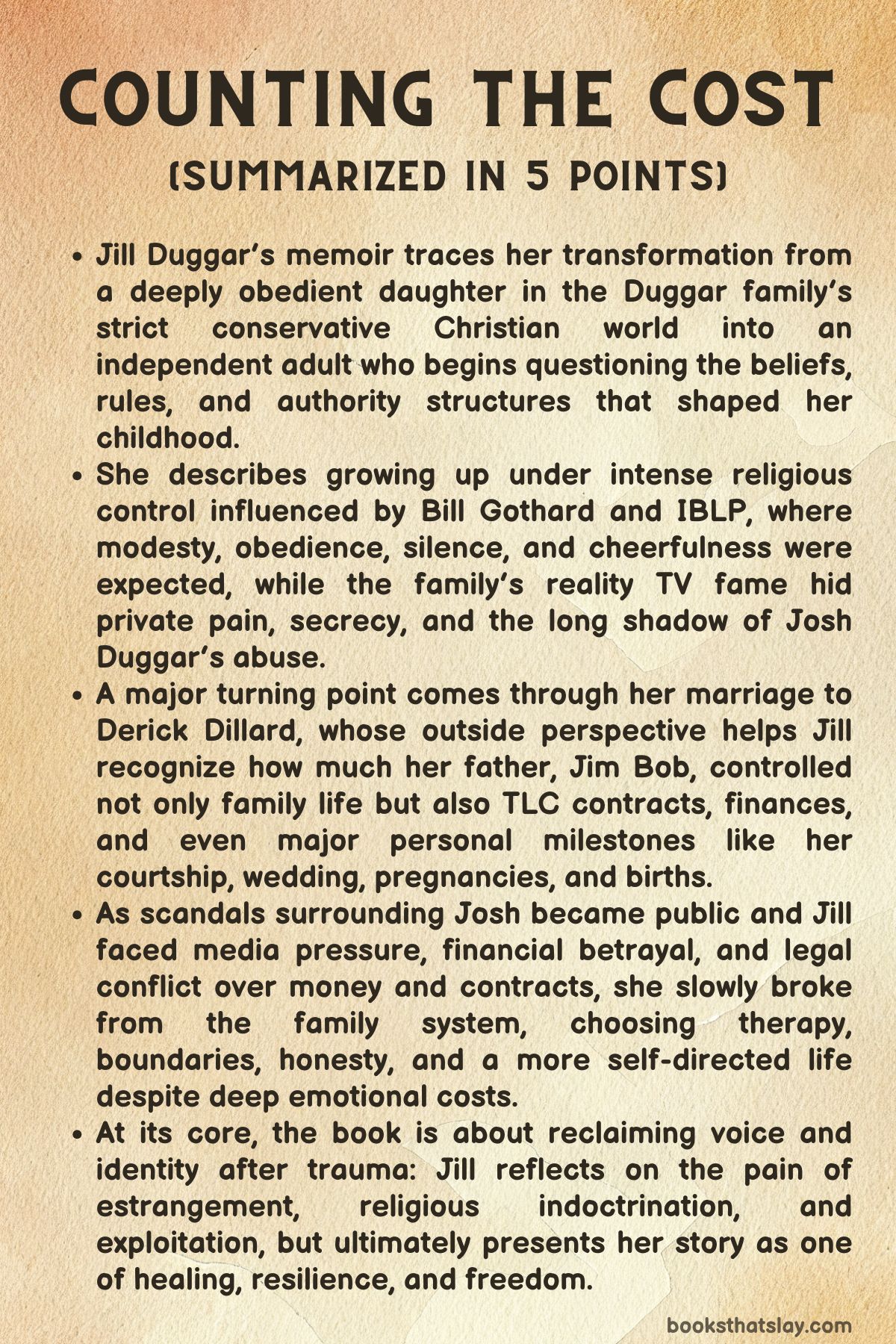
Key People
Jill Duggar
Jill Duggar is the central figure of Counting the Cost, and her narrative is shaped by her journey from obedient daughter to independent woman. As a child, she internalized the values of obedience, modesty, and service, striving to live up to her parents’ ideals and the teachings of IBLP. She cherished approval from both her parents, especially her mother, and longed to be the perfect “Sweet Jilly Muffin.”
Her early life was dominated by modesty rules, constant comparison to other “model families,” and a pressure to set an example for the world. As she matured, Jill’s identity became entwined with the family’s growing fame and their TLC show, where she experienced both the excitement of new opportunities and the suffocating loss of privacy. Her story is deeply marked by trauma from her brother Josh’s abuse, the pressure to remain silent, and later the betrayal she felt when her father manipulated contracts and finances.
Despite these challenges, Jill’s character arc is one of resilience and awakening: she grows into someone who questions authority, embraces therapy, sets boundaries, and builds her own life with Derick. Her shift to wearing pants, getting a nose piercing, and pursuing transparency reflect small but powerful acts of independence. Ultimately, Jill emerges as a woman determined to live authentically, despite the cost of estrangement.
Jim Bob Duggar (“Pops”)
Jim Bob Duggar, referred to as “Pops,” is portrayed as a man deeply invested in control, image, and authority.
At first, he appears to Jill as an honest and God-fearing father, but over time, his obsession with maintaining power—both within the family and through the television show—comes into sharper focus. He embodies IBLP teachings, especially the “umbrella of authority,” which places parents as unquestionable figures over their children.
Jim Bob thrives on public recognition and fame, leveraging the family’s television presence as ministry while simultaneously reaping its financial benefits, often at the expense of his children. His protective attitude toward Josh, contrasted with his judgment of Jill’s minor choices, exposes hypocrisy and favoritism. He manipulates contracts, withholds financial transparency, and pressures Jill into compliance, escalating conflicts when she and Derick begin asserting independence.
While he occasionally shows moments of remorse, such as issuing a rare apology after being confronted, his role in Jill’s life is largely one of control, dominance, and betrayal. He represents both the familial and systemic structures Jill must fight against to achieve freedom.
Michelle Duggar
Michelle Duggar, Jill’s mother, is depicted as a constant, nurturing presence whose selflessness and gentle demeanor made her a role model for her daughters. In Jill’s youth, she epitomized the perfect Christian mother—soft-spoken, cheerful, and endlessly patient.
Jill deeply admired her, striving to earn praise for being like her. However, as Jill matured, Michelle’s role became more complex. Though she provided emotional comfort and occasionally supported Jill in small ways, such as during the birth of her child, she often acted as a mediator for Jim Bob’s demands rather than challenging them. Her complicity in the system, whether by delivering contracts secretly or reinforcing rules, highlights her alignment with the structure of authority in the household.
Michelle embodies the idealized but constrained role of a submissive wife within IBLP, one that influenced Jill’s early aspirations but also contributed to her struggles with autonomy. Her quiet loyalty to Jim Bob makes her both a source of love and disappointment in Jill’s journey.
Derick Dillard
Derick Dillard emerges as Jill’s partner in independence and resistance. Introduced into her life through her father’s matchmaking efforts, Derick initially represents the adventurous world outside the Duggar bubble, with his missionary work in Nepal appealing to Jill’s longing for something beyond her controlled upbringing.
Over time, Derick becomes not only her husband but also her ally in challenging Jim Bob’s authority and the exploitative structures of TLC contracts. His insistence on fair compensation, his legal confrontations with Jim Bob, and his willingness to walk away from the show all highlight his determination to protect his family and carve out autonomy.
While his assertiveness sometimes puts Jill in conflict with her father, Derick’s presence strengthens her courage to step into her own identity. His career as a prosecutor later mirrors his personal fight for justice and transparency. Derick’s character underscores the themes of partnership, resilience, and the pursuit of integrity in the face of manipulation.
Josh Duggar
Josh Duggar plays a dark and pivotal role in Jill’s story. His abusive actions toward his sisters, including Jill, introduce trauma that reverberates throughout her life. The family’s response—silence, cover-ups, and prioritizing reputation over protection—amplifies Jill’s sense of betrayal.
Later, Josh’s pornography addiction, infidelity, and eventual conviction for possessing child sexual abuse material only deepen the fractures within the family. Jill’s pain is compounded by Jim Bob’s protective stance toward Josh, contrasted with harsh judgment toward her for far lesser acts. Josh symbolizes both the unspoken harm within the family and the hypocrisy at its core.
His presence in the book is less about his personal development and more about the lasting damage his actions—and the family’s mishandling of them—inflicted on Jill.
Bill Gothard and IBLP
While not family members, Bill Gothard and the Institute in Basic Life Principles serve as influential characters in Jill’s life. Gothard’s teachings shape the Duggar household’s strict rules on modesty, obedience, and authority.
Jill recalls meeting him with reverence, seeing him as a spiritual authority who validated her parents’ choices. The IBLP conferences, “model families,” and rituals of cheerful submission reinforced her childhood desire to live up to impossible standards. Over time, however, Jill comes to recognize the limitations and harms of this ideology, particularly its role in justifying her father’s control and silencing dissent.
Gothard and IBLP function as the ideological backbone of Jill’s struggles, making them critical “characters” in the broader story of her journey to independence.
Themes
Authority and Control
In Counting the Cost, authority emerges as a constant force shaping Jill Duggar’s life, beginning in her earliest memories within the Duggar household. Her father Jim Bob’s dominance is illustrated through both religious teachings and family practices that emphasized absolute obedience.
Authority was presented not as guidance but as a protective umbrella, under which children were expected to remain unquestioningly compliant. This theme extends beyond the family home into Jill’s adult years, particularly through the contractual entanglements with TLC. Her father’s insistence on binding her to agreements she never knowingly signed and his tendency to turn financial and personal conflicts into moral failures on her part reinforce how authority was not only spiritual but also economic and legal.
Even as an adult, Jill is confronted with the lingering effects of her father’s control, which blurred the boundaries between parental concern and coercion. The power imbalance is further reflected in how Jim Bob prioritized protecting Josh over addressing Jill’s trauma, exposing how authority in her family operated selectively and often unjustly. Control, framed as spiritual protection, became a mechanism that silenced her voice, constrained her autonomy, and demanded compliance, even when her well-being was at risk.
Only by resisting these structures—through therapy, legal action, and boundary-setting—did Jill begin dismantling the grip of authority that had defined her life.
Religious Indoctrination
The teachings of Bill Gothard and the Institute in Basic Life Principles play a pivotal role in the shaping of Jill’s worldview, underscoring the theme of religious indoctrination. From childhood, Jill was immersed in an environment where faith was equated with submission, modesty, and separation from the outside world.
Conferences, homeschooling materials, and family practices all reinforced the idea that spiritual worth came through rigid obedience. Music, clothing, and friendships were heavily policed to ensure alignment with IBLP’s standards. These teachings were not simply about faith but about molding a uniform lifestyle that extended into adulthood. The religious indoctrination is most evident in how Jill internalized self-policing—correcting her own discomfort when faced with differences at the beach or in other families.
Later, when crises involving Josh became public, the same indoctrination compelled her to protect the family’s image rather than address her own victimization.
Even her marriage was influenced by IBLP frameworks of courtship, with parental blessing treated as a divine prerequisite. Yet, Jill’s eventual questioning of these rules—wearing pants, getting a nose piercing, and pursuing therapy—demonstrates the unraveling of this indoctrination.
Religion, once a tool of control, gradually became something she re-examined and redefined on her own terms, marking a shift from blind obedience to conscious belief.
Exploitation Through Fame
The transformation of the Duggar family into a televised spectacle reveals the theme of exploitation, both financial and emotional. From the earliest documentaries to the long-running series, Jill recounts how her family’s private life became a commodity for TLC, often at the expense of their autonomy.
Childhood experiences, relationships, and even births were scripted, filmed, and monetized, with little input from those most affected. The exploitation is compounded by Jim Bob’s mediation of all contracts through Mad Family Inc., which allowed him to reap financial benefits while withholding income and transparency from his children.
Jill’s discovery that $130,000 was declared under her name without her knowledge epitomizes the extent of this manipulation. Beyond financial aspects, the emotional exploitation was equally damaging. Jill was compelled to participate in interviews defending her family during the Josh scandal, despite her trauma, illustrating how her pain was converted into public relations material.
The show’s demands infiltrated milestones like her wedding and childbirth, moments that should have been private but were instead leveraged for ratings. This pattern of exploitation underscores how fame, presented as a divine platform, served to enrich her father and sustain the family brand, while Jill was left to bear the personal costs.
Trauma and Silence
One of the most haunting themes is the enduring trauma Jill experiences, particularly around Josh’s abuse and the culture of silence that surrounded it. When first confronted with Josh’s misconduct as a child, Jill was instructed not to stir up contention but to move on quietly.
The message was clear: family unity and reputation outweighed individual safety or healing. Years later, when the abuse became public, Jill was retraumatized as her victimization was exposed to the world without her consent. Instead of receiving support, she was asked to participate in damage control, an act that placed her pain secondary to the preservation of the Duggar image.
The enforced silence extended into her financial and legal struggles, where questioning her father was framed as disobedience. This theme reveals the generational impact of suppressing pain, where the appearance of faithfulness demanded self-erasure. Through therapy, Jill begins confronting this trauma, acknowledging that silence was never healing but compounding.
Her willingness to eventually speak publicly, both in her book and through interviews, represents a refusal to carry silence any longer. In breaking it, she not only acknowledges her own suffering but also offers solidarity to others silenced in similar systems.
Autonomy and Identity
The gradual emergence of Jill’s autonomy and identity provides one of the most compelling arcs of Counting the Cost.
For much of her life, Jill defined herself through obedience, aspiring to be the perfect daughter who mirrored her mother’s image of modesty and selflessness. Marriage initially did not free her from these expectations, as she and Derick remained entangled in contracts and family obligations. However, small choices—like refusing TLC cameras on her honeymoon, challenging her father on financial matters, or wearing pants—signaled the beginnings of self-assertion.
These acts, though seemingly modest, carried profound weight in the context of her upbringing, where conformity was expected. Autonomy also manifested in her decision to prioritize therapy, transparency with the public, and her children’s education outside of IBLP homeschooling. Her identity shifted from being part of a collective family brand to being an individual with her own convictions and boundaries. This journey was neither simple nor without cost, as estrangement and guilt accompanied her independence.
Yet, her persistence in forging a life with Derick—outside the orbit of her father’s authority and the demands of fame—marks her transformation from a daughter defined by others to a woman defining herself. This theme underscores the resilience required to reclaim identity after years of control, and the courage it takes to prioritize authenticity over appearance.