Cursed City Summary, Characters and Themes
Cursed City by Kate Golden is a dark urban fantasy centered on Vivienne Abbot, a hunter whose body has become the unwilling vessel for an ancient destructive spell known as the syrabraxa.
What begins as a struggle to rescue Reid and escape the Brood develops into a much larger conflict involving corrupt institutions, supernatural politics, buried family history, and competing visions of who deserves power. Viv’s changing abilities force her to question everything she was taught about hunters and deviants, while her relationships with the very different Graveheart brothers challenge her assumptions about love, morality, loyalty, and identity. It’s the 2nd book in the Harker Academy series.
Summary
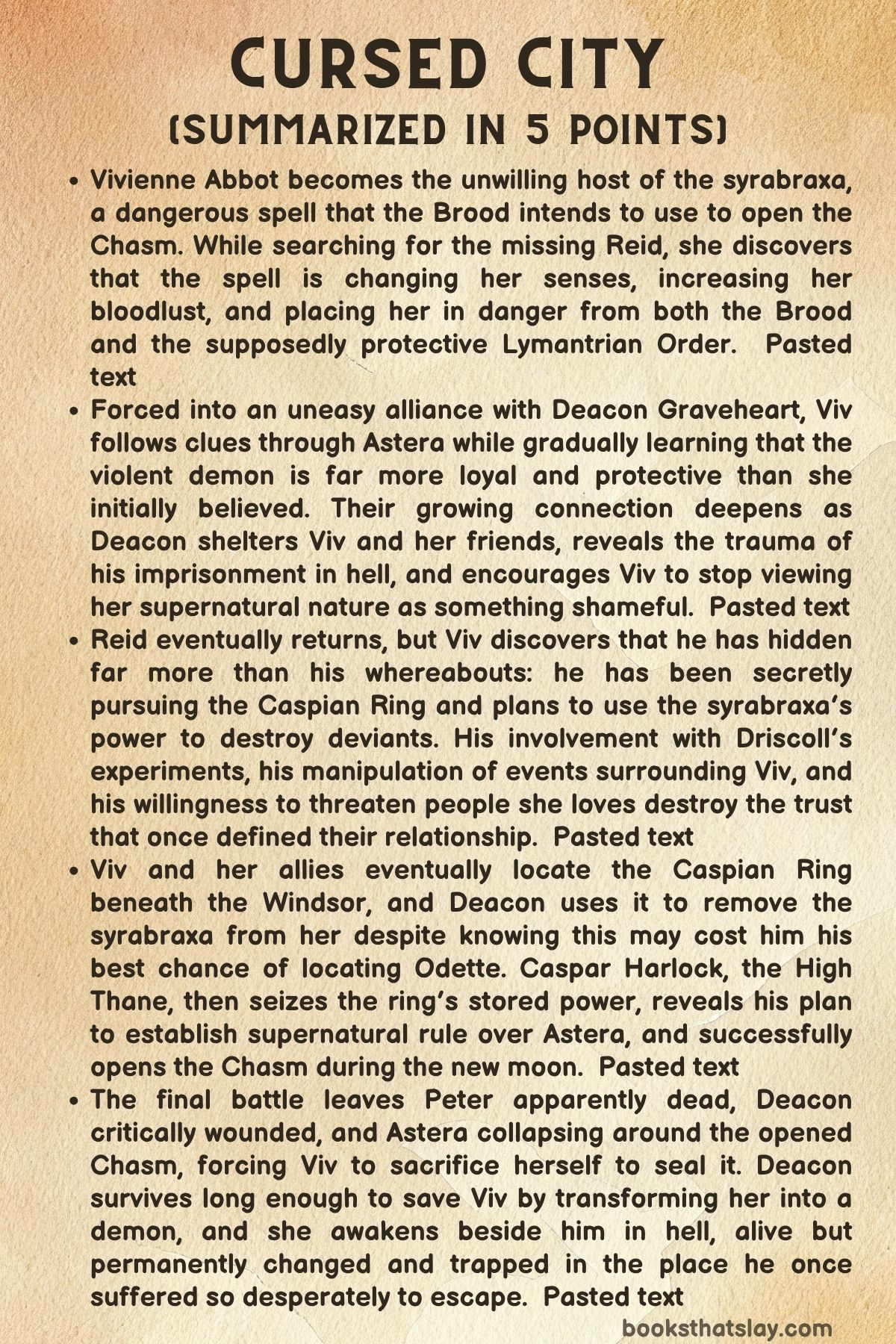
Cursed City begins immediately after Vivienne Abbot escapes the Brood, carrying the syrabraxa inside her body after Dean Driscoll implanted the spell along her spine. Reid has been left behind during the escape, and when Viv reaches Deacon Graveheart’s nightclub, Fever Dream, she discovers that Reid has disappeared into Brood custody while her own condition may kill her within months.
Deacon wants to confine Viv for her own protection, but she refuses to remain powerless while Reid may be suffering. After escaping Fever Dream, she returns to Penny, finally tells her the truth about hunters, deviants, Harker Academy, her father, and Driscoll, and brings Penny into the supernatural world that Viv has hidden from her for years.
Viv confesses to Fiona and her friends that she is the syrabraxa host. Because the Elders might kill her rather than risk the spell reaching the Brood, Fiona agrees to conceal the truth while Sophia, Peter, Elliot, Penny, and Viv begin searching for Reid independently.
Their investigation takes them to an abandoned cinema where Viv unexpectedly encounters Deacon and Ward. When members of the Brood arrive, Viv and Deacon are forced into an uneasy alliance, and their interrogation of a captured vampire produces a useful lead: Finn attends secret gatherings at an exclusive establishment known as the Manor.
Viv accompanies Deacon to the Manor while pretending to be his escort. Her developing syrabraxa senses allow her to identify Finn, and while secretly following him she and Deacon learn that Reid escaped captivity alive.
The news brings relief but also confusion because Reid makes no attempt to contact Viv. As weeks pass, the syrabraxa becomes increasingly aggressive, sharpening her supernatural perception, creating violent cravings, invading her dreams, and causing physical pain whenever she resists its demand that she kill deviants.
Viv and her friends search for a cure while a new Citadel instructor, Landon, arrives at Harker. A trip to Shiloh Asylum leads to another disturbing episode when Viv nearly loses control while killing a werewolf, but soon afterward she receives a silver camera from Reid, proving that he is still alive.
The attempt to locate Reid magically requires Deacon’s blood. A ritual reveals that Reid has secretly been hiding somewhere on Harker grounds, increasing Viv’s frustration because she cannot understand why someone who claims to care for her would allow her to believe he might be dead.
At a family event, Viv receives a far more dangerous revelation. Caspar Harlock, the sophisticated billionaire close to her mother, is not merely part of supernatural society; he is Deacon and Reid’s uncle and the High Thane who rules the Brood.
Viv and Fiona bring their information to the Elders, but Professor Dawnmere must first use fairy magic to hide Viv’s syrabraxa. During the meeting, Viv discovers that the five seemingly ancient human leaders of the Lymantrian Order are themselves supernatural beings, destroying another assumption on which her identity as a hunter was built.
Her trust in Harker deteriorates further when Landon catches her with Deacon and takes them to the magical Mer. The Mer recognize the darkness inside Viv and give her the cryptic clue “the band lights the attic,” while Deacon kills Citadel hunters to prevent them from taking her to the Elders.
Unable to remain at Harker, Viv moves into Fever Dream with Penny and Hound. Living among Deacon’s people changes her impression of him because she discovers loyalty, friendship, film, art, and private vulnerability beneath the violent persona he normally presents.
Deacon also reveals that Caspar has imprisoned a woman named Odette whom he desperately wants to find. He hopes Viv’s expanding supernatural senses will eventually become strong enough to locate her, giving him a personal reason for keeping Viv alive that has nothing to do with Reid.
Meanwhile, Reid’s photographs lead Viv toward Simon and Son’s, where she encounters Nicco, a djinn magically compelled to conceal information about a powerful artifact. By working around the wording of the commands controlling him, Viv realizes that the object she needs is a ring.
Her friends identify it as the Caspian Ring, an ancient relic capable of removing magical afflictions. The discovery gives Viv genuine hope, yet her worsening bloodlust and increasingly intimate connection with Deacon make her question whether she can still trust her own emotions.
Finn eventually attacks Fever Dream with a large Brood force. Viv and Deacon escape to Harker and hide together in the archives, where Deacon finally reveals the scars covering his body and admits that his own father once banished him to hell, where he suffered prolonged torture.
Their emotional closeness deepens during the night. Deacon encourages Viv to stop treating her aeon nature as something shameful, and for the first time in years he falls asleep without nightmares while beside her.
The following morning Reid finally appears. Viv is overjoyed to see him alive, but their reunion is damaged by months of secrecy, his jealousy toward Deacon, and Viv’s inability to ignore how much she herself has changed.
Reid explains that he has secretly been searching for the Caspian Ring so he can save Viv. She tries to rebuild their romantic relationship, yet something remains wrong: Reid disappears without explanation, avoids difficult questions, and seems uncomfortable with parts of Viv that Deacon has taught her to value.
Another family revelation leads Viv to Ada Cadell, the grandmother she believed lost to history. The mysterious woman Viv encountered at Shiloh was actually Ada, an aeon who once carried a syrabraxa and survived, meaning Caspar now possesses access to another possible host.
With the new moon approaching, Caspar can use the syrabraxa to open the Chasm. Viv’s group realizes that finding the Caspian Ring before him is no longer merely about saving Viv; it may be the only way to stop a supernatural catastrophe.
The greatest personal betrayal comes at Harker when Viv discovers that Reid has secretly been working with Orin and manipulating events for years. Reid reveals that he sees himself as the rightful heir to the Throne of Bael and intends to acquire the syrabraxa’s power so he can destroy deviants on a massive scale.
His deception extends backward through Viv’s entire relationship with him. He knew about Driscoll’s experiments, knew girls were being used as potential hosts, knew Viv was the aeon Driscoll needed, and passed along information that contributed to Penny’s kidnapping.
Reid insists that his love for Viv is genuine, but Viv realizes that genuine affection does not excuse manipulation. His willingness to threaten Fiona and Nora demonstrates that he has placed his mission above the safety of people Viv loves.
After the betrayal, Deacon gives Viv the full history of the Graveheart family. He admits killing the woman Reid once loved, explains how their father manipulated both brothers, and reveals that the events surrounding her death contributed to Deacon’s banishment to hell.
Deacon also explains that Odette became Caspar’s hostage because of his attempt to protect her. Viv promises that even if the syrabraxa is removed and her locating ability disappears, she will still help Deacon find Odette, transforming their alliance into a commitment that extends beyond immediate necessity.
At the ACFAC gala, Caspar arrives with Ada while presenting himself publicly as a political reformer supporting Beatrice’s mayoral campaign. His speech reveals that he is already preparing Astera’s human institutions for the authoritarian supernatural order he intends to impose once the Chasm is opened.
Viv, Deacon, Sophia, Peter, Ward, and the others descend into ancient catacombs beneath the Windsor. After fighting an ogre and deciphering the Mer’s clue, Viv finally discovers the Caspian Ring.
Viv hesitates because removing the syrabraxa means losing the ability that might help locate Odette. Deacon refuses to allow her to sacrifice herself for him and places the ring on her hand, causing the relic to draw the syrabraxa out of her body and finally freeing her from the spell.
Their victory lasts only moments because Reid arrives demanding the ring, followed by Caspar, the Brood, Ada, and Beatrice. The confrontation forces Viv to balance several impossible priorities: protecting her family, preventing Reid from obtaining catastrophic power, saving Ada, and stopping Caspar from opening the Chasm.
Caspar eventually gains the ring and channels the syrabraxa’s stored power. Contrary to everyone’s expectations, the spell does not drive him mad, and he remains fully aware as he releases its force into the ground and opens the Chasm beneath Astera.
The catacombs collapse as Viv and her companions fight for survival. Deacon suffers terrible injuries, Sophia’s leg is badly damaged, and Peter returns into the collapsing chamber to recover the ring.
Peter encounters Finn and knowingly sacrifices his own chance to escape so the others can kill him. Finn is destroyed, but the ceiling collapses on Peter, leaving Sophia devastated.
Viv ultimately chooses to sacrifice herself to seal the Chasm. She believes she dies after closing the rupture, having accepted that protecting Astera may require the loss of her own life.
Instead, a severely injured Deacon crawls through the ruins to reach her. Unable to accept her death, he transforms Viv into a demon and saves her life.
Viv awakens in hell, where silver burns her and her body can transform into demonic form. Her sacrifice successfully sealed the Chasm, but that success also means there is no open path back to the mortal world.
Deacon is there with her because he chose to follow rather than abandon her. Cursed City therefore ends with Viv alive but permanently transformed, separated from the human identity she once fought to preserve and trapped beside Deacon in the very place whose memories have haunted him for centuries.
Characters
Vivienne Abbot
Vivienne is the emotional and moral center of Cursed City, and her development depends on the collapse of almost every certainty with which she begins the story. She starts as a trained hunter who instinctively divides the supernatural world into humans worth protecting and deviants who are potential threats, but becoming the host of the syrabraxa forces her to experience violent instincts, altered senses, supernatural dreams, and forms of power that make such categories increasingly difficult to maintain.
Her greatest strength is her refusal to surrender responsibility for her own decisions. Even when Deacon, Fiona, Reid, the Elders, and the Brood all have different ideas about what should happen to her body, Viv continually insists on making the choice herself, whether that means escaping Fever Dream, confronting Finn, protecting Penny, searching for the ring, or sacrificing herself to close the Chasm.
Viv’s emotional arc is equally important. Reid initially represents the form of love she thinks she wants, while Deacon gradually becomes the person who sees the parts of her that she has spent years treating as shameful and refuses to ask her to diminish them.
By the conclusion, Viv has lost the syrabraxa only to become a demon. The transformation is deeply ironic because the woman trained to kill deviants is now one herself, leaving her final identity radically different from anything she could have imagined at the beginning.
Deacon Graveheart
Deacon is one of the most complicated figures in Cursed City because cruelty, loyalty, violence, humor, trauma, and affection coexist in him without fitting comfortably into conventional categories. He initially appears dangerous and morally careless, killing enemies without hesitation and repeatedly mocking Viv’s human ethical boundaries.
Life at Fever Dream reveals another side of him. Baz, Ward, his employees, Penny, and eventually Viv are treated as members of a community he protects, while his determination to find Odette demonstrates that attachment and loyalty drive many of his decisions.
His history in hell explains much of his relationship with pain. The scars across his body, brutal nighttime workouts, insomnia, nightmares, and willingness to treat injury casually are not evidence that suffering means nothing to him; they reveal how thoroughly he has learned to survive it.
Deacon’s importance to Viv comes from his refusal to see her aeon nature as contamination. Where Viv has learned to fear her own aggression and abnormality, Deacon sees power that can be directed toward protection, and that acceptance becomes crucial to her developing self-respect.
His final decision defines him most clearly. Returning to the hell that traumatized him in order to reach Viv, then transforming her rather than allowing her to die, demonstrates that his attachment has become stronger than his deepest fear.
Reid Graveheart
Reid undergoes the darkest reversal in Cursed City. Much of the early novel positions him as the missing man Viv desperately loves and Deacon reluctantly searches for, encouraging both Viv and the reader to interpret his secrecy through suffering, shame, and captivity.
His eventual return reveals that these explanations contain truth without containing the whole truth. Reid was tortured by Finn, did search for the Caspian Ring partly to save Viv, and does appear genuinely capable of loving her, yet those facts exist beside deliberate manipulation and an ideological commitment to exterminating deviants.
Reid’s tragedy is that he believes moral purpose can redeem destructive methods. His desire to protect mortals and challenge powerful demons may contain legitimate grievances, but he becomes willing to endanger Penny, exploit Driscoll’s experiments, threaten Fiona and Nora, and use Viv’s condition as part of a much broader campaign.
His contrast with Deacon is especially revealing. Deacon openly presents himself as dangerous while repeatedly demonstrating loyalty; Reid presents himself as principled while concealing ambitions that require betrayal.
Reid is therefore not simply exposed as someone who never cared about Viv. His love appears real, which makes his betrayal more disturbing because the book shows that affection can exist alongside manipulation, entitlement, secrecy, and terrible choices.
Penny
Penny gives Cursed City one of its strongest examples of ordinary human courage. She enters the supernatural conflict without Viv’s training, aeon abilities, or magical heritage, yet repeatedly refuses to accept the role of helpless civilian.
Her initial reaction to Viv’s years of secrecy includes understandable hurt, but that disappointment never becomes abandonment. Penny follows Viv into dangerous investigations, uses her technical abilities to bypass security, lives secretly at Harker, later stays at Fever Dream, and becomes an important practical member of the group.
Penny also develops independently of Viv. Her closeness with Ward and her refusal to leave Astera demonstrate that the supernatural community is becoming part of her own life rather than something she experiences only through her roommate.
Her role challenges Viv’s protective instincts. Viv repeatedly wants to keep Penny away from danger, but Penny insists that friendship does not mean allowing Viv to make every decision for her.
That resistance matters because it mirrors Viv’s own struggle against people who claim to control her for her protection. Penny therefore helps expose the difference between caring for someone and denying that person agency.
Sophia
Sophia is among Viv’s most dependable allies and represents the solidarity Viv eventually discovers within the hunter community. She participates in dangerous searches, fights beside Viv against Brood forces, helps research the Caspian Ring, and repeatedly accepts enormous personal risk without turning Viv’s supernatural condition into a reason for fear or rejection.
Her competence becomes especially visible during the catacomb mission. Sophia fights the ogre with exceptional skill and continues participating even as the situation grows more dangerous.
Her relationship with Peter adds a quieter emotional dimension. Peter’s love for her is visible to the group long before he confesses it, while Sophia’s eventual devastation at his apparent death emphasizes how much their bond mattered even before it was formally defined.
Sophia therefore represents a form of loyalty based on action rather than declarations. She may not dominate the political conflicts around the Brood and the Elders, but when Viv needs someone beside her, Sophia is repeatedly there.
Peter
Peter begins as a friend whose limitations are clearly visible. He freezes during the werewolf attack near Shiloh and is ashamed of himself afterward, showing that knowledge and good intentions do not automatically produce courage under pressure.
His later actions show meaningful growth. Peter continues helping Viv research the syrabraxa and Caspian Ring, participates in increasingly dangerous missions, and remains involved even after learning how powerful their enemies really are.
His feelings for Sophia also reveal his gentleness and insecurity. He is terrified that admitting his love will destroy their friendship, making his hesitation emotionally understandable rather than cowardly.
Peter’s apparent death gives his arc its tragic culmination. He returns into the collapsing catacombs to recover the ring and then sacrifices his opportunity to escape so that Finn can be destroyed, turning the person who once froze in battle into someone capable of acting decisively when the people he loves depend on him.
Elliot
Elliot functions as one of the stable members of Viv’s Harker circle. He participates in investigations, joins visits to Fever Dream, researches the crisis with the others, and helps maintain the network of trust that keeps Viv from becoming completely isolated.
His importance is less about a private personal conflict than about consistency. Even as Viv becomes a target of the Brood, leaves Harker, hides among deviants, and becomes increasingly difficult for the Order to understand, Elliot continues treating her as a friend rather than a problem to be contained.
That loyalty becomes particularly important once institutions fail Viv. Elliot, Sophia, Peter, and Penny collectively create an alternative community based on personal trust rather than official authority.
Fiona
Fiona occupies a difficult position between personal loyalty and institutional faith. As interim dean, she has responsibilities to Harker and the Lymantrian Order, yet she repeatedly protects Viv even when doing so requires withholding information from the Elders.
Her reaction to discovering that the Elders are deviants reveals how deeply institutional identity has shaped her. Fiona initially struggles to accept the implications because admitting the truth would mean questioning the authority around which much of her life has been organized.
Yet she never becomes merely obedient. She protects Penny, hides Viv’s condition, helps investigate Caspar, and later suffers physical violence rather than willingly cooperate with Reid.
Fiona therefore represents someone confronting the painful difference between an institution’s stated ideals and its concealed reality. Her growth lies not in instantly abandoning everything she believed but in continuing to choose people and evidence even when those choices destabilize her worldview.
Caspar Harlock
Caspar is the principal architect of the supernatural crisis in Cursed City, but his menace comes partly from how successfully he functions within ordinary human society. He is not introduced publicly as a monstrous ruler; he appears as a wealthy businessman, philanthropist, political supporter, and trusted associate of Beatrice.
That disguise reflects his broader strategy. Caspar does not merely want to unleash supernatural violence but to reshape Astera politically, using human institutions and public fears to prepare society for a future in which deviants openly dominate.
His treatment of family is similarly instrumental. Finn serves him, Odette becomes leverage over Deacon, Ada becomes a possible magical resource, and Beatrice becomes a political tool.
The gala exposes the scale of his ambition. His public language about order and crime disguises his intention to establish authoritarian supernatural rule, while his private actions show that people matter to him primarily according to their usefulness.
His successful opening of the Chasm also makes him more dangerous than his enemies anticipated. Their belief that the syrabraxa would destroy his sanity proves false, allowing Caspar to claim immense power without losing control.
Finn
Finn embodies the Brood’s cruelty in its most openly sadistic form. Unlike Caspar, who relies on social respectability and long-term calculation, Finn takes obvious pleasure in violence, intimidation, murder, and domination.
His obsession with Reid and Viv makes him a constant physical threat throughout the story. He tortures Reid, pursues Viv, attacks Fever Dream, murders Deacon’s flight crew, and eventually fights amid the collapse beneath the Windsor.
Viv’s dream from Finn’s perspective reveals how deeply cruelty defines him. His treatment of mortals and captive supernatural beings suggests that violence is not merely a political tool but a source of personal gratification.
His final confrontation with Peter completes his role as one of the novel’s clearest embodiments of predatory power. Finn is eventually destroyed, but Peter’s sacrifice ensures that the victory carries a devastating cost.
Ward
Ward initially appears as one of Deacon’s physically intimidating supernatural allies, but his behavior gradually reveals reliability, loyalty, and emotional depth. His willingness to fight beside Viv despite injuries shows how seriously he treats membership in Deacon’s chosen community.
His growing closeness with Penny is particularly important. Their relationship helps demonstrate that the barrier Viv once imagined between human beings and deviants is far less absolute than hunter ideology suggests.
Ward also acts as evidence for Deacon’s capacity to inspire loyalty without ruling through the fear associated with Caspar. He follows Deacon because of personal allegiance, not because supernatural hierarchy forces him to obey.
That distinction makes Ward more than a powerful fighter. He becomes part of the alternative social structure forming around Fever Dream, where humans and supernatural beings create bonds that contradict the rigid divisions promoted elsewhere.
Baz
Baz plays a quieter but important role in Deacon’s circle. He saves Viv early by giving her vampire blood, later answers questions about the previous syrabraxa host, and remains loyal to Deacon throughout the escalating conflict.
His knowledge of earlier supernatural events makes him valuable because he connects Viv’s current crisis with a longer history. He also refuses to pretend that he will keep secrets from Deacon, emphasizing the trust operating inside their group.
Baz reinforces Viv’s growing understanding that being a deviant says very little about a person’s actual morality. His actions are often more protective than those of the official authorities supposedly dedicated to protecting humanity.
Beatrice Abbot
Beatrice represents Viv’s ordinary family life and the dangerous ignorance separating the mortal and supernatural worlds. She expects Viv to participate in family events, political appearances, and social obligations without realizing that her daughter is carrying a supernatural weapon and being hunted by some of Astera’s most powerful beings.
Her relationship with Caspar makes that ignorance especially consequential. She interprets him through his mortal reputation and accepts his political assistance without understanding that he is using her ambitions as part of his plan for Astera.
The confrontation beneath the Windsor finally destroys that protective ignorance. Beatrice is forced to see Caspar’s supernatural identity and recognize how completely her political world has been manipulated.
Her presence also raises the emotional stakes for Viv. Saving Astera is no longer an abstract duty when Viv must simultaneously protect a mother who never understood the war being fought around her.
Nora Abbot
Nora remains less involved in the supernatural conflict than Beatrice, but her importance lies in what she represents to Viv. She belongs to the family life Viv has tried to keep separate from hunting, the Brood, and the syrabraxa.
Reid’s willingness to mention Brood forces near Nora’s home becomes a decisive sign of how far he has fallen. By using Nora as implied leverage, he crosses directly into threatening someone whose only relevance to the conflict is her relationship to Viv.
Nora therefore helps measure the personal cost of secrecy. Viv’s determination to tell her family the truth if she survives reflects an understanding that ignorance has stopped being protective once enemies know exactly whom she loves.
Dean Driscoll
Driscoll’s death does not remove his influence from the story. He created the immediate crisis by experimenting with the syrabraxa, murdering David Cadell, identifying Viv as a suitable host, and placing the spell inside her body.
His betrayal also corrupts Viv’s understanding of Harker. A dean who represented hunter authority was secretly willing to sacrifice young women and cooperate with forces that the institution claimed to oppose.
The fact that Harker publicly mourns him as an innocent leader becomes especially painful for Viv. She knows the truth but cannot reveal it safely, forcing her to watch an institution preserve a false image of a man responsible for enormous suffering.
Driscoll therefore remains a symbol of corruption concealed beneath respectable authority. His actions prepare Viv to question the Elders later because she has already learned that prestigious titles do not guarantee moral legitimacy.
Landon
Landon arrives as a disciplined Citadel hunter and initially appears to represent competent institutional authority. His demanding combat instruction and determination to uncover Viv’s secrets make him an immediate source of pressure.
His attempt to expose Viv through the Mer demonstrates the danger of his certainty. Landon believes uncovering hidden supernatural influence is inherently justified, but his methods place Viv directly in danger and contribute to the violence that finally drives her away from Harker.
He is therefore not written with the obvious sadism of Finn or the ideological ambition of Reid. His danger comes from confidence in a system whose leaders are concealing fundamental truths from the people serving them.
Professor Dawnmere
Professor Dawnmere represents a more compassionate use of supernatural knowledge. When Viv and Fiona reveal the syrabraxa, she provides magical concealment rather than treating Viv as something that must immediately be destroyed.
Her willingness to sacrifice part of her fairy wing to help Viv approach the Elders illustrates both personal generosity and quiet resistance. She works within Harker yet does not blindly prioritize institutional procedure over an individual life.
Dawnmere’s role also reinforces the growing instability of hunter categories. Someone visibly connected to supernatural magic becomes one of the people who protects Viv from the supposedly supreme leadership of the hunting Order.
Ada Cadell
Ada is crucial because she transforms Viv’s condition from an apparently unprecedented disaster into part of a family history. Once Viv realizes that the mysterious Shiloh patient is her grandmother, she also realizes that another aeon carried a syrabraxa and survived.
Ada therefore represents both hope and danger. Her survival proves that the spell does not necessarily guarantee immediate death, but it also makes her another potential host Caspar can exploit.
Her connection to David and Viv deepens the generational dimension of the conflict. The supernatural struggle has affected the Cadell family across decades, linking Viv’s current suffering with secrets that existed long before she understood her father’s true life.
Odette
Odette is absent physically but enormously important to Deacon’s motivations. Caspar’s control over her explains why a demon as powerful and rebellious as Deacon has avoided a direct confrontation with the High Thane for so long.
She also changes Viv’s understanding of Deacon. His desperation to locate Odette proves that beneath his apparent selfishness he is capable of maintaining loyalty across years of uncertainty and helplessness.
Viv’s promise to continue searching for Odette even after losing the syrabraxa becomes an important emotional turning point. It tells Deacon that her commitment to him is no longer dependent on what supernatural usefulness she can provide.
Orin
Orin becomes most important when his relationship with Reid exposes the truth about Reid’s secret agenda. Viv enters the Harker archives expecting Orin to be an obvious Brood enemy, only to discover that he treats Reid as someone whose commands deserve obedience.
That moment destroys Viv’s remaining assumptions about Reid before he has even explained himself. Orin therefore functions as the visible evidence of a conspiracy that had previously existed only through unanswered questions and inconsistencies.
His presence demonstrates that Reid has not merely been conducting private research. Reid has built working relationships with dangerous supernatural figures while presenting himself to Viv as someone fundamentally opposed to their world.
Nicco
Nicco is a djinn trapped by the wording of wishes made centuries earlier. His inability to reveal the Caspian Ring directly makes him less a willing obstacle than a victim of supernatural compulsion.
Viv’s response to him reveals an important aspect of her morality. She recognizes that his violence is involuntary and protects him from Deacon’s retaliation rather than treating his supernatural nature as proof of guilt.
His magical restrictions also reinforce one of the story’s recurring concerns with control. Nicco technically lives freely, yet ancient commands still govern what he can say and force him to attack anyone who comes too close to the secret he was ordered to protect.
Hound
Hound provides companionship amid increasingly violent circumstances. His attachment to Penny and later to Deacon helps soften the atmosphere around Fever Dream while also revealing unexpected tenderness in people Viv initially sees as threatening.
Deacon’s claim that he does not like dogs becomes less convincing as Hound immediately attaches himself to him. These small interactions matter because they show ordinary affection existing inside a world otherwise dominated by torture, political schemes, magical violence, and betrayal.
Themes
Identity Beyond Categories
Viv’s transformation challenges the belief that human, hunter, aeon, demon, and deviant can function as simple moral categories. At the beginning, she has been trained to associate supernatural difference with danger, yet the people who repeatedly protect her include vampires, demons, werewolves, fairies, and other beings whom hunter culture teaches her to approach with suspicion.
Cursed City gradually separates identity from morality. Driscoll is a hunter and betrays the principles his institution claims to defend, the Elders lead the Lymantrian Order while secretly being supernatural themselves, Reid presents himself as an enemy of deviants while committing serious betrayals, and Deacon openly embraces his demonic nature while repeatedly risking himself for others.
Viv’s aeon identity sits at the center of this conflict. She initially experiences her supernatural senses and violent instincts as evidence that something is wrong with her, especially once the syrabraxa intensifies them.
Deacon offers a radically different interpretation by arguing that strength and aggression do not determine how she will use them. Viv begins recognizing that morality lies in choice rather than species, power, or instinct.
The ending makes that lesson irreversible. Viv becomes a demon, meaning she can no longer preserve any emotional distance between herself and the category she was trained to hunt.
Her future therefore depends on accepting that identity can contain contradiction. Becoming supernatural does not erase the values that made her willing to sacrifice herself for Astera, just as being human or a hunter never guaranteed virtue in anyone else.
Power, Control, and Personal Agency
Nearly every major conflict involves someone attempting to control another person’s body, abilities, choices, information, or future. Driscoll turns Viv into the syrabraxa host without her consent, Caspar intends to use a host to open the Chasm, the Elders may sacrifice Viv to protect their political balance, and Reid wants access to the spell because it can advance his ideological mission.
Even characters who love Viv occasionally attempt to decide what is best for her. Deacon initially confines her at Fever Dream, Fiona withholds information for protective reasons, and Reid conceals his plans while claiming that his ultimate goal includes saving her.
Viv repeatedly rejects this pattern. Escaping confinement, investigating Reid, choosing her allies, deciding how to handle the Caspian Ring, and finally sacrificing herself are expressions of her insistence that her life cannot become property simply because others consider their goals important.
The theme also appears through secondary characters. Nicco is bound by wishes that override his will, Odette is kept as leverage over Deacon, Penny resists Viv’s attempts to exclude her from danger, and the possessed Harker students become literal examples of bodies controlled by another power.
The story therefore treats agency as a moral boundary. Protection becomes dangerous when it turns into ownership, and good intentions do not excuse stripping another person of the right to choose.
Viv’s development reflects her growing awareness of this principle. She learns that caring about someone requires respecting that person’s decisions even when fear makes control seem easier.
Love, Loyalty, and Betrayal
The novel repeatedly asks whether love is meaningful when it exists beside secrecy, manipulation, violence, or conflicting loyalties. Viv’s relationships with Reid and Deacon provide the clearest contrast because both men care for her, yet their ways of expressing that attachment move in opposite directions as the story develops.
Reid’s love appears genuine, but he repeatedly denies Viv information that would allow her to make informed choices. He knows far more about Driscoll, the syrabraxa, and the supernatural struggle than he admits, and his larger mission eventually takes priority over the safety of people Viv loves.
His betrayal is therefore painful precisely because his feelings are not necessarily false. The story suggests that love can be sincere and still become harmful when mixed with entitlement, secrecy, and ideological obsession.
Deacon begins from the opposite position. He openly presents himself as immoral, dangerous, and unwilling to conform, yet gradually proves dependable through action.
He protects Viv, houses her friends, allows her to see his trauma, removes the syrabraxa despite the possibility that doing so will prevent her from finding Odette, and finally follows her into hell. His loyalty becomes increasingly credible because it repeatedly costs him something.
Friendship follows the same pattern. Penny, Sophia, Peter, Elliot, Fiona, Ward, and Baz continue standing beside one another even when institutional systems become unreliable.
The book therefore treats loyalty as something proved under pressure. Words matter, but the decisive measure is what characters are willing to risk when another person’s survival conflicts with convenience, ambition, fear, or self-interest.
Institutional Corruption and the Illusion of Moral Authority
Harker and the Lymantrian Order initially represent structure, training, protection, and moral certainty. Viv’s experiences gradually expose how fragile those assumptions are, beginning with Driscoll and culminating in the discovery that the Elders themselves are supernatural beings who have hidden their identities while governing an organization devoted to hunting deviants.
Cursed City does not simply argue that institutions are secretly evil. Instead, it shows how systems preserve power by controlling information, maintaining acceptable public narratives, and teaching members to trust authority before asking difficult questions.
Driscoll is publicly mourned even though Viv knows what he did. The Elders maintain enormous wealth and longevity while refusing to explain their own nature, and Citadel hunters such as Landon enforce institutional suspicion without understanding the full truth behind the commands they follow.
Caspar mirrors this structure from the opposite side. He builds mortal political influence through money, philanthropy, public fear, and Beatrice’s campaign, proving that supernatural domination can operate through respectable civic institutions as effectively as through physical violence.
Viv eventually learns to judge systems by conduct rather than reputation. Fever Dream appears criminal and dangerous yet becomes a place where her friends receive protection, while Harker appears honorable yet becomes somewhere she must flee.
The contrast does not replace one unquestioned authority with another. Instead, the story pushes Viv toward independent moral judgment, forcing her to evaluate people and institutions through evidence, choices, and consequences rather than inherited labels.