Daggermouth Summary, Characters and Themes
Daggermouth by HM Wolfe is a dystopian story of political cruelty, rebellion, inherited violence, and unexpected loyalty in the divided city of New Found Haven.
At its center are Greyson Serel, the masked executioner and son of a dictator, and Shadera Kael, a deadly mercenary hired to assassinate him. Their first encounter should make them permanent enemies, yet the oppressive system controlling both their lives forces them into an alliance neither wants. Around them, rebels, family members, spies, soldiers, and survivors prepare for a conflict that will expose how deeply personal tyranny can become and how difficult it is to separate guilt from survival.
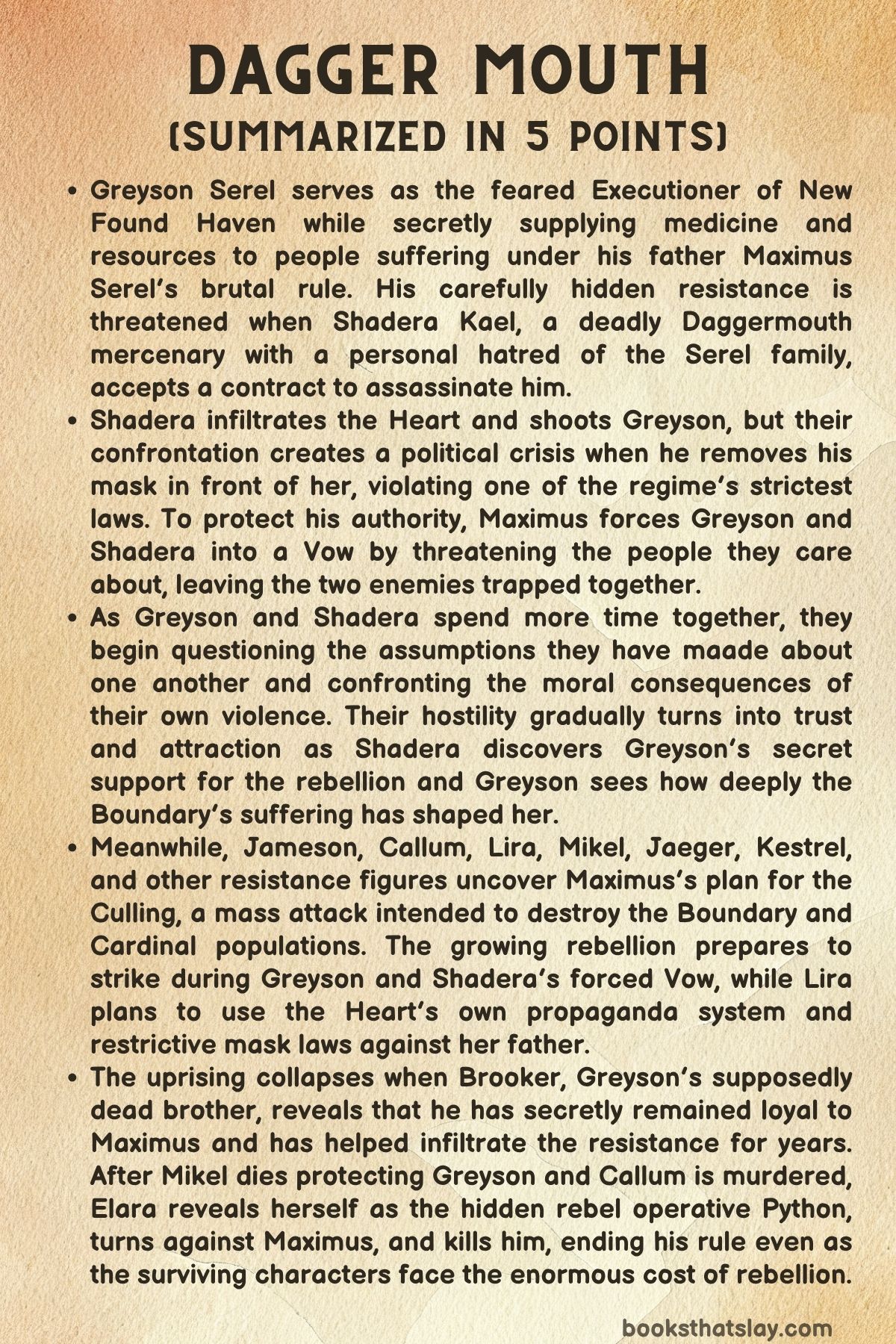
Summary
New Found Haven is divided into social rings whose differences determine nearly every part of a person’s life. At the center is the wealthy Heart, ruled by President Maximus Serel, while the Boundary and Cardinal rings endure hunger, environmental damage, limited medicine, surveillance, and violent punishment.
Greyson Serel, Maximus’s son, serves publicly as the Heart’s Executioner. He has been raised to believe that mercy is weakness, yet beneath the mask he increasingly questions the regime he represents.
During the execution of two people condemned for loving across faction boundaries, Greyson hesitates before killing the woman. Captain Mikel completes the execution, leaving Greyson publicly exposed as someone capable of compassion in a society where compassion can be interpreted as weakness.
Greyson’s secret life is even more dangerous. He steals food stamps, medicine, bandages, and other supplies and hides them beneath patrol vehicles so rebels in the poorer rings can retrieve them.
His private opposition to the regime does not erase his guilt. Greyson has executed hundreds of people, and he understands that helping some victims cannot undo the deaths he has caused.
His father responds to his hesitation by ordering him to complete a ceremonial Vow with Moraine Daunt. The marriage is intended to reinforce Greyson’s loyalty and remind him that even his personal life belongs to Maximus.
At the same time, Shadera Kael, one of the Boundary’s most dangerous Daggermouth mercenaries, receives a contract from Jaeger Nolin to assassinate Greyson. The payment could feed Boundary families for a year, but money is not her only motivation.
Maximus ordered the execution of Shadera’s parents when she was a child. She has spent years hating the Serel family and regards Greyson as another willing participant in the same oppressive machine.
Shardera enters the Heart through maintenance routes and positions herself to kill Greyson. She even watches him execute a woman whose crime involved smuggling medicine, strengthening her belief that he deserves to die.
Rather than shoot him from a distance, however, she decides he should see the person killing him. She wants Greyson to understand why he is being punished.
Their confrontation becomes a violent fight in which each discovers that the other is far more formidable than expected. Shadera eventually shoots Greyson in the abdomen.
Instead of begging for his life, Greyson seems almost willing to die. He then removes his mask in front of her, violating one of the Heart’s most serious laws because an elite face may normally be seen only by someone joined to that person through a Vow.
Before Shadera can finish the assassination, Veyra officers and members of the Serel and Daunt families enter. What began as a murder attempt becomes a political crisis.
Maximus eventually discovers a legal solution that can protect the regime from embarrassment. If Greyson and Shadera complete a Vow, the illegal unmasking can be reinterpreted as part of an eventual marital bond.
Both refuse, but Maximus threatens people they love. Jameson, Boundary clinics, Lira, Callum, and countless civilians become leverage, leaving Greyson and Shadera with no meaningful choice.
Shardera is moved into Greyson’s apartment before the ceremony. Their early interactions are hostile, physical, and charged by years of assumptions about one another.
She sees a privileged executioner who has willingly killed the oppressed. He sees a Daggermouth killer belonging to the group he believes murdered his older brother, Brooker.
Gradually, their certainty begins to weaken. Shadera notices evidence that Greyson has suffered years of abuse from Maximus, while Greyson is forced to confront the reality of poverty in the Boundary through someone who has actually lived it.
They also recognize unsettling similarities between themselves. Greyson kills under the authority of the state; Shadera kills under contracts accepted through the Daggermouths.
Each has built moral arguments around violence. Their growing closeness forces both to question whether those arguments are as strong as they once believed.
Meanwhile, resistance activity expands. Jameson Vine, revealed to be the rebel commander known as Ghost, discovers that food supplies are collapsing and Heart surveillance drones are mapping the Boundary with disturbing precision.
Callum Thane, Greyson’s closest friend, operates another hidden network inside the Heart. His clubs provide access to information, protection, and secure spaces beyond ordinary surveillance.
Lira Serel, Greyson’s sister, also begins moving against their father. She has spent years helping create propaganda for Maximus, but the violence inside her own family eventually convinces her that survival alone is no longer enough.
Greyson and Shadera’s relationship changes further when Maximus abuses his children during a family confrontation and shoots Greyson. Shadera tends to Greyson’s wound and reveals that Maximus executed her parents.
Greyson allows her to see the scars and markings created by the life his father forced upon him. Their identities as assassin and executioner become less important than the shared understanding that Maximus has shaped both their lives through violence.
Their attraction grows, but so does the danger surrounding them. Greyson eventually reveals the brutal legal meaning of the Vow: Shadera will lose significant independence, and the ceremony demands sexual proof of the marriage.
Greyson assures her that he will never force himself upon her. His rejection of the ritual shows Shadera that his opposition to the Heart is not merely private resentment but a genuine rejection of its values.
Jameson eventually infiltrates the Heart with Jaeger and discovers that Captain Mikel is secretly cooperating with the resistance. When Jameson reaches Shadera, he offers her a way out.
She chooses to stay. Escaping would give Maximus an excuse to slaughter innocent people, and Greyson reveals that he is the unknown Heart contact who has been secretly supplying medicine to the rebels.
The decision changes Shadera’s relationship with Jameson. His love for her remains real, but she can no longer return to the uncomplicated connection they once shared.
The resistance soon uncovers an even greater threat. Maximus is developing gas weapons for a planned mass killing known as the Culling, intended to eliminate the Boundary and Cardinal populations while leaving the Heart protected.
The discovery becomes personal when Lira recognizes a captured surveillance officer as one of the men who abused her during childhood. Maximus had effectively offered his own daughter to officers as a way of securing loyalty.
Lira kills the man herself and refuses to allow anyone to interpret what happened to her as evidence of weakness. Her anger becomes another force pushing the rebellion toward open conflict.
Soon afterward, Maximus separates Greyson and Shadera and imprisons them. While they are confined in neighboring cells, he reveals information designed to destroy their fragile trust.
Brooker, Greyson’s supposedly murdered brother, had secretly lived under the name Levi Pierce. Shadera had once accepted the contract to kill Levi without knowing his true identity.
Maximus then reveals that he himself arranged contracts against both sons. Their apparent deaths at Daggermouth hands could be used to justify exterminating the outer rings and replacing their populations with wealthy outsiders.
Shardera is devastated by the possibility that her entire moral understanding of Daggermouth work has been built on manipulated information. If one contract could be based on lies, she cannot know how many of her previous victims were falsely presented as deserving targets.
Greyson is equally shattered. He had begun to trust and care for the woman who now appears responsible for his brother’s death.
Outside their prison, however, the rebellion discovers that Brooker is actually alive. Rebels explain that Shadera wounded him without knowing his identity and that he was secretly rescued, after which his death was staged.
They also reveal that Shadera’s original assassination of Greyson was supposed to become part of an extraction plan. Jaeger had substituted ammunition meant to prevent Greyson’s true death, but Shadera unknowingly disrupted the arrangement by using a separate stolen weapon.
As the Vow approaches, multiple resistance factions coordinate an uprising. Boundary and Cardinal civilians move into underground shelters, fighters infiltrate the Heart, Callum interferes with surveillance, and Lira prepares to hijack the regime’s own media system.
Greyson and Shadera are released from captivity shortly before the ceremony. Greyson is horrified by the extent of Shadera’s injuries and finally recognizes that his anger toward her has allowed Maximus to isolate them from one another.
They begin rebuilding their bond. Lira leaves Shadera a dress along with instructions not to hide the bruises inflicted by Maximus’s men, turning Shadera’s injured body into visible evidence of the regime’s cruelty.
At the Vow, Greyson and Shadera complete the required ceremony but then deliberately remain unmasked before the assembled population. Shadera openly displays her injuries.
Lira takes the rebellion further. She removes her own mask, exposes herself to the city, and inspires hundreds of Heart women to do the same, many displaying scars and bruises created by the supposedly civilized society that controls them.
For a moment, resistance appears to have broken through the Heart’s carefully maintained image. Then Maximus reveals that he anticipated almost everything.
The rebels’ systems have been compromised. Fighters have been captured, resistance leaders have been trapped, and the supposedly coordinated uprising has been manipulated into bringing Maximus’s enemies together.
The greatest betrayal comes from Brooker. His years among the rebels were never a genuine defection but part of a long infiltration planned with Maximus.
Brooker captures Callum and reveals that his relationships, apparent assassination, and revolutionary connections were all components of the deception. He also exposes the truth that Mikel, not Maximus, is Greyson’s biological father.
The situation collapses into gunfire. Brooker murders Callum as Callum attempts to reach Lira, and Maximus prepares to kill Greyson.
Mikel sacrifices himself by stepping between Maximus and Greyson, dying while protecting the son he had spent years secretly watching over.
The final reversal comes from Elara, Maximus’s wife, who has long appeared powerless under his abuse. In the chaos, she takes a weapon, frees Shadera, kills several guards, removes her mask, and confronts her husband.
Elara reveals that she is Python, the mysterious resistance operative whose identity had remained hidden even from many of the people fighting Maximus. Her apparent obedience allowed her to observe, survive, and quietly build resistance from inside the president’s household.
She forces Maximus to kneel and rejects everything he has taught his family about strength. His strength has always depended on domination, while hers has depended on patience, endurance, careful observation, and the ability to survive long enough to act.
Elara finally kills Maximus, ending the rule of the man who controlled her family and terrorized New Found Haven. The victory comes at a terrible cost, with Mikel and Callum dead, Brooker exposed as a traitor, and the rebellion badly damaged, but Maximus’s assumption that fear would permanently guarantee obedience is finally disproved.
Characters
Greyson Serel
Greyson is one of the most morally conflicted figures in Daggermouth because he occupies two opposing positions at once. Publicly, he is the feared Executioner of an authoritarian government, yet privately he steals essential supplies and sends them to the very people his father’s system persecutes.
His guilt is essential to understanding him. Greyson never pretends that secret acts of kindness erase the people he has killed, and his awareness of his own responsibility prevents him from becoming a simple misunderstood hero.
Maximus’s abuse explains much of Greyson’s emotional repression without removing his agency. He was trained from childhood to watch death without reacting, conditioned to associate mercy with weakness, and forced into an identity built around obedience and violence.
Shardera changes him because she refuses both to fear him and to excuse him. Their arguments force Greyson to confront the uncomfortable idea that coercion may explain his actions without making their consequences disappear.
His gradual attachment to Shadera also changes the meaning of vulnerability for him. Removing his mask during their first confrontation is almost an invitation to death, while later revealing his scars becomes an act of trust.
By the end of the book, Greyson has moved from quietly resisting Maximus within the boundaries available to him toward openly rejecting the identity his father created. He becomes strongest not when he performs the role of Executioner perfectly, but when he begins choosing what kind of man he wants to become.
Shadera Kael
Shardera begins Daggermouth with an apparently clear moral framework. The Serels are oppressors, Daggermouths act according to their contracts, and her violence feels justified because it is directed toward people she believes deserve it.
That certainty allows her to function after losing her parents and growing up in the Boundary. Becoming a deadly mercenary gives structure to grief that might otherwise overwhelm her, while emotional distance protects her from forming attachments that could be taken away.
Her attempted assassination of Greyson begins breaking that certainty. She expects a privileged monster but instead discovers a man who hates his father, helps the rebellion, bears evidence of abuse, and feels genuine remorse for the deaths associated with his position.
The prison massacre marks another important change in Shadera. She enters prison as an individualistic fighter but risks her life to redirect violence away from defenseless prisoners, revealing that beneath her insistence on self-sufficiency is a powerful instinct to protect others.
Her discovery that she unknowingly attacked Brooker is especially destructive because it attacks the foundation of her identity. She must acknowledge that a contract is only as morally reliable as the information behind it and that professional distance cannot guarantee innocence.
Shardera’s relationship with Greyson therefore becomes part of a larger reckoning with herself. She learns that admitting love, grief, fear, guilt, or the need for family does not make her less dangerous or less capable; it makes her less controlled by the defenses she built as a child.
Maximus Serel
Maximus embodies authoritarian power at both the political and domestic levels. His government controls food, medicine, movement, marriage, gender roles, punishment, and even the visibility of a person’s face, while his family experiences the same obsession with obedience inside their home.
He does not merely demand loyalty; he tries to manufacture it through terror. Greyson is trained through violence, Lira is exploited as a political object, Elara is tortured and controlled, and civilians throughout the outer rings are denied basic necessities as a method of domination.
Maximus’s greatest weakness is his belief that every human relationship can be converted into leverage. Whenever someone resists him, he threatens another person they love, assuming affection will always create obedience rather than solidarity.
The planned Culling reveals the full extent of his moral corruption. He is willing to destroy entire populations not because they present an unavoidable military danger but because their deaths can serve political and economic goals.
His final failure comes from misunderstanding endurance. He interprets Elara’s long silence as submission and therefore never recognizes that someone can appear obedient while quietly preparing to destroy the system controlling them.
Lira Serel
Lira initially appears to be the polished daughter of the ruling family, but much of that image has been carefully constructed for survival. She works within Maximus’s propaganda operation while privately resenting his authority and secretly developing skills that Heart society discourages women from possessing.
Her history of abuse gives her rebellion particular force. Maximus has treated her body, future marriage, public image, and emotional life as assets belonging to him, making the political oppression of women inseparable from her personal experience.
Lira refuses to let victimhood become the sole definition of her character. When the truth about her childhood abuse emerges, she insists that suffering did not transform her into something fragile but gave her anger that she can direct toward the people responsible.
Her relationship with Callum shows both her emotional vulnerability and her demand for equality. She loves him deeply but refuses to allow that love to excuse secrecy, rejection, or overprotectiveness.
Her public unmasking is the culmination of her development. By using her understanding of propaganda to create a moment Maximus cannot control, she turns years of enforced performance into a weapon against the regime.
Callum Thane
Callum operates through information, secrecy, patience, and calculation rather than through formal political authority. His clubs make him a powerful figure inside the Heart, but their greater importance lies in the protected networks and hidden intelligence systems behind their glamorous appearance.
He has a strong moral code even though his methods can be brutal. His punishment of Davish for abusing Marina demonstrates that Callum is willing to use violence against powerful people when official systems refuse to protect vulnerable individuals.
His major flaw is his belief that withholding information can always be justified by strategy. Like other resistance leaders, he sometimes treats knowledge as something to be distributed according to usefulness rather than according to the emotional rights of the people directly affected.
His relationship with Lira gradually exposes the limits of his emotional control. Years earlier he rejected the possibility of a genuine relationship, but seeing the extent of her suffering forces him to admit that distance has not protected either of them.
Callum’s death is especially cruel because he dies trying to reach Lira after finally choosing emotional honesty. His fate also shows how severely Brooker’s deception damages the resistance, since Callum is killed by someone whose hidden loyalties he failed to detect.
Jameson Vine
Jameson initially appears through his intimate relationship with Shadera, but the story gradually reveals his much larger importance as Ghost, a commander responsible for nearly a thousand resistance fighters.
His love for Shadera is sincere, but it is also something he must learn to understand more maturely. He initially imagines saving her from the Heart partly through restoring the relationship they once had, only to discover that her feelings and circumstances have changed.
Jameson’s strongest quality is his understanding that rebellion is ultimately about keeping people alive. When younger fighters demand immediate action, he recognizes that bravery without preparation can produce unnecessary deaths.
His own political commitment comes from personal loss. His sister died because medicine was unavailable, making the deprivation imposed on the Boundary something he understands not as an abstract injustice but as a direct cause of preventable death.
By the time he leads fighters toward the Heart, Jameson has accepted that loving Shadera does not mean possessing her future. He begins to value their friendship independently of whether she ever becomes his romantic partner again.
Elara
Elara is initially presented as a woman trapped inside a violent marriage, often trying to reduce conflict without openly confronting Maximus. Her apparent powerlessness encourages both the regime and the reader to underestimate her.
That appearance is ultimately revealed as one of the story’s most effective acts of concealment. Elara has survived by observing carefully, controlling what Maximus knows about her, and acting only when an opportunity has real consequences.
Her connection with Mikel reveals that the emotional history of the Serel household was built on coercion long before the present rebellion. Greyson’s true parentage also means that Elara has spent years protecting a secret capable of threatening Maximus’s sense of ownership over his family.
The revelation that she is Python completely reframes her earlier behavior. The woman who seemed to endure the regime from inside its most powerful household has actually been contributing to its destruction.
Her killing of Maximus is therefore not a sudden transformation into strength. It is the moment when a form of strength that has existed quietly for years finally becomes visible.
Captain Mikel
Mikel occupies one of the most complicated positions in the story because he publicly appears to be a loyal officer of Maximus while secretly assisting resistance operations.
His relationship with Greyson changes the meaning of many of his earlier actions. The revelation that he is Greyson’s biological father explains why his protection sometimes seems to extend beyond ordinary military responsibility.
Mikel’s secrecy is morally complicated because Greyson lives for years without knowing the truth. Yet Mikel’s position inside the Veyra also allows him to protect resistance activities that might otherwise have been discovered.
His death completes his role as a father in the most direct way possible. When Maximus fires at Greyson, Mikel places his own body between them, choosing his son’s survival over his own.
Brooker Serel
Brooker is first defined by absence. Greyson’s grief over his supposed murder shapes his hatred of the Daggermouths and becomes one of the emotional tools Maximus uses to manipulate him.
The revelation that Brooker is alive initially seems hopeful because it suggests that one of the family’s deepest losses can be reversed. His apparent work with the rebels also makes his survival seem connected to a larger cause.
That hope is deliberately destroyed when Brooker reveals his true loyalty. His years among the resistance were part of Maximus’s infiltration strategy, making him one of the story’s most damaging betrayers.
Brooker’s betrayal matters because it is not merely political. He allowed his siblings to mourn him, built relationships with rebels, encouraged Farrow’s trust, and participated in a plan that placed enormous numbers of people in danger.
His actions demonstrate how effectively authoritarian systems can exploit family loyalty, grief, romantic attachment, and trust as strategic resources.
Jaeger Nolin
Jaeger is both Shadera’s guildmaster and one of the closest things she has to a parental figure after the deaths of her parents. He recognizes her ability, gives her work, and helps shape the survivalist identity through which she understands herself.
His role in resistance strategy is far more morally uncertain. Jaeger withholds crucial information because he believes compartmentalization protects larger plans, yet those secrets repeatedly place individuals in situations they do not fully understand.
His handling of Greyson’s assassination contract illustrates this problem. He attempts to manipulate events by changing ammunition without telling Shadera everything, believing he can control the consequences through incomplete information.
Jameson’s anger toward him exposes one of the book’s central problems within revolutionary movements: leaders opposing manipulation can begin manipulating their own allies in the name of necessity.
Kestrel Farrow
Kestrel Farrow represents the Cardinal rebellion and helps broaden the conflict beyond the Boundary. Her conversations with Jameson reveal that repression is not limited to one neglected area but affects multiple communities surrounding the Heart.
She is practical enough to understand that separate resistance movements can no longer succeed independently. Cooperation becomes necessary because Maximus’s plans threaten entire populations rather than isolated factions.
Her relationship with Brooker also makes the later betrayal deeply personal. What appears to be a partnership between two people committed to resistance is eventually exposed as another part of Brooker’s infiltration.
Farrow therefore becomes another example of how political deception can violate intimate trust as seriously as military trust.
Moraine Daunt
Moraine Daunt has relatively little direct control over the central events, but her intended Vow with Greyson demonstrates how marriage operates politically within the Heart.
She is initially positioned not primarily as a romantic partner but as part of Maximus’s attempt to display Greyson’s obedience. Their planned union shows that elite relationships are arranged according to loyalty, reputation, and public symbolism.
When Greyson’s unmasking makes the marriage impossible, the Daunt family’s concern centers on political humiliation and punishment. Moraine’s role therefore helps establish the social system that later makes Greyson and Shadera’s forced Vow possible.
Dr. Knowles
Dr. Knowles appears briefly but performs an important moral function when he quietly reveals that he knows Greyson has been supplying medicine to the outer rings.
His gratitude confirms that Greyson’s secret resistance is not meaningless. People have survived because of the supplies he has risked his life to distribute.
At the same time, the doctor’s appreciation does not erase Greyson’s guilt as Executioner. Instead, Dr. Knowles helps establish that a compromised person can still perform actions with real value even when those actions cannot repair everything already done.
Chapman
Chapman functions as a stabilizing presence within the Serel household and around Greyson. He often appears at moments when violence, surveillance, or family conflict threatens to escalate beyond control.
His role becomes particularly important when Greyson sends Lira away from Maximus with Chapman after a violent confrontation. That trust suggests Greyson sees him as someone capable of protecting family members when formal authority cannot be trusted.
Although Chapman has less development than the central characters, his presence emphasizes the existence of smaller loyalties inside the Heart that do not necessarily follow Maximus.
Maya
Maya appears during one of Greyson’s lowest periods, when he seeks physical escape before the forced Vow. Their connection is deliberately presented as emotionally limited rather than romantic.
Her role illustrates Greyson’s earlier habit of separating physical intimacy from emotional vulnerability. Before Shadera, he is more comfortable using temporary encounters as distraction than allowing another person access to his fear, guilt, or loneliness.
This makes his later emotional openness with Shadera more significant because the change involves far more than sexual attraction.
Davish
Davish represents the protected corruption of Heart elites. His abuse of Marina demonstrates how wealth and social status can allow powerful people to harm workers without expecting meaningful consequences.
Callum’s secret punishment of him exists because the official system cannot be trusted to defend someone like Marina. Davish therefore helps demonstrate why unofficial networks of justice have developed even within the supposedly privileged Heart.
His information about reduced aid and secret Serel activity also makes him useful to the resistance despite his moral corruption.
Marina
Marina’s experience is largely presented through Callum’s response to the abuse she suffered, but her situation reveals the vulnerability of workers inside the Heart.
Her existence complicates any simple belief that everyone living in the central ring enjoys equal protection. Class and power continue to determine whose suffering matters even within the wealthiest part of the city.
Through Marina, the story shows that oppression under Maximus extends beyond geographic divisions and includes hierarchies inside the Heart itself.
Marcus Webb
Marcus Webb is a Veyra surveillance officer whose capture gives the resistance crucial information about the Culling.
His importance becomes much darker when Lira recognizes him as one of the officers involved in her childhood abuse. He therefore connects the regime’s political violence with the intimate violence Maximus used to secure loyalty among his own men.
Lira’s decision to kill Marcus herself is not presented as an attempt to erase what happened. Instead, it becomes a declaration that she will no longer allow the men who benefited from Maximus’s power to define her as powerless.
Rook
Rook appears as a trusted member of Jameson’s rebel structure and is selected as a potential successor if Jameson dies.
That decision indicates Jameson’s awareness that leadership must survive individuals. A resistance depending entirely on one commander would be dangerously vulnerable.
Rook therefore represents continuity and the organizational discipline required for rebellion to function beyond personal heroism.
Hawk
Hawk is one of the fighters whose physical scars reflect the suffering endured in the Cardinal.
Jameson’s recognition of him emphasizes that the people entering the conflict are not abstract soldiers. Their bodies carry evidence of the conditions that made resistance necessary.
Though Hawk occupies limited space in the story, he helps keep the rebellion grounded in ordinary people whose experiences extend beyond the central characters.
Themes
Power, Control, and the Manufacture of Obedience
Power in Daggermouth operates by controlling not only governments and armies but food, marriage, clothing, bodies, family relationships, and even the right to reveal one’s face. Maximus maintains authority by making obedience part of ordinary existence, ensuring that resistance always carries consequences beyond the individual who resists.
The repeated use of loved ones as leverage demonstrates how authoritarian power exploits emotional connection. Greyson and Shadera accept the Vow because Maximus threatens other people, while Elara, Lira, and Greyson repeatedly restrain themselves because rebellion could bring violence against family members.
The mask laws provide one of the clearest symbols of this control. Faces are treated as regulated objects rather than natural parts of identity, particularly when the rules surrounding women and marriage reveal how political authority enters intimate life.
The mass unmasking led by Lira therefore matters because it transforms a private symbol of obedience into collective defiance. Once hundreds of women violate the rule together, punishment becomes harder to isolate and fear becomes less effective.
Maximus ultimately fails because he understands control only through intimidation. He never fully understands that forcing people to obey does not guarantee genuine loyalty, and the difference between those two things becomes fatal.
Violence, Guilt, and Moral Responsibility
Violence in the story is rarely divided neatly between innocent heroes and obvious villains. Greyson executes people for the state, Shadera kills people through contracts, rebels torture prisoners for information, and resistance fighters prepare to kill members of the regime.
Greyson and Shadera become especially important because each initially possesses a justification for violence. Greyson sees himself as trapped by his father and his position, while Shadera believes the professional structure of Daggermouth contracts separates her killings from state executions.
Their relationship forces both arguments to weaken. Shadera recognizes that contract information can be manipulated, while Greyson accepts that coercion does not undo the reality that people died by his hand.
The book therefore distinguishes explanation from absolution. Trauma, manipulation, and fear may explain why someone committed violence, but recognizing those pressures does not automatically remove responsibility for the consequences.
At the same time, moral responsibility is presented as something that can lead to change rather than permanent condemnation. Greyson’s guilt motivates resistance, and Shadera’s crisis over Brooker pushes her toward a more honest understanding of herself.
The question becomes less about whether a character has remained morally pure and more about what that person does after recognizing the harm connected to their choices.
Identity, Masks, and the Right to Define the Self
Masks operate as both literal objects and representations of socially imposed identity. Greyson’s mask marks him as the Executioner, Lira’s mask supports her performance as the obedient daughter, and Heart women are expected to hide themselves according to laws designed by men.
Greyson’s first unmasking before Shadera is therefore far more than a legal violation. At a moment when he appears ready to die, removing the mask also means rejecting the identity through which Maximus has controlled him.
Shardera faces a related struggle without sharing the same custom. She defines herself through the Daggermouth identity because it gives her a sense of certainty, competence, and emotional protection, but the revelation about Brooker forces her to reconsider whether that identity reflects who she truly wants to be.
Lira’s public removal of her mask turns identity into a collective political question. When hundreds of women follow her, the act declares that the regime does not possess the authority to decide how women appear, whom they belong to, or what their scars mean.
Elara’s final revelation develops the theme in a different direction. She survives partly because Maximus misidentifies her as submissive, demonstrating that an imposed identity can sometimes become camouflage until a person is ready to reveal who they have chosen to become.
Love, Loyalty, and Trust Under Oppression
Love repeatedly creates both vulnerability and resistance. Maximus recognizes affection primarily as a weakness he can exploit, which is why he threatens Lira, Callum, Jameson, Elara, and entire communities whenever he needs obedience from someone else.
Yet those same relationships eventually create alliances stronger than fear. Greyson and Shadera move from attempted murder to mutual protection because each gradually learns to see the person beneath the political identity assigned to them.
Their relationship is especially important because trust develops without requiring either of them to ignore the other’s past. Shadera does not pretend Greyson’s executions never occurred, and Greyson cannot immediately overlook her involvement in Brooker’s apparent death.
Jameson’s development offers another form of love. His feelings for Shadera begin with romantic hope, but he gradually accepts that caring for her does not give him ownership over her choices or guarantee the future he wants.
Lira and Callum similarly discover that love without honesty becomes unstable. Their relationship improves only when both begin rejecting secrecy as a substitute for protection.
Brooker provides the darkest reversal of the theme because he uses trust as a weapon. His betrayal demonstrates why loyalty is so difficult in a society built on surveillance and deception, but the wider rebellion also shows that oppression cannot eliminate the human desire to trust, protect, and stand beside others.