Dance of Thorns Summary, Characters and Themes
Dance of Thorns by Jagger Cole is a dark, mafia-tinged romance that starts with trauma and amnesia and grows into a story about survival, control, and choosing to stay alive. Dove Marchetti wakes from a violent night with her memory shattered and her best friend presumed dead.
Years later, grief and guilt push her to the edge—until she meets Bane Antonov, the man who was supposed to marry the friend she lost. What follows is a forced alliance, a manufactured scandal, and a marriage built on leverage, anger, and secrets that refuse to stay buried. It’s the 6th book in the Darkest Dance series.
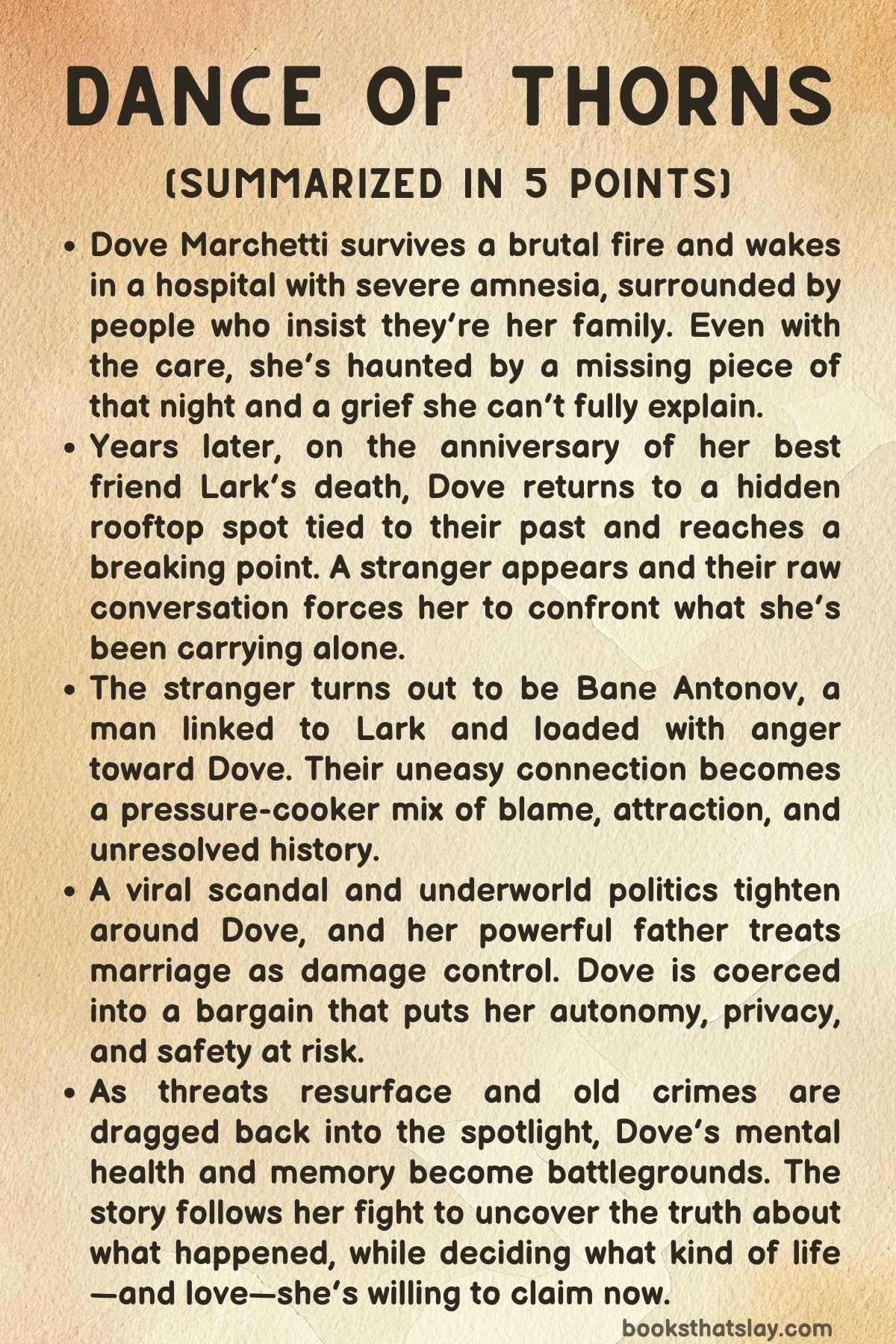
Summary
Dove Marchetti comes back to consciousness in chaos—pinned on the floor of a burning building while gunshots snap nearby and men shout her name as they search for her. Her head has been shaved, her scalp is bleeding, and smoke burns her lungs.
She cannot remember who she is or why she’s there. As she is dragged from the wreckage, she begs the rescuers to save someone else too, a “her” trapped in the next room.
Before anyone can reach the other person, the structure collapses and an explosion knocks Dove out.
She wakes in a hospital surrounded by strangers who insist they’re family. A man says he is her father, and a doctor explains she has severe head trauma and total amnesia.
A tearful woman tries to soothe her, promising that nobody can hurt her anymore. Across the room, a younger man dressed in black watches her with open hatred.
Dove feels a sick sense of familiarity even as fear prickles her skin. When she demands to know what happened to the person she tried to save, her father tells her the truth as he understands it: her best friend, Lark, is dead.
Dove breaks apart, convinced that whatever happened is her fault, even if she can’t remember the details.
Seven years pass. Dove’s life looks functional on the outside, but guilt and old cravings sit close to her ribs.
On the anniversary of Lark’s death, she returns to a secret mechanical deck high above New York—an old hiding place she and Lark once claimed as their own. Barefoot, with a letter tucked into a shoe, Dove climbs onto the ledge with the intention of ending her life where the two of them once laughed, smoked, and watched the city glitter.
She tells herself it’s fitting. She tells herself she’s tired.
Mostly, she tells herself she deserves it.
She isn’t alone. A man climbs up through the trap door and walks to the edge like he belongs there.
He smokes, speaks calmly, and acts as if he might jump too. Dove blurts out for him to stop, and he turns the question back on her, pointing out her shoes and the note like evidence in a case.
They trade blunt truths about pain, self-hatred, and what it means to keep living when you don’t feel like you fit anywhere. Their conversation lands in a dark joke: if the tabloids found them, they’d turn tragedy into romance.
The man suggests they jump together. Dove agrees.
They count down.
At “two,” he moves behind her, muttering a refusal—then shoves her balance off. Dove tips backward over open air.
Panic takes over as she realizes she wants to live. She screams and claws for purchase.
The man catches her hoodie and holds her dangling over the drop. When she looks up, she recognizes him at last: Bane Antonov, the man who once loved Lark.
His face is hard, and for one terrible second Dove believes he might let go.
He drags her back onto the roof anyway. Dove demands a truce, not for herself, but for Lark.
Bane agrees—only for that night. The handshake between them is tense, charged, and unsettling.
They decide they’ve avoided each other long enough. Before they part, they agree to meet again the next night to talk about Lark and how either of them is supposed to live with what happened.
When Dove returns the next evening, she dresses up and claims it’s for Lark, though she can’t ignore the nervous heat in her body. Bane arrives in black and closes the distance until she’s pinned against a wall.
He tells her she looks like Lark, and then he kisses her with aggression that feels less like desire and more like punishment. Dove shoves him away—only to spot paparazzi filming nearby.
Bane grabs her throat, leans close, and hisses that she should have jumped.
It’s a setup. Bane later admits he paid for the footage because his family needs leverage.
The Antonovs want access to the Marchetti shipping dock, and a public scandal can force an alliance. Bane originally planned to seduce Dove’s half-sister Chiara, get caught, and make marriage inevitable.
After the rooftop encounter, he decides Dove is the better target—more vulnerable, more useful, and, to him, a more satisfying way to settle old rage. The clip spreads quickly, and the pressure lands on Dove’s father, Don Cesare Marchetti.
At home, Dove expects fury. Instead, Cesare calls it an opportunity.
An alliance with the Antonov bratva would protect the family’s new waterfront interests. Dove is treated like a bargaining chip.
Her stepmother, Felicity, weaponizes Dove’s past, calling her an addict and implying she’s promiscuous. The humiliation deepens when Cesare says the Antonovs are demanding an STD panel as part of the arrangement.
Dove refuses—until Cesare corners her privately and makes the trap clear. If she leaves the property, she’ll have nothing.
Worse, he threatens to use her rehab history to have her forcibly taken back to an Italian facility under the claim she’s relapsing. With no safe exit, Dove gives in.
The marriage will happen.
Dove is brought to Bane’s residence near Central Park, a dark, heavily guarded building that feels more like a fortress than a home. In a library thick with silence and power, she confronts Bane: why would he force the best friend of his dead fiancée to marry him?
Bane refuses to speak Lark’s name in any tender way. He reduces everything to business—ports and manpower—then strips away any illusion of choice.
He tells Dove he wants her, and he expects access to her body.
When Dove resists, he produces a folder of confidential rehab and medical records and threatens to expose her history to her ballet world and social circle. He goes further, showing that he has her private internet history too.
Then he presents a written agreement—an explicit contract that turns intimacy into obligation and obedience into terms on paper. Under threat of public ruin, Dove signs.
Bane orders her to undress, and Dove complies with cold defiance, refusing to show him how much she’s shaking.
From Bane’s point of view, the hatred is old and sharpened. He and Lark were outcasts together at Thornfield Academy.
He loved her, and he blames Dove for the night everything ended. In his memory, Lark was assaulted and killed during captivity, while Dove survived, later losing her memory during the rescue and fire.
Bane decides that if he can’t bring Lark back, he can make Dove pay.
Bane begins asserting control in unpredictable ways. He commands, tests boundaries, and makes it clear that relapse and self-harm are forbidden.
He refuses full sex at first, not out of restraint, but to keep power in his hands. When Dove tries to block him from moving her in by citing her father’s religious image, Bane allows it—for now—warning her that the agreement is active and he will act when he chooses.
That night, Dove spirals in her carriage house, battling panic and warped memories. She takes medication to sleep.
She dreams of the past, and the dream slides into something sexual—then she jolts awake to find Bane in her bedroom, acting on the contract. Fear, rage, and unwanted physical response collide inside her, leaving her shaken and furious as he leaves with a cruel remark about her “pleasant dreams.”
As time passes, Dove’s reality grows unstable. On her way to Bane’s building, she senses footsteps behind her.
The pursuit feels real enough that she runs, slamming into the back door and screaming for help. Guards search with weapons drawn, but find nothing.
Bane arrives furious and frightened, pushing past pride to take care of her. He finds Dove standing under the shower in a dissociated haze.
He steps in with her, forces her attention back, carries her to bed, and holds her until she can breathe again. When she whispers that she isn’t imagining it, he tells her he believes her.
Bane investigates anyway. He knows the case that shaped everything: Lorenzo Cielo, “The Barber,” a serial killer linked to thirteen murdered young women.
Lark and Dove were the final two victims taken. Bane also knows a hidden truth—Lorenzo once worked for Cesare Marchetti under another name, and Cesare buried the connection.
Security footage shows no one chasing Dove, and a bus driver confirms something worse: when Dove nearly got hit earlier, no one shoved her—she stepped into traffic herself. The line between threat and self-destruction blurs.
Dove secretly reads Lark’s diary, hiding it under another book jacket. She admits her symptoms are worsening—shadows, fear, gaps—and plans to see her doctor about her medication.
At the same time, her feelings for Bane shift. When he holds her, she feels safer than she has in years.
Bane surprises her with a hidden art studio he built for her, even bringing her easel from home. The tenderness cracks something open.
Dove kisses him, and the heat between them turns intense, messy, and real in a way that scares her because it isn’t only about punishment anymore.
Then the past claws back in public. After rehearsal, reporters swarm Dove, shouting questions about Lorenzo Cielo and “new allegations.” The crowd presses close enough to steal her air.
Bane arrives and pulls her out, but one shouted question hits like a punch: did she help kidnap and murder Lark? Lawyers explain that the Cielo family is pushing for a reopened investigation and has found a prosecutor willing to pursue it.
Dove’s medication and mental health will be used to attack her credibility. Dove asks Bane if he ever planned to harm Lark.
He denies it and shares his own childhood kidnapping to explain that trauma doesn’t make her “crazy.” Dove clings to him, needing something solid.
They proceed with a small wedding at Nikolai Antonov’s mansion. Before the ceremony, Nikolai treats Dove with surprising kindness, noticing her sobriety token and medication and responding with empathy instead of contempt.
The ceremony is quiet, intimate—then chaos erupts. U.S. Marshals storm the property and arrest Dove on a warrant connected to the murder of Lorenzo Cielo.
After bail, the lawyers reveal the evidence: an old autopsy has been reopened, and investigators now claim Lorenzo’s throat was cut in addition to gunshot wounds. A knife near his remains has been retested.
The blood is Lorenzo’s, and a second degraded DNA profile matches Dove. With her memories unreliable and her symptoms worsening, Dove feels trapped in a nightmare that keeps rewriting itself.
The narrative then fractures into buried truth. Bane wakes wounded on a bathroom floor after violence, finding a dead woman nearby and Lark in a bathtub with a deep wound to her wrist, bleeding out.
Despite his own injuries, he crawls to her, climbs into the tub, and holds pressure to save her, begging her to stay. Lark drifts in and out, sensing warmth and love, then panic when she can’t feel Bane’s pulse.
A woman’s voice promises help, calling her “baby” and “Mommy’s here.”
The story jumps back decades to reveal what was stolen. Lydia Bancroft, trapped in an abusive marriage to Cesare Marchetti, tries to escape while pregnant with twins.
With help from Agatha and the Obsidian Syndicate, Lydia attempts to protect both newborn girls by splitting their routes. One baby—Lark—goes with Agatha.
Lydia keeps Dove. Cesare intercepts them, takes Dove at gunpoint, and shoots Lydia, leaving her for dead.
Lydia survives but believes she has lost both daughters.
Years later, a letter explains the full truth: Dove and Lark are fraternal twins, daughters of Lydia and Cesare. Agatha raised Lark in secret while staying close to Cesare to protect both girls.
Lydia lived under Syndicate protection, partially paralyzed, watching from afar. A later rescue attempt went wrong because Lorenzo Cielo—someone Lydia trusted—betrayed them and revealed himself as a sadistic killer.
Lydia killed Lorenzo and managed to save one child, but the chaos and manipulation warped identities and memories, leaving the twins growing up with lies layered over their origins.
Back in the present, Dove reunites with Lydia and learns that efforts are underway to dismantle the false evidence tying Dove to Lorenzo’s death. She discovers the remains once believed to be Lark’s belonged to another victim, and she quietly compensates that victim’s surviving family, trying to do one clear thing right.
At a private airfield, Lydia waits with Dove and Bane, trembling with hope. When Lark finally arrives alive, the sisters meet again after years of grief and misunderstanding.
Lydia holds both daughters, overwhelmed by relief, and the broken pieces of their history begin to settle into something that makes sense.
In the end, Dove stands on a rooftop again, but she is no longer there to die. With Bane beside her, she chooses life, not because pain vanished, but because she refuses to let it decide the ending.
Bane proposes again—this time as a choice, not a contract—and Dove says yes. Together, they commit to moving forward, carrying the past without letting it steer them off the ledge.
Characters
Dove Marchetti
Dove Marchetti is the emotional core of Dance of Thorns—a survivor whose life is shaped by trauma, fractured identity, and a relentless sense of culpability. Her first defining trait is disorientation: she wakes in a burning building with her scalp shaved, bleeding, and her memory erased, and that blankness becomes the permanent wound beneath everything she does.
Even seven years later, she moves like someone carrying an invisible sentence, returning to the Empire State Building’s hidden deck not for nostalgia but for punishment, convinced that dying where she once laughed with Lark is the only fitting symmetry. Dove’s psychology is driven by guilt that functions almost like a dependency—she craves it the way she craves oblivion, whether through relapse, numbness, or the fantasy of ending her life.
Yet what makes her more than a passive victim is her stubborn agency inside captivity: when the marriage trap closes, she resists openly, mouths off, and tries to negotiate terms even when she knows the odds are stacked. Her defiance isn’t naïve courage; it’s a survival reflex, a way to stay herself when others rewrite her into a bargaining chip.
Over time, her arc becomes less about “remembering” and more about reclaiming: she learns to question what she assumed about Lark, about Bane, and about herself, especially as paranoia, medication issues, and public accusations threaten to erase her credibility. By the end, Dove’s growth is not tidy healing—she still bears scars and fear—but she stops treating survival as an injustice and begins treating it as a choice she is allowed to make.
Bane Antonov
Bane Antonov is built from grief that has calcified into cruelty, and that cruelty is often presented as control—of narrative, of bodies, of outcomes. When he meets Dove on the ledge, he doesn’t arrive as a rescuer; he arrives as someone who is also flirting with annihilation, and the most revealing moment is that he interrupts the shared countdown not out of tenderness, but out of refusal—he refuses to let fate grant Dove an escape.
His hatred is intimate and complicated: Dove resembles Lark closely enough to trigger longing and rage at the same time, so his instinct is to punish what he cannot stop wanting. Bane’s antagonism is not random brutality; it’s targeted, strategic, and often staged—he orchestrates a viral scandal, weaponizes optics, and turns marriage into a public trap that conveniently doubles as a private revenge.
What deepens him is that his need to dominate sits alongside a genuine protectiveness he tries to deny; when Dove is chased and collapses into shock, he responds with urgency and care that breaks through the “business” mask. His internal conflict is that he wants to believe he’s acting for family and leverage, but he repeatedly reveals he is acting for emotional reasons he refuses to name: obsession, grief, guilt, and a twisted hunger for connection through pain.
As the truth about Lorenzo, Cesare, and the twins emerges, Bane’s role shifts from executioner to anchor—still intense, still controlling by instinct, but increasingly capable of empathy, especially as he recognizes trauma in Dove because it mirrors his own history of being taken. His final evolution isn’t a softening into harmlessness; it’s a reorientation of power, where he chooses devotion and protection over vengeance and finally offers Dove a future that isn’t built on coercion.
Lark Peltier
Lark Peltier functions like a haunting presence for much of Dance of Thorns, yet she is not merely a dead ideal; she is revealed as a complex person shaped by secrecy, fear, and survival instincts that were misunderstood by the living. In the early narrative, Lark is the “lost saint” figure—Dove’s best friend, Bane’s beloved, the tragedy that froze everyone else in place.
But as her diary and the resurfacing truth enter the story, Lark becomes more human and more unsettling: she suspected a “secret,” feared violence, and may have been spiraling under paranoia that looks less like melodrama and more like an accurate response to an environment full of concealed predators and powerful liars. The later revelation that the remains believed to be hers were not hers reframes her entire role from martyr to stolen life—someone whose identity was effectively erased twice, first by captivity and then by mistaken death.
In the bathtub sequence, Lark’s perspective is especially important because it shows her not as an abstract symbol but as a terrified, conscious person fighting to stay, terrified not only of dying but of being abandoned. Her reunion with Dove and Lydia turns her from a memory used as a weapon into a living stake in the truth, and her existence forces the other characters to confront how much of their pain was constructed by manipulation, misinformation, and the convenient narratives of powerful men.
Don Cesare Marchetti
Don Cesare Marchetti is the story’s cleanest representation of institutional cruelty—violence that doesn’t always look like fists but like systems, leverage, and ownership disguised as “family duty.” He presents himself as pragmatic and protective, but his protection is transactional: he treats Dove’s body, reputation, and future as assets to trade for manpower and security. His most chilling trait is how calmly he threatens confinement—he doesn’t need to hit Dove to break her; he only needs to remind her that he controls her money, her home, and even her freedom through the specter of forced rehab.
Cesare’s manipulation is also social and psychological: he allows Felicity to shame Dove, demands humiliating medical compliance, and frames these violations as reasonable costs of “saving face.” The later connections to Lorenzo—buried, obscured, paid off—suggest Cesare’s power has long relied on hiding monsters in his orbit and cleaning the mess afterward. He is not a complicated villain in the sense of secretly loving Dove; his version of love is possession, and his parenting is indistinguishable from governance.
In this story, Cesare isn’t merely an obstacle to romance—he is the architect of the cage that makes romance possible only through rebellion.
Nikolai Antonov
Nikolai Antonov operates as a quieter, more controlled form of power—one that contrasts with Cesare’s overt coercion and even Bane’s volatile dominance. He is strategic and reputation-aware, clearly invested in alliances and assets, but what sets him apart is his capacity to acknowledge the human cost without dismissing it.
When Dove’s medication and sobriety token spill out, he responds not with disgust or judgment but with recognition, implying a worldview that understands suffering as part of the terrain rather than a stain to punish. That empathy doesn’t make him harmless; it makes him formidable, because it suggests he can balance brutality with discernment, choosing when to be warm and when to be ruthless.
As a father figure, he functions as both mirror and corrective to Bane—someone who understands the machinery of family obligation but can still offer Dove a kind of legitimacy that isn’t rooted in humiliation. Nikolai’s presence stabilizes the Antonov side of the story, turning them from cartoon antagonists into a structured empire where affection and violence can coexist, and where Dove can occasionally be treated as a person rather than a bargaining chip.
Felicity Marchetti
Felicity is the domestic face of cruelty—less powerful than Cesare in formal authority, but vicious in the intimate arena where shame is most effective. Her defining function is to weaponize Dove’s past: addiction, vulnerability, and scandal become ammunition for degradation, and she uses moral language to justify cruelty, implying that Dove deserves humiliation because she is “damaged.” Felicity’s hostility also protects her own position; by keeping Dove marked as inferior, she reinforces the hierarchy that privileges Felicity and her daughter within the Marchetti household.
What makes her particularly corrosive is that she doesn’t need to invent threats—she intensifies them, amplifies them, and turns the family into a tribunal where Dove is always already guilty. Even when she isn’t driving the plot’s biggest decisions, she maintains the emotional atmosphere that makes those decisions possible, ensuring Dove feels isolated, dirty, and alone enough to be controlled.
Chiara Marchetti
Chiara is a study in constrained presence—someone whose silence is not emptiness but strategy, fear, and complicity tangled together. Positioned as Dove’s half-sister and initially the intended target of Bane’s original plan, she becomes an emblem of how daughters in these families are treated as movable pieces, valued for alliance potential rather than autonomy.
Her frequent quiet observation during confrontations suggests she has learned that visibility is dangerous; speaking might make her the next tool, the next sacrifice, or the next scapegoat. Chiara’s role also sharpens Dove’s isolation: being watched rather than supported underscores how few true allies Dove has inside her own home.
Even without overt action, Chiara adds tension because she represents the alternative outcome Dove narrowly avoids—being chosen not for who she is, but for how useful her image is to men negotiating power.
Sergey
Sergey functions as Bane’s operational extension—the lieutenant who translates emotional chaos into actionable reality. His presence emphasizes that Bane’s world is not only personal trauma but an organized machine with surveillance, guards, and protocols, and Sergey is the part of that machine that keeps running even when Bane is destabilized by Dove.
When he reports that cameras show nothing, he becomes the voice of doubt that forces a more uncomfortable possibility: Dove’s perceptions may be compromised, not because she is weak, but because trauma and medication are distorting her reality. Sergey’s role is important because he keeps the narrative honest; he doesn’t flatter Bane’s anger or indulge romantic delusions—he provides facts, and those facts often increase the danger.
Val
Val represents the kind of loyalty that exists outside blood empires—friendship that doesn’t require ownership. In the ballet world, where people avoid asking questions because everyone has secrets, Val still acts: when reporters swarm, she doesn’t freeze into polite distance but physically fights through the crowd to get Dove out.
That action matters because it shows Dove is not entirely alone, and it also frames the public scrutiny as a form of violence in itself—one that can be resisted only by people willing to get their hands dirty. Val’s function in the story is to anchor Dove to something resembling normal care, a reminder that support can exist without contracts, threats, or bargains.
Evelina
Evelina is part of Dove’s fragile social ecosystem—someone close enough to be present in crisis but distant enough that the mafia-family gravity still shapes what she can safely do. Standing with Dove and Val when the reporters ambush them, she highlights how quickly private trauma becomes public spectacle in this world, and how even friends may be limited by fear, etiquette, and the unspoken rules of survival.
Evelina’s presence contributes to the sense that Dove’s life is lived on a stage where every association is watched, and where comfort often comes not from what people say, but from who simply stays nearby.
Taylor Crown
Taylor Crown embodies the sharp-edged salvation of competence—someone brought in not to soothe feelings but to win wars with paper and procedure. As an elite attorney, Taylor represents the shift from emotional conflict to institutional threat: once prosecutors and reopened autopsies enter the story, survival depends less on willpower and more on strategy, evidence, and narrative control.
Taylor’s presence also underscores a grim irony: Dove’s trauma and medication, which are part of her survival, can be reframed as tools to discredit her, and Taylor’s job is to prevent the system from turning those truths into weapons. In a world where power often means brute force, Taylor is a reminder that power also lives in language, filings, and the ability to shape what the law is allowed to believe.
Fumi
Fumi complements Taylor Crown by reinforcing that the legal battle is not symbolic; it is technical, adversarial, and ruthless. Where Dove’s story is full of unreliable memory, degraded DNA, and reopened records, Fumi represents precision—someone who can take chaotic, frightening claims and break them into defensible positions.
Fumi’s importance lies in how they help convert Dove from a passive accused person into someone with a structured defense, pushing back against a narrative designed to make her look unstable and guilty. In a story obsessed with who controls the truth, Fumi stands for the idea that truth sometimes survives only if someone is skilled enough to protect it.
Lorenzo Cielo
Lorenzo Cielo, known as “The Barber,” is the concentrated horror at the center of the plot—an embodiment of predation, sadism, and the ease with which monsters can hide behind respectable employment and powerful patrons. His impact on the living characters is less about his personality and more about the lingering architecture of fear he leaves behind: trauma symptoms, public suspicion, buried connections, and evidence that can be manipulated long after death.
What makes Lorenzo especially corrosive is how his shadow gets used by others—his history becomes a political weapon, a headline machine, and a convenient mechanism to blame Dove. Even when he is not physically present, the story shows that a predator’s violence can keep multiplying through institutions, rumors, and corrupted records, turning survivors into suspects and turning grief into a tool for control.
Lydia Bancroft
Lydia Bancroft is the narrative’s counterforce to erasure—a mother who survives, endures, and eventually restores the truth that powerful men tried to bury. Her defining traits are resilience and calculated secrecy: fleeing abuse while pregnant, relying on allies like Agatha and the Obsidian Syndicate, and making impossible choices under threat, she becomes a portrait of motherhood in a world where love is punished.
Lydia’s partial paralysis and years in hiding emphasize that “survival” is not victory; it is cost, ongoing consequence, and endurance without recognition. Her revelation that she killed Lorenzo and that the twins’ identities were confused by trauma and manipulation reframes the entire story’s moral map, exposing how much of Dove’s guilt was engineered.
In the present, Lydia’s warmth doesn’t erase her hardness; it proves she can be both nurturing and deadly when necessary. Her reunion with Dove and Lark is not just sentimental closure—it is the restoration of identity, lineage, and agency that Cesare and Lorenzo tried to destroy.
Agatha
Agatha is the quiet architect of survival—an ally whose choices shape the entire timeline while keeping her mostly offstage. By raising Lark in secret while maintaining proximity to Cesare, she embodies the morally gray reality of protecting children in a criminal ecosystem: safety often requires compromise, deception, and living near the danger.
Agatha’s letter functions like a key turning in a lock, releasing the truth that had been sealed by fear and misinformation. Her role suggests devotion without glory—years of vigilance, sacrifice, and strategy so that at least one child might live free of a man like Cesare, even if that freedom is imperfect and fragile.
Antonio
Antonio serves as a stabilizing “old world” protector figure—a person Dove turns to when the legal pressure and psychological unraveling make her feel untethered. His importance lies in what he represents to Dove: a familiar anchor from a life where loyalty was more predictable than love, and where protection could be requested without begging.
In seeking him out, Dove reveals a crucial part of her character—she doesn’t only want romance or rescue; she wants steadiness, someone who can witness her fear without exploiting it. Antonio’s presence reinforces that, even in criminal families, there are individuals who function as guardians rather than owners, and that those distinctions matter when someone’s mind and memory are under siege.
Melinda
Melinda appears at the story’s most visceral turning point, present in the blood-soaked scene where Bane and Lark are found injured and dying. Even with limited detail, her role is significant because she marks the immediacy of violence around Lark’s survival—she is a casualty that signals this moment was not an accident but a brutal confrontation with lethal stakes.
Her death also becomes part of the atmosphere of confusion and trauma that shapes what Bane and Lark remember, what others believe, and how easily narratives of blame can form when bodies are left behind and truth is delayed.
Themes
Trauma, memory, and identity after violence
Dove’s first clear moment is not a normal “beginning” but an emergency: heat, smoke, pain, gunfire, strangers calling her name, and the immediate recognition that something essential inside her has been wiped out. That loss of memory doesn’t function as a convenient mystery device; it becomes the core condition that shapes how she experiences herself.
Her identity is no longer a stable story she can tell, but a set of fragments other people keep trying to hand back to her—“father,” “family,” “friend,” “survivor”—labels that may be true in fact yet feel unreal in her body. The result is a life lived with constant disorientation: she is expected to grieve properly, behave appropriately, and accept explanations, while her mind can’t attach those explanations to lived recollection.
This creates an unusually harsh kind of loneliness, because she is surrounded by familiarity that she cannot access.
The theme becomes more complicated because trauma keeps returning even when memory does not. Dove’s panic episodes, paranoia, dreams, and sudden bodily reactions show how experience can lodge in the nervous system without forming a coherent narrative.
She may not “remember,” but her body responds as if it remembers everything. That gap—between what she can explain and what she feels—invites other people to define her, diagnose her, or dismiss her, which makes her vulnerability socially dangerous in a world where power is inherited and weaponized.
The renewed investigation and the way her medication is framed as a credibility problem reflects how trauma survivors can be treated as unreliable by default, especially when institutions want clean stories with clear villains and clean victims.
Against that pressure, Dance of Thorns shows identity as something Dove has to rebuild under hostile scrutiny. She is forced to decide which parts of herself are hers—her sobriety work, her art, her desire to live—rather than letting family or enemies turn her into a symbol.
Even the later revelations about her origin and the confusion surrounding who was saved and who was lost underline how identity can be manipulated by secrecy and violence. The point isn’t that the “truth” sets her free instantly; it’s that reclaiming truth gives her a foundation to choose who she will be going forward, instead of living as the afterimage of other people’s crimes and decisions.
Guilt, survival, and the question of who “deserved” to live
Dove’s guilt is not a mild regret; it drives her toward the ledge with preparation and ritual, returning to the same hidden place year after year until she is ready to end her life there. That detail matters because it shows guilt as something she has rehearsed into identity, a punishment that feels appropriate rather than merely painful.
She believes Lark’s death is her fault even when she can’t fully remember what happened, which reveals how survivors often construct a moral explanation when the factual explanation is missing. If she can’t locate the logic of the event, she locates the logic inside herself: she lived, therefore she must be the reason someone else didn’t.
The narrative also places this guilt beside addiction cravings and exhaustion, suggesting that self-destruction is not one choice but a cluster of pressures that all point in the same direction.
Bane carries a mirrored version of the same theme, except his guilt is shaped into accusation. He looks at Dove and sees the absence that should have been impossible: Lark gone, Dove present.
From his view, survival becomes a kind of theft, a moral imbalance that demands correction. This is why he can rescue Dove from the ledge and still speak like someone deciding whether to let her fall—his intervention does not automatically mean compassion.
It can also be control, judgment, even a test of whether she is allowed to live. Their dynamic shows how grief can harden into a private courtroom, where one survivor becomes prosecutor and the other becomes the defendant, regardless of what actually happened.
The story also highlights how “deserving” is a poisonous framework. Dove punishes herself because she assumes she did not earn survival; Bane punishes her because he assumes she did not deserve it; Cesare treats her survival as an asset to trade; the legal system treats her as a convenient suspect because her history makes her easy to question.
In each case, the value of her life is debated by others, which is exactly what pushes her toward the conclusion that she has no claim to it. The eventual shift away from suicide is not presented as a tidy cure.
It is a reorientation: instead of asking whether she deserved to live, she chooses to live, and that choice becomes its own justification. The rooftop at the end carries the echo of the first rooftop, but the meaning changes—she is no longer staging her death as repayment.
She is practicing staying.
Power, coercion, and the way families turn people into leverage
The world around Dove is built on transactions, and family is not protection but infrastructure for control. Cesare’s authority works through dependence: housing, money, reputation, and the threat of institutional confinement.
The rehab threat is especially chilling because it reframes “care” as a weapon. What should be a medical support system becomes a mechanism for captivity, and Dove understands that resistance will be interpreted as instability, which can then be used as proof that she needs to be controlled.
This is coercion that looks respectable from the outside, which makes it harder to fight. When Felicity humiliates Dove and Cesare demands an STD panel as if Dove’s body is a product being inspected, the theme becomes explicit: bodily autonomy does not exist for her inside this system unless it aligns with the family’s strategy.
Bane’s plan extends the same logic into public narrative. The staged kiss and the viral clip are not only scandal; they are a method of manufacturing “consent” by forcing a social reality into place.
Once the story is out, it becomes a cage: the family can claim marriage is the rational solution, and Dove is pressured to accept it “for optics,” which means for power. Bane’s later use of private medical and internet history is another layer of the same theme.
Blackmail does not just threaten exposure; it threatens exile from every community that gives her identity and stability, including the ballet world and her social circle. The contract formalizes that coercion into paperwork, turning domination into something that can be pointed to as agreement, even when the conditions of that agreement are fear and entrapment.
What makes this theme hit harder is how it interacts with trauma. Dove is not being coerced from a position of strength; she is being coerced while already struggling with guilt, instability, and a fragile sense of self.
The people with power exploit that fragility: they know she will be blamed, disbelieved, or written off as an addict. The book also shows how these systems recruit spectators—reporters shouting accusations, society friends who avoid the subject, relatives who stand by silently—so coercion becomes communal, not just private.
When the U.S. Marshals appear immediately after the wedding, the timing underlines how institutions and criminal empires can collide in ways that still leave the same person crushed in the middle. Dance of Thorns presents power as something that can change uniforms—father, fiancé, lawyer, federal agent—while using similar tools: control the narrative, control the body, control the options.
Desire, consent, and the confusion created by fear and attachment
The relationship between Dove and Bane is charged because it is not built on mutual safety at the start; it begins in a moment of suicidal crisis, shifts into resentment and revenge, and then becomes legally and socially enforced. That structure immediately raises the problem of consent, not as a simple on/off switch but as a field full of distortions.
Dove’s “yes” is obtained under threat of exposure and confinement, and the presence of a signed document becomes a way to override her spoken resistance. The story does not treat paperwork as moral permission; it shows how formality can be used to disguise coercion, letting the powerful claim legitimacy while the powerless experiences violation.
At the same time, Dove’s body sometimes responds in ways that don’t match her fear or anger, which is part of what makes the dynamic psychologically intense. This is not presented as proof that she “wanted” harm; it reflects how the body can react to stimulation even when the mind is distressed, and how survivors can feel shame or confusion about those reactions.
That confusion becomes another tool for control because it destabilizes her ability to argue for her own reality. If she feels something, does that make it her fault?
If she is drawn to moments of tenderness, does that erase the threats? The theme explores how easily attachment can grow in captivity-like conditions, especially when the captor figure also offers protection from other dangers.
Bane’s behavior further complicates consent because he oscillates between cruelty and care. He is capable of humiliating Dove, invading her privacy, and enforcing sexual access, and he is also capable of holding her through shock, building her an art studio, and believing her when she feels hunted.
Those gestures can be read as genuine feeling, but they also function as emotional leverage. The person who hurts her is also the person who can soothe her, which makes the bond feel inevitable even when it is unhealthy.
That is why the theme is less about romance and more about the instability of desire under coercion: when safety is scarce, any shelter can start to feel like love.
As the narrative progresses, the possibility of a different kind of consent begins to appear—one that would require honesty, boundaries, and a shift away from revenge. The second proposal at the end matters symbolically because it suggests an attempt to rebuild the relationship on chosen commitment rather than forced alignment.
The theme does not erase what came before; it insists that desire and attachment do not automatically mean justice, and that care does not automatically repair harm. It leaves the reader with the uncomfortable truth that feelings can be real even when the foundation is damaged, and that rebuilding autonomy is the only way intimacy can become something other than control.
Public narrative, surveillance, and the violence of being watched
From the rooftop paparazzi to reporters swarming after rehearsal, the story treats visibility as a weapon. Dove’s private crisis becomes content, her body becomes proof, and her reputation becomes a bargaining chip others exchange.
The staged kiss is the clearest example: a moment engineered to be recorded creates a reality that spreads faster than any explanation. Once the clip loops on television, Dove is no longer dealing only with Bane and her family; she is dealing with an audience.
That audience does not need facts to participate. It only needs an image and a rumor.
The humiliation is not incidental—it is part of the mechanism that drives her toward compliance because resisting would mean enduring a public storm with little protection.
The theme goes beyond media to include a wider sense of surveillance. Bane’s possession of Dove’s confidential records and even her internet history suggests that privacy itself is fragile in this world.
If someone powerful wants to know you, they can obtain information that should have been protected, and that knowledge becomes a leash. The legal system also becomes a form of surveillance when old evidence is reopened and her degraded memory is treated as suspicious.
The re-testing of the knife, the degraded DNA profile, and the new narrative around Lorenzo’s death show how forensic details can be used not just to find truth but to create a story that serves someone’s interests. Dove is pushed into the position of performing credibility: every medication bottle, every symptom, every gap in memory is something others can point to.
The reporters’ shouted accusation—that she helped kidnap and murder Lark—illustrates how public narrative can create a second trauma on top of the first. Dove already carries survivor guilt and fractured memory; now she must also carry the possibility that strangers will treat her as a monster.
This is not simply “bad press.” It is a threat to her ability to exist in ordinary spaces: leaving a theater becomes dangerous, walking down a street becomes terrifying, and even her internal symptoms become questionable because everyone is watching for instability. The theme shows how being watched changes what fear feels like.
Fear becomes anticipatory, performative, and constant, because any moment can be captured, twisted, and used.
By contrast, the most healing moments are private: the shower scene where Bane grounds her, the hidden studio, the reunion at the airfield, the final rooftop where the choice is life. These scenes suggest that recovery requires spaces where a person is not being turned into evidence.
Dance of Thorns treats the gaze—media, family, institutions—not as neutral attention but as pressure that can crush a vulnerable person into silence, compliance, or self-erasure. The struggle is not only to survive violence, but to survive being turned into a story other people profit from.
Sisterhood, separation, and the longing for a safe origin
The bond between Dove and Lark drives almost every major decision, even when Lark is believed dead. The annual return to the hidden deck is not only grief; it is devotion to a relationship that once functioned as Dove’s sense of belonging.
Their shared rituals—music, smoking, watching the city—represent a version of adolescence where they could step outside family expectations and feel like themselves. When that bond is severed by abduction and presumed death, Dove’s life becomes shaped around the absence, and her guilt becomes a way of keeping connection alive, even if the connection is painful.
In that sense, the theme of sisterhood begins as chosen family: Lark is the person Dove begged to save in the burning building, the person she cannot stop trying to repay.
The later revelation that they are twins transforms the theme without replacing it. It reframes their closeness as something that was not accidental, but it also exposes how easily a “safe origin” can be stolen.
Their mother’s attempt to escape abuse, the splitting of the routes, the loss of both daughters, and the long years of watching from afar show family not as a stable starting point but as something repeatedly fractured by violence and betrayal. The fact that identities were confused and manipulated after trauma reinforces that even biological truth can be disrupted by power.
The theme is not sentimental; it is brutal about how women’s bodies and children can become objects in conflicts between men, organizations, and institutions.
Lydia’s presence introduces another layer: maternal love that exists even when it cannot be expressed openly. Her story shows endurance as a form of love—surviving, hiding, arranging protection, trying again, and living with the cost of only saving one child.
That reality forces Dove to reconsider blame. If even a mother could not control outcomes in that world, then Dove’s lifelong self-conviction that she alone caused Lark’s fate begins to look like a cruel simplification.
The theme also highlights how family secrets can be both protective and destructive: Agatha’s choices, the Syndicate’s involvement, and the buried connection between Cesare and Lorenzo show that secrecy can keep someone alive while also distorting their life.
The reunion at the airfield is the emotional payoff of this theme, but it also functions as repair of identity. Dove is no longer a lone survivor clinging to a dead friend; she becomes a daughter and a sister with living witnesses to her origin.
That does not undo trauma, but it changes the shape of her future. The relationship with Lark moves from a haunting absence to a present bond that can hold grief and joy together.
In Dance of Thorns, sisterhood becomes the idea that a person can finally be known by someone who shares the same wound, and that being known can make survival feel less like punishment and more like a shared decision to keep going.