Dark Sisters Summary, Characters and Themes
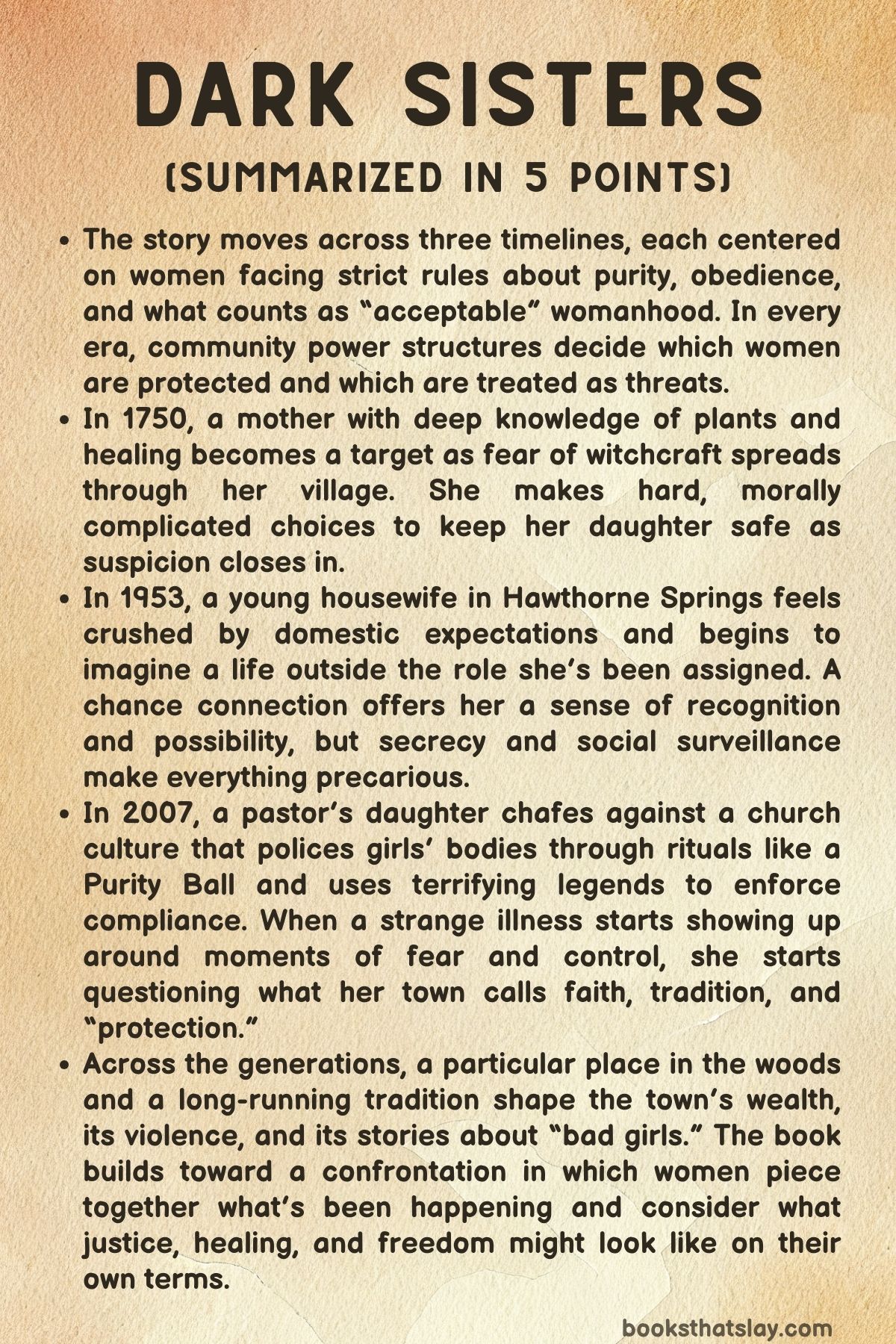
Dark Sisters by Kristi deMeester is a horror novel that moves across centuries in one insular, church-ruled town, showing how a community can turn women’s bodies into doctrine, warning, and currency. In 1750, a mother and daughter become targets when “witch” panic spreads.
In 1953, a young wife discovers desire and the cost of being seen. In 2007, a pastor’s daughter pushes back against purity culture as a female-only sickness returns. The book builds a single, unsettling lineage of fear, power, and revenge.
Summary
In 1750, a woman looks back on the two times she has nearly died. As a girl she almost drowned, saved only because her brother pulled her from the water and brought her back.
Now, as an adult, she lives in a village where fear has turned contagious. Women are being accused of witchcraft, tried by rumor, and hanged.
The narrator knows why people look at her too long: her mother taught her plants, remedies, and how to listen to the natural world. That knowledge has always helped neighbors quietly, but in a season of terror it reads like proof of evil.
She also has a daughter, Florence—young, devout, engaged to a respected man named Benjamin—yet the narrator senses that church ties and a polite reputation will not keep a rope from Florence’s throat once a name starts circulating.
The mother begs Florence to leave with her before it is too late. Florence refuses, holding tight to her faith and the belief that her place in the community will protect her.
When Florence goes back to her chores, the mother makes a choice she hates but believes is necessary. She performs a private ritual, killing a hen and eating its heart to steel herself.
It is less about spectacle than decision: she is preparing to do something that will force Florence out of danger, even if it costs their relationship.
In 2007, Camilla Burson sits in the pews of Hawthorne Springs, daughter of a powerful pastor and a face the town expects to obey. The church service is another lesson in purity and compliance, centered on the upcoming Purity Ball where girls pledge their virginity to their fathers and to God.
Camilla feels the humiliation beneath the ceremony, the way the language always lands hardest on girls. Her father warns the congregation with a local story: the Dark Sisters, figures used to frighten girls into submission.
The legend clings to a recurring illness in Hawthorne Springs—one that seems to pick only women and girls, beginning with sore throats, then sores, blackened gums, and death. Camilla has tried to act unimpressed, but she has memories that won’t stay quiet: childhood games about the Sisters that ended in real panic and injury.
She also knows the pattern the town avoids naming—whenever girls say they’ve seen the Sisters, women start getting sick.
After church, Camilla argues with her friends Noah and Brianna about what’s real. Noah treats the legend like a story adults tell to control kids.
Brianna, who lives with fewer protections than Camilla’s wealthy family, doesn’t laugh so easily; she’s watched how quickly the town punishes girls who step wrong. Camilla suggests a party disguised as a prayer vigil—something to claim a little space inside a culture that polices them constantly.
Her father shuts the idea down immediately. At home, Camilla overhears her mother Ada speaking with a friend, Vera.
Ada admits she has nightmares about her own Purity Ball, as if something happened to her that night that her mind refuses to hold. She fears letting Camilla attend, describing a sound from her memory that makes her stomach turn.
In 1953, Mary Shephard is a young housewife in the same town, newly married with a baby daughter, living inside a postcard-perfect life that feels like a locked room. She is expected to smile, host, pray, and be grateful.
Instead she feels restless, furious, and frightened by how quickly she is disappearing. After a breakdown, she tells her husband Robert she is losing herself.
Robert responds in the language of fixes: he arranges childcare and finds her part-time work as a typist. The job gives Mary daylight again—train rides, city streets, the simple relief of being alone in her own mind for a few hours.
Then the city shows her another danger. Her employer harasses her, and Mary flees, shaken and ashamed, drifting into a department store where she meets Sharon Hutchins, a confident saleswoman with an ease Mary has never learned.
Sharon’s attention feels like air. They talk, they eat lunch together, and Mary feels something click into place that her marriage and church vocabulary have never allowed her to name.
Sharon notices Mary’s careful posture and careful words. When Mary blurts out that Sharon must be a witch, she expects offense, but Sharon only shrugs it off and explains her beliefs as nature and energy—something you can honor without harming anyone.
Sharon prays to a “Goddess Mother,” a phrase that both startles and comforts Mary in the same breath. Mary keeps returning to the store, hunting for Sharon between lunch breaks, inventing reasons to be nearby.
Soon, meeting Sharon becomes the axis Mary’s days turn on.
Back in 1750, the mother acts. She invites Benjamin into her cottage, feeds him, and uses the hard resolve she has summoned to tell a lie designed to save Florence: she claims Florence cannot bear children, that a childhood fever ruined her chances.
In that world, the accusation is enough to end an engagement without a fight. Benjamin leaves devastated, convinced Florence hid the truth.
He finds Florence on the road, and his hurt curdles into coldness. On the way home, Florence is spit on and called a witch.
She returns to her mother sobbing—her engagement ended, her name poisoned. The mother doesn’t apologize.
She tells Florence the only thing that matters now is leaving before the town decides to make an example of her. That night they pack what they can—tools, seeds, food, weapons, chickens—and disappear into the woods under a new moon, hiding their trail like fugitives.
In 2007, Camilla’s attempted rebellion becomes a spark in dry grass. She sneaks out, tells Noah to spread the word, and throws a bonfire party.
Boys mock the Dark Sisters until one of them stages a grotesque prank: fake convulsions, a bloody “tongue,” screams, and panic. It’s meant to be funny, but it lands like cruelty.
A fight erupts, and Brianna—already tired of being the one expected to endure humiliation—explodes at Camilla. She calls out Camilla’s privilege, the way Camilla can break rules and still be cushioned by family influence.
The next morning, Camilla learns Brianna has been taken to Retreat, the town’s controlled “rehabilitation” facility for girls. Soon Camilla is taken there too.
At night, she wakes outside as if sleepwalking and sees two pale, fused faces in the branches of the tree near the field—the Dark Sisters watching her. The fear is bodily, immediate, and real.
At Retreat, Camilla is treated like a problem to be corrected. Sessions reduce womanhood to obedience.
Pastor Wade interrogates her, uses scripture as a weapon, and crosses physical boundaries with casual entitlement. Camilla searches for Brianna and finally finds her through a smuggled note and a staff member willing to help.
When they meet, Brianna is already sick. A tooth drops into the sink.
Her mouth shows sores and spreading rot. Camilla promises they will get out, and she starts planning an escape by performing compliance—smiling, nodding, playing the role the adults want until she can move unseen.
In 1953, Mary and Sharon cross lines Mary was taught never to approach. They share cocktails, touch, and finally kiss.
Mary breaks down, terrified of sin, of losing her child, of the town’s gaze. Sharon asks for honesty more than courage, and they try to keep going anyway, quietly.
Mary’s choices ripple outward. At a Bible study that becomes a wine-soaked gossip session, Mary accidentally reveals that Vera doesn’t want a baby.
The room turns predatory, eager for a “wrong” woman to correct. Vera flees, and Mary realizes how quickly a community can turn concern into punishment.
The origin story tightens in 1764, revealing what Hawthorne Springs has been doing with the legend. Gideon Dudley leads fathers and their daughters into the woods to the black walnut tree.
The girls drink a drugged “Communion” and collapse. Gideon cuts the girls high on the thigh, then has the fathers cut their own daughters, smearing blood onto a Bible page filled with names.
The men then press their mouths to the wounds and drink. It’s called holy.
It’s framed as prosperity. It is, in truth, theft: taking what belongs to women and rewriting it as men’s blessing.
Interludes show how Anne Bolton and Florence Dudley—the mother and daughter from 1750—become trapped as symbols. Over time, the town turns them into the “Dark Sisters,” a threat used to discipline girls, while the real ritual continues behind scripture and smiles.
The girls who survive carry fragments in nightmares and panic, memories that return even when the town insists nothing happened.
In 2007, the Purity Ball becomes the moment Camilla can no longer pretend. Drugged punch, the woods, a cut on her thigh, a mouth-shaped bruise, and the horrifying clarity of waking during an assault: Grant Pemberton between her legs, blood on his mouth, and her father beside him holding the Bible, both calm, both certain they are entitled.
The next day, Camilla finds proof in her father’s office. Inside the prized Bible is a handwritten lineage of names connected like a family tree, leading back to Anne Bolton and Florence Dudley, and a bloodstain beside the words: “And from their blood will we prosper.” When Camilla is caught, she fights, runs, and is captured, then helped escape by a staff member who knows where cameras can’t see.
Camilla reaches Noah and Brianna, and together they go to the tree. Camilla approaches alone and asks how to save her mother.
The Dark Sisters show her the truth: the original bargain, the betrayal that poisoned it, the way men turned women’s power into a pipeline for wealth, and how the sickness is both punishment and signal. Healing is possible, but only if women accept the parts of themselves the town taught them to bury.
Camilla agrees to act as a conduit. She smears her blood on the tree and calls everyone bound by the stolen blood—those harmed and those who benefited—into the clearing.
Women arrive as if pulled by a thread: townspeople, girls from Retreat, Vera, and others whose bodies have carried the cost for years. Church leaders arrive too, dragged by the same bond.
Camilla explains what was done, offers the women a chance to leave, and finds none willing to look away anymore. Then the reckoning comes.
The tree responds as hair-like braids wrap around the men, gagging and tightening. Blood is taken back.
What was consumed in secret is returned in the open, and the men who built a system on girls’ bodies are ended by the thing they tried to control.
By dawn, the clearing is quiet. The men are gone.
The women are shaken, changed, and newly aware of what has always been theirs. Ada looks stronger already, as if the sickness has finally lost its grip.
Camilla, Brianna, and Noah walk away together, leaving the tree behind—not as a place for men’s rituals, but as the marker of a truth the town can no longer hide.
Characters
Anne Bolton
Anne is the story’s earliest anchor and the clearest illustration of how a woman’s “deviance” is manufactured by a fearful community. In Dark Sisters, she begins as a practical survivor—marked early by the near-drowning that teaches her how thin the line is between life and death, and how much women’s lives depend on the choices of others.
Her inheritance is knowledge: what her mother taught her about herbs, the land, and healing. But in a village primed for witch-hunting, competence becomes evidence, and care becomes suspicion.
Anne’s love for Florence is fierce and active rather than sentimental; she will lie, manipulate social perception, and even cross into blood-ritual territory if it means keeping her daughter breathing. That desperation is the seed of everything that follows: Anne’s protective instinct evolves into a moral compromise, then into a kind of founding bargain with power—one she believes she controls until she realizes she has created conditions that can turn on women as easily as they can shelter them.
Later, when the curse blooms, Anne’s decline is not only physical but existential: she’s forced to watch how the “safety” she tried to purchase becomes a machine that feeds on women’s bodies and stories, and how motherhood—once her justification—can be weaponized against her by her own child.
Florence Dudley
Florence is the novel’s turning point—where love curdles into something incandescent and punitive. She starts as the daughter who believes belonging will keep her safe: faith, engagement, community reputation, obedience.
Her refusal to flee at first isn’t naïveté so much as a survival strategy shaped by patriarchy; she has learned that safety is earned by being “good.” When that bargain collapses—when she is spat on, labeled a witch, and discarded by the man she expected would protect her—Florence’s devotion doesn’t simply break, it reverses direction. What makes her terrifying is not that she gains power, but that she chooses clarity: she sees the mechanisms of betrayal in her mother’s lie, in the town’s hunger for scapegoats, and later in the settlement’s blood bargain with the tree.
Her relationship with the walnut becomes a theological argument written in flesh: if the world punishes women for imagined sin, she will punish real treachery without apology. Florence’s curse is not random evil; it is targeted justice distorted by grief, and it reveals how righteous anger can become indistinguishable from cruelty when it is finally allowed to act.
By the time she is bound into the legend of the Dark Sisters, Florence embodies the story’s bleakest insight—when women are denied lawful power, the power that remains often arrives as myth, nightmare, and consequence.
Hope
Hope functions as the emotional bridge between Anne’s desperate pragmatism and the later systematized violence of the town. She is drawn to the tree’s promise not because she is monstrous, but because she is a mother living inside scarcity, fear, and the constant threat of men’s judgment.
She represents the ordinary seduction of “just this once” choices: one cut, one offering, one secret sisterhood meant to protect daughters. What gives Hope weight is that she is neither saint nor villain; she is the kind of person a community produces when it teaches women that survival is a private task solved through quiet bargains instead of collective resistance.
Her presence also shows how quickly solidarity can be bent into complicity. She participates in a ritual framed as sisterhood, yet the sisterhood is built on surrendering something intimate—blood, truth, agency—to an entity that grows stronger the more it is fed.
Hope’s later posture, including what she privately tells Anne, suggests that even within complicity there is fear and awareness, but awareness does not automatically become escape. She is a portrait of how systems persist: not solely through zealots, but through frightened people trying to keep their children alive.
Joan
Joan brings intensity and volatility to the early sisterhood, and her arc demonstrates how curiosity and carelessness can accelerate catastrophe. She is eager for the “unnatural” prosperity the settlement enjoys and less burdened than Anne by hesitation or moral accounting.
That eagerness makes her dangerous—not because she intends harm, but because she treats the rite as a tool rather than a threshold, speaking too freely, repeating Anne’s lie about Florence, and exposing the fragile seams holding their new life together. Joan’s body ultimately becomes a message when she is found dead and impaled on a tree, which is both plot escalation and symbolic warning: the magic is not a private advantage; it is a public debt that will be collected.
Joan’s death also shows how quickly blame travels to the nearest woman, how easily men convert tragedy into accusation, and how violence becomes “purification” when the community needs a scapegoat. She is the story’s reminder that when power is accessed through secrecy, the cost of a single slip is not embarrassment—it is extermination.
Benjamin
Benjamin represents the socially sanctioned version of male goodness: polite, respected, “devout,” and therefore assumed safe. In Dark Sisters, that assumption is precisely what the narrative dismantles.
Benjamin’s engagement to Florence is less a romance than a social shield Florence believes in, and Anne understands that shields made of men can shatter instantly under communal pressure. When Anne lies that Florence cannot bear children, Benjamin’s devastation is genuine, but what follows is more revealing: he hardens, withdraws affection, and aligns his perception with wounded entitlement.
His reaction shows how deeply women’s worth is tied to fertility, and how quickly “love” becomes conditional when masculinity is bruised. Benjamin may not be one of the explicit ritual architects later, but he participates in the same ideological structure—where a woman’s body is a contract, and deception (even when forced by survival) justifies punishment.
He is important because he illustrates the quiet continuum from disappointment to cruelty; not every harm comes from overt monsters, and Benjamin is the proof.
Gideon Dudley
Gideon is the narrative’s clearest embodiment of institutionalized predation: the man who takes a private horror and turns it into tradition. He is not simply violent; he is managerial, theological, and procedural.
He gathers fathers, organizes daughters, deploys scripture, and reframes abuse as “Communion,” transforming consent into irrelevance by sedating girls and promising they “won’t remember.” Gideon’s genius—if it can be called that—is his ability to make other men accomplices by making them believe they are participating in prosperity rather than atrocity. He weaponizes faith to launder appetite into doctrine, and he invents a lineage of control by writing names, recording bloodlines, and anchoring theft in text.
His claim that he has “proven” faith by taking his wife’s blood reveals the core of his power: women’s bodies are resources, and holiness is whatever keeps men wealthy. Gideon matters not only for what he does, but for what persists after him—his ritual outlives his life because it is profitable, socially defended, and spiritually disguised.
Felicity Dudley
Felicity appears at a crucial moment because she makes the generational horror undeniable: the violence is not an isolated crime, it is inheritance. She is a child positioned at the intersection of family, religion, and extraction—brought by her father into a rite that uses her purity as a pretext for violating her.
Her blood is both literal and symbolic currency: it is smeared into a Bible, consumed by men, and converted into the town’s promised prosperity. Felicity’s role underscores the novel’s most bitter inversion—girls are told their bodies belong to God, but the system treats those bodies as communal property administered by fathers and pastors.
Even when the drug dulls memory, the narrative insists the body remembers: nightmares, panic, the dread of woods, the lingering sense of threat that returns in later generations. Felicity is less an individual arc than a living receipt, proving the town’s wealth is paid for in daughters.
Camilla Burson
Camilla is the modern protagonist through whom the book translates inherited violence into conscious revolt. She begins in discomfort and disbelief, caught between the polished certainty of her father’s sermons and the visceral sense that something is profoundly wrong.
She is surrounded by language designed to make her small—purity, obedience, submission—yet her inner life refuses to cooperate. What distinguishes Camilla is her capacity to hold contradictions: she can mock the legend publicly while privately tracking the pattern of sightings and sickness; she can crave normal teenage rebellion while sensing the stakes are not merely social.
The Purity Ball becomes her crucible, not because it is “a ceremony,” but because it is revealed as a mechanism of drugging, assault, and blood-theft disguised as faith. Camilla’s transformation is not from innocence to cynicism; it is from confusion to naming.
Once she finds the Bible’s bloodline record, the horror becomes legible, and she stops trying to survive by individual cleverness and starts building collective consequence. Her final choice—to become a conduit, to mark the tree with her own blood, to summon both victims and thieves—turns the story from haunting into reckoning.
Camilla is written as someone who reclaims narrative control: she refuses the gaslighting, refuses the church’s script, and forces truth into the open where women can act on it together.
Pastor Henry Burson
Henry is the book’s portrait of charismatic authority as a predatory technology. He does not merely preach purity; he weaponizes it to create a town-wide compliance engine where girls are trained to distrust their own bodies and mothers are trained to distrust their own memories.
His power is layered: wealth, surveillance, community reverence, and the theological permission structure that lets him shame women while presenting himself as their protector. His most chilling trait is not rage but calm administration—doses measured, stories rehearsed, injuries reframed as accidents, assaults recast as hallucinations caused by “spiked punch.” That managerial cruelty is how systems endure: he anticipates resistance and pre-writes the explanation.
Henry is also a link in the bloodline chain; the Bible record shows him as caretaker of a hereditary crime, turning lineage into entitlement. He represents the modern face of Gideon’s project—less overtly ritualistic in presentation, but identical in function: women’s bodies are tapped, their pain is sanctified, and their testimony is treated as sin.
Ada Burson
Ada is the character through whom the story shows how trauma can be both buried and inherited, even when the household looks immaculate. She is not simply “a mother who fears for her daughter”; she is a woman who carries a blank spot where something unbearable lives, and the blank spot leaks out as nightmares, dread, and sensory fragments like the “horrifying sound” she cannot fully place.
Ada’s anxiety around the Purity Ball is not abstract morality—it is embodied alarm, the kind that persists when memory has been forcibly scrambled or socially suppressed. Her private conversation with Vera reveals a network of women who suspect the town’s rituals are not symbolic, but they lack language safe enough to say it out loud.
Ada’s later physical horror—hair rising from her throat—turns metaphor into symptom: silence becomes sickness. Importantly, Ada is not portrayed as powerless in spirit; she tries repeatedly to intervene, to keep Camilla from the Ball, to push against Henry’s control.
Her tragedy is that individual resistance inside a controlled environment is easily neutralized, and her survival depends on what Camilla eventually accomplishes: making private dread into public truth.
Noah
Noah operates as Camilla’s closest ally and as a test case for whether boys can stand outside the town’s machinery. He is not presented as morally flawless; he moves within a culture that normalizes cruelty, pranks, and dominance games, and he has to decide what kind of person he will be when those games turn into real harm.
His punch to Sam after the cow-tongue “Dark Sisters” prank is significant because it marks a boundary—he recognizes that humiliation and terror are not harmless fun when girls’ bodies are the usual target. Later, his role becomes logistical and protective, helping coordinate escape and showing up at the crucial moment in the woods when Camilla is being led toward assault.
Noah’s importance is not that he “saves” Camilla—she ultimately saves herself and others—but that he refuses to be absorbed into the male solidarity the town expects. He is a counterexample that highlights how deliberate the town’s predation is: it is not inevitable male behavior; it is chosen and organized.
Brianna
Brianna is the story’s sharpest lens on class, constraint, and the unequal cost of rebellion. She sees what Camilla initially cannot: that privilege changes which risks are survivable and which are fatal.
Her anger after the party isn’t simply hurt feelings; it is the fury of someone whose future is already negotiated by other people, who understands that “having fun” can become evidence against a girl in a town built to discipline women. When Brianna is taken to Retreat, the narrative shows how institutional control works on the less protected first.
Her illness—the rotting mouth, the blood, the molar falling out—is both literal threat and symbolic indictment: the system’s punishment begins by consuming women’s ability to speak. Brianna’s later healing matters because it signals possibility, but it also emphasizes that healing is not granted by authorities; it is reclaimed by women outside the sanctioned channels.
Brianna becomes Camilla’s partner in strategy and survival, and their reconciliation is more than friendship—it is coalition, built on the recognition that they are fighting the same structure from different starting lines.
Grant Pemberton
Grant is the modern embodiment of entitled violence wrapped in adolescent charm. He approaches Camilla with flirtation and sweet punch, using social familiarity as camouflage for chemical control.
His role in the assault is explicit, but what makes him especially horrifying is how seamlessly he collaborates with adult men, including Camilla’s father, revealing the ritual as a pipeline rather than a one-off crime. Grant calling Camilla “blood” collapses romance into extraction: she is not a person to him, she is a resource tied to the Bible’s lineage.
He also shows how boys are trained into the town’s tradition—how predation is handed down like a privilege, with the Bible as ledger and justification. Grant’s end is not framed as tragedy; it is framed as consequence, the moment when the violence he participated in finally returns ownership to the people he treated as prey.
Sam
Sam functions as a portrait of casual misogyny escalating into social permission for harm. His “prank” at the bonfire is not only cruel; it rehearses the town’s power dynamics by turning female fear into entertainment and punishing Brianna for refusing to play along.
The fake choking and bloody tongue mimic the very illness that targets women, which underscores how thoroughly the culture normalizes women’s suffering as spectacle. Sam’s behavior also serves as a catalyst: it fractures the friend group, exposes the fault lines between those who can laugh and those who can’t afford to, and foreshadows how “jokes” in Hawthorne Springs are never truly jokes—they are trial runs for control.
Even when Sam is not central later, he remains thematically important as a smaller-scale version of the same impulse that drives the pastors and fathers: humiliation as dominance.
Vera
Vera is the novel’s most haunting witness figure—someone who sees too much, says too little, and pays for it anyway. She moves through the story as a woman trying to navigate the town’s expectations while carrying knowledge that could destroy her if spoken.
Her appearance leaving a doctor’s office hints at reproductive conflict, and the Bible study scene shows how quickly women are policed by other women when patriarchy has taught them surveillance is virtue. Vera’s disappearance is not just plot tension; it is the logical outcome of living in a system where refusing motherhood or deviating sexually is treated as spiritual treason.
When she is forcibly taken and imprisoned by her husband and church leaders, the book makes explicit what the town’s gentler rhetoric conceals: the “Path” is enforced confinement. Vera’s encounter with the Dark Sisters in the woods reads like a surrender and an appeal—she recognizes the larger power behind the town’s cruelty and, in her fear, offers apology as if apologizing for being trapped.
Her eventual presence in the final reckoning completes her arc from isolated victim to part of a collective return, suggesting that witnessing becomes power only when it is shared.
Mary Shephard
Mary is the story’s mid-century pressure chamber: a woman whose life is materially comfortable and spiritually suffocating. She is introduced as restless, angry, and frightened by her own intensity—symptoms that her world interprets as failure of femininity rather than a sane response to confinement.
Her part-time job offers a glimpse of autonomy, but the harassment she experiences shows that the outside world has different cages, not no cages. Sharon ignites Mary’s desire and self-recognition, giving her a language beyond wifehood and motherhood, yet Mary’s reflex is to moralize her own hunger as sin because that is the only framework her community has given her for female longing.
What makes Mary tragic is that she tries to bargain with the system instead of escaping it—trying to fit Sharon into Hawthorne Springs, trying to use the Purity Ball as cover, trying to keep church respectability while pursuing something real. Her choices reveal how oppression trains people to seek “safe” loopholes rather than freedom, and how those loopholes often deliver them directly into the ritual’s jaws.
Mary’s love is genuine, but her fear is stronger for too long, and the cost of that delay becomes catastrophic not only for her but for Vera, for Sharon, and for the generations that inherit the town’s mechanisms.
Sharon Hutchins
Sharon is the novel’s embodiment of alternative spirituality and unapologetic selfhood, and she is dangerous to Hawthorne Springs precisely because she offers women a different map. She is confident, charismatic, and emotionally lucid—she names what Mary can barely think.
Her “Goddess Mother” prayer and her language about nature and energy aren’t decorative; they establish a worldview where female power is not shameful, where desire is not inherently corrupt, and where secrecy is recognized as slow death. Sharon’s refusal to join The Path is one of the story’s clearest acts of wisdom; she understands that assimilation would not protect her or Mary, it would only force them to perform obedience while being harvested anyway.
Sharon also senses “old magic” at the tree, which positions her as someone attuned to the deeper currents beneath the town’s polished surfaces. Her tenderness with Mary is real, but she will not accept being turned into a hidden compartment in someone else’s life forever.
Sharon is a figure of possibility in the narrative—what life could look like if women’s desires were allowed daylight—yet she is also a reminder that possibility alone cannot dismantle a structure built to punish it.
Robert Shephard
Robert is written as the polite face of control, the kind that smiles while tightening the net. He initially responds to Mary’s distress with seemingly reasonable solutions—childcare, part-time work—which makes him appear supportive.
But his support is also containment: he adjusts the environment to keep Mary functional within her assigned role rather than questioning the role itself. His most revealing moment is at the Purity Ball aftermath, when he sees the ring and hears Mary’s lies and chooses not to erupt.
That composure is not mercy; it is calculation. By pretending normalcy, Robert positions himself as the arbiter of what happens next, signaling that he has social power, allies, and time.
His alignment with the church leaders in Vera’s imprisonment confirms where his loyalties ultimately land. Robert demonstrates how patriarchy often does not need overt brutality at home; it needs men who can appear calm while enabling institutions to do the violence for them.
Pastor Brighton
Pastor Brighton represents the mid-century enforcement wing of the church, the one that converts doctrine into captivity. He is a religious bureaucrat of punishment, framing a woman’s reproductive choices as spiritual rebellion and prescribing isolation as “correction.” His role in Vera’s abduction reveals the mechanism of moral kidnapping: the church presents coercion as care, imprisonment as guidance, and terror as salvation.
Brighton is important because he shows this is not merely a few bad men acting secretly; it is a coordinated community practice with pastoral authorization. He is the bridge between Gideon’s original ritual logic and Henry’s modern administration—different era, same theology of ownership.
Pastor Wade
Pastor Wade, encountered at Retreat, is the story’s portrait of institutional grooming disguised as counseling. In Dark Sisters, he interrogates Camilla’s “dishonesty” and uses biblical examples of “sinful women” as a cudgel, but his most damning trait is how he blurs authority into physical violation, touching her inappropriately while maintaining a veneer of spiritual instruction.
Wade’s presence shows that Retreat is not a rehab for girls; it is a factory for compliance where shame is the primary tool and boundaries are intentionally confused. He isn’t the mastermind—he is the employee who keeps the machine running day to day, proving that predatory systems require many hands, not only one charismatic leader.
Robin
Robin is the quiet disruption inside the institution, a reminder that even controlled spaces can contain cracks. Robin uses knowledge of camera blind spots, staged gestures for surveillance, and small acts of assistance—smuggling a note, cutting zip ties, guiding Camilla through hidden corridors—to turn Retreat’s own control infrastructure against itself.
Robin’s bravery is practical rather than dramatic; she does what can be done with the access she has, which makes her one of the most believable resistors in the story. She also embodies the novel’s shift from individual suffering to collective strategy: escape does not happen through hope alone, but through information, coordination, and risk-sharing.
Barbara
Barbara appears as a caretaker figure at Retreat, offering medication and a tone of calm authority. She reads as the institutional “soft face,” the person who makes a coercive place feel clinical rather than carceral.
Whether she believes the doctrine or simply performs her job, her function is the same: to smooth panic, to keep girls sedated or managed, and to preserve the appearance that everything happening is treatment. Barbara matters because she demonstrates how harm is often distributed; not everyone is a preacher or a rapist, but many people are positioned to normalize the aftermath and keep victims quiet through routine, paperwork, and pills.
Themes
Female bodies controlled as property
Hawthorne Springs builds its social order by claiming ownership over girls’ and women’s bodies, then dressing that ownership up as protection. In Dark Sisters, the Purity Ball is not a harmless ceremony; it is a public contract in which fathers and church leaders frame virginity as a commodity that must be guarded, displayed, and “given” on approved terms.
The language of purity and obedience turns normal adolescent development into a moral crisis, so a girl’s body becomes a site of surveillance rather than selfhood. That same structure appears centuries earlier in a harsher form: accusations of witchcraft function as an early legal excuse to remove women whose knowledge, independence, or refusal to conform threatens male authority.
The story keeps showing how easily a community converts fear into policy: a rumor becomes a sentence, a sermon becomes a rule, and a ritual becomes tradition. The most disturbing expression of this theme is the blood-harvest practice, where fathers cut their daughters and drink from them under the banner of “faith” and prosperity.
The act is both sexual and economic, meant to extract power and wealth from female bodies while erasing women’s consent and memory. The illness that attacks mouths and throats reinforces the same idea: women are punished through the very organs needed to speak, refuse, testify, and tell the truth.
When Camilla wakes to the bruise shaped like a mouth around her wound, the injury becomes evidence of a culture that consumes girls and then rewrites the event as hysteria, alcohol, or misbehavior. Control is not maintained only by violence; it is maintained by denial and paperwork too—names in a Bible, family lines recorded like inventory, and “treatments” at Retreat that replace care with captivity.
Religion as a tool for fear, shame, and social discipline
Faith is presented as something many characters genuinely hold, but the town’s institutions use religion as an instrument for public control rather than spiritual life. Sermons teach girls to distrust their own desire, curiosity, and anger, and they teach boys and men that leadership includes entitlement.
The church’s moral framework is built around constant suspicion: a girl’s clothing, a woman’s disappointment, a wife’s refusal to have a child, or an outsider’s different prayer practice can all be labeled “sin” and treated as a threat to the community’s survival. Because shame is framed as love, harm becomes easy to justify.
Retreat is the clearest example: it is an administrative version of a dungeon, where routine schedules, “identity” sessions, and forced compliance replace any real listening. The interrogations are designed to produce confession, not understanding, and the inappropriate touching by a pastor exposes the hypocrisy inside the system—those who claim holiness use their access to violate.
The Bible itself becomes a physical object of corruption: it carries a bloodstain beside the line about prosperity and contains a lineage of names that maps generations of exploitation. That record makes religion look less like moral guidance and more like an archive of theft.
Even the town’s legends are weaponized as theology; the Dark Sisters are used as a threat to keep girls obedient, while the real horror is the male ritual hidden behind prayer language. The result is a community where believing in God can exist, but trusting the institution becomes dangerous, because the institution protects its own power first and calls that protection “righteous.”
Knowledge labeled dangerous when it belongs to women
Across the timelines, women’s knowledge repeatedly attracts punishment, especially when it is practical, bodily, or rooted in nature rather than sanctioned education. The 1750 narrator’s herbal skill and understanding of the natural world mark her as suspicious, not valuable, because it gives her influence outside church and male oversight.
The word “witch” becomes a convenient label that collapses many anxieties—about illness, poverty, fertility, and sexual fear—into a single target. The story shows how quickly that label spreads because it offers the town a simple explanation and an easy scapegoat.
In 1953, a different kind of knowledge becomes dangerous: the knowledge of one’s own desire. Mary’s attraction to Sharon is not treated as a private reality to be understood; it is treated as evidence of moral failure and social contamination.
The community’s women’s circles appear warm on the surface, yet they operate as an informal intelligence network, gathering information and turning it into social punishment. Vera’s private choices about pregnancy show the same pattern.
The town cannot tolerate a woman who does not want motherhood because that refusal challenges the idea that women exist mainly as vessels for family continuity. Knowledge about contraception, bodily autonomy, or even the simple statement “I don’t want this” is treated as rebellion.
In 2007, Camilla’s growing awareness—about her mother’s fear, the town’s patterns of sickness, and the way stories predict real harm—makes her a threat to her father’s authority. The men’s system depends on women doubting their own perceptions.
That is why they drug girls, insist they will not remember, and then claim any fragments of memory are “hallucinations.” The struggle is not only over bodies but over reality itself: who gets to define what happened, what counts as proof, and which voices are credible.
Inherited trauma and the way communities recycle harm
The repeated ritual across centuries makes suffering feel generational rather than isolated. The girls brought to the tree in 1764 are not victims of a single criminal act; they are part of a repeating mechanism that trains each generation to accept what it cannot name.
Even when the drugged girls “won’t remember,” the story insists that memory returns as nightmares, panic, and a lifelong fear of the woods. That detail matters because it shows trauma as something that persists in the body even when language is stripped away.
The town’s women inherit symptoms, anxieties, and silences, and they also inherit the social rules that keep those experiences private. Ada’s nightmares and dread around the Purity Ball suggest a wound that was never allowed to become a story.
Vera’s disappearance and later captivity demonstrate how the community actively prevents trauma from being spoken; it is easier to call a woman unstable than to face what the system did to her. The illness that rots mouths becomes a literal version of the same dynamic: when a culture forces women to swallow fear and lies, the damage surfaces physically.
The curse’s logic—betrayal and hidden cruelty causing internal decay—fits the town because it has been living on betrayal for generations, especially betrayal by fathers, husbands, and pastors who claim love while extracting power. What makes the trauma generational is that it is not only personal memory; it is institutional memory.
Names written in the Bible, ceremonies repeated, and rules taught to children ensure the harm continues even when individual perpetrators die. The town itself becomes a machine that turns secrecy into tradition and tradition into “normal.”
Power reclaimed through truth, community, and embodied justice
The resolution centers on reclaiming what was taken—blood, voice, memory, and the right to define reality. Camilla’s discovery of the Bible lineage transforms suspicion into proof, and proof into collective action.
The women’s gathering at the tree shows the power of shared truth: once the story is spoken out loud, the town’s private sufferings become connected rather than isolated. That connection matters because the system relies on each woman thinking she is alone, confused, or uniquely guilty.
Healing is presented not as becoming “pure,” but as accepting the full self, including anger and darkness, without letting shame dictate the terms. The Dark Sisters are redefined from a cautionary monster into a record of stolen women’s history.
The women’s final act of drinking the men’s blood reverses the older ritual, but it also exposes what the men always called it: a harvest. The violence is deliberate and slow, matching the long history of slow violence done to girls through ceremonies, drugs, and silence.
This is not presented as a neat moral lesson; it is presented as a reckoning rooted in the body and in memory. The women are no longer pleading to be believed.
They are deciding what justice looks like in a world where courts, churches, and families were built to protect the perpetrators. The ending’s “open future” does not pretend the town will become safe overnight, but it insists on one crucial shift: women now know the source of the sickness, the purpose of the myths, and the mechanism of control, and that knowledge belongs to them rather than to the men who exploited it.