Darkrooms Summary, Characters and Themes | Rebecca Hannigan
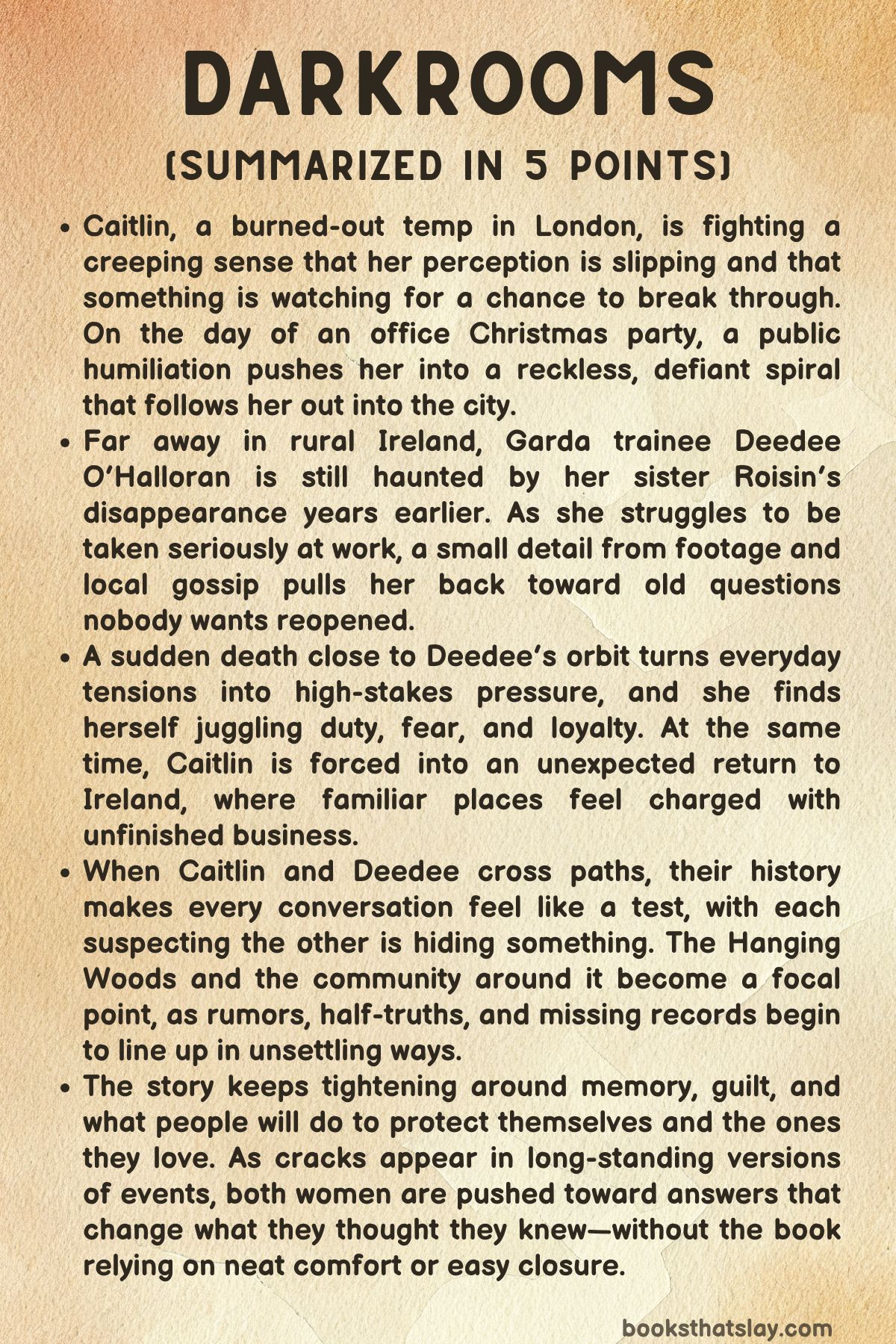
Darkrooms by Rebecca Hannigan is a psychological crime novel that moves between London and a small Irish town in the days around Christmas. Caitlin Doherty, exhausted and unstable, is haunted by visual “shadows” and by what she did as a child.
Deedee O’Halloran, a Garda trainee, has spent most of her life living beside the unanswered disappearance of her sister Roisin. When Caitlin returns to Ireland after her mother’s sudden death, old wounds reopen and long-buried evidence starts to surface. The story follows two women circling the same past, as guilt, denial, and power inside a respected family finally begin to crack.
Summary
Caitlin Doherty is working her last day as a temp in a London office on the afternoon of the company Christmas party. She is running on almost no sleep and relies on routines to keep herself steady, because she sometimes sees “shadows” that make the world feel wrong and unreal.
The office is loud, sweaty, and getting messier by the minute as coworkers drink and joke. Caitlin keeps her head down, trying to reach the end of the day without falling apart.
A coworker, Mark, recently made permanent, decides to perform for the room by mocking Caitlin. He calls her “crazy,” speaks about her as if she is not present, and dares her to react.
Nobody steps in. Caitlin feels cornered.
If she argues, he will twist it. If she leaves, he will take it as proof he was right.
She chooses a third option: she will control the moment.
She walks to the drinks, takes the last wine, downs it in front of everyone, then approaches Mark with a fake smile and a too-long hug. While he basks in the attention, she slips his heavy wallet from his back pocket and hides it up her sleeve.
She leaves the office with people laughing behind her, then heads to the kitchen and quietly sabotages the party by emptying beer down the sink and setting the tap to overflow under tea bags and paper filters. In the lift, as the doors close, the shadows rush back stronger.
Caitlin feels a hard certainty that sleep will not fix this. Something inside her wants something real, something physical, and she thinks of blood.
In Bannakilduff, Ireland, Garda trainee Deedee O’Halloran is stuck in a station watching the same seconds of CCTV again and again, footage connected to a drug-related death involving the O’Sullivan brothers. Her colleague Mac needles her, tries to order her around, and makes sure the room notices her discomfort.
Another guard, Florian Carroll, cuts in with jokes that redirect the humiliation, but Deedee still feels small and angry. She wants to prove she belongs.
Under everything else, Deedee is consumed by a much older case: the disappearance of her sister Roisin in 1999. Roisin was last seen following another girl—Caitlin Doherty—into the Hanging Woods.
Both girls went in. Only Caitlin came out.
The town moved on with a shrug that never felt like an answer. Deedee never did.
Replaying the CCTV, Deedee notices a detail other officers dismiss: a cocker spaniel in the background. She recognizes the dog as Copper, a local animal she has seen on her walks.
Superintendent Doyle encourages her to follow up, even as others mock her for treating the sighting like a breakthrough.
Back in London, Caitlin rides the Tube with Mark’s stolen wallet. Inside she finds cash and a small bag of cocaine.
She thinks she sees Roisin on the train and pushes through the carriages after the glimpse, but it turns out to be a sleeping teenage girl who only resembles Roisin in passing. A well-dressed man sits beside the unconscious girl and begins testing what he can get away with—small touches, checking whether she responds.
Caitlin watches, sickened, and feels the carriage thin out in a way that seems unreal, as if the shadows are clearing space for something to happen. A noisy group of women enter and confront the man, breaking the moment.
Caitlin slips away and drops money into a homeless person’s cup, but the sight of the sleeping girl has stirred up something worse. In her mind, Roisin is not a missing person.
Roisin is someone Caitlin killed.
Deedee walks through Bannakilduff during the solstice season, thinking about the day Roisin vanished and the way the investigation went nowhere. Community assumptions, delays, and distractions helped bury the truth.
At the cemetery she talks at her parents’ grave and feels the familiar pressure of grief and responsibility. When she spots teenagers trampling graves, she snaps, grabbing one of them and threatening them until they scatter.
The aggression shocks her. At home, her partner Sean comforts her as she breaks down.
Later she studies Roisin’s old belongings, including a hand-drawn map of the woods. Florian sends her flirtatious messages, which she shuts down, reminding herself she will not damage her relationship with Sean.
Caitlin, still tense and sleepless, ignores a message from her mother and starts moving through London with a sense of purpose. She targets a wealthy woman, pretends to fall, injures her own hands, and steals the woman’s gold bracelet.
A man named George offers help. Caitlin, on impulse, gives the name “Roisin” and flirts.
George invites her to an exclusive club, where Caitlin bluffs her way into the group by claiming elite school connections and offering Mark’s stolen cocaine as a party gift. The gamble works.
She uses George’s attention as a shield, because when she feels desired and watched, the shadows loosen their grip.
In Bannakilduff, Deedee meets friends in a pub. The conversation turns toward Roisin.
They admit they are tired of tiptoeing around Deedee’s grief, and Deedee storms out, raw and furious. At the door she collides with Kathleen Doherty, Caitlin’s mother, who is in a fur coat and shouting into a phone.
Kathleen falls hard, her head striking the frame and then the pavement. Deedee drops beside her, terrified by the sound of the impact.
She tells onlookers Kathleen tripped and dragged her down too, trying to protect herself and control the story.
Deedee gets Kathleen into a taxi. Kathleen drifts in and out, fixated on her broken phone and on a call she believes is coming.
She mutters about Caitlin, about accidents, about regret, about trying to be better. The driver complains and threatens extra charges.
At Kathleen’s gatehouse home beside the Branagh family’s “Big House,” Kathleen vomits on Deedee’s new boots. Deedee guides her inside.
The gatehouse feels cold and neglected, cluttered with old papers and ashtrays, yet the kitchen is oddly spotless. Kathleen settles in front of a teen movie on TV and falls asleep still in her coat.
Deedee considers leaving but stays long enough to build a small fire, afraid Kathleen might freeze. She steps outside to smoke and notices an open back-bedroom window, which she closes.
Then she crosses to the Big House through the field and lets herself in through a back door she knows is rarely locked. Inside she finds Maureen Branagh asleep with the TV on and runs into Sean.
Sean’s father Colm is deteriorating. Deedee blurts out the idea of having a baby, desperate for something that feels like a future.
Sean doesn’t meet her where she is. He says there is too much going on.
Sean drives Deedee home. Later Deedee realizes she still has Kathleen’s phone, calls Sean with it, and tells him she loves him.
He says it back, but only after noting the number. Deedee feels steadied anyway, as if being tied to the Branaghs gives her protection.
In London, Caitlin and George go to his townhouse. Their sex is rough and angry.
George tries to soften afterward, but Caitlin stays detached. Then she receives a call from Cork: her mother, Kathleen, has been found dead at home.
Caitlin panics, leaves, and returns to her flat where her friend Lola meets her with pills meant to keep her upright. Caitlin decides she has to go back to Ireland.
Caitlin flies to Cork close to Christmas. Maureen calls and offers her a room at the Big House and help with the funeral.
At the airport, Deedee picks Caitlin up. The meeting is tense from the start.
Deedee pokes at the old wound, asking what Caitlin remembers about Roisin and implying Caitlin has avoided responsibility for years. Caitlin is exhausted, defensive, and frightened by the drive past the Hanging Woods.
When they arrive, the gatehouse is taped off, the death treated as a case. Caitlin scratches Deedee’s car with her key before heading to the Big House.
Sean greets Caitlin warmly and takes her bags. Deedee watches the welcome and feels shut out.
Sean later warns Deedee that Mac is saying she was drunk and knocked Kathleen down. If Kathleen died from the fall, Deedee could be in serious trouble.
He tells her he defended her, then uses affection to quiet her and sends her away.
Caitlin settles into the Big House. Maureen explains that a neighbor noticed lights and found Kathleen dead.
Caitlin visits Colm upstairs and sees his frailty. Alone later, she sees a dead crow hit her window and feels pulled toward the gatehouse.
She sneaks out, forces her way inside, and moves through her mother’s things, sick with grief and anger. She puts on Kathleen’s heels and fur coat and stands at the sink staring toward the Hanging Woods.
She finds dried blood on the coat’s collar. Kathleen’s phone is missing.
When Caitlin calls it, she hears ringing somewhere near, but not in the house. She spots an orange cigarette butt among menthol filters and another outside, proof someone else has been there.
The next morning Caitlin sees Deedee in town and follows her, convinced Deedee will lead her to Lee Casey, a man Caitlin believes is connected to the forces stalking her. Deedee enters Casey’s cottage.
Caitlin limps after her, picks up a heavy rock, and raises it to strike at the figure in the doorway. The rock flies, grazes Deedee’s shoulder, and Caitlin falls.
Deedee drags Caitlin away, furious and shaken. Casey shows a boarding pass and insists he arrived only yesterday.
Caitlin swings between panic and icy certainty, insisting he is lying. Deedee decides Caitlin is dangerous.
Caitlin claims she has evidence from the gatehouse: blood on the coat and cigarette butts. Deedee tries to dismiss it as grief, but privately she is rattled.
Caitlin also denies being near the woods during the night, contradicting herself in ways Deedee notices. Back in town, Deedee smokes, and Caitlin locks onto the habit.
Deedee urges Caitlin to leave Bannakilduff. Caitlin fires back that Roisin’s disappearance is Deedee’s fault, because Roisin followed Caitlin into the woods after a fight involving Deedee.
At the Big House, Caitlin lies about her bruises. A young guard, Florian, arrives asking if they saw anything connected to a missing blond girl reported near the woods.
Caitlin recognizes the girl’s links to the Quinn family but stays quiet. Florian asks to check the darkroom shed on the property in case someone used it for shelter.
Maureen unlocks it. Inside are boxes and old photography tools.
Florian leaves contact cards.
Deedee goes to the pub and tries to secure CCTV from the night Kathleen fell. The bartender says the system auto-deletes after three days, but hints he can hold it if Deedee returns in uniform.
Another guard, Jo, brings Deedee Caitlin’s stolen bracelet, dropped off by Lee Casey. Jo also discovers something alarming in the old Roisin case: interview notes from Michelle Quinn are missing.
Caitlin, meanwhile, finds tapes and negatives hidden under Colm’s bed. She begins to suspect the Branagh family has been hiding more than illness.
Deedee, already suspicious, goes to the Hanging Woods with Roisin’s map and finds the marked clearing. There is a stump scarred with axe marks, suggesting recent use.
Back at the Big House, Deedee checks Caitlin’s luggage and finds a tag with a different name and address, plus Mark’s wallet. She also finds Caitlin’s drawings of Roisin imagined as an adult and tears the pages out to keep as evidence.
Deedee pushes Maureen about the darkroom and watches carefully. Maureen brushes it off, but Deedee catches a flicker of worry between Maureen and Sean that feels like recognition.
Deedee later sees images from the darkroom that leave her horrified, convincing her Colm used photography to record abuse.
Caitlin goes into the woods and follows a string that seems to guide her. The string ends, and suddenly the season shifts.
Caitlin finds herself in bright summer sun, back in 1999 on the day Roisin vanished. She relives the moment: Roisin arrives urgent and determined to tell Maureen about what Colm has been doing.
Caitlin, terrified of being abandoned and flooded with jealousy and panic, pushes Roisin. Roisin falls near the stump.
Caitlin strikes her in the forehead with a rock. She runs for help, and Maureen later reassures Kathleen and helps cover what they present as an accident.
Back in the present, Deedee confronts Colm. He admits there were photographs and insists they must be destroyed.
He denies killing Roisin but does not deny harming girls. Deedee realizes Maureen has kept him sedated for years.
In rage, Deedee prevents him from calling for help and takes the sedatives, leaving Maureen and Sean scrambling as Colm begins to seize.
In the woods, Caitlin digs for Roisin’s body where she believes it was buried, but finds nothing. Desperate and starving, she decides to die and hangs herself with her belt from a branch.
Deedee, running through the woods carrying bundles of photographs, hears her and finds Caitlin suspended above the trench. Deedee hesitates for a brutal second—saving Caitlin risks losing evidence if Sean destroys the darkroom.
She chooses Caitlin and cuts her down. Rain begins, washing over the photographs.
They fade toward blank because the chemical fixing step was skipped.
Caitlin coughs back. She explains the fading and admits she destroyed negatives to prevent copies.
Then she says she thinks she knows where Roisin is. They go to Kathleen’s gatehouse.
Inside, Deedee finds Kathleen’s notebooks and an Alcoholics Anonymous Big Book with a list that includes “Find the child” and “Deirdre,” suggesting Kathleen had been trying to correct old wrongs. Caitlin points out a name—Michael—which she connects to Michael Doyle, implying Kathleen had a relationship with him and may have sought his help.
A disturbance of trapped crows draws Deedee to the fireplace. She finds a soot-blackened bundle hidden inside the chimney.
When she unwraps it, she finds a child’s skull and jawbone. Roisin has been there all along, concealed in the one place nobody wanted to look too closely.
Caitlin admits she pushed Roisin and hit her, but says she did not mean to kill her. Deedee, wrecked by the confirmation, confronts Maureen at the Big House.
Maureen tries to deny it, then finally tells the truth: Roisin told her what Colm had done, and she would not stop talking. Maureen strangled Roisin to silence her and protect her family.
She also admits she has kept Colm drugged and helpless to contain what he might reveal.
Deedee runs to stop Sean from demolishing the darkroom and destroying whatever evidence remains. Sean rages at her and reminds her he knows her secrets, trying to keep her afraid.
Jo arrives after Deedee texts her. When Deedee spots a hidden manila envelope behind a broken wall, she and Jo struggle with Sean until Superintendent Doyle arrives and helps restrain him.
Inside the envelope are older photographs—proof that survives because it was processed differently. Sean is arrested.
With the evidence secured, the chain of events becomes clear: Colm abused girls and documented it. Roisin tried to speak up.
Maureen killed her. Kathleen believed Caitlin’s story about an accident and called for help covering it, trying to keep her daughter from being destroyed, then spent years trying to make herself “better” while still trapped by what she had enabled.
Other local incidents, including the hit-and-run connected to the Quinn family, slot into the larger pattern of people acting to protect themselves.
At the hospital, Deedee and Caitlin confront Maureen by Colm’s bed. Deedee tells her it is finished.
Guards arrive to arrest Maureen. Later, Deedee and Caitlin walk toward the solstice celebration and listen to Kathleen’s final voicemail.
The town’s music and lights carry on as if nothing changed, but for them everything has. The truth is out, the dead have names again, and the two women step into the crowd together, facing whatever comes next.
Characters
Caitlin Doherty
Caitlin is the volatile center of Darkrooms—a woman living on the edge of exhaustion, dissociation, and compulsion, whose inner reality keeps bleeding into the outer one. Her “shadows” are not just a spooky motif; they function like a symptom and a force at once, amplifying how unsafe she feels in her own body and how quickly she turns to control as a survival strategy.
In London she is cornered by humiliation and powerlessness, and her response is not to plead for dignity but to seize it through performance and petty sabotage—stealing Mark’s wallet, destroying the office booze, and turning the room’s laughter into something she authors rather than endures. That pattern follows her everywhere: when she senses threat, she scripts a role, adopts a name, and treats identity like a costume she can swap to stay one step ahead of shame.
Her impersonation of “Roisin” is especially revealing because it is both camouflage and confession—she uses the name to flirt, to manipulate, to pass, and to keep the memory of what she did buried in plain sight.
Caitlin’s morality is messy in a way that feels deliberately uncomfortable: she can be sharply perceptive about predation and social cruelty, yet she is also capable of startling violence and self-justifying coldness. She intervenes indirectly when she senses a man testing an unconscious girl on the Tube, but she also later approaches danger with a rock in her hand, convinced that preemption is the only way to survive.
Underneath her thefts, lies, and razor-edged superiority is a childlike terror of abandonment—especially of being left behind for someone better, someone loved more, someone safer to keep. That jealousy and panic are what flood back in the time-slip to 1999, when her fear of losing Roisin curdles into aggression, and then into the act that fractures both their lives.
Even in adulthood, Caitlin’s relationship to truth is shaped by that moment: she wants reality to be stable, but she cannot tolerate what stability would force her to admit. Her near-suicide exposes the core contradiction in her character—she fights like someone who refuses to lose, yet she carries a grief and guilt so heavy she is willing to vanish if she cannot control the narrative anymore.
By the end, when she helps Deedee reach Roisin’s remains and stays beside her in the aftermath, Caitlin does not become “redeemed” so much as finally pinned to the truth, no longer able to outrun it through performance.
Deedee O’Halloran
Deedee is built from two opposing pressures: the need to be competent and respected in a job that constantly diminishes her, and the need to resolve a private agony that has hollowed out her family for decades. As a Garda trainee she moves through everyday humiliations—being ordered to make tea, being mocked for her instincts, being dismissed as emotional—and each slight lands because it mirrors the larger wound of Roisin’s disappearance, the way her community and institutions failed to treat the loss with urgency.
Deedee’s intelligence is quiet but persistent; she notices details others overlook, like the dog on CCTV, and she keeps working even when the room wants her to shrink. That persistence is not only professionalism—it is grief turned into method, the belief that if she can just see clearly enough, she can reverse time.
What makes Deedee compelling is that her empathy and her rage live side by side, often in the same decision. When Kathleen falls, Deedee is exhausted and angry, but she still chooses care over convenience, hauling her through the night because she cannot abandon someone vulnerable.
She also has moments where her restraint snaps—grabbing teenagers in the cemetery, slapping away Colm’s emergency button, stealing sedatives as an act of vengeance and leverage—and those moments do not read like corruption so much as the inevitable overflow of a woman forced to swallow too much for too long. Her relationship with Sean reveals another layer: she wants belonging and safety, but the “safety” offered by the Branagh household is conditional, laced with control and secrets.
Deedee’s arc is the gradual realization that what she thought was a stable home base is a structure designed to manage her, and that her loyalty has been used as a tool to keep truth buried.
Deedee’s ultimate strength is her capacity to choose the right thing even when it costs her. In the woods, she is torn between securing evidence and saving Caitlin’s life, and she chooses life—an act that speaks to her core moral compass even when she is furious.
When she finally confronts Maureen and then stops Sean from destroying the darkroom, Deedee becomes the force that turns suspicion into consequence. The ending leaves her bruised but no longer trapped inside the unanswered question of Roisin; she steps forward carrying truth rather than chasing it, and that shift is what makes her transformation feel earned.
Roisin O’Halloran
Roisin is physically absent for most of the story, yet she is the gravitational center around which everyone’s choices spin. She exists as memory, projection, and accusation: Deedee’s life is shaped by her disappearance, Caitlin’s psyche is haunted by her, and Bannakilduff’s social fabric is stitched with the silence that followed her vanishing.
Roisin’s presence in the narrative is defined by the way others keep trying to rewrite what she meant—some turning her into a tragedy to be pitied, others into a problem to be managed, and a few into a threat because she knew too much. The fragments we do get portray her as bright and determined, a child with enough courage to speak about what she saw and enough faith to believe adults would do the right thing.
That courage is exactly what makes her dangerous to the Branaghs. Roisin’s intention to tell Maureen about Colm’s abuse reframes her disappearance not as misadventure but as silencing.
In that sense, Roisin is not only a victim; she is also a mirror held up to the town’s cowardice and complicity. The revelation that her body was moved and hidden for years underscores how thoroughly her truth was treated as an infection to contain.
When Roisin is finally found, she stops being an idea and becomes a fact again, and the story’s moral landscape shifts: grief becomes evidence, memory becomes record, and the people who shaped their lives around silence can no longer pretend silence was harmless.
Maureen Branagh
Maureen is the story’s most chilling expression of respectable cruelty—someone who can offer tea, warmth, and maternal reassurance while simultaneously orchestrating concealment and control. She operates through atmosphere: hospitality that disarms, chatter that blurs focus, and domestic routines that make people feel cared for even as they are being managed.
Her power comes from how effectively she presents the Branagh home as a refuge, especially to someone like Caitlin returning raw with grief, and to someone like Deedee who longs for stability. That refuge is real in the sensory sense—food, fire, familiarity—but it is ethically poisoned, a stage built to keep terrible truths out of sight.
Maureen’s motivations are not framed as madness but as a cold calculus of protection—protection of her family name, her household, her husband’s position, and the myth that what happens inside the home can be contained there. Her admission that she strangled Roisin because Roisin would not stop talking is devastating precisely because of how simple it is: not a dramatic accident, not a panicked mistake, but a deliberate act of silencing.
Maureen’s long-term sedation of Colm reveals the same logic: she does not seek justice, she seeks containment, choosing control over accountability. Even when exposed, she initially clings to denial, showing how practiced she is at turning reality into a story that benefits her.
Maureen embodies the idea that evil can be domestic, organized, and smiling—an authority figure who treats truth as an existential threat.
Sean Branagh
Sean’s menace lies in his casualness—how easily he shifts from warmth to intimidation, from comforting partner to enforcer of the family’s unspoken rules. He is skilled at making people doubt themselves, especially Deedee, by reminding her who “keeps her secrets” and repositioning himself as both protector and gatekeeper.
His affection is not always fake, but it is transactional: he offers closeness when it stabilizes the system and withdraws it when someone becomes inconvenient. The jealousy Deedee feels when she sees Sean embracing Caitlin is not only romantic; it is also political, because it signals who currently has access to the family’s center and who is being pushed to the edges.
Sean’s relationship to the darkroom is crucial. He is not merely adjacent to the horror; he becomes the active agent trying to destroy evidence, raging when Deedee threatens the structure that has protected him.
His belittling of Deedee in moments of conflict reveals contempt underneath intimacy, a belief that her role is to be managed, not to act. Even before the arrest, Sean reads as someone who has internalized the family’s entitlement—an assumption that consequences are for other people.
When the evidence finally surfaces and he is restrained, the story exposes him as a person whose identity depends on secrecy, and whose violence escalates the closer truth gets to daylight.
Colm Branagh
Colm is the rotten core that the Branagh household has tried to wrap in layers of routine and denial. His physical frailty in the present does not soften what he represents; instead it highlights how long predation can hide behind status, age, and illness.
The darkroom imagery attached to him is not accidental—he is linked to the act of developing, fixing, and preserving images, which becomes a metaphor for how abuse is documented, possessed, and re-experienced as power. The existence of photographs depicting abuse suggests not only harm but an attempt to memorialize harm, turning violation into something collectible.
Colm’s partial confession is slippery. He frames the photographs as something that “must be destroyed,” acknowledging wrongdoing while still trying to control the terms of exposure.
His claim that he did not kill Roisin functions as a technical defense, a way to separate himself from the most socially legible crime while still leaving the broader violence intact. He is also portrayed as dependent—drugged, bedbound, managed—which complicates the present-day dynamics without absolving him.
Colm is both perpetrator and protected asset, kept alive and quiet as part of the family’s containment strategy. The fact that some photographs “won’t fade” becomes the narrative’s verdict on him: the truth he tried to control survives him.
Kathleen Doherty
Kathleen is the story’s portrait of a woman worn down by regret, addiction, and long years of trying to outrun a catastrophe she helped bury. Her presence begins as a figure of chaotic vulnerability—the injured woman tapping a broken phone, drifting in and out of coherence, obsessed with making contact—yet her later significance deepens into something tragic and morally tangled.
Kathleen’s gatehouse is a physical map of her internal life: cluttered, cold, half-abandoned, yet with pockets of order, as if she kept trying to be “better” without knowing how to rebuild the foundation. Her insistence on television and cigarettes reads like self-soothing, a way to keep silence filled so memory cannot speak.
Kathleen’s connection to the cover-up reframes her not as a passive victim of circumstance but as someone who made choices under unbearable pressure. The notebooks and recovery material hint at long-term attempts at accountability—lists that include “Find the child” and Deedee’s name suggest that guilt never let her fully rest.
Her reaching for Caitlin, her warnings in the taxi, and the sense that she has been “looking for years” position her as a person who wanted the truth but lacked the courage or clarity to bring it into the open while alive. Even after death, Kathleen drives the plot like a final message: her missing phone, her voicemail, her hidden chimney bundle.
She becomes the conduit through which what was buried returns, forcing the living to do what she could not.
Florian Carroll
Florian functions as a pressure-release valve in the station and a subtle indicator of what decent authority can look like in a compromised environment. Early on he disrupts Mac’s humiliation of Deedee by redirecting ridicule away from her, which marks him as socially perceptive and willing to intervene.
His flirtatious messages suggest charm, but Deedee’s reaction—deleting the selfie, reaffirming her commitment to Sean—positions Florian less as a romantic path and more as a test of Deedee’s emotional loyalties and vulnerabilities.
As a guard, Florian is also a quiet presence on the perimeter of the central crimes: he visits the Big House asking about sightings, checks structures like the darkroom shed, and operates as a procedural thread that contrasts with the town’s older culture of secrecy. He is not the hero of the case, but he represents the possibility of institutional integrity—small actions that, in a different past, might have prevented decades of silence.
Connor “Mac” McPherson
Mac embodies the everyday misogyny and bullying that make Deedee’s professional life feel like another trap. His needling is not just personal nastiness; it is a performance of hierarchy, using humiliation to remind Deedee that she is still “new,” still expected to serve, still easy to dismiss.
The fact that others tolerate him until Florian intervenes shows how normalized his behavior is and why Deedee’s anger keeps accumulating—she is not fighting one man, she is fighting a room that treats her dignity as optional.
Mac also becomes dangerous because he spreads a narrative that could destroy Deedee. His claim that she knocked Kathleen down while drunk reveals how quickly gossip turns into professional threat in a small community.
He functions as a reminder that official truth is often shaped by loud confidence rather than evidence, which is exactly the dynamic that allowed Roisin’s case to rot for so long.
Superintendent Doyle
Doyle represents the institutional face of the investigation—someone with enough authority to either shut Deedee down or legitimise her instincts. His encouragement to pursue the CCTV lead involving Copper suggests he can recognize competence even when others mock it.
At the same time, he operates within a system that previously failed Roisin, so his supportive moments carry an implicit question: is he different from the past leadership, or is he simply better at appearing reasonable?
Doyle’s arrival during the climax, when Sean is restrained and the envelope is discovered, signals the shift from private confrontation to official consequence. He becomes the figure through whom the story’s revelations are translated into action, which matters because Bannakilduff’s deepest problem is not only what happened, but what the town chose not to process through formal accountability.
Jo
Jo is the practical ally Deedee needs—someone who brings information, believes patterns, and is willing to show up when danger escalates. Her discovery that interview notes from Michelle Quinn are missing is a crucial detail because it points to active interference, not mere incompetence.
Jo’s willingness to receive and return the bracelet and to engage with Deedee’s concerns places her as a connective character, bridging personal clues with procedural reality.
When Jo arrives at the darkroom demolition and helps restrain Sean, she becomes the difference between Deedee being dismissed as hysterical and Deedee being supported as an investigator. Jo’s role highlights a key theme in Darkrooms: justice often requires not only truth, but witnesses who refuse to look away.
Mark Lewis
Mark is the London-office antagonist whose cruelty is banal but catalytic. His public humiliation of Caitlin is designed to strip her of personhood—talking about her as if she is not present, labeling her “crazy,” and relying on the office’s silence as his shield.
He represents a familiar social violence: the kind that thrives in workplaces because it can be reframed as joking, stress, or “just how he is.” What makes Mark important is not depth of backstory but the precision with which his behavior explains Caitlin’s escalation. He triggers the part of her that refuses to be powerless, and her response—stealing his wallet—shows how she converts humiliation into retaliation.
The contents of his wallet, including cocaine, add a layer of hypocrisy and risk. Mark publicly polices Caitlin’s sanity while privately carrying his own illicit escape hatch, reinforcing how authority often belongs to those who can hide their mess and expose someone else’s.
Lola
Lola appears as Caitlin’s anchor in London, though their connection is steeped in dependency rather than simple friendship. Caitlin’s plan to meet Lola for a tranquilizer points to a life structured around chemical interventions and crisis management, and Lola’s arrival with pills to keep Caitlin awake after the news of Kathleen’s death suggests a relationship where care and enabling blur together.
Lola does not “fix” Caitlin; she helps her function inside dysfunction.
Lola’s relative absence from the Ireland plot also matters: she represents the London life Caitlin built to escape the woods, and Caitlin leaving that life behind signals the story’s insistence that some pasts cannot be relocated away from.
George
George is a mirror for Caitlin’s talent at manipulation and her hunger for control. He is drawn to her as a novelty and a flirtation, and she uses that desire as a tool—bluffing elite credentials, offering cocaine as social currency, and letting his attention buffer her from the “shadows” and from her own memory.
George’s initial gesture of offering a handkerchief reads as care, but the relationship quickly turns into something rough and transactional, exposing how easily intimacy becomes performance when one person is dissociating and the other is consuming the thrill.
George also functions as a test of Caitlin’s limits: she notices valuable sketches but does not steal them, suggesting that her compulsions are strategic rather than indiscriminate. When she receives the call about Kathleen’s death, George becomes irrelevant instantly, showing that Caitlin’s attachments are often situational—useful until the real crisis breaks through.
Ettie
Ettie operates as a symbol of wealth, entitlement, and the social circle Caitlin infiltrates. As the bracelet’s owner, she is both a literal target of theft and a representation of the world Caitlin pretends to belong to in order to stay afloat.
The friction between Ettie and George also reveals how performative that circle’s loyalty is; conflict is managed through status games, not empathy.
Ettie’s primary function is to show Caitlin’s capacity to weaponize class signals—education, confidence, gifts—while simultaneously despising what she is doing. Ettie becomes part of the atmosphere that lets Caitlin’s identity fraud feel plausible, which underscores how easily surfaces can be mistaken for truth.
Brendan
Brendan, the taxi driver, is a small but vivid embodiment of social impatience toward vulnerability. His threat to charge extra if Kathleen vomits frames care as inconvenience, which heightens how alone Kathleen is even when surrounded by people.
Brendan’s role emphasizes that cruelty in Darkrooms is not always grand; sometimes it is the everyday refusal to treat suffering as real.
Gerry
Gerry, the pub bartender, becomes a gatekeeper of evidence and a reminder of how fragile truth can be when it depends on informal cooperation. His statement about CCTV deletion deadlines creates urgency, and his condition that Deedee return “in uniform” signals how authority must be performed to be honored.
Gerry’s position is ambiguous—helpful on the surface, but part of a town ecosystem where information is a form of power.
Fi and Mags
Fi and Mags represent friendship strained by prolonged grief. Their jokes about Deedee’s job show familiarity, but their insistence that they cannot “tiptoe” around Roisin reveals exhaustion and discomfort with the emotional rules Deedee’s loss has imposed on the group.
They are not villains; they are people who have adapted by hardening, and their pushback exposes how isolating long-term trauma can be, even among friends.
Their confrontation with Deedee also triggers one of the story’s sharpest turns, underscoring how quickly ordinary social friction can spill into catastrophe in a town where everyone is already carrying too much.
Michelle Quinn
Michelle is a key hinge in the town’s hidden history, less through direct scenes and more through the suspicious absence of her statements. The missing interview notes imply that her testimony was inconvenient, which suggests she either knew something about Roisin’s disappearance or about the men and institutions surrounding it.
Michelle’s presence through her daughter—caught trampling graves—also shows how trauma ripples down generations, warping respect, boundaries, and the town’s relationship with the dead.
Oisín Quinn
Oisín’s role reveals the violence that can erupt when a community tries to handle predation privately. His act of running Colm over is framed as retaliation rooted in witnessing, which places him in the story as both avenger and participant in the town’s cycle of secrecy and consequence.
Oisín’s choice does not deliver justice in a clean way; it adds another layer of buried truth, another act that people must either confront or conceal.
Lee Casey
Casey serves as a convenient suspect—an outsider-shaped figure onto whom fear and pattern-seeking can be projected. Caitlin’s certainty that he has been present “every time” reads as paranoia mixed with intuition, the mind trying to make chaos legible by giving it a single face.
Casey’s calm presentation of a boarding pass challenges that narrative, forcing the possibility that Caitlin’s “shadows” and trauma distort causality.
Casey’s cottage scene is important because it exposes how dangerous Caitlin’s certainty can be. Even when she is wrong, the conviction feels real to her, and that is the point: Darkrooms treats perception as unstable, but still capable of producing very real harm.
Michael Doyle
Michael appears as a name inside Kathleen’s life rather than a fully embodied figure, but that is precisely why he matters. His implication in Kathleen’s notes suggests an intimate connection that may have shaped how the cover-up was managed, offering a glimpse of relationships and loyalties running alongside official channels.
Whether as confidant, lover, or fixer, Michael represents the blurred line between personal entanglement and institutional action in a small community.
Copper
Copper, the cocker spaniel, is a deceptively important minor character because he functions as a factual anchor in a story filled with distortion and denial. Where people reinterpret memories and reshape narratives, the dog is simply there—captured in the background of footage, tied to a real location and real movement.
Deedee’s recognition of Copper validates her observational skill and symbolizes the investigative principle the town resisted for years: that truth often starts with the small, unglamorous detail someone bothered to notice.
Themes
Unreliable perception and the fear of losing reality
Caitlin’s day in the London office is framed by her constant attempt to keep her mind anchored while her vision is invaded by shadows that make the world feel unsteady. That instability isn’t presented as a vague mood; it shapes her decisions minute by minute.
She tries to “act normal” at work, counts down hours, uses grounding routines, and still ends up experiencing reality as something that can tilt without warning, especially when stress spikes. The office party becomes a pressure chamber: heat, alcohol, noise, humiliation, and the sense that other people can turn into a hostile crowd at any moment.
When Mark publicly labels her “crazy,” the cruelty lands not only as insult but as a threat to her grip on what is happening, because being dismissed as unstable is a way of stripping her credibility and agency. Later, on the Tube, she watches a man test a sleeping girl’s boundaries and senses the carriage emptying in a way that feels unreal; whether or not the emptiness is literal, the experience captures how isolation can become perceptual.
In Darkrooms, the tension is that Caitlin’s perceptions are sometimes wrong (she mistakes strangers for Roisin, she misreads situations), yet they also point toward real danger (predation on the train, the sense of someone else being in her mother’s house). That creates a disturbing double bind: she cannot fully trust her senses, but she cannot afford to ignore them.
The story uses that bind to show how paranoia and intuition can sit side by side, and how trauma can make the brain scan constantly for threats, turning ordinary public spaces into scenes of looming risk.
Public humiliation, misogyny, and the social enforcement of silence
The narrative repeatedly shows women being corrected, mocked, and controlled in public settings where resistance carries consequences. Caitlin’s workplace humiliation is loud and communal: Mark performs dominance in front of an audience, and the audience’s passivity is part of the violence.
Nobody intervenes, not because they agree with him in principle, but because the cost of stepping in feels higher than the cost of letting it happen. That same social mechanism appears in Bannakilduff, where Deedee is treated as an errand-runner and is baited into embarrassment by a colleague who assumes he can order her around.
When Florian punctures the dynamic by mocking Mac, the moment matters because it demonstrates that the power structure is held up by performance; ridicule can be redirected, and status can shift, but only if someone chooses to act. Deedee’s own relationships also show how silence is enforced privately: friends who claim they are “done tiptoeing” push into Roisin’s absence in a way that feels like a demand that Deedee manage everyone else’s discomfort.
Even Sean’s affection contains pressure, because he reminds Deedee—explicitly and implicitly—that loyalty to the Branagh family comes with expectations about what she should ignore. The story treats misogyny less as a single villain’s attitude and more as a group habit: men humiliating women, women smoothing it over to keep peace, and institutions treating women’s anger as a problem to be corrected.
The consequence is not only emotional harm; it’s investigative harm, too, because the missing-girl case becomes a story the town has learned to live around rather than confront honestly.
Sexual predation, consent, and the ways power tests boundaries
Several scenes focus on the moment before overt violence, when someone tries to see what they can get away with. On the Tube, a man touches a sleeping girl lightly, not because he has already decided what he will do, but because he is checking whether anyone will stop him and whether she will react.
The discomfort is heightened by the sense that the carriage empties, leaving the girl more vulnerable. The intervention by the hen party is a blunt reminder that safety often depends on collective action, not on the victim’s ability to defend herself.
Caitlin’s sexual encounter with George carries a different kind of boundary-testing. The sex is rough and aggressive, and afterward George shifts toward intimacy while Caitlin remains detached, suggesting a mismatch not only in desire but in what the encounter means to each of them.
Caitlin uses sexuality strategically, adopting the name “Roisin,” playing a role, offering drugs, and letting attention function as protection. That strategy gives her leverage in the moment but also exposes her to a kind of danger that is harder to define: being pulled into someone else’s control through appetite, status, and secrecy.
Meanwhile, Colm’s abuse is the darkest version of this theme: the systematic exploitation of children, the creation of images, and the quiet assumption that his authority will keep him safe. Darkrooms treats consent not as a single yes/no event but as something shaped by power, environment, and threat.
It shows how predators operate through small steps, and how communities protect them by refusing to look closely.
Evidence, images, and the fight over what can be proven
Photography is not just atmosphere in Darkrooms; it is a battleground over reality. The darkroom holds the literal record of harm, and the story keeps emphasizing that truth needs to be made material to survive denial.
The fading photographs caused by the missing fixer step turn evidence into something fragile, highlighting how easily proof can disappear even when someone tries to preserve it. Caitlin’s knowledge about the chemicals and process becomes morally charged: she understands how images are stabilized, and she has also destroyed negatives to prevent copies.
That detail makes the theme sharper because it shows how control over images equals control over narrative. The manila envelope of older photographs that “won’t fade” contrasts with the ruined prints in the rain, suggesting that some truths resist erasure, but only if they are stored, hidden, and later found.
Deedee’s work as a Garda trainee is repeatedly about tiny slivers of footage, missing notes, and mocked leads; the case depends on noticing what others dismiss, like the dog in the background or the suspicious absence of an interview record. The theme also extends to identity: Caitlin carries stolen objects, false names, altered versions of herself, as if she is constantly developing a new “print” to show the world.
By the end, the struggle is not just to know what happened, but to hold onto the evidence long enough for the truth to outlast the people who benefit from silence.