Daughter of Genoa Summary, Characters and Themes
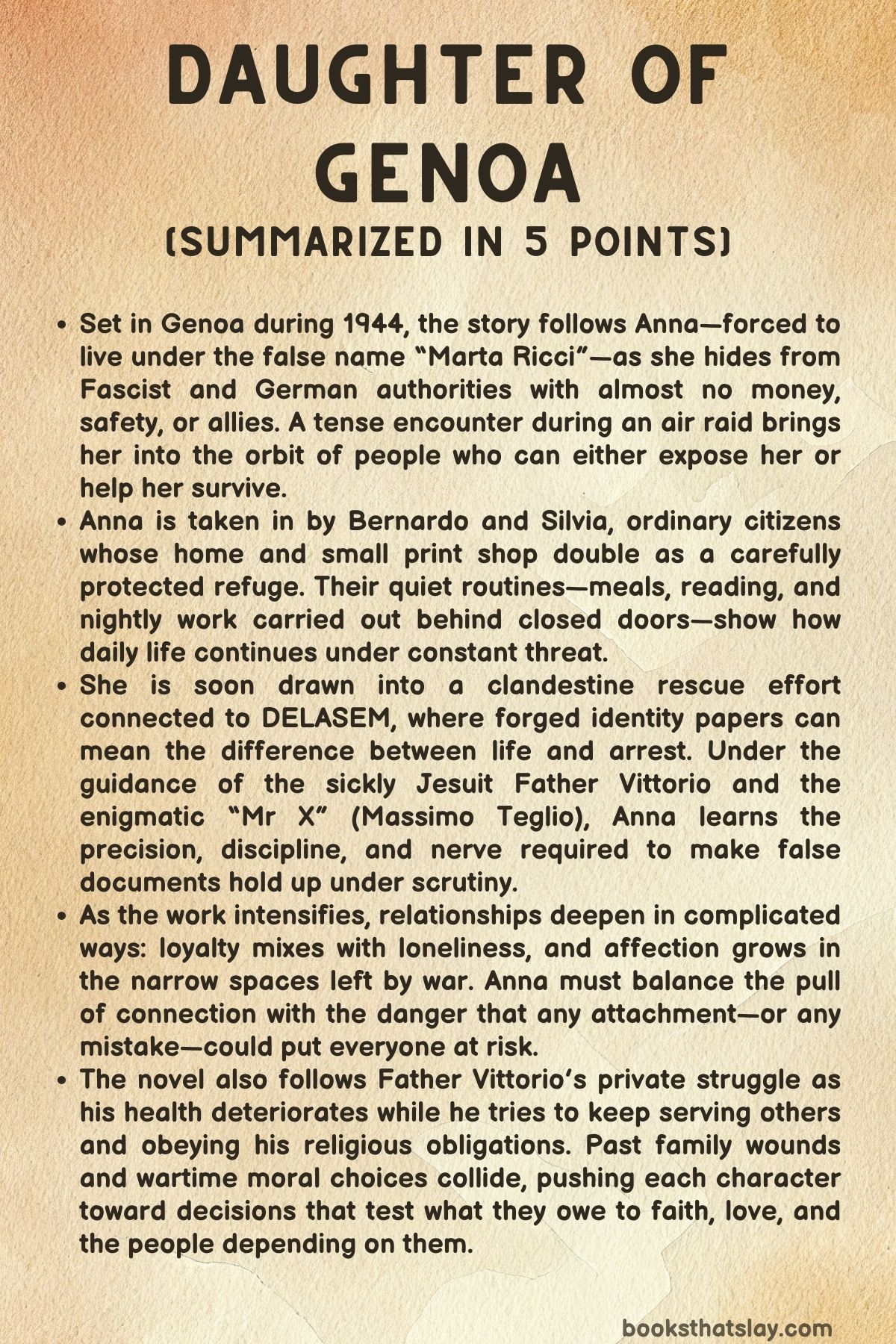
Daughter of Genoa by Kat Devereaux is a historical novel set in German-occupied Genoa during 1944, when Italy’s Racial Laws and Nazi rule have turned daily life into a test of nerves, secrecy, and luck. The story follows Anna, a Jewish widow living under the false name “Marta Ricci,” as she tries to stay invisible while the city shakes under air raids and roundups.
When a chance encounter pulls her into a covert rescue network protected by church figures and civilian allies, Anna finds herself doing more than surviving. She becomes part of a risky operation built on forged papers, shared courage, and fragile trust.
Summary
In 1944 Genoa, Anna lives under the name Marta Ricci, alone and broke in a small flat in Carignano. She keeps her life narrow: quiet movements, few outings, and constant vigilance.
When her landlady threatens to involve a relative at police headquarters over late rent, Anna’s fear spikes. One mistake could expose her as Jewish and send her into the hands of German or Fascist authorities.
That same day, an air-raid siren forces her into a public shelter beneath Galliera Hospital. In the crowded tunnel, she notices a Jesuit priest watching her with unusual focus.
She meets his gaze with anger, then watches him leave, uneasy that he may have recognized something off about her.
At dawn, the priest, Father Vittorio, looks for the woman he saw. A Red Cross nurse named Dora pulls him aside and admits she invented a reason to summon a priest because she needs help with a woman whose papers look wrong.
Dora has found “Marta” collapsed near bombed-out buildings, and she recognizes the telltale signs of crude identity documents. Patrols are sweeping the area after the bombing, checking displaced civilians.
Dora and Vittorio reach the ruins where a local woman is trying to comfort Marta. Dora briskly clears the bystander away and pushes Marta to move immediately.
Vittorio takes Marta’s arm and guides her through damaged streets as she panics at the sight of a German uniform. He keeps her steady and gets her out of the danger zone, then asks where she can go.
She admits she has nowhere.
Vittorio brings her to a small print shop, Tipografia Guichard, near via Assarotti. The entrance requires a distinctive pattern on the bell, and the owner, Bernardo, lets them in with irritation at the unannounced visit.
Upstairs, Bernardo’s wife Silvia offers bread and a room, asking gentle questions that Marta can barely answer before breaking down. Silvia explains the safety measures in the building, including a hidden rope ladder that can drop into a courtyard and a trusted custodian who can help if the worst happens.
For days, Marta sleeps and recovers, then insists on being useful. She begins helping with the shop’s accounts, quickly correcting errors and proving she has skills worth keeping.
Vittorio returns and, in private, warns Marta not to seek involvement in anything risky. He argues that not knowing details could protect her if she’s caught.
Marta pushes back: danger already follows her, and she has no family waiting if she disappears. Vittorio still refuses to include her and leaves, torn between duty and concern.
Soon a visitor arrives using the same bell signal: an elegant man known only as “Mr X.” Marta recognizes him as Massimo Teglio, a key figure in a clandestine rescue network. He brings a ration card and cash and asks careful questions.
The next day he returns and reveals he has identified her: Anna Pastorino, born Anna Levi. He confronts her with blunt truths about interrogation and torture, warning that even a small slip could destroy many lives.
Anna refuses to be treated like a passive liability. She points out that the household is already taking risks for her and that trust must go both ways.
When she challenges his past ties to prominent Fascist circles, he admits youthful foolishness but insists he never served the ideology, and he still uses old connections as leverage when necessary.
To show what his network can accomplish, Teglio compares Anna’s shabby forged card with a far better document. He can print forms and cut stamps, but final legitimacy often requires access to official embossing and marks that can’t be faked easily.
He offers Anna work forging identity cards. Anna accepts at once, relieved to have purpose and a way to fight back.
Teglio hides a list of names inside a battered detective novel and instructs that Silvia and Bernardo will print blanks during the night. Father Vittorio will teach Anna the practical techniques in the morning.
Equipment is stored in separate places to limit damage if one site is raided.
Life in the flat continues with an odd mix of normal routines and secret labor. Silvia and Bernardo read the Bible aloud, listen to Radio Londra, and keep the household calm on the surface while the press clanks below.
Anna tries to sleep but can’t stop thinking about what she has agreed to do and what it could cost.
Vittorio, meanwhile, is quietly ill. He manages a persistent cough and shortness of breath through strict habits and denial.
His superior, don Francesco, and Mr X ask him to support the forgery work. Obedience leaves him little choice, and he agrees while his other duties are reduced.
He marks hiding places on a map, carrying the weight of families depending on him.
The forgery work begins. Anna fills in details neatly from Teglio’s lists while Vittorio checks each card and adds a forged mayor’s signature with practiced speed.
They work in careful shifts to avoid errors. When a blank remains, Vittorio insists Anna make a new card for herself with a more plausible background, then transfers her photograph onto it with a scalpel and glue.
Teglio later arrives to add stamps and other official marks. Anna grows more confident, stamping efficiently and learning the rhythm of the work.
A courier delivers finished documents inside a book, and Anna realizes Dora, the Red Cross nurse, is helping in a quiet, dangerous way.
Weeks pass, and Anna becomes an essential part of the operation. Teglio visits often, and their partnership turns personal.
Some identity cards arrive with photographs already attached, and the faces unsettle Anna—proof of how many people are betting their lives on a piece of paper. Teglio teaches her a methodical checking process so anxiety doesn’t create mistakes.
She begins to recognize familiar names and faces, which becomes both painful and reassuring: it means some people she feared lost are still alive.
Air raids continue to batter Genoa. One daytime attack damages major institutions, including the Curia.
Anna is frantic for Teglio and Vittorio. Vittorio returns shaken but alive, describing how Teglio chose not to shelter underground because it was too risky for him.
When Teglio survives the strike, Anna’s reaction betrays how much he means to her. Silvia notices and speaks frankly: attachments form fast in wartime, and Anna must protect her own heart.
Vittorio, sensing more than he wants to admit, wrestles with jealousy and guilt.
Vittorio’s illness worsens. Bernardo forces him to see a trusted doctor, Rostan, who diagnoses a pleural effusion—fluid pressing on Vittorio’s lungs.
Rostan warns of possible causes, including tuberculosis, heart failure, or cancer, and says the outlook could be grim. Vittorio allows a painful procedure to draw off fluid, which eases his breathing, but the news lands like a sentence.
He tries to keep serving, postponing confession to his superiors whenever urgent tasks arise.
Anna and Teglio finally drop the masks between them. After a scare, Teglio calls her “Anna” without thinking, and they agree to use their real names in private.
In a brief pocket of safety while Silvia is away, Anna and Massimo admit their loneliness as widows and the strain of living with constant fear. They become lovers, knowing the timing is terrible and the future uncertain.
Anna returns to the kitchen that evening flushed and unsettled, while Silvia, without prying, repeats her warning: loving someone who takes constant risks will hurt.
Vittorio keeps pushing past his limits. He escorts refugees, battles rashes and exhaustion, and confesses to Fulvio, a stranger who becomes an unlikely confidant, that he is in love with Marta—without admitting the full truth of who she is or what that love means for his vows.
Then Vittorio realizes what he has been refusing to see: Anna’s heart is with Mr X, not him. The recognition brings relief, grief, and humiliation all at once, and he spirals into physical decline.
A conversation between Anna and Vittorio opens an even deeper wound. Vittorio mentions his estranged father, a Genoese shipbuilder who ruled his home through anger.
Anna reacts, and the truth comes out: Vittorio’s father is the Commendatore who once employed her as a confidential secretary. Anna explains how she lost her job after the Racial Laws and how the dismissal set off a chain of consequences.
Her husband Stefano, desperate to secure their emigration plans, confronted the Commendatore, only to meet cruelty and insinuation. The Commendatore claimed sensitive shipyard documents had gone missing and suggested Anna was responsible, pointing to her Jewish identity and her family connections abroad.
Stefano’s father, Captain Pastorino, obsessed with honor, believed the insinuations and refused to help Anna in any meaningful way. To preserve reputation, the family sent Stefano away on a merchant ship, the Antonio Montaldo.
The ship was sunk off the Spanish coast, and Stefano died. Anna was left isolated, unable to work, and treated as a permanent stain.
Vittorio is devastated by the link between his family and Anna’s ruin. He asks her to keep the conversation private and leaves, carrying shame and rage toward his father.
Don Francesco warns that German attention is tightening, and everyone must be careful.
Massimo secures Anna a place on an escape route to Switzerland, insisting she must go. Anna resists, unwilling to abandon him and the work that has given her purpose, but Massimo is firm, haunted by losses in his own family.
Before the plan can unfold, an emergency breach forces a sudden change. Massimo orders Anna, Silvia, and Bernardo to flee at once under a backup plan to Torre Pellice.
Father Vittorio has already been moved to a safe house. Silvia destroys Anna’s “legal” card, and the trio disguise themselves as wealthy travelers with a maid.
At Brignole station, a German soldier demands papers, but Silvia’s commanding performance gets them onto the train. As the hills slide past, Anna tries to hold onto hope—yet a cold certainty grows that the people she is leaving behind may not be waiting for her in any future she can reach.
Vittorio’s condition collapses further. Convinced he may be dying and terrified his father’s influence could expose the network, he confronts the Commendatore at the ruined shipyard.
The older man attempts a show of forgiveness and tries to pull Vittorio back under his control, but Vittorio refuses and returns to the Jesuit house. He tells don Francesco and Mr X about the danger his father represents and admits his love for Anna.
Mr X orders him into hiding in a leper ward at San Martino Hospital, a place Germans avoid. Don Francesco embraces him goodbye, knowing they may not meet again.
On the way, SS men stop Vittorio and mistake him for don Francesco Repetto. Vittorio understands instantly what an arrest of the real Repetto would mean for the rescue network and the people it protects.
To draw the danger onto himself and shield others, he confirms the false identity, saying, “Yes, I am Francesco Repetto.”
Characters
Anna Levi / Anna Pastorino / “Marta Ricci”
Anna is the moral and emotional center of Daughter of Genoa: a Jewish woman made doubly vulnerable by both the racialized machinery of the state and the practical hazards of daily survival under occupation. Her assumed identity, “Marta Ricci,” is not just camouflage but a second skin that shapes how she moves, speaks, and even thinks; the fear of exposure becomes a constant physiological reality, visible in her panic responses, her isolation, and her fierce reflex to control details.
What makes Anna compelling is how quickly she refuses to remain only a hidden victim: once sheltered, she insists on usefulness, turning her intelligence into action through bookkeeping, verification, and eventually the precise craft of forging identities. Her arc is also deeply intimate—widowhood, betrayal by institutions, and the slow reawakening of desire—so that love and purpose arrive tangled together.
Even when romance with Massimo grows, Anna’s strongest defining trait remains her insistence on agency: she chooses risk, chooses competence, chooses truth, and finally chooses to run only when it becomes the only way to keep others alive.
Father Vittorio
Vittorio is a man split between vows and desire, obedience and conscience, body and spirit, and the story makes that fracture feel painfully human rather than abstractly religious. His first appearance as a watchful presence in the shelter sets up an ambiguity that later becomes his defining burden: his gaze can be protective, but it can also endanger; his attention can save, but it can also expose.
He is drawn to Anna with a tenderness that scares him precisely because it is real, and the narrative does not let him hide behind piety as an easy shield—he remains responsible for the consequences of his choices. His illness intensifies everything: the weakening body forces urgency, strips away his denial, and makes every duty feel like borrowed time.
Vittorio’s greatest strength is that he keeps choosing service even as his private world collapses, and his most heartbreaking quality is that he tries to carry love, fear, and mortality without burdening others—until the final act of self-sacrifice, when he accepts a false identity to protect the network, turning his own name into a shield for everyone else.
Massimo Teglio / “Mr X”
Massimo operates like the story’s quiet engine: calm, methodical, and strategically charming, he embodies a kind of wartime professionalism where survival depends on systems, not heroics. His anonymity as “Mr X” is itself a tactic—names become liabilities—yet the narrative steadily reveals the man underneath: a widower, a grieving brother, someone who has learned to convert feeling into action because feeling alone cannot keep people alive.
He is pragmatic about fear, blunt about torture, and unapologetically focused on operational security, which makes his care for Anna more convincing: it grows not from sentimentality but from repeated proof of her steadiness and skill. At the same time, Massimo is not presented as morally simple; his earlier proximity to power and his ability to leverage old associations suggest a life lived among compromises, and he carries the ambiguity of someone who can navigate corrupt structures without being consumed by them.
His love is protective but also harsh when needed—he insists Anna leave because he knows how easily one mistake becomes a deportation—and that refusal to indulge comfort becomes one of his most defining acts of devotion.
Silvia Guichard
Silvia is the novel’s great domestic strategist: she turns a home into a fortress without ever letting it stop being a home. Her bravery is rarely loud; it lives in routine—bread brought back, a chair positioned by the stove, knitting beside dangerous paperwork, a bath made possible, a medicine offered without drama.
Her compassion is practical and psychologically acute: she recognizes trauma without demanding confession, and she sees emotional entanglements forming before the people inside them can admit it. Silvia’s moral authority comes from her steadiness; she does not romanticize risk, but she does not retreat from it either, and she protects the operation through small, disciplined choices—separating materials, rehearsing contingencies, performing class and confidence in public when papers might fail.
She is also the story’s quiet voice of adult realism: she permits tenderness, warns against illusions, and understands that survival requires both secrecy and human warmth.
Bernardo Guichard
Bernardo is the hard edge that makes Silvia’s sanctuary credible. Where Silvia soothes, Bernardo secures; where she reads emotion, he reads threat.
He is stern, suspicious by necessity, and impatient with improvisation because he knows that one sloppy habit can destroy everyone connected to the print shop. His bluntness can feel abrasive, but it is a form of care: he enforces boundaries, pushes Vittorio to seek medical attention, and treats operational risk as something to be managed rather than endured.
Bernardo’s courage is also distinctly working-class and logistical—bells, signals, timetables, paper stock, hiding places—suggesting that resistance often depends less on speeches than on people who do difficult, unglamorous jobs correctly every single day.
Dora
Dora functions as a bridge between danger and rescue, and her role highlights how medical and humanitarian cover could become a tool for clandestine resistance. She is decisive, perceptive, and brave in the specific way required of someone moving through ruined streets and shifting patrols: she reads identity papers, recognizes patterns of forgery, and understands how quickly bureaucracy becomes a death sentence.
Dora’s authority comes from action—she does not debate whether to help Anna, she simply acts—and her presence shows another kind of courage: the ability to stay calm while handling bodies, bomb sites, and the constant possibility that compassion will be punished. Even when she reappears later as a courier, her reliability reinforces the novel’s sense that survival depends on networks of ordinary professionals doing extraordinary things under the cover of their daily work.
Don Francesco Repetto
Don Francesco is the network’s moral architect: a man who balances pastoral duty with operational command, understanding that protection requires both compassion and ruthless clarity about risk. He assigns tasks, controls information, and insists on mapping the hidden families—choices that emphasize organization over impulse.
He is also emotionally burdened: he grieves losses without indulging despair, and he speaks in a way that tries to keep people functional by reframing guilt into purpose. His relationship to Vittorio is especially revealing; he needs Vittorio, limits him, comforts him, and ultimately becomes the identity Vittorio takes on to save others, which underlines how leadership in this world is both power and peril.
Don Francesco represents the church not as a monolith but as a contested shelter—capable of protection, compromise, and sacrifice.
Dr Rostan
Dr Rostan represents a rare pocket of truth in a landscape of lies: medicine as both care and confrontation. His scenes cut through wartime improvisation with clinical urgency, forcing Vittorio to stop narrating himself as merely tired or devoted and admit the possibility of death.
Rostan’s compassion is skilled rather than sentimental; he examines, diagnoses, and explains consequences with reluctant honesty, and he respects Vittorio enough to require the truth from him. He also embodies a quiet ecumenical solidarity—trusted despite denominational difference—showing how necessity and shared ethics can override formal boundaries.
His presence emphasizes that resistance is not only political or clandestine; it is also the refusal to abandon the sick, even when treating them could invite danger.
Fulvio
Fulvio is a small but crucial figure: the stranger who becomes an anchor. He appears at moments of collapse, offering brandy, sunlight, and conversation that distracts the mind long enough for the body to recover.
His humor is not trivial; it is a survival tool, a way of granting a man dignity when illness and fear threaten to strip it away. Fulvio also provides a kind of secular confession booth for Vittorio, receiving truths without judgment and without institutional consequence.
He symbolizes the accidental kindnesses that keep people alive—proof that not every lifeline is part of an organized network, and that sometimes endurance depends on one ordinary person noticing another in distress.
Signora Pittaluga
Signora Pittaluga embodies the everyday menace of wartime civilian life: not ideological evil, but the lethal power of ordinary leverage. Her demand for rent and threat to involve a connection at police headquarters shows how quickly poverty can become exposure, and how bureaucracy infiltrates even the smallest domestic interactions.
She is less a villain than a reminder that hiding is not only threatened by soldiers; it is threatened by landlords, neighbors, gossip, and the thin line between “late rent” and “suspicious woman.” Her presence clarifies why Anna’s terror is rational: the state’s violence reaches her through seemingly mundane channels.
Signora Traverso
Signora Traverso appears briefly, but she illustrates the moral uncertainty of bystanders. Sitting with the shaken “Marta” in the ruins, she offers a form of human presence that could be kindness—or could become risk if curiosity turns into questions.
Dora’s brisk dismissal of her reveals how resistance often must override social niceties; even well-meaning attention can attract patrols, and safety sometimes requires severing contact quickly. Traverso functions as a portrait of civilian proximity: people are close enough to help, and close enough to endanger, often without meaning to do either.
Tiberio
Tiberio, the cat, is more than atmosphere: he is a small emblem of continuity, comfort, and the stubborn persistence of ordinary life under extraordinary threat. His presence beside Anna as she lies awake hearing the press downstairs underscores the tension between danger and domestic normality—paperwork that saves lives being made beneath a sleeping animal’s steady breathing.
Tiberio also signals the Guichard household’s humanity; they are not only operatives but people who still care for something vulnerable and non-strategic, which is its own quiet defiance.
Stefano Pastorino
Stefano is tragic because his love, pride, and insecurity combine into a set of decisions that accelerate catastrophe. His response to Anna’s dismissal reveals a fragile masculinity shaped by status and ambition; he cannot bear to ask for help early because it feels like humiliation, yet he clings to a belief in his own superiority that poisons intimacy when Anna most needs solidarity.
Stefano’s confrontation with the Commendatore is a turning point that exposes how powerless individual dignity is against entrenched authority, and his eventual death at sea turns private conflict into irreversible loss. He is not portrayed as purely cruel or purely noble; he is a man whose internalized hierarchy makes him vulnerable to manipulation, and whose late realization comes too late to save either himself or Anna.
Captain Pastorino
Captain Pastorino represents reputation as a destructive religion. He is less concerned with truth than with the appearance of honor, and that obsession makes him easy for the Commendatore to control: insinuation is enough, because scandal matters more than evidence.
His refusal to support Anna meaningfully after Stefano’s death is a form of moral abandonment dressed as propriety—charity instead of advocacy, distance instead of protection. He demonstrates how families can become instruments of social discipline, enforcing the era’s prejudices not through ideological zeal but through fear of what others might think.
Margherita
Margherita, though largely offstage, haunts Massimo’s choices. Her fate—arrest and deportation after a small, human decision to return for belongings—becomes a lesson Massimo cannot unlearn: danger is often concentrated in the moment you relax, the moment you act like life is normal.
Margherita functions as grief given narrative weight; she is the reason Massimo refuses certain risks, the reason he insists Anna leave when she wants to stay, and the reason love is always shadowed by the memory of how quickly love can be punished.
Italo Balbo
Balbo appears as a shadow from the past that still exerts pressure on the present. He is not a living character in the immediate action, but he functions as Massimo’s proof that old social ties can be repurposed into wartime leverage, even when those ties were formed in compromised circles.
Balbo’s mention sharpens Massimo’s moral complexity: survival and rescue sometimes depend on access to tainted networks, and purity can be a luxury the hunted do not have.
Themes
Identity Under Persecution and the Cost of a Name
In Daughter of Genoa, survival begins as an administrative problem and becomes an existential one: the difference between living and dying can be the ink on a card, the origin stamp, the address that “sounds right,” and the confidence with which you say your own name. Anna’s enforced transformation into “Marta Ricci” is not a simple disguise but an ongoing performance in which every mundane interaction becomes dangerous.
Rent, a landlady’s impatience, a glance held too long in a shelter, a doorbell pattern that signals either help or catastrophe—ordinary details become tests of whether her invented self will hold. The narrative keeps returning to how fragile that invention is, especially when it must be supported by others who also take risks: Dora’s quick judgment, Silvia’s domestic sheltering, Bernardo’s guarded cooperation, and Teglio’s controlled authority.
Yet the story refuses to romanticize false identity as liberation. Anna is not “reborn” into a new self; she is reduced to the narrowest possible version of selfhood, defined by what she must not reveal.
Even the act of receiving a better identity card carries a moral weight, because it is not only her shield but also a symbol of the system trying to erase her. The book’s attention to paperwork shows how modern oppression relies on documentation: who can work, who can move, who can exist legally.
When Anna begins forging identities for others, the theme deepens. She is no longer just hiding inside a counterfeit life; she becomes an author of lifelines for strangers.
That shift brings a disturbing intimacy with the mechanism that threatens her. She has to think like the state to defeat it, learning what officials expect to see and how suspicion forms in a bureaucrat’s mind.
Identity becomes both a weapon used against her and a tool she can wield in defense of others. The repeated insistence on plausible details also highlights a cruel irony: under racial persecution, “truth” matters less than what fits the occupiers’ assumptions.
The self is forced into a shape that the powerful will accept, and dignity is preserved only in private moments, when real names can finally be spoken without immediate fear.
Moral Courage as Daily Practice, Not Heroic Gesture
Courage in Daughter of Genoa is presented as a sequence of small, exhausting decisions rather than a single dramatic stand. The rescue network operates through habits: signals, routines, divided storage of tools, careful compartmentalization of knowledge, and an acceptance that security is built from repetition.
Silvia’s home is not portrayed as a romantic hideout; it is a working node in a system that must function even while bombs fall and patrols roam. The moral center of the story is the refusal to treat “helping” as an abstract virtue.
Helping requires calculation, discomfort, and sometimes an almost harsh practicality. Dora’s brisk intervention at the ruins, Silvia’s insistence on safety measures, Bernardo’s suspicion of unannounced arrivals, Vittorio’s warning that ignorance can be safer—these choices show a world where compassion must be paired with discipline or it will fail.
The theme also challenges the idea that courage looks the same for everyone. For Anna, courage includes letting others see her vulnerability, accepting dependence when pride would rather refuse, and later, taking responsibility for the lives represented by the faces on the forged cards.
For Vittorio, courage includes choosing obedience to a mission that conflicts with personal longing, showing up while his body weakens, and continuing to move through the city despite the risk and pain. For Teglio, courage appears in the steady management of danger: he cannot afford public panic, because he is a pillar others rely on.
Even Bernardo’s bluntness can be read as moral seriousness—he understands that sentimentality can get people killed. The book also insists that courage is not clean.
It comes with fear, mistakes, and moments of hesitation. Vittorio’s temptation to delay telling his superiors about his condition, Anna’s reluctance to leave work that gives her meaning, and the constant tension between love and prudence show courage as something practiced under pressure rather than possessed as a trait.
By situating bravery in cramped rooms, stairwells, ledgers, and the physical act of signing a forged mayor’s name, the narrative underscores that resistance often depends on ordinary people doing unglamorous tasks reliably. The ethical achievement is not only defying violent power, but also maintaining steadiness—keeping hands from shaking, continuing after a near miss, and returning to the table the next morning to produce another set of papers for people who may never know the names of those who saved them.
Love, Loneliness, and Wartime Attachment
The emotional life of Daughter of Genoa is shaped by scarcity: scarcity of safety, privacy, certainty, and time. In that scarcity, attachment becomes both refuge and risk.
Anna’s loneliness at the start is not simply sadness; it is a strategic isolation enforced by terror of discovery. When she is taken into Silvia and Bernardo’s home, intimacy returns first as care—food, a room, a bath, a chance to sleep without immediate pursuit.
From there, feelings develop in the pressured environment of shared danger. The story is careful about how wartime closeness can accelerate trust: when someone shelters you, their kindness can feel like fate, and gratitude can slip into longing.
Silvia names this dynamic directly, not to shame Anna, but to ground her in realism. That directness matters because the book refuses to treat romance as a separate plot from survival.
Love in this setting is tangled with operational risk. Teglio’s visits carry practical purpose—lists, ration cards, stamps, instructions—yet the very regularity of that purpose becomes a kind of courtship, a ritual that gives Anna structure and something to anticipate.
Their intimacy is framed through widowhood, shared loss, and the recognition that desire does not vanish because history becomes brutal. Instead, desire can intensify because every day might be the last day.
This creates tenderness, but also a threat: loving someone who must keep moving, who cannot choose safety, means choosing an ongoing fear of sudden absence. The book shows how bodies respond to that strain—crying, clinging, sleeplessness, the need for touch that confirms reality after the shock of near-death.
At the same time, love is not presented as salvation. Anna’s relationship with Teglio does not erase her danger; it sharpens it, because it introduces stakes beyond her own survival.
Vittorio’s love for “Marta” is even more fraught because it collides with vows and obedience. His affection becomes a private torment that he tries to discipline into duty, yet it still shapes decisions, confessions, and moments of weakness.
The narrative treats these attachments as morally complex rather than indulgent. Love can strengthen resolve, but it can also pull attention away from caution.
It can offer a reason to endure, while also making the prospect of loss unbearable. By portraying multiple kinds of affection—romantic, protective, communal—the novel argues that human connection is itself a form of resistance, but one that comes with consequences the characters must face without illusions.
Faith, Duty, and the Limits of Spiritual Authority
Religion in Daughter of Genoa is not a decorative backdrop; it is an institution with resources, rules, and moral ambiguities. Church protection enables the clandestine work, yet the story does not simplify the Church into a single heroic force.
It presents a layered reality: priests and laypeople, formal obedience and personal conscience, compassion and operational necessity. Father Vittorio embodies the tension between spiritual duty and human frailty.
His role is defined by obedience—he agrees to help with forgery because obedience is required—and by the discipline of a life structured around service. At the same time, his body is failing, and the book emphasizes how religious commitment does not grant immunity from fear of death, nor does it eliminate longing for intimacy.
His suffering introduces a theme about the limits of spiritual authority over physical reality. He can pray, he can follow routines, he can insist he is well, but fluid still fills his chest, and weakness still interrupts his will.
That collision forces a reckoning: how does a person built on duty respond when duty might be killing him? The story also uses faith as a language people borrow even when their lives are not primarily theological.
Silvia reading the Bible aloud while illegal documents are being produced in the same building is a striking moral image: scripture and subversion occurring side by side, not as contradiction but as a lived response to evil. Yet this faith is practical, not sentimental.
It supports risk-taking, but it also demands prudence: compartmentalization, reduced duties, mapping where families hide. Don Francesco’s leadership reflects an ethic of responsibility that must account for consequences.
He reassures, assigns, calculates exposure. The presence of a Waldensian doctor adds another dimension: care and trust extend across religious boundaries, suggesting that moral action is not confined to a single confession.
The theme also includes the painful reality that spiritual offices can be exploited by occupiers. Vittorio’s final choice to confirm a false identity as don Francesco Repetto shows how religious status becomes a target, and how the safety of a network may depend on sacrificial deception.
Importantly, the book does not treat this as a neat martyr narrative. Vittorio’s decision is driven by strategic urgency and the knowledge of what disclosure would do to others.
Faith here is not only belief; it is an organizational shelter and a source of ethical vocabulary that competes with personal desire. The novel asks what it means to be “good” when goodness must be implemented through secrecy, forgery, and lies told for protection.
It presents a spirituality that is judged less by purity of method and more by the urgency of saving lives.