Dead Fake Summary, Characters and Themes
Dead Fake by Vincent Ralph is a modern YA thriller set in a small town that never moved on from an old massacre. Sixteen-year-old Ava lives in the shadow of her uncle Miles, the man everyone believes murdered the Fairbourne family years ago.
When a creepy online “game” starts circulating at school—promising staged “kills” through deepfake videos—Ava’s fear turns personal. The videos look real, spread fast, and begin echoing details from the town’s most infamous crime. As attention-hungry classmates treat it like entertainment, Ava starts pulling at threads no one wants touched, and finds herself closer to the truth than is safe.
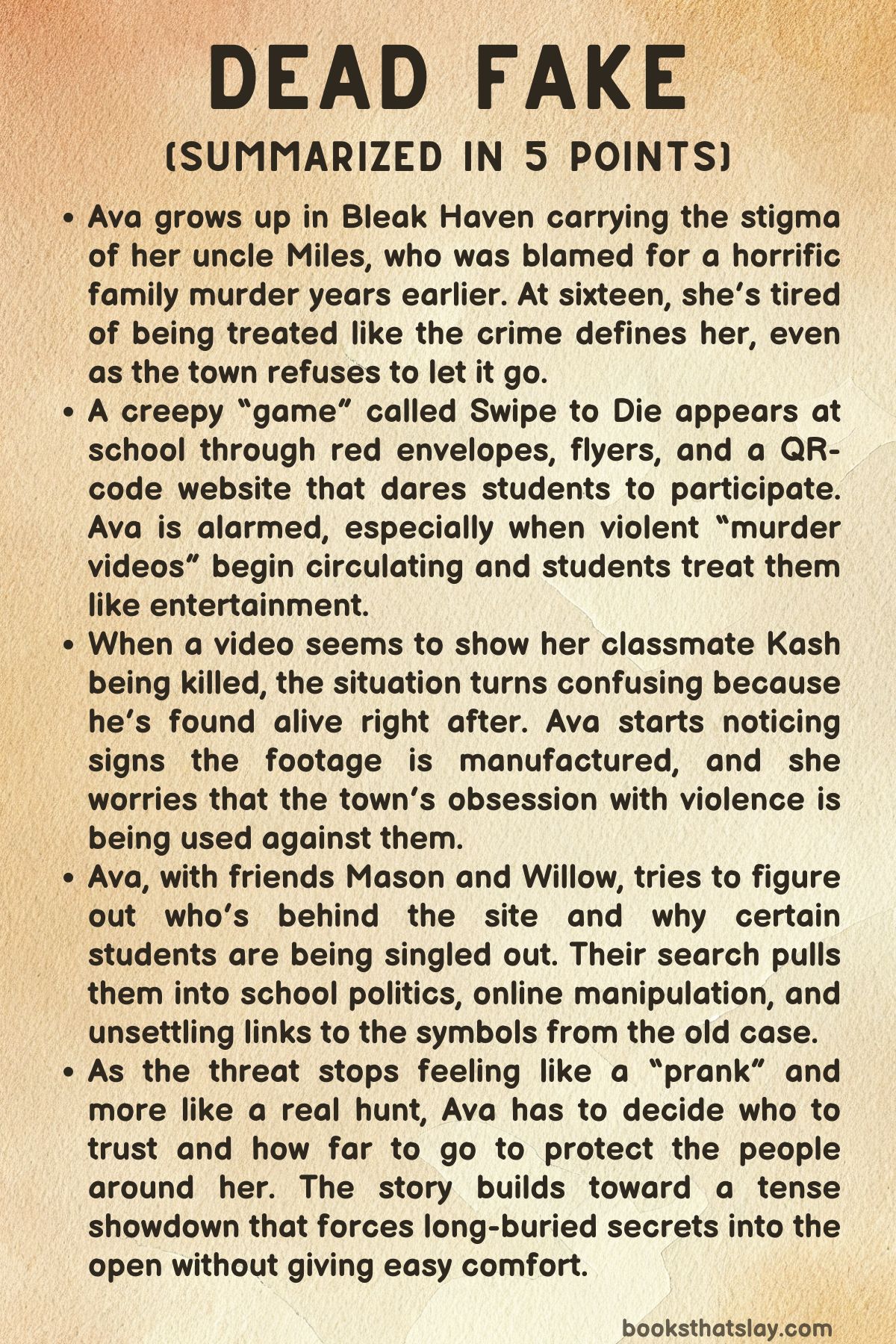
Summary
Ava has spent her whole life paying for what her uncle Miles did—or what the town says he did. In Bleak Haven, people remember him as the friendly man who helped neighbors and played kindly with Ava when she was little.
Then everything changed when he broke into the Fairbournes’ home and killed most of the family. Shareen Fairbourne died with her throat cut.
Grant Fairbourne was killed in the kitchen with a hammer, and someone carved crossed-out eyes into his forearm. Their daughter Maggie was smothered in her bed.
Only young Archie survived by hiding. In the backyard, Grant managed to stab Miles in the heart before his own death.
Miles died there, and the case hardened into local legend. Ava grew up with strangers judging her by bloodline, as if she carried the violence in her veins.
At sixteen, Ava is tired of being treated like a warning sign. Her closest friends are Mason and Willow, and she works on the school newspaper with Kash Ellison.
One morning in their newsroom, Kash shows Ava a red envelope that was slipped under the door. Inside is a note inviting them to play a game called Swipe to Die and claiming that “the first kill” will be revealed soon.
Ava immediately wants to report it to the principal and the sheriff, but the threat spreads faster than adults can react. Flyers pop up all over school with a QR code and the question: “ARE YOU READY TO BE MURDERED?” Students scan the code and reach a website where they answer horror-movie questions, then swipe a bloody hand icon and receive a message promising something will happen soon.
Many students laugh it off, treat it as a prank, and keep playing. Ava refuses, unsettled by how easily people turn fear into fun.
Later that day, Ava visits her aunt Kaylee and her little sister Harper. Harper is only four, born after Miles died, and still innocent of most of the town’s gossip.
That small pocket of normal life matters to Ava more than she can explain. But the calm doesn’t last.
That night, Ava is home with Harper when Mason shows up frantic, insisting Kash is dead. He says he watched Kash die in a shared video.
Upstairs, Mason plays the clip: a masked figure in black breaks into Kash’s house, chases him, trips him, and slices his throat. Ava is sick with shock and calls 911.
Sheriff Adeoye arrives quickly—but then delivers a confusing truth: Kash is alive. The sheriff personally went to Kash’s home and Kash answered the door.
Ava shows the video anyway, yet the sheriff still insists there’s no crime scene, no victim, no proof of anything. After the officers leave, Ava replays the clip and spots strange visual glitches that don’t behave like normal video.
She starts to suspect the footage is a deepfake: a realistic fabrication designed to look like a murder.
The next morning confirms it. Kash is at school, alive and energized, already treating the incident like a major story.
He believes someone created a deepfake of his death after he interacted with Swipe to Die. Instead of being scared, he’s thrilled by the attention and prints a special edition for the newspaper, describing his “murder” as if it’s a daring experiment.
Students swarm him, hungry for the next video. Ava watches the excitement with dread, especially when she notices the mask used in the fake clip: stitched mouth, crossed-out eyes—details that feel too close to Bleak Haven’s old case.
Soon more videos appear, featuring other students. Phones buzz in class as clips spread: a boy drowned in a bowl of bloody apples, Verity Malloy stabbed on a dark street, and other staged killings that look real enough to cause panic.
The school tries to clamp down. Principal Whitlock bans phones and gathers students in the gym to condemn the videos and warn about the danger of deepfakes.
But the ban doesn’t stop curiosity; it only pushes it underground.
Ava and Mason decide they can’t sit still. They study the Swipe to Die site and the pattern of its “highlights,” then identify five students who seem positioned as upcoming targets: Priyanka Mondhal, Zachary Lacey, Amaya Johnson, Steven Lin, and Anne-Marie Venn.
They print their photos and bring everything to Sheriff Chike Adeoye. Ava insists that if the site is “predicting” deaths, someone might try to make the next one real.
Chike listens carefully and takes the photos, but tells Ava not to warn anyone yet—he says it could cause panic and ruin the investigation. Ava leaves feeling steadier because an adult finally treated her seriously, but she still doesn’t trust that waiting will keep anyone safe.
On Main Street, Ava and Mason run into Anne-Marie, who talks like someone enjoying the spotlight. She brushes off their concern and even suggests she might become an on-camera presenter connected to the site.
When Ava tries to give simple safety advice, Anne-Marie gets defensive and implies Ava is acting dramatic. She also drops a comment that rattles Ava: according to Anne-Marie, Kash said he and Ava weren’t really friends anymore.
The remark lands like a shove, making Ava wonder what Kash told people about her—and why.
That night, Ava searches Kash’s belongings and finds something that changes the whole shape of her suspicions. In Kash’s notebook are detailed storyboards that map out the “murder” video shot by shot—camera angles, movement through the house, where Kash falls, and the moment the knife reaches his throat.
Ava also finds drawings of the same stitched-mouth, crossed-eye mask. It looks like Kash didn’t just become a victim of the deepfake; he may have planned it, rehearsed it, or even created the concept himself.
To understand how a student could pull this off, Ava goes to the school’s tech spaces and confronts Conor, Willow’s boyfriend, and the advanced computer club. The students explain that deepfakes are easier than most people think if you have the right hardware, software tools, and enough social media footage to copy a face and voice.
You don’t need to be a programming genius—just determined, resourced, and willing to learn. Ava leaves shaken.
It means Swipe to Die could be run by someone hiding in plain sight.
Ava tells Willow and Mason what she found, and Willow’s reaction is immediate: Kash may have built the whole scandal to boost the newspaper’s attention and his own ambitions. It makes a twisted kind of sense.
Kash had been treating the deepfake “murder” like publicity, not trauma. Ava decides she has to turn the evidence over to Sheriff Chike, even though doing so could destroy Kash’s reputation after death.
Before she can act safely, Ava and Mason are pulled into a terrifying situation one night when they come upon Anne-Marie stumbling in the road, smeared with blood, with a masked figure approaching. Ava tries to help, but Anne-Marie bolts and the masked attacker closes in.
Ava and Mason run, are ambushed, and Ava fights violently to protect Mason—until the scene collapses into laughter. It was a prank.
Trey Schofield and Anne-Marie staged it, and Conor wore the mask. Ava is furious and humiliated, but what unsettles her most is how precisely they lured her to that spot, as if someone wanted to test her reactions.
At school the next day, Conor apologizes, saying Trey pressured him to share information about Ava’s movements so Trey could scare her as payback for her warnings. Willow is disgusted with Conor and sides with Ava.
Ava shares the bigger truth with Willow: Kash is dead, the deepfakes are escalating, and the five “targets” might be in danger. Willow insists on joining the investigation.
Then the threat stops being theoretical. Police block off Burnt Oak, the wealthy neighborhood, and Ava hears the news: Trey Schofield has been murdered.
The grief around school is heavy, and Ava realizes the town’s old violence is no longer just a story people gossip about. Sheriff Chike confronts Ava about not following instructions and questions her about her whereabouts, making it clear she’s now in the circle of suspicion simply because she keeps showing up near the truth.
Ava still hands him Kash’s notebook and tells him her belief that Kash created Swipe to Die, and that someone else may have hijacked it.
When Ava returns home, she finds a package on the porch: a message with a crossed-out eye drawn in red and words that chill her—“I’m sorry, Ava”—written in handwriting that appears to match Miles. Ava doesn’t tell her mother.
Her mother insists Miles was the killer, citing the evidence and the survivor’s identification. But Ava can’t ignore what’s happening now: Trey was killed with a lump hammer, matching the old Fairbourne case, even though Trey’s deepfake showed a different weapon.
The deepfakes aren’t just jokes; they’re being used as a cover, a distraction, or a script.
Ava searches for answers closer to home and ends up at Kaylee’s house, where she finds a shoebox of letters, including typed ones that seem to be from Shareen Fairbourne. Kaylee catches her, and Ava shows her the threatening note.
Kaylee claims she doesn’t know why Miles carved the eye symbol and sends Ava away. Ava’s unease grows into terror when she’s attacked in her own home.
A masked intruder smothers her with a pillow. Ava fights back, injures the attacker, and barricades herself and Harper in a bedroom.
The intruder returns with a lump hammer, breaks in, hits Ava, and ties her to a chair.
When Ava wakes, the killer reveals herself: Kaylee. Kaylee confesses that Miles didn’t kill the Fairbournes—she did.
She says Miles had an affair with Shareen and fathered Archie, and Kaylee couldn’t stand it. She claims she carved the crossed-out eye into Grant as punishment for refusing to accept the truth, killed Shareen with a knife, killed Grant with a hammer, smothered Maggie, and then stabbed Miles and framed him, ensuring the town would hate the wrong person for years.
Kaylee explains that the new murders began because she discovered Kash’s deepfake project and felt enraged that her symbol was being copied and turned into entertainment. She killed Kash, then Trey, and planned to frame Anne-Marie next—then kill Ava—while making Harper the next “survivor” who would identify the wrong monster, repeating the cycle.
Kaylee uses Ava’s phone to lure Anne-Marie with a message, and Anne-Marie arrives with Mason. They break in and find Ava bound.
Kaylee attacks with the hammer, injuring Mason. Anne-Marie fights back with a knife long enough for Ava to free herself.
Ava tells them Kaylee is the killer, and in the struggle Ava smothers Kaylee with a cushion until Kaylee dies.
Ava finds Harper tied in a closet and frees her. To protect Harper from the truth of who attacked them, Ava puts the mask back on Kaylee’s face before help arrives.
Police and ambulances flood the house as Ava’s mother returns and sees the covered body. Ava finally speaks the truth aloud: Miles wasn’t the murderer.
Sheriff Chike arrives, apologizes, and the survivors cling to the fact that Harper is alive, even as the damage settles in.
In the aftermath, Harper has nightmares, and authorities search for Kaylee’s hidden letters to piece together what really happened years ago. At school, Ava, Willow, Mason, Anne-Marie, and Ms. Swift meet for support.
Kash is not publicly named as the creator of Swipe to Die, preserving his family from another wave of attention. But Bleak Haven’s hunger for spectacle hasn’t disappeared.
Months later, new flyers appear with a QR code for a new game—Click to Kill—and Ms. Swift reveals she has been collecting them, warning the group that something new may already be starting.
Characters
Ava
Ava is the emotional and moral center of Dead Fake—a sixteen-year-old forced to grow up in the long shadow of a crime she didn’t commit but can’t escape. Because she is Miles’s niece, Bleak Haven treats her like guilt is hereditary: potential relationships curdle into morbid curiosity, everyday interactions carry judgment, and even her grief has to compete with the town’s appetite for scandal.
That pressure shapes her into someone hyper-alert to danger and hypocrisy; she reads people’s tone shifts, notices inconsistencies in videos, and refuses to treat violence as entertainment the way many classmates do. Ava’s intelligence shows up as pattern recognition rather than showy brilliance—she clocks distortions in the “murder” clip, connects the stitched-mouth/crossed-out-eyes imagery to the old case, and keeps returning to the idea that the story everyone believes might be wrong.
At the same time, she is not written as fearless; she is anxious, angry, and often isolated by what she knows. Her need to protect others repeatedly clashes with authority—especially when Sheriff Chike tells her to stay quiet—so her arc becomes a tense negotiation between being “just a kid” and being the only one acting like the threat is real.
The climax forces her into the most brutal kind of self-definition: she survives an attempted murder, learns her aunt is the real monster, and ends the violence with her own hands. Even then, Ava’s compassion remains intact—she puts the mask back on Kaylee to protect Harper from the truth in the moment, revealing that Ava’s strongest instinct is still care, not spectacle or revenge.
Miles
Miles is the story’s defining absence: dead from the beginning, yet powerful enough to shape almost every relationship and fear in Bleak Haven. To Ava’s childhood memory, he was gentle and reliable—someone who played kindly with her, supported her mother, and earned the town’s affection.
That remembered warmth is crucial, because it creates a psychological trap: if he was truly capable of slaughter, then safety and goodness are illusions; if he was framed, then the town has been worshipping a lie for years. For most of the novel, Miles functions like a cultural curse—his name polices Ava’s social life, justifies cruelty toward her, and provides a ready-made explanation for any new horror that resembles the old one.
The crossed-out eye carving and the hammer motif turn him into a symbol rather than a person, which is exactly how the town uses him: as a story that ends discussion. The note addressed to Ava in his handwriting is the ultimate manipulation of that symbol, exploiting both grief and fear by implying a dead man’s reach extends into the present.
When the truth comes out, Miles becomes tragic in a different way: not a monster who hid in plain sight, but a man destroyed by another person’s obsession and jealousy, then weaponized as the perfect scapegoat. His role ultimately exposes how easily communities choose the version of events that requires the least complexity—and how that choice can keep the real evil safe.
Kaylee
Kaylee is the novel’s most chilling character because she embodies a convincing mask of normalcy while carrying the story’s original and ongoing violence. On the surface she is “Aunt Kaylee,” a caregiver and anchor for family life, raising Harper and maintaining a household that should represent refuge from the town’s ugliness.
She even appears to be healing, stepping into the possibility of happiness with Simon, which makes her feel like a figure of hope and resilience. That surface is not just deception; it is part of her psychology—Kaylee wants to be seen as righteous, wronged, and justified.
Her confession reveals a worldview built on possession and punishment: she kills because she cannot tolerate betrayal, carves the crossed-out eye because she believes others are refusing to “see” her truth, and frames Miles because he is both an obstacle and an ideal fall guy. What makes her especially dangerous is that she is not acting impulsively; she is methodical, symbolic, and strategic.
She understands narrative power—how an “identified killer” can freeze a case forever, how a child witness like Archie can be turned into proof, and how repeating a signature can steer suspicion toward the same convenient culprit. Her reaction to Swipe to Die is revealing: she doesn’t just fear exposure; she is offended that her symbol has been borrowed, as though violence is her private language.
By the end, Kaylee is less a twist villain than a commentary on control—how someone can build an entire moral identity around the belief that love entitles them to ownership, and that punishment is the same thing as justice.
Harper
Harper is innocence placed inside a story about manufactured horror and inherited blame. She is too young to fully understand the town’s obsession and is described as mostly untouched by it, which makes her a rare pocket of normal warmth in Ava’s life.
That softness matters because it’s also what the killer targets: Harper is the leverage Kaylee uses to corner Ava and the “new Archie” Kaylee wants to create—another child shaped into the role of false witness. Harper’s presence raises the stakes beyond survival into legacy; the question becomes not only who lives, but who gets to grow up without being defined by a lie.
After the reveal, Harper’s nightmares show the real cost of violence: even when the killer is stopped, the body keeps remembering. Harper also reframes Ava’s heroism—Ava isn’t fighting to clear a name in the abstract; she’s fighting to stop the next child from being trapped in the same story cycle that trapped Archie and crushed Miles.
Mason
Mason is Ava’s most immediate human support: loyal, protective, and willing to follow her into fear even when he doesn’t fully understand the logic yet. He is the one who brings the deepfake “murder” to Ava, which positions him as the messenger who cracks open the story’s central terror—technology that looks real enough to collapse reality.
Mason’s role is also to ground Ava emotionally; when the town trivializes Swipe to Die as entertainment, Mason’s panic and later determination validate Ava’s sense that something is wrong. He participates in the amateur investigation—identifying likely targets, going to Sheriff Chike, trying to warn people—and his presence keeps Ava from becoming isolated into a solitary-girl-detective trope.
The prank ambush is a turning point for him as well: he is physically attacked, nearly choked, and then mocked, which transforms the situation from “scary online nonsense” into social cruelty with real bodily risk. When Kaylee attacks in the climax, Mason’s broken arm is both literal injury and symbolic proof that this is no game and no rumor.
He ends the story as one of the few who has seen the truth up close, which gives him a survivor’s gravity: he isn’t just Ava’s sidekick; he becomes part of the small circle carrying the burden of what really happened.
Willow
Willow represents the possibility of friendship that isn’t contaminated by the town’s appetite for scandal. She has a brightness and warmth that can pull Ava back toward ordinary teenage life, yet she also has enough backbone to pivot into seriousness when Ava’s fears become evidence-based.
What makes Willow valuable in the group is how quickly she can translate emotion into action—once she understands the pattern and the stakes, she asks to join the investigation rather than staying on the sidelines. Her anger at Conor after the prank shows a clear moral line: she won’t excuse harm as “just a joke,” especially when it targets someone already under community pressure.
Willow’s position as Conor’s girlfriend also gives her a painful proximity to betrayal; she has to accept that someone close to her can enable cruelty, even if indirectly, which mirrors Ava’s larger journey of discovering that the threat is inside the family. In the aftermath, Willow becomes part of the support circle at school, reinforcing the theme that survival is communal—people heal not by forgetting the story, but by refusing to carry it alone.
Kash Ellison
Kash is both victim and catalyst in Dead Fake, a student journalist whose ambition collides with the town’s hunger for sensational violence. He’s introduced as a coworker with Ava on the school paper, someone sharp enough to recognize a story and eager enough to chase attention.
His reaction to the first deepfake—excitement rather than fear—defines him: Kash is attracted to narrative power and believes he can control it. The notebooks and storyboards complicate him further, suggesting he didn’t merely report on Swipe to Die but may have conceptualized or developed it, at least as a project meant to provoke, entertain, or revive readership.
That makes him morally messy in a way the book treats carefully: Kash’s choices may be reckless, but his death is not framed as deserved. Instead, he becomes the example of how playing with violent imagery can invite real violence, especially in a town where someone has already turned murder into a signature.
Kash’s legacy is managed after his death—his role as creator is kept quiet—which speaks to the community’s need to preserve a simpler narrative of innocence. He ultimately embodies the theme that technology doesn’t create cruelty, but it can amplify it, monetize it, and hand it to people who are already looking for an excuse.
Sheriff Chike Adeoye
Sheriff Chike is authority under pressure, portrayed as neither incompetent nor fully trustworthy from Ava’s perspective. His early dismissal—insisting Kash is alive despite the video—sets up the story’s friction between institutional certainty and a new reality where footage can be fabricated.
As the situation escalates, Chike listens more than other adults typically do in teen thrillers: he takes Ava seriously enough to accept photos of potential targets, promises protection, and later receives the notebook evidence instead of dismissing it outright. Yet he repeatedly draws a boundary—telling Ava not to warn people, reminding her she’s a kid, refusing to confirm details—which shows the limits of police cooperation and the way authorities control information to manage panic.
That control becomes morally ambiguous because it sometimes protects the investigation and sometimes protects reputations, including the fragile stability of the old Miles narrative. Chike’s role highlights a central tension: when truth becomes uncertain and history is already tainted, institutions may default to secrecy and containment, even when transparency could save someone.
His apology near the end matters because it signals humility and recognition: he realizes the truth was closer to Ava than to the official story, and that the town’s certainty about Miles helped hide Kaylee.
Deputy Cosgrove
Deputy Cosgrove functions as the visible barrier of law enforcement—the first line of “stay back” and “go home” that Ava repeatedly collides with. While not deeply explored emotionally, Cosgrove’s presence reinforces the way the system closes ranks during crises, especially in a wealthy area like Burnt Oak where police presence becomes a gatekeeping force.
Cosgrove’s role is important mainly as contrast: where Chike sometimes engages Ava, Cosgrove represents the blunt refusal that pushes her to act independently.
Principal Whitlock
Principal Whitlock symbolizes institutional response in the face of digital chaos. The phone ban and the junior-class assembly show an adult attempt to regain control through policy and moral condemnation rather than through understanding why the deepfakes spread so fast or what fear they trigger.
Whitlock’s approach treats Swipe to Die as a behavioral problem—students sharing inappropriate content—when Ava experiences it as a threat pattern tied to real violence. This gap illustrates a recurring theme in the novel: adults respond to the surface layer—screens, rumors, discipline—while the actual danger is physical and personal.
Ms. Swift
Ms. Swift is one of the few adults positioned as emotionally competent support rather than mere authority. She addresses the students directly about fear, points them toward counseling, and later participates in a survivors’ support meeting, which marks her as someone who recognizes trauma as something that needs community and language.
Her final revelation—collecting flyers for the next game—casts her as a vigilant witness who has learned from the town’s mistakes, suggesting she refuses to let the cycle restart unnoticed. Ms. Swift’s role expands the ending beyond closure into warning: survival is not the end of the story if a community keeps feeding the same appetite for spectacle.
Anne-Marie Venn
Anne-Marie is a complicated mix of performative confidence and vulnerability, someone who treats danger as social capital until it becomes real. Her willingness to engage with Swipe to Die—talking about presenting for it—shows how the town’s teens have absorbed the idea that violence can be a stage.
She brushes off Ava’s concerns, pushes back defensively, and seems to enjoy the attention, which makes her initially hard to sympathize with. Yet the staged “attack” prank reveals she is also entangled in peer dynamics and manipulation; she participates in cruelty that targets Ava, then later becomes one of the people who risks entering a house to save her.
That shift matters: Anne-Marie is not purely shallow or malicious—she is a teenager navigating status and fear, capable of being reckless and then brave. In the climax she actively fights Kaylee off with a knife, moving from someone flirting with horror as entertainment to someone forced into real self-defense.
Anne-Marie ends as a survivor whose relationship with violence has been permanently rewritten: the game stops being content and becomes memory.
Trey Schofield
Trey embodies entitlement and social power used carelessly, especially in how he orchestrates the prank as retaliation against Ava’s warning to Anne-Marie. His actions show the cruelty of the town’s hierarchy: Ava is already stigmatized, and Trey chooses to weaponize fear against her for the sake of amusement and pride.
That choice makes his later murder feel sharply ironic—someone who treated terror like a tool becomes an actual victim of it. Trey’s death also disrupts assumptions; the emotional response from the football team underscores his popularity and reveals how communal grief is distributed unevenly based on status.
Narratively, Trey’s murder is a hinge point: it proves the threat is no longer hypothetical, ties the new killings to the old hammer signature, and suggests the deepfake game has been hijacked by someone with a personal history of real violence.
Conor Abbot
Conor is the portrait of technical capability mixed with weak boundaries. He belongs to the advanced computer space, understands how deepfakes can be produced, and sits close to the tools that could enable something like Swipe to Die.
Yet his defining trait isn’t villainy; it’s pliability. He helps Trey locate Ava’s movements and plays the “killer” in the prank, then apologizes and claims he was pressured.
That arc positions Conor as a cautionary figure: harm doesn’t only come from masterminds; it also comes from people who cooperate “a little,” justify it as social obligation, and underestimate consequences. His relationship with Willow amplifies this theme because it shows how betrayal can occur without hatred—just cowardice.
Rosita and Marco
Rosita and Marco function as the story’s practical lens on the technology behind the fear. They demystify deepfakes by explaining the ingredients—hardware, AI tools, and plentiful social media footage—making the horror feel both less supernatural and more disturbing because it becomes accessible.
Their presence prevents the plot from relying on vague “hacker magic” and instead supports the theme that modern terror can be assembled from ordinary digital scraps.
Verity Malloy
Verity appears primarily as one of the students featured in a deepfake “death,” and her importance lies in what she represents: how easily a person’s identity can be dragged into public panic without consent. Even when the video is fake, the social consequences—fear, rumor, attention—are real.
Verity’s inclusion shows the cruelty of Swipe to Die as a system: it turns classmates into props and makes everyone complicit as viewers.
Priyanka Mondhal, Zachary Lacey, Amaya Johnson, Steven Lin
These four, identified as potential targets based on the deepfake pattern, are less individualized in the summary and more representative of the way panic spreads through lists and predictions. Their main narrative purpose is to show Ava and Mason’s urgency and the ethical problem of warning people: naming possible victims can protect them, but it can also terrify them and turn them into public symbols.
The fact that the police tell Ava not to warn them highlights how institutions manage risk differently than teenagers do, and how the fear of chaos can compete with the fear of death.
Shareen Fairbourne
Shareen exists in the story as both victim and hidden key. Her death is part of the community’s foundational trauma, but the later revelation reframes her not just as someone murdered in a break-in, but as the person at the center of Kaylee’s jealousy and Miles’s alleged affair.
The typed letters that appear to be from Shareen turn her into a posthumous voice, suggesting she may have been trying to communicate truths that were buried. Shareen’s role supports one of the book’s darkest ideas: victims can be used as story tools by survivors and by killers alike, and the “official” version of their death may have little to do with who they really were.
Grant Fairbourne
Grant is positioned as the second anchor of the original crime narrative: killed with a hammer and marked with the crossed-out eye carving. In the town’s memory, his death is evidence of Miles’s brutality; in the truth, it becomes evidence of Kaylee’s signature and her need to punish.
Grant represents how a killer can write a message onto a body and then let the community decode it incorrectly for years.
Maggie Fairbourne
Maggie’s death by smothering is one of the most intimate and cruel elements of the original massacre, and it resonates later when Ava is attacked with a pillow. That repetition links past to present and underscores that the killer’s methods are not random; they are personal rituals.
Maggie’s role in the narrative is to deepen the horror of the original event and to show how violence echoes across time when the truth is buried.
Archie Fairbourne
Archie is the living hinge between history and present, the child who survived by hiding and whose identification of Miles becomes a cornerstone of the official story. Kaylee’s plan to turn Harper into a new Archie reveals what Archie has always represented: not just a survivor, but a tool of certainty.
Archie’s existence raises a painful question about memory and trauma—how reliable is a child witness under extreme terror, and how easily can that testimony be steered by adults who want closure? Even without appearing directly in the present timeline, Archie shapes the entire plot as the proof that helped lock the wrong story into place.
Ava’s Mother
Ava’s mother represents the protective instinct that can harden into denial. She insists Miles was guilty because she saw his body in the morgue and because the case had fingerprints, weapons, and Archie’s identification—details that have anchored her understanding for years.
Her certainty is emotionally understandable: believing the official story allows her to compartmentalize trauma, protect her children from further chaos, and avoid reopening old wounds. Yet that certainty also isolates Ava, who carries doubts alone.
When Ava finally tells her the truth, the mother becomes part of the story’s painful repair—forced to reprocess grief not only as loss, but as injustice done to someone she once loved.
Simon
Simon functions as a symbol of “life continuing” and of a world outside the town’s obsession. His presence on a date with Kaylee suggests possibility—someone who doesn’t treat the Fairbourne murders as the only lens through which to view a person.
Ironically, that normalcy also helps Kaylee maintain her mask, which is part of what makes the eventual reveal so disturbing: the killer is not isolated from ordinary romance and community life; she is participating in it.
Themes
Public Stigma, Reputation, and the Cost of Inherited Blame
Ava’s daily life is shaped less by what she has done and more by what people think her family represents. In Dead Fake, the town’s memory of the Fairbourne murders becomes a permanent label stuck to Ava’s name, turning school corridors, friendships, and dating into situations where she is treated like an extension of her uncle’s alleged cruelty.
What makes this stigma especially damaging is how ordinary it feels to everyone else: people ask invasive questions, trade theories, and treat her discomfort as the price she should pay for being connected to a notorious story. The cruelty is not always loud or openly violent; it often shows up as assumptions, avoidance, curiosity disguised as concern, and the constant expectation that Ava should explain herself.
That pressure distorts her sense of identity, because she is forced to respond to a narrative she did not create and cannot escape. Even when she tries to focus on normal teenage milestones, the town pulls her back into the role of “the killer’s niece,” and the attention surrounding Swipe to Die intensifies that effect by reviving the imagery tied to her uncle’s case.
Ava’s anger and exhaustion are not simply teen frustration; they reflect how long-term public suspicion can corner someone into hypervigilance and isolation, where even kindness from others can feel conditional. The story also shows how institutions can reinforce this stigma: officials who minimize concerns, classmates who keep sharing “content,” and adults who prefer tidy conclusions over messy truth all contribute to Ava being seen as a problem to manage rather than a person to protect.
The eventual revelation that Miles was framed does not erase the years of social punishment Ava endured; instead, it exposes how quickly a community can choose a villain and how hard it is for the wrongly associated to reclaim a life that was never allowed to be fully theirs.
Reality, Deepfakes, and the Collapse of Trust
The early fake murder video does more than frighten Ava; it destabilizes the basic rules of evidence. A recording used to mean “this happened,” but the deepfake turns that assumption into a trap, and Ava’s terror is sharpened by the fact that authorities initially dismiss her despite the clip’s apparent clarity.
The story treats the technology as a force that changes social behavior, not just a clever plot device. Once the students begin scanning codes and sharing videos, the community’s idea of truth becomes crowdsourced entertainment: belief is driven by shock value, not verification.
Ava’s attention to small visual distortions becomes an act of survival, because noticing flaws is the only way to protect herself from manipulation. This creates a new kind of vulnerability: even when someone is alive, their reputation can be murdered in public, and the emotional impact on viewers is real regardless of whether the footage is authentic.
The school’s attempts at control, like banning phones, highlight a deeper problem: managing devices does not repair broken trust, and it does not address the hunger to watch something extreme. The deepfakes also weaponize uncertainty.
When everyone knows a video can be fabricated, denial becomes easier for the guilty and the indifferent alike. The killer benefits from confusion, because confusion slows response, fractures consensus, and makes victims doubt their own judgment.
The theme pushes further when Kash’s creative ambition is revealed to be connected to the project. His notebooks show how easily “fiction” can become a blueprint for real harm when the audience is primed to treat violence as a game.
By the time real murders occur, the deepfakes have already trained the town to question its eyes, and that hesitation becomes part of the danger. The ending with new flyers suggests a grim lesson: once a community learns to treat evidence as content, the door stays open for new cycles of manipulation, because the public’s appetite and the technology’s power keep evolving faster than the systems meant to protect people.
Violence as Entertainment and the Community’s Hunger to Watch
Swipe to Die succeeds because it taps into a culture that treats fear as fun when it happens to someone else. The students’ excitement, the swarming attention around Kash, and the quick spread of clips show how violence becomes social currency: watching proves you’re in the loop, sharing proves you’re part of the moment, and disbelief is framed as being boring or overly sensitive.
Ava’s refusal to participate isolates her, not because she lacks curiosity, but because she recognizes how quickly “pretend” cruelty reshapes what people accept as normal. The theme becomes more disturbing when the town’s older history bleeds into the new spectacle.
The crossed-out eyes and the familiar mask design are not just references; they are proof that the community has never properly processed what happened years ago, and so it is vulnerable to reenacting it as a trend. The story also shows how entertainment changes empathy.
When students watch staged deaths on their phones, they rehearse emotional responses that look like concern but function like consumption. Even after a real murder occurs, the crowd’s reactions are uneven, suggesting that popularity, status, and social narratives influence who is mourned loudly and who is reduced to a headline.
The prank staged by Trey, Anne-Marie, and Conor exposes another layer: young people who have been surrounded by the “game” begin copying its logic in real life, using fear as a tool for social power. They lure Ava into a frightening scene and treat her panic as a punchline, which mirrors how the broader community treats the original murders as a story that belongs to everyone.
The theme is not limited to teenagers; adults also participate through gossip, selective attention, and the desire for a simple villain. Even law enforcement choices about what to reveal and what to suppress connect to the way information is managed for public reaction rather than public healing.
By the time the truth is uncovered, it is clear that the real threat is not only one person with a weapon. It is a culture that keeps rewarding spectacle, creating conditions where cruelty spreads faster than care, and where the line between “watching” and “enabling” becomes dangerously thin.
Family Secrets, Betrayal, and the Distortion of Love
The betrayal at the center of the story is made more painful because it comes from someone positioned as safety. Ava’s relationship with her aunt Kaylee carries the comfort of family routine and the illusion of stability, especially through Harper’s presence and the idea that life can still contain warmth.
When Kaylee is revealed as the killer and the architect of the original murders, the theme becomes about how love can be used to justify control and harm. Kaylee’s confession reframes the past: jealousy, rage, and a desire to punish are dressed up as moral righteousness, and she treats her violence as a kind of correction for being “ignored” or not “seen.” The story explores how easily a family can become trapped by a secret, even when they think they are protecting one another.
Ava’s mother clings to the official narrative because it is supported by evidence and because believing it keeps the world orderly: the monster is dead, the case is closed, and the family can try to move on. Kaylee exploits that need for closure, and she also exploits Ava’s vulnerability by using symbols and handwriting associated with Miles to force a specific psychological reaction.
The theme also examines the complicated grief of loving someone connected to horror. Kaylee admits that even after everything, feelings do not switch off neatly, which reflects a broader truth: family attachment can survive alongside disgust, confusion, and anger.
That emotional complexity becomes a weapon in the wrong hands, because it makes people easier to manipulate and slower to suspect the familiar. Harper’s role sharpens this theme further.
Kaylee’s plan to turn Harper into a new “Archie” shows how abusers try to manufacture narratives and recruit children into them, using innocence as proof and misdirection. Ava’s decision to mask Kaylee’s face to protect Harper captures the painful aftermath of betrayal: the survivor must manage not only their own trauma, but also the emotional survival of someone smaller who cannot yet carry the full truth.
Cycles of Trauma, Repetition, and the Fear of What Returns
The story repeatedly shows that unresolved violence does not stay in the past; it reshapes the present until someone confronts it honestly. Ava’s town has lived for years with a fixed story about Miles, and that story becomes a shortcut that prevents deeper questions.
The result is a community that believes it has “moved on” while still organizing its identity around the old tragedy. Swipe to Die functions like a trigger that reactivates fear, but it also exposes how many people were already living with that fear in quieter forms: Ava’s constant scrutiny, Kaylee’s unspoken fixation, and the town’s readiness to turn new events into a remake of the old case.
Trauma appears not only as panic and nightmares, but as patterns of decision-making. Ava’s need to investigate, her refusal to accept easy answers, and her urgency to warn others are shaped by a lifetime of being treated as adjacent to danger.
Even Sheriff Chike’s responses reflect an institutional pattern: protect order, control information, minimize panic, and only later admit what was missed. The cycle theme becomes most explicit when the murder method repeats and the crossed-out eye returns.
Those symbols show how a past crime can become a script for later crimes, especially when someone is emotionally invested in preserving the meaning they assigned to it. Kaylee revives the violence not because she is stuck in nostalgia, but because she feels ownership over the story and resents anyone else using her “signature.” That is a chilling form of repetition: not simply copying, but insisting on authorship of harm.
After Kaylee’s death, the survivors are left with the long work of recovery, and the narrative does not pretend that truth instantly heals everything. Harper’s nightmares and the group support meeting acknowledge that survival continues after the headline ends.
The final appearance of a new QR-code game pushes the theme into the future, suggesting that the conditions that produced Swipe to Die can reappear with a new name and a new audience. The threat is not identical events repeating, but the same human weaknesses being exploited again: fascination, denial, and the desire for easy stories.
The ending warns that breaking cycles requires more than catching one killer; it requires changing how communities treat violence, how they handle truth, and how they protect the people most likely to be turned into symbols.