Dead in the Water Summary, Characters and Themes
Dead in the Water by John Marrs is a psychological thriller about what happens when a brush with death seems to switch on a buried past. After a near-drowning off Brighton beach, Damon begins seeing a bloodied red-haired boy who appears in flashes, reflections, and waking nightmares.
What starts as a terrifying mystery becomes an obsession that strains his marriage, destabilizes his mind, and pulls everyone close to him into danger. The story moves fast, but its real engine is Damon’s need to know whether his visions are trauma, guilt, or a warning—and what the truth will cost.
Summary
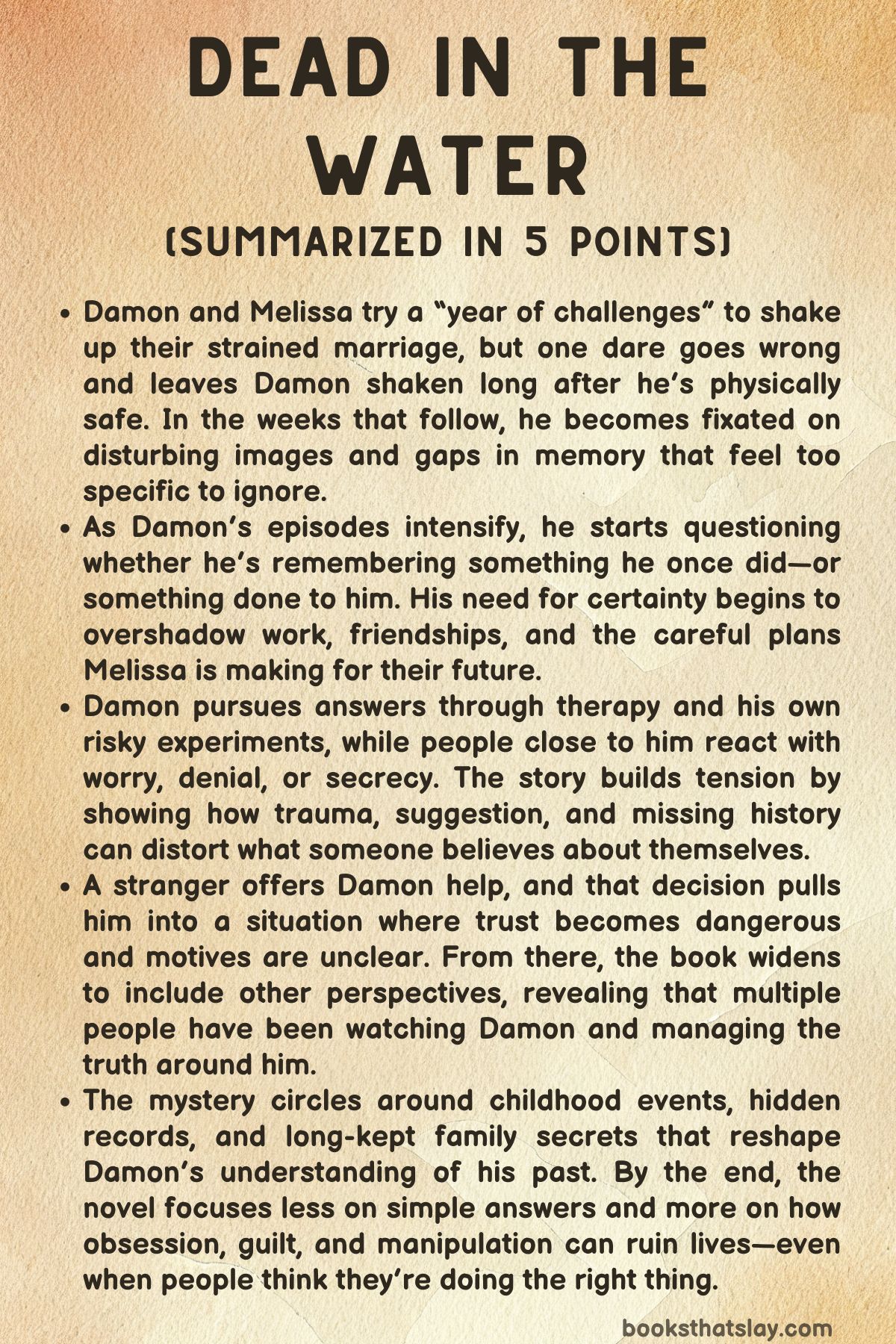
Damon and Melissa are trying to refresh their marriage while juggling tight finances and plans for a baby. Damon suggests a “year of challenges”: each month, one of them dares the other to do something uncomfortable.
Melissa isn’t thrilled, but Damon talks her into it. The first challenge is harmless enough—karaoke in a cheap bar, with Melissa pushed into singing a song that makes her feel exposed.
She does it, and Damon leaves the night oddly uneasy, as if she’s already planning something worse.
Melissa’s challenge is designed to hit Damon where he’s weakest: swimming in the sea at Brighton in February. Damon fears open water, but he also doesn’t want to break their deal.
They push into the freezing surf and head toward a line of yellow buoys. Damon struggles, swallows seawater, and fights panic, but they reach the marker and turn back.
On the return, the water turns rough and the pull of the sea becomes dangerous. Melissa swims ahead, calling to him.
Then she turns—and Damon is gone.
Melissa reacts on instinct. She dives again and again into dark water, refusing to stop even as exhaustion sets in.
She finally spots the flash of Damon’s shorts underwater, drags him up, and hauls him toward shore. On the beach he is lifeless.
Melissa starts CPR, forcing herself through each step until Damon finally coughs up seawater and gasps. While he’s still shaking and half-conscious, he asks a question that makes no sense: “Who was he?” When Melissa presses him, Damon says, “The boy.
The boy I think I killed?”
Two weeks later, Damon tries to act normal—he even goes out with friends to celebrate surviving. But he feels detached, like he’s watching his own life from a distance.
His body hasn’t fully recovered: his hearing is muffled, he’s on medication, and he feels as if everyone is celebrating a version of him that isn’t real. Inside his head, one image repeats with terrifying clarity: a red-haired boy on the ground, bleeding, his hand reaching out.
Damon sees himself standing over the boy, then the memory blanks. Melissa insists it’s a byproduct of shock and oxygen deprivation, but Damon can’t accept that.
The vision doesn’t feel like a random nightmare. It feels like a missing fact.
Soon, Damon starts seeing the boy when he’s awake. A child with red hair appears briefly on a bus and points directly at him, causing Damon to nearly step into traffic.
At home, Damon’s fear intensifies. He struggles even with running water in the shower.
After turning it off one night, he thinks he sees blood on the bathroom floor and small footprints trailing away—then the scene snaps back to normal. At work, he tries to keep himself together, but the boy shows up again, more vivid than before, standing in blood and reaching toward Damon with a dark, gaping mouth.
Damon bolts, sweating and shaking, and starts wondering whether he’s losing his mind.
Damon searches for explanations: near-death experiences, trauma responses, hallucinations. Nothing reassures him.
Meanwhile, complicated family planning adds pressure. Melissa and her partner, Adrienne, are pursuing a co-parenting arrangement with Damon as the biological father.
Damon agrees, partly because he still loves Melissa in a way he can’t fully admit, and partly because he wants to matter in a family again. During a fertility clinic appointment, the boy appears, and Damon blurts out a panicked refusal in front of strangers.
He later vomits in the bathroom and decides the only way forward is to identify the boy and learn what really happened.
He travels to London to see Helena, his former foster mother, hoping she can connect his childhood to what he’s seeing. Helena is older now, frail after strokes, and strangely guarded.
She avoids his questions, deflects his talk about a dead child, and tries to convince him it’s only the aftereffects of drowning. As Damon leaves, he glimpses the red-haired boy behind Helena, pointing and screaming silently.
Damon walks away with the sick certainty that something real is surfacing—and that Helena knows more than she’s saying.
Desperate, Damon tries hypnotherapy. The therapist warns him that recovered memories can be unreliable, especially when trauma is involved, but Damon insists.
Under hypnosis he sees a wooded path near a road and the red-haired boy lying injured, bleeding from the mouth and ears. Damon approaches as if he knows the boy’s name, but panic hits and the session collapses.
Damon leaves feeling followed, as if the boy is always just out of sight.
Melissa meets Damon and is alarmed by his condition—weight loss, exhaustion, a hunted look. Damon confesses everything: the boy has been appearing for weeks, and Damon believes it’s tied to something he did.
He begs Melissa to help him return to the state he was in when he nearly died, convinced it will unlock the missing truth. He even asks her to kill him and bring him back.
Melissa refuses, horrified. Damon tells her he’ll do it without her.
Damon turns to an online forum and connects with a stranger offering help. A woman named Laura arrives at his flat.
She seems calm, practical, and prepared. She checks for cameras, deletes traces, and takes control of the setup.
Damon believes she’s there to assist him in a controlled death-and-revival attempt. But once he’s restrained, Laura reveals her real intent: she moves the defibrillator out of reach and tightens the rope, letting him choke while filming.
Damon realizes too late he’s been lured into an execution.
Melissa bursts in at the last moment and cuts Damon down. Damon has no pulse.
Melissa performs CPR and shocks him with the defibrillator until he returns. She wants to call an ambulance, but Damon refuses.
Now he’s certain the visions aren’t just in his head—someone is actively trying to stop him from remembering. Soon after, Damon is attacked in a car park by an unknown man who threatens him and warns that Melissa will suffer if Damon talks.
The dead boy appears nearby, watching like an audience.
Under mounting fear, Melissa makes a terrible choice. She agrees to help Damon trigger another near-death state, this time by forcing his head under ice-cold bathwater and reviving him with equipment.
Damon experiences the same rapid-fire replay of memory fragments and wakes with a new detail: the boy’s name is Callum Baird, and he was Damon’s friend. Damon confirms online that Callum was found dead as a child and no one was charged.
Knowing the name doesn’t ease Damon’s obsession. It sharpens it.
He insists he needs the final piece: how Callum died, and what role Damon played.
Damon seeks out his estranged father, Ralf, recently out of prison. Damon confronts him, rage spilling over, convinced Ralf is tied to the childhood death and the fire that killed Damon’s mother.
The encounter escalates into violence. Damon is struck from behind by his grandmother, who protects Ralf with brutal force and drives Damon away with threats that reveal there’s more hidden history than Damon understands.
Pieces start falling into place through old therapy recordings Damon finds at Helena’s home. On cassette tapes, he hears his twelve-year-old self in sessions, refusing to accept his mother’s death, describing abuse, volatile moods, and a “boyfriend” whose presence fills Damon with terror.
The recordings hint at extreme events Damon can barely process, including violence he inflicted and the suggestion that he was capable of serious harm. Damon learns he had a baby brother, Bobby, who died in infancy—another tragedy buried under years of silence.
The final tape ends abruptly in chaos: a scream, smashing sounds, and then nothing. Damon also realizes Helena has vanished.
Meanwhile, Laura is shown operating with calculated patience. She tracks information, reviews footage, and uncovers something that confirms Damon’s involvement in a present-day killing he doesn’t remember committing.
Damon receives a video that shows him running a man down in a car park, hitting him again, and dragging the body into a storage area. Damon is sickened, not only by the act but by the fact that he has no memory of it.
The past isn’t just returning—it’s repeating.
Damon seeks answers from Dr Owen Fernandez-Jones, linked to the old recordings and Helena’s choices. He learns that after Damon’s violent behavior as a child, he was subjected to an experimental, damaging treatment involving electricity and machinery intended to suppress aggression by harming parts of the brain.
It did change Damon—but it also stripped away memory. Damon realizes the “new” version of himself was built on blank spaces someone else filled in.
The truth expands into something even uglier. Helena wasn’t only a foster parent trying to help; she helped reshape Damon’s history while he was vulnerable, convincing him his memories were false.
Ralf, imprisoned for a child’s murder, had taken the blame to protect Damon’s chance at a normal life. And behind it all, a predatory figure had been present much longer than Damon knew.
Damon’s personal life collapses as well. Adrienne and Melissa’s relationship fractures under the strain of Damon’s instability and the secret that Melissa had an abortion years earlier.
When Damon learns this, it fuels a new spiral—one that ends in real violence. Damon kills Melissa and Adrienne when they try to cut him off and protect themselves.
He hides what he’s done, wraps their bodies, and moves them, planning one last end for himself.
Laura returns for Damon’s final setup: restraints, icy water, defibrillators. Damon lets her drown him, believing he deserves it and believing it will end the noise in his head.
Afterward, Laura’s narration reveals her obsession with killing desperate people—and her history with Damon’s mother. Years earlier, Laura had manipulated Damon’s mother into ending her life, listening as it happened.
Discovering Damon was her son, Laura hunted him, determined to finish what she started. Police later arrest Laura, and she is convicted for Melissa and Adrienne’s murders and for Damon’s death—though she insists she didn’t kill the women.
The closing twist reassigns the final act. Sally—Helena’s daughter—reveals she found Damon still barely alive after Laura left him.
Sally, who has carried her own violent impulses for years, smothered Damon and ended him herself. She also ends Helena’s suffering in the same way.
Sally frames these acts as necessary, even merciful, while quietly accepting that the urge in her hasn’t disappeared. The story ends with Sally stepping into a new phase of life, outwardly normal, while the shadow of what she is—and what she’s willing to do—remains close.
Characters
Damon
Damon is the story’s volatile center: a man who begins as an anxious, ordinary husband trying to “fix” stagnation with a playful experiment, and ends as someone whose identity collapses under the weight of buried violence. His near-drowning doesn’t simply traumatize him; it punctures the mental edits that have been holding his life together, turning his mind into a crime scene he can’t stop revisiting.
What makes Damon unnerving is the way his desperation masquerades as determination—he frames his increasingly extreme choices as a hunt for truth, but the truth he’s chasing is also permission to keep escalating. His visions of Callum and his mother aren’t just supernatural-style hauntings; they function as intrusive moral evidence that his psyche can no longer suppress, and the more he tries to control them through self-induced “returns,” the more he reveals a core need to dominate the narrative of what he did.
By the end, Damon’s brutality is inseparable from his grief and entitlement—his fixation on fatherhood, betrayal, and “what was taken from him” becomes the justification he uses to take everything from others, and even his final surrender reads less like repentance than a last attempt to choreograph the ending on his terms.
Melissa
Melissa is both caretaker and catalyst, written as someone whose competence under pressure becomes a trap she can’t escape. She saves Damon at Brighton with trained precision, and that capability—her ability to act decisively while terrified—becomes the very mechanism Damon later weaponizes when he asks her to kill and revive him.
What gives Melissa depth is the constant collision between her ethics and her exhaustion: she wants to be rational, to frame Damon’s experiences as trauma, to preserve a future with stability and a child, yet she repeatedly gets pulled into Damon’s chaos because she still feels responsible for him. Her love is not naïve; it is complicated by history, guilt, and the lingering intimacy of a relationship that never fully loosened its grip.
As she crosses lines she never thought she could cross, Melissa becomes a portrait of how proximity to a destructive person can distort judgment—she makes choices that feel like harm reduction in the moment, until the story reveals how far those choices have carried her from the life she thought she was building. In Dead in the Water, Melissa’s tragedy is that her instinct to save lives becomes entangled with a man determined to turn survival into a method.
Adrienne
Adrienne functions as the clearest voice of external reality, which is why the narrative positions her as an antagonist to Damon’s momentum. She sees what Melissa tries not to see: that Damon’s presence turns every plan into a hostage negotiation, and that “helping” him keeps expanding the radius of danger.
Adrienne’s fear isn’t only about morality or legality; it is about contamination—she senses that Damon’s unresolved attachment and instability will infect the co-parenting arrangement and their relationship. Yet Adrienne is not simply a boundary-setter; her eruption of the abortion secret shows that she, too, can choose a cutting truth as a weapon in conflict.
That moment exposes how power shifts in the triangle: Adrienne tries to protect a future, but in doing so she triggers the very collapse she fears, revealing that even the most “reasonable” person in a volatile dynamic can miscalculate when emotion overrides strategy.
Helena
Helena is one of the most chilling figures because her love is indistinguishable from control. She presents as the stabilizing foster mother Damon trusts, but her evasions, the turned-down photographs, and her instinct to “protect” him foreshadow a deeper manipulation: she is not guarding Damon from pain so much as guarding a constructed version of Damon from the truth.
Helena embodies the morally corrosive idea that a good outcome can justify coercion—she participates in reshaping a child’s memory and identity, persuading herself it is mercy, even as it erases accountability and primes a catastrophic return. Her later helplessness in the care home becomes a grim inversion of her earlier dominance: the woman who once engineered narratives is reduced to a body waiting for someone else to decide her ending.
Helena’s arc forces a disturbing question: whether “saving” a child by rewriting him is a form of care, or simply a quieter kind of violence that defers the harm until it explodes.
Laura
Laura is predatory patience given human form, and the narrative’s most explicit portrait of compulsion disguised as service. She doesn’t kill in heat or panic; she researches, sanitizes, disables devices, and treats a death scene like a procedure—her calmness is part of the violence, because it tells the victim there will be no mercy and no improvisation.
What makes Laura especially frightening is her emotional economy: she feeds on desperation, selecting people who volunteer their vulnerability, then reframing her cruelty as compliance with their request. Her history with Damon’s mother reveals the long game—she doesn’t just take lives, she cultivates access, inserting herself where someone wants to be heard, helped, or saved.
Laura represents a particular modern horror: the weaponization of intimacy and “care” through systems that are supposed to support the vulnerable, turning the language of help into a lure.
Callum Baird
Callum’s presence is largely posthumous, but he functions as the story’s moral anchor—an image that refuses to let Damon’s present-day persona overwrite what he did. The boy appears bloodied, reaching, choking, laughing, accusing; these shifting manifestations make him less a single ghostly figure and more the unstable shape of Damon’s guilt, fear, and fragmenting memory.
Callum is also the symbol of the crime that cannot be neatly reassigned: even when Damon tries to externalize blame onto his father or his damaged mind, Callum persists as the evidence that a child suffered and someone has to own it. His “character” is developed less through dialogue or backstory than through impact—the way his death reorganizes every adult relationship around secrecy, protection, and denial.
Bobbi
Bobbi, Damon’s mother, is rendered through aftermath—fire, smoke, burned flesh, and the echo of a life spent struggling in darkness. She is depicted as someone whose depression reshaped Damon’s childhood into a role reversal where the child becomes caretaker, and that inversion quietly seeds Damon’s later distortions around control, anger, and entitlement.
Bobbi’s appearances are not gentle hauntings; they are scorched and accusing, suggesting that what Damon buried is bound up with both love and rage, dependency and resentment. The revelation of Laura’s manipulation reframes Bobbi’s end as both tragedy and exploitation, highlighting how isolated suffering can become an opportunity for a predator.
Bobbi’s “character” is the emotional origin point: the grief Damon cannot process cleanly, the blame that keeps shifting targets, and the first fire that teaches the story what it means for pain to become contagious.
Ralf
Ralf is constructed as a looming answer Damon wants—an external villain who could explain everything—yet his role is complicated by sacrifice, fear, and the brutality of family loyalty warped into concealment. He is undeniably violent and threatening, and his presence carries the weight of institutional harm, intimidation, and a household where danger was normal.
At the same time, the narrative uses Ralf to explore a corrosive kind of protection: taking blame, shaping outcomes, and keeping Damon away not out of tenderness but out of terror that Damon’s true self will resurface. Ralf’s cruelty toward Damon reads as both punishment and strategy, suggesting a man who believes containment is the only way to prevent further catastrophe.
He is less the final monster than the diseased root system of the family—where violence, secrecy, and “love” grow intertwined until no choice is clean.
Damon’s Grandmother
Damon’s grandmother is a blunt instrument of denial and damage control, someone who treats truth as a threat to be managed rather than a moral necessity. Her willingness to assault Damon and abandon him underscores how the family’s survival ethic operates: protect the structure, eliminate the risk, and silence anything that could reopen the past.
She frames the experimental “treatment” and the cover-up logic with a cold pragmatism that suggests long practice at rationalizing the irrational. What makes her disturbing is that she’s not delusional—she’s lucid, and her lucidity becomes a form of menace, because she understands exactly what she’s doing when she chooses fear and reputation over justice.
She represents the generational handoff of cruelty: the older figure who ensures the next generation never truly escapes the family’s worst instincts.
Jodi
Jodi, the hypnotherapist, is a small but important stabilizing presence because she introduces the theme of unreliable memory with professional caution. She doesn’t promise revelation; she warns of distortion, which positions her as someone trying to keep Damon anchored to reality even as he clings to the idea that there is a single recoverable “scene” that will explain him.
Her role highlights Damon’s selective listening: he wants a tool, not help, and when she can’t give him certainty, he moves on to riskier, more coercive methods. Jodi’s restraint acts like a mirror—showing how far Damon has drifted from seeking healing into seeking absolution through spectacle.
Dr Hugo Dahl
Dr Dahl exists largely through recordings, but his sessions reveal the early architecture of Damon’s self-understanding and the points where intervention failed. He presses, probes, and tries to name patterns—violence, grief, displacement—yet the tapes also convey how fragile therapy becomes when the environment around the child is still saturated with secrecy and threat.
The abrupt breakdown at the end of the final recording reads like the narrative’s statement that something ruptured beyond the capacity of ordinary care: either Damon’s psyche, the system around him, or the adults’ willingness to face consequences. Dahl symbolizes the tragic limit of professional help when the truth is being actively manipulated by those with power over the child.
Dr Owen Fernandez-Jones
Fernandez-Jones embodies the story’s institutional horror: the use of “treatment” as sanctioned harm when a child is inconveniently violent and the adults want results. Surrounded by old equipment and an aura of secrecy, he represents a medicalized shortcut—alter the brain, erase the risk, call it improvement.
His role is pivotal because he turns Damon’s missing memories from a psychological mystery into an ethical catastrophe: someone didn’t just fail to help Damon, someone collaborated in making Damon forget what he must not forget. Fernandez-Jones is less a healer than a technician of erasure, enabling the central tragedy that a boy’s violence could be hidden rather than confronted.
Jason
Jason, Damon’s coworker, functions as an everyday contrast: casual jokes, normal rhythms, the kind of human contact that could have grounded Damon if Damon were capable of receiving it. His presence shows how Damon’s crisis is invisible to people who only see him in brief, functional contexts, and how easily serious deterioration can be waved off as stress or weirdness.
Jason is not cruel; he’s simply unequipped, which makes him representative of a broader theme in Dead in the Water: that ordinary social spaces rarely know what to do with someone unraveling, and so they default to humor, distance, or discomfort.
Garry
Garry appears through absence and implication, but he is a crucial hinge in the plot’s mechanics, linking Laura’s operational side to Damon’s exposure. His phone, his car, and the tools connected to them become the accidental archive of violence—the mundane technology that preserves what Damon wants to deny.
Garry’s role highlights how predatory networks depend on infrastructure: apps, devices, recordings, and the careless traces people leave behind. Garry is less a fully realized personality and more an enabling node—proof that evil often travels through ordinary objects and small oversights.
Sally
Sally is the quiet culmination of the book’s generational violence: the child shaped by Helena’s secrets, illness, and proximity to death, who learns to translate fascination into action while keeping the face of normalcy. She is introduced as a teenager with an intense relationship to mortality, and the story gradually reframes that intensity as something more dangerous—an internal appetite she has learned to justify as righteousness.
Her final reveal is chilling because it is not impulsive in the childish sense; it is deliberate in the self-mythologizing sense, where she convinces herself she is doing what must be done. Sally’s ability to curate Damon’s confession with Carolina, to erase pieces for “protection,” and to step into adulthood while carrying a private ledger of killings suggests a person who understands narrative power as well as Helena did, but uses it with fewer illusions about kindness.
Sally is the most unsettling character because she represents continuity: even after the predator is caught and the bodies are found, the impulse remains—adaptable, plausible, and ready to start again.
Carolina
Carolina plays the role of pragmatic guardian, stepping in to contain fallout and protect Sally from being consumed by scandal. Her guidance to delete parts of Damon’s confession is framed as care, but it also echoes the story’s recurring moral pattern: suppress, curate, and control the truth to preserve the living.
Carolina may not share Sally’s impulses, yet her choices still participate in the same ecosystem of selective disclosure that has driven the tragedy from the start. Carolina represents how easily “protection” can slide into complicity, even when the intention is understandable.
Finn
Finn enters as a warning sign rather than a fully developed figure, because his significance is what he represents: Sally moving toward a new attachment while her violent urges persist. His older age and her suggestive framing imply a continuation of patterns—secrecy, power dynamics, and the possibility of a new stage on which Sally can rehearse the same justifications.
Finn is less a character with established depth and more an ominous doorway, signaling that the story’s cycle is not closed, only relocated.
Themes
Memory, Suppression, and the Unreliability of What Feels True
Damon’s entire crisis begins with a “memory” that arrives with the force of certainty while he is dying, even though he cannot place it inside any coherent timeline. What makes his experience so destabilizing is not only the content of the image—a red-haired boy bleeding and reaching out—but the way it refuses to behave like an ordinary recollection.
It returns as a sensory assault, shows up in reflections, appears in places where it cannot logically exist, and keeps changing shape as Damon tries to hold it still. The story treats memory as something that can be both deeply convincing and fundamentally untrustworthy, especially when the mind has been altered by trauma, medical intervention, or deliberate manipulation.
Hypnotherapy offers the promise of recovery, yet it arrives with a warning that recovered scenes may be distorted, and Damon’s partial regressions prove that “accessing” the past does not guarantee understanding it.
What adds another layer is the revelation that Damon’s gaps are not simply psychological defenses but the result of adults making decisions about what he should be allowed to remember. Helena and the doctor do not merely guide him away from the truth; they restructure his sense of identity and reframe his history so thoroughly that his adult self experiences his own past as a haunting.
In that context, the hallucinations become more than symptoms. They act like the mind forcing an audit on a life built on missing information.
Dead in the Water suggests that when memory is forcibly rearranged—whether through experimental treatment, therapeutic pressure, or protective lies—the cost is not forgetfulness but fragmentation. Damon is left with a self that functions on the surface while a buried narrative keeps pushing upward through panic, visions, and compulsive repetition, until the need to know becomes more powerful than the instinct to survive.
Death, Rebirth Fantasies, and the Addiction to Second Chances
Damon’s first near-death experience becomes a blueprint for obsession. He discovers that dying briefly produced a rush of meaning: a fast, vivid review of life, a sensation that answers exist just beyond the threshold.
Instead of processing survival as a warning, he processes it as proof of access. That turns death into a tool and rebirth into a method.
His repeated attempts to recreate the experience—testing drowning sensations, arranging a controlled hanging, buying a defibrillator, planning timing and equipment—show a compulsive escalation similar to addiction. Each attempt requires a stronger dose of danger because the previous one did not deliver the complete answer.
The story also exposes the seductive moral logic Damon builds around this. He convinces himself he is not seeking death for despair but seeking truth for responsibility.
That belief makes his actions feel purposeful, even noble, which allows him to ignore the obvious fact that he is asking other people to participate in something lethal. The “second chance” fantasy becomes self-justifying: if he can return with clarity, then the risk must be worth it.
Yet the narrative keeps showing the opposite. Each attempt strips away stability, deepens paranoia, and damages Melissa’s ability to protect herself emotionally and ethically.
The alternate-life visions near the end sharpen the theme by showing what Damon truly wants: not just answers, but a version of life where he is ordinary, loved, safe, and forgiven. Those visions are not presented as a spiritual reward; they read like the brain offering comfort at the edge of extinction.
That makes the tragedy sharper—Damon keeps trying to force a rebirth into a life he cannot ethically claim. The desire for a reset is deeply human, but it becomes dangerous when someone tries to manufacture that reset through harm, turning resuscitation into a ritual and turning loved ones into instruments for a private redemption that may never be achievable.
Predation, Manipulation, and the Weaponization of Vulnerability
Laura represents a specific kind of evil: not impulsive, not chaotic, but methodical and euphoric. Her actions expose how easily desperation can be exploited when someone is searching for help outside legitimate systems.
Damon posts on a niche forum asking for assistance in dying and returning, and that request is essentially an advertisement of vulnerability. Laura responds by doing what predators do best: she appears competent, calm, ordinary, and helpful, while quietly controlling the environment—checking devices, planning CCTV avoidance, disabling the defibrillator, pushing it out of reach, and filming.
The violence is not only the act; it is the staged professionalism that turns Damon’s trust into a trap.
The most chilling part is that Laura’s motivation is not revenge or ideology; it is pleasure and ownership. She talks about “getting” Damon’s mother and then “getting” Damon, framing human lives like trophies collected through psychological access.
Her earlier manipulation of Bobbi over the phone shows predation operating through words rather than weapons, proving that the story’s danger is not limited to physical confrontation. It can be remote, patient, and intimate.
Laura’s fixation also exposes how institutions can inadvertently enable predators: helplines, volunteer roles, care environments. Access to suffering becomes a hunting ground when oversight is weak and trust is automatic.
This theme also broadens the story’s sense of threat. Damon is not only confronting his own capacity for violence; he is also confronting the fact that people exist who are drawn to the vulnerable, who can read desperation like a map, and who can mimic empathy as camouflage.
Manipulation is shown as a skillset that thrives on silence: victims feel ashamed, relationships become secretive, and the predator benefits from the target’s desire to hide what they are doing. That is why the recordings and digital evidence matter so much—because the story insists that predation is sustained by invisibility, and the only thing that disrupts it is exposure, even if exposure arrives too late to save anyone.
Justice, Accountability, and the Uneasy Gap Between Truth and Consequence
A crucial tension in the narrative is that “the truth” does not guarantee justice. Callum’s death remains unresolved for years, and the absence of charges becomes part of Damon’s obsession because it implies that a moral debt is still open.
Yet when the story finally reveals the deeper reality—experimental treatment, scapegoating, rewritten history, hidden confessions—the idea of justice becomes messy rather than satisfying. If a father takes the blame to protect a son, is that love or complicity?
If a foster parent rewrites a child’s memories to keep him functional, is that care or abuse? The story repeatedly forces the question: who should pay, and what does paying even mean after years of concealment?
Digital evidence becomes a modern form of accountability. Footage, apps, files, emails, and recordings do what people refused to do: they preserve reality when human testimony collapses under fear and loyalty.
That is how Laura is eventually tracked, and that is how Sally chooses what parts of Damon’s confession to keep or delete. The power to curate truth becomes a form of control, and the story shows how justice can be shaped not only by what happened, but by what survives in a usable form.
The ending pushes the theme into discomfort by revealing that the “official” outcome is partly wrong. Laura is convicted of certain murders and Damon’s manslaughter, yet the final truth about Damon’s death is different.
Sally’s decision to finish him, and her later decision to end Helena’s suffering, creates a private justice system based on personal certainty and self-authorization. Accountability is fragile: institutions can punish, but they can also misattribute; families can confess, but they can also edit; individuals can seek answers, but they may pursue them in ways that create new victims.
The story leaves justice looking less like closure and more like an unstable compromise—one that can be manipulated by whoever controls the narrative at the last moment.