Death and Dinuguan Summary, Characters and Themes
Death and Dinuguan by Mia P. Manansala is a cozy mystery set in Shady Palms, Illinois, where food and friendships sit right alongside secrets and danger. Lila, a Filipino American café co-owner, is gearing up for Valentine’s Day with her partners and a new chocolate shop in town.
What starts as playful collaboration and community planning turns into a high-stakes search for answers when violence hits one of Shady Palms’ newest women-owned businesses. With the police stretched thin and fear spreading through local entrepreneurs, Lila and her circle lean on teamwork, local knowledge, and stubborn determination to uncover the truth. It’s the 6th book in the Tita Rosie’s Kitchen Mystery series.
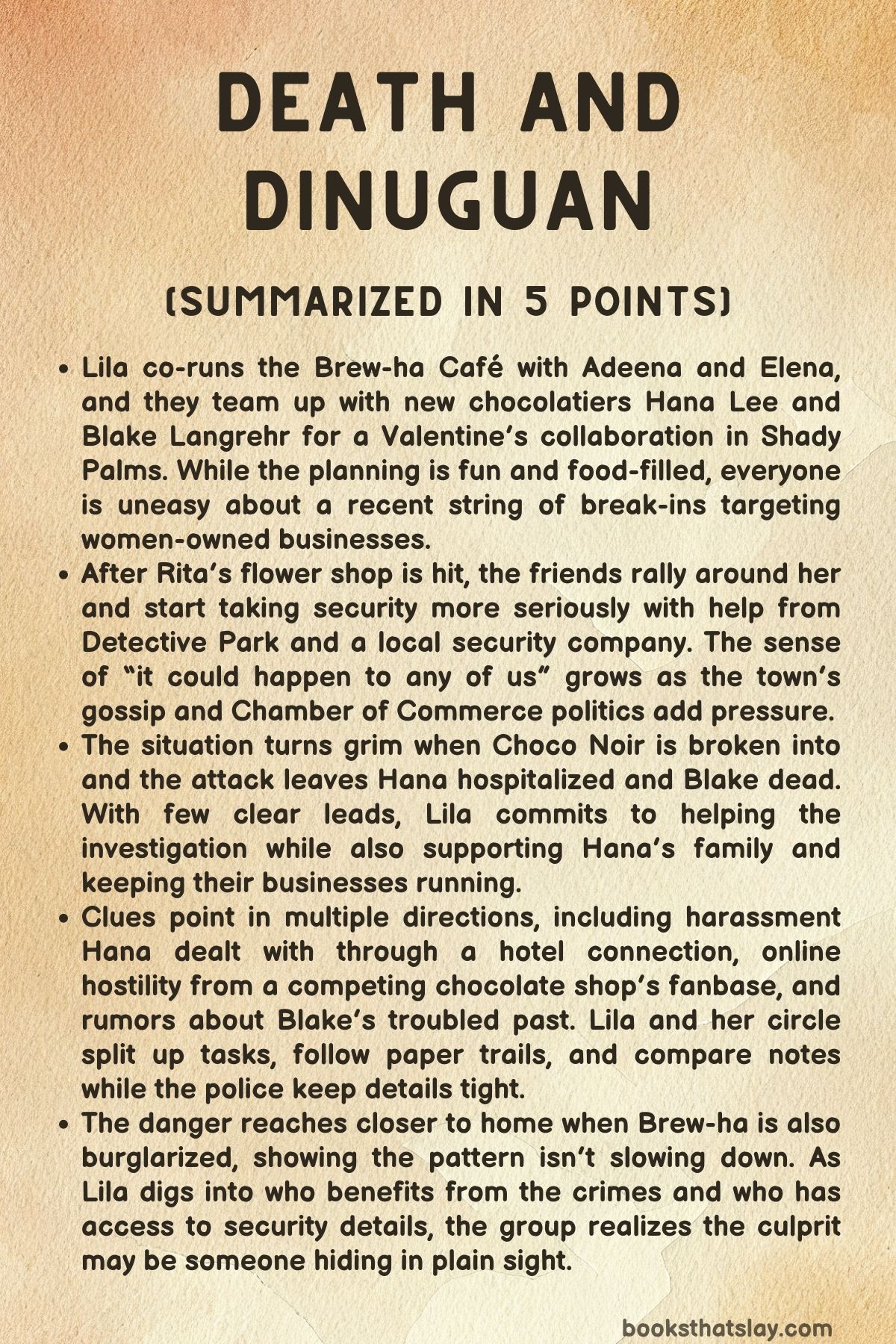
Summary
Lila co-owns the Brew-ha Café with her best friend Adeena and Adeena’s girlfriend, Elena. As Valentine’s Day approaches, they meet Hana Lee and Blake Langrehr, the pair behind a newly opened artisan chocolate shop, Choco Noir.
The first meeting is warm and energetic, full of tasting and ideas. Hana and Blake create custom chocolates inspired by each café partner’s background: a pistachio rose white chocolate for Adeena, a spicy Mexican hot chocolate flavor for Elena, and ube truffles for Lila.
They plan cross-promotions for a big town Valentine’s event hosted with help from Lila’s cousin Ronnie and his girlfriend Izzy at the winery, with florals handled by Elena’s cousin Rita.
But the upbeat planning is shadowed by a troubling pattern: a string of break-ins has been hitting women-owned businesses around Shady Palms. The group talks about strengthening security, including a company recommended through Detective Jonathan Park, Lila’s boyfriend Jae’s brother.
That concern becomes real fast when Ronnie calls everyone to the winery for an “emergency,” only for them to learn Rita’s flower shop has been broken into. Cash is stolen, the shop is trashed, and Rita is shaken.
The women rally around her, offering legal help through Adeena’s brother Amir and practical advice about alarms and cameras. Over dinner at Lila’s aunt’s restaurant, they meet Ben Smith from Safe & Secure Solutions and his employees, Hector and Vinny, who explain security options while the group tries to steady itself and stay optimistic.
A women entrepreneurs get-together soon follows, and the mood swings between support and worry. The town’s business culture has tensions, especially from older male members of the Chamber of Commerce who resent the success and visibility of women entrepreneurs.
Hana, meanwhile, is dealing with her own problem: Shawn Ford, a hotel liaison, keeps pushing past professional boundaries and asking her out. Blake urges Hana to block him, and Hana finally does, but the situation leaves everyone uneasy.
Then tragedy strikes. Lila is having dinner with Jae when a call comes in: Choco Noir has been attacked.
At the hospital, Lila learns Hana is in a coma and Blake has been killed. The police think it might be linked to the earlier robberies, but they can’t confirm anything yet.
The shop showed no signs of forced entry, suggesting the attacker may have been let in or had a way to avoid breaking in. The shock spreads through their community.
Lila, furious and scared, commits to helping find answers—both for justice and for the safety of the women being targeted.
Detective Park, no longer in an official police role, becomes a central organizer. He divides tasks among the group: Lila and her partners gather local information; Ronnie and Izzy monitor Chamber politics; Amir uses his legal access to help get updates; and Lila’s godmothers and family members use their networks to collect background on Blake, Hana, and the shop.
Park warns them not to confront burglary victims directly because someone is getting bolder, and the risk is rising.
As Lila balances café work with investigating, she picks up unsettling details. At a business event delivery, she overhears men mocking the burglaries and belittling women business owners, hinting that resentment may be fueling more than opportunistic theft.
Beth and Valerie Thompson, connected to local business leadership, confirm the pattern: burglary victims are women involved in the Chamber. They also share that Hana and Blake had issues with Shawn Ford and may have filed complaints about him.
Another potential source of conflict is The Chocolate Shoppe, a long-standing local chocolate business whose online posts and fan comments have turned nasty toward Choco Noir, stirring division in town.
A key lead appears through gossip at Brew-ha: someone claims Blake’s ex-husband showed up at Choco Noir shortly before the attack, confronting her and getting kicked out. Soon after, Detective Park meets with Blake’s parents, who reveal the ex, Patrick Murphy, was emotionally abusive and refused to leave Blake alone even after divorce and a restraining order.
Patrick becomes the obvious suspect—until Park checks and confirms Patrick has a strong alibi backed by public records, witnesses, and security footage.
Patrick still provides a crucial piece of information: Blake was in serious debt and had borrowed money from a dangerous lender in Minneapolis, even forging paperwork that dragged Patrick into the mess. The implication is chilling—Blake may have been desperate enough to take huge risks to get out from under that financial pressure.
Before the community can recover, Brew-ha is burglarized. The front window is smashed, the register and safe are taken, and Vinny is attacked during the response.
Lila is rattled not only by the loss, but by the message: this is personal, and it’s escalating. Still, she and her partners push through commitments, including supplying drinks for a chocolate-themed hotel event.
During that event, Lila spots Shawn Ford and sneaks into the office area. In a risky, illegal search of his desk drawers, she discovers Hana’s personal belongings—items that shouldn’t be in his possession.
She photographs everything and escapes just in time.
Detective Park explains that photos aren’t enough on their own, but they can help support a warrant when combined with formal complaints and witness statements. Shawn soon shows up at Brew-ha, aggressive and frantic, accusing Lila of setting him up.
Lila triggers a silent alarm, and security arrives quickly to restrain him until police can arrest him.
Even with Shawn in custody, Lila notices another pattern: many burglary victims have used the same security company, Safe & Secure Solutions. The possibility of an inside connection becomes hard to ignore.
A planned meeting to discuss it is interrupted when Hector appears in Brew-ha’s kitchen, armed, insisting he wants to talk—while an accomplice watches the front. Lila discreetly signals for help, and Adeena clears customers by pretending there’s a café emergency.
Police arrive, Hector surrenders, and the accomplice is revealed as Charlene Choi, a Chamber-linked bookkeeper with access to business details.
Charlene and Hector confess to targeting women-owned businesses by using Chamber information, insurance expectations, and security-system knowledge. They claim they never meant to hurt anyone.
The situation spiraled when Blake, desperate over her debt, pushed for a staged robbery at Choco Noir for insurance money. During the setup, Hana returned unexpectedly, refused to cooperate, and a struggle broke out.
Blake was killed, and Hana was attacked and left unconscious.
Hana eventually wakes and begins recovering, supported by Jae’s family and the community. Blake’s parents transfer ownership of Choco Noir and the apartment to Hana, recognizing both Hana’s loss and her commitment to the business they built together.
Valentine’s Day arrives with a community event that’s quieter than planned but full of support: Hana leads a children’s truffle activity, Aria is surrounded by people who care about her, and Shady Palms shows it can still come together after fear and loss.
Characters
Lila
In Death and Dinuguan, Lila functions as the emotional center and the story’s primary engine: she’s a small-business owner whose everyday competence (running Brew-ha Café, managing staff flow, creating new menu items, juggling partnerships) becomes the same skill set that fuels her investigative momentum once violence hits her community. Her defining trait is protective loyalty—she moves quickly from cheerful collaboration (Valentine’s chocolates, cross-promotions, winery events) to a fierce vow to find the attacker when Hana is hospitalized and Blake is killed.
Lila’s strengths are also her flaws: her curiosity and initiative repeatedly push her toward risky lines she’s explicitly warned against, and her willingness to cross boundaries (snooping, picking locks) shows a moral flexibility born less from arrogance than from desperation to protect the people she loves. The burglary of Brew-ha punctures her sense of safety and forces her to confront vulnerability directly; she’s not just solving a puzzle, she’s trying to reclaim control over a life that suddenly feels penetrable.
Across the arc, Lila embodies community-based resilience—she grieves, panics, and doubts, but she keeps showing up, coordinating support, holding space for others’ pain, and turning care into action.
Adeena
Adeena is the grounded strategist of the café trio, balancing warmth with a crisp, practical intelligence. She contributes an anchored calm during crises—whether it’s immediately offering legal help for Rita through her lawyer brother Amir or literally steadying Lila during a near panic after the café break-in.
Adeena’s role highlights how community support can be structured, not just emotional: she thinks in terms of resources, accountability, and next steps. Her cultural identity is treated as a point of pride and creativity (a chocolate inspired by her Pakistani background), and the story uses her as a reminder that “friendship” here is an active verb—showing up, protecting, organizing, and doing the unglamorous work when everyone else is spiraling.
Even when Lila veers into danger, Adeena’s presence acts like a moral and emotional ballast, keeping the group from tipping into chaos.
Elena
Elena brings both tenderness and steel to the trio, and her perspective often bridges the personal and the logistical. Her devotion is most visible in how she shadows Rita after the burglary, placing herself physically and emotionally between her cousin and the world’s sharp edges.
Yet Elena is also operationally sharp: she takes the lead on vendor logistics with the hotel, helps steer conversations to extract useful details, and later plays a critical role in the trap that exposes the inside connection—showing she’s not only nurturing but also capable of controlled confrontation. Elena’s arc emphasizes that care can be tactical; she comforts, yes, but she also listens for inconsistencies, watches who knows what, and understands that safety is built through systems as much as feelings.
Hana Lee
Hana enters as creative spark and community newcomer—an artist-chocolatier excited to collaborate, teasing and laughing with the café group, planning a showcase and constructing an ambitious chocolate sculpture. The attack transforms her into the story’s central wound: her coma becomes a prolonged uncertainty that reshapes everyone’s priorities, turning the town’s background tension into an urgent threat.
Hana’s characterization remains vivid despite her absence because her relationships keep her present—Jae’s devastation, Aria’s displacement, the group’s fundraising, and the discovery of her belongings hidden away. When she wakes and returns, it functions as emotional resolution rather than simple relief: her survival becomes a symbol that the community’s collective effort meant something, even though nothing can reverse Blake’s death.
Hana also represents the cost of ignoring harassment; the pressure from Shawn Ford isn’t just unpleasant background, it’s part of the ecosystem of entitlement and misogyny that the story keeps pointing at as a real danger.
Blake Langrehr
Blake’s character is built from contrast: she appears first as playful collaborator and business partner, then becomes the murder victim whose history pulls the investigation into darker territory—abusive marriage, isolation, debt, and desperation. The revelation that Blake was drowning financially and tangled with a loan shark reframes her not as careless but cornered, and it complicates the morality of the crime: she is neither villain nor saint, but someone who made catastrophic choices under pressure.
Her final actions, as explained later, underscore a protective instinct—she tries to shield Hana when the staged plan collapses—suggesting that even amid desperation, she still chooses another person’s safety over her own. Blake’s arc also exposes how private suffering can be invisible to a community until tragedy forces it into public view.
Jae
Jae is both intimate partner and connective tissue: Lila’s boyfriend, Hana’s cousin, and Detective Park’s brother, he sits at the intersection of family grief and investigative urgency. His character is defined by steadiness under strain—supporting Lila, caring for Aria, sharing updates, and staying present even when he’s emotionally shattered at Hana’s bedside.
He’s protective in a way that can become controlling under stress, particularly when tensions flare (like forcing Patrick to talk), but that protectiveness reads as grief-driven rather than domineering. Jae’s quieter function is tonal: he keeps the story rooted in human cost, reminding everyone that the case isn’t an abstract mystery—it’s his family, his niece, his community.
Detective Jonathan Park
Park embodies the story’s tension between official process and community urgency. As a former detective now operating outside formal authority, he has expertise and instincts but lacks full access, making him both leader and constraint: he organizes roles, warns against dangerous moves, and pushes for corroboration rather than rumor, yet he also shares enough direction that the group effectively becomes an informal investigative network.
His arguments with Detective Nowak highlight institutional friction—ego, jurisdiction, and control—while his willingness to coordinate community action shows a pragmatic understanding that trust and information often live outside police channels. Park’s character is also quietly compassionate; he measures harm, tries to prevent escalation, and keeps returning the focus to safety even when everyone wants immediate answers.
Detective Nowak
Nowak represents the guarded gatekeeping of an active investigation, and his dynamic with Park suggests a past mentorship that has curdled into rivalry or resentment. He withholds information, refuses collaboration, and becomes a symbol of why the community feels compelled to act—because the official pipeline feels slow, opaque, and dismissive.
Even without being painted as corrupt, he functions as an obstacle: the face of procedure when people want urgency, and the reminder that “doing things the right way” can feel like abandonment to victims’ loved ones.
Ronnie
Ronnie is the convivial organizer who uses social gatherings to hold the community together. His “emergency meeting” that turns into wine-drinking is comedic on the surface, but it also reveals something meaningful: his instinct is to pull people close in moments of fear.
Later, his chamber-of-commerce role becomes instrumental, positioning him as someone who can navigate power structures, read local politics, and chase information that isn’t accessible through friendships alone. Ronnie’s importance lies in how he channels anxiety into connection—he keeps people talking, eating, planning, and therefore functioning.
Izzy
Izzy is a steady, celebratory presence whose work at the winery makes her a facilitator of community rituals—sangria Sundays, chocolate wine, Valentine’s events. She often lightens the atmosphere without minimizing pain, which is a specific kind of emotional intelligence: she helps the group keep living while grieving.
Izzy’s role in chamber inquiries and public events also shows how social capital can be protective; she’s part of the network that keeps the town’s women entrepreneurs visible, supported, and less isolated.
Rita
Rita’s burglary is the story’s early warning flare, and her shaken quietness afterward becomes a portrait of post-violation vulnerability. She isn’t treated as merely a plot device; her fear changes the group’s behavior, escalating security conversations and highlighting how targeted crimes corrode confidence long before anyone is physically harmed.
Elena staying close to her reflects Rita’s need for safety through proximity, while her florist role ties her to the Valentine’s event and the town’s aesthetic joy—making the break-in feel like an attack on beauty and celebration as well as money. Rita’s presence underscores that even “nonviolent” crimes can leave deep emotional damage.
Sana
Sana provides domestic warmth and communal grounding through hosting Sangria Sunday, creating a space where business owners can be friends, not only competitors. Her home becomes a symbol of chosen-family infrastructure—where people can decompress, share fears, and exchange information.
By anchoring gatherings in everyday comfort, Sana helps the story show how community resilience is maintained: not only through dramatic action, but through routine, hospitality, and the decision to keep meeting even when fear tries to isolate everyone.
Yuki
Yuki’s role is quieter, but she contributes to the sense of a diverse, interconnected group of women entrepreneurs who trade support and information. Her presence helps widen the social landscape beyond the café trio, emphasizing that the threat isn’t personal to one protagonist—it’s communal.
In a story where social networks become investigative tools, Yuki functions as another thread in the net that eventually tightens around the truth.
Bernadette
Bernadette is the catalyst messenger who abruptly shifts the story from tension to tragedy. Her call is the pivot point: the moment the community’s abstract worry about burglaries becomes a nightmare with names, blood, and irreversible loss.
Even with limited page-time in the summary, Bernadette’s function is emotionally significant—she’s the voice that forces Lila and Jae to confront the new reality.
Aria
Aria is the living stake of the crime’s aftermath: a child whose stability depends on how the adults respond to grief, danger, and displacement. Her presence intensifies the moral urgency—this isn’t only about justice for Hana and Blake, it’s about preventing a child’s world from collapsing further.
The story uses Aria to show tenderness amid chaos: Lila’s delight in meeting her, the group’s efforts to cheer her, her bonding with a dog, and her participation in community healing moments. Aria symbolizes both fragility and continuity—the reason everyone keeps going.
Tita Rosie
Tita Rosie functions as matriarchal stability—her restaurant is a physical hub where nourishment and information exchange happen side by side. She offers comfort as a form of leadership: feeding people, gathering them, and letting the familiar rhythms of shared meals hold them together when emotions threaten to fracture them.
Tita Rosie’s presence reinforces the story’s theme that care work is power, especially in communities under threat.
Lola Flor
Lola Flor is the abrasive, formidable elder whose bluntness hides deep investment in her family and community. Her “gruffness” reads like armor—an old-school toughness that doesn’t easily permit softness—making her unexpected request for feedback on her mocha mamon cakes feel meaningful: it’s vulnerability expressed in the language she can tolerate.
She also serves as a key node in the community gossip network, showing how information travels through churches, restaurants, and family circles as effectively as it does through official channels.
Amir
Amir represents professional leverage and protective infrastructure. He isn’t only “the lawyer brother”; he’s the group’s way of turning emotion into action that carries weight—securing updates, advising victims, and making sure people aren’t navigating institutions alone.
In a story about women being targeted and dismissed, Amir’s presence signals that the community has allies who can push back through formal systems, not only through amateur sleuthing.
Valerie Thompson
Valerie is a portrait of polished power within the local business ecosystem—prominent, connected, and acutely aware of boardroom dynamics. Her significance lies in how she frames the burglaries as political and structural: victims tied to the chamber of commerce, hostility from older male members, and pressure from within governance structures.
Valerie is also a pragmatic informant, steering Lila toward Shawn Ford and hinting at competitive business rivalries, demonstrating that influence can be used either to protect the vulnerable or to maintain appearances—she chooses to help.
Beth
Beth serves as both insider and pressure point, positioned within the Thompson Family Company and squeezed by a critical board member. She provides key connective tissue by confirming patterns among the robbery victims and pointing Lila toward a strategy—approaching Shawn Ford as a woman because he might underestimate her.
Beth’s role highlights the story’s recurring idea that misogyny isn’t only violent; it’s also instrumental—men who feel entitled can be easier to trap precisely because they assume control.
Terrence
Terrence operates as a bridge to Blake and Hana’s professional past, reminding the reader that their lives extended beyond Shady Palms. His shock at the news humanizes the tragedy by showing ripple effects—this loss lands not only on family and lovers, but on colleagues and friends who suddenly realize how close violence was to someone they worked with.
Even without major investigative contribution in the summary, Terrence represents the broader circle of grief and the way creative communities mourn.
Stan
Stan provides local texture and practical assistance: a diner owner who notices community pain and offers a lead through his niece Diane. His function reinforces how this town works—information is exchanged through everyday places, and people help because they feel responsible for one another, not because they’re chasing glory.
Martha
Martha, alongside Stan, strengthens the sense of a partnered community business that’s observant and supportive. By sharing Diane’s contact information and speaking openly about the burglaries, she contributes to the informal intelligence network that becomes crucial.
Martha’s presence adds emotional realism: these crimes affect what people talk about over meals, not only what detectives discuss in offices.
Diane Kosta
Diane illustrates a victim who has adapted—running a cheerful pet photo shoot while still living with the reality of being targeted. Her studio’s security details, back-alley door, and armed alarm emphasize how women business owners are forced into constant risk-calculation.
Diane also inadvertently introduces a tangible clue through the green paisley handkerchief, showing how small, ordinary objects can carry investigative weight when fear has made everyone notice details.
Zoey Hong
Zoey is a professional gatekeeper in the hotel ecosystem—polite, competent, and cautious, aware that vendors and clients come with politics. She enables opportunity for Brew-ha (the tea event, potential supplier status) while also embodying institutional self-protection: she implies discomfort about Shawn Ford but doesn’t want to say too much.
Zoey’s guardedness feels realistic rather than villainous—she is balancing liability, workplace dynamics, and business continuity. Her role underscores how harassment is often an “open secret” managed through euphemism until someone forces it into the light.
Shawn Ford
Shawn is the story’s most visible embodiment of entitlement: pushy, persistent, and predatory in how he targets Hana and leverages professional power. The discovery of Hana’s belongings in his desk transforms him from “creepy nuisance” into a concrete threat, and his later eruption at the café confirms his volatility.
Shawn also demonstrates how dangerous men can hide in plain sight within respectable institutions, shielded by bureaucracy, plausible deniability, and the assumption that women will stay quiet. Even when the larger crime’s solution expands beyond him, Shawn remains a key figure in showing how harassment and violence sit on the same continuum of control.
Ben Smith
Ben initially appears as the comforting promise of safety—a security company owner offering upgrades and reassurance—making his proximity to the burglaries feel especially unsettling once suspicion shifts toward Safe & Secure Solutions. The summary ultimately frames Ben as someone whose employees function like family to him, which complicates the moral landscape: trust isn’t only broken by strangers, but by people embedded in the community’s protective systems.
Ben’s role highlights one of the story’s sharpest anxieties: what happens when the institution you pay for safety becomes the pathway to harm.
Hector
Hector is a study in betrayal through expertise. As a security worker, he has specialized knowledge that should protect people, yet he weaponizes it—bypassing systems, pursuing targets, and ultimately escalating into direct intimidation with a gun.
His insistence that they “didn’t plan to hurt anyone” reads as self-justification that collapses under the reality of Blake’s death and Hana’s coma, illustrating how people rationalize harm when they believe their intent was “only” financial. Hector’s surrender, triggered by coordinated response and community quick thinking, shows that control can be challenged when people prepare, communicate, and refuse isolation.
Vinny
Vinny is the human face of collateral damage. His humorous reaction to dinuguan early on makes him feel approachable and ordinary, which heightens the later shock when he’s attacked and injured during the café burglary response.
Through Vinny, the story emphasizes that violence spreads outward: even those adjacent to the central conflict—workers, responders, bystanders—can be hurt when criminal schemes spiral. His relationship with Ben and Hector as “family” adds poignancy, showing how criminality can exist within genuine bonds, not only within cold calculation.
Charlene Choi
Charlene is a chilling example of white-collar access turned predatory. Her bookkeeping and chamber-of-commerce connections allow her to select victims with precision, predict coverage, and exploit the very networks meant to support local business owners.
Charlene’s role brings the story’s gendered tension into sharper focus: the crimes aren’t random—they are targeted, opportunistic, and enabled by insider knowledge of women’s financial vulnerabilities. Her exposure hinges on a social detail—knowing about a new safe she shouldn’t know about—showing that even sophisticated schemes can unravel through human inconsistency and community attentiveness.
Greg Sanders
Greg represents the defensive posture of entrenched local power. As vice president of the chamber, he participates in conversations that feel like damage control—explaining limited help and implicitly protecting the organization’s reputation.
His presence reinforces the theme that institutions often prioritize optics over people, especially when the harmed group is made up of women who are already facing resentment for succeeding.
Gladys Stokes
Gladys appears as a background force whose name triggers reactions—especially Anita’s—suggesting she’s influential or polarizing in the local business scene. Even without full detail in the summary, Gladys functions as an example of how small towns accumulate unofficial power brokers: people whose opinions, gifts, and alliances can shift relationships between businesses.
Her “olive oil brownies” moment adds a subtle texture of social politics—kind gestures can still carry tension depending on the history behind them.
Anita Carter
Anita is volatile on the surface—defensive, stressed, and quick to anger—yet her characterization points to pressure rather than malice. She’s caught between family expectations, public perception, and the consequences of the shop’s online behavior; being pushed off social media control implies conflict about image management and accountability.
Anita’s awkward cover-up when she starts ranting about Gladys suggests she’s managing more than she wants to reveal, but the story also clears her of the central crime and shows her trying to engage professionally with Brew-ha. Anita embodies a business owner navigating insecurity: fear of competition, fear of judgment, and fear that one misstep will define her brand.
Vince Carter
Vince operates as the smoother counterbalance to Anita—diplomatic, customer-facing, and keenly aware of what should and shouldn’t be said. His sharp interruption when Anita is about to mention a sales bump reads as protective secrecy, suggesting business realities they don’t want public, even if not criminal.
Vince’s role highlights a recurring motif: people manage narratives constantly in this town, and what they hide might be petty, reputational, or profound—making every conversation feel like it has a second layer.
Erin
Erin, as the newly promoted social media manager, represents the younger generation dealing with the fallout of the older generation’s choices. Her candid slip about Anita being pushed aside for “making them look bad” reveals internal family dynamics and a desire to sanitize public image rather than address underlying harm.
Erin’s presence underscores how workplaces often push uncomfortable truths onto lower-status employees, who end up carrying information they didn’t ask to hold.
Felice
Felice’s brief role at City Hall emphasizes the limits of official channels for outsiders and the way information sometimes comes in sideways—like hearing that someone takes ballroom dancing lessons and realizing that’s a potential access point. Felice represents civic bureaucracy as both resource and dead end: you might get a useful detail, but rarely the whole story.
Chuy
Chuy functions as a potential connector to street-level knowledge about the burglaries, suggesting that the town has multiple information layers: formal (police, chamber), social (restaurants, group chats), and informal (people who “might know”). Even without payoff in the provided summary, Chuy’s mention reinforces that Lila’s investigation is essentially about mapping the town’s hidden circuits of influence.
Patrick Murphy
Patrick is an unsettling portrait of coercive control that persists even after divorce. His verbal cruelty about Blake, his admitted violation of boundaries through hiring a private investigator, and the restraining-order history paint him as emotionally abusive and entitled.
Yet his solid alibi forces a more complicated narrative: being a terrible person doesn’t automatically make him the murderer, and the story uses that to challenge easy suspect logic. Patrick’s revelations about Blake’s debt and the loan shark deepen the tragedy—his information is credible and useful, even though he is personally contemptible—showing how truth can come from someone you’d rather never hear from again.
Mr. Langrehr
Blake’s father embodies raw, furious grief. His focus is action—find the ex-husband, force police movement, demand answers—because rage feels more survivable than helplessness.
He also reveals how families reconstruct the victim’s story after death, searching for causes and culprits that make the loss feel explainable. Mr. Langrehr’s presence adds emotional realism: he’s not interested in procedure, only in the urgent need for someone to be held responsible.
Mrs. Langrehr
Blake’s mother carries the grief differently—still intense, but expressed through detail and memory: the restraining order, the workplace harassment, the isolation Patrick enforced. Her testimony gives Blake back some voice after death, ensuring Blake isn’t reduced to a body in a crime scene.
Mrs. Langrehr also becomes part of the story’s healing arc when the family later gives Hana ownership of Choco Noir and the apartment, transforming loss into a deliberate act of care and continuity.
Longganisa
Longganisa, Lila’s dog, operates as comfort, routine, and accidental investigator. In a narrative heavy with fear and suspicion, the dog anchors scenes in everyday life—walks, photo shoots, small joys—while also nudging the plot forward through the found handkerchief.
Longganisa symbolizes the stubborn persistence of normalcy: even when the world is dangerous, life keeps asking to be lived, fed, walked, and loved.
Gino Pacino
Gino Pacino, Blake’s dog, becomes a tender extension of grief and recovery. The bond that forms between Gino Pacino and Aria gives the aftermath a quiet emotional logic: companionship as medicine, especially for a child who can’t fully articulate what she’s lost.
The dog’s presence helps reframe the ending from “case closed” to “community rebuilding,” where healing looks like small attachments forming again.
Themes
Female Solidarity and Empowerment
In Death and Dinuguan, the strength of female relationships forms the backbone of the story. The women of Shady Palms—Lila, Adeena, Elena, Hana, Rita, Izzy, and others—are not just friends or colleagues; they represent a collective resilience against a community and system that often undervalues them.
Each woman runs her own business, faces unique cultural and personal challenges, and yet finds empowerment in collaboration and mutual support. Their camaraderie extends beyond business partnerships into acts of emotional care, protection, and advocacy, especially when one of them becomes a victim.
Through their shared grief, anger, and determination after the attack on Hana and Blake, the novel underscores how women in small communities must rely on each other when institutions fail them. Their initiatives—organizing fundraisers, ensuring each other’s safety, and conducting their own investigations—become acts of quiet rebellion against patriarchal complacency.
The narrative showcases their intelligence and resourcefulness, portraying them as multifaceted individuals balancing family, love, and entrepreneurship. The women’s solidarity isn’t idealized but realistic; they disagree, make mistakes, and still choose to stand together.
This shared resilience transforms grief into collective strength, illustrating how empowerment often begins in the smallest gestures—offering a meal, comforting a friend, or sharing information over coffee. The story’s portrayal of women’s networks, especially among immigrants and minorities, highlights how cultural bonds and friendship create a safety net stronger than any formal institution.
Community, Cultural Identity, and Belonging
The setting of Shady Palms acts as a microcosm of multicultural America, where diverse traditions converge through food, language, and business. Death and Dinuguan celebrates cultural pride and the joy of representation through Lila’s Filipino heritage, Adeena’s Pakistani background, and Elena’s Mexican roots.
The Brew-ha Café and Tita Rosie’s Kitchen are not just businesses but cultural sanctuaries that allow characters to express identity through cuisine and hospitality. Food becomes both comfort and communication—it bridges generational gaps, fosters friendships, and heals trauma.
Each recipe, from ube truffles to dinuguan, carries layers of meaning about home, memory, and survival. Yet the novel also acknowledges the challenges of belonging in a town that is still adjusting to diversity.
The tension within the Chamber of Commerce and the xenophobic undercurrents reveal that acceptance often comes with resistance. Still, the warmth of the community—seen in gatherings, shared meals, and Valentine’s events—shows how identity thrives when rooted in compassion rather than conformity.
The narrative suggests that belonging is an act of persistence; it is created daily through small affirmations of who one is and where one comes from. For Lila and her friends, community is not a passive inheritance but an ongoing construction that they defend and redefine with every act of kindness and courage.
Gendered Violence and Misogyny
Running beneath the cozy, communal atmosphere of Death and Dinuguan is a chilling commentary on the everyday threats women face in public and private life. The series of burglaries targeting women-owned businesses is not only a crime plot but a reflection of systemic misogyny that manifests through intimidation, harassment, and dismissal.
The novel exposes how violence against women is often minimized until it escalates, as seen in the attacks on Blake and Hana. The hostility of certain male chamber members and the gossiping townsmen reveal an undercurrent of resentment toward successful women who challenge traditional hierarchies.
Even more disturbing is the complicity of trusted figures—such as Hector and Charlene—who exploit women’s trust for personal gain. Blake’s abusive marriage and Hana’s harassment by Shawn Ford depict different forms of male dominance, from coercive control to predatory entitlement.
What deepens the theme is how the women respond—not with passivity, but with agency. Their investigation and mutual protection stand as defiance against the idea that women must endure or stay silent.
Through these events, the book critiques how patriarchal systems devalue women’s labor and safety while glorifying male authority. It portrays the slow but steady reclamation of power by women who refuse to be victims.
The narrative’s resolution—where the truth is uncovered by female intuition and teamwork—serves as an assertion that justice often begins where women refuse to accept silence.
Justice, Morality, and Accountability
Justice in Death and Dinuguan operates on multiple levels—legal, moral, and emotional. The novel questions whether institutional justice is sufficient or even functional when those most affected by crime are women and minorities.
Lila’s investigation, aided by her friends and Detective Park, demonstrates how official systems often lag behind personal moral conviction. The revelation that some crimes were staged for insurance, and that greed and desperation motivated the violence, complicates the moral landscape.
Characters like Blake, who becomes both victim and participant in wrongdoing, reveal how survival instincts can blur the line between guilt and innocence. Even Hector and Charlene, while culpable, act from motives of financial strain and social frustration, showing that crime in Shady Palms is rooted in deeper inequities.
Lila’s approach to justice emphasizes understanding and prevention over punishment, focusing on healing the wounds left behind. The final chapters, where Hana recovers and the community reunites at the Valentine’s event, embody restorative justice—the idea that reconciliation and truth-telling repair what violence destroyed.
The novel insists that accountability must come with empathy, not vengeance. By blending mystery with moral introspection, it offers a realistic view of justice as a messy, human process that depends as much on compassion as on law.
Resilience, Healing, and Renewal
Amid grief, fear, and betrayal, Death and Dinuguan radiates a message of hope rooted in resilience. Lila and her circle endure repeated losses—friends attacked, businesses destroyed, and trust broken—yet they continue to create, nurture, and rebuild.
Healing is portrayed not as an isolated emotional state but as a communal process fueled by acts of care. The café’s reopening, the hospital visits, the family meals—all become rituals of restoration.
Food again plays a symbolic role; it nourishes both body and spirit, acting as a conduit for love and forgiveness. Hana’s eventual recovery mirrors the town’s slow return to safety and trust.
The Valentine’s event, filled with music and laughter, transforms a day once marked by tragedy into one of renewal. Even the title’s contrast between “Death” and “Dinuguan” captures this paradox—life and loss intertwined, yet reconciled through cultural meaning and emotional endurance.
The novel affirms that resilience is not just survival; it is the ability to find sweetness amid bitterness, to rebuild with tenderness after violence. Through its portrayal of friendship, family, and food, the story closes on a hopeful reminder that even in the aftermath of betrayal and pain, healing is possible when a community chooses to face its scars together.