Death and Other Occupational Hazards Summary, Characters and Themes
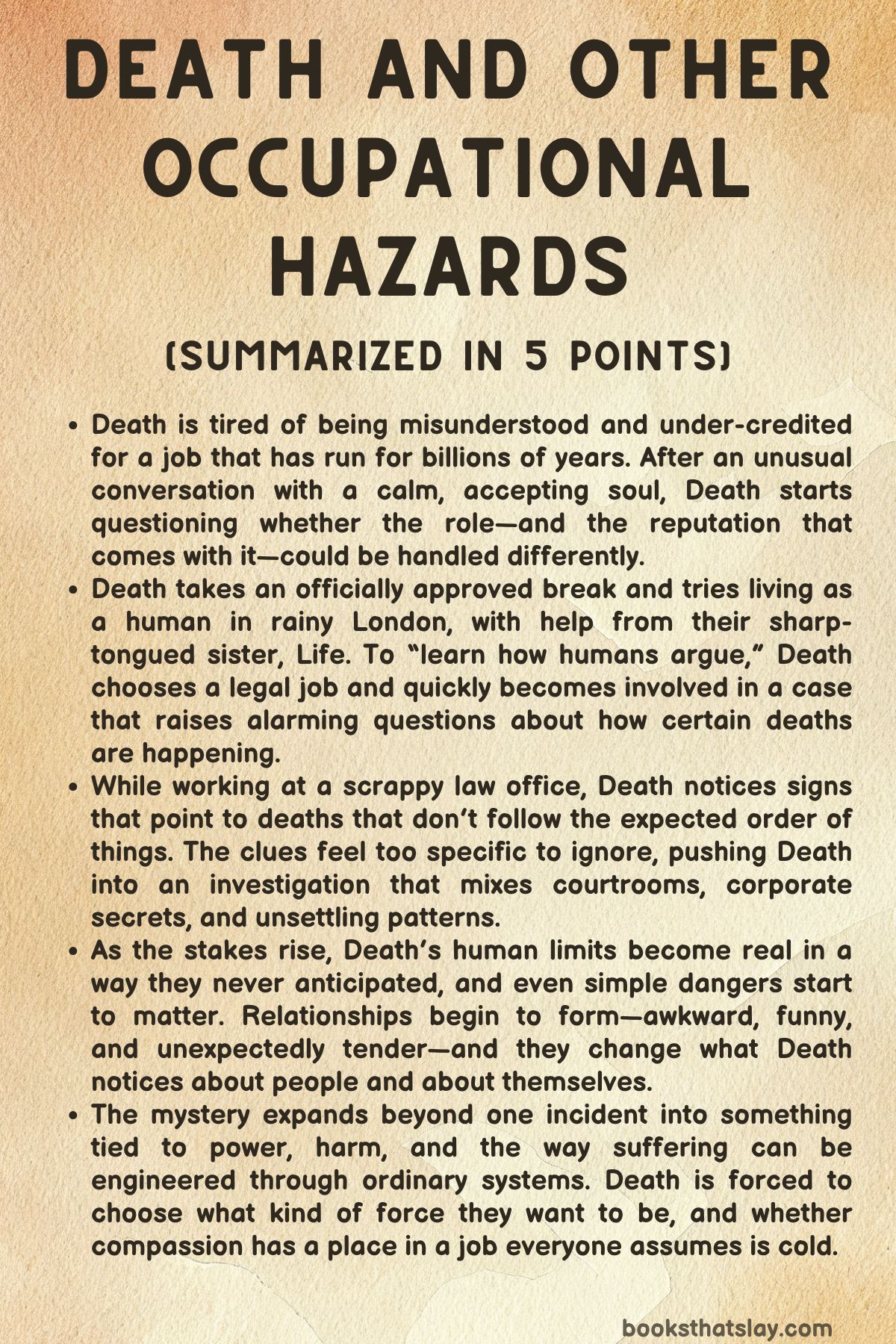
Death and Other Occupational Hazards by Veronika Dapunt is a comic, sharp-edged fantasy that treats Death not as a horror, but as a tired civil servant who’s been doing an essential job for billions of years and still gets mocked for the uniform. When Death takes a rare sabbatical to live among humans, they choose a new name—Delara—and attempt to learn how people argue, defend, and justify themselves by working in a London law office.
But an impossible case appears: deaths that Death did not cause. Delara is pulled into an investigation that spans crime, corporate wrongdoing, and forces older than any city—while learning, against their will, what attachment and love can cost.
Summary
Death has worked since the earliest life began, performing a task that never ends and almost never earns gratitude. Humans fear and insult Death, drawing them as a skeleton with a scythe and assuming cruelty where there is only inevitability.
Even the Boss—the being who oversees creation—dismisses Death’s irritation about reputation, insisting the work matters more than how it is perceived. On a routine collection, Death escorts a furious ninety-eight-year-old who insists it is unfair to be taken before reaching a hundred.
As always, Death explains there is no bargaining and guides him onto the Boat that carries souls across a dark river toward the Underworld. Around them are souls who refuse, souls who howl, souls who regret, and souls too numb to care.
During the crossing, a rare kind of passenger—one of the “Miscellaneous”—approaches Death calmly and asks how they are doing. He explains that his life’s work involved helping people accept dying, and he is fascinated to finally meet the one figure he spent his career discussing.
The conversation unsettles Death, because it is the first time in eons someone has treated them like a person rather than a disaster. Other souls interrupt with complaints and comparisons.
Someone jokes that Death’s job sounds like human HR: necessary, disliked, blamed for everything. The idea sticks, especially when the soul tells a story about an HR cousin who escaped burnout by taking a sabbatical and finally confronting the people who took advantage of her.
For the first time, Death imagines change. They request leave from the Boss, and, to their surprise, it is granted.
Death’s sister, Life, meets them on Earth—manifesting as a grey-haired woman who looks exhausted and irritated. Life thinks the sabbatical is irresponsible and warns Death that a human body brings risks: accidents, mistakes, and real harm.
Still, she has arranged a small London flat, complete with a snoring flatmate who is a junior doctor, and she gives Death the tools of human existence—money, identification, a smartphone, and interview addresses. One rule lands like a slap: in this form, Death can cause death without intending to.
Death chooses the name Delara and decides that learning to argue like a human will help them argue their case to humanity. They aim for law, starting as a paralegal.
At a shabby basement law office, Delara interviews with Phil, a solicitor handling violent crime. He tests Delara with crime-scene photos.
Delara remains calm, because the images are not shocking—they are familiar. Many of the dead faces are people Delara personally guided away.
Then Phil shows a man dead in a penthouse: Luigi Iuliano. Delara freezes, because Luigi’s soul was never taken on the Journey.
The death happened while Delara was still working as Death. That should be impossible.
At the scene, police found strange Aramaic writing filled with numbers and the word “Death.” Delara can read it. Phil hires Delara immediately.
Delara tries to confirm whether someone covered their duties incorrectly during the sabbatical, but the Temp who filled in shows clean logs. No missing entries, no mistakes.
Back at the office, Delara learns the staff: Abby the receptionist; Hinesh and Gemma, assistant solicitors who help keep the chaotic place running. The details of Luigi’s death are bizarre—his body supposedly contained Vandellia cirrhosa, vampire fish, despite Luigi never traveling to the Amazon.
It suggests something unnatural was inserted into reality. Delara contacts the Boss mentally.
The Boss admits the death was unplanned and warns that such events damage creation itself, but he refuses to explain more and claims he does not know who caused it.
Delara wants to visit the penthouse scene, but Phil blocks them. In court, Delara studies case files and focuses on Dr Marco Altamura, a bioscience researcher who claims he knew Luigi through the Italian community.
Delara tries awkwardly to meet him in person, fails, then takes Gemma’s advice and uses LinkedIn. Marco agrees to talk.
During the meeting, Life briefly appears as a beetle—offering instinctive, disruptive thoughts that derail Delara’s composure and embarrass them. Delara presses Marco about Luigi.
He admits Luigi supplied cocaine and other hard-to-get goods, and he avoided telling police to prevent trouble for others. He knows nothing about the Aramaic notes, but he speaks about plans, and how sometimes flexibility becomes a kind of survival.
Delara leaves believing Marco isn’t the killer, but sensing he is connected to the hidden structure around Luigi’s life.
At an office Easter party, Delara senses an old, foul presence: the Vice President for Pandemonium & Perdition, a Devil-like executive who amplifies human cruelty rather than creating it. Delara slips away to a private club in Mayfair where the VP inhabits the body of an Albanian crime boss.
The VP mocks Death, tries to flirt, and treats the unplanned death like entertainment. Delara forces him back by briefly revealing their true nature.
The VP denies causing Luigi’s death, claiming he would never risk his position by breaking the Plan. The confrontation escalates until a glass breaks and Delara cuts their hand—discovering, with shock, that a human body can bleed and be injured.
Soon after, Delara is attacked in Soho, stabbed in a dark alley, and collapses. Rats nearby make noise and draw attention after someone drags Delara behind bins.
Delara wakes in hospital days later. Life appears as an exhausted surgeon and scolds them with fury and fear.
Delara tells Life about Luigi’s death and the Boss’s confirmation. Life assumes the VP is responsible and wants him removed, but Delara argues the VP gains nothing from unplanned deaths and the Boss truly does not know who did it.
Then Life delivers the worst news: unlike her, Death cannot jump between bodies. Life can inhabit any life form; her bodies die, but she continues.
Delara has only this one human body on Earth, and if it dies, Death dies.
When Delara recovers enough to return to the office, coworkers treat them like a miracle. Background checks show Delara “doesn’t exist,” and Phil hints someone in the Metropolitan Police warned him not to investigate.
The staff decide Delara must be undercover, and they interpret Delara’s questions about Luigi as part of a covert operation. Delara lets them believe it.
Marco visits with his small dog Cerberus, who sits close to Delara with eerie recognition, as if he senses what Delara is.
Marco brings a new lead: an obituary for an American scientist in Baton Rouge who died suddenly of a fungal infection on the same day Delara arrived on Earth. Delara recognizes another unplanned death.
Marco says he knew the scientist too and is an expert on parasites. Delara searches for more anomalies but finds nothing else obvious.
Pride and duty wrestle inside them: leave and return “home,” or stay long enough to solve what should not exist.
Delara can’t afford travel to the U.S., and office demands trap them in London. At an environmental protest where Phil sends Delara for outreach, Delara finds Life nearby, inhabiting a furious protestor and getting dragged from a fountain by police.
In a tent afterward, Delara and Life argue about responsibility and suffering. Life refuses to fly Delara anywhere, but suggests investigating the dead scientist’s company through its UK office in Bracknell.
Together they infiltrate the corporate building, borrowing bodies and bending access rules. Key files show “Access Denied,” so they return at night.
Life sabotages security updates by inhabiting the Head of IT. Delara, posing as HR, terrifies a nervous employee by letting a hint of their true nature leak through.
Life later warns them not to use that power—but also quietly acknowledges it mattered to Delara.
Inside a secure lab, they find sick and dead animals and documents proving the company’s fungus-resistant grains cause severe harm over time, especially in children. The company’s regulatory application omits the damaging data, and the paperwork shows political coordination to push the product.
Photos of the dead scientist include Aramaic notes like those at Luigi’s scene. The same hand is behind both deaths.
The VP arrives, revealing himself and escalating the confrontation. Life punches him.
He draws a gun, admits he stabbed Delara earlier as an experiment, and shoots Life in the shoulder. He warns Delara that releasing Death’s full essence on Earth could end everything permanently.
Delara begins to unleash it—the air thickens with the force of endings—then panics at the scale of what they are and drags it back. They escape with a rescued lab beagle.
Outside, Life and Delara fight bitterly. Life accuses Delara of choosing the Plan over her sister, then abandons Delara by leaving her host body.
A storm breaks as the Boss arrives in rage. He confronts Delara for nearly releasing their essence in the human world.
The VP tries to spin the situation to his advantage, but the Boss warns him never to attempt to kill Death on Earth again and orders him away. The Boss suspends Delara, binds their essence, and leaves them powerless and alone, with the rescued dog shivering in their arms.
With nowhere else to go, Delara takes the dog to Marco’s flat above a fish-and-chip shop. Marco helps clean and bandage Delara and listens as Delara hints at the grains scandal and the attack.
Delara returns to Phil and reveals enough to trigger his instincts: a huge company poisoning people, potentially hundreds harmed. Phil sees the legal storm and calls the team in excitement.
Marco, meanwhile, shares his own history: his family’s long battle with mafia pressure on farmland, his father’s refusal, retaliation, and the chain of tragedies that followed. He believes his sister was executed after trying to leave a man connected to the mafia while pregnant.
The police shut it down quickly. Marco had tried to get close to Luigi to learn the truth, and now Luigi is dead.
He agrees to help Delara investigate—but demands to know how Delara knew details about his sister’s death. Delara lies, claiming to be a private investigator.
Marco doesn’t fully believe it, but they form an uneasy partnership.
They investigate another strange death: Cathy Hopper, CEO of a company called Rassi, found dead in a supermarket warehouse after hundreds of spiders attacked. The scene details don’t add up.
The body outline suggests she died on her back beside banana crates wrapped in plastic, but Delara argues that a venomous attack should have caused frantic movement. A worker named Mike insists the position is correct and shows a photo.
He also mentions an odd logistical detail: tomatoes were stored across from the bananas, against the warehouse’s usual system. Delara pockets rotten fruit under the pretext of research; in truth, they have begun feeding rats, drawn to them since the stabbing.
Newspaper articles appear featuring Delara at crime scenes and feeding rats near the Soho stabbing site. Police say Delara isn’t suspected but want to talk.
Someone is tracking Delara and controlling the story. Then executives from the grains-linked business offer Phil a massive retainer that reads like hush money.
As they leave, the executives complain Delara signed the visitor book as “Death.”
At Marco’s flat, Delara connects the tomato anomaly to Marco’s explanation of mafia involvement in supply chains and supermarket price pressure. Delara learns the tomatoes from the warehouse were dumped in a landfill, unreachable now.
An old promotional photo of Cathy in Sicily’s Parco dei Nebrodi becomes their next lead, and Delara decides to go to Palermo. Marco follows—warned by Delara’s sister—insisting he won’t let Delara walk into danger alone.
In Sicily, the photo location proves more branding than reality, but local farmers confirm mafia land pressure and mention a figure called “Grosso Naso” who does business with English supermarkets. Delara and Marco confront him at a wholesale market.
He admits he has met Cathy and worked with Rassi, then turns hostile when Delara asks about spiders and tomatoes. Outside, Marco kisses Delara, but Grosso Naso’s men capture them and threaten them with a gun in a shed filled with crates and old coffins.
Delara survives by revealing impossible details from the men’s lives—personal promises, hidden violence—frightening them into backing down. They admit they burn expensive waste on land used for tomatoes, contaminating soil and causing sickness.
They deny killing Cathy, then release Delara and Marco. Marco, shaken, accuses Delara of lying about who they are.
The trust between them cracks.
Back in London, Delara is confronted at work by officials waving articles about Delara at scenes—and accusations that Delara stole a bloodied beagle from Bracknell. They claim Delara has no sister in any records and insist Delara is dangerous.
Delara is taken to a psychiatric hospital, drugged, stripped of autonomy, and forced through monitored routines. Another patient, Elsie, screams that Delara is Death.
When Delara tries to question her, guards inject both of them and Delara blacks out.
Delara later watches the Thames on the South Bank, thinking about the Temp’s offer: resign as Death and the Temp will reveal who is behind the unplanned murders—maybe even allowing Delara to save Life. But Delara fears what the Temp and the VP would do if they took over Death’s role.
Then the HCD, an ancient figure tied to judgment and punishment, locates Delara using a smartwatch feature. Marco comes too.
They hide in the Tate Modern, where Marco admits he has anonymously investigated the ’Ndrangheta for years and initially grew close to Delara partly to determine whether Delara was connected to them. He also admits he avoided relationships for fear of endangering others, but he couldn’t stop feeling for Delara.
Marco shares what he has uncovered: Cathy’s public charity persona was staged, and she likely knew poisonous tomatoes were linked to earlier deaths. She moved them ahead of an inspection, trying to keep them from being tested.
Marco also has an email showing Cathy planned a trial partnership with the grains company, tying the deaths together through food corruption. As Marco says he is “famished,” Delara sees the pattern clearly: food, poisoned food, engineered scarcity, slow suffering.
The culprit isn’t the VP. It is Famine—one of the horsemen of the Apocalypse—acting through systems of exploitation and contaminated supply.
Delara demands the Boss help locate Famine. The HCD resists, bitter because the Boss once had him crucified, but agrees.
They lie in locked park grass at night, and the Boss arrives as wind and presence. Delara demands answers.
The Boss refuses, saying everything will die eventually and claiming Delara already has all the help they need. He leaves Delara furious and close to breaking.
Delara considers sacrificing themselves to save Life, believing the world is already tipping into mass death.
Delara returns to Marco for what feels like a final goodbye. News reports suggest mysterious mass deaths are increasing worldwide, as if Life is failing.
Marco insists Delara eat, and in the quiet domestic moment of coffee, dogs, and spaghetti, Delara experiences a small human happiness that feels both strange and precious. Marco admits he loves Delara—he is in love with Death.
They sleep together, and afterward Marco makes Delara promise not to sacrifice themselves. Delara agrees, and realizes it is their first deliberate lie.
Before dawn, Delara leaves. The HCD meets them and escorts them to a derelict East London apartment block where the Temp and the VP demanded Delara come.
Inside, poison has been scattered to kill insects and rats; Delara’s rat allies die as the Temp collects their souls. In the basement, the Temp and VP force Delara toward resignation.
Delara demands they reveal where Famine is and allow the HCD to stop him. The Temp says Famine is “everywhere.” Then Life arrives in a weakened, flickering state, inhabiting a stocky man’s body.
Life pulls a gun on the VP, but the VP mocks her and reveals he has many bodies ready. In the gunfire, the VP shoots the HCD dead while Life shoots the VP’s current host.
The HCD promises to return in three days. Lights flood the room, revealing bound hostages with guns to their heads: Abby, Hinesh, Gemma, Phil, and Marco—along with Garm on a lead.
Life is too weak to jump into the gunmen’s bodies to save everyone. The VP orders Delara to shoot themselves, threatening to torture and kill the hostages one by one.
Delara searches for another way. Then the VP kicks Garm.
The dog breaks free and runs to Delara—and is shot. Garm dies in Delara’s arms.
The Temp steps forward to take the dog’s soul, and Delara’s grief snaps something open. Death’s full essence surges back, violent and absolute.
Delara destroys the Temp instantly. The VP begs, and Delara destroys him too.
But the unleashed power is not only Death—it is the Pale Rider of prophecy, and it begins to spread toward Life, ready to end everything. Life, exhausted, accepts the end.
Delara looks at Garm’s body and clings to the memory of love, joy, and ordinary human warmth. With agony, Delara fights their own essence, pulling it back piece by piece until it is contained.
The pain becomes unbearable, and Delara’s body collapses into nothing.
Delara awakens in a quiet, waiting-room-like afterlife space. The HCD appears in a robe and says he spoke with the Boss; he may return to work part-time.
The Boss is waiting. Delara enters a bright landscape filled with flowers and meets the Boss, who confirms Life is healed and the unplanned deaths have been undone.
He admits he steered events indirectly and reveals Delara’s essence was never truly taken—only bound by Delara’s belief and fear. He shows Delara their human body in surgery and Marco waiting outside in despair.
The Boss offers choices: remain in peace, return as a human, or resume the role of Death—warning that staying mortal too long will fracture Delara’s mind.
Delara wakes in a hospital bed with flowers and friends. Life evacuated most people before the building collapsed.
Marco is alive, injured but present. Later, Delara meets Life on a beach, where Life confesses the most painful truth: she caused the first two unplanned deaths herself.
She was overwhelmed by suffering, wanted to die, and believed someone else could do her job better. She says the VP caused the spider death by taking over Cathy to frame Life and kill Delara.
Delara comforts Life and tells her that love—costly and confusing—was what allowed Delara to stop the apocalypse inside themselves.
After recovery, Delara and Marco travel to Sicily, caring for the injured Cerberus. But as the holiday ends, Delara admits they cannot stay human.
They love Marco, but they cannot abandon their role, cannot leave Life alone, and cannot stop being the one who arrives at every end. They say goodbye, and Delara lets the human body fade, becoming Death again—returning to the Boat, guiding souls with gentleness, with Garm’s spirit always beside them as Life continues creating, and the sisters move forward together.
Characters
Death (Delara)
Death begins as a weary, ancient professional who has done the same indispensable work for billions of years and feels chronically misunderstood by the very beings they serve. What makes Death compelling here is the gap between their cosmic authority and their emotional inexperience: on the Boat they can end arguments with finality, yet one sincere conversation with a “Miscellaneous” soul destabilizes their certainty and triggers the first real bout of self-reflection about purpose, public perception, and burnout.
Taking the sabbatical is not just a workplace rebellion against the Boss; it is Death trying to learn the human art of persuasion so they can “make their case” to the living, which is why the choice of law is thematically perfect. In human form, Death’s identity crisis intensifies because the role that once made them untouchable becomes fragile, embodied, and politically vulnerable—an existential demotion that forces them to confront fear, injury, and the possibility of personal death.
As Delara, Death’s personality sharpens through contradiction: they are literal inevitability, yet they are new to lying, flirting, comfort, and hope. They often default to procedural thinking—logs, causes, plans, evidence—because it resembles the order of the Plan, but the more they investigate the Unplanned deaths, the more they drift into a human kind of moral urgency.
Their “essence” becomes a metaphor for overwhelming truth: it can end all arguments because it ends all life, and the story continually tests whether Death can be powerful without being catastrophic. Delara’s defining transformation is that they learn restraint not as weakness, but as love made practical: when they pull back the Pale Rider force at the climax, it is not because they fear punishment, but because they finally understand what humans mean by choosing one life, one bond, one moment of joy over abstract destiny.
By the end of Death and Other Occupational Hazards, Death returns to their role gentler and more present, not because humanity finally praises them, but because they themselves have found meaning in accompaniment—being there at the end as an act of care rather than mere function.
Life
Life is the story’s urgent counterweight to Death: where Death moves slowly and speaks in finalities, Life is hurried, irritable, practical, and exhausted by constant creation and triage. Her ability to inhabit any life form makes her appear omnipresent and adaptable, but it also reveals a hidden loneliness: she can be everywhere and still feel unseen by the one person who should understand her most.
Life’s anger at Death’s sabbatical is not only sibling frustration; it is panic at imbalance, because she experiences death and suffering not as an abstract necessity but as an accumulating, daily weight she cannot put down. Her scolding tone masks fear, and the revelation that Death can truly die in one human body is the most intimate terror she can offer—proof that this break is not a vacation but a gamble with cosmic consequences.
Life’s most important complexity is her moral break. When she confesses she caused the first Unplanned deaths, it reframes her earlier harshness as a kind of self-disgust: she is the principle of continuance who, under crushing overload, wanted to stop existing and believed someone else might do better.
That confession makes Life more than an archetype of vitality; it makes her a character who can fail ethically in the name of compassion, and then must live with the consequences. She also embodies a harsher truth than Death: she knows that care can become coercion, that “saving” can become controlling, and that suffering can push even the most life-affirming being toward nihilism.
In the end, Life is healed not by being right, but by being forgiven and understood, and her bond with Death becomes less adversarial and more reciprocal—two workers carrying creation together, finally acknowledging each other’s burdens.
The Boss
The Boss functions as a creator-manager whose authority is absolute but whose communication is evasive, which gives him the unsettling texture of a parent and a CEO at once. His insistence that Death shouldn’t care how humans depict them reads like managerial detachment, yet it also hints at a cosmic philosophy: public perception is noise compared to the functioning of the system.
The Boss’s most significant trait is his strategic withholding. He grants the sabbatical, forbids Life from warning Death about mortality, refuses to reveal Famine’s location, and later admits he “helped indirectly,” suggesting he orchestrates conditions for growth while maintaining plausible deniability.
This makes him neither purely benevolent nor purely cruel; he is committed to outcomes, not comfort, and he treats his creations as both beloved and instrumental.
What deepens him as a character is the way he frames responsibility. He claims unplanned death tears the fabric of creation, yet he cannot or will not fully police it, implying limits to omniscience or a deliberate choice to allow conflict to test the structure.
When he binds Delara’s essence after the near-release in the lab, it feels punitive, but the later revelation that the binding depended on Delara’s belief reframes him as someone who understands the psychology of power: he disciplines not only through force but through narrative. His final offer—peace, humanity, or the job—casts him as a maker who values choice, but with an unsettling caveat about mental fracture if Death stays mortal too long.
The Boss embodies the ambiguous ethics of creation itself: guidance that can look like manipulation, protection that can look like control, and love that is expressed through tests rather than tenderness.
The “Miscellaneous” Soul
The Miscellaneous soul is the story’s quiet catalyst—the first person in ages to meet Death without fear, bargaining, or contempt, and to ask a disarming question about how Death is doing. His calmness and curiosity are radical in a world where most souls categorize Death as a threat or a bureaucrat.
He represents a human accomplishment that Death has rarely been forced to acknowledge: acceptance, meaning-making, and the ability to look at mortality without flinching. Because his life’s work was helping others accept death, he mirrors Death’s own role while operating from the opposite side of the veil, making him the bridge between cosmic inevitability and human emotional intelligence.
His significance is not in plot mechanics but in permission. By treating Death as a person rather than a function, he legitimizes Death’s burnout and opens the possibility that Death can have needs without betraying the job.
The encounter plants the idea that the problem is not only how humans see Death, but how Death sees themselves. In that sense, the Miscellaneous soul is an early model of the compassion Delara later learns to practice, and his brief presence reverberates through Death’s choice to seek change rather than endure in silence.
The Temp
The Temp is opportunism wearing a polite uniform: a substitute worker who appears procedural and harmless but ultimately reveals the predatory logic of bureaucracy when it is detached from care. The Temp’s offer—resign and you will learn the truth and maybe save Life—turns grief into leverage and turns “help” into coercion, making them a villain not of spectacle but of systems.
Unlike the VP, who embodies cruelty and temptation, the Temp embodies administrative takeover: the idea that Death’s role can be reduced to a job vacancy, a slot that can be filled by someone who wants the authority without the responsibility to guide gently.
What makes the Temp especially dangerous is how they exploit the very values Death is trying to learn. Delara becomes invested in investigation, proof, and human-like problem solving; the Temp weaponizes that curiosity by dangling answers as payment for self-erasure.
Their harvesting of rat allies during the final confrontation is a small but telling cruelty: they don’t merely threaten humans, they target the fragile bonds Delara formed at the margins. When Delara annihilates the Temp with unleashed essence, it is the story’s clearest statement that some threats cannot be reasoned with because they do not share the premise of dignity.
VP for Pandemonium & Perdition
The VP is cruelty with a corporate title, a Devil-like executive who amplifies what is worst in humans while protecting himself with hierarchy and deniability. His charisma is performative—flirtation, mockery, insinuation—because he trades in destabilizing others, especially Death, whose dignity he wants to puncture.
He is also a manipulator of narratives: he tries to frame Life, tries to present himself as the one who “intervened,” and repeatedly turns chaos into plausible workplace politics. His willingness to experiment with killing Delara on Earth exposes a chilling curiosity, as if Death’s vulnerability is not a boundary but a lab condition to test.
Yet the VP is not the mastermind of every Unplanned death, and that matters. He thrives on suffering, but he also fears getting fired, implying even evil in this universe has employment constraints.
This tension gives him a peculiar realism: he is ambitious, self-preserving, and obsessed with influence, and he treats bodies as interchangeable assets. His final defeat is not just physical; it is symbolic.
When he begs and is destroyed, the story strips away his executive insulation and reveals the smallness underneath the theatrics. He represents corruption that hides behind institutions—harm conducted not as a chaotic rampage but as an organized, self-justifying enterprise.
Phil
Phil is the pragmatic solicitor who becomes Delara’s doorway into human systems of guilt, evidence, and consequence. He is not heroic in the romantic sense; he is tired, sharp, occasionally dismissive, and motivated by the grind of violent crime and the lure of big cases.
His role in Delara’s journey is crucial because he teaches the limits of what law can do: Phil wants procedure, boundaries, and plausible stories, and he repeatedly tries to keep Delara from trespassing into police work. Yet he is also responsive to competence.
The moment Delara reads the Aramaic and demonstrates an impossible steadiness in the face of horror, he hires them, revealing a kind of moral flexibility that is common in overworked professionals—if it helps the case, he can live with oddness.
Phil’s complexity emerges when the “killer grains” company tries to buy silence. His excitement at legal potential sits uncomfortably beside the ethical crisis, showing how easily justice can be bent by money even among those who believe they fight for it.
Still, he doesn’t become a simple sellout; he reacts with a mix of ambition and alarm, sensing Delara’s methods are dangerous and choosing, at least in that moment, to pursue names and facts rather than accept hush-money. Phil embodies a theme that mirrors Death’s own: work can erode you, but it can also be the place where you accidentally do something brave.
Gemma
Gemma functions as a grounded, socially fluent guide to modern human survival—she introduces Delara to practical tactics like using LinkedIn, and she gives shape to the office’s informal intelligence. She is perceptive enough to notice Delara’s oddities without immediately turning them into accusations, which makes her a quiet stabilizer in the narrative.
Gemma’s openness also highlights Delara’s alienness: when Gemma offers ordinary solutions, Delara’s worldview—built on inevitability and the Plan—keeps colliding with the human belief that problems can be solved through networking, logistics, and persistence.
Later, as a hostage, Gemma’s presence becomes proof of the cost of Delara’s entanglement. The story uses characters like Gemma to transform abstract stakes—cosmic balance, unplanned death—into intimate responsibility.
Gemma is not defined by a grand backstory, but by what she represents: the ordinary colleague who becomes extraordinary through vulnerability, and whose life forces Death to understand that “humans” are not a single mass but a collection of singular, irreplaceable people.
Hinesh
Hinesh is part of the office ecosystem that normalizes Delara’s human life, offering routine, teamwork, and the social texture that Death has never had to navigate. His role becomes especially important because the story repeatedly contrasts cosmic entities with people who simply do their jobs: Hinesh’s competence and ordinariness show that meaning can exist without metaphysics.
He also serves as one of the bodies the system threatens, illustrating how evil leverages proximity—harm becomes more persuasive when it can be aimed at your coworkers rather than at strangers.
In the hostage scene, Hinesh’s inclusion clarifies Delara’s growth. Early on, Delara could regard humans as categories on the Boat; by this point, Delara has faces, voices, and workplace relationships that make “ending it all” emotionally impossible.
Hinesh, like Gemma, becomes a moral anchor: someone who forces Death to measure power not by what it can do, but by what it must refuse to do.
Abby
Abby, the receptionist, sits at the front desk of human life in miniature: she is gatekeeper, witness, rumor hub, and caretaker of the office’s social cohesion. Her presence helps humanize Delara’s workplace, because receptionists often know everyone’s moods, crises, and secrets, and that kind of quiet knowledge mirrors Death’s own omniscience in a more tender, mundane register.
Abby also becomes a symbol of how institutions rely on undervalued labor—the same theme that drives Death’s resentment about being unappreciated.
When Abby becomes a hostage, the story pulls that theme tight: the “small” people in the system are the ones most easily used as collateral. Abby is not framed as powerless, though; her continued existence inside the narrative is itself a critique of how easily the world forgets the people who keep it functioning.
Through Abby, the novel suggests that dignity is often held by those with the least formal power.
Dr Marco Altamura
Marco is both love interest and intellectual counterpart: a scientist trained to think in parasites, systems, and hidden causes, who meets a cosmic being and responds not with worship but with curiosity and method. He is defined by grief and courage—his sister’s murder and the suspected mafia retaliation shape his life into a long, careful investigation carried out under threat.
That history gives Marco an emotional clarity Delara lacks: he understands loss not as an occupational constant but as a wound that changes who you are. His skepticism toward Delara is therefore earned; he has lived in a world where secrets are weapons, and he cannot afford naïveté.
Marco’s arc is the story’s most human kind of faith. He does not believe because of miracles; he believes because of patterns, documents, and the hard discipline of continuing after tragedy.
His anonymous publishing about the ’Ndrangheta shows a moral stubbornness: he will speak even if he must hide his name, which parallels Delara’s struggle to act responsibly while concealed inside “Delara.” As their relationship deepens, Marco becomes the place where Death learns tenderness in practice—coffee, bandages, dogs, spaghetti, laughter. His declaration that he loves Death is not gothic glamour; it is a radical acceptance of the whole truth of a person, including what terrifies him.
And when Delara chooses not to remain human, Marco embodies the cost of duty: love can be real and still not be enough to change what you are.
Cerberus
Cerberus, Marco’s small dog, is a living threshold creature in a story about thresholds. His dislike of others contrasts with his closeness to Delara, implying an animal recognition that bypasses deception and social performance.
The moment Delara remembers being present at a death connected to Cerberus’s past suggests that animals carry memory in scent, feeling, and association—and that Death, even disguised, leaves an imprint. Cerberus becomes a quiet mirror to Delara’s role: he guards, he senses, he chooses proximity when it matters.
Cerberus also anchors Marco’s tenderness. His rescue story shows Marco’s instinct to protect the vulnerable, which later extends to Delara.
In a narrative full of cosmic entities and institutional violence, Cerberus represents the small, stubborn fact of companionship—one creature deciding another creature is safe to be near.
Garm
Garm is the emotional fulcrum of the climax because his bond with Delara is uncomplicated and therefore devastating. Unlike humans, who negotiate meaning through language and suspicion, Garm’s loyalty is immediate and bodily—he runs to Delara, he stays close, he becomes safety made tangible.
When he is kicked and shot, the story turns the hostage scene from a strategic dilemma into raw grief, and it is precisely that grief that unlocks Delara’s essence. This is not a cheap trigger; it reveals the thematic logic that love is what makes Death dangerous and what makes Death merciful.
Love gives Death something to lose, and therefore something to protect.
Afterward, Garm’s spirit remaining beside Death transforms him into more than a sacrificed pet; he becomes a permanent reminder of what Delara learned among humans. As a companion on the Journey, Garm symbolizes a gentler practice of death: not abandonment into darkness, but accompaniment with a familiar presence.
In the closing movement of Death and Other Occupational Hazards, Garm is the proof that Delara’s sabbatical mattered—something real followed Death back.
The HCD
The HCD is a paradoxical ally: bitter, damaged, and still willing to help. His resentment toward the Boss—shaped by a brutal past punishment—shows how even cosmic hierarchy leaves trauma in its wake.
Yet he supports Delara when it counts, tracking her, accompanying her, and facilitating contact with the Boss despite personal hatred. He represents the cost of serving power without being power: someone who has seen the system’s cruelty up close and therefore distrusts its moral claims.
His death in the hostage confrontation, paired with his promise to return in three days, reinforces the story’s layered relationship with mortality. For the HCD, death is both event and interval, which makes him a liminal figure—neither fully human nor fully mythic, but a working-class supernatural being with grudges, loyalty, and limits.
His later appearance in the afterlife space, offering part-time work and guiding Delara toward the Boss, gives him a subtle redemption: he does not become a saint, but he chooses cooperation over bitterness, suggesting healing is possible even for those crushed by cosmic politics.
Famine
Famine enters as revelation rather than constant presence, which fits the nature of the threat: hunger is often invisible until bodies start dropping. Famine’s involvement reframes the Unplanned deaths into a pattern of systemic harm—poisoned food, corrupted supply chains, slow suffering—rather than isolated murders.
This makes Famine a villain of infrastructure, not impulse: the kind of force that thrives on ordinary people being too busy, too poor, or too powerless to see the whole machine. The idea that Famine is “everywhere” captures how hunger is not only an entity but a condition distributed across markets, politics, and neglect.
As a character, Famine also sharpens Delara’s ethical crisis. Death can handle endings; what unmoors them is engineered suffering that turns life into prolonged deprivation.
Famine’s shadow forces Death to confront a truth that the Plan alone does not solve: some endings are not merely destined, they are manufactured. Famine embodies apocalypse as policy—catastrophe born not from meteors or magic, but from systems that decide who eats and who doesn’t.
Cathy Hopper
Cathy Hopper is a study in curated virtue. Publicly, she is a glossy corporate figure with staged charity optics; privately, she is implicated in hiding toxic supply-chain truths and maneuvering around inspections.
Her death by spiders is spectacular, but its meaning is deeply ordinary: it is punishment and framing wrapped in sensational imagery, designed to distract from the slow violence of poisoned food and corporate cover-ups. Cathy’s character matters because she shows how harm is often administered by people who look respectable, who understand branding, and who weaponize public trust.
Her movements—shifting tomatoes, coordinating trials, managing appearances—place her at the hinge between commerce and mortality. Cathy is not just a victim; she is also a participant in a structure that kills quietly.
The story uses her to expose how death can be both event and outcome: the spider attack is immediate, but the real horror is the years-long harm to children from toxic grains. Cathy embodies the moral rot at the center of the conspiracy Delara uncovers.
Luigi Iuliano
Luigi begins as a corpse, but he functions as the narrative’s first fracture in reality. His death is shocking because it is missing the essential ritual: Death did not take his soul, meaning the cosmic order has been breached.
That absence turns Luigi into a diagnostic tool for Delara—proof that something outside the Plan is operating—and it also exposes the vulnerability of Death’s authority. Luigi’s penthouse setting and cocaine connections position him within criminal networks, but the crucial detail is not his lifestyle; it is that he becomes the first clear symptom of Unplanned mortality tied to larger corruption.
Luigi also matters in Marco’s personal story. For Marco, Luigi is not only a dead supplier but a lead into the ’Ndrangheta’s violence and the truth about his sister.
This dual function—cosmic anomaly and human clue—makes Luigi a bridge between metaphysical stakes and real-world injustice. In the structure of the novel, Luigi is the first domino: the body that proves the world is no longer following the rules.
“Grosso Naso”
“Grosso Naso” embodies agromafia power: the blend of intimidation, market control, and rural exploitation that turns food into a weapon. He appears as a local force—wholesale market, boxes, men with guns—but the story frames him as an extension of a larger chain that reaches English supermarkets and corporate decisions.
His hostility when questioned about spiders and tomatoes signals not just guilt but territoriality: he is used to fear being the primary language of negotiation.
What makes him chilling is that he doesn’t need to be supernatural to feel inevitable. He represents a human version of Death’s certainty: when he wants something, it happens, and people suffer if they resist.
The shed with crates and coffins is a perfect symbolic staging—commerce beside burial—because his business model treats life as collateral. Through “Grosso Naso,” the book links the apocalypse motif to something painfully contemporary: the violence embedded in supply chains and the way ordinary consumption can be built on coercion.
Enzu and Giosepa
Enzu and Giosepa are the story’s grounding witnesses—farmers who speak from lived pressure rather than ideology. Their warnings about land coercion and the figure who trades with English supermarkets connect Delara’s cosmic investigation to the slow economics of fear.
They are not plot engines; they are reality checks. By hosting Delara and Marco and naming what everyone else avoids naming, they represent the courage of people who cannot opt out of the system because the system is literally their land.
Their importance is also tonal. In a novel full of supernatural hierarchy and high-stakes confrontation, Enzu and Giosepa bring back the human scale: seasons, crops, community, and the daily calculation of safety.
They remind Delara that death is not only a singular moment on a Boat; it can be the cumulative result of pressure applied over years, until a life narrows and breaks.
Elsie
Elsie is a disruptive seer figure inside the psychiatric hospital sequence, and her power is social rather than supernatural. By screaming that Delara is Death, she punctures the institutional narrative that Delara is merely unstable, forcing the reader to confront how truth and diagnosis can clash when the truth is impossible.
Elsie’s outburst also demonstrates the violence of containment: the system responds not with curiosity but with sedation, making her less an individual character and more a lens on how institutions manage what they cannot explain.
Elsie matters because she mirrors Delara’s own predicament. Delara is an entity whose identity cannot be safely spoken in that environment, and Elsie becomes the one person who says it aloud—then gets punished for it.
Through Elsie, the story highlights how easily unusual perception is framed as madness, and how quickly “care” becomes control when it serves the institution’s comfort more than the patient’s reality.
Themes
Identity, Reputation, and the Need to Be Seen
Death begins from a place of deep irritation that looks petty on the surface but is actually existential: being reduced to a cartoon image and misunderstood for billions of years. In Death and Other Occupational Hazards, reputation isn’t a vanity project; it is tied to meaning and morale.
Death’s work is constant, necessary, and emotionally loaded, yet the public narrative paints them as a villain or a joke. That mismatch creates a quiet injury: when everyone believes they know what you are, they stop being curious about who you are.
The “Miscellaneous” soul who asks how Death is doing becomes important because he offers recognition without fear or bargaining. That single act pushes Death toward self-reflection and, eventually, experimentation with a new identity on Earth.
Choosing the name “Delara” matters because it signals agency: Death refuses a label handed down by others and tries to define themself in a human frame, with human paperwork, human embarrassment, and human vulnerability. The workplace misunderstanding—coworkers deciding Delara must be an undercover agent—adds another layer: even when Death tries honesty, people interpret them through familiar scripts.
The theme keeps escalating as Delara’s identity becomes both weapon and liability. Her “nonexistence” in records, her accidental signature as “Death,” and the media attention turn identity into a public battleground where truth is less powerful than the story that spreads fastest.
By the end, reputation stops being a public-relations problem and becomes a moral choice: Delara returns to being Death not because she failed at being human, but because she finally defines the role on her own terms—gentler, more present, and no longer begging for human approval to validate the work.
Work, Burnout, and the Politics of Responsibility
A sabbatical sounds like a small comedic twist—Death taking time off—but it exposes how work can become a trap when duty is treated as personality. The Boss frames Death’s task as nonnegotiable and discourages concern for perception, which is a familiar managerial logic: the job needs doing, so feelings are irrelevant.
Yet the story treats labor as more than tasks; it is bound up with ethics, hierarchy, and control. Death’s office-life mirror on Earth makes this explicit.
In the law firm, there are deadlines, gatekeeping, petty authority, and a constant pressure to monetize harm. Phil’s excitement about a huge case and retainer money shows how institutions can treat suffering as an opportunity.
At the same time, that same system gives Delara a language for arguing, evidence-gathering, and procedure. The theme becomes sharper when “unplanned” deaths appear.
If Death’s work represents structured responsibility, unplanned deaths represent a terrifying loss of governance—harm without accountability. The Boss admits unplanned deaths damage creation, yet refuses transparency, which resembles an organization that acknowledges risk but hides causes to preserve power.
Life’s anger is another version of burnout: she is surrounded by suffering, blamed by default, and forced to hold the whole living world in her body after body. Her confession later—that she caused early unplanned deaths out of overwhelm and a wish to stop—turns burnout into a moral crisis rather than simple fatigue.
The story asks a hard question: what happens when the people responsible for keeping the system stable are no longer able to bear the system? Delara’s arc answers by rejecting resignation as escape.
Returning to the role is not submission; it is a re-commitment shaped by what she learned about limits, consequences, and the human cost of systems that treat caretakers as tools.
Corruption, Exploitation, and the Everyday Machinery of Harm
The investigation thread reveals a world where harm is not an accident but a business model. The poisoned grains, the manipulated studies, the omitted data, and the political coordination show how suffering can be manufactured slowly, then disguised behind paperwork and plausible deniability.
The story does not treat evil as theatrical; it treats it as organized and profitable. The company executives offering a massive retainer in exchange for silence shows how corruption prefers contracts over violence when possible.
The supermarket supply chain, the mafia pressure on farmers, the burning of waste on tomato land, and the disposal of evidence into a landfill all illustrate how exploitation hides inside logistics. Even Cathy Hopper’s staged charity work contributes to this machinery, because image management becomes part of the harm: public goodness as cover for private damage.
The cruelty is amplified by the fact that victims are often distant and statistical—children harmed over years, communities sickened, animals dying in labs. That distance allows perpetrators to feel clean.
The theme also shows how institutions resist truth. Police lists, restricted access, “Access Denied” files, and the quick shutting down of Marco’s family case demonstrate how systems can be bent by money, fear, or influence.
Against that, Delara’s legal training becomes relevant: evidence, witness credibility, the story a court will accept. But the book also warns that legality and morality are not aligned.
A correct legal move can still protect a harmful system if it is shaped by power. By linking unplanned deaths to food corruption and “agromafia,” the story suggests that mass harm does not need supernatural causes; it already exists through human structures.
The supernatural elements raise the stakes, but the core discomfort remains human: people can create conditions that resemble a curse without believing they are monsters.
Connection, Tenderness, and What Makes Existence Worth Bearing
Delara’s relationship with Marco, the dogs, and even the rats shifts the story from a procedural mystery into an exploration of attachment. Death starts as someone who guides souls as routine, but on Earth she learns the smallness of comfort: coffee, bandages, a sofa, a shared meal, laughter over feeding spaghetti to dogs.
These moments are not decorative; they teach Delara why living beings cling to life even when it hurts. Connection also becomes a risk.
Marco’s history with the ’Ndrangheta shows that love makes a person targetable, and his avoidance of relationships is a strategy for survival. Delara experiences the same logic when her coworkers and Marco are used as hostages.
Yet the book refuses the conclusion that connection is therefore a mistake. Instead, it argues that tenderness is the only force that can counterbalance despair.
Marco loving Death is not presented as a gimmick; it becomes a statement that even what is feared can be loved when encountered honestly. Delara’s deliberate lie to Marco—promising not to sacrifice herself while planning to do it—shows her growth in one direction and her immaturity in another.
She is learning intimacy, but she still reaches for duty as the final answer. The dogs intensify this theme because their affection is direct and uncomplicated.
Garm’s death is the emotional trigger that unlocks Delara’s essence, but it is also the memory of joy and love that allows her to contain it again. That contradiction is the point: grief can destroy, and it can also anchor.
The ending, where Delara returns to her role with Garm’s spirit beside her, frames connection as something that persists beyond forms. She does not remain human, not because love failed, but because she cannot abandon the responsibility shaped by love.
The theme closes by suggesting that tenderness does not remove pain; it gives pain a reason not to become cruelty.