Death on the Lanai Summary, Characters and Themes
Death on the Lanai by Rachel Ekstrom Courage is a comedic murder mystery built around Blanche, Dorothy, Rose, and Sophia, whose friendship is tested during an elegant gathering on a secluded island.
The author combines an isolated-house mystery, art-world rivalries, romantic history, and the familiar personalities of the four women. What begins as an invitation from one of Blanche’s former lovers becomes an investigation involving a stolen royal brooch, hidden corridors, forged paintings, anonymous threats, and a suspicious death. The danger is genuine, but the women solve the case through loyalty, observation, humor, and their ability to recognize one another’s strengths. It’s the 2nd book of the Golden Girls cozy mystery series and the sequel to Murder by Cheesecake.
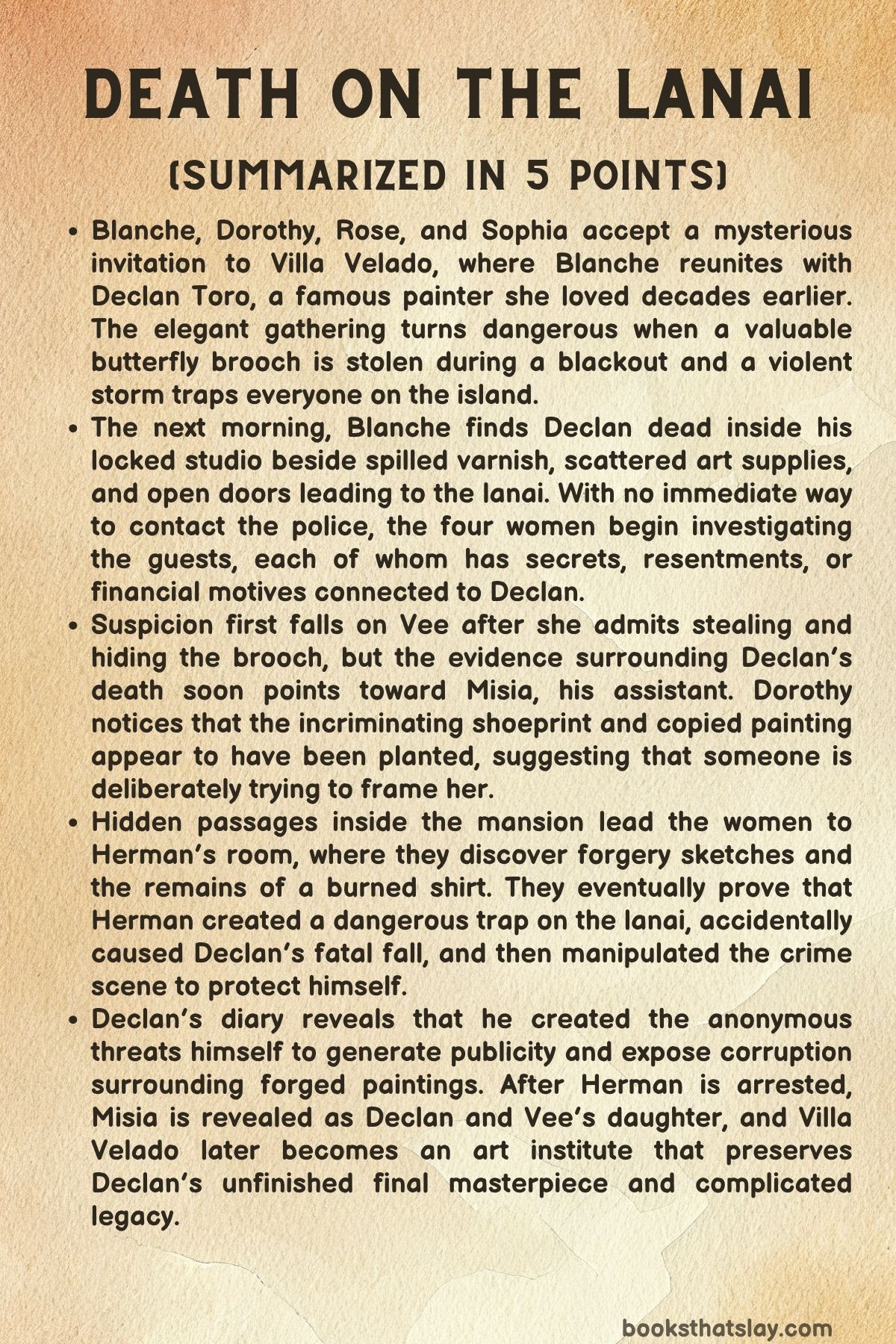
Summary
Blanche Devereaux begins an ordinary morning distressed by the discovery that she has no social engagements for the approaching weekend. Dorothy, Rose, and Sophia initially think she has received terrible news, but they soon realize that Blanche considers an empty calendar a serious personal crisis.
Their conversation is interrupted by the arrival of an unaddressed parcel containing an invitation to a gala at Villa Velado, a private mansion on Isla Sosiega. The invitation is signed only with the initials “ET,” tells the recipient to dress to kill, and instructs her to wear the object enclosed in the package.
Inside an ornate wooden box, the women find a valuable butterfly brooch made from gold and precious stones. Because the invitation does not name its intended recipient, each woman offers a reason she may have been chosen, though Blanche confidently assumes that a rich and romantic admirer has sent it to her.
The four women decide to attend the gathering together. Blanche chooses an elegant champagne-colored dress, helps Sophia into an ivory silk outfit, and ultimately allows Sophia to wear the butterfly brooch because it perfectly complements her clothes.
As they prepare, Blanche reflects on her late husband, George. Her interest in dating is partly an effort to recover the love, security, and desire she once experienced in her marriage, although she rarely allows others to see how much grief remains beneath her confidence.
Dorothy’s former husband, Stan, appears shortly before they leave and asks Dorothy to spend the evening with him. Dorothy refuses, recognizing that returning to him would mean repeating a pattern of disappointment, and chooses the company of her friends instead.
The journey to Isla Sosiega immediately becomes unsettling. The women meet Ralph, a rough-looking but surprisingly refined boatman who rows them across the bay in an old vessel and leaves them at a damaged dock leading toward the isolated Villa Velado.
At the mansion, they are welcomed by a handsome, silver-haired man who first mistakes Sophia for someone named Bianca because she is wearing the brooch. When Blanche steps forward, she recognizes him as Declan Toro, an artist she loved during her youth but has not seen for more than thirty years.
Declan reveals that he is the internationally famous painter known as El Toro. The initials on the invitation refer to his artistic name, and the magnificent brooch was intended for Blanche as a gesture of appreciation for the role she played in his early creative life.
Blanche remembers the period when she left her wealthy Southern family and moved to New York to become an actress. She lived with her friend Maxine, struggled with money and household responsibilities, and found city life far more demanding than she had imagined.
Declan was then a poor art student living in the same building. He first helped Blanche carry a heavy bag of laundry, and their growing relationship brought companionship, romance, and artistic excitement into a difficult period of her life.
The supposed gala is actually an intimate dinner attended by several people connected to Declan’s past and career. Among them are Vee, an installation artist and his former great love; Akiko Kakutani, the gallery owner who helped establish his reputation; Luis Cabrera, a young journalist; and Herman Price, an insurance appraiser associated with Declan’s artwork.
Misia, Declan’s resentful but capable assistant, manages the event, while Ralph serves as caretaker, cook, groundskeeper, and boatman. The guests appear polished, but Declan’s elaborate toasts reveal old rivalries, financial disputes, romantic wounds, and professional resentments.
Declan identifies Blanche as his first muse, Vee as his first true love, Akiko as the woman who discovered him, Luis as the man who will record his return, and Herman as the person responsible for assigning financial value to his art. He announces that he has created a major new work and plans to reveal a secret that will restore his standing in the art world.
As a storm strengthens outside, Blanche tries to establish herself among the influential guests. Herman hints that Declan has received mysterious messages, but thunder interrupts him before he can explain their content.
Declan serves Blanche a piece of “Off-Key” Lime Pie, recreating a dessert she once prepared when proper key limes were unavailable. The gesture proves that he has preserved even the smallest details of their relationship, and Blanche begins imagining that their reunion may hold romantic possibilities.
The atmosphere changes when lightning strikes near the villa and the electricity fails. In the darkness, Sophia is attacked beneath the dining table, and someone tears the butterfly brooch from her dress.
Declan reveals that Queen Elizabeth gave him the brooch and that it possesses immense financial and emotional value. Everyone is searched, but the jewel cannot be found, leaving the guests certain that the thief has hidden it somewhere inside the mansion or on the grounds.
The storm has destroyed the generator shed, cut the telephone line, damaged the boat, and left the group trapped on the island. Declan postpones the unveiling of his painting until morning, while the guests retire knowing that one of them has stolen the brooch.
The next day, Declan leads Blanche and her friends through a concealed passage into a private gallery filled with works inspired by Blanche, whom he knew as Bianca Holloway. Her face appears in paintings and sculptures modeled after famous masterpieces, revealing how deeply she influenced his artistic development.
Declan explains that the brooch was meant as a thank-you rather than a demand that Blanche renew their relationship. He has invited everyone because each guest represents unfinished business, a hidden betrayal, or an unresolved part of his past.
He then locks himself inside his studio and prepares to meet the guests individually. Blanche is chosen for the first meeting, but when she enters the room, she finds Declan lying motionless beside open doors leading onto the lanai.
Paint containers, jars, twine, and other materials are scattered around him, and a large pool of red liquid covers part of the floor. Rose provides a compact mirror, which Blanche holds near Declan’s mouth to test for breathing, but he is dead.
The women consider an accidental fall, natural causes, and murder. Since transportation and communication remain unavailable, they understand that they are trapped with Declan’s body and possibly with the person responsible for his death.
Herman assumes control of the investigation, claiming that his experience with insurance fraud and art authentication qualifies him to examine the scene. Dorothy distrusts his authority, particularly because he quickly begins questioning Blanche and her friends as though they are suspects.
The red liquid does not appear to be blood, and no one can determine the exact cause of death. Herman seals the studio with painter’s tape and declares that the truth must be discovered before the weather clears and anyone leaves the island.
Unwilling to depend on Herman, Blanche stages an elaborate fainting spell while secretly stealing Ralph’s key ring. Dorothy and Sophia use the keys to enter the studio without visibly breaking the seal.
They discover that the red pool smells like a chemical substance, probably varnish. A smear suggests that Declan slipped, while twine mixed among the containers indicates that someone may have constructed a trap on the lanai.
The full cup of cold coffee provides a rough indication of when Declan died. The open lanai doors are also suspicious because Misia previously explained that Declan normally kept them closed to prevent the wind from disturbing his materials.
Dorothy and Sophia also inspect Declan’s enormous unfinished masterpiece. From a distance, it forms a portrait of Declan, but its surface consists of many miniature images representing Blanche, Vee, Akiko, and others who shaped his life.
After escaping discovery, the women organize their investigation around motive, means, and opportunity. They question how anyone could have entered the locked studio, considering the possibility of a copied key, the lanai entrance, or some undiscovered route through the villa.
Fresh footprints later lead the guests to a flowerpot where the stolen butterfly brooch has been buried. The closest prints appear to match Dorothy, Vee, or Ralph, increasing suspicion rather than resolving the theft.
Blanche remembers seeing fresh soil on Vee’s hand during the earlier fainting performance. When confronted, Vee admits stealing the brooch because she believes it rightfully belongs to the woman who supported Declan through the most important years of his life.
Vee considers Blanche no more than a romantic memory from Declan’s youth, while Blanche sees Vee as the person who replaced her. Blanche eventually tells Vee she may keep the brooch, but Herman retains it as evidence belonging to Declan’s estate.
Herman reveals that Declan received anonymous death threats created from letters cut out of newspapers and magazines. Luis also received a warning telling him not to write about Declan or the new painting, suggesting that someone wanted to prevent the artist’s return.
When the group reenters the studio to move Declan’s body away from the open doors, Herman discovers a partial shoeprint in the sticky red substance. The print becomes central evidence because it must have been created while the varnish was still wet.
A search of the guest rooms leads to Misia’s quarters, where Herman finds a stained shoe with a sole resembling the print. Several early El Toro paintings are also hidden beneath her bed, including a copy of a portrait displayed elsewhere in the villa.
Misia insists that the evidence has been planted. Dorothy agrees that the discoveries appear suspiciously convenient, especially when she and Sophia realize that the shoeprint was not present during their secret examination of the studio.
Someone must have produced the print after the first inspection to direct blame toward Misia. There is also no trail of varnish connecting the studio to her room, and the duplicate painting could easily have been placed beneath her bed.
Blanche later discovers a concealed panel inside the women’s bedroom. It opens into narrow corridors containing one-way viewing windows, allowing someone to observe the rooms and travel through the mansion without using the hallways.
The passages provide a possible method for entering bedrooms, planting evidence, stealing documents, and approaching the studio unseen. Since Herman possesses the architectural plans of Villa Velado, Dorothy suspects that he knows far more about the hidden routes than he admits.
The women use the corridors to enter Herman’s room. They find a sketchbook containing detailed studies of El Toro paintings, suggesting that Herman possesses both the artistic ability and technical knowledge needed to create convincing forgeries.
They also discover the burned remains of a shirt in his fireplace. The surviving buttons suggest that Herman destroyed the garment because it had been stained by varnish or another substance connecting him to the studio.
In Declan’s bedroom, the women find the original version of the portrait copied from Misia’s room. They also uncover records suggesting that forged paintings entered the market, that Akiko mishandled sales, and that Vee attempted to profit from private letters written during her relationship with Declan.
The folder containing Declan’s will is empty. Blanche eventually locates his small diary inside a hollowed-out art book, although she initially struggles to read the tiny handwriting because she refuses to admit that she needs reading glasses.
Declan’s diary reveals that he was humiliated by his recent professional failures and deeply concerned about forgeries. He planned his gathering as a dramatic return that would force former associates to confront their dishonesty.
The diary also shows that Misia’s identity was important to him and that his harsh treatment concealed pride in her artistic ability. His behavior toward her had a personal meaning that neither the guests nor Misia fully understood.
The women confront the group and expose the hidden misconduct surrounding Declan. Akiko’s business practices allowed him to be underpaid, Vee tried to sell private letters, and Luis had not revealed the real purpose of his assignment.
Dorothy then accuses Herman of framing Misia. She explains that he used the secret passages, borrowed Misia’s shoe to create the false print, planted the copied painting beneath her bed, and burned his stained shirt.
Herman confesses that he constructed a crude trap on the lanai. He claims that he intended to catch the person sending the threats by tying containers together with twine and positioning them near a cracked jar that leaked slippery varnish.
Declan unexpectedly stepped onto the lanai, encountered the trap, slipped, and died. Herman maintains that his purpose was protection, but his unauthorized and reckless plan directly caused the fatal accident.
Declan’s diary reveals that there was never an outside enemy. Declan created the threatening letters himself to attract publicity, increase interest in his comeback, and pressure the people around him into confessing their betrayals.
Misia purchased early works under false names at Declan’s request, while Luis was secretly investigating the forged paintings and helping Declan prepare a memoir. Declan intended to expose the truth but also hoped to forgive those willing to admit what they had done.
When Dorothy insists that the evidence must be given to the authorities, Herman becomes desperate. He takes the diary, seizes Rose, and threatens her with a fireplace poker while demanding that Misia be blamed.
Rose says the agreed distress word, “mayonnaise,” alerting her friends. Blanche distracts Herman by flattering him and pretending to sympathize, while Rose suddenly makes her body limp and causes him to lose his balance.
During the struggle, Rose pulls off Herman’s false mustache, revealing another part of the identity he invented. Blanche takes the poker, Rose escapes, and Herman runs through the villa carrying Declan’s diary.
At the same time, Sophia disappears. Dorothy fears that her mother has fallen into the water or encountered the large crocodile living near the estate, especially after Sophia’s glasses are discovered beside the damaged dock.
Sophia soon returns in a police boat with Detective Carmen Silva and Officer Pierno. She had discovered that the weather had cleared, reached the shore through the secret passages, attracted a passing Jet Ski, and contacted the authorities on the mainland.
Herman attempts to escape by jumping into the swimming pool, unaware that Ralph’s rehabilitated crocodile, Elizabeth Taylor, is behind him. Blanche strikes him with her shoes, Ralph calls the crocodile away with beef jerky, and the police arrest Herman.
Herman admits that his accent, mustache, and sophisticated identity were inventions designed to help him gain respect in the art world. Akiko and Vee reject his self-pity, pointing out that reinvention does not excuse endangering others or framing an innocent woman.
A final family secret is then revealed. Misia is the daughter of Declan and Vee, born after Declan refused to leave for California with Vee, and she later became his assistant without telling him who she was.
Declan’s diary proves that he recognized Misia immediately and privately admired both her talent and determination. He planned to tell her that he loved her after finishing his masterpiece, while Vee admits taking the will because she wanted to protect Misia, who is probably his heir.
Six months later, Villa Velado has become the Declan Toro Art Institute under Misia’s leadership. Blanche works in community relations, the restored butterfly brooch is displayed proudly, and Declan’s unfinished final self-portrait becomes one of the institute’s most powerful works.
Ralph manages the estate’s natural preserve, Vee creates a memorial installation, and Detective Silva remains connected to the women. Dorothy meets an appealing man named Vincenzo, but she ultimately returns home with Blanche, Rose, and Sophia, recognizing that their friendship provides a deeper source of security than romance or personal achievement.
Characters
Blanche Devereaux
Blanche is the emotional center of Death on the Lanai, and the mystery becomes deeply personal because it reconnects her with a love she left behind more than thirty years earlier. Her glamorous self-presentation, confidence, and constant romantic optimism initially make Declan’s invitation appear to be another flattering adventure.
Beneath that performance, Blanche carries grief connected to George, regret over lost time, and a fear that the strongest love of her life may already be behind her. Declan’s return awakens both youthful hope and painful questions about the choices she made after leaving New York.
The hidden gallery forces Blanche to recognize that she mattered to Declan in ways she never understood. She was not merely a brief girlfriend but the first muse who helped him develop his artistic identity, and that discovery gives her past a permanence she had never imagined.
Her rivalry with Vee reveals Blanche’s insecurity as much as her pride. She wants to believe that Declan’s earliest love was his truest one, but she gradually accepts that Vee shared decades of history, struggle, and artistic growth with him.
Blanche’s theatrical instincts also become practical tools during the investigation. Her false fainting spell, emotional intelligence, flirtation, social confidence, and ability to manipulate Herman’s vanity all help the women gather evidence and protect Rose.
Declan’s death leaves Blanche without the romantic second chance she briefly imagined, yet she refuses to let grief reduce her to helplessness. By supporting the art institute and preserving his legacy, she transforms loss into purposeful work while remaining committed to Dorothy, Rose, and Sophia.
Dorothy Zbornak
Dorothy functions as the group’s principal investigator because she combines skepticism, intelligence, patience, and a strong sense of responsibility. She questions easy conclusions, especially when Herman assumes authority and begins presenting convenient evidence against other guests.
Her refusal to return to Stan at the beginning establishes an important aspect of her development. Dorothy understands that familiarity does not always equal security, and she chooses relationships based on trust rather than nostalgia.
During the investigation, Dorothy studies physical details such as the varnish, coffee, twine, open doors, shoeprint, and absence of a trail leading to Misia’s room. She does not simply collect clues but considers when each clue appeared, who controlled access to it, and how it might have been manipulated.
Dorothy’s greatest strength is her willingness to challenge the structure of the apparent solution. While everyone else accepts the evidence against Misia, Dorothy remembers that the shoeprint was missing during her first inspection and recognizes that the crime scene changed after Herman took control.
Her relationship with Sophia combines irritation, protectiveness, and deep admiration. Dorothy worries constantly about her mother’s safety, but Sophia’s successful trip to the mainland proves that age has not diminished her independence or resourcefulness.
Dorothy also serves as Blanche’s emotional support despite becoming the target of Blanche’s grief and frustration. Their reconciliation inside the secret passages confirms that Dorothy’s loyalty is not weakened by temporary conflict.
By the conclusion, Detective Silva recognizes Dorothy’s investigative ability, and Vincenzo offers the possibility of romance. Dorothy enjoys the attention but chooses to leave with her friends, showing that she no longer measures fulfillment solely through marriage or partnership.
Rose Nylund
Rose appears innocent, literal-minded, and easily distracted, but these qualities repeatedly become sources of insight. Because she does not approach the guests with obvious suspicion, people underestimate her and often reveal more around her than they would around Dorothy or Blanche.
Her stories about St. Olaf can seem unrelated to the investigation, yet one of them provides the important idea that anonymous writing may reveal distinctive habits. Rose’s unusual experiences allow her to make connections that more conventional reasoning might overlook.
She also possesses considerable courage. Rose agrees to observe Herman despite the discomfort created by his romantic interest, steals his wallet, and continues gathering information even when the risks become clear.
Her capture reveals both vulnerability and quick thinking. By using the distress word “mayonnaise,” Rose communicates with her friends without alerting Herman, and her decision to make her body limp helps break his control.
Rose’s kindness shapes her responses throughout the story. She comforts Blanche after Declan’s death, tries to see the best in frightened suspects, and does not immediately treat eccentricity as proof of guilt.
Her emotional intelligence is less polished than Dorothy’s reasoning or Blanche’s social performance, but it is equally valuable. Rose often notices sincerity, fear, and affection that others overlook, helping the group distinguish genuine grief from calculated behavior.
Sophia Petrillo
Sophia brings fearlessness, sarcasm, practical instinct, and a refusal to be dismissed because of her age. Even after being attacked during the blackout, she does not retreat from the investigation or allow the others to treat her as fragile.
Her decision to hide beneath the dining table during the darkness is sensible rather than cowardly. She responds to immediate danger quickly, kicks her attacker, and survives the theft of the brooch without serious injury.
Sophia is particularly effective when assisting Dorothy inside the studio. She watches for danger, helps create the bathtub excuse, and supports Dorothy’s physical examination of the evidence.
Her bluntness frequently cuts through the other characters’ performances. While Blanche dramatizes, Herman lectures, and the guests conceal their motives, Sophia often identifies the practical problem hiding beneath their words.
Sophia also contributes to the group’s understanding of the frame-up. Her observation that more than Misia is being framed helps redirect attention from the apparent suspect toward the person controlling the investigation.
Her disappearance produces one of the book’s greatest moments of anxiety, yet the truth demonstrates her independence. Sophia notices the weather has improved, uses the passages to reach the shore, attracts help, and persuades the authorities to return with her.
Rather than needing rescue, she becomes the person who rescues everyone else. Her success challenges assumptions about age and proves that competence can appear in forms that younger people fail to recognize.
Declan Toro
Declan is both the victim and the architect of the gathering that produces the central crisis. As El Toro, he has achieved international fame, but his private life remains shaped by old loves, professional betrayals, artistic insecurity, and fear that his influence is disappearing.
His relationship with Blanche represents youth, possibility, and the beginning of his artistic identity. The secret gallery shows that he continued carrying her image through decades of work even after their romantic relationship ended.
Vee represents a different stage of his life. She knew him through struggle, success, and emotional conflict, yet Declan’s refusal to leave with her caused a separation that affected both Vee and their daughter.
Declan’s treatment of Misia is one of his greatest failures. Although he recognizes her as his daughter and admires her talent, pride prevents him from speaking honestly before his death.
His plan to send himself death threats reveals how desperation has corrupted his judgment. He wants to create publicity, expose forgeries, force confessions, and stage a dramatic comeback, but his methods manipulate everyone and create the conditions in which Herman’s trap becomes possible.
Declan is neither an innocent saint nor the secret murderer of himself. He is a brilliant but flawed artist who tries to control the meaning of his legacy and dies before completing the personal reconciliations he has postponed.
His unfinished self-portrait becomes a suitable final work because it is composed of the people who made him who he was. The missing portion reflects not only interrupted artistic labor but also the relationships he failed to complete.
Herman Price
Herman is the central antagonist of Death on the Lanai, although he initially presents himself as the calmest and most qualified person in the mansion. His knowledge of insurance, authentication, and criminal manipulation allows him to control the investigation while concealing his own involvement.
He repeatedly withholds information until revealing it will strengthen his authority. The death threats, villa plans, shoeprint, and evidence against Misia all pass through his hands, giving him the opportunity to determine what the group sees and when they see it.
Herman’s greatest crime is not intentional murder but reckless self-importance. He constructs a dangerous trap without Declan’s permission, believing that he alone can protect the artist and capture the supposed enemy.
After Declan dies, Herman refuses to accept responsibility. He creates a false shoeprint, plants a copied painting, uses Misia’s footwear, burns his stained shirt, and attempts to build a complete case against an innocent woman.
His sketchbook shows that his interest in art exceeds professional appraisal. He possesses the knowledge required to reproduce Declan’s work, making him part of the forgery problem he claims to investigate.
The false accent, mustache, and invented background expose his dependence on performance. Herman believes the art world will respect him only if he appears cultured and mysterious, but his reinvention becomes a justification for dishonesty rather than a path toward honest achievement.
His final violence against Rose destroys any remaining claim that his actions were protective. Once his reputation is threatened, he values escape and self-preservation more than human life.
Misia
Misia first appears as Declan’s efficient but resentful assistant, a woman whose competence is taken for granted while her frustration is treated as evidence of disloyalty. Her position makes her vulnerable because she has access to the villa, knowledge of Declan’s habits, and an openly difficult relationship with him.
The evidence planted in her room is effective because it transforms ordinary aspects of her life into signs of guilt. Her shoes, cutout-word vision board, secret purchases, and hidden paintings can all be misinterpreted when removed from their real context.
Misia’s refusal to explain herself immediately makes her appear defensive, but her secrecy protects a painful personal history. She is the daughter of Declan and Vee, and she became Declan’s assistant without openly revealing her identity.
Her relationship with Declan is defined by mutual pride. Misia wants recognition based on her talent rather than family connection, while Declan knows who she is but delays acknowledging her because he intends to reveal his feelings in a dramatic future moment.
The diary proves that Declan admired her ability and cared for her, but this private affection cannot erase the harm caused by his public coldness. Misia needed honesty while he was alive, not praise discovered after his death.
Her eventual leadership of the Declan Toro Art Institute allows her to define his legacy on her own terms. She moves from serving his career in silence to directing an institution that can preserve his work while supporting future artists.
Vee
Vee is proud, wounded, artistically accomplished, and unwilling to accept Blanche’s romantic interpretation of Declan’s past. She sees herself as the woman who lived through his most difficult and productive years, while Blanche represents an idealized memory from his youth.
Her theft of the brooch emerges from emotional resentment rather than financial need. Vee believes the object should belong to the person who supported Declan’s mature life, and taking it becomes an attempt to claim recognition she feels has been denied.
Her anger toward Blanche contains jealousy, but it also reflects years of unresolved abandonment. Vee asked Declan to leave with her for California during a personal crisis, and his refusal ended their relationship at the moment she needed his commitment.
The revelation that Misia is their daughter changes the meaning of Vee’s secrecy. She concealed the pregnancy, raised Misia without Declan, and later removed the will because she feared that Misia’s inheritance or identity might be threatened.
Vee’s attempt to sell private letters complicates her moral position. She may have been motivated by anger, financial concerns, or a desire to reclaim control over her own history, but the act still violates the privacy of their relationship.
Her new memorial installation suggests that grief eventually replaces competition. By contributing her own art to the institute, Vee honors Declan without surrendering her independent identity.
Akiko Kakutani
Akiko is the gallery owner who recognized Declan’s talent and helped transform him from a struggling artist into an international figure. Her importance to his career gives her authority within the group, but it also places her near the financial misconduct surrounding his work.
Declan’s records suggest that her business practices allowed him to be underpaid and may have contributed to the circulation of forged paintings. Whether every action was deliberately fraudulent remains uncertain, but she clearly benefited from an art market that depended on controlling information.
Akiko knew about at least some of the death threats and asked Herman to investigate them. Her decision to rely on him rather than contact the authorities helps Herman establish the role he later exploits.
Her arguments with Vee reveal old resentments involving art, money, access, and Declan’s loyalties. Both women helped shape his life, yet each feels the other received influence or recognition she did not deserve.
Akiko nevertheless refuses Herman’s claim that deception was necessary for social advancement. She understands reinvention and prejudice, but she draws a clear moral distinction between creating a new identity and harming innocent people.
Luis Cabrera
Luis presents himself as a young journalist preparing an article about Declan’s comeback. His notebooks, questions, and habit of recording statements make Dorothy suspicious because he sometimes behaves more like an investigator than a cultural reporter.
He has concealed the true purpose of his work, but his secrecy is not evidence of murder. Declan recruited him to investigate the forged paintings and help produce a memoir that would explain the artist’s career and expose those who profited from deception.
The anonymous warning sent to Luis supports the illusion of an outside enemy. Because Declan himself created the threats, Luis becomes another participant manipulated into believing that the comeback project has attracted real danger.
His unnecessary glasses offer a comic parallel to Herman’s false mustache and accent. Luis wants to appear older, more intelligent, and more serious, revealing how easily professional environments encourage people to construct artificial versions of themselves.
Unlike Herman, Luis’s performance does not become violent. Once the truth emerges, his dishonesty appears immature and insecure rather than malicious.
Ralph
Ralph’s rough appearance initially makes him seem threatening, especially when he arrives in an old rowboat and guides the women toward an isolated mansion. His refined speech and multiple responsibilities quickly complicate that first impression.
As Villa Velado’s caretaker, cook, groundskeeper, boatman, and animal rehabilitator, Ralph possesses extensive access to the estate. That access makes him a natural suspect, particularly after the barefoot print appears similar to his foot.
The search of his room reveals reptiles, amphibians, movie memorabilia, and an eccentric admiration for celebrities. These discoveries make him unusual but also demonstrate how easily harmless private interests can be treated as suspicious.
Ralph’s grief over Declan appears genuine, and his protective relationship with Misia suggests deep loyalty. He defends her when others accuse her and supports her anger over the invasion of Declan’s private spaces.
His care for Elizabeth Taylor, the crocodile, reflects patience and compassion. The animal becomes important during Herman’s capture, but Ralph controls her calmly rather than using her as a weapon.
Detective Carmen Silva
Detective Silva enters near the conclusion but quickly provides the official authority missing throughout the investigation. Sophia brings her to the island after reaching the mainland and reporting the death, threats, and damaged transportation.
Silva listens to an extraordinary story without dismissing the women once the evidence becomes clear. Her pursuit of Herman helps convert the friends’ deductions into an enforceable legal outcome.
Her later presence at the art institute shows that the case creates a continuing relationship rather than a brief official encounter. She respects Dorothy’s investigative ability and treats the women as capable participants rather than troublesome amateurs.
Stan Zbornak
Stan appears briefly before the women leave for the island, but his scene establishes Dorothy’s emotional progress. He offers companionship, compliments her appearance, and tries to reenter her life through familiar charm.
Dorothy’s refusal shows that she no longer confuses nostalgia with change. Stan represents a past pattern in which hope repeatedly led to disappointment, and choosing her friends demonstrates healthier judgment.
George Devereaux
George is absent from the present action because he died before the story begins, yet his memory remains central to Blanche’s emotional life. Her dating habits are partly attempts to recover the intimacy, admiration, and security she experienced in their marriage.
Declan’s return does not erase George’s importance. Instead, it forces Blanche to consider how different forms of love can remain meaningful without replacing one another.
Maxine
Maxine is Blanche’s friend and roommate during her youthful period in New York. Although she appears only through Blanche’s memories, her presence represents the practical support Blanche needed when independence proved more difficult than expected.
Living with Maxine places Blanche outside the protection of her wealthy family and exposes her to financial limits, household responsibilities, and ordinary city struggles. This period prepares the circumstances in which she meets Declan.
Officer Pierno
Officer Pierno accompanies Detective Silva back to Villa Velado and assists in the pursuit and arrest of Herman. His role is primarily practical, helping restore order after the guests have spent the storm isolated from official assistance.
His arrival marks the end of the private investigation and the beginning of legal accountability. Herman can no longer control evidence or determine which version of events the group will accept.
Vincenzo
Vincenzo appears at the art institute six months after Declan’s death and immediately establishes a warm connection with Dorothy. Their shared interests and mutual attraction suggest that Dorothy may still experience romance without returning to old patterns.
His role is less about beginning a complete relationship than demonstrating Dorothy’s openness to possibility. She gives him her number but still leaves with her friends, balancing romantic hope with confidence in the life she already possesses.
Themes
Friendship as the Strongest Form of Security
The central mystery repeatedly separates appearance from genuine reliability, and Death on the Lanai presents the friendship among Blanche, Dorothy, Rose, and Sophia as the most dependable relationship in the story. Romantic partners, artistic collaborators, assistants, gallery owners, and professional advisers all conceal information, but the four women continue choosing one another even when fear and grief create tension.
Their abilities are different rather than interchangeable. Dorothy analyzes evidence, Blanche reads emotions and performs convincing distractions, Rose gains information through kindness and underestimation, and Sophia acts with practical courage when others assume she needs protection.
Their investigation succeeds because no single woman controls it. Each clue becomes useful only after they compare memories, question assumptions, and combine their individual methods.
The friendship also has emotional value beyond solving Declan’s death. Dorothy supports Blanche while she mourns a lost second chance, Blanche protects Rose during the hostage crisis, and the group’s fear over Sophia’s disappearance demonstrates how deeply each woman belongs to the others.
The epilogue reinforces this idea when Dorothy chooses to return with her friends despite meeting Vincenzo. Romance remains possible and meaningful, but it does not replace the stable affection already present in her life.
The final boat ride shows security as something created through repeated loyalty rather than wealth, marriage, fame, or professional success. The women are safest not because danger has disappeared but because they face it together.
Reinvention, Performance, and Authentic Identity
Nearly every major character performs a version of the self designed for a particular audience. Blanche presents confidence and romantic certainty, Luis wears unnecessary glasses to appear serious, and Declan constructs a dramatic comeback intended to control how the art world remembers him.
Herman’s transformation is the most destructive example. He creates a false accent, background, mustache, and sophisticated identity because he believes his ordinary origins will prevent others from respecting him.
The problem is not reinvention itself. Akiko and Vee acknowledge that they also had to redefine themselves while facing social prejudice and limited opportunities, but they reject Herman’s belief that ambition excuses manipulation.
Performance can be useful when it remains connected to moral purpose. Blanche’s fainting spell and flirtation are theatrical, yet she uses them to uncover evidence, protect her friends, and challenge a false accusation.
Performance becomes dangerous when it replaces accountability. Declan’s anonymous threats create an artificial enemy, Herman presents himself as an objective investigator, and the planted evidence constructs a false identity for Misia as a resentful murderer.
The hidden passages extend this concern by turning the villa into a place where people can watch one another without being seen. Identity is constantly shaped by who observes, who controls information, and which version of events gains authority.
The story ultimately favors self-knowledge over perfect authenticity. People may change their appearance or public role, but their choices reveal whether the transformation serves courage, insecurity, generosity, or harm.
Art, Ownership, and the Value of a Legacy
Declan’s work belongs simultaneously to the artist who created it, the people who inspired it, the businesses that sold it, the collectors who purchased it, and the family members who inherit it. This conflict creates emotional, financial, and legal questions that cannot be resolved by market value alone.
The butterfly brooch becomes an early symbol of disputed ownership. Declan intends it as gratitude for Blanche, Vee believes she deserves it because of her years beside him, and Herman treats it as evidence belonging to the estate.
The paintings create even greater uncertainty. Blanche discovers that her youthful image shaped Declan’s early style, while Vee and Misia influenced later parts of his life and work.
Forged paintings threaten more than financial value. They weaken trust in Declan’s artistic identity by making it difficult to distinguish his creative decisions from imitations produced for profit.
The unfinished self-portrait provides a more honest representation of legacy than the polished comeback Declan planned. Its miniature faces acknowledge that no artist creates an identity alone, because every relationship contributes something to the final image.
Misia’s establishment of the art institute changes the purpose of Declan’s estate. Instead of allowing the villa to remain a monument to one famous man, she creates a place that preserves his work while encouraging new artists.
The incomplete section of the final painting is not repaired or disguised. Its absence preserves the truth that Declan’s life ended with unresolved relationships, unfinished apologies, and words of love he waited too long to speak.
Secrets, Delayed Truth, and the Cost of Silence
Every major conflict grows from information that someone chooses not to reveal. Declan hides his knowledge of Misia’s identity, Vee conceals the pregnancy and removes the will, Herman hides the trap, Akiko withholds knowledge of the threats, and Luis disguises the real purpose of his reporting.
Some secrets are intended to protect others. Vee wants to defend Misia’s future, Misia wants her talent judged independently, and the women keep their investigation private because they do not trust Herman.
Other secrets exist to control people. Declan sends threats to create fear and publicity, while Herman plants evidence so that the group will accept his preferred suspect.
The novel repeatedly shows that delayed truth can be almost as damaging as direct dishonesty. Declan may love Misia and admire her work, but keeping those feelings in a diary leaves her to experience his behavior as rejection.
Blanche also carries regret about delaying contact with people she loves. Her memories of missing the chance to see Big Daddy before his death intensify her grief over losing Declan soon after their reunion.
The hidden passages give physical form to secrecy. The villa contains unseen routes through which people can observe private moments, enter locked spaces, and alter events without appearing publicly responsible.
Truth becomes restorative only when it is shared and accepted. The final confrontation exposes forgery, theft, family history, false identities, and professional misconduct, allowing the survivors to rebuild relationships and institutions on a more honest foundation.