Death’s Daughter Summary, Characters and Themes
Death’s Daughter by S. A. Barnes is a supernatural dark-academia novel centered on Jocasta “Jo” Trelane, a university student descended from Death.
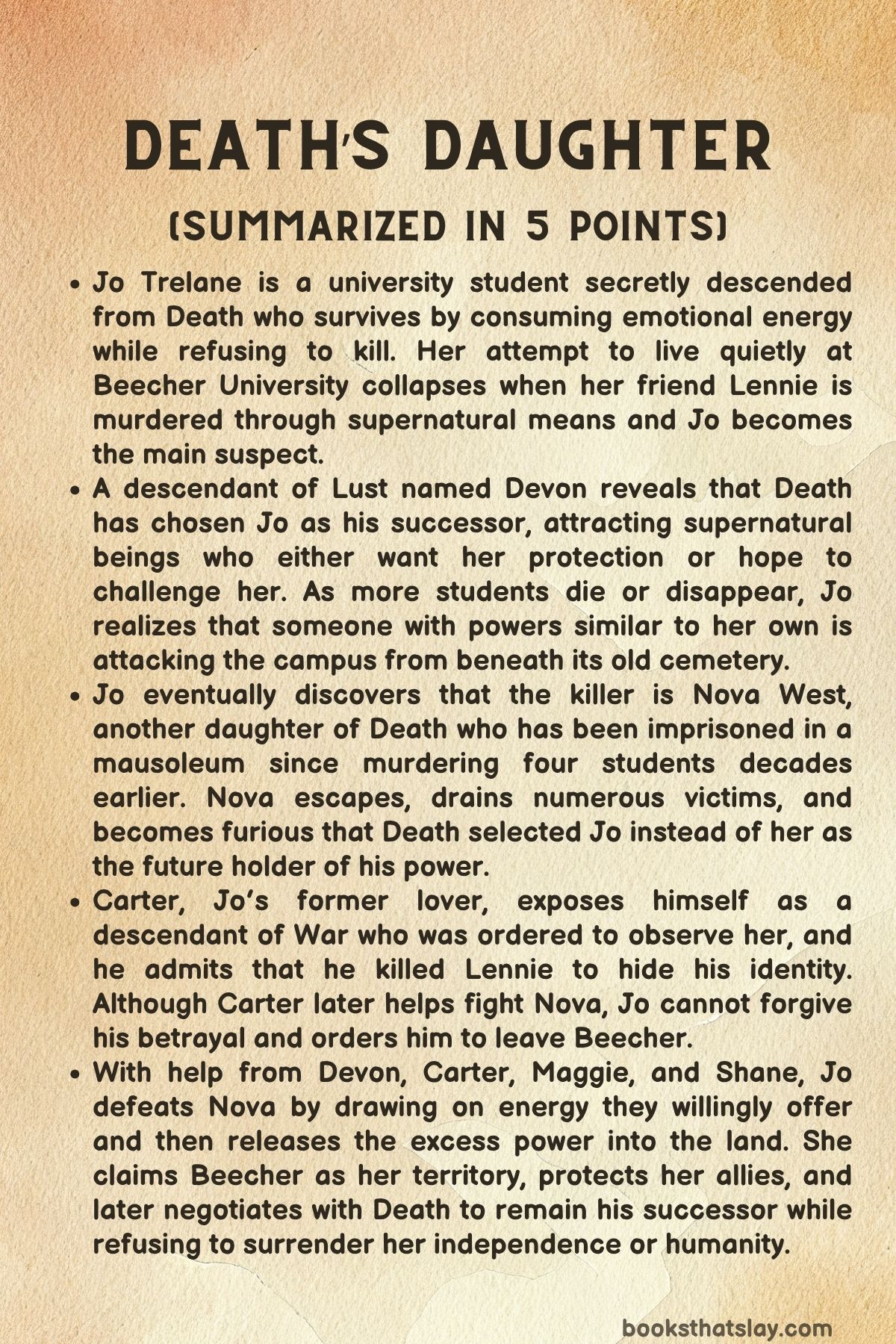
Jo hides her identity while surviving on the emotional energy of others, hoping that discipline and isolation will allow her to live like an ordinary human being. Her carefully controlled existence collapses when Death names her as his successor, attracting dangerous supernatural offspring to her campus. A series of murders forces Jo to investigate her family, confront betrayal, and decide whether power can be used without losing compassion. The book combines murder, romance, family conflict, and questions about moral responsibility. It’s the 1st book of The Children of the Old Ones #1 series.
Summary
Jocasta “Jo” Trelane studies psychology at Beecher University, where she has created a life far removed from her supernatural family. As the daughter of Death, she survives by consuming life energy, but she refuses to kill and instead takes small amounts from sadness, rejection, disappointment, and emotional pain.
Jo chose Beecher because the town appears to be a magical dead zone, allowing her to avoid the descendants of the Old Ones. Her closest friends are Chessa, her practical roommate; Daan, a kind Dutch student; and Lennie, a wealthy young woman whose frequent emotional crises provide Jo with a steady source of energy.
Jo’s fragile sense of normality is further complicated by Carter Lowden, a graduate student with whom she once shared a secret relationship. They met before realizing that Carter would become a teaching assistant in one of Jo’s classes, and their attraction continued despite the professional consequences.
Carter later ended the relationship, yet neither of them has fully moved on. When he unexpectedly appears at Happy’s, the bar where Jo and her friends have gathered, their argument reveals jealousy, unresolved desire, and Carter’s concern that Jo is intentionally extending her education to avoid making decisions about her future.
The evening changes when a charismatic stranger enters the bar and spreads supernatural desire through the room. The stranger, Devon, is a descendant of Lust, and his magic causes nearly everyone around him to become fascinated by him.
Devon immediately recognizes Jo as Death’s daughter and attempts to discuss an important announcement involving the Old Ones. Jo knows nothing about it, and when she accidentally feeds on Devon’s emotional energy, he becomes frightened by the strength she has been hiding.
After Devon leaves, Lennie accuses Jo of taking the men she wants and benefiting from everyone else’s unhappiness. Their argument turns physical when Lennie accidentally strikes Jo with a ring, and the evening ends with anger, humiliation, and several unresolved grievances.
The next morning, Jo awakens feeling unusually powerful and satisfied. She soon discovers Lennie’s mutilated body beneath her residence hall window and realizes that the life energy released by Lennie’s death entered her while she slept.
The physical evidence does not match an ordinary fall, and traces of magic remain around the body. Someone has murdered Lennie through supernatural means, placed her beneath Jo’s window, and possibly arranged the scene to frame Jo.
Detective Ximena Morales questions Jo after learning about the argument at Happy’s and Lennie’s repeated attempts to call her before dying. Jo cannot explain the magical evidence, so she refuses to continue without legal representation and calls Carter, the only person whose number she remembers.
Carter collects her from the police station and immediately believes she is innocent. Their tense drive back to campus exposes their continuing attraction, but it also shows how little they truly know about one another.
When Jo discovers that Chessa is missing from the crowd outside the sealed residence hall, she fears another attack. She eventually finds Chessa and Daan unharmed at the Foreign Language House, although Lennie’s death leaves all of them frightened and grieving.
Because Jo is informally treated as a suspect, she cannot return to her room. Carter offers his apartment, but Jo first searches for Devon at the Nantucket Inn, believing that he may know something about the supernatural conflict.
At the motel, Jo encounters Erik Simmons, a student employee who fears her because she previously used her powers against him. Erik had been helping predatory men exploit teenage girls, and Jo had nearly drained him while forcing him to confront the harm he caused.
Carter initially believes Jo abused someone psychologically unstable, but he apologizes after hearing the truth. Their renewed emotional closeness leads to a kiss, although Carter withdraws after receiving a mysterious message, convincing Jo that he is still hiding important information.
Unable to locate Devon, Jo calls her mother, Dr. Kelly James-Trelane. Her mother cannot contact Death directly, but she explains that a similar supernatural announcement occurred when Jo was born and drew numerous magical visitors to their home.
Jo later finds Devon living among fraternity members whom he has placed under his influence. After she forces him to release them, he finally explains the announcement: Death intends to fade and has named Jo as his successor.
The news terrifies Jo because she has spent her life resisting Death’s values. She remembers her childhood lessons with him, including an incident in which he treated human deaths as demonstrations of power rather than tragedies.
Devon explains that the announcement has made Jo a target. Some supernatural offspring will seek her protection, while others will challenge or kill her to gain status, territory, or favor among the Old Ones.
Jo refuses to accept the position, but Devon warns that rejecting the title cannot erase the announcement. Lennie’s death is likely the first attack in a conflict that will continue wherever Jo goes.
Soon afterward, Jo and Devon witness a student named Izzy walk in a trance through a sorority window and step from an icy roof. Jo attempts to save her by transferring life energy into her body, but an unseen force reverses the connection and begins draining Jo instead.
Devon breaks the link before Jo is killed, although Izzy later dies. The attacker appears capable of sending death magic through the ground without revealing a physical location.
At the Nantucket Inn, Devon tells Jo about Amelia, the first person destroyed by his uncontrolled influence. Amelia became completely dependent on him and died by suicide after he ended their relationship, while Devon’s family celebrated the event as proof of his power.
Devon explains that he was born into Aphrodite’s Family, a cult that breeds descendants of Lust and uses them to control human beings. He wants Jo’s protection because she may be strong enough to free him permanently from the people who created and exploited him.
Other supernatural offspring soon arrive seeking the same protection. Maggie Chen-Wright, a daughter of Sanguine who controls water, and Shane, a teenage descendant of Taranis, tell Jo that her reputation for restraint has made her a possible leader for those who reject cruelty.
Their conversation is interrupted by news of a deadly incident at the Foreign Language House. Several students have died from what authorities describe as carbon monoxide poisoning, while Daan remains alive but critically injured.
At the hospital, Jo and Devon are confronted by JT, a descendant of Fear who feeds on terror. He attempts to dominate them through their deepest fears and declares his intention to defeat Jo and claim Beecher.
Jo transforms her fear into anger and drains decades from JT’s life, leaving him physically elderly. She allows him to live so that he can warn other challengers that Beecher and its people are under her protection.
Although Jo has not formally accepted Death’s title, her treatment of JT becomes an act of leadership. She is beginning to defend territory, create a reputation, and use fear in ways that resemble the Old Ones she despises.
Inside the hospital, Jo reunites with Chessa and Carter before visiting the unconscious Daan. His condition convinces her that hiding the truth has left her friends defenseless, so she gathers Chessa, Carter, and Devon in the hospital chapel.
Jo reveals that she is not fully human, that supernatural beings exist, and that Death has selected her as his replacement. Chessa and Carter initially think she is suffering a breakdown until Jo kills a plant and Devon demonstrates his influence.
The truth devastates Chessa, who realizes Jo has consumed energy from her friends’ emotions. Carter leaves without speaking, while Chessa accuses Jo of viewing human beings as sources of food rather than equals.
Jo and Devon return to a campus being evacuated after sinkholes, earthquakes, disappearances, and unexplained deaths. Most of the destruction surrounds an old cemetery, where the power beneath the ground prevents Jo from claiming Beecher as her territory.
They discover translucent human husks from which every trace of life has been removed. One belongs to Jack, a missing fraternity student, proving that the attacker is draining victims far beyond what Jo previously believed possible.
Carter follows Jo into the cemetery and insists on helping. Working with Devon and Chessa, they research the university’s history and discover that unusual suicides and deaths increased after five female students disappeared in 1977.
Four of the women were found dead, but the fifth, Nova West, was never recovered. An old mausoleum dedicated to the missing women appears to be the center of the supernatural disturbance.
Before investigating it, Jo and Carter finally confront their romantic conflict. Carter confesses that he loves Jo, and they share a moment of intimacy that temporarily gives both of them the closeness they have repeatedly denied themselves.
That emotional reconciliation does not resolve the dangers surrounding them. Chessa also discovers reports of a man Jo killed as a teenager, forcing Jo to explain that she acted in self-defense against a supernatural attacker.
Jo, Devon, Carter, and Chessa enter the cemetery after dark and open the mausoleum. Inside, they find a young woman dressed in clothing from the 1970s who claims that Death imprisoned her and intends to kill her.
Jo notices inconsistencies in the woman’s story and realizes that she is Nova West. Nova has survived within the mausoleum for decades by sleeping and whispering destructive suggestions to emotionally vulnerable people who pass nearby.
Nova reveals that she murdered the other four missing students during a ritual intended to gather enough magical power to challenge Death. Death responded by imprisoning her, but she learned to extend her abilities through the ground.
Lennie’s death released enough life energy to awaken Nova fully. The deaths, sinkholes, husks, and apparent suicides all carry Death’s magical signature because Nova is also one of his daughters.
Nova is enraged when she learns that Death selected Jo rather than her as his successor. She drains Jo and Devon, uses their energy to escape the barrier, and prepares to kill them.
Carter then reveals supernatural powers of his own and tears open Nova’s body through violence. He is a descendant of War who was sent to Beecher to watch Jo on War’s behalf.
Chessa uses pepper spray to disrupt Nova, allowing the group to escape, but Detective Morales finds them outside the mausoleum. Chessa deliberately gets herself detained so Jo and Devon can leave and continue pursuing Nova.
Carter confesses that he learned Jo’s identity after she entered his class and secretly reported information about her to War. He also reveals that Lennie saw him feeding during a violent fight and threatened to tell Jo what he was.
Fearing exposure, Carter followed Lennie to Branwick Hall and killed her when she refused to remain silent. He insists that he has now chosen Jo over War, but Jo cannot forgive his murder or betrayal.
Jo orders Carter to leave Beecher and warns that she will kill him if he returns. Her decision ends their relationship despite her love for him and leaves her grieving both Lennie and the future she imagined with Carter.
Nova soon abducts Chessa and takes control of the hospital where Daan is being treated. Jo recognizes that she cannot defeat her sister alone and tells Devon to recruit Carter, Maggie, Shane, and every available ally.
Inside the hospital, Nova uses newborns, patients, and Chessa as leverage. Jo keeps her talking long enough for the others to arrive, then begins a coordinated attack.
Devon distracts Nova through desire, Carter uses the power of violence, Maggie removes moisture from Nova’s body, and Shane attacks her with lightning. Jo accepts willingly offered energy from all four and uses their combined strength to drain Nova.
Nova rapidly ages, disintegrates, and leaves behind only empty clothing. Jo releases the excess power into the ground, restores her allies, revives Daan, and claims Beecher as a territory extending toward the ocean.
The act also binds Devon, Carter, Maggie, and Shane to Jo through magic. Although the authorities arrest them, Devon’s influence and the absence of ordinary explanations eventually secure their release.
Chessa chooses to remain Jo’s roommate, though their friendship can no longer return to its earlier innocence. Daan awakens without memories of the supernatural attack, and Jo allows him to believe a simplified account.
Jo visits Lennie’s memorial and replaces a formal portrait with an image that reflects Lennie’s lively personality. She still misses Carter, but she knows that loving him cannot erase what he did.
Death finally arrives at Beecher and reveals that the succession announcement was partly a test. He and War made a wager over whether Jo would accept her nature, with Carter serving as War’s agent.
Death praises Jo for defeating Nova, gathering allies, and claiming territory, while dismissing the human deaths as unimportant. He orders Jo to leave Beecher and begin training under him.
Jo refuses and recognizes that Death cannot easily replace her without admitting that he misjudged two daughters. She negotiates an agreement in which she remains his successor in name while he leaves Beecher, her allies, and her loved ones alone.
Death accepts because he sees Jo’s strategic defiance as proof that she truly belongs to him. Jo understands that the conflict with the Old Ones is not over, but she decides to learn their rules, defend her territory, and use her power without surrendering her concern for human life.
Characters
Jocasta “Jo” Trelane
Jo is the central character of Death’s Daughter, and nearly every conflict grows from the tension between her supernatural inheritance and her determination to live ethically. She possesses the ability to consume life energy, yet she creates strict rules that allow her to survive without deliberately killing human beings.
Her restraint does not mean that she is harmless. Jo can manipulate suffering, drain years from a person’s life, kill living things instantly, and eventually channel enough power to destroy Nova and claim an enormous territory.
Jo’s greatest strength is her refusal to accept that birth determines morality. Death treats human beings as temporary objects, but Jo forms sincere friendships, values individual lives, and experiences guilt whenever her survival harms someone else.
Her relationship with feeding remains morally complicated because she secretly benefits from her friends’ distress. Although she usually takes only small quantities, Chessa’s anger reveals that Jo has never fully confronted the violation involved in consuming emotional energy without consent.
Jo’s desire to appear ordinary also creates danger. By hiding the truth, she prevents Chessa, Daan, and Lennie from recognizing supernatural threats, and she eventually accepts that secrecy can become another form of selfishness.
Her development is defined by the movement from avoidance to responsibility. At first, she believes refusing power will protect her humanity, but Nova’s violence shows that unused authority can leave innocent people vulnerable to those who have no moral limits.
Jo does not become compassionate because she is weak; she proves that compassion can guide strength. Her victory comes when she accepts help, takes energy freely offered by allies, defeats her sister, and returns the power rather than keeping it for herself.
Her final confrontation with Death demonstrates her strategic growth. Instead of obeying him or attacking recklessly, she identifies his pride, understands the wager, and negotiates from a position of psychological advantage.
Devon
Devon is a descendant of Lust whose beauty and supernatural influence make people desire, admire, and obey him. His abilities initially present him as dangerous, especially when he controls the patrons at Happy’s and later surrounds himself with enchanted fraternity members.
Beneath his confident behavior, Devon is frightened, lonely, and desperate for protection. He was created through a cult’s breeding program and raised in an environment where domination was treated as success.
The death of Amelia forms the center of his guilt. His uncontrolled power made her emotionally dependent on him, and when he tried to leave, she lost the will to continue living.
Devon’s family celebrated Amelia’s destruction, teaching him that power mattered more than responsibility. His rejection of that lesson explains why he studies Jo so carefully before asking for an alliance.
He wants evidence that Jo’s mercy is genuine because choosing the wrong protector could return him to another form of captivity. His willingness to release people from his influence when confronted shows that, unlike many supernatural offspring, he recognizes consent as morally important.
Devon becomes Jo’s most informed ally and the person with whom she can discuss hunger, guilt, territory, and supernatural politics without hiding. He understands her fear of becoming like Death because he shares the fear of becoming like his own family.
His attraction to Jo is real, but he generally avoids using his power to obtain affection from her. When he calms her panic with magic, he does so openly and carefully, reflecting his effort to use an inherently manipulative ability with restraint.
Devon also challenges Jo’s belief that refusing leadership is automatically ethical. He helps her see that power can shelter vulnerable people, including supernatural beings who want to escape abusive families and territorial conflicts.
Carter Lowden
Carter is one of the novel’s most emotionally complicated characters because he is simultaneously Jo’s lover, protector, observer, betrayer, and enemy. His identity as a descendant of War explains his physical confidence, attraction to conflict, intense self-control, and ability to draw strength from violence.
His relationship with Jo begins before either understands the academic complication created by his position as her teaching assistant. Their repeated separations and reunions reflect genuine desire, but they also reveal how both use secrecy to avoid confronting emotional commitment.
Carter truly loves Jo, and many of his protective actions are sincere. He collects her from the police station, cares for her injuries, remains with Chessa at the hospital, follows Jo into danger, and ultimately turns against War.
His love, however, does not erase the fact that he entered Jo’s life under false pretenses. Once he discovered her identity, he continued reporting information to War while allowing Jo to believe he was an ordinary human being.
Carter’s murder of Lennie exposes the moral limit of his redemption. He kills her to protect his secret and later describes the act as quick, revealing how easily his War inheritance allows him to treat lethal violence as a practical solution.
His confession proves that he is capable of honesty, but it comes only after Nova forces his supernatural identity into the open. Jo’s decision to exile him recognizes that remorse cannot restore Lennie or undo the deliberate choices that caused her death.
Carter’s participation in the final battle shows that he is willing to risk punishment from War for Jo. His future remains morally uncertain because he has chosen Jo over his father, yet he has not fully separated love from possession, secrecy, or violence.
Chessa
Chessa is Jo’s roommate and one of the strongest representatives of ordinary human judgment. She is practical, observant, loyal, and willing to challenge Jo rather than offering automatic forgiveness.
Before learning the truth, Chessa treats Jo’s strange habits as personal eccentricities. After the revelation, she immediately understands the ethical implications of Jo feeding on her friends’ emotions and refuses to accept Jo’s intentions as a complete excuse.
Her anger is important because it prevents the story from treating Jo’s restraint as perfect morality. Chessa forces Jo to recognize that taking small amounts without permission still turns friendship into an unequal relationship.
Despite her fear, Chessa refuses to abandon Daan or the investigation. She researches Jo’s past, studies Beecher’s history, identifies the 1977 disappearances, and enters the cemetery even though she has no supernatural protection.
Her use of pepper spray against Nova is both practical and courageous. Chessa cannot overpower an offspring of Death, but she uses the tool available to her and creates an opportunity for the others to escape.
She also allows herself to be detained by Detective Morales so Jo and Devon can continue their pursuit. This decision shows that her loyalty survives even while trust remains damaged.
By the end, Chessa chooses knowledge over comforting ignorance. She does not fully forgive Jo or pretend that their friendship is unchanged, but she stays because informed caution offers greater safety than separation.
Lennie
Lennie is emotionally volatile, wealthy, insecure, and deeply dependent on the attention of others. Her constant romantic disappointments and personal crises make her an easy source of emotional energy for Jo.
Her friendship with Jo contains real affection, but it is weakened by jealousy and resentment. Lennie believes Jo attracts people effortlessly and fails to understand why Jo repeatedly withdraws from the attention she receives.
Devon’s influence intensifies Lennie’s insecurity at Happy’s. Once his magic disappears, she directs her humiliation toward Jo and accuses her of taking every man she wants.
Lennie’s claim that Jo thrives on other people’s misery comes dangerously close to the truth. The accusation remains with Jo because it exposes the hidden imbalance inside their friendship.
Her murder begins the central investigation and transforms the succession announcement into a personal crisis. Carter kills her not because she is powerless or irrelevant, but because she witnesses his true nature and refuses to remain silent.
Lennie’s repeated calls suggest that she wanted to speak with Jo after their argument, possibly to apologize or warn her. That lost opportunity adds guilt to Jo’s grief and prevents their conflict from receiving a peaceful resolution.
The memorial photograph chosen by Jo restores Lennie’s individuality. Rather than allowing her to be remembered only as a victim, Jo selects an image of her laughing and alive.
Daan
Daan is affectionate, gentle, and emotionally generous. He often acts as a calming presence within the friendship group and tries to care for Lennie after the argument at Happy’s.
His guilt over leaving Lennie alone shows his tendency to assume responsibility for events beyond his control. He believes that remaining with her might have prevented her death, even though Carter’s supernatural nature would have made ordinary intervention extremely dangerous.
Daan’s injuries at the Foreign Language House make the cost of Jo’s secrecy impossible to ignore. His unconscious body becomes evidence that the people around Jo are involved in the conflict whether or not they understand it.
Jo’s apology beside his hospital bed marks a turning point in her thinking. She realizes that pretending to be fully human has protected her comfort more than it has protected her friends.
Daan’s revival after Jo releases energy into Beecher reflects the constructive potential of her abilities. The same power that drains life can also restore it when Jo acts through generosity rather than hunger.
His lack of memory at the end allows him to return temporarily to ordinary life. However, the decision to conceal the truth from him raises continuing questions about whether protection justifies withholding knowledge.
Death, also known as Mors
Death is Jo’s father, an ancient Old One who views mortality as a system rather than a human tragedy. In Death’s Daughter, he functions as both a family figure and the embodiment of inherited power without empathy.
During Jo’s childhood, he teaches her to feed by turning human deaths into demonstrations. His praise when she drains life shows that he values ability, control, and dominance rather than compassion.
Death’s absence shapes Jo as much as his presence. He provides a supposedly safe home, influences the course of her childhood, and then disappears without giving her a way to contact him.
Naming Jo as his successor appears at first to be an honor, but it is also an act of manipulation. He understands that the announcement will attract challengers and force her to confront the supernatural world she has avoided.
His willingness to involve War in a wager reveals his emotional distance. The deaths of Lennie, Izzy, Jack, Emile, and many hospital patients mean little to him compared with proving that his daughter can survive.
Death does not want Jo to remain compassionate; he wants her to demonstrate cunning, territorial authority, and strategic aggression. Ironically, Jo satisfies him by refusing his command and manipulating his concern about losing face.
His acceptance of her conditions is temporary rather than benevolent. He remains interested because Jo has finally become a player capable of challenging him rather than a child who simply hides.
Nova West
Nova is Jo’s older half-sister and a distorted reflection of what Jo might become without moral restraint. Like Jo, she possesses Death’s ability to consume life, but she treats human beings as material for ambition.
Nova begins as a Beecher student in the 1970s and becomes obsessed with awakening magical forces connected to the land. She murders four fellow students in a ritual designed to give her enough power to challenge Death.
Her imprisonment in the mausoleum does not lead to remorse. Instead, decades of isolation deepen her rage, entitlement, and belief that Death unfairly denied her recognition.
Nova survives by whispering destructive suggestions to vulnerable people. This method reveals her patience and cruelty because she turns existing sadness into suicide, fear, and death without exposing herself.
When Lennie’s released energy awakens her, Nova begins draining people through the earth. Her ability to reduce victims to empty husks shows that she consumes without limits or concern for what remains.
Nova’s anger at Jo is rooted in more than sibling rivalry. Jo receives the succession she believes belongs to the stronger and more ambitious daughter, challenging Nova’s belief that power alone determines worth.
She cannot understand why Death would select someone who refuses to kill freely. That failure prevents her from recognizing Jo’s greatest advantage: the ability to earn genuine loyalty rather than dependence based on fear.
Nova’s defeat occurs when Jo accepts freely offered energy from multiple allies. The contrast demonstrates that domination may produce immediate obedience, but trust produces cooperation strong enough to overcome isolated power.
Dr. Kelly James-Trelane
Jo’s mother is an intelligent human woman whose relationship with Death left her frightened, displaced, and responsible for raising a supernatural child. Her career and controlled manner suggest that she built stability as a defense against forces she could never fully understand.
She loves Jo, but fear affects the way she expresses that love. The circumstances of Jo’s birth and childhood created an emotional distance that Jo interprets as resentment.
Dr. James-Trelane understands that the Old Ones operate through manipulation. Her warning that refusing to play merely makes a person part of someone else’s game accurately predicts Jo’s situation.
She cannot give Jo a direct solution because Death never treated her as an equal partner. The fact that he appeared whenever he wished and never provided contact information reflects the imbalance within their relationship.
Her revelation that Death arranged their suburban home changes Jo’s view of her childhood. Even the place she considered separate from him existed under his influence.
Although her role is limited, she provides important historical context. Through her, Jo learns that supernatural attention surrounded her from birth and that Death’s succession plan may have been developing for years.
Detective Ximena Morales
Detective Morales is persistent, skeptical, and ambitious. From the evidence available to her, Jo is connected to Lennie’s death, Izzy’s fall, the cemetery disturbance, and several other impossible events.
Her suspicion is therefore reasonable even when it places Jo in danger. Morales does not know that magic exists, so every supernatural explanation sounds like evasion or psychological instability.
She repeatedly searches for material explanations involving violence, access, motive, and opportunity. Her determination contrasts with the university’s willingness to describe deaths as accidents, gas leaks, or earthquakes.
Morales also demonstrates practical compassion at the hospital. Once the scale of the disaster becomes undeniable, she directs Jo toward Chessa rather than wasting time pretending she fully understands the situation.
Her gradual recognition that Jo knows more than the authorities reflects the breakdown of ordinary institutions when confronted by supernatural power. She remains committed to protecting people even when the evidence no longer follows familiar rules.
Morales represents the human demand for accountability. Her presence reminds Jo and her allies that supernatural motives do not erase the consequences of bodies, injuries, missing students, and frightened families.
Maggie Chen-Wright
Maggie is a television meteorologist and a daughter of Sanguine who can control water. Her professional public identity contrasts with the hidden supernatural inheritance that shapes her private life.
She approaches Jo cautiously because alliances among supernatural offspring are often coercive. Maggie wants evidence that Jo will protect weaker descendants rather than forcing them into service.
Seeing Jo risk her own life for Izzy convinces Maggie that Jo’s reputation for mercy has substance. Her decision to kneel before Jo reflects both fear and hope.
Maggie’s experience and maturity make her an important ally. She understands territorial politics and recognizes that Jo’s reluctance to lead may leave compassionate supernatural beings exposed to more violent powers.
During the battle with Nova, Maggie attacks by drawing moisture from her body. The action shows both the severity of her abilities and her willingness to use them when innocent people face immediate danger.
Her freely offered energy helps Jo win, distinguishing their alliance from arrangements based on magical compulsion. Maggie follows Jo because she believes in the kind of protection Jo might provide.
Shane
Shane is a teenage descendant of Taranis whose abilities are still developing. His youth makes the supernatural competition especially threatening because older and stronger beings could easily recruit, control, or kill him.
He follows Maggie and looks to her for guidance. Their request for Jo’s protection suggests that supernatural children often depend on informal alliances rather than reliable family care.
Shane’s presence broadens Jo’s understanding of leadership. Rejecting the succession would not merely preserve her personal freedom; it could abandon young descendants like Shane to violent factions.
His lightning becomes essential during the attack on Nova. Although inexperienced, he participates directly and trusts Jo enough to offer his energy.
Shane represents the future Jo may be able to protect. His survival gives practical meaning to her decision to accept responsibility without copying the cruelty of the Old Ones.
JT
JT is an offspring of Fear who openly enjoys consuming terror in hospitals and cancer centers. He represents the most predatory form of supernatural feeding because he chooses locations where people are already frightened and vulnerable.
His confidence depends on making others experience their deepest fears. He initially dominates Jo and Devon by turning private anxieties into overwhelming sensations.
Jo defeats him by converting fear into anger. This response breaks his control and shows that emotional power is not absolute when the victim understands its source.
The punishment Jo gives him is severe. By draining decades from his life, she deliberately creates a living warning for future challengers.
JT’s survival becomes politically useful because he spreads Jo’s reputation. His defeat marks the point at which Jo begins using the methods of territorial authority, even though she remains uncomfortable with the role.
Erik Simmons
Erik is a motel employee who helped predatory men exploit teenage girls. He rented rooms to minors and informed older men when vulnerable girls were present.
Jo previously punished him by making him feel his life draining away. His terror when she returns demonstrates how close she came to killing him.
Erik complicates the question of Jo’s restraint because her violence against him arises from moral outrage. She does not attack an innocent person, but she still acts as judge and executioner without legal authority.
Carter’s initial defense of Erik also reveals the danger of incomplete information. Once Jo explains what Erik did, Carter recognizes why she considered ordinary consequences inadequate.
Erik’s presence shows that human cruelty exists alongside supernatural violence. The Old Ones are not the only beings capable of exploiting weakness, and Jo’s abilities tempt her to impose immediate punishment when human systems fail.
Izzy
Izzy becomes one of Nova’s victims when she is compelled to walk through an upper-story window and step from an icy roof. Her lack of self-preservation makes it clear that the apparent suicide is magically induced.
Jo’s attempt to save her is important because it is the first time she deliberately tries to transfer life rather than consume it. The effort reveals that Jo instinctively wants her abilities to become a source of restoration.
Nova uses Izzy as a connection through which to drain Jo. This reversal forces Jo to experience the helplessness and terror felt by those she feeds upon.
Izzy’s eventual death deepens Jo’s guilt even though she did everything she could. Her fate demonstrates that compassion alone cannot defeat a hidden enemy without knowledge, allies, and sufficient strength.
Jack, Emile, Aadesh, and the Beecher Students
Jack is the fraternity member whose disappearance leads Jo and Devon to one of the emptied husks near the cemetery. His death provides undeniable proof that Nova is removing every trace of life from her victims.
Emile survives the first attack at the Foreign Language House but later dies. His decline emphasizes that escaping the immediate scene does not guarantee recovery after supernatural feeding.
Aadesh searches for Jack and reflects the human confusion surrounding the disappearances. Jo sends him away rather than revealing the horrifying condition of Jack’s remains.
The wider student population experiences the conflict through evacuations, rumors, missing friends, collapsing roads, and official explanations that fail to match reality. Their vulnerability gives Jo’s territorial claim its moral purpose.
The students are not simply background victims. Their deaths and fear force Jo to decide whether Beecher is merely a hiding place or a community she is responsible for defending.
Themes
Inherited Identity and Moral Choice
Jo’s conflict begins with a power she did not request and a family identity she cannot erase. Death’s Daughter repeatedly separates inheritance from destiny by showing that Jo may possess Death’s abilities without accepting his beliefs about human worth.
Death assumes that feeding, killing, territorial control, and strategic cruelty are natural expressions of what Jo is. Nova accepts that reasoning completely and builds her identity around proving that she is the strongest and most deserving child.
Jo’s resistance takes a different form. She limits her feeding, values friendship, feels guilt, and attempts to use life energy to save Izzy rather than consume her.
Her restraint is imperfect because she still feeds secretly on emotional pain. The novel therefore avoids presenting morality as a simple rejection of violence and instead treats it as an ongoing examination of motives, methods, consent, and consequences.
Carter and Devon face similar conflicts with inheritance. Carter can choose loyalty over War but cannot undo Lennie’s murder, while Devon can reject his family’s cult even though his powers still influence desire.
The story argues that ancestry creates pressures and capacities rather than complete moral definitions. Jo becomes most fully herself when she accepts what she can do while refusing to let Death decide why or for whom she will do it.
Power, Responsibility, and Leadership
Jo initially believes that refusing authority will protect her from corruption. She wants to remain a student, avoid supernatural politics, and deny Death the satisfaction of seeing her act like an Old One.
Events at Beecher reveal that withdrawal does not eliminate power. Her reputation, abilities, and family connection affect others even when she refuses to acknowledge them.
Devon, Maggie, and Shane seek her protection because neutrality offers them no safety. Without a leader capable of resisting violent families, they will remain vulnerable to forced alliances, territorial aggression, and exploitation.
Nova represents power without responsibility. She treats every human death as a usable source of energy and views strength as proof of entitlement.
Jo slowly realizes that leadership can be defined by the protection it provides rather than the obedience it demands. Her victory becomes possible only when she accepts energy offered voluntarily and uses it for a shared purpose.
Releasing the excess power afterward is equally important. Jo does not keep everything she has taken, and the energy restores Daan and strengthens the land rather than serving only her ambition.
Her territorial claim is therefore both political and ethical. She accepts that Beecher belongs under her protection, but she refuses to treat its inhabitants as possessions.
Consent, Hunger, and Exploitation
Supernatural feeding creates a continuing examination of consent. Jo survives by drawing energy from emotional pain, Devon feeds through desire, Carter gains strength from violence, JT consumes fear, and Nova drains life directly.
Each ability can turn another person’s emotional state into nourishment. The moral difference between the characters depends largely on whether they recognize the humanity of the person being used.
Jo considers herself restrained because she takes only small amounts and avoids killing. Chessa’s reaction exposes the weakness in this defense because Jo never told her friends that their suffering was sustaining her.
Devon’s history with Amelia provides another example. Even though his power was initially uncontrolled, Amelia’s dependence destroyed her autonomy and reduced every part of her life to a need for him.
Devon’s later behavior shows an effort to create limits. He releases people when Jo confronts him, warns her when he uses magic to interrupt her panic, and avoids forcing affection from her.
Nova and JT reject all limits. They select vulnerable people precisely because fear, grief, illness, or despair makes those people easier to consume.
The alliance against Nova offers an alternative model. Jo’s companions willingly give her their energy, transforming feeding from exploitation into cooperation based on trust and shared risk.
Secrecy, Trust, and Betrayal
Jo believes secrecy is necessary because humans cannot safely understand her nature. For years, hiding protects her from exposure, but it also prevents her friends from recognizing danger and making informed choices.
Chessa’s sense of betrayal comes from more than fear of magic. She realizes that Jo has consumed her emotions while presenting their relationship as equal and ordinary.
Carter’s deception is even more destructive because it combines surveillance, romance, and murder. He allows Jo to become emotionally vulnerable while secretly reporting to War.
His love may be genuine, but sincerity in one part of a relationship cannot cancel calculated dishonesty in another. Jo’s decision to exile him acknowledges that trust requires more than strong feelings.
Devon earns trust differently. He begins as a suspicious figure, yet he gradually reveals his history, motives, guilt, and needs without waiting for exposure to force the truth from him.
Jo’s eventual confession in the hospital chapel produces immediate pain, but it also ends the illusion that ignorance can protect Chessa and Carter. Honest knowledge gives Chessa the ability to choose whether she will remain involved.
Trust is not fully restored by the conclusion. Chessa stays but remains cautious, Daan receives only a partial explanation, and Carter remains connected to Jo through magic despite his exile.
The story presents trust as something damaged permanently by deception yet still capable of being rebuilt through accountability, consent, and difficult choices.