Delilah Green Doesn’t Care Summary, Characters and Themes
Delilah Green Doesn’t Care by Ashley Herring Blake is a witty, heartfelt romance that centers on the complicated dynamics between family, love, and personal growth. Delilah Green, a photographer, returns to her hometown for her estranged stepsister Astrid’s wedding, reluctantly agreeing to photograph the event despite their tumultuous relationship.
Amidst the wedding preparations, she crosses paths with Claire, Astrid’s best friend, and their chemistry is undeniable. What follows is a heartfelt exploration of family ties, unspoken emotions, and the possibility of new beginnings, as Delilah and Claire navigate the challenges of a blossoming connection while confronting their pasts.
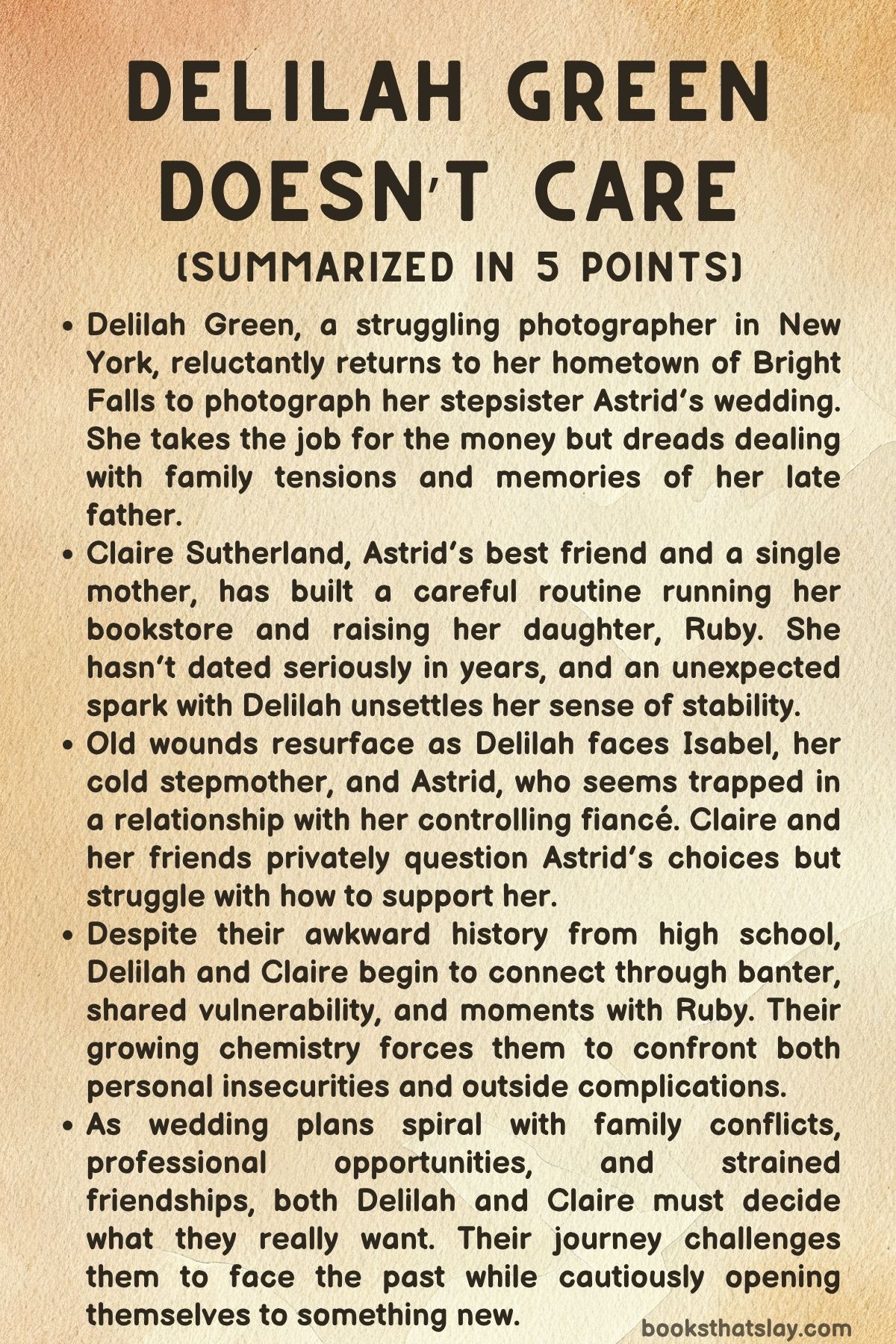
Summary
Delilah Green, a queer photographer living a commitment-free life in New York City, is jolted awake in a stranger’s bed after a casual hookup by persistent calls from her estranged stepsister, Astrid Parker.
Astrid guilt-trips Delilah into returning home to photograph her upcoming wedding, sweetening the deal with a substantial five-figure check. Still grieving her father’s death years earlier and harboring deep resentment toward her cold stepmother Isabel and the town that made her feel like an outsider, Delilah reluctantly agrees. She plans to do the job, collect the money, and leave as quickly as possible.
Upon arriving in Bright Falls, Delilah heads straight to the local bar. There, she catches the eye of Claire Sutherland, Astrid’s best friend and a single mother who runs the town bookstore. Claire, feeling stuck in her routine and recently dealing with the return of her ex-husband Josh (Ruby’s father), has been encouraged by her outspoken friend Iris to flirt and reclaim some excitement.
Tipsy and unaware of the stranger’s identity, Claire approaches the tattooed, curly-haired woman with confidence and asks for her number. Delilah immediately recognizes Claire from their high school days—when Claire and her friends were part of the popular crowd that made Delilah feel invisible and awkward after her father’s death—but she plays along, flirting heavily and enjoying the spark.
Delilah sees this as both genuine attraction (she’s had a quiet crush on Claire since their teens) and a chance for petty revenge against Astrid’s circle.
The flirtation turns electric until Astrid arrives and reveals Delilah’s identity, mortifying Claire. Delilah, undeterred, decides to pursue Claire anyway, partly out of desire and partly to prove she can “win” in this environment where she once felt powerless.
Wedding preparations force the group together. Delilah photographs events while clashing with Isabel’s perfectionism and Astrid’s tightly wound control. At a lavish brunch hosted by Isabel, Delilah feels suffocated by the family dynamics and accidentally (or semi-intentionally) knocks over a towering champagne flute display, causing chaos and allowing her a dramatic exit.
That evening, she visits Claire’s bookstore, where their conversation shifts from awkward tension to charged banter. The chemistry is undeniable, and Claire begins to see past Delilah’s sarcastic, guarded exterior to the loneliness beneath.
As pre-wedding events unfold—dinners, fittings, and group activities—Claire grapples with her attraction to Delilah while managing co-parenting with Josh, who has returned wanting more involvement with Ruby (their spirited eleven-year-old daughter).
Delilah bonds unexpectedly with Ruby, connecting over photography and playfulness, which softens Claire’s reservations.
Meanwhile, Claire and Iris grow increasingly concerned about Astrid’s fiancé, Spencer: a condescending, controlling man who belittles Astrid’s life in Bright Falls and expects her to mold herself to his vision. The friends hatch “Operation Shit Boot” (Iris’s colorful name for the plan) to open Astrid’s eyes, and Delilah reluctantly joins the scheming, earning Iris’s grudging respect.
The romance between Delilah and Claire intensifies through stolen moments, flirtatious texts, and eventual passionate encounters. Delilah’s walls start to crack as she experiences real connection, but Claire’s responsibilities as a mother and her fear of disrupting Ruby’s stability create push-pull dynamics.
After one intimate night, Claire pulls back the next morning, making Delilah feel like a secret rather than a priority. This leads to hurt feelings and emotional confrontations, highlighting Delilah’s deep-seated fear of abandonment and Claire’s struggle to balance desire with practicality.
A pivotal group camping trip—framed as a fun getaway but secretly aimed at exposing Spencer—brings everything to a head.
The trip includes Astrid, Spencer, Claire, Iris, Delilah, Josh, and Ruby. Tensions simmer: Delilah feels jealous watching Claire and Josh interact (despite their platonic co-parenting), old high school wounds resurface, and the friends execute playful pranks on Spencer (including a memorable cayenne pepper incident in his underwear) that highlight his true colors.
Amid campfire talks and outdoor chaos, Delilah and Claire grow closer, stealing intimate moments. Delilah also connects more deeply with Ruby, acting as a mentor figure. However, misunderstandings and insecurities flare, leading to a temporary rift.
Back in town, revelations deepen the emotional stakes. Delilah overhears a confrontation involving Astrid and Isabel, prompting her to discover Astrid’s old journals.
These show that Astrid had reached out and cared about Delilah during their youth—contradicting Delilah’s long-held belief that she was completely unwanted and invisible.
This shakes Delilah’s narrative of isolation and forces her to confront how trauma and differing perspectives distorted their sisterly bond. Astrid, meanwhile, begins questioning her engagement as Spencer’s flaws become impossible to ignore.
The relationship between Delilah and Claire faces its biggest test when external pressures and internal fears cause a breakup-like separation. Delilah feels excluded from Claire’s “real” life, while Claire worries about rushing into something that could affect Ruby.
They eventually have an honest conversation where both acknowledge their mistakes: Claire admits she should have been more inclusive, and Delilah apologizes for her defensive sarcasm and assumptions.
Delilah receives exciting news—a last-minute invitation to showcase her photography (including queer-themed work) at the prestigious Whitney Museum of American Art in New York, just days after the wedding events.
This forces her to confront what she truly wants: the nomadic, detached life she built or the possibility of staying and building something real in Bright Falls.
In a raw climax, Astrid calls off her wedding after fully seeing Spencer’s toxicity and her own patterns shaped by Isabel’s controlling expectations.
The sisters have a heartfelt confrontation where they air years of misunderstandings, apologize, and take tentative steps toward reconciliation. Isabel remains largely unrepentant, serving as a symbol of the conditional love and perfectionism the younger women must reject.
Delilah attends her Whitney show in New York, feeling the professional validation she craved, but the achievement feels hollow without her new connections.
Astrid surprises her by attending and offering genuine support, even encouraging Delilah to pursue Claire. They repair their bond, agreeing to move forward without erasing the past.
Back in Bright Falls, Josh clarifies his intentions: he wants to be a stable, present co-parent to Ruby but has no interest in rekindling romance with Claire. This frees Claire emotionally. Delilah, after reflecting on her growth, decides to stay in Bright Falls.
She moves into the space above her late father’s old office, choosing permanence over detachment. Claire, Ruby, and Delilah begin building a blended family rooted in honesty, respect, and mutual support. Ruby thrives with Delilah’s playful influence, and Claire embraces vulnerability and joy alongside her responsibilities.
The story closes on a warm, found-family note. Delilah, Claire, Astrid, Iris, and their circle gather at Stella’s (the local bar) to celebrate new beginnings. They toast to love, forgiveness, growth, and the courage to choose connection despite fear.
Delilah’s return marks not an end to her independence but the start of a richer life—one where she can be both the sharp, artistic woman she became in New York and someone who belongs, loves, and stays.
Characters
Delilah Green
Delilah is introduced as a rebellious and emotionally guarded character who masks her vulnerability with sarcasm, defiance, and a penchant for casual encounters. Her return to Bright Falls forces her to confront the deep wounds of her past—most significantly her estrangement from her stepsister Astrid and the rejection she felt from her stepmother Isabel.
Photography is both her career and her means of expression, capturing not just images but the emotions she often struggles to articulate. Delilah carries the weight of her father’s death and the loneliness that followed, leaving her constantly wary of intimacy and belonging.
Yet, through her growing relationship with Claire and her bond with Ruby, she begins to shed her armor, revealing a capacity for tenderness, loyalty, and love that surprises even herself. In Delilah Green Doesn’t Care, her arc is one of reluctant homecoming, self-acceptance, and finding the courage to choose permanence over detachment.
Claire Sutherland
Claire is portrayed as a woman defined by responsibility and resilience. A single mother raising her daughter Ruby while running her bookstore, she often sacrifices her personal happiness to prioritize stability.
Her past relationships—especially with her ex, Josh—left her wary of romance and reluctant to be vulnerable again. Despite this, her attraction to Delilah awakens a dormant desire for connection and authenticity, pulling her into an emotional journey that balances her roles as a mother, friend, and partner.
Claire’s interactions with Ruby highlight her constant struggle to be both the “strict” parent and the loving one, and her eventual openness to Delilah shows her bravery in risking her heart again. She embodies a quiet strength and the courage to redefine what family and love mean on her own terms.
Astrid Parker
Astrid is initially presented as tightly wound, perfectionist, and consumed by her upcoming wedding. Much of her behavior stems from living under Isabel’s oppressive expectations, which shaped her into someone who measures her worth by control and appearances.
Her relationship with Spencer reveals her vulnerability to manipulation, as she clings to the idea of stability while ignoring the red flags her friends see clearly. Her dynamic with Delilah is central to the story of Delilah Green Doesn’t Care: though they clash constantly, their friction is rooted in misunderstood attempts at connection during their youth.
The discovery of Astrid’s old journals proves she did care for Delilah deeply, complicating the narrative Delilah had built around her own isolation. Astrid’s eventual decision to call off her wedding and reconcile with both Claire and Delilah shows significant growth, as she chooses authenticity over image and begins to step out from Isabel’s shadow.
Isabel
Isabel represents the rigid, critical force that shaped much of Astrid and Delilah’s strained lives. Her obsession with appearances, social standing, and control consistently overshadows her daughters’ needs for warmth and acceptance.
For Delilah, Isabel embodies rejection, a stepmother who never filled the void left by her father’s death. For Astrid, Isabel is both a source of approval to be won and a chain to be broken.
Though Isabel is not given the same emotional redemption as other characters, her role is vital: she is the catalyst for much of the conflict and a symbol of the toxic expectations the younger women must unlearn. Her presence makes the characters’ eventual defiance and chosen paths more powerful.
Ruby
Ruby, Claire’s daughter, is a bright, imaginative, and spirited child who brings both joy and complexity to the narrative. Her relationship with her parents highlights the difficulties of co-parenting after separation, especially her frustration with Claire’s perceived strictness compared to Josh’s easygoing nature.
Ruby quickly bonds with Delilah, recognizing in her a playful, understanding spirit that allows her to feel seen and respected. This bond serves as a bridge between Claire and Delilah, showing Claire that her daughter thrives when surrounded by authenticity and affection.
Ruby’s innocence and openness often diffuse tense moments, but she also pushes the adults to confront their own shortcomings, making her a surprisingly pivotal character in the story’s emotional evolution.
Josh
Josh, Claire’s ex and Ruby’s father, is a complex figure straddling the line between irresponsibility and genuine desire to be present. Initially, he is portrayed as the unreliable, “fun parent” who frustrates Claire with his inconsistency.
Yet his journey reveals an effort to grow into someone more dependable, both as a father and as a co-parent. His flirtations with Claire reflect lingering chemistry, but his eventual clarity—that he wants to focus on Ruby and not rekindle their romance—shows maturity.
Josh’s arc emphasizes the theme of imperfect people striving to do better, and his evolution helps Claire finally close the door on their romantic history and embrace her future with Delilah without guilt.
Iris
Iris, Claire and Astrid’s close friend, serves as both comic relief and the voice of reason throughout the novel. Witty, outspoken, and unafraid to meddle, she often pushes the other characters to confront truths they might prefer to ignore.
Her nudging is partly responsible for Claire’s initial reconnection with Delilah, and her sharp observations about Spencer expose his flaws early on. Despite her irreverence, Iris deeply cares for her friends and provides unwavering support during moments of crisis.
She embodies the spirit of found family, offering warmth and acceptance where blood relatives fail. Iris’s presence lightens the narrative while underscoring the importance of friendship as a stabilizing force.
Themes
Family and Estrangement
The relationship between Delilah and her stepsister Astrid, along with their shared history under Isabel’s authority, forms a constant undercurrent in Delilah Green Doesn’t Care. The novel highlights how estrangement in families often grows not only from overt conflict but also from years of unspoken resentment and silence.
Delilah’s bitterness toward Isabel and Astrid is deeply rooted in her childhood alienation, where she felt invisible after her father’s death. Yet as the story progresses, it becomes clear that this narrative is only partly true.
Astrid’s old journals reveal her attempts to include Delilah, proving that misunderstandings and differing perspectives shaped their fractured bond. This theme demonstrates that memory and trauma can distort relationships, creating walls that seem impenetrable until confronted directly.
Isabel represents the force of control and conditional love, her obsession with appearances serving as a wedge between the sisters. By the novel’s conclusion, the confrontation with Isabel and the honesty between Astrid and Delilah allow space for reconciliation, suggesting that healing from estrangement is possible but requires vulnerability and acknowledgment of past failures.
Identity and Self-Expression
Delilah’s identity as a queer woman and as an artist is not just central to her romantic life but also to her sense of purpose. Photography becomes the means by which she asserts her perspective and validates her experiences, especially in contrast to Isabel’s dismissal of her.
The invitation to the Whitney Museum’s Queer Voices exhibition underscores how Delilah’s creative self-expression is inseparable from her queer identity—it is both personal and political. At the same time, Claire’s journey reflects a quieter, more interior exploration of identity.
As a mother, bookstore owner, and bisexual woman, she negotiates multiple roles, often feeling pulled in opposing directions. Her hesitance to pursue Delilah stems not from a lack of attraction but from fear of disrupting her daughter’s stability and her own carefully managed life.
Through their romance, the novel suggests that self-expression is not only about artistic creation but also about embracing authentic desire, refusing to remain hidden or diminished by societal or familial pressures.
Love and Vulnerability
The romance between Delilah and Claire is built upon a tension between desire and fear, making vulnerability the true heart of their relationship. Both characters carry histories that make intimacy difficult: Delilah hides behind sarcasm and casual hookups, while Claire shields herself with practicality and restraint.
Their attraction challenges these defenses, pushing each to take emotional risks. For Delilah, the act of staying—whether in Bright Falls, in Claire’s bed, or in Ruby’s life—contradicts her established pattern of detachment.
For Claire, letting Delilah in requires her to admit that stability and safety are not the same thing, and that vulnerability can be transformative rather than destructive. Their intimacy scenes are not just physical encounters but moments of revelation, where words and gestures expose hidden fears and desires.
This theme underscores how love, particularly queer love, requires courage to move beyond secrecy, judgment, and fear of abandonment into a space of mutual recognition and acceptance.
Parenthood and Responsibility
Claire’s role as Ruby’s mother, and her tense co-parenting dynamic with Josh, foregrounds the theme of parenthood and its complexities. Claire constantly bears the weight of responsibility, often cast as the “strict parent” while Josh enjoys the role of the fun, inconsistent father.
This imbalance reinforces Claire’s sense of isolation, yet it also illustrates the gendered expectations surrounding parenting. Her fear of Josh’s unreliability extends to her reluctance to embrace Delilah, as Claire prioritizes stability for Ruby above her own romantic fulfillment.
At the same time, Delilah’s unexpected bond with Ruby reshapes this theme. Ruby’s affection for Delilah provides Claire with reassurance that her daughter can thrive in a family dynamic not defined by conventional structures.
Parenthood in the novel is shown as both a burden and a joy, one that requires constant negotiation between personal desire and responsibility. By the end, Josh’s growth into a more reliable co-parent and Delilah’s integration into Ruby’s life suggest that families can be redefined in ways that honor love, trust, and chosen connections as much as biological ties.
Control and Independence
Throughout the narrative, the tension between external control and personal independence surfaces repeatedly, most vividly in Astrid’s relationship with Spencer and Isabel’s domination over both sisters. Spencer’s condescension and possessive behavior mirror Isabel’s fixation on status, highlighting how control can erode confidence and individuality.
Astrid’s eventual decision to end her engagement demonstrates the painful but necessary act of reclaiming independence from suffocating expectations. For Delilah, independence has long been her default stance—leaving Bright Falls, refusing attachments, and relying on fleeting connections.
Yet her journey shows that independence without trust can become another form of isolation. The balance between asserting autonomy and allowing interdependence with others becomes crucial.
Claire, too, embodies this theme, caught between independence as a single mother and the vulnerability of relying on others. The novel portrays independence not as isolation but as the freedom to choose connections authentically, without coercion or fear of judgment.