Demon Copperhead Summary, Characters and Themes
Demon Copperhead by Barbara Kingsolver is a contemporary reimagining of Charles Dickens’ David Copperfield, set in the heart of Appalachia. Through the voice of Damon Fields, nicknamed Demon Copperhead, the novel explores cycles of poverty, addiction, foster care, and resilience in rural Virginia.
Kingsolver crafts a deeply personal narrative that sheds light on systemic neglect and the human cost of the opioid epidemic, while balancing tragedy with humor, wit, and raw honesty. It is both a coming-of-age story and a searing social commentary, giving voice to a community often overlooked, and following Demon’s struggle to survive, belong, and ultimately seek redemption.
Summary
Damon “Demon Copperhead” Fields is born in a trailer in rural Lee County, Virginia, to a teenage mother battling addiction. His father, Copperhead, died before his birth, leaving behind a reputation that clings to Demon through appearance and rumor.
His birth is chaotic, with his mother unconscious and neighbors—the Peggot family—stepping in to save him. This dramatic beginning foreshadows a life marked by instability and hardship.
As a child, Demon forms an inseparable bond with Matt Peggot, known as Maggot. Together they spend their days playing superheroes in the woods, creating their own adventures against the backdrop of poverty.
Maggot’s grandmother, Mrs. Peggot, becomes a stabilizing force for Demon, offering care and discipline that his own mother cannot provide. His mother cycles between attempts at sobriety and relapses, leaving Demon to learn self-reliance far too early.
Despite this, Demon holds onto dreams of the ocean, a place he has never seen but imagines as a symbol of escape and possibility.
Tragedy and dysfunction ripple through the community around him. Maggot’s mother, Mariah, is sent to prison after defending herself against an abusive partner, Romeo Blevins.
The justice system fails her, reinforcing Demon’s growing awareness of how women suffer unjustly in his world. His own life takes a darker turn when his mother begins a relationship with Murrell “Stoner” Stone.
Initially charming with his flashy truck and job, Stoner quickly reveals himself to be controlling and abusive. He marries Demon’s mother, asserts dominance in the household, and terrorizes Demon with harsh punishments and constant belittlement.
Demon finds refuge in the Peggot household and brief visits to Aunt June in Knoxville, where he bonds with Emmy, a cousin scarred by her own traumas.
Despite these moments of connection, Demon’s home life deteriorates. Stoner isolates his mother, enforces humiliating chores, and drives her into relapse.
When she overdoses, Demon calls for help despite Stoner’s resistance. Social services intervene, placing Demon in foster care while his mother enters long-term rehab.
His eleventh birthday delivers the devastating news of her death from an overdose, cementing a loss that defines him.
Foster care introduces new challenges. He is placed with Mr. Crickson, or “Creaky,” a widower who runs a grim, exploitative farm.
The environment is harsh, filled with relentless labor, poor food, and cruelty. Other foster boys—Swap-Out, Tommy, and the charismatic Fast Forward—become his companions.
Fast Forward dominates the group, creating a pseudo-family where he collects their belongings and initiates them into smoking and drugs. Despite his flaws, Fast captures Demon’s admiration, encouraging his artistic talent for comics and feeding his longing for brotherhood.
Visits with his mother before her death, and later the continued shadow of Stoner, reinforce Demon’s conflicted feelings about family and belonging.
As Demon moves into adolescence, school and football provide fleeting stability. Art class with Ms. Annie nurtures his creativity, while football transforms him into a local hero.
Coach Winfield mentors him, offering discipline and support that Demon craves. His friendships, particularly with Angus, give him grounding, though tensions rise as Angus dreams of college and escape.
Demon also experiences early romantic entanglements, from secret phone calls with Linda Larkins to his obsession with Dori, a striking girl who foreshadows his struggles with love and addiction.
Fast Forward reemerges in his life, now a landowner and local figure whose charisma masks darker tendencies. Demon idolizes him, drawn into parties, drugs, and risky behavior, despite warnings from others like Rose, who recounts Fast’s violent past.
Demon resists these truths, clinging to loyalty even as his life drifts further into recklessness. His relationship with Dori intensifies, but her words about his likely fate—prison or ruin—haunt him.
The turning point comes with the death of Hammer at Devil’s Bathtub, an incident shrouded in drugs, recklessness, and conflicting stories. Rose accuses Demon of complicity, while he struggles to defend himself and Maggot.
The Peggot family, devastated, clings to a version of events that paints Hammer as a hero. Legal troubles threaten Maggot, and June steps up to secure defense, showcasing her resilience as the family’s backbone.
Demon, meanwhile, spirals deeper into addiction, haunted by loss and anger.
Eventually, June confronts him with the possibility of rehab. Initially resistant, he wanders into the wilderness, confronting his despair and the ghosts of those he’s lost—Hammer, Fast, Dori.
In the solitude of Sand Cave, he resolves to try recovery. This marks the beginning of his slow climb toward sobriety.
In Knoxville, he enters a sober house, surrounded by fellow addicts like Viking, Gizmo, and Chartrain, who each carry their own burdens. He works stocking produce at Walmart, studies for his GED, and reignites his artistic ambitions.
Encouraged by librarian Lyra and Ms. Annie, he launches a webcomic, “Demon Copperhead,” and begins a project chronicling Appalachian struggles. These steps reflect his attempt to reclaim agency and transform his pain into creativity.
Though sobriety is fragile, Demon finds stability in work, art, and connections. Angus thrives in college but remains a vital part of his life, grounding him through letters and visits.
Maggot, after detention, returns changed but striving, while Emmy rebuilds her life in Asheville. The Peggot family, scarred yet enduring, remains a source of love and resilience.
Years later, Demon returns to Lee County, visiting figures from his past—Annie, now a mother, and Coach Winfield, weakened but still meaningful to him. The most important reunion is with Angus.
Their banter reveals their deep bond, and she invites him to join her on a journey to the ocean, the dream he carried since childhood. They drive east together, leaving behind ghosts and scars.
Demon reflects on survival, loss, and the fragile hope of redemption, embracing sobriety and the uncertain road ahead with Angus by his side.
Through Demon’s voice, Demon Copperhead captures the struggle of a boy born into poverty and neglect, navigating systems stacked against him, yet clinging to humor, creativity, and the possibility of love. His story is one of endurance—finding light amid the darkest circumstances and choosing, finally, to move forward.
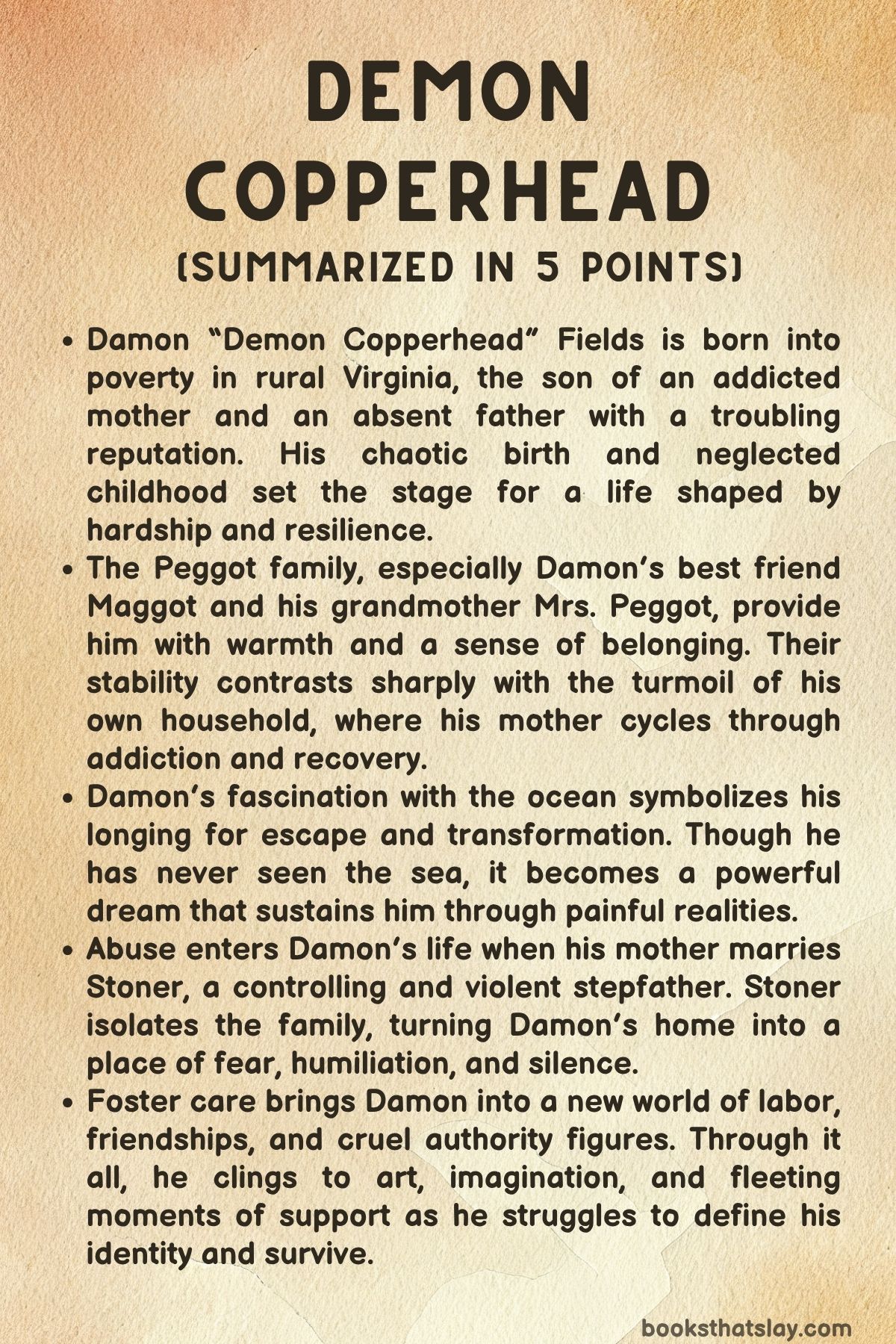
Characters
Damon Fields
Damon, the central narrator of Demon Copperhead, embodies the voice of a child born into poverty and neglect who nevertheless develops an extraordinary capacity for storytelling, resilience, and self-reflection. His childhood is marked by abandonment, his mother’s addiction, and the cruelty of an abusive stepfather, yet Damon maintains a sense of humor and biting wit that shields him from despair.
He is shaped by longing—for love, for the ocean he has never seen, and for a life beyond the confines of rural Lee County. Throughout his journey, Damon reveals his vulnerability and defiance, oscillating between reckless choices and remarkable creativity.
His art and imagination become lifelines, enabling him to reframe trauma into narrative and envision possibilities outside of suffering. Damon’s resilience lies not in denying his pain but in using it as fuel for reinvention, eventually guiding him toward sobriety, purpose, and tentative hope for a future beyond survival.
Demon’s Mother
Damon’s mother is a tragic figure whose life is consumed by addiction, fragility, and the pull of destructive relationships. Though she loves Damon in her way—bringing him small treats, apologizing for his hardships—her inability to protect him from Stoner or provide stability leaves deep scars.
Her vulnerability is amplified by her dependence on abusive men and her cycles of relapse. To Damon, she embodies both fierce longing for maternal love and the bitter reality of abandonment.
Her death from an overdose on his eleventh birthday crystallizes the failure of the systems around her: a woman punished by circumstance, illness, and societal neglect, whose love was real but whose capacity to nurture was tragically limited.
The Peggot Family (Mrs. Peggot, Mariah, Maggot, and Emmy)
The Peggots provide Damon with his closest experience of family stability and unconditional care. Mrs. Peggot becomes a surrogate grandmother, offering him warmth, discipline, and a sense of belonging that contrasts with the chaos of his own home.
Maggot, Damon’s best friend, shares in his childhood adventures and later reflects the darker paths of their community through rebellion and addiction. Mariah’s story of abuse and imprisonment illustrates how women in their environment are often punished for their survival instincts, and her absence profoundly shapes Maggot.
Emmy, sharp and wounded, introduces Damon to a different rhythm of life when he visits Aunt June, sparking both companionship and a fleeting sense of romantic connection. Collectively, the Peggots reveal how community, kinship, and resilience coexist with generational trauma and systemic injustice.
Murrell “Stoner” Stone
Stoner epitomizes the destructive, domineering force of toxic masculinity in Damon’s life. At first appearing charismatic and stable, he quickly reveals himself as controlling, cruel, and sadistic.
His taunts about Damon’s masculinity and his calculated isolation of Damon’s mother expose his manipulative grip. Stoner’s violence and humiliations—forcing Damon into degrading punishments—turn the household into a prison.
He is both a personal antagonist and a symbol of the larger cycles of abuse that devastate Appalachian families. His power lies not only in physical strength but also in his ability to manipulate appearances, presenting himself as a loving husband to outsiders while terrorizing his family within.
For Damon, Stoner becomes the embodiment of the villains he sketches in his notebooks, a figure against whom his inner resistance and eventual survival sharpen.
Aunt June
Aunt June stands out as one of the novel’s quiet pillars of resilience and care. A hardworking nurse raising her niece Emmy, June balances exhaustion with determination to provide stability and love.
She is practical, no-nonsense, and hardened by experience, but her presence offers Damon glimpses of a different life—one marked by responsibility and perseverance rather than chaos. June becomes instrumental in steering him toward rehab and recovery, embodying the possibility of healing through tough love and persistence.
She reflects the unsung strength of women who hold fractured families together despite personal sacrifice.
Emmy
Emmy is both companion and mirror for Damon, carrying her own scars but displaying sharpness and intensity that draw him in. Their bond in childhood, particularly during Damon’s visits to Aunt June, suggests both camaraderie and early romantic tension.
Emmy represents the possibility of connection outside Damon’s immediate suffering, yet her life too is marked by instability and struggle. Later, her recovery in Asheville underscores the fragility of survival in their world, where every individual carries the weight of loss but still clings to the hope of rebuilding.
Fast Forward (Sterling Ford)
Fast Forward is one of the most charismatic and dangerous figures in Damon’s story. First introduced as the dominant foster child in Creaky’s household, he exerts both terror and admiration over the younger boys, turning their vulnerability into a kind of rough brotherhood.
To Damon, Fast embodies allure and risk, an idol whose confidence and magnetism suggest escape from powerlessness. As they reconnect later, Fast introduces Damon to drugs, parties, and dangerous circles, representing both temptation and destruction.
His violent tendencies, hidden cruelty, and eventual downfall reveal him as a deeply flawed survivor of trauma who passes on harm even as he radiates charisma. Fast’s fate embodies the precarious line between idol and cautionary tale in Damon’s world.
Tommy Waddles
Tommy is a foster brother whose kindness and sensitivity contrast with the brutality of their environment. Mocked and beaten for his weight and softness, he nevertheless finds quiet resilience in reading and drawing.
His doodles of skeletons are his way of processing pain, echoing Damon’s own reliance on art. Later, as an adult, Tommy emerges as a reminder that survival can take gentler, quieter forms—paths of endurance and creativity rather than dominance.
For Damon, Tommy becomes both a comrade in suffering and a living example that tenderness need not be erased by hardship.
Miss Barks
Miss Barks, Damon’s young caseworker, provides a fleeting but meaningful symbol of kindness and dignity amid the harsh foster system. Her compassion, attentiveness, and beauty leave a lasting impression on Damon, offering him the rare sense of being cared for without judgment.
Though her role is brief, she represents the possibility of empathy within an otherwise indifferent bureaucracy, highlighting how small gestures of humanity can shape a child’s memory and resilience.
Coach Winfield
Coach Winfield becomes a father figure to Damon during his high school years, offering structure, encouragement, and pride in his athletic abilities. He treats Damon like a son, driving him hard while also giving him a sense of belonging that he craves.
Yet Coach is also flawed, battling his own demons of addiction, and his eventual decline mirrors the fragility of role models in Damon’s world. For Damon, Coach represents both the promise of guidance and the inevitability of disillusionment, yet his influence remains significant in shaping Damon’s sense of discipline and ambition.
Angus
Angus emerges as Damon’s closest confidante in adolescence, their bond laced with banter, loyalty, and unspoken intimacy. While she teases him and challenges his worldview, she also grounds him, offering emotional honesty that contrasts with the falsehoods of others in his life.
Her trajectory—focusing on college and envisioning a future beyond Lee County—highlights the choices Damon struggles to embrace. In their reunion years later, Angus symbolizes both continuity and possibility, offering him a chance at companionship and escape.
She becomes the figure through whom Damon might finally bridge his yearning for love, belonging, and the ocean he has always dreamed of.
Themes
Poverty and Structural Inequality
The fabric of Demon Copperhead is shaped by the harsh realities of generational poverty in rural Appalachia. Damon’s life begins in a trailer with an addicted mother and no father, and from that moment, his trajectory is bound to a system designed to fail him.
The story never treats poverty as simply a lack of money—it becomes a condition that affects education, opportunity, and dignity. Schoolteachers explain to the children that their lack of resources is no accident, but the result of deliberate exploitation by coal companies that hollowed out the region, leaving families with nothing but broken bodies and broken dreams.
Damon comes to see how the exploitation of labor, the closing of industries, and the absence of social safety nets conspire to keep communities trapped. Even when glimpses of escape appear—through football stardom, art, or city life—they are fragile, constantly under threat from addiction, crime, or systemic neglect.
The narrative portrays poverty as both an external trap and an internalized identity, teaching Damon and his peers to expect less of themselves and to fight for scraps in a world that has written them off before they can even stand on their own.
Addiction and Its Consequences
Addiction courses through Damon’s story like a river cutting through stone, shaping every bend in his life. His mother’s struggle with pills and alcohol sets the stage for neglect, vulnerability, and eventual tragedy.
The opioid epidemic, which devastates Appalachia, is depicted not as individual weakness but as a communal scourge, engineered by pharmaceutical companies that flooded poor counties with prescription painkillers. Damon’s eventual slide into addiction mirrors what he witnessed in others: the slow erosion of choice, the constant bargaining between temporary relief and long-term ruin, and the shattering of relationships under the weight of dependency.
Dori’s presence underscores this theme, as her beauty and allure are quickly consumed by her addiction, foreshadowing Damon’s own descent. Recovery is portrayed as fragile and ongoing rather than triumphant; Damon’s time in rehab and sober living reminds the reader that sobriety is not a finish line but a daily negotiation.
In this way, addiction in the novel functions as both personal affliction and collective tragedy, exposing how despair and systemic abandonment leave entire communities vulnerable.
Abuse and Power Dynamics
From his earliest years, Damon is forced to navigate a world defined by power wielded through violence. Stoner’s dominance over his mother and his cruelty toward Damon illustrate how abuse is both physical and psychological, breaking down self-worth while enforcing silence.
Stoner’s manipulations—mocking Damon’s masculinity, turning his mother against him, and isolating them from any support—show how abusers thrive by controlling narratives as much as they control people. Foster care does not bring relief, only another hierarchy of intimidation under Creaky and later under Fast Forward, whose charisma disguises a different form of dominance.
Even among children, power replicates itself in cruel games and pecking orders. Abuse in the novel is never an isolated act but part of a cycle, one that Damon risks replicating when anger boils over.
The narrative insists on showing the scars of such power: broken bodies, silent endurance, and the lifelong work of resisting the urge to submit or retaliate in kind.
The Search for Belonging and Family
Damon’s journey is haunted by a desperate need for connection, and this longing becomes one of the most poignant aspects of the novel. His biological family fails him repeatedly, with his mother lost to addiction and his father absent even in memory.
Yet Damon finds fragments of family in unexpected places: the Peggots’ home, where Mrs. Peggot’s warmth offers brief stability; friendships with Maggot and Angus, who remind him that love can survive hardship; and even in the chaotic foster household, where bonds with Tommy and Swap-Out carry flickers of solidarity. Football offers a kind of belonging, as the team and Coach Winfield temporarily fill the void left by broken homes.
Yet these communities are fragile, often collapsing under the weight of lies, addiction, or death. Damon’s eventual reconnection with Angus and their shared drive toward the ocean suggests that family is not defined by blood but by the people who walk beside you through pain and recovery.
The search for belonging, though fraught, becomes Damon’s lifeline, grounding his story in resilience rather than despair.
Survival and Resilience
At its heart, the novel is a story of survival against relentless odds. Damon endures poverty, abuse, loss, and addiction, yet his humor, art, and imagination keep him tethered to hope.
His superhero fantasies, born in childhood, evolve into a metaphor for resilience: though he cannot escape his circumstances by sheer strength, he survives by creating stories, drawing his pain into something larger than himself. The recurring image of water and the ocean symbolizes his longing for transformation—a place where he might shed the weight of his past and begin anew.
Survival is not portrayed as heroic or glamorous; it is messy, exhausting, and often lonely. Yet the fact that Damon continues, that he reaches a point of sobriety, creative expression, and tentative love, makes his resilience extraordinary.
His story is not about escaping hardship entirely but about learning to carry it without drowning, making survival itself a kind of victory.