Destined for an Early Grave Summary, Characters and Themes
Destined for an Early Grave by Jeaniene Frost is a paranormal romance and urban fantasy novel centered on Cat Crawfield and her vampire husband, Bones. The book follows their relationship through a dangerous test involving old secrets, erased memories, supernatural politics, and an enemy who claims Cat belonged to him before she ever met Bones.
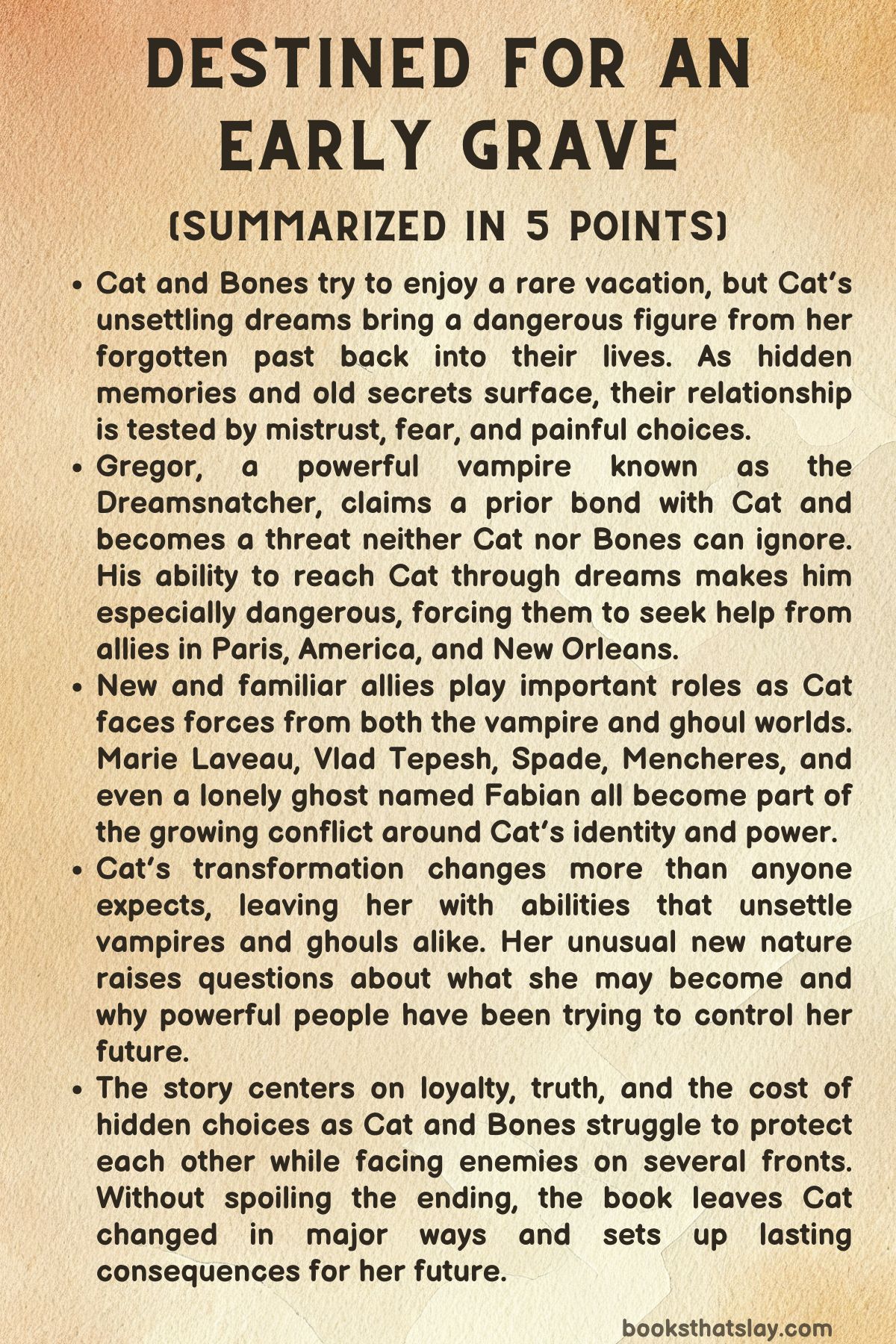
It mixes romance, action, vampire law, ghoul politics, and questions of trust. At its core, the story is about Cat fighting for control over her own life while discovering that her past has been shaped by other people’s choices. It’s the 4th book of the Night Huntress Universe.
Summary
Cat Crawfield and Bones finally try to take a vacation together after surviving years of danger, enemies, and supernatural conflict. Their peace does not last long.
Cat begins having strange dreams about a blond vampire who insists that Bones is not truly her husband. The dreams feel too real to dismiss, and the vampire’s claims disturb her deeply.
When Mencheres explains the truth, Cat learns that the vampire is Gregor, also known as the Dreamsnatcher. Gregor has the rare ability to pull people from their dreams into his physical location, which makes him dangerous in a way Cat has never faced before.
The situation becomes even more unsettling when Cat finds out that Gregor once kidnapped her when she was sixteen. He had taken her before she ever met Bones because he believed she was destined to become powerful and wanted to claim her before anyone else could.
Mencheres had stopped him, imprisoned him, and erased Cat’s memories of that time. Now Gregor has escaped.
He says Cat was blood-bound to him first, and he wants her back.
Cat is furious and confused. She has built her life around Bones, yet she now learns that a hidden part of her past may affect her future.
Bones is just as threatened by Gregor’s return, but his fear comes from love as much as jealousy. He knows Gregor is not only powerful but also tied to Cat’s missing memories.
The idea that Cat may have once belonged to Gregor, even through manipulation, creates tension between them.
The danger becomes physical when Cat and Bones are attacked in Paris by armed ghouls. Bones is shot with silver bullets, leaving him badly injured.
Cat reacts with unexpected strength, carrying him to safety and escaping the attack. They go first to Spade’s home and then return to America, trying to stay ahead of Gregor and understand the wider threat forming around them.
Their search for help leads them to New Orleans, where they seek out Marie Laveau, the powerful ghoul queen known as Majestic. Marie rules her city with authority, and both vampires and ghouls respect her influence.
Cat meets her beneath Saint Louis Cemetery and explains that she recognizes only Bones as her husband, no matter what Gregor claims. Marie does not offer blind loyalty, but she gives Cat cautious support and keeps order in her territory.
In New Orleans, Cat and Bones also meet Fabian, a lonely ghost who becomes attached to Cat. Unlike many of the supernatural beings around them, Fabian has no army, no title, and no political power.
Still, his ability to move unseen makes him valuable. He becomes a spy and ally, proving that even someone overlooked can affect the outcome of larger events.
Gregor soon appears in the open and confronts Bones. Their hatred is immediate, but Marie prevents them from fighting in her city.
During this time, Cat discovers that Gregor’s blood could restore her erased memories. This revelation shakes her trust in Bones and Mencheres.
They had known more than they told her, and although they believed they were protecting her, Cat feels robbed of the truth. She resents being treated as someone whose past can be hidden for her own good.
The conflict between Cat and Bones grows worse. Bones fears that if Cat regains her memories, she may feel drawn to Gregor or question her bond with him.
Cat, however, wants the right to know what happened to her. Their argument cuts deeply because both of them are acting from pain.
Bones wants to keep her safe and keep their love intact. Cat wants honesty, choice, and control over her own mind.
Cat eventually dreams herself to Gregor and regains the memories Mencheres took from her. She remembers being sixteen, meeting Gregor, and living with him for weeks.
She sees how he charmed her, influenced her, and tried to shape her future before she understood what was happening. The memories are disturbing, but they do not prove what Gregor wants them to prove.
Cat realizes that he manipulated her. He did not truly win her love or loyalty.
When Cat returns to Bones, the truth does not repair everything. Bones is hurt, angry, and afraid that Cat needs space to decide what she really wants.
He leaves her, believing that she must be free to choose without him standing in the way. Cat is devastated by the separation.
For her, there is no real choice to make: Bones is the one she loves. But the damage caused by secrets, fear, and Gregor’s interference leaves them both wounded.
Cat spends time with friends and later stays with Vlad Tepesh, who becomes one of her strongest allies. Vlad understands power, violence, and survival, and he gives Cat support without treating her as fragile.
Meanwhile, Gregor increases the pressure. His followers threaten people close to Cat, and the ghoul Apollyon spreads dangerous rumors.
He claims Cat intends to become a vampire-ghoul hybrid and threaten all ghouls. These lies stir fear and political unrest.
To stop Gregor from stealing her through dreams and to make herself stronger, Cat chooses to become a full vampire. Bones turns her, but the transformation does not happen normally.
Cat keeps a heartbeat, and she does not behave like a typical new vampire. Even more surprising, she gains the ability to absorb powers from vampire blood.
Her strange new nature frightens and fascinates the supernatural world.
At a formal gathering meant to calm the conflict, Cat’s condition alarms both vampires and ghouls. Her existence seems to break rules they thought were fixed.
Gregor then makes the fight more personal by abducting Cat’s mother, Justina, and turning her into a vampire. Cat, Bones, Spade, Vlad, and their allies launch a rescue.
The battle is costly. Cat’s friend Rodney is killed, adding grief to the already intense conflict.
During the rescue, Cat discovers another part of her new ability. After drinking Vlad’s blood earlier, she suddenly manifests his power over fire.
She sets fires during the attack and realizes she can channel the abilities of vampires whose blood she drinks. This makes her far more powerful than anyone expected, but it also makes others fear what she might become.
Mencheres finally admits the full truth. Years ago, his visions showed Cat’s future power.
He took her from Gregor and helped arrange her first meeting with Bones because he believed Cat’s abilities could not be allowed to fall under Gregor’s control. His choices may have saved Cat from Gregor, but they also manipulated her life.
Bones is furious, and Cat must face the fact that many people have tried to direct her fate.
The immediate threat still comes from Gregor, so a formal duel is arranged between him and Bones. The fight is brutal.
Gregor cheats by using a blade that injects liquid silver into Bones, weakening him badly. As Gregor comes close to killing Bones, Cat’s fire erupts.
She destroys Gregor’s head and ends his threat for good.
The Law Guardians initially try to execute Cat for interfering in the duel, but Bones exposes Gregor’s cheating. Lucius accidentally confirms the truth, proving Gregor broke the rules first.
Cat is spared, Gregor is dead, and Justina is rescued, though her transformation into a vampire has changed her life forever.
By the end of Destined for an Early Grave, Cat and Bones survive the war Gregor brought to them, but they are not unchanged. Their relationship has been tested by secrets, jealousy, fear, and painful choices.
Cat has claimed her own truth and rejected Gregor’s control, yet her new vampire nature creates fresh uncertainty. She is no longer the same half-vampire hunter she once was.
Her powers are growing, the supernatural world is watching, and the consequences of what she has become remain unresolved.
Characters
Cat Crawfield
Cat is the emotional and moral center of Destined for an Early Grave, and her character is shaped by the struggle between love, memory, identity, and power. In this book, she is forced to confront a hidden part of her past that others have controlled for years, and that discovery deeply unsettles her sense of self.
Gregor’s claim over her threatens not only her marriage to Bones but also her belief that she has always chosen her own path. Cat’s anger toward Bones and Mencheres comes from more than hurt pride; it comes from the realization that important choices about her life were made without her knowledge.
Her decision to become a full vampire shows both desperation and courage, because she chooses a permanent transformation in order to protect herself and those she loves. Even after becoming a vampire, Cat remains unusual, keeping a heartbeat and developing the ability to absorb powers through vampire blood.
This makes her both frightening and extraordinary, suggesting that her identity can no longer fit neatly into human, vampire, or half-breed categories. Cat’s greatest strength is her refusal to let others define her, whether Gregor tries to claim her, Mencheres tries to guide her destiny, or the supernatural world tries to fear her.
Bones
Bones is one of the most passionate and conflicted figures in the book. His love for Cat is fierce, loyal, and protective, but that same intensity sometimes turns into fear and secrecy.
He is deeply wounded by Gregor’s claim because it attacks the foundation of his relationship with Cat, making him question whether her love for him is fully free or partly shaped by missing memories. Bones’s decision to leave Cat is painful because it comes from both love and insecurity; he believes he is giving her the freedom to choose, but he also abandons her when she needs emotional steadiness the most.
His anger toward Mencheres reveals his strong sense of betrayal, especially when he learns that his own grandsire manipulated events around Cat’s life. In the duel with Gregor, Bones represents honor and endurance, fighting within the rules even when Gregor secretly cheats.
His vulnerability in that fight makes the stakes personal and emotional, because his strength alone is not enough to save him. Bones remains heroic, but the book also shows that his pride, fear of losing Cat, and tendency to hide painful truths can damage the very relationship he wants to protect.
Gregor
Gregor is the main antagonist of the story and one of its most manipulative characters. Known as the Dreamsnatcher, he is dangerous because his power allows him to invade dreams and turn private vulnerability into physical captivity.
His claim that Cat belongs to him is not presented as love but as possession. When Cat regains her memories, it becomes clear that Gregor’s past connection to her was built on manipulation, charm, and control rather than genuine trust.
He tries to rewrite Cat’s life by insisting that he had the first claim on her, but his actions prove that he values ownership more than her will. Gregor’s cruelty grows as the conflict develops, especially when he targets people close to Cat and abducts Justina.
His decision to cheat during the duel with Bones exposes his cowardice beneath his confidence. He wants the appearance of legitimacy and power, but he is willing to break the rules when he cannot win fairly.
Gregor is frightening not only because of his supernatural ability but because he represents a past that tries to steal Cat’s future.
Mencheres
Mencheres is one of the most morally complex characters in the book. He acts with long-term vision and strategic intelligence, but his choices raise serious ethical questions.
His decision to erase Cat’s memories and imprison Gregor may have been meant to protect the future, yet it also violates Cat’s autonomy. Mencheres believes he is preventing Cat’s power from falling under Gregor’s control, but in doing so, he treats her life like a piece in a larger supernatural design.
His visions give him knowledge others lack, and that knowledge makes him powerful, but it also isolates him from ordinary moral accountability. He does not act out of simple malice; in fact, his intentions are partly protective.
However, the damage caused by his secrecy is enormous, especially to Cat and Bones’s relationship. Mencheres shows how dangerous wisdom can become when it turns into control.
He is not a villain like Gregor, but the book makes it clear that manipulation done for a supposedly good reason can still deeply harm the people involved.
Marie Laveau
Marie Laveau, also known as Majestic, is a commanding and politically important presence in the story. As the ghoul queen of New Orleans, she represents authority, balance, and the careful management of supernatural power.
Marie is not easily impressed or emotionally swayed, but she listens to Cat and recognizes the seriousness of Gregor’s threat. Her support is cautious rather than sentimental, which makes her feel powerful and realistic.
She protects the order of her city by preventing open violence between Bones and Gregor, showing that her first loyalty is to stability and control. Marie’s role also expands the supernatural world by showing that ghoul politics are just as significant as vampire conflicts.
She is neither a simple ally nor an enemy; she is a ruler who helps when it serves justice, order, and her own judgment. Her presence adds dignity and danger to the story because every interaction with her carries political weight.
Fabian
Fabian is a gentler and more sympathetic character who brings emotional warmth to the book. As a lonely ghost, he stands apart from the violent struggles of vampires and ghouls, yet he still becomes important because of his ability to observe and spy.
Fabian’s usefulness does not come from physical strength but from loyalty, quiet courage, and his unusual position between the living and the dead. His friendship with Cat gives him a sense of belonging, and his willingness to help shows that even a seemingly minor or overlooked figure can affect major events.
Fabian also softens the darker atmosphere of the story. Around him, Cat is not only a fighter or a supernatural anomaly; she is someone capable of kindness and friendship.
His character reminds the reader that loyalty can come from unexpected places.
Spade
Spade is a steady and dependable ally whose role is defined by loyalty, composure, and old-world honor. When Cat and Bones need refuge, his home becomes a place of temporary safety, showing that he is someone they can trust during crisis.
Spade does not dominate the central conflict, but his presence strengthens the network of relationships around Cat and Bones. He represents the kind of friendship that is practical rather than dramatic: he offers shelter, support, and assistance without demanding attention.
In a story filled with betrayal, hidden memories, and political manipulation, Spade’s reliability matters. His character helps show that Cat and Bones are not isolated; they survive partly because they have allies who stand with them when danger becomes overwhelming.
Vlad Tepesh
Vlad is one of Cat’s most fascinating allies because he combines menace, humor, power, and unexpected emotional support. When Cat is separated from Bones and emotionally devastated, Vlad gives her a place to recover without treating her as fragile.
His friendship with Cat is sharp-edged but genuine, and he respects her strength while also challenging her. Vlad’s pyrokinetic ability becomes especially important when Cat later absorbs and manifests his fire power.
This connection reveals the strange nature of Cat’s new vampire state and marks one of the clearest signs that she has become something unprecedented. Vlad is dangerous, but he is not careless.
He understands power and survival, and his alliance with Cat shows that he values courage and loyalty. His character adds intensity to the book because he is both a source of comfort and a reminder of how terrifying true supernatural power can be.
Justina Crawfield
Justina, Cat’s mother, is important because her fate makes the conflict with Gregor deeply personal. Her abduction and forced transformation into a vampire are cruel acts meant to hurt Cat in the most intimate way possible.
Justina has long been connected to Cat’s human life and complicated family history, so her change into a vampire carries emotional weight beyond the immediate danger. It permanently alters her identity and her relationship with Cat.
Gregor uses her as a weapon, but Justina’s survival also reinforces Cat’s determination to fight back. Her transformation is tragic because it is not chosen freely, and it leaves consequences that cannot be easily undone.
Through Justina, the book shows that supernatural conflicts do not only affect warriors and rulers; they also devastate families.
Apollyon
Apollyon is a dangerous political agitator whose influence comes from fear, rumor, and prejudice. As a ghoul, he exploits anxiety about Cat’s unusual nature by spreading the idea that she might become a vampire-ghoul hybrid and threaten ghouls.
His role is important because he shows that Gregor’s conflict with Cat and Bones is not only personal but also political. Apollyon understands that fear can be turned into a weapon, and he uses misinformation to stir hostility.
Unlike Gregor, who wants direct possession of Cat, Apollyon is more concerned with what Cat represents. Her existence challenges the boundaries between supernatural groups, and he turns that uncertainty into panic.
His character reflects how communities can be manipulated when leaders use fear instead of truth.
Rodney
Rodney is a loyal and tragic figure whose death gives the rescue mission a heavy emotional cost. He is not merely a background casualty; his loss reminds the reader that Cat’s battles have real consequences for the people around her.
Rodney’s death also intensifies Cat’s grief and anger, showing that victory in this world often comes with sacrifice. His presence in the story represents the friends and allies who stand beside Cat even when they are not as powerful as the major supernatural figures.
When he dies, the danger of Gregor’s campaign becomes more painful and immediate. Rodney’s character matters because his death prevents the conflict from feeling distant or purely political; it becomes personal, irreversible, and heartbreaking.
Lucius
Lucius plays a smaller but important role near the end of the book because his accidental confirmation exposes Gregor’s cheating. His mistake helps shift the judgment of the Law Guardians and prevents Cat from being executed for interfering in the duel.
Lucius is significant because he shows how truth can emerge unexpectedly, even from someone who does not intend to help the heroes. His role also reinforces Gregor’s dishonesty.
Without that accidental confirmation, Cat’s act of saving Bones might have been treated only as a violation of the duel’s rules. Lucius therefore becomes a key part of the resolution, not through courage or loyalty, but through the unintended power of revealing what Gregor tried to hide.
Themes
Love Tested by Distrust and Fear
Cat and Bones’ relationship in Destined for an Early Grave is tested not by lack of love, but by fear, secrecy, and wounded pride. Their bond has already survived violence and danger, yet Gregor’s return exposes how fragile trust can become when one person’s past has been hidden from them.
Cat feels betrayed because Bones and Mencheres knew more than they admitted, especially about the memories taken from her. Bones, meanwhile, fears that Cat’s restored past might change her feelings or reveal a bond with Gregor that threatens their marriage.
Their conflict shows how love can become strained when protection turns into control. Bones leaves because he believes Cat deserves the freedom to choose, but his decision also causes deep pain because it removes the partnership Cat depends on.
The theme is powerful because their love is not presented as perfect. It must survive jealousy, anger, silence, and difficult truths before it can become stronger.
Identity, Memory, and Personal Choice
Cat’s erased memories raise serious questions about identity and consent. When Mencheres removes part of her past, he does not simply hide information; he changes how Cat understands herself.
Gregor’s claim over her depends on a version of Cat that she cannot remember, while Bones’ place in her life depends on the person she has consciously chosen to become. Once Cat regains her memories, she sees that Gregor influenced and manipulated her, but those memories still matter because they belong to her.
The conflict is not only about who Cat loved first, but about who has the right to define her life. Her anger toward Mencheres and Bones comes from being denied the truth about her own history.
This theme becomes even stronger when Cat chooses to become a full vampire. Her transformation is not forced by Gregor, Bones, or Mencheres; it is her decision, made to protect herself and reclaim control over her future.
Power, Control, and Manipulation
Power in this story is often shown through control over others. Gregor’s dreamsnatching ability makes him dangerous because he can invade private spaces and remove people from safety.
His interest in Cat is not based on genuine love; it is based on possession, prediction, and advantage. Mencheres also uses power in a morally troubling way.
He believes his visions justify manipulating Cat’s life, erasing her memories, and arranging events to keep her away from Gregor. Even when his intentions are better than Gregor’s, his actions still deny Cat the freedom to decide for herself.
Marie Laveau represents another kind of power: political authority, restraint, and public order. She does not rush into violence, but her presence controls what others can do in New Orleans.
Through these figures, Destined for an Early Grave shows that power becomes dangerous when it treats people as pieces in a larger plan rather than as individuals with their own will.
Transformation and Uncertain Consequences
Cat’s transformation into a full vampire marks a major shift in her life, but it does not give simple answers. Instead of becoming ordinary by supernatural standards, she becomes even more unusual.
She keeps a heartbeat, reacts differently from other new vampires, and gains the ability to absorb powers from vampire blood. This change reflects her entire position in the supernatural world: she does not fit neatly into one category, and that makes others fear her.
The rumors spread by Apollyon show how quickly difference can become political danger. Cat’s new powers help her survive and defeat Gregor, but they also create uncertainty about what she may become.
Her ability to use Vlad’s fire is thrilling and frightening because it suggests strength without clear limits. The theme of transformation is therefore not only about gaining power.
It is about accepting that change can save someone while also leaving behind new risks, responsibilities, and fears.