Devour Me Summary, Characters and Themes
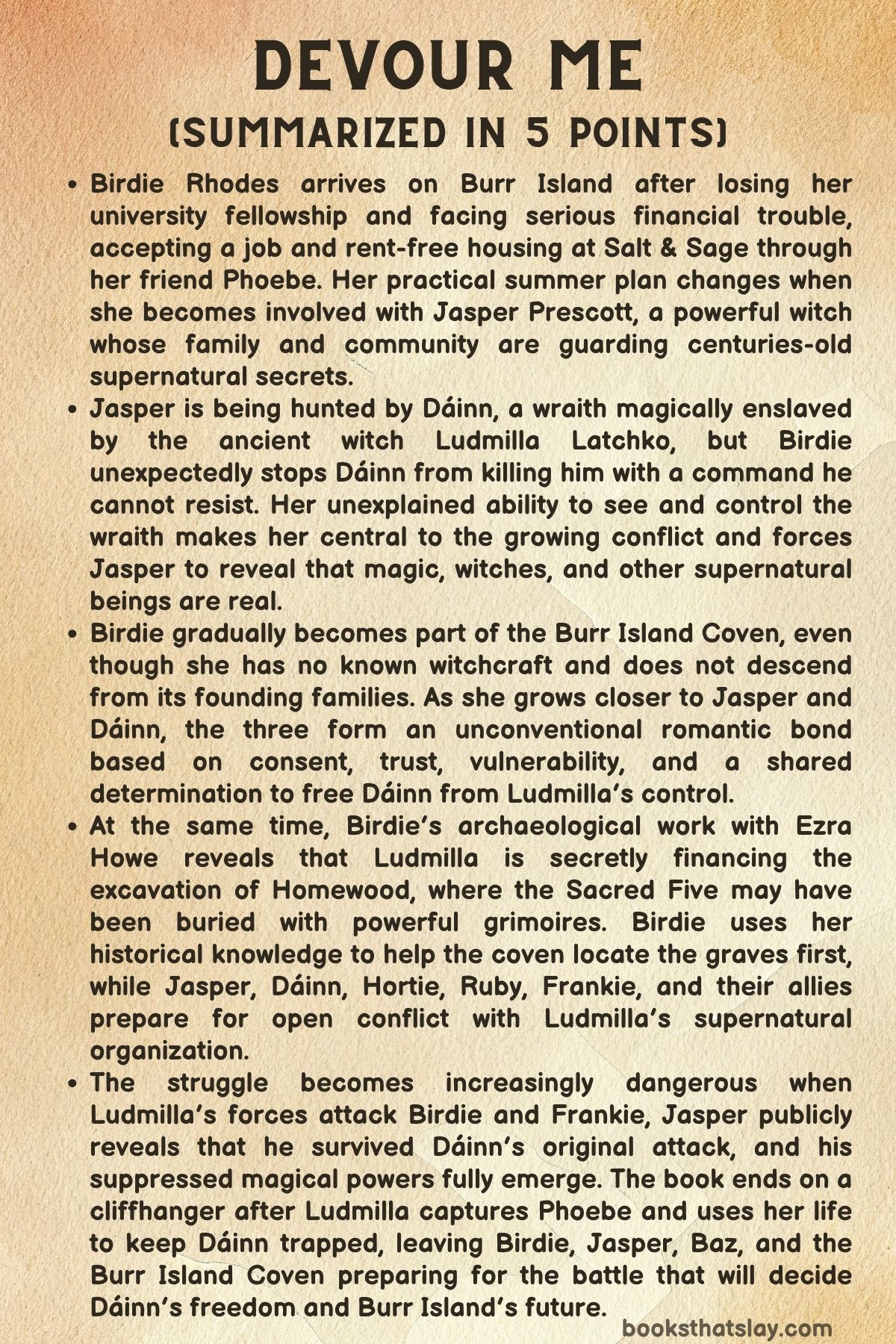
Devour Me by Emily Rath is a paranormal romance centered on Virginia “Birdie” Rhodes, a financially struggling doctoral student whose temporary move to Burr Island places her inside a hidden supernatural society.
What begins as a practical arrangement involving a research fellowship, a rent-free apartment, and work at an occult shop soon brings her into the lives of witch Jasper Prescott and enslaved wraith Dáinn. As Birdie discovers that magic is real, she becomes essential to a centuries-old conflict involving the island’s coven, an ancient enemy named Ludmilla Latchko, buried magical history, and a mysterious ability that allows Birdie to command a creature no ordinary human should be able to control.
Summary
Birdie Rhodes enters the summer believing her greatest problem is financial survival. Her expected teaching fellowship disappears after Professor Abbott leaves the university, leaving Birdie unable to cover tuition or housing and terrified that the homelessness she experienced earlier in life could return.
Her friend Phoebe Prescott offers a solution by asking Birdie to take her place at Salt & Sage, the family’s shop on Burr Island. Birdie can work there and live rent-free in the apartment above the store while assisting Professor Ezra Howe with an archaeological research project connected to Homewood, an early settlement associated with women accused of witchcraft.
The arrangement brings Birdie into contact with Phoebe’s uncle, Jasper Lyons Prescott. Jasper initially refuses to hire her because Burr Island hides genuine supernatural secrets, and he is already convinced that something dangerous is haunting him.
Jasper is the high priest of the Burr Island Coven and carries years of emotional responsibility. After losing his sister Gracie and living under the judgment of his mother Esther, he has built his life around duty, control, and protecting others rather than pursuing happiness for himself.
Birdie eventually wins him over through determination and an improvised tarot reading. When she draws the Death card, she interprets it not as literal death but as transformation, exhaustion, and the need to end an old way of living, unknowingly describing Jasper with startling accuracy.
Jasper gives her the job and apartment, although their attraction quickly complicates their professional relationship. Birdie begins settling into island life, experiencing generosity and belonging that challenge the rigid self-reliance she developed after a childhood dominated by religious control and later periods of instability.
Unknown to Birdie, Jasper’s fears are justified. A wraith named Dáinn has been ordered to murder him by Ludmilla Latchko, the witch who has magically enslaved Dáinn for 172 years and repeatedly uses him to hunt and consume victims chosen for him.
When Dáinn attacks Jasper, Birdie sees him even though an ordinary human should not be capable of perceiving an unmanifested wraith. More astonishingly, when she commands Dáinn to stop, he is forced to obey and return Jasper’s stolen soul.
The incident changes all three of their lives. Jasper realizes Birdie possesses an unexplained supernatural ability, while Dáinn becomes fascinated by the woman who has accomplished something no one else has ever done.
Dáinn also discovers that failing to complete Jasper’s murder creates a loophole in his bondage. Because Ludmilla ordered him to kill Jasper and Jasper remains alive, Dáinn is technically still carrying out his assignment, meaning Ludmilla’s magical cage cannot hold him while the hunt remains unfinished.
He lies to Ludmilla and tells her Jasper is dead. For the first time in almost two centuries, Dáinn gains enough freedom to seek allies and begins considering whether Jasper and the Burr Island witches can destroy his mistress.
Meanwhile, Birdie becomes increasingly involved with the Homewood excavation. Ezra Howe believes the Sacred Five—Charity Ames, Mathilde Blake, Alice Dent, Sybil Hastings, and Be-Good Prescott—may have been buried there with their grimoires after the destruction of their settlement in the seventeenth century.
Jasper knows far more about those women than Birdie realizes because they are the founders of Burr Island’s magical community. He also discovers that Ezra’s project is financed by the Raven Hill Group, an organization tied to Ludmilla’s supernatural trade in magical artifacts.
Dáinn approaches Jasper and explains that Ludmilla’s ravens are artificial magical Eyes spying on the island. He also gives Jasper an enchanted pendant that allows him to stage his death, helping convince Ludmilla that her original order was successfully completed.
The Burr Island Coven gathers under the appearance of mourning Jasper and finally learns the scale of the danger. Dáinn reveals himself to them, explains his enslavement, and warns that Ludmilla may be the same ancient witch the Sacred Five once fought centuries earlier.
The coven also learns that Dáinn’s bond is renewed through a blood-moon ritual involving Ludmilla’s blood and the sacrifice of another witch’s soul. Destroying her stored blood supply could weaken her enough for them to disrupt the ritual and possibly free Dáinn.
Birdie remains outside these secrets until Jasper’s lies become impossible to sustain. Her research for Ezra reveals increasingly suspicious efforts to locate the Sacred Five’s graves, while Jasper’s fabricated death and strange behavior convince her that something far larger is happening.
Eventually Jasper tells her the truth: he is literally a witch, the supernatural world exists, the creature who attacked him was a wraith, and Birdie possesses an ability nobody understands. Although furious about the deception, Birdie does not leave Burr Island.
Instead, she accepts an invitation to join the coven. Because no human outsider has ever been initiated, Jasper creates a new ceremony based on oath, intention, and crossing the magical threshold of Prescott House, and the house itself accepts Birdie as a member.
This acceptance transforms Birdie’s relationship with the community. The woman who has spent much of her life surviving alone is welcomed into a family based not on biological descent but on deliberate commitment.
Dáinn, meanwhile, obtains a temporary human body from his old friend Basil “Baz” Barnes, a powerful necromancer. Calling himself Daniel Black, he begins working at Salt & Sage and attempting to get closer to Birdie without immediately revealing that he is the same creature who attacked Jasper.
Once Birdie learns Daniel’s identity, Dáinn allows her to experience his true nature directly. During a supernatural hunt through the forest, he catches her and begins feeding, but Birdie commands him to stop and once again forces him to obey.
The repeated success proves that her ability is genuine. Dáinn then trusts Birdie with his true name, an intimate act for a wraith, while Birdie promises never to use that trust against him.
The emotional connection among Birdie, Jasper, and Dáinn develops beyond rivalry. Birdie refuses to allow the two men to treat affection as a contest, and the three begin forming a consensual relationship built around trust, desire, vulnerability, and freedom of choice.
Their magical connection becomes even more significant when Dáinn feeds from Jasper during an experiment conducted by Baz. Because Jasper offers part of his soul willingly, Dáinn retains what he consumes instead of returning it, leaving Jasper permanently changed but giving Dáinn a kind of nourishment he has rarely experienced.
Baz investigates Birdie but cannot determine exactly why she can control Dáinn. He suspects her unexplained biological origins may connect her to an old magical experiment and obtains her blood under a strict magical promise that it will be used only for genetic investigation.
At the same time, Birdie uses her historical training to help the coven search for the Sacred Five before Ezra and Ludmilla can find them. Ruby, the coven’s Memory Keeper, reveals a secret archive containing family records and Robert Dent’s original journals, confirming that evidence central to Ezra’s excavation really exists.
Birdie concludes that the graves are probably located in an unscanned section of Homewood. To delay Ezra, Dáinn interferes with his ground-penetrating radar while Jasper uses improvised magic to curse the equipment so it appears to fail naturally.
The plan works temporarily, but Ezra’s Raven Hill contacts are prepared to replace the equipment. Birdie and Frankie therefore travel to Winthrop University to borrow another machine before Ludmilla’s organization can act.
There they are confronted by Enzo Barsotti, a powerful fire witch connected to Ludmilla. Frankie fights him to protect Birdie and suffers devastating burns before Dáinn answers Birdie’s call and kills Enzo.
The attack proves that Ludmilla is aware of their interference. Jasper realizes her ravens have been watching their movements and, enraged by his own failure to stop the surveillance, finally releases a side of his magic he has suppressed for years.
Jasper discovers that he possesses not only the green earth magic associated with his family but also power over water, storms, and lightning. Rather than remaining hidden behind the fiction of his death, he reveals himself to Ludmilla’s spies and destroys every raven in the sky.
This moment ends the coven’s defensive strategy. Jasper publicly announces through his actions that he is alive and that Burr Island is prepared to fight.
Dáinn knows Ludmilla will soon summon him, so he warns Birdie that the situation has become critical. Before leaving, he and Birdie finally acknowledge their love and discover another remarkable feature of her power: Dáinn can feed from Birdie willingly, stop when commanded, and emerge satisfied without permanently taking part of her soul.
After Dáinn disappears, Birdie encounters Baz at the island’s magical boundary. Although Jasper distrusts him, she decides the coven needs his power and formally invites him onto Burr Island.
The wards accept Birdie’s invitation, proving that her initiation was not merely symbolic. Even without conventional witchcraft, she possesses genuine authority as a member of the coven.
Dáinn is then taken before Ludmilla and her inner circle. With Jasper’s survival exposed and Enzo missing, he abandons the performance of obedience and tells Ludmilla directly that he has hated her throughout the 172 years of his captivity.
Ludmilla reveals additional information about Homewood, including the claim that Mathilde Blake and the Sacred Five deliberately burned the church themselves. Whatever remains hidden there is still important enough that Ludmilla has spent centuries seeking it.
Unable to imprison Dáinn normally while his assignment against Jasper remains incomplete, Ludmilla creates a more effective prison. Her followers bring in Phoebe, who has been kidnapped after returning from Germany, and place a demonic collar around her neck.
The collar will kill Phoebe if Dáinn attempts to leave, takes her with him, or interferes with the device. Dáinn therefore remains physically capable of escape but morally trapped because freedom would require sacrificing someone Jasper and Birdie love.
Phoebe recognizes Dáinn as the creature who once attacked her uncle and asks whether Jasper has a plan. Dáinn assures her that Jasper will come for Ludmilla and finish the conflict, even if doing so costs him his life.
The book closes without resolving the coming war. Birdie, Jasper, Baz, and the Burr Island Coven are preparing to fight, while Dáinn and Phoebe remain trapped inside Raven Watch and Ludmilla’s true objective at Homewood has yet to be fully uncovered.
Characters
Virginia “Birdie” Rhodes
Birdie is the central human perspective in Devour Me, and her development is driven by the contrast between survival through independence and safety through chosen connection. Her early financial crisis matters because money, housing, and education are not abstract concerns for her; losing them threatens to return her to circumstances she has fought hard to escape.
Her childhood under fundamentalist adoptive parents taught her to conceal parts of herself and distrust authority presented as moral certainty. Later homelessness strengthened her determination never to depend on anyone, creating a capable but defensive woman who instinctively attempts to repay every kindness.
Burr Island slowly challenges that worldview. Phoebe’s friendship, the islanders’ generosity, Jasper’s protection, and eventual coven membership show Birdie that accepting care does not automatically mean surrendering autonomy.
Her strongest defining quality is judgment. Even after discovering magic, she does not abandon her academic ethics, blindly accept Jasper’s commands, or allow Ezra’s scholarly ambitions to justify taking private family materials.
Birdie’s mysterious power over Dáinn makes her supernatural importance undeniable, yet her value to the coven extends beyond that ability. Historical expertise, courage, empathy, practical organization, and the willingness to question inherited traditions allow her to become a meaningful member without possessing conventional witchcraft.
Her relationships with Jasper and Dáinn also reveal her refusal to be treated as a passive object between two powerful supernatural men. She insists upon choice, establishes boundaries, accepts desire on her own terms, and helps transform their rivalry into a relationship based on mutual consent.
Jasper Lyons Prescott
Jasper is one of the emotional centers of Devour Me, a man whose power has been shaped as much by repression as by inheritance. As high priest of the Burr Island Coven, he feels responsible for his family, the island, its secrets, and everyone who depends on its protections.
His mother Esther appears to have damaged his confidence deeply by treating elements of his magic and personality as dangerous or inadequate. The result is a man who trusts discipline more easily than instinct and responsibility more easily than desire.
Birdie unsettles him because she sees exhaustion beneath his authority almost immediately. Her tarot reading identifies the central problem of his life: Jasper has become so accustomed to carrying everyone else that transformation feels almost irresponsible.
His treatment of Birdie changes significantly over the story. He begins by trying to decide what is safest for her, but gradually learns that protecting her cannot mean controlling her choices.
Dáinn produces a similar transformation. Jasper moves from seeing him as a predator who nearly killed him to recognizing the wraith as a victim of prolonged abuse, then as an ally, friend, and finally someone he openly desires and refuses to abandon.
The discovery of Jasper’s second elemental affinity represents his personal liberation. Destroying Ludmilla’s ravens with lightning is not simply an increase in magical strength; it is his rejection of Esther’s judgment and of the version of himself built around fear of his own abilities.
Dáinn
Dáinn gives Devour Me much of its conflict between monstrous nature and moral choice. He is genuinely dangerous and capable of consuming souls, yet the book distinguishes what he inherently is from what Ludmilla has forced him to become.
For 172 years, Ludmilla has selected his victims, controlled his feeding, confined him between assignments, and renewed their bond through repeated magical violence. His cruelty, theatrical behavior, hunger, and possessiveness therefore exist beside the habits of someone who has been denied meaningful autonomy for generations.
Birdie fascinates him first because she can see and command him. That fascination becomes far more significant when she refuses to treat his enslavement as something that requires repayment before she helps him.
Jasper becomes equally important. The witch he was ordered to kill eventually calls him a friend, gives him trust, offers part of his soul voluntarily, kisses him without shame, and tells him that his name feels like home.
Dáinn’s human render also exposes an important internal conflict. He enjoys being able to participate in ordinary life, work in Salt & Sage, interact with customers, and receive affection, but he ultimately needs Birdie and Jasper to accept the wraith rather than only the attractive body Baz provides.
By the ending, Dáinn openly defies Ludmilla even though his magical bondage has not been destroyed. His imprisonment beside Phoebe shows that freedom for him has become moral as well as physical: he could escape, but refuses to purchase liberty with the life of someone his chosen family loves.
Ludmilla Latchko
Ludmilla is the principal antagonist of Devour Me and represents power maintained through ownership, coercion, and the reduction of other beings to resources. Her enslavement of Dáinn is the clearest example, but her entire organization follows the same logic.
She has survived far beyond an ordinary lifespan and built Raven Watch into a network involving magical artifacts, supernatural allies, surveillance, wealth, political influence, and human intermediaries. Rather than confronting Burr Island directly, she uses Ezra’s legitimate archaeological intentions to bypass protections designed to resist malicious magical intrusion.
Her cruelty is especially disturbing because it is systematic rather than impulsive. She manages Dáinn through confinement, forced killing, control over food, ritual renewal of his bondage, and even petty punishments such as removing books from his cage.
Ludmilla also understands emotional leverage. When ordinary imprisonment can no longer contain Dáinn, she kidnaps Phoebe and creates a situation in which his freedom would directly cause another person’s death.
Her long interest in Homewood suggests that her conflict with Burr Island predates nearly everyone currently involved. The revelation that the Sacred Five may have intentionally burned the church indicates that the accepted historical narrative hides a much larger confrontation between the founders and Ludmilla.
Phoebe Prescott
Phoebe functions as Birdie’s first genuine connection to Burr Island and is responsible for bringing her into the Prescott world. Her offer of a job, housing, transportation, and friendship changes Birdie’s summer before either woman understands how important the decision will become.
Her “Summer of Yes” encourages Birdie to consider living rather than merely surviving. Through Phoebe, Birdie begins experimenting with spontaneity, pleasure, generosity, and the possibility of belonging somewhere.
Phoebe also carries a private wound connected to her family. Although born into the Prescott line, her expected witchcraft never awakened, placing her in an awkward position within a family and community structured around inherited magic.
Her friendship with Birdie survives the revelation that Phoebe concealed the supernatural world from her. By the ending, Phoebe becomes central to the conflict when Ludmilla abducts her and uses her life to restrain Dáinn, transforming one of the story’s warmest relationships into a direct vulnerability for the heroes.
Hortense “Hortie” Hastings
Hortie provides knowledge, humor, emotional stability, and practical magical expertise within Devour Me. She lives with Jasper at Prescott House and occupies a role closer to elder family member and mentor than romantic companion.
Her relationship with Jasper reveals how much he needs people who can challenge his seriousness without undermining him. She understands his emotional habits, jokes about his resistance to love, and refuses to let his desire for control dictate every household decision.
Hortie also accepts Birdie more readily than many members of the coven. Their conversation about historical research establishes that Birdie is interested in restoring humanity to persecuted women rather than exploiting them as academic objects.
Her potion-making becomes strategically valuable once open conflict approaches. She is not merely an eccentric elder who interprets tea leaves; she possesses knowledge that may keep people alive when the coven faces enemies with far more combat experience.
Basil “Baz” Barnes
Baz is one of the story’s most morally ambiguous allies. An immensely powerful mage and necromancer, he possesses abilities the Burr Island witches desperately need, but his habit of turning relationships into transactions makes both Jasper and Birdie reluctant to trust him.
His long history with Dáinn is particularly revealing. Baz considers himself a friend, yet Dáinn eventually confronts him with the fact that assistance has repeatedly come with conditions, bargains, or opportunities for experimentation.
Baz nevertheless provides indispensable help. He creates Dáinn’s corporeal render, conceals evidence after Enzo’s death, investigates Birdie’s unexplained abilities, and offers magical resources beyond anything available to the isolated coven.
His curiosity regarding Birdie can become ethically dangerous, especially when he uses magical influence or seeks access to her blood. Birdie and Jasper force him to accept clearer boundaries, making his alliance dependent on accountability rather than unquestioned magical authority.
Ezra Howe
Ezra is not presented as openly supernatural or intentionally evil, which makes his role more complicated. He is an ambitious academic genuinely interested in Homewood and the Sacred Five, but his desire for discovery gradually pushes him toward questionable methods.
Birdie initially respects the scholarly importance of his project. Recovering lost histories, identifying human remains, and locating primary sources could restore individuality to women remembered largely through stories of persecution.
The problem is that Ezra becomes increasingly willing to prioritize access over consent and results over provenance. His request that Birdie use personal relationships to obtain Robert Dent’s journals demonstrates the danger of treating privately held history as something scholarship automatically deserves.
His relationship with Raven Hill makes him especially useful to Ludmilla. Because Ezra believes he is performing legitimate archaeology rather than carrying out magical aggression, he can approach areas that the island’s wards might otherwise protect.
Mercy Bartlett
Mercy begins as one of the coven members most suspicious of Birdie, and her resistance reflects legitimate concerns rather than simple hostility. Centuries of secrecy have taught Burr Island witches to treat outsiders as potential threats.
When Birdie accidentally reveals knowledge of Jasper’s survival, Mercy immediately understands the danger created by keeping a human partially informed. Her willingness to consider memory alteration or banishment shows how seriously she takes supernatural security.
Yet Mercy is also capable of revising her judgment. After Birdie defends her contribution and demonstrates her commitment, Mercy formally accepts her with a water blessing and calls her sister.
That shift matters because Birdie’s membership becomes legitimate through more than Jasper’s personal affection. Mercy represents the wider coven beginning to recognize that tradition must adapt when circumstances change.
Ruby
Ruby serves as the coven’s Memory Keeper and therefore protects one of Burr Island’s greatest treasures: its hidden historical archive. Her role places her at the meeting point between Birdie’s scholarly passion and the coven’s need for secrecy.
The underground collection could dramatically change public understanding of American witchcraft, yet exposing it would also endanger generations of magical families. Birdie’s reaction to Ruby’s archive demonstrates how much she has changed, because she chooses responsibility to living people over professional fame.
Ruby’s preservation of Robert Dent’s journals also provides essential evidence for the search for the Sacred Five. She embodies the idea that memory is not merely information but something entrusted to a community.
Frankie
Frankie initially represents resistance to Birdie’s inclusion in the coven. She considers a recently arrived human too dangerous to admit into a community protected by generations of secrecy.
Their confrontation during the trip to Winthrop allows both women to speak openly about risk. Birdie does not demand unquestioning acceptance and instead acknowledges that trust must be demonstrated, helping Frankie move from suspicion toward practical respect.
Frankie then proves her own loyalty decisively when Enzo attacks. She places herself between Birdie and an extraordinarily powerful fire witch and suffers severe burns while protecting someone she had only recently questioned.
Her actions show that disagreement does not prevent solidarity. Once Birdie belongs to the coven, Frankie treats the responsibility of protecting another member as more important than her personal doubts.
Esther Prescott
Esther’s influence persists even when she is not physically central to the action. As Jasper’s mother, she appears to have shaped much of his insecurity about his own abilities and encouraged the belief that certain parts of his magic were dangerous.
Her judgment contributes to Jasper’s habit of suppressing instinct and defining himself through obligation. His eventual discovery that his unusual powers represent a second elemental affinity rather than a defect directly contradicts the identity formed under her influence.
Esther therefore functions as part of the internal conflict Jasper must defeat before he can fully confront Ludmilla. Reclaiming his magic also means rejecting the authority of a parental voice he carried long after childhood.
Gracie Prescott
Gracie, Jasper’s deceased sister and Phoebe’s mother, remains important through absence. Her death helped push Jasper more deeply into responsibility for his family, niece, shop, and coven.
Jasper’s grief contributes to his fear of attachment because love has become associated with eventual loss. His relationships with Birdie and Dáinn force him to reconsider whether avoiding connection actually protects him from pain or merely guarantees loneliness.
Cora
Cora is one of the younger members of the Burr Island Coven, only nineteen, and her presence emphasizes how unprepared the community is for the kind of war Ludmilla represents. Jasper is not commanding seasoned supernatural soldiers but people whose ordinary lives have largely unfolded under the protection of the island.
She nevertheless participates directly in preparations and helps Jasper when Frankie is returned with terrible burns. Her contribution shows the coven’s willingness to mobilize across generations once survival is genuinely threatened.
Pickles
Pickles initially appears to Birdie as the black cat associated with Salt & Sage, but the animal is part of the island’s supernatural reality. Pickles repeatedly senses danger before Birdie understands what is happening and reacts strongly to magical presences.
The character also provides a bridge between the ordinary and supernatural sides of Birdie’s new life. What looks like another charming feature of an eccentric occult shop becomes one more indication that the island has been revealing its true nature to her long before anyone explains it directly.
Enzo Barsotti
Enzo is one of Ludmilla’s powerful supernatural agents and demonstrates the level of violence her organization can deploy. His fire magic overwhelms Frankie during the confrontation at Winthrop and nearly turns Birdie’s attempt to secure archaeological equipment into a fatal encounter.
His willingness to threaten and torture Birdie separates him sharply from characters whose power is restrained by loyalty or ethics. Dáinn’s killing of Enzo marks the point at which the conflict moves beyond surveillance and deception into open lethal warfare.
Jonah Clarke
Jonah possesses magical Sight strong enough to perceive Dáinn when Jasper initially hides the wraith from the gathered coven. His observation forces Jasper’s carefully controlled revelation to happen immediately.
Although his role is smaller than those of the central characters, Jonah demonstrates that the Burr Island witches possess varied abilities that may become strategically important. His Sight also proves that even Jasper cannot completely manage how supernatural truth emerges once the community is under pressure.
Mathilde Blake and the Sacred Five
Mathilde Blake, Charity Ames, Alice Dent, Sybil Hastings, and Be-Good Prescott exist primarily through historical records, inherited memory, and the unresolved mystery of Homewood. Yet their decisions continue determining events centuries after their deaths.
The accepted story presents them as persecuted women who died when their settlement was attacked. Ludmilla’s claim that they intentionally burned the church suggests they were active participants in a concealed magical struggle rather than merely passive victims.
Their buried grimoires appear to contain knowledge Ludmilla has sought for centuries. Recovering the truth about them therefore becomes simultaneously an academic problem, a family responsibility, and a question of magical survival.
The Members of Ludmilla’s Inner Circle
Figures such as Dimitri, Nikolaj, Vivienne, Mindy, and the pact demon Orion Blodwen expand the threat beyond Ludmilla herself. They show that she has spent centuries constructing a network populated by powerful supernatural beings rather than relying entirely on her own magic.
Their presence also exposes the imbalance facing Burr Island. Jasper commands shopkeepers, farmers, young witches, elders, and people protected by isolation, while Ludmilla surrounds herself with experienced and dangerous allies.
Clarence and Kitty
Clarence and Kitty belong to Baz’s unconventional supernatural household and help establish the wider world beyond Burr Island. Clarence is a vampire, while Kitty is a human medical trainee living among beings and magic that Birdie initially would have considered impossible.
Their presence broadens the story’s supernatural society and shows that mixed communities of humans and nonhumans already exist elsewhere. Birdie’s own place among witches and a wraith is therefore unusual but not entirely without precedent.
Themes
Freedom, Control, and the Right to Choose
Freedom in Devour Me is repeatedly defined not simply as the absence of physical imprisonment but as the ability to make meaningful choices about one’s body, relationships, work, identity, and future. Dáinn provides the most extreme example because Ludmilla has spent 172 years controlling his movement, feeding, victims, and supernatural nature, turning an instinctive predator into an unwilling instrument of execution.
Birdie’s experiences operate on a different scale but reinforce the same concern. Her fundamentalist childhood demanded obedience, her homelessness deprived her of security, and financial precarity threatens to make practical necessity determine every decision she makes.
Jasper also lives under inherited forms of control. Esther’s judgment has taught him to distrust portions of himself, while his position as high priest encourages him to treat personal sacrifice as an obligation.
The developing relationship among Birdie, Jasper, and Dáinn therefore emphasizes consent with unusual frequency. Feeding, sexual intimacy, coven membership, magical testing, and even the sharing of names become meaningful because characters are repeatedly asked whether participation is freely chosen.
Ludmilla represents the opposite principle. She converts people, artifacts, magic, history, and affection into forms of ownership, making the coming struggle about far more than physical survival.
Chosen Family and Belonging
Birdie arrives on Burr Island accustomed to thinking of independence as the safest form of existence. Her history has taught her that homes disappear, authority can become abusive, generosity may come with conditions, and depending on others can create vulnerability.
The island gradually offers her an alternative understanding of belonging. Phoebe gives without demanding repayment, residents contribute a welcome basket, Hortie accepts her presence, Mercy eventually calls her sister, and Jasper creates a new ritual because existing tradition has no place for someone like Birdie.
Her initiation becomes especially important because magical belonging has historically depended on descent from the Sacred Five. Birdie possesses neither the expected bloodline nor conventional witchcraft, yet the magical protections of Prescott House and Burr Island recognize her promise.
Dáinn experiences a parallel transformation. After centuries of being treated as property, the simple fact that Jasper calls him a friend carries enormous weight, while Birdie’s willingness to help without demanding payment is almost incomprehensible to him.
The emerging bond among the three central characters expands this idea further. Family becomes something created through trust, protection, desire, responsibility, and repeated acts of choosing one another rather than something guaranteed by blood or social convention.
History, Memory, and Ownership of the Past
The conflict surrounding Homewood asks who has the right to uncover history and what responsibilities accompany that knowledge. Birdie begins as an academic excited by the possibility of recovering the lives of women whose identities have been overshadowed by stories of persecution.
Ezra shares part of that intellectual ambition but becomes increasingly willing to treat private materials and burial sites as resources necessary for professional discovery. His pursuit of the Dent journals shows how easily scholarly importance can become an argument for overriding the wishes of descendants.
Birdie’s response to Ruby’s hidden archive marks an important change. As a historian, she immediately understands its extraordinary academic value, but as a member of the coven she recognizes that publication could expose living magical families and destroy the safety their ancestors fought to preserve.
Devour Me therefore treats historical evidence as something carrying obligations to both the dead and the living. Recovering facts does not automatically justify making them public.
The mystery of the Sacred Five strengthens this idea because even their accepted history may be incomplete. Ludmilla’s claim that the women intentionally burned the church suggests that the difference between recorded history and lived truth may determine the outcome of the present conflict.
Identity Beyond Inherited Definitions
Characters throughout Devour Me struggle against identities imposed by parents, tradition, supernatural nature, or social expectations. Birdie has been labeled by religion, poverty, academic institutions, and her supposed humanity, yet repeatedly demonstrates that none of those categories fully explains who she is.
Jasper believes himself to be a green witch whose unpredictable lightning represents something wrong or uncontrolled. When he finally accepts his connection to water and storms, he discovers that what he interpreted as deficiency was actually evidence of a wider magical identity.
Dáinn faces the harshest version of the same question. He is a predator who consumes souls, but Ludmilla has encouraged him to understand that nature as proof that he deserves control, while Birdie and Jasper begin separating his biological instincts from the choices forced upon him.
Phoebe also challenges inherited expectations because her Prescott blood does not produce the witchcraft everyone anticipated. Birdie enters the opposite situation: she lacks the required ancestry but is nevertheless recognized by the coven’s magic.
These contrasts undermine the assumption that blood, species, upbringing, or tradition must dictate a person’s role. The story repeatedly places greater moral weight on chosen loyalties, accepted responsibilities, self-knowledge, and the courage to redefine identities inherited from others.