Discipline by Larissa Pham Summary, Characters and Themes
Discipline by Larissa Pham is a quiet, sharp novel about what it means to keep going after a life breaks open. Christine, a writer newly out of a long relationship, drifts through the first stops of a book tour carrying more than a suitcase: unfinished grief, old shame, and the lingering afterimage of a past in art that she abandoned.
Chance encounters turn into mirrors—people asking her to explain how creation works, how truth survives inside fiction, how identity can be tried on and discarded. As Christine moves from cities to small towns to an island off Maine, the book tracks her attempt to face the person who once derailed her, and to decide what she will and won’t let define her.
Summary
Christine, a novelist at the beginning of a loosely planned book tour, arrives late to the airport after the end of a five-year relationship. The flight is crowded, and she is forced to check her suitcase.
When she lands, she waits at baggage claim and discovers her bag is missing. She reports the loss and heads into the city on an elevated train, watching the wind off the huge lake and the way the city meets the water as if it has nowhere else to go.
She goes straight to a university where she is scheduled to read. She shares an early scene from her novel, gives a short talk, and answers questions.
A student wearing a small silver cross asks whether she writes by plan or by faith. Christine says she begins with an outline, but writing changes the plan, and finishing requires trust—trust in the work, and in her own willingness to stay with it.
The student presses further, describing how stories can be felt in the body, and asks how Christine knows which ideas deserve her time. Christine admits she doesn’t always know; she starts anyway, and continues because she has to.
After the event, a reception is held, but she is drained and still unsettled by the missing suitcase. Outside the building she lingers, flipping through postcards and flyers, and recognizes an abstract painting by a painter she once knew.
Then her phone rings: the airline has located the man who took her bag by mistake. He has agreed to return it.
Christine suggests they meet at the Art Institute downtown, partly because it is convenient, partly because she wants something to do besides go back to a hotel and sit with her thoughts.
On the museum steps she meets Henry, a young redheaded graduate student studying cellular and molecular biology. He apologizes, embarrassed, and hands over her suitcase.
They talk in the warm daylight. Henry explains the research he does on internal signals in cells and how small changes can ripple outward, shaping bodies—symmetry, organs, development.
Because he took the wrong suitcase, he is also missing his own things, which means he has no obligations for the day. He asks if he can come inside with her.
Christine agrees.
In the galleries they move from one room to the next, pausing at Asian art and then the modern wing. Henry asks about her book and whether fiction can feel true.
Christine explains that writers often borrow from life, sometimes closely, sometimes by transforming details until the truth is carried by the shape of the scene rather than the facts. Henry admits he used to write poems but stopped because he was ashamed of how narrowly they circled his own anxieties and relationships.
Christine watches him look at the art—quick, restless, eager for her response, as if her opinion might settle something for him.
They stop at a small oil painting of ocean waves by Vija Celmins. Christine is taken by it and points out the effort involved, the proof of time in the surface, the fact that it is not a photograph.
Henry finds it dull and prefers a larger, more dramatic abstract canvas nearby. Their difference in taste becomes a small lesson about attention: Christine values the labor of looking; Henry leans toward what announces itself loudly.
As they walk, Henry talks about movies he likes, especially noir and thrillers, because they have clear rules and offer distance from ordinary life. He also begins to tell Christine about his own life.
He has recently visited his girlfriend in California, yet he keeps circling back to an earlier relationship with a woman named Aya. He describes how their intimacy grew through letters and emails while she was away, how they became a couple afterward, and how Aya changed after taking a tech job in San Francisco, in ways that slowly ended what they had.
Even now, while dating someone else, he sometimes hopes he will see Aya again and catches himself scanning faces on the street.
When they reach the museum entrance, Christine retrieves her suitcase. Outside in the fading light, Henry walks her a short distance.
He leans in as if to kiss her. Christine stays still, making it clear she doesn’t want it, tells him she is leaving, and walks away.
As she goes, she imagines Henry returning to San Francisco, roaming its streets in his mind, still searching for the person who is no longer his.
That night Christine checks into an old downtown hotel. For a moment the staff tells her the room assigned to her is already occupied under her name, a mistake corrected as a system error, but the brief confusion leaves her with a jolt of unease, as if her identity might be replaced without warning.
After dinner at the bar, she walks to the lakeshore and stands facing the black water stretching into the night, thinking of distance and erasure.
The next day, rather than taking a bus to the next tour stop, Christine accepts a ride from Zoë, a professor in queer studies. As they drive west through cornfields and windmills, Zoë talks about her research into online communities, especially role-play spaces where people invent characters, names, genders, and entire worlds.
Zoë describes students who are quiet in class but write with intensity about their online selves, creating lives that feel more vivid than the one they present in person. Christine connects this to her own past, remembering a period near the end of her relationship when she and her ex tried role-playing as strangers at bars, using performance to avoid what they could not say directly.
Zoë also talks about her girlfriend, Karo, who recently suffered a sudden, severe allergic reaction at a restaurant. Since then, Karo has lived cautiously—carrying EpiPens, cooking carefully, hesitating at new experiences.
Zoë worries about what it means to stay in a relationship that feels safe but might become narrow, and she fears leaving in a way that would look like abandonment. When they arrive, Christine receives an email with no subject line that reads, “That’s not how I remember it,” a message that makes her immediately understand her ex has found her and is watching the story she is telling.
As the tour continues, Christine’s thoughts return to the life she left behind before writing. She remembers being a painter in an MFA program.
A professor who had known her as an undergraduate drew her close, praised her, invited her into his social world, and then took her on a trip to the mountains where the relationship shifted into something she did not fully choose but could not easily refuse. Afterward he withdrew.
During a brutal critique, he stayed silent while others tore into her work. Humiliated, she avoided the studio, lost confidence, withdrew from the program, moved to New York, and gave away her art supplies as if she could remove that part of herself completely.
One night, in a small-town bar, she listens to local young men talk about a girl who sends messages from their phones. She drinks and stares at a framed Edward Hopper print, thinking about the roles people perform and the way a place can invite reinvention.
A young man named Tyler buys her a drink and asks what she does. Wanting to be someone else where no one knows her, she tells him she is a figure skater.
She holds the lie carefully, almost tenderly, because it gives her a temporary escape from the person she has been.
Later, Christine meets her ex, Colin, for dinner in her hometown while she is back for a book event. Colin is sober now.
He tells her he feels “no pain,” sleeps well, and lives according to routines he built to survive. They talk about their relationship in New York, which revolved around drinking and going out, and about how it ended when he left for graduate school.
Colin tells her the moment that pushed him to quit: a four-day backpacking trip on the Midstate Trail while he was at MIT. He brought alcohol, drank too much, then panicked when it ran out.
On the trail he shook, sweated, couldn’t sleep, and spent a miserable night by a lake staring at the stars while craving another drink. The next morning he hiked out, bought beer at a gas station, vomited in the parking lot, and called a friend to rescue him.
In the car, he finally admitted he had to stop.
Christine talks about her tour and her writing career, which began while she worked in arts administration—first handling other people’s work, then publishing her own. When Colin asks about her family, she refuses to talk about them, growing flustered enough that she spills sparkling water on her skirt.
They acknowledge how little they truly spoke when they were together. When she says she isn’t dating, Colin invites her to come to his apartment.
Colin’s home is carefully arranged, full of chosen rituals. He plays ambient music and removes Christine’s shoes with a deliberate intimacy that feels both familiar and strange.
They have sex. Afterward, Christine notices how his sobriety has been built into small repeated actions that organize his life.
Colin says he repeats his sobriety story so it doesn’t turn into a sealed-off place of shame. He asks whether she finds him boring; she says he is different.
He admits he used to see himself as a failure and admired her ambition, especially when she began to write. Christine avoids telling him what she is carrying, asks to have sex again, then asks to sleep.
She lies awake thinking about the event she must attend the next day.
In the morning they visit the art museum where she once worked as a teenager. She wants to see a Helen Frankenthaler painting she loved, but it looks smaller and emptier than she remembers.
The change rattles her, and she becomes emotional about endings. She asks Colin whether being wrong about the past means she is bad at knowing what makes her happy, then stops him from answering because she can’t bear a neat conclusion.
They talk about how some of Frankenthaler’s early paintings degraded over time, and Colin says it is fine that things hurt; if he regretted everything before sobriety, he wouldn’t have enough life left to be himself. Christine almost tells him why she left graduate school but doesn’t.
Colin says he missed her after they broke up because she knew him; Christine realizes she barely thought of him then. They leave the museum, carrying the mismatch between memory and reality.
As Christine’s tour goes on, her own novel begins to appear inside the narrative: in her book, the protagonist kills an older male artist based on the professor who harmed her. In Los Angeles, Christine meets Frances, a college friend who has become a successful painter.
They eat Korean barbecue and visit galleries. Frances talks about a residency where a needy man constantly intruded on her space, and then she tells Christine she read Christine’s book.
Frances points out that the protagonist never actually paints—she is always preparing, interrupted, or prevented from working. The comment lands like a diagnosis.
Christine admits she stopped painting after what happened with the professor, never told Frances, and emptied her studio as if she could erase the evidence. Frances says she keeps painting because it is the only thing that stops her from wanting to die.
Christine admits she wanted to die too. Later, they are racially harassed by another driver, and both of them shout back, anger cutting through their exhaustion.
At another bookstore event, Christine thinks she sees the old professor in the back, but he leaves before she can confirm. Soon after, she begins receiving emails from him commenting on her readings and favorite passages, implying he is following her online, possibly through burner accounts and posted videos.
Shaken, she deletes a shared recording of her reading, then replies to his emails anyway, pulled into a conversation she never wanted. He tells her he likes the scene where the protagonist trashes his studio, as if her anger is entertainment.
The tour starts to collapse. A Taos event is canceled for lack of registrations.
Another stop asks to reschedule. Christine is house-sitting in Taos at a friend’s cottage where renovations have left plastic sheeting hanging in the kitchen, turning the space into something temporary and unstable.
She wakes with a nosebleed, drives toward Ghost Ranch, and grows paranoid when a white sedan seems to follow her until she speeds away. She thinks about her most recent ex, the life they built together, how he fought with her over the novel and her secrecy, and how he left her after meeting someone else.
At Ghost Ranch, she visits a paleontology museum and reads that fossils are mineral deposits that take the shape of a creature’s cells—stone shaped like what once lived, memory without flesh. The idea stays with her.
Alone, jittery, and still receiving messages from the professor, she abruptly changes her plans and begins packing again.
Christine flies from Taos to Dallas, then to Portland, Maine, rides a bus to Rockport, and takes a ferry to a small island. The sea is blue-green, and dusk blurs the line between water and sky.
On arrival, an older man she calls the old painter is waiting—Richard, the professor who once pulled her close and then abandoned her in public. He takes her suitcase, drives her through dark roads lined with evergreens, and points out the few public places on the island.
Most houses are inherited family property, he says; he is one of the newcomers. His tone suggests both pride and loneliness.
His house sits near a rocky beach and a long dock. Inside, large windows face the sea and the air smells of turpentine.
Richard immediately shows Christine his new paintings: small seascapes, a change from the bold abstract work that made him famous. He tells her he moved here full-time after retiring two years earlier.
He shows her the guest room and a studio crowded with old canvases. Christine unpacks her laptop and notebooks, aware that she has canceled the rest of her tour to come here, as if she has chosen a different kind of confrontation than any stage could offer.
That night, unable to sleep, she walks to the dock, strips, and enters the sea. The water shocks her into full attention.
As she moves her hands, bioluminescence lights up around her—sparks in the dark, brief and vivid. She shouts into the night and remembers once seeing a woman cry on a boardwalk with a raw sound that seemed to come from deep inside the body.
When she returns to the house, she showers and finally sleeps.
In the morning Richard points out a distant, defunct lighthouse on a rocky outcropping and tells her a story from his childhood. He describes a dare where other boys left him in the lighthouse overnight.
He forgot matches. The boys returned disguised, destroyed his things, pinned him down, stripped him to humiliate him, and left.
A storm came. He was soaked, cut his arm on broken glass, grew feverish, and was later rescued.
He says nothing happened to the boys, and his father beat him afterward for agreeing to the dare and being unprepared. Christine pushes him on the story, then snaps that this isn’t his tragic explanation for what he did to her.
He dismisses it as old history.
Over breakfast, Richard asks whether she is still painting. Christine says she isn’t.
When he asks why, she tells him he already knows. Furious, she packs and confronts him about why he brought her here.
Richard enters her room, clutching his own body, and tells her he is dying.
He explains that after a minor stroke and retirement, he began suffering pain, weight loss, and digestive problems. While traveling for tests, he wandered into a bookstore, saw Christine’s novel, bought it, and read it in waiting rooms.
The book made him feel remembered in a way he didn’t expect; it mirrored their history but also reshaped it, and he cried when he finished. He was diagnosed with late-stage pancreatic cancer and chose not to pursue treatment.
Estranged and alone, he expected to die unnoticed. Reading her book made him want contact.
He looked her up, saw she was successful and traveling, and wrote to her because he wanted her to know he was real, not just a figure she could write away. She replied, and now he says she is the only person he wants to speak to at the end.
Christine stays.
Days pass. She notices signs of his illness: medical bills, prescription bottles, jaundice, the way he tries to hide weakness.
Richard insists on swimming daily to a buoy and back, treating endurance like proof he still controls something. Christine alternates between conversation with him and long solitary walks.
At night she continues secret swims to see the glowing water, as if the sea offers a private language that doesn’t require explanation.
They talk about art and about people from Christine’s past, including Frances. Christine needles Richard about his possessions and discovers his speedboat is named Julie, after a college girlfriend who died suddenly.
In the kitchen one evening, while Christine cooks, she asks directly why he did what he did to her years ago. They speak about the mountain trip, the shift in power, the withdrawal afterward.
Christine tells him that she lost her ability to paint because of him, that his attention and disappearance hollowed out the place where her work used to live. Richard comes close and touches her back, saying he shouldn’t have.
Christine answers that he shouldn’t.
Christine has been on the island for nearly three weeks when the narrative settles into the daily reality of Richard’s decline. One morning they go out on his boat on a bright, calm day.
Richard looks gaunt, but on the water he seems most himself. Christine remembers hearing him vomit violently the night before, then drinking water and saying he hopes dying won’t strip him of dignity.
As the boat drifts, Christine asks how he wants to die. Richard says he wants it to be like this: at sea, on a nice day, peacefully.
Christine jokes that she could push him overboard. He refuses, saying that wouldn’t be peaceful.
Then he asks her directly whether she still wants to kill him. The question forces the truth into the open: her anger has not disappeared just because he is sick.
Back at the house, Christine cooks while Richard paints seascapes in thin washes. He mentions a retrospective show in the city that opened in late spring, something he arranged after learning he was ill.
He admits he wanted to sell work and place pieces in museums, not out of sentimentality but out of a final desire for control. He suggests Christine’s novel was meant to correct the story of their past, written against him.
Christine thinks about how her writing moved from trying to understand the past into shaping it into a finished object, something sharp and presentable.
That evening Richard complains about his overgrown hair and the lack of a barber on the island. Christine offers to cut it.
In his bedroom and bathroom, she sees how sparse his life is beyond the medical supplies he barely uses. She sits him on a shower chair, turns on clippers, and carefully trims his hair.
When she finishes, he looks cleaner, more contained. But as she unplugs the clippers, he slides a hand along her arm and touches her chest.
Christine jerks away, ashamed and furious, and calls him disgusting. Richard tells her she is free to leave.
Christine stays anyway, understanding that she is still here for something she hasn’t yet gotten.
That night Christine overhears Richard on the phone, catching fragments about something being “authorized” and being picked up. The next morning he insists they take a trip and rushes her onto the ferry to the mainland.
In the car he reveals they are going to a pharmacy. Christine realizes he has arranged a way to end his life.
Over lunch he becomes lively and nostalgic, then has to pull over to vomit. He asks about Christine’s love life and concludes she must be single because she came all this way to confront him.
He needles her, saying she hid parts of herself, and then claims the real thing she hid was that she is an artist. Near the pharmacy he announces he wants to leave his house to her.
Christine refuses. Richard speaks as if it’s already decided.
They pick up the prescription. On the drive back, Christine takes the wheel while Richard sleeps with the stapled pharmacy bag in his lap.
She knows the bag contains powders that, mixed with water, will put him to sleep and stop his heart. Back on the island, Richard sets the bag in the kitchen as if it were ordinary mail.
That night, while Richard sleeps, Christine tears open the bag, pours all three powders into the toilet, and flushes twice. In the morning Richard discovers the bag is empty and panics.
He pleads, explaining he can’t get another prescription. Christine tells him she threw it out and refuses to help him die.
Richard rages, then collapses into terror. Christine feels a harsh satisfaction at ruining his plan, and then she cries because she knows she has taken away the death he wanted.
For two days they don’t speak. Christine wanders the island for hours and stops cooking.
On the third morning Richard makes breakfast—omelets and toast—as a peace offering. They speak again.
He apologizes in a vague, incomplete way and tells her she should leave soon, but he says he wants something before she goes. That afternoon they take the boat out again.
Richard teaches Christine to pilot, encouraging her to go faster as they skim over waves toward sunset. On the way back he cuts the engine and says he wants to swim to see the bioluminescence.
Christine resists, then relents.
Richard climbs into the dark water, and sparks flare around him as he moves. Then he suddenly swims hard away from the boat.
Christine understands what he is doing. She dives in fully clothed and fights the cold as she reaches for him.
In the water they struggle. Richard begs her to let go so he can do it.
Christine drags him back, refusing. Bioluminescence flashes around them like proof that every movement matters.
Richard tells Christine she has given him too much power. Christine admits she can’t forgive him and says he can’t die until she does, tying their fates together out of rage and refusal.
Richard grips her face and tells her she must choose: either let him ruin her life forever, or move on. Finally, Christine says she is letting him go.
She releases him and swims back to the boat alone. She climbs aboard, starts the engine, and drives toward shore.
Back at the house, Christine showers, changes clothes, and then sees Coast Guard boats searching with flashing lights. She moves through the rooms and cleans methodically, as if order is the only thing she can control now.
She finds Richard’s wet seascape still on the easel, marked by a small point of light in the sky. In his old studio, she chooses a large unprimed canvas, finds gesso, and begins calmly priming it—brushing white across the surface, preparing the ground for something that has not yet been made.
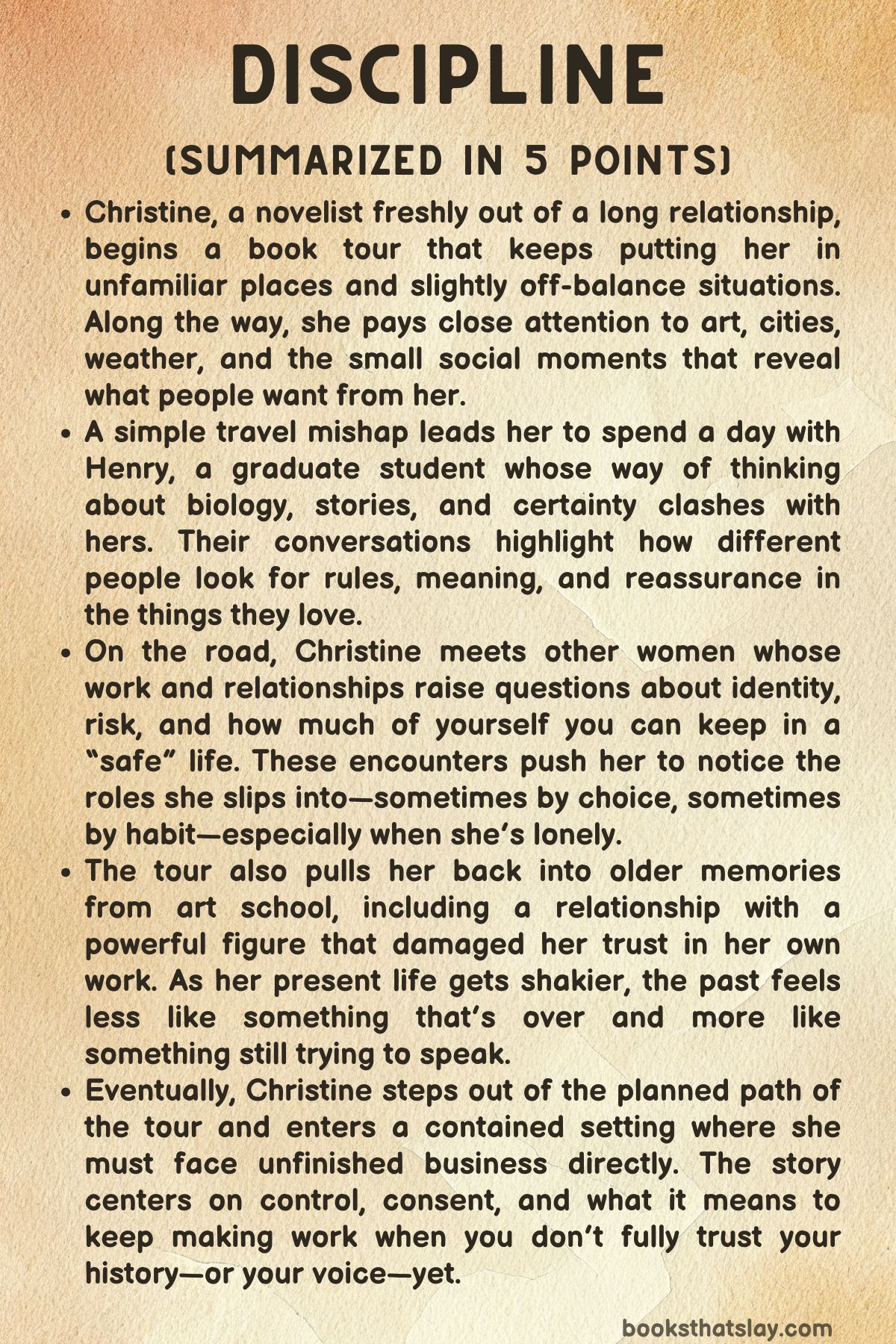
Characters
Christine
Christine is the novel’s steady lens and its most volatile weather system at once: a working writer moving through public rituals of “success” (airports, readings, receptions) while privately unraveling after the end of a long relationship. In Discipline, her suitcase going missing is more than a travel inconvenience—it echoes her larger disorientation, the feeling that her life has been picked up by someone else and carried off while she’s still expected to perform competence on schedule.
She is intensely observant, registering wind off the lake, museum light, motel errors, the texture of plastic sheeting, the grid of renovation film—details that function like emotional instruments, measuring how safe or exposed she feels. Christine’s voice continually tests the line between honesty and invention: she lies to Tyler that she is a figure skater and momentarily experiences the lie as a livable self, which shows how identity becomes a tool for survival when she is exhausted by being “herself.” Her central wound is creative and bodily at once: the collapse of painting after the professor’s betrayal is not framed as a simple career shift but as a severing of trust in her own perception and desire.
Writing becomes her substitute discipline—an art that can be done alone, controlled, revised, and made to “hold” what painting could no longer hold. Yet even writing doesn’t free her from the past; it becomes the very object that lures the old painter back into her life and forces her to confront the ethics of turning lived harm into narrative shape.
Across the story, Christine’s power is in refusing easy closure: she can be cruel, guarded, and withholding, but her refusal is also her integrity—she will not grant redemption on demand, will not permit a “tragic backstory” to launder damage, and will not accept someone else’s script for what her healing should look like.
Henry
Henry arrives as a seeming accident—an apology at museum steps—but quickly reveals the story’s interest in mismatched hungers: his hunger for connection, clarity, and rules contrasts with Christine’s guarded, process-driven relationship to meaning. He is intelligent and earnest, a scientist who talks about developmental signals and symmetry, and his scientific worldview shapes his emotional one: he likes noir and thrillers for their clear structure and distance from ordinary life, and he seeks similar clarity in conversation, wanting Christine’s reactions, her validation, her explanations.
Henry’s restlessness in the museum—his preference for large, dramatic abstractions and boredom with the small Celmins seascape—mirrors his impatience with subtlety in intimacy, as if he wants the “big” feeling without lingering in the work that produces it. His confession about Aya exposes him as someone who narrates his life in longing loops: he is currently attached to a girlfriend, yet still scans crowds for a past love, rehearsing an unfinished story rather than inhabiting the present.
That pattern culminates in his attempted kiss, which isn’t villainy so much as entitlement born from momentum—he mistakes shared time and disclosure for permission. Christine’s stillness becomes a boundary that the novel treats as an achievement: she does not negotiate, soften, or explain away her no; she simply refuses the move Henry believes is next.
By the time she leaves, Henry has become a cautionary figure about romantic projection: his emotional life is less about who is in front of him than about who he wants to find, and Christine can see him, already, wandering elsewhere.
Zoë
Zoë functions as both a character and an intellectual corridor, widening the book’s concerns from private pain into systems of identity, performance, and chosen selves. As a professor in queer studies researching internet communities, she offers Christine a language for the ways people invent and inhabit identities—names, genders, worlds—especially when their offline lives feel constrained.
Her conversation about online role-play isn’t presented as escapism but as real lived experience, and it resonates with Christine’s own impulse to try on other selves, whether through role-play with her ex during their decline or through the spontaneous lie to Tyler. Zoë’s personal conflict—her love for Karo and her fear that “easy” can become limiting—shows a different flavor of discipline: the daily practices of care, risk management, and compromise that accumulate around vulnerability.
Karo’s allergy changes the geometry of their life, shrinking spontaneity and expanding caution, and Zoë is torn between tenderness and panic, worried that leaving might look like abandonment and staying might become a quiet form of self-erasure. In this sense, Zoë is a mirror for Christine’s larger predicament: how to tell the difference between a life you choose and a life that simply happens to you, and how to exit a story without becoming the villain in someone else’s narrative.
Karo
Karo is mostly seen through Zoë’s account, but her presence is potent because it dramatizes how a single bodily event can reorganize desire, fear, and the limits of the possible. After the severe allergic reaction, Karo’s life becomes governed by vigilance—EpiPens, controlled cooking, an understandable suspicion of new experiences—and the relationship becomes shaped by the infrastructure of safety.
Karo embodies the theme that bodies remember and bodies dictate; her fear is not abstract but earned, and the novel treats it as a real constraint rather than a mere metaphor. At the same time, Karo’s situation exposes the emotional cost of constant caution for both partners: love becomes entwined with restriction, and the question becomes not “is this love real?” but “what kind of future can love sustain when the world feels like a threat?” Karo’s character helps clarify that discipline is sometimes survival practice, not self-improvement, and that what looks like limitation from the outside may be the only way someone can keep living inside their own skin.
Tyler
Tyler appears briefly, but his function is surgical: he offers Christine a stage for reinvention and reveals how quickly identity can be performed into temporary reality. He is a young man at a small-town bar, casual and curious, buying her a drink and asking the ordinary question—what do you do?—that becomes for Christine an opening to escape herself.
Tyler is less individualized than symbolic, yet he is not merely a prop; he represents the social ease of anonymity, the way strangers allow you to become whoever you say you are because they have no prior claim on your history. Christine’s choice to tell him she’s a figure skater is telling: she selects a discipline that is both athletic and aesthetic, a body trained to make difficulty look effortless, and she holds the lie “as if it’s real,” suggesting that what she wants is not deception but a different set of constraints—ones she can control.
Tyler’s presence also underscores the book’s attention to power in small interactions: he is polite, not predatory, and yet the scene still pulses with Christine’s desire to manage how she is seen, because being accurately seen has not always been safe for her.
Colin
Colin is the ex who returns not as a romantic prize or simple antagonist but as a study in self-narration, recovery, and the seductions of order. When Christine meets him again, he presents sobriety as a life architecture: he feels “no pain,” sleeps well, lives with careful rituals, and repeats his “story” so it does not harden into an unspoken black box.
That repetition is his discipline—an ongoing practice of meaning-making that keeps relapse and shame at bay. His Midstate Trail episode is a hinge moment that reveals the body’s tyranny in addiction: the panic as alcohol runs out, the shaking and sweating, the desperate drive for relief, the humiliating vomiting at a gas station.
The narrative doesn’t romanticize this; it shows sobriety as earned through terror and choice, then maintained through structure. Colin’s refusal of AA’s “higher power” element also characterizes him as someone who wants agency and logic, who will rebuild himself through systems he can understand—coding, work, design, routine.
In intimacy, he is deliberate to the point of choreography, removing Christine’s shoes as if he’s staging tenderness, and the sex that follows feels less like reconciliation than like two people testing whether their old map still fits. Colin also reveals a difference in how memory works between them: he missed her because she “knew him,” while she realizes she barely thought of him then, an honesty that punctures sentimental reunion narratives.
He offers compassion without demanding absolution—telling her it’s fine that things hurt and that regret cannot erase the life that made him himself—yet he also tries to draw her out, asking about family and being refused. With Colin, Christine confronts a haunting question: if your memory changes, if the museum painting looks smaller than you remember, does that mean you were wrong about what once saved you?
Colin’s steadiness suggests a possible answer—pain and error can be part of a life without invalidating it—but Christine is not ready to accept simplicity, even when it arrives in a gentle voice.
Nick
Nick enters as a small but crucial figure: the friend who rescues Colin at the breaking point and becomes the witness that makes change possible. In the sobriety story, Nick represents the difference between private suffering and shared reality; when Colin calls him, the crisis stops being a solitary spiral and becomes something another person can hold.
Nick’s agreement—his willingness to come, to drive, to hear “I have to stop,” and to accept that statement as real—gives Colin a social anchor for transformation. Though we do not see Nick in depth beyond this, his role matters because it shows that discipline is rarely purely internal; it often begins when someone else confirms that your life is worth saving and that your confession will not be punished.
Nick is an understated emblem of nonjudgmental support, the kind that doesn’t moralize but simply shows up.
Aya
Aya exists through Henry’s telling, and that distance is meaningful: she is less a fully present person than a persistent image Henry cannot stop consulting. In his narrative, Aya is associated with intimacy that deepened through writing—letters and emails—and then fractured through life choices, especially her tech job in San Francisco and the changes it brought.
What stands out is not the specific details of Aya’s character but how she functions as Henry’s unresolved template for desire: he admits he still hopes to run into her and scans faces, suggesting that Aya has become an organizing absence, a way to keep longing alive even while in another relationship. Aya’s partiality also points to how storytelling can distort people into symbols; Henry’s version of her may be accurate, but the novel emphasizes his fixation more than her reality.
Aya therefore becomes a character who demonstrates how memory can become a habit, and how the past can be used—consciously or not—to avoid the risks of fully choosing the present.
Frances
Frances is the sharpest mirror Christine has among her peers: a successful painter whose continued devotion to art is both admirable and terrifying, because it exposes what Christine lost and what she fears she can’t regain. Their reunion in Los Angeles is charged with the intimacy of shared history, and Frances’s directness—especially her observation that Christine’s protagonist never actually paints—cuts through Christine’s protective narratives.
That critique lands as both aesthetic and existential: it suggests that even in fiction, Christine cannot yet return to the act that was stolen from her; she can only circle it, prepare for it, be interrupted before it begins. Frances’s own story about a needy man intruding on her residency space shows how gendered entitlement keeps trying to colonize women’s work, and her confession that she paints because it’s the only thing that stops her from wanting to die places art not in the realm of career but of survival.
When Christine admits she wanted to die too after what happened with the professor, their friendship becomes a site of mutual recognition, not motivational uplift. The racist harassment they experience driving together further situates them in a world that polices bodies and belongs, reminding the reader that vulnerability is not only personal but social.
Frances thus embodies both continuity and refusal: she refuses to stop making, even when making is what exposes her to harm, and her existence challenges Christine to consider whether returning to art might not be a restoration of the old self but the invention of a new one.
Richard
Richard—first encountered as “the old painter”—is the novel’s densest knot of power, harm, artistry, and mortality. He is charismatic in the way institutions often reward: a known artist with a retrospective, a man whose work once read as bold and public, now quietly painting small seascapes in thin washes as his body fails.
His house smells of turpentine, his windows face the sea, and his life is sparse—prescription bottles and medical supplies he barely uses—suggesting a person who has long outsourced care to distance, reputation, and avoidance. Richard’s past cruelty toward Christine is not treated as an isolated sin but as a system of grooming and withdrawal: drawing her close, praising her, expanding her access, then abandoning her at the moment she most needed protection, letting critique destroy her while he stayed silent.
The harm he did is creative annihilation—he doesn’t just hurt her feelings; he helps collapse her belief in her own work until she gives away her supplies and leaves the program. When he reappears through emails and then physically on the Maine island, he arrives with a complicated claim: he is dying, estranged, and feels “remembered” by the way Christine’s novel mirrored and distorted their past.
His desire to speak is framed as urgent, but it is also self-serving, another attempt to control the story at the end. He wants recognition without pity, acquisition without condemnation, a record that flatters him even as his body collapses.
Richard’s illness introduces vulnerability, but Discipline refuses to let vulnerability automatically equal innocence. His late-stage pancreatic cancer, the vomiting, jaundice, and weight loss make him pitiable, yet he continues to exercise power through need, invitation, and provocation—asking if she still wants to kill him, claiming her book was meant to “set the record straight,” needling her about hiding that she’s an artist, treating the house-bequest idea as inevitable.
The most revealing moment is the haircut scene: even while physically weak, he reaches to touch her chest, reasserting the old entitlement, proving that the harm is not only memory but present behavior. His planned “good death” through assisted suicide powders becomes the ultimate attempt at control—choosing the terms, the timing, the aesthetic of exit.
Christine’s decision to flush the powders is therefore ethically tangled: she prevents his self-authored ending, partly from principle and partly from the ugly satisfaction of denying him what he wants. Their final confrontation in the bioluminescent water externalizes their power struggle into a physical one—two bodies in freezing dark, light sparking around them as if the ocean is recording every motion.
When Richard says she has given him too much power, he admits what has always been true: her life has been organized around his gravitational field, even in refusal. His last demand is not forgiveness but a choice—either let him ruin her life or move on—and Christine’s release of him is not mercy so much as a refusal to remain bound.
His disappearance forces her into the quiet aftermath where meaning must be made without the perpetrator’s presence, and the final image of Christine priming an unprimed canvas suggests that Richard’s story ends not with his redemption but with her return to beginnings on her own terms.
Julie
Julie appears as a name on Richard’s speedboat, and her offstage presence deepens his character by revealing how he stores grief inside possessions and labels. Naming the boat after a college girlfriend who died suddenly suggests a man who commemorates loss through objects rather than relationships, turning intimacy into a controlled artifact.
Julie’s death also complicates the temptation to see Richard as purely predatory; he has been wounded too, and he has carried that wound for decades. But the book’s logic does not allow his grief to absolve him.
Julie functions as a reminder that everyone has a story that could be framed as tragic, and that tragedy is not a moral credential. Her presence adds texture to Richard’s loneliness while reinforcing the novel’s insistence that pain and harm can coexist in the same person without canceling each other out.
Themes
Loss, Aftermath, and the Search for a New Center
Christine’s tour begins in a small disruption that quickly turns into a governing mood: the missing suitcase, the unfamiliar city by the lake, the sense of arriving a beat late to her own life. That practical loss works like a pressure point, forcing her to move through the day without the usual objects that signal stability and routine.
The broader loss is already present before the bag goes missing: the end of a long relationship has taken away the shared structure that used to organize time, attention, and self-understanding. What follows is not a neat period of mourning but a restless sequence of encounters, travel segments, museums, bars, and hotel rooms that function as temporary containers for feelings she cannot hold all at once.
The novel insists that “moving on” is not an internal decision Christine can make once and be done with; it behaves more like weather, changing across hours and places, sometimes calm and sometimes sharp. Even moments that seem neutral, such as standing by the lakeshore at night or watching the ferry wake at dusk, register as tests of endurance: can she face an expanse without immediately trying to fill it?
The story also treats endings as events that keep producing new endings. Christine meets people whose lives echo her own in altered forms: Henry who is stuck scanning crowds for a past love, Zoë who fears that choosing ease might turn into quiet surrender, Colin who rebuilds himself through order after addiction, and later Richard whose body is ending while his need to be seen remains urgent.
Each connection shows a different response to loss: romanticizing it, intellectualizing it, ritualizing it, or turning it into a claim on someone else. Christine’s own response is complicated by her role as a writer on tour, asked to speak smoothly about process and meaning while her private life feels unstable.
The public identity of “successful author” becomes a thin shell that can crack in ordinary moments, like when she spills water or cannot answer questions about family. In Discipline, loss does not simply cause sadness; it reorganizes power, desire, memory, and the body’s sense of safety.
Christine’s eventual turn back toward making something new does not erase what happened. It shows how survival can look like returning to a blank surface with the knowledge that the past will still be present, even if it no longer gets to dictate the next move.
Making and Unmaking: Creative Work, Faith in Process, and the Cost of Stopping
From the first reading event, Christine frames creativity as a practice of beginning without certainty. Her answer to the student about plans and faith points to a key tension: art starts as intention, then becomes a relationship with what emerges.
That idea recurs across the book through repeated scenes of looking, judging, and trying to decide what counts as “true.” At the museum, the disagreement about Vija Celmins’s wave painting becomes an argument about attention itself. Christine values time, labor, and quiet precision; Henry wants spectacle and instant impact.
The book uses that contrast to clarify Christine’s own standards: she is drawn to work that holds up under close looking, work that refuses to perform importance through size or drama. In the background is a critique of art worlds that elevate famous male abstraction while sidelining other forms of discipline, including careful representation and patience.
Christine’s sensitivity to this is not only aesthetic; it reflects her history of being trained, praised, and then dismissed in a setting where approval could be withdrawn without explanation.
The most severe creative rupture is the end of her painting life after the professor’s betrayal and the later critique where he stays silent as others attack her work. Silence becomes an artistic injury: not just a lack of defense, but a refusal to witness.
Christine’s exit from painting is portrayed not as a simple change of interest but as a loss of access to a part of her mind and body. She gives away supplies, avoids studios, and later writes a novel in which the protagonist kills an older male artist.
That fictional violence signals how creativity can become a site of retaliation when direct confrontation feels impossible. Yet the book refuses to romanticize the idea that turning pain into art automatically heals it.
Writing offers Christine a different kind of control: she can revise, sharpen, and complete. Painting, as she experienced it, demanded exposure, critique, and the risk of being seen before the work is ready.
Richard’s island seascapes complicate the meaning of artistic maturity. The famous abstract painter now makes small, quiet paintings while dying, as if returning to something elemental.
Christine’s final act of priming an unprimed canvas is not presented as a triumphant “return.” It is an intentional preparation, a choice to rebuild the conditions for making rather than waiting for inspiration or permission. The novel treats creative work as both refuge and battleground: a place where truth is sought, where control is negotiated, and where the self can be damaged when authority is abusive.
The book’s idea of discipline is not productivity culture. It is the sustained decision to keep working even when certainty is unavailable, and to reclaim the right to begin again.
Power, Grooming, and the Long Shadow of Violation
Christine’s history with her professor is described through a sequence that many readers will recognize as grooming: attention framed as mentorship, praise offered as special access, social inclusion used to blur professional boundaries, then a trip that changes the relationship and leaves Christine stranded in confusion. The narrative emphasizes how power works through ambiguity.
Nothing needs to be publicly declared for harm to occur; the imbalance itself is the mechanism. Once the professor withdraws, he does not need to attack her directly.
His silence in critique functions as a signal to the room: she is no longer protected, no longer favored, and therefore safe to tear apart. This shows how institutions can enable harm without overt rules being broken.
The professor’s status creates a climate where others participate, and Christine internalizes the humiliation as evidence of her own failure rather than evidence of an abusive dynamic.
The later parts of the book show how violations do not stay in the past. They reappear as anxiety, avoidance, and a distorted sense of what intimacy requires.
Christine meets men who test boundaries in smaller ways: Henry’s near-kiss that assumes entitlement to closeness because of a shared day, Tyler’s flirtation that invites her to become a different person for entertainment, and Colin’s carefully staged intimacy where tenderness is both real and controlling. Richard’s behavior becomes the clearest repetition: he invites Christine to his isolated home under the cover of conversation and reckoning, then touches her sexually when she is cutting his hair, turning a caregiving act into a moment of degradation.
The scene is important because it shows how the body can register disgust and fury even when the mind is still negotiating what is “allowed” to count as harm. Christine stays, not because she is confused about what happened, but because she is trying to extract something that has never been given: accountability that does not center the abuser’s comfort.
Richard’s confession that he is dying and felt “remembered” by her novel adds another layer: abusers can frame themselves as lonely, fragile, or misunderstood, and this framing can tempt victims into caretaking. The book keeps pressing on this trap.
Even when Richard apologizes, he does so in a way that tries to reduce the act to a past mistake rather than an abuse of power with lasting consequences. Christine’s resistance is not only moral; it is survival.
She refuses to let his story become the final story. The novel shows that violation is not limited to physical acts.
It includes theft of confidence, theft of artistic future, and theft of the right to define what happened. The theme’s force comes from its realism: even when Christine gets proximity to her abuser at the end, there is no clean closure, only the hard work of deciding what she will and will not allow to shape her life.
Identity as Performance, Experiment, and Escape
Christine repeatedly encounters situations where identity feels adjustable, sometimes by choice and sometimes by pressure. Zoë’s research on online role-play communities makes this explicit: people invent characters, genders, and histories, and those inventions can be more vivid than their offline presence.
Christine recognizes something familiar in that, not because she lives a double life online, but because she understands the desire to step out of the fixed story other people hold about you. The book treats role-play as both liberation and warning.
It can open room for self-discovery, but it can also become a way to avoid truth when truth feels too heavy or too exposed. Christine’s memory of role-playing as strangers with her ex during their relationship’s decline suggests the latter.
The experiment is meant to revive desire, but it also admits that the relationship’s real identity has become unlivable.
In the bar where Tyler approaches her, Christine tells a lie that is strikingly physical: she says she is a figure skater and holds the lie “as if it’s real.” The choice matters because skating is discipline, performance, and bodily control. In that moment, she wants an identity that is visible and admired, but also distant from her actual vulnerabilities.
The lie becomes a small rehearsal of what the tour already requires: to be someone coherent in public while feeling fragmented inside. The book also explores identity through creative mediums.
Christine used to be a painter, then becomes a writer; each role comes with different expectations, different forms of judgment, and different ways of being seen. Henry asks whether novels can feel true even when invented.
Christine answers by describing how life is reworked into fiction. That exchange positions identity as something authored: not fake, but shaped.
Race and gender intensify these dynamics. Christine and Frances being racially harassed in a car reveals how quickly identity can be forced on someone from outside, turning the self into a target regardless of personal intention.
In art spaces dominated by famous male names and in academic spaces where a professor’s gaze determines value, Christine’s identity is also negotiated under systems that reward compliance. Her reluctance to discuss family functions similarly: withholding becomes a boundary, a refusal to let strangers claim her origin story as entertainment or explanation.
The novel suggests that identity is not a single stable core that travel and time reveal. It is something that can be performed to survive, edited to make art, hidden to stay safe, and sometimes rewritten to see what else might be possible.
The danger is when performance stops being a choice and becomes a requirement imposed by others. Christine’s growth is not about finding one “true” self; it is about regaining the right to decide when and how the self is shown.
Memory, Competing Narratives, and the Fight Over What Is “Real”
The book is filled with reminders that memory is not a private archive. It is contested territory.
Christine receives an email from her ex with the message, “That’s not how I remember it,” and the line lands like a warning: the past is not only painful, it is arguable. This matters because Christine is a novelist whose work draws from life.
When she writes, she turns experience into a shaped narrative with pacing, emphasis, and scenes that carry symbolic weight. That shaping can feel like clarity, but it also creates vulnerability: other people may read themselves into the work and demand control over their representation.
The professor’s later emails, his comments on her readings, and the implication that he follows the tour through burner accounts show a disturbing form of surveillance. He is not only haunting her memory; he is trying to insert himself into the present as an interpreter of her story.
Richard’s reaction to Christine’s novel is especially fraught. He says the book “mirrored and distorted” their past, and his tears are framed as a response to being seen.
Yet the book makes clear that being seen is not the same as being held accountable. Richard wants recognition without consequence, voice without surrendering authority.
The question of what is real becomes a power struggle: whose account stands, whose pain counts, whose version becomes the official one. Christine’s own uncertainty appears in the museum scene with Frankenthaler, when the painting looks smaller and emptier than she remembered.
The change suggests that memory can be sincere and still wrong. That possibility frightens her because she worries that misremembering means misjudging happiness, misjudging love, misjudging her own life.
Colin’s response offers a counterpoint: being wrong does not make her morally defective. It means time changes perception, and perception is not a contract.
The fossil description at Ghost Ranch pushes this theme into material metaphor: fossils as stone memory, a mineral outline of living cells rather than the original body. The past remains as shape and impression, not as recoverable substance.
Christine’s writing behaves similarly: it preserves outline, intensity, and pattern, but it cannot resurrect the past without transforming it. The novel does not argue that there is one correct version of events waiting to be discovered.
It argues that telling the story is part of survival, and that control over the telling is often what abusers and ex-partners fight for. Christine’s final movement toward painting again is also a movement toward a form of memory that does not rely on argument.
The canvas can hold feeling without requiring consensus. The theme resolves not by proving who is right, but by showing Christine stepping out of the courtroom of competing narratives and back into the act of making.
Control, Ritual, and the Desire for Order After Chaos
Several characters in the book build systems to manage what feels unmanageable. Colin’s sobriety story is the clearest example.
His account of the trail, the panic as alcohol runs out, the physical collapse, and the humiliating rescue clarifies addiction as a form of captivity. When he stops drinking, he replaces chaos with rituals: ambient music, deliberate routines, a carefully designed apartment, even the intimate gesture of removing Christine’s shoes.
These acts are not only aesthetic. They are scaffolding, a way to keep life from sliding into the old pattern.
Colin repeats his sobriety “story” so it does not become a sealed-off source of pain. That repetition turns narrative into maintenance, like checking a lock each night.
The book invites respect for this discipline while also showing its interpersonal consequences. Order can soothe, but it can also create distance.
Christine senses that Colin is “different,” and the difference raises questions about intimacy: what does closeness mean when one person’s stability depends on control?
Zoë’s girlfriend Karo also embodies control as safety. After a severe allergic reaction, Karo cooks cautiously, carries EpiPens, and fears new experiences.
The relationship becomes “easy” partly because risk is minimized. Zoë’s worry is not only about boredom.
It is about whether safety can quietly turn into shrinking. Christine sees herself in this dilemma: after betrayal and humiliation, avoiding risk feels reasonable, yet it can also freeze the self in a defensive posture.
Even Richard, who appears reckless, is obsessed with control. He wants a “good death” on his own terms, and later he tries to secure an assisted death prescription.
He also wants control over Christine’s attention, her schedule, even her inheritance, announcing he will leave her the house as if decision-making is his natural right.
Christine’s own relationship to control is conflicted. Writing gives her revision and completion, but it can also become a way to turn life into a finished object so it stops surprising her.
Tour logistics, canceled events, and the unsettling plastic sheeting in the Taos cottage intensify her sense that the world is full of systems that can fail without warning. The suitcase mix-up at the start is a smaller version of this: identities and belongings can be swapped; official processes can correct it, but not quickly enough to prevent the fear.
The book treats control as neither virtue nor vice. It is a response to vulnerability.
The question is where control is directed: toward self-care and steadiness, or toward domination of others. Christine’s final act of preparing a canvas suggests a healthier control: not controlling outcomes or people, but controlling conditions for work, attention, and recovery.
It is structure without coercion, order without the need to erase uncertainty.
Mortality, Agency, and the Ethics of Letting Go
Richard’s terminal illness forces the book to confront death not as an abstract idea but as a negotiation of agency, fear, and dependence. Richard wants a death that feels dignified, and he imagines it happening on the water, in beauty, without panic.
He also wants Christine as witness, and that desire complicates everything. His vulnerability is real, but it does not cancel his history of exploiting power.
When he asks Christine whether she still wants to kill him, he is naming the violence he inspired in her imagination, but he is also trying to control the frame: to turn her anger into a dramatic question he can manage. The assisted death prescription introduces an ethical crisis that is intimate rather than philosophical.
Christine destroys the powders and then experiences two conflicting responses: satisfaction at blocking his plan and grief at taking away what might have been a merciful ending. The book does not treat her action as purely heroic or purely cruel.
It shows how trauma can make someone refuse to grant mercy to the person who harmed them, even when mercy might be morally compelling in isolation.
The ocean scenes, especially the bioluminescent swims, connect mortality to bodily immediacy. The glowing water is not sentimental comfort; it is a reminder that life is physical, strange, and fleeting, and that fear can sit beside awe.
Richard’s final attempt to swim away from the boat is an extreme assertion of agency: a choice to exit on his own timing. Christine’s chase and struggle with him in the freezing water becomes the book’s emotional core because it stages their entire relationship as a fight over power.
Richard begs to be released; Christine refuses because she cannot bear the idea that he gets to decide the ending after taking so much from her. When Richard tells her she has given him too much power, he is admitting that her fixation has kept him central, even in hatred.
His final challenge is blunt: either let him continue to ruin her life or move on.
Christine’s decision to let go is not forgiveness. She explicitly says she cannot forgive him.
Letting go is framed as refusing the arrangement where his life and death remain the organizing principle of her inner world. It is also a recognition that keeping him alive for her own unresolved needs is another form of captivity, for both of them.
The Coast Guard search lights after Richard disappears show the impersonal aftermath: institutions arrive, procedures begin, the world keeps moving. In that ordinary continuation, Christine finds the possibility of returning to herself.
Priming the canvas after his disappearance connects mortality to creation: endings can clear space, but the space must be actively claimed. In the novel, agency is not portrayed as absolute freedom.
It is a series of choices made under pressure, with imperfect information, in a body that remembers harm. The ethical work is not to find a pure stance, but to act in a way that no longer hands the past the authority to decide what comes next.