Disenchanted Summary, Characters and Themes
Disenchanted by Lucy Jane Wood is a fantasy novel about Sage Hemlock, a museum scholar who has spent fifteen years fearing the very magic that makes her a witch.
Her life is built around restraint, research, and the belief that abandoning magic will protect everyone she loves, yet the arrival of an old grimoire connected to historical witch Lilara Mournfell forces Sage into a living fairy tale. What begins with playful transformations gradually becomes a dangerous curse that attacks identity, family, love, and self-worth. At its center, the story asks whether pain comes from who we are or from the meanings fear teaches us to attach to ourselves. It’s the 3rd book of the Selcouth series.
Summary
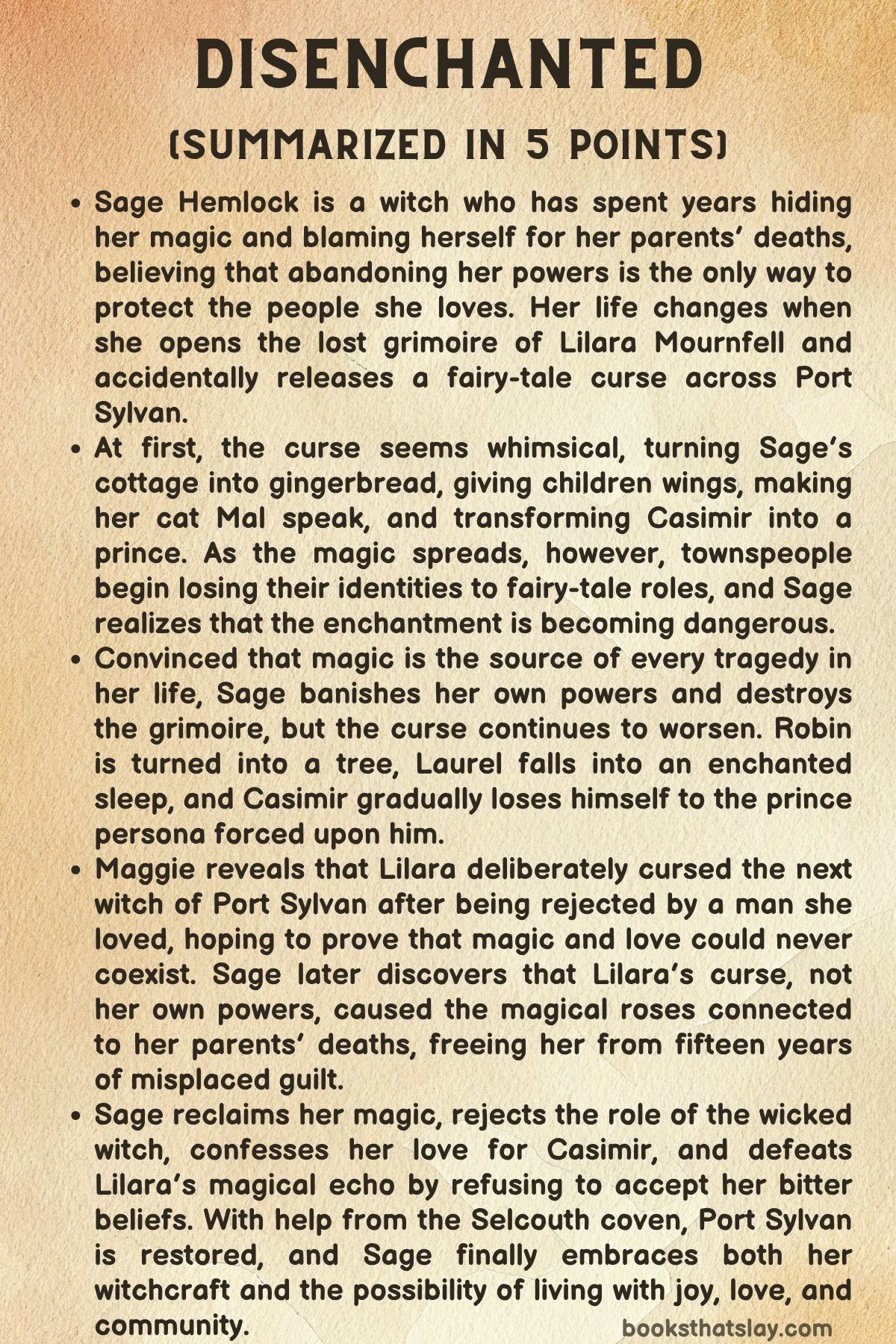
Sage Hemlock works at the heritage museum in Port Sylvan, where she gives tours devoted to the town’s supernatural history while carefully hiding the fact that she is a real witch. Her deepest academic fascination is Lilara Mournfell, a historical woman who supposedly abandoned her magic because she believed her powers endangered others, and Sage has spent years treating Lilara as proof that she too can one day become ordinary.
Sage’s fear of witchcraft is rooted in the death of her parents when she was fifteen. Her powers had recently emerged, and because magical changes appeared around flowers she had gathered shortly before their deaths, she became convinced that her own abilities had poisoned them.
Since then, Sage has lived under strict emotional control, using magic as little as possible while obsessively researching methods of removing it altogether. She is supported by Casimir Everald, her longtime friend and museum colleague, who knows that she is a witch and repeatedly challenges her belief that magic makes her dangerous.
Casimir is energetic, theatrical, affectionate, and almost completely opposite to Sage’s guarded personality. Their teasing friendship conceals a deep emotional intimacy, while Sage’s siblings Robin and Laurel, her ghostly housemate Maggie, and her cat Mal make up the small circle she allows herself to love.
As October progresses, Sage’s magic becomes increasingly unstable. Objects move, plants grow unexpectedly, lights break, food changes, and even ordinary surroundings begin responding to her presence, leaving Sage convinced that something outside herself is stimulating her dormant power.
The museum then receives an unexplained package containing an old leather-bound book marked with the same celestial symbol found on Lilara Mournfell’s surviving cloak. When Sage discovers that one of the cloak’s star charms fits the book’s lock, she realizes that the mysterious object may be Lilara’s lost grimoire.
Ignoring Casimir’s warnings, Sage opens the book and reads a glowing incantation that appears across its pages. Golden magic erupts from the grimoire, another voice seems to join Sage’s own, and a strange spell declares that rejected magic will grow until it spreads everywhere.
By the following morning, Sage discovers that her cottage has transformed into a gingerbread house. Soon afterward, schoolchildren sprout fairy wings and pointed ears, Casimir’s shadow behaves independently, and other impossible changes begin spreading through Port Sylvan.
Sage eventually admits to Casimir that she activated Lilara’s grimoire, and together they begin investigating its connection to the transformations. A celestial charm chain taken from Lilara’s cloak attaches itself to Sage’s wrist like a bracelet, with individual symbols appearing to correspond to each supernatural event.
A beanstalk rises into the clouds, Mal gains the ability to speak, residents acquire fairy-tale clothing, and Casimir becomes dressed as an elaborate prince. Instead of immediately destroying the enchantment, Sage is persuaded by Casimir, Robin, and Laurel to consider the possibility that Lilara’s magic might be encouraging her to experience wonder rather than punishment.
For the first time in years, Sage begins using magic willingly. She casts a concealment spell to protect Port Sylvan from outside witches, rescues a man from enchanted water, outsmarts a troll through riddles, and even shrinks the obnoxious Patrick Gamble into a jam jar when his recklessness becomes unbearable.
These experiences make Sage unexpectedly happy. Her own powers calm when she stops suppressing them, and she begins rediscovering the imaginative, playful person she was before her parents died.
Her relationship with Casimir also changes. His admiration becomes increasingly personal, and their long-standing friendship approaches romance as he openly praises Sage’s intelligence, courage, magical ability, and beauty.
Sage even recreates one of the first spells she ever cast as a teenager, producing a small heart-shaped flame. Instead of feeling ashamed afterward, she experiences happiness and nostalgia, suggesting that her earliest relationship with magic was not based on destruction at all.
The enchantment, however, begins becoming more threatening. Laurel is bruised after travelling in a transformed pumpkin carriage, Robin is injured by a magical axe, Patrick’s personality is altered by his assigned role, and residents increasingly behave as though they are characters following scripts rather than autonomous people.
Sage also becomes disturbed by the fact that everyone seems to receive an obvious fairy-tale identity except her. When an enchanted mirror finally shows Sage visually aligned with Lilara’s witch imagery, she concludes that her assigned role must be the wicked witch.
Her fears worsen after moonlight reveals a hidden message inside the grimoire. The words appear to describe a witch doomed to loneliness and incapable of being truly loved, confirming Sage’s long-held belief that magic inevitably destroys happiness.
Unable to tolerate the possibility that her powers will hurt Casimir, Robin, or Laurel, Sage secretly destroys years of magical research and performs a banishment spell. Her magic leaves her body and enters Lilara’s grimoire, after which Sage throws the book into a fire, believing she has finally protected everyone.
Instead of relief, she feels hollow and bereaved. Even worse, the fairy-tale curse does not disappear: the gingerbread cottage remains, Casimir is still a prince, Mal can still speak, and a vast enchanted forest overtakes part of Port Sylvan.
The curse then becomes openly dangerous. Residents lose themselves inside repetitive fairy-tale identities, and Sage discovers Robin transformed into a living tree after being lured into the forest by an imitation of Laurel’s voice.
Laurel has also been captured by the story, lying unconscious in a golden cage at the top of a magically altered tower. Sage can do little for either sibling because she has willingly surrendered the power that might have helped her fight the enchantment.
A clue eventually sends Sage and Casimir back to Maggie. The ghost recognizes Lilara’s bracelet and reveals that she personally knew Lilara, whom she called Lily, when they were young.
Maggie’s preserved letters completely overturn Sage’s historical interpretation. Lilara had once loved her magic and joyfully revealed it to a man she trusted, but when he rejected her because she was a witch, Lilara redirected her anger toward her own powers.
She eventually removed her magic in the hope that doing so would make her worthy of love. Her bitterness then became cruelty, and before leaving Port Sylvan she deliberately created a curse intended for the next witch who inherited the town’s magical legacy.
The enchantment was designed to give that future witch wonder, love, and happiness before violently taking them away. Lilara wanted another witch to reach the same conclusion she had reached: that magic and love could never coexist.
Sage realizes that she has spent years admiring someone whose suffering closely resembles her own but whose conclusions were deeply distorted by rejection. Yet understanding Lilara does not immediately free Sage from self-blame, because she still believes her own magic killed her parents.
By Halloween, Casimir’s prince identity has nearly consumed him. Under the curse’s influence he draws his sword against Sage, sees her as the wicked witch who must be destroyed, and is stopped only when Maggie and Mal intervene.
Sage then enters the transformed Equinox Gallery, now a fairy-tale castle, where she encounters a magical echo of Lilara. Lilara claims the curse was intended as protection and insists that no one can genuinely love a witch, but Sage finally challenges the woman she once treated as her intellectual hero.
Sage recognizes that Lilara’s magic did not cause her rejection; the man who feared her made that choice. She also understands that suppressing magic did not save Lilara from pain but allowed bitterness to define her life.
Lilara sends Sage into a magical labyrinth, where Sage begins treating herself with compassion instead of automatic condemnation. At its center, she finds the supposedly destroyed grimoire and senses her own abandoned power waiting inside it.
Sage finally understands the difference between possessing power and choosing how that power is used. Lilara’s magic became destructive because Lilara used it to punish someone else, whereas Sage’s power does not carry an automatic moral identity.
When Sage opens the grimoire, she is taken into a recovered memory of herself at fifteen. She sees that the roses she gathered for her parents were completely ordinary and that another supernatural force was already present around her emerging witchcraft.
The truth is devastating but freeing: Sage did not transform the roses that killed her parents. Lilara’s curse had already attached itself to the next witch of Port Sylvan and was responsible for the unnatural black roses connected with their deaths.
Sage therefore spent fifteen years punishing herself for an act she never committed. Her magic returns to her, not as a threat but as a restored part of herself, and she confronts Lilara with a confidence she has never previously possessed.
When Casimir arrives under the control of his princely identity, Sage refuses to see him as proof that she is unlovable. She uses magic and knowledge of fairy-tale conventions to redirect him toward a dragon, giving herself time to confront Lilara without harming him.
Sage then openly declares that she loves Casimir and that her feelings existed before any enchantment created their fairy-tale roles. At midnight she rejects the identity of the wicked witch, refuses Lilara’s worldview, and breaks the curse.
Afterward, Casimir returns to himself and explains that even while the curse was taking over his mind, his memory of Sage remained strong enough for him to resist completely disappearing. He confesses that he has loved her for years, and Sage finally admits that her feelings for him are equally deep.
A mysterious doorway then leads Sage and Casimir to Hecate House, headquarters of the Selcouth coven. Instead of finding the threatening organization she imagined, Sage encounters witches who are surprised that she escaped their attention and who respond to her story with concern rather than punishment.
For perhaps the first time in her adult life, Sage chooses to ask others for help. The coven restores Port Sylvan, frees Robin and Laurel, reverses the magical transformations, and even recovers the research Sage believed she had destroyed.
Sage refuses to erase Lilara from history, recognizing that understanding someone’s suffering does not require excusing the harm that person caused. Lilara’s grimoire remains part of the museum exhibition as evidence of both her importance and her destructive choices.
Maggie also gains new possibilities through the coven, while Mal retains his ability to speak. Most importantly, Sage ends the story no longer hiding from the central truth about herself.
At the delayed Halloween celebration, Sage wears a witch’s hat and cloak openly. When a child asks what she is, she proudly answers that she is a witch and embraces the magic she once believed she needed to destroy.
Characters
Sage Hemlock
Sage Hemlock is the emotional and psychological center of Disenchanted, and nearly every major conflict grows from the difference between who she actually is and who she believes herself to be. Intelligent, sarcastic, intensely organized, and academically driven, she has built her adult identity around controlling anything that might expose vulnerability.
Her greatest contradiction is that she studies magic obsessively while refusing to accept her own. Scholarship gives her a way to remain close to witchcraft while pretending she is approaching it objectively, so her museum career becomes both an intellectual vocation and an elaborate method of emotional avoidance.
Sage’s guilt over her parents’ deaths shapes nearly every decision she makes. She interprets responsibility in absolute terms, believing that because her magic appeared near the time of the tragedy, she must have caused it, and this belief turns self-denial into what she considers a moral obligation.
Her protectiveness toward Robin and Laurel comes from the same source. Sage loves her siblings deeply, but she often turns that love into control because she believes preventing every possible danger is the only way to compensate for failing to save their parents.
Her relationship with Casimir reveals another side of her personality. He can irritate, challenge, comfort, and amuse her in ways few others can because he knew her before her defensive identity became completely fixed, and his acceptance repeatedly contradicts Sage’s belief that being fully known will lead to rejection.
The fairy-tale curse becomes transformative because it forces Sage to experience magic outside the framework of guilt. When she solves riddles, rescues people, casts protective spells, laughs while shrinking Patrick, and recreates her childhood heart-shaped flame, she discovers that power can produce pleasure, connection, creativity, and protection.
Her lowest point arrives when she banishes her magic. The emptiness that follows proves that removing witchcraft does not remove grief, fear, or responsibility; instead, Sage realizes that she has amputated part of her identity in an attempt to solve emotional wounds that magic never created.
By the end of the novel, Sage’s greatest achievement is not defeating Lilara but changing the way she judges herself. She accepts that mistakes made under fear do not define her forever, acknowledges that asking for help is a form of strength, and chooses to identify proudly as a witch rather than treating witchcraft as evidence of moral corruption.
Casimir Everald
Casimir is Sage’s closest friend, research partner, emotional anchor, and eventual romantic partner, making him one of the most important forces in Disenchanted. His theatrical personality, social ease, humour, and willingness to embrace absurdity contrast sharply with Sage’s need for control.
Beneath his playful behaviour is considerable emotional intelligence. Casimir understands when Sage needs teasing, when she needs physical reassurance, when her obsessive work has gone too far, and when her claims of independence are actually attempts to isolate herself.
He has known Sage’s secret since university, when he witnessed one of her most frightening magical episodes and responded with acceptance instead of fear. That memory matters because Casimir becomes living evidence against Sage’s assumption that discovering the truth about a witch automatically leads to rejection.
Casimir also refuses to treat Sage as fragile. He questions her beliefs about Lilara, challenges her desire to erase her magic, and repeatedly reminds her that she is not responsible for everything that happens around her.
His transformation into a fairy-tale prince initially appears humorous, but it ultimately becomes one of the curse’s cruelest attacks. As his personality is gradually overwritten, Casimir loses control of his speech and behaviour until he is compelled to hunt Sage as the supposedly wicked witch.
Even then, his emotional connection to Sage survives. After the curse breaks, he explains that his memory of her remained stronger than the artificial identity trying to replace him, showing that his love is not a magical fabrication created by the fairy tale.
Casimir’s eventual confession completes an emotional arc that has been present throughout the story. He does not love Sage despite her witchcraft; he loves the whole person, including her intelligence, severity, vulnerability, strange humour, scholarship, and magic.
Lilara Mournfell
Lilara Mournfell is both the historical obsession and central antagonist of Disenchanted, but the novel refuses to reduce her to a simple villain. For much of the story, Sage interprets Lilara as a brave woman who recognized the danger of witchcraft and sacrificed her powers to protect others.
The truth reveals a much more complicated person. Lilara once loved magic and wanted to share it, but rejection by a man she trusted caused her to reinterpret the source of her pain.
Rather than holding the man responsible for his prejudice and cowardice, Lilara concludes that witchcraft itself makes love impossible. Her banishment of magic therefore comes from shame and desperation, not from the noble self-sacrifice Sage has imagined.
Lilara becomes most disturbing when private suffering develops into a desire to reproduce that suffering in someone else. Her curse is constructed so that another witch will discover joy and love before losing them, because Lilara wants her bitterness to become a universal truth rather than admit that her own conclusion might have been wrong.
The magical echo Sage meets is therefore trapped inside a worldview created by pain. Lilara genuinely seems to believe she is protecting Sage, which makes her cruelty more revealing: she has mistaken the repetition of trauma for wisdom.
Sage’s final rejection of Lilara is also a rejection of inherited self-hatred. She can acknowledge the loneliness and rejection that damaged Lilara while refusing to excuse the deliberate suffering imposed on innocent people.
Robin Hemlock
Robin is the practical, dependable middle Hemlock sibling and provides a steady counterweight to both Sage’s anxiety and Laurel’s enthusiasm. He loves Sage without accepting her belief that she must spend the rest of her life compensating for their parents’ deaths.
His relationship with Sage reveals how distorted her guilt has become. From Robin’s perspective, she is not the dangerous older sister who failed him but someone who has carried an impossible burden long after everyone else stopped asking her to carry it.
Robin’s woodsman transformation turns his reliability against him. When he hears what sounds like Laurel calling for help, he immediately enters the forest because protecting his younger sister is as instinctive for him as protecting everyone is for Sage.
His transformation into a tree is one of the curse’s most severe attacks on Sage. She has spent years believing vigilance will keep her siblings safe, yet Robin’s fate demonstrates that self-punishment has never given her the control she imagines it provides.
Even while trapped, Robin tells Sage to run rather than sacrifice herself for him. His response reinforces an important reality she repeatedly forgets: her family members are not passive people waiting for her protection but individuals who love and protect her in return.
Laurel Hemlock
Laurel brings imagination, impulsiveness, optimism, and fairy-tale enthusiasm into Disenchanted, making her temperament almost perfectly suited to the enchantment’s earliest stages. Where Sage sees danger, Laurel often sees possibility, adventure, and wonder.
Her belief that whimsy can be another form of joy becomes an important challenge to Sage’s worldview. Laurel does not deny that magic carries risk, but she questions whether avoiding every uncertain experience is actually the same thing as living safely.
Laurel also understands that Sage’s overprotectiveness is connected to grief. She and Robin repeatedly reject Sage’s assumption that their parents’ deaths created a permanent debt she must repay through constant sacrifice.
The curse eventually uses Laurel’s fairy-tale openness against her. Her transformation into a sleeping princess inside a tower shows how a role that first appears beautiful can become imprisonment when it overrides individual choice.
Sage’s reaction to Laurel’s helpless condition exposes the limits of protective control. She cannot force her sister awake, cannot immediately solve the enchantment, and must finally confront how much of her identity has been constructed around preventing losses that no person can completely prevent.
Maggie
Maggie is the Victorian ghost who shares Sage’s cottage and functions as both domestic companion and moral guide. Although permanently bound to the house for much of the novel, she frequently possesses a healthier understanding of freedom than Sage does.
Her conversation with Sage about being cursed is especially significant. Maggie points out that Sage would never blame her for tuberculosis or for becoming a ghost, exposing the double standard Sage applies when judging her own suffering.
Maggie also embodies the idea that circumstances do not determine moral worth. She cannot control the supernatural condition that trapped her, but she can decide how she treats others and what kind of presence she becomes in their lives.
Her connection to Lilara transforms her importance in the plot. Maggie knew Lily as a real girl rather than a historical legend, allowing Sage to replace academic projection with personal evidence.
The letters Maggie preserved reveal both Lilara’s earlier joy and her later bitterness. Through Maggie, the past stops functioning as a myth that Sage can manipulate to support her fears and becomes a more complicated human history.
Maggie’s loyalty is also practical rather than merely comforting. She helps save Sage when Casimir attacks under the curse’s influence, supports her after she loses her magic, and eventually receives assistance from Selcouth that expands her own possibilities beyond the cottage.
Mal
Mal begins as Sage’s ginger cat but becomes a far more active character when the curse gives him speech. His sarcasm and demanding behaviour provide comic energy, yet his conversations with Sage are often surprisingly perceptive.
Because Mal has lived closely with Sage without participating in her historical theories, he approaches her guilt with unusual simplicity. He sees a frightened child who tried to do something loving for her parents rather than a dangerous witch responsible for murder.
His insistence that Sage deserves forgiveness, pleasure, and magic directly opposes the internal rules by which she has lived. He cannot provide proof that her interpretation is wrong, but he recognizes how cruelly she treats herself.
Mal also demonstrates loyalty through action. He helps protect Sage from Casimir during the prince persona’s attack and remains one of the companions who refuses to abandon her even after she has surrendered her powers.
His continued ability to speak after Port Sylvan is restored suits his personality perfectly. Mal does not merely survive the fairy-tale disruption; he keeps one of its impossible gifts, suggesting that not every magical change needs to be erased simply because it came from a dangerous event.
Bonnie
Bonnie is one of the senior Selcouth witches Sage meets after entering Hecate House. Her importance comes partly from how completely she contradicts the threatening image Sage has constructed of organized witchcraft.
Rather than punishing Sage for hiding or treating her as irresponsible, Bonnie responds to the Port Sylvan crisis as someone interested in helping. This reaction reveals how much of Sage’s fear of the coven has been shaped by isolation and assumption rather than direct experience.
Bonnie also represents competence without emotional coldness. Her ability to use Earth Sorcery to help remove the magical thorns and beanstalk demonstrates that power can be practiced collaboratively and responsibly.
Through characters like Bonnie, Sage encounters a model of witchhood based on community rather than secrecy. The experience offers her a future in which magic can be learned, discussed, corrected, and shared instead of hidden.
Arty
Arty is another senior figure at Hecate House and plays an important role in showing Sage what support can look like after years of self-reliance. In Disenchanted, Arty represents an institution that has learned to value second chances rather than demanding perfection.
Arty immediately recognizes a problem Sage has rarely been able to articulate: highly capable people are often left unsupported because everyone assumes they can handle everything themselves. That observation speaks directly to Sage’s exhausting habit of becoming the person who researches, protects, fixes, and endures without asking for assistance.
The magical library Arty shows Sage is also symbolically important. Sage has always used scholarship as a defensive structure, but Hecate House offers the possibility that research can become an expression of curiosity and community instead of fear.
Through Arty, Sage begins imagining a future in which expertise does not require isolation. Learning can coexist with wonder, and responsibility does not have to mean carrying every problem alone.
Patrick Gamble
Patrick Gamble functions as a secondary character, but his transformation helps expose both the comic and threatening qualities of the fairy-tale enchantment. Dressed as a knight, he becomes convinced that he must perform heroic acts even when his actions create additional danger.
His accusation that Sage is a witch and a hag reflects the familiar fairy-tale tendency to divide people into simplistic moral roles. Sage’s response is important because she no longer reacts only with fear or concealment.
Instead, she uses scholarship to understand the troll, magic to control the situation, and humour to deal with Patrick himself. Shrinking him into a jam jar becomes one of the moments when Sage realizes that using power does not automatically make her cruel.
Patrick later becomes evidence that the enchantment is doing more than changing appearances. His increasingly role-driven behaviour helps Sage recognize that the curse is capable of rewriting personality and therefore must eventually be stopped.
Bridgey
Bridgey becomes important during the darker phase of the curse when Sage and Casimir discover her trapped inside a repetitive fairy-tale routine. She serves porridge and repeats the same behaviour again and again, with little sign of her ordinary personality.
Her condition provides one of the clearest demonstrations of what is truly at stake. The danger is no longer unusual clothing, impossible buildings, or humorous transformations but the replacement of personal identity by predetermined roles.
Bridgey’s fate also forces Casimir to acknowledge that Sage’s concerns were justified. What had once seemed like magical celebration has become a system in which people are losing their freedom to think, speak, and behave as themselves.
Themes
Self-Acceptance and the Rejection of Shame
The central emotional struggle in Disenchanted concerns the damage caused when a person treats an essential part of themselves as something that must be removed before they deserve safety or love. Sage does not merely dislike her magic; she has transformed rejection of it into a moral principle, believing that suppressing herself is evidence of responsibility.
Her eventual banishment of magic reveals the weakness in that belief. Once her power is gone, Sage does not become peaceful, safe, or emotionally free; she becomes hollow because the spell has removed part of her identity without touching the grief and fear that originally made her hate it.
Lilara represents the destructive endpoint of the same logic. After being rejected by someone she loves, she concludes that magic makes her unworthy of love and eventually builds an entire curse around forcing another witch to reach the same conclusion.
Sage breaks the pattern when she understands that identity is not equivalent to moral destiny. Magic can be used protectively or destructively just as intelligence, love, anger, and grief can, meaning the ethical question lies in choice rather than existence.
Her final willingness to call herself a witch publicly is therefore more than a declaration of supernatural identity. It marks the moment when she stops asking whether she must become someone else before she is allowed to participate fully in her own life.
Guilt, Grief, and the Illusion of Control
Sage’s guilt over her parents’ deaths gives her the illusion that constant vigilance can prevent future loss. If she caused the original tragedy, then perhaps becoming more careful, more controlled, and less magical can guarantee that nothing similar ever happens again.
That belief is psychologically appealing because guilt can feel easier to manage than uncertainty. Accepting that terrible events may happen without being entirely preventable would force Sage to acknowledge that loving people always involves vulnerability.
Her behaviour toward Robin and Laurel shows the consequences. She protects them compulsively because she believes another loss would prove that she has failed again, yet neither sibling asks her to live this way.
The curse systematically destroys Sage’s illusion of control. Robin becomes a tree, Laurel falls into an enchanted sleep, Casimir turns against her, and the town continues changing even after Sage has sacrificed her magic.
These events force Sage to recognize that self-punishment cannot purchase safety. Control has never been the same thing as care, and constantly anticipating disaster has not prevented suffering; it has mostly prevented Sage from enjoying the relationships she is so desperate to preserve.
The recovered memory of her parents finally separates grief from guilt. Once Sage learns that Lilara’s curse altered the roses, she can mourn what happened without continuing to treat herself as the cause.
Love as Recognition Rather Than Rescue
Love in Disenchanted is meaningful because it does not require Sage to become less herself. Casimir, Robin, Laurel, Maggie, and Mal repeatedly care for her without accepting her belief that she must eliminate her magic to deserve that care.
Casimir provides the clearest romantic version of this idea. He knows Sage is a witch long before their friendship becomes romantic and never treats her magic as a defect that must be corrected.
His eventual confession matters because it directly answers Lilara’s central fear. Lilara believes being fully known as a witch makes genuine love impossible, while Casimir’s affection becomes deeper precisely because he knows Sage’s difficult, brilliant, magical, anxious, stubborn self.
Yet the novel avoids presenting romance as the thing that cures Sage. Casimir can challenge her beliefs and remain beside her, but Sage still has to decide that she deserves a life larger than fear.
The other relationships reinforce the same principle. Robin and Laurel refuse to let Sage define herself through responsibility for them, Maggie challenges her harsh moral reasoning, and Mal insists that the frightened teenager she once was deserves compassion.
Love therefore becomes a form of recognition rather than rescue. Sage’s relationships matter because other people see parts of her that shame has taught her to misinterpret, but her transformation becomes complete only when she begins seeing those parts differently herself.
Stories, Roles, and the Freedom to Choose
Fairy tales are not simply decorative elements in the novel; they become a way of examining the danger of allowing inherited stories to determine identity. Port Sylvan’s residents gradually stop behaving like themselves because the curse forces them into familiar categories such as prince, princess, knight, woodsman, sleeping maiden, and witch.
At first, these roles appear playful because they give ordinary life colour and imagination. Their danger becomes clear when the people assigned to them lose the ability to choose how they speak, act, and understand others.
Sage has been doing something similar to herself long before Lilara’s enchantment begins. She has accepted an internal story in which magic creates tragedy, witches are dangerous, responsible people suppress desire, and protecting others requires personal sacrifice.
Lilara is even more completely trapped by such a narrative. She turns one man’s rejection into a universal rule that no witch can be loved, then creates a curse intended to make reality conform to that belief.
Sage’s final victory comes when she refuses the role offered to her. She is told that she is the wicked witch, yet instead of behaving according to the story’s expectations, she chooses compassion, love, humour, knowledge, courage, and joy.
The ending therefore argues that stories can guide people without imprisoning them. A person may inherit fear, family history, cultural assumptions, or even a literal magical role, but identity remains partly determined by the decision to accept, question, revise, or completely reject the story one has been given.