Downpour Summary, Characters and Themes
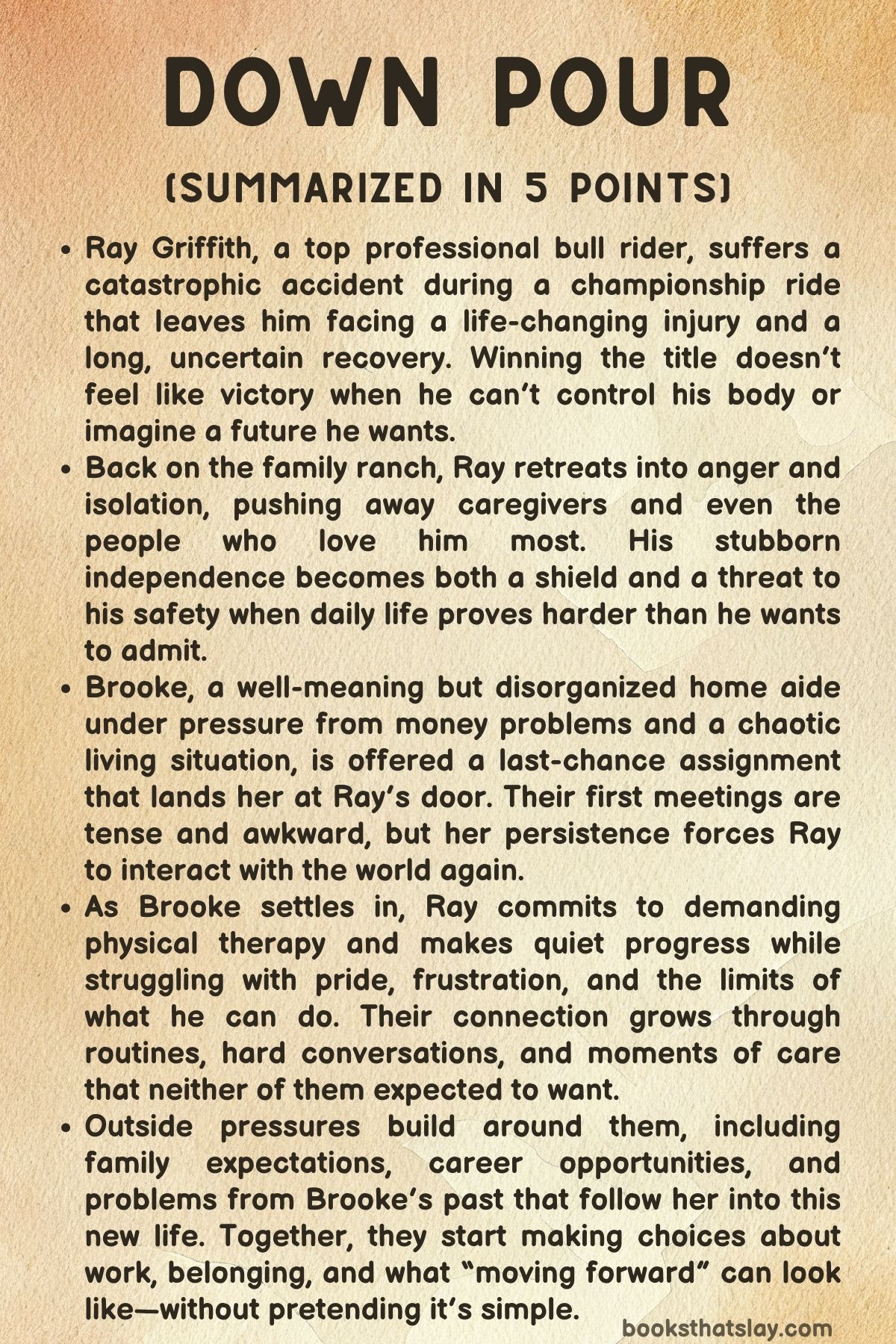
Downpour by Maggie C. Gates is a contemporary romance set against the rough-edged world of rodeo and the quieter, harder work of rebuilding a life. After a championship ride ends in a catastrophic injury, bull rider Ray Griffith returns home to his family ranch with fame that feels useless and a body he can’t fully trust.
When Brooke, a chaotic-but-kind home aide with her own money troubles, is assigned to care for him, their clash of tempers turns into an uneasy partnership. The story follows recovery, boundaries, family pressure, and the choice to begin again. It’s the 2nd book in The Griffith Brothers series.
Summary
Ray Griffith is at the top of his sport, chasing another professional bull-riding title in front of a roaring crowd. Mid-ride, everything goes wrong.
He’s thrown violently, struck by the bull, and hits the dirt head-first. The noise fades, his body stops responding, and the arena becomes a blur of panic as medics rush him out.
His brother Christian is there, gripping his hand, but Ray can’t feel a thing before he blacks out.
Ray spends weeks drifting in and out of consciousness, surrounded by machines, muffled voices, and the constant pain of breathing support. When he finally opens his eyes for real, Christian is beside him.
Ray’s first question isn’t about the future—it’s about the score. Christian shows him the championship buckle: Ray won.
The victory lands like an insult. He can’t lift his arms.
He can’t feel the buckle. He can’t move.
Months later, Ray is back at his parents’ ranch, trapped in a routine that strips away his pride. He needs help with everything.
He’s angry, humiliated, and sinking into a depression he can’t disguise from the people who love him. Therapy is relentless and miserable.
Sensations he can’t control—pain, itching, electric stimulation—become daily torture. He starts wishing the accident had finished him.
When doctors offer an invasive, experimental spinal stimulation surgery as part of a clinical trial, Ray doesn’t hesitate. The risks don’t scare him as much as the thought that this is all his life will ever be.
Time crawls, and progress comes in small, brutal increments. One day, exhausted and furious, Ray concentrates on his hand and manages the tiniest movement—enough to scratch an itch against a pillow.
It’s a minor act that feels like a miracle. Later, Christian finds him lifting a cup to drink on his own.
Christian’s shock turns into tears. Ray tries to play it off with a bitter joke, because hope is dangerous and he doesn’t trust it.
A year after the accident, Ray moves into a newly built, wheelchair-accessible house on the ranch, intentionally tucked away behind trees. He wants solitude.
He wants control. That illusion breaks fast when he finds a caregiver already inside preparing a hospital bed.
He orders her out. Over the next weeks, he fires aide after aide for talking too much, asking questions, or simply being present.
His brothers—Christian, Nate, and CJ—along with their partners, confront him: the town doesn’t have endless caregivers, and Ray can’t keep burning bridges. Ray refuses to listen.
His stubbornness turns dangerous. After changing the locks to keep everyone out, Ray tips his wheelchair in the kitchen amid broken glass and running water.
He ends up on the floor, helpless and furious, while his mother pounds on the door outside. The moment makes one thing clear: isolation isn’t strength.
It’s a trap.
Brooke enters from a very different life. She’s a home aide with a big heart and a messy streak—late, disorganized, and constantly scrambling.
She shares a chaotic house with roommates who eat her food, demand cash, and treat her like an easy target. At work, her manager, Peggy, tells her she’s on her last chance after driving away clients.
Brooke finishes a shift with an elderly client, Mr. Wilson, and then gets an emergency assignment: high pay, a cash bonus, and double pay if she lasts a week.
Brooke gets lost on the drive and ends up at Griffith Brothers Ranch. When she finds the secluded house, she meets a cow with pool noodles on its horns and ends up sitting outside with the animal’s head in her lap, trying to calm her nerves.
A truck arrives carrying Christian, his partner Cassandra, and Ray in his wheelchair. Cassandra’s reaction is sharp.
Ray’s is worse—cold, angry, and immediate. He tells Brooke to leave.
Brooke, flustered, chatters, tries to offer a peace offering in the form of a little plant, and drops it, smashing the pot. Cassandra laughs like she’s watching a show.
Brooke returns anyway. She needs the paycheck, and she’s stubborn in her own way.
She talks too much, tries too hard, and keeps tripping over Ray’s boundaries. Ray resents her cheerfulness and the way she fills his quiet space.
One day he can’t open a bottle of ibuprofen and throws it in frustration. Brooke simply opens it and sets the pills where he can reach them, then steps away without making a performance of helping him.
The kindness hits Ray like a bruise. Later, when Ray reacts to her closeness in a way that makes him feel exposed and powerless, he explodes, screams at her to get out, and fires her.
That night he lies awake, angry at her, at himself, and at the body he no longer controls.
Brooke comes back the next day. She admits she needs the work, and Ray, despite himself, offers a deal: strict rules, no touching him, punctuality, and driving him into town.
On the deck, they trade pieces of their lives. Brooke confesses she’s waiting until she turns twenty-five to access a trust fund, clinging to the idea that her life will finally stabilize.
Ray admits he built his identity on bull riding and never planned for another version of himself.
Their days settle into a strained routine. Brooke tries to cook and nearly sets the kitchen on fire.
Cassandra storms in, puts out the mess, and unleashes years of family frustration on Ray—especially about his refusal to see his nieces, Bree and Gracie. Brooke pushes gently, asking why he shut them out.
Ray admits the girls’ mother died, he stepped in for a while, then left, and the distance became easier than facing what he’d lost. Brooke urges him to reconnect.
Ray shuts down, not ready to be the uncle they want when he barely tolerates being himself.
Outside the ranch, Brooke’s own life gets uglier. A roommate named Nick corners her about money and threatens her housing.
Christian steps in at the right moment, making Nick back off. Ray hears about it and pretends not to care, but he starts watching Brooke more closely, even scrolling her social media when she’s late.
When she finally arrives one day looking shaken and hiding behind sunglasses, Ray forces her to look up. Her face is bruised, her eye bloodshot.
Ray demands the truth. Brooke reveals it happened at work—Mr. Wilson, during a dementia episode, didn’t recognize her and hit her.
Ray tells her not to go back, but Brooke panics: losing that client could cost her job and her home. Ray pulls Cassandra into the situation, and the Griffiths make a decision that changes everything: Brooke is hired full-time to work for Ray, with better pay and a place to live.
Brooke moves into the guest room at Ray’s house, leaving behind the chaos of her roommates. Ray shows care in awkward, quiet ways—making sure she’s comfortable, setting out small comforts, and slowly letting her into the edges of his life.
As Ray’s motivation in physical therapy grows, his therapist notices the difference and credits Brooke’s presence. Ray even risks public space again, going out to eat with her.
When Brooke’s old roommates confront her for money, Ray publicly backs her up and makes it clear she isn’t alone anymore.
As their trust builds, attraction becomes impossible to ignore. They start a private, consensual relationship with strict boundaries and secrecy because of Brooke’s employment contract and Ray’s need to feel in control of something.
Their connection doesn’t fix Ray’s anger or Brooke’s insecurity, but it gives them a place where they can be honest about what they want and what they fear.
Ray also reveals a hidden truth: he has been practicing walking short distances in private, terrified that if his family sees progress and it disappears, it will crush them. Brooke promises to keep his confidence and becomes both a witness and an anchor as he tests the limits of his recovery.
She begins spending time with the wider Griffith family and bonds with the ranch itself—especially the horses and the rhythms of ranch work. For the first time in years, Brooke starts to feel like she belongs somewhere.
A break-in at Ray’s house jolts that fragile peace. The house is ransacked, but valuables are left behind; what’s missing are Ray’s prescription medications.
Brooke is terrified she’ll be blamed. Ray insists they handle it together—police report, security upgrades, and family support.
Suspicion turns toward Brooke’s former roommates, who have been trying to squeeze money from her.
Tension spikes again when Brooke overhears Ray joking with others about finding her another job so he can fire her. Hurt, she assumes he wants her gone and prepares to leave.
Ray follows her to the pond and explains: he doesn’t want her staying because she’s trapped as his employee. He wants her to choose him and the ranch freely, and he wants her to build a future that isn’t based on caretaking him.
Instead of big promises, he offers a handwritten apology that shows he’s trying, even when he’s clumsy at it. Brooke accepts, moved by the effort and by the way Ray has been quietly nurturing not just his recovery, but their life together.
At a family dinner, Ray finally stops hiding. He stands from his wheelchair and makes his way to a chair, showing everyone he can walk short distances with therapy.
The room erupts with shock and emotion. Ray makes it clear he still relies on his wheelchair, but he’s reclaiming options.
The ranch is changing too, with a lodge and restaurant project expanding under Cassandra’s drive and investors’ money. Brooke is offered a new role connected to an equine program—work that fits her strengths and gives her independence.
She steps into the job with real purpose.
Then danger arrives in the open. During a bonfire near the construction site, lights are spotted inside the unfinished lodge.
Ray, CJ, and ranch hands investigate. A man bolts—Brooke recognizes Nick.
A confrontation turns violent, shots are fired, and an explosion erupts when a tank is hit. The lodge catches fire.
In the chaos, Ray shields Brooke, CJ subdues the intruders, and police arrest Nick and another roommate, Chandler. Brooke crumbles under guilt, convinced she brought this threat to the family.
Ray refuses to let her carry it alone and makes the point that what happened is on the criminals, not on her.
In the aftermath, the Griffiths welcome Brooke as one of their own. She settles into her new job, running schedules, helping with horses, and organizing the growing ranch operations.
Ray continues therapy and starts considering new career paths—coaching, speaking, brand work—ways to use his name without pretending he’s still the same man who rode bulls for a living. At dinner, the family navigates growing pains: investors, new plans, and CJ’s resistance to change.
Brooke stays steady through it, and Ray asks the question that matters most—if she’s happy, and if she wants a future with him and this place. Brooke says yes.
Months later, Brooke is pregnant. Ray is doing better in therapy and has adapted to driving with hand controls, building a life that fits who he is now.
At a family gathering, Ray announces the pregnancy, and the ranch erupts in celebration. Then he adds one more surprise: he proposes, getting down on one knee with help from his brothers.
Brooke says yes, choosing not just Ray, but the family and the future they’re creating together.
Characters
Ray Griffith
Ray Griffith begins Downpour as a man whose identity is inseparable from control, adrenaline, and public dominance: a champion bull rider who measures his worth in points, buckles, and the ability to endure pain in front of a crowd. The accident doesn’t just break his spine; it shatters the one story he has ever trusted about himself, so when his body fails him, his selfhood collapses with it.
His early months after injury show him at his most raw—humiliated by dependence, furious at his limitations, and so ashamed of needing help that he weaponizes isolation as if loneliness can substitute for dignity. Ray’s cruelty to caregivers isn’t really about them; it’s a defensive reflex against being seen as weak, a way to pretend he still has power by controlling who gets access to him.
What makes Ray compelling is that his recovery is not framed as a neat, inspirational climb but as something jagged: experimental surgery, incremental sensations, setbacks, rage, sexual frustration, and a constant tug-of-war between hope and fear of disappointment. His decision to hide his emerging ability to stand and take steps reveals the core wound driving him—he’s terrified of believing again, because belief creates the possibility of losing twice.
Brooke becomes the pressure point that forces Ray’s emotional evolution, not by “fixing” him but by disrupting his closed system. He is drawn to her brightness yet resents how easily she can move through life’s small freedoms, and that tension makes him oscillate between tenderness and harshness.
Over time, Ray’s love grows out of an unfamiliar place: not performance, but presence. The way he quietly covers Brooke when she falls asleep, rescues the plant she thought was dead, and tries to engineer a future where she stays by choice rather than financial necessity shows a man learning to express devotion without the old language of trophies and spectacle.
Even his sexual dominance reflects the same psychological architecture—control as safety, rules as protection, intensity as an escape from helplessness—yet he’s careful about consent and communication, suggesting that what he truly wants isn’t to overpower Brooke but to reclaim agency in a world that stole it from him. By the end, Ray’s growth isn’t simply that he can walk a few steps; it’s that he can rejoin the family he shut out, accept new forms of purpose, and choose a life that includes vulnerability—marriage, community, and impending fatherhood—without experiencing those things as threats to his masculinity.
Brooke
Brooke enters Downpour as a person who looks like chaos on the surface—late, scattered, talkative, messy logistics—but underneath that noise is a survival strategy shaped by insecurity and instability. She is someone who has learned to keep moving, keep joking, keep filling silence, because silence invites other people’s judgments and, worse, her own fear.
Her trust fund timeline reveals a deeper theme in her character: she’s living in a liminal state, enduring a precarious present while clinging to a future escape hatch, which makes her both optimistic and trapped. Brooke’s home life with exploitative roommates shows her vulnerability and people-pleasing tendencies; she is used to being squeezed for money, space, and emotional labor, and she has normalized it enough that she initially downplays threats and harm.
Even her job problems—lateness, disorganization—read less as laziness and more as a young woman stretched thin, trying to hold together too many unstable pieces without support.
What makes Brooke powerful as a character is that her kindness is not naïve; it’s stubborn. She keeps coming back to Ray not because he’s easy to love, but because she recognizes the lonely pain beneath his anger and refuses to let his worst moments define his whole self.
Her chatter and warmth aren’t just personality quirks—they’re tools she uses to create safety and connection, and with Ray they become a kind of emotional physical therapy, coaxing him back into relationship with the world. Brooke also has a backbone that sharpens as the story goes on: she stands up to Ray’s cruelty, to Cassandra’s skepticism, to the redheaded woman’s disrespect, and eventually to the idea that she only belongs where she is “allowed” to exist.
Her reaction to being assaulted by Mr. Wilson during a dementia episode is especially revealing—she’s scared and hurt, but her first panic is economic, because she understands how quickly a fragile life can collapse when income disappears. That realism keeps her from feeling like a manic pixie fantasy; she is grounded by consequences.
Brooke’s arc becomes one of earned belonging. She moves from being a disposable employee and exploited roommate to becoming someone the Griffith family actively chooses and publicly welcomes.
Her shift into ranch work, especially the equine program, is significant because it’s the first time she’s not simply reacting to survival needs; she’s building a role that fits her strengths and gives her a stable identity. In her relationship with Ray, she evolves from a caretaker trying to prove her usefulness into a partner who can demand respect, negotiate boundaries, and envision a future.
By the end, Brooke’s pregnancy and engagement don’t read as a fairy-tale reward so much as the culmination of what she’s been seeking all along: safety, home, and a love that doesn’t require her to shrink herself to be kept.
Christian Griffith
Christian functions as the emotional anchor of the Griffith family and the clearest mirror to Ray’s decline and recovery. From the opening accident, Christian is positioned as the one who crosses boundaries—jumping the barrier, taking Ray’s hand, staying close through the fog of the hospital—because his love expresses itself through action and protectiveness.
He is the brother who can both comfort and confront, which becomes vital once Ray turns his pain outward and starts firing aides as a way to punish the world for changing. Christian’s role in the intervention highlights his pragmatism: he understands the limitations of their small town resources, but more importantly, he refuses to indulge Ray’s self-destruction just because it’s understandable.
Christian also becomes a bridge between Brooke and the ranch’s protective bubble. When he intervenes with Nick outside the coffee shop, it shows that he’s not only loyal to Ray but committed to safeguarding the environment around him, and he recognizes that Brooke’s safety matters because Brooke matters to Ray.
Christian’s concern about Brooke’s bruises, his willingness to loop Cassandra in for help, and his steady presence in the background mark him as a caretaker figure who carries responsibility without making it a performance. He can intimidate when needed, but his strength is emotional steadiness: he doesn’t collapse under crisis, and he doesn’t let others drown in it either.
In many ways, Christian represents the “family machine” that keeps going when Ray tries to shut everything down—supportive, stubborn, and quietly relentless.
Cassandra
Cassandra is the family’s sharp edge: strategic, protective, and unsentimental in the way that people become when they’ve had to hold things together for too long. Her initial hostility toward Brooke reads as territorial defense—Ray has been vulnerable, caretakers have cycled through, and Cassandra refuses to let a stranger become another unpredictable variable in the household.
Yet Cassandra’s skepticism isn’t cruelty for its own sake; it’s a screening mechanism. She watches Brooke’s mistakes, waits for the pattern to repeat, and is ready to remove her if she becomes a liability.
At the same time, Cassandra isn’t blind to usefulness, and once she sees Brooke’s effect on Ray—his motivation, his reentry into family life—she pivots quickly from gatekeeper to organizer.
Cassandra’s broader role is that she embodies adaptation. While Ray mourns the life he lost, Cassandra is already building the infrastructure of the life that can exist now: investors, brand offers, coaching opportunities, speaking gigs, a docuseries, and the ranch’s lodge and restaurant expansion.
She is the character most willing to engage with reinvention, even when it’s messy or unpopular, which is why she clashes with more tradition-minded characters like CJ. Cassandra also becomes the one who formalizes Brooke’s belonging by turning her into an employee of the ranch rather than a temporary aide, giving Brooke a stable identity and placing her inside the family ecosystem.
Her competence is a form of love—she may not be soft, but she is fiercely invested in the family’s survival and future.
Nate Griffith
Nate appears as part of the supportive sibling network that Ray both relies on and resents, and his presence highlights what Ray believes he’s been denied: forward momentum. Nate has a wife, a child, and a life that continues to expand, which contrasts with Ray’s stalled existence and intensifies Ray’s bitterness early on.
Yet Nate’s significance is that he returns, shows up, and stays connected even when Ray tries to make connection impossible. He’s part of the group that refuses to let Ray vanish behind trees and locked doors.
Nate’s role also reinforces the theme that the family system is larger than Ray’s pain; life on the ranch involves partners, children, routines, and plans, and Ray must decide whether he will remain outside that circle or rejoin it.
CJ
CJ is the ranch’s pulse of tradition and hands-on identity—someone whose relationship to the land and animals is not just work but self-definition. His bond with Indy, his ease in the barn, and his focus on practical ranch expansion frame him as grounded and action-oriented, the kind of person who solves problems with movement rather than conversation.
CJ also becomes an important point of entry for Brooke into the ranch world: he treats her as capable, teaches her paths, introduces her to the animals, and recognizes her potential value to the equine program. That matters because Brooke’s belonging isn’t only romantic; it becomes vocational and communal, and CJ is one of the first to validate her competence outside of caregiving.
At the same time, CJ represents resistance to change. The introduction of outside investors and Luca DeRossi sparks visible discomfort, and his storming out at dinner signals a deeper fear that the ranch’s identity is being bought, reshaped, or diluted.
This tension gives the ranch storyline stakes beyond romance: it’s not only about Ray and Brooke building a future, but about the family negotiating what “future” even means without losing itself. CJ’s protective instincts also flare during the Nick incident—he tackles, ties up, reacts fast—which underscores that beneath his roughness is fierce loyalty and a readiness to defend the family at real risk.
Claire Griffith
Claire, Ray’s mother, is a quiet reservoir of warmth and endurance. Her anger when Ray locks her out and her relief when she notices him seeming better show a mother’s emotional whiplash: she is constantly balancing compassion for his suffering with exhaustion from being pushed away.
Claire’s comfort is expressed through doing—food, baking, routine—and her scenes with Brooke are significant because Claire offers Brooke a version of family that Brooke has lacked. When Brooke goes to bake at Claire’s house after the break-in, it’s not just about desserts; it’s about seeking shelter in a maternal space where care doesn’t have to be earned through perfection.
Claire also helps normalize Brooke’s presence, making her feel less like an outsider and more like someone who belongs at the table, which indirectly supports Ray’s reintegration too.
Peggy
Peggy functions as the hard gate of the working world Brooke is trying to survive. She’s not villainous, but she is firm, because Brooke’s mistakes have consequences for clients and the agency’s reputation.
By giving Brooke “one last chance,” Peggy sets the pressure-cooker conditions that push Brooke toward the Griffith ranch job in the first place. Peggy’s importance is structural: she represents how precarious Brooke’s life is, how close she is to losing housing and income, and why Brooke tolerates chaos and mistreatment longer than she should.
Even when Brooke thinks she’ll be fired after missing Mr. Wilson’s shift, the outcome shifts because the Griffiths intervene, showing how Brooke’s trajectory changes once she has people with resources choosing to protect her rather than exploit her.
Mr. Wilson
Mr. Wilson is not primarily a character with agency in the romance plot, but he is a crucial emotional catalyst. His dementia episode—where he doesn’t recognize Brooke, hits her, and throws a plate—forces Brooke and Ray into an intimacy that isn’t flirtation but fear and care.
The incident clarifies Brooke’s vulnerability and sense of responsibility, because her first instinct is not anger but panic about losing her job and housing. For Ray, Mr. Wilson’s assault triggers protective anger and tenderness, revealing that even while Ray insists on distance and rules, he is already emotionally invested in Brooke’s wellbeing.
Mr. Wilson also quietly highlights the reality of caregiving as labor with risks, not just a narrative device to bring two people together.
Bree
Bree functions as both innocence and consequence in Ray’s life. As one of Ray’s nieces, she represents the relationships Ray damaged during his retreat into bitterness, and her begging to see him makes his isolation feel less like a private choice and more like collateral harm.
Bree’s storyline later—bringing Mason to dinner as a supervised compromise—also mirrors the book’s larger theme of negotiating change with care. Just as Ray must rejoin family life gradually and on new terms, Bree is navigating growing up within a protective system that is learning to loosen its grip without abandoning safety.
Gracie
Gracie, like Bree, is a symbol of Ray’s unfinished emotional business. Her presence amplifies the ache of Ray’s withdrawal and the family’s grief over losing him emotionally even when he is physically alive.
Gracie’s role is to keep the stakes personal: Ray’s recovery isn’t only for himself or for Brooke, but for the children who want access to him and for the family identity that depends on connection. When Brooke plays with the girls after the break-in, it reinforces that Brooke isn’t just Ray’s partner—she’s someone who can restore warmth to the family spaces Ray left cold.
Becks
Becks appears as part of the stable adult partnership model within the Griffith ecosystem. As Nate’s wife and mother to their daughter, she represents continuity and the possibility of building a life that integrates love, work, and family rather than sacrificing one for the other.
Even when she isn’t at the center of major scenes, her presence helps frame the Griffith family as a living system of relationships, not just Ray’s tragedy. That matters because Ray’s arc involves learning to believe that he can still have what his siblings have—partnership, family rituals, a future—even if it looks different than the life he expected.
Charlie
Charlie, Nate and Becks’ daughter, adds another layer to what Ray has been missing while he isolates. Children in the story function as emotional truth-tellers: they don’t care about pride, only presence.
Charlie’s existence reinforces the passage of time and the reality that life continued on the ranch even when Ray tried to freeze his world in anger. She also embodies the “future” the family is building—something Ray is eventually invited back into, culminating in his decision to propose and become a father himself.
Nick
Nick is the clearest embodiment of Brooke’s past: opportunistic, coercive, and comfortable using intimidation to extract what he wants. His confrontations with Brooke—demanding money, threatening her housing—show how normalized exploitation has been in her life, and his escalation into theft and violence exposes the danger beneath what might otherwise be dismissed as “bad roommate drama.” Nick’s presence also forces Ray into a protective role that bypasses his self-absorption, because defending Brooke becomes a way for Ray to access purpose and agency outside his body’s limitations.
When Nick is caught at the construction site and the situation turns into gunfire and an explosion, he becomes the external threat that cements Brooke’s full break from her old life and accelerates her integration into the Griffith family’s protection.
Chandler
Chandler functions as part of the same predatory ecosystem as Nick, reinforcing that Brooke’s vulnerability wasn’t accidental—it was being targeted and exploited by more than one person. Chandler’s arrest alongside Nick underscores that the threat to Brooke was coordinated and persistent, not a single misunderstanding.
As a character, Chandler heightens the stakes of Brooke’s transition: leaving her old living situation isn’t merely “moving out,” it’s escaping a pattern of manipulation that could have continued indefinitely if she hadn’t found stability at the ranch.
Devin
Devin’s role, though smaller, contributes to the portrait of Brooke’s former life as crowded, irresponsible, and draining. The roommates’ partying, entitlement, and willingness to treat Brooke as a resource rather than a person show why Brooke is so desperate to keep her job and why the Griffith home—despite Ray’s volatility—can still feel safer.
Devin helps illustrate that Brooke’s earlier “cheerfulness” wasn’t coming from a joyful environment; it was something she carried in spite of her environment.
Callie
Callie, Ray’s physical therapist, represents disciplined hope. She doesn’t indulge Ray’s mood, but she also doesn’t treat him like a fragile symbol; she treats him like a patient who can be pushed, corrected, and believed in.
Her insistence that he try again after falling, and the message Ray repeats about getting up now for every time he couldn’t before, becomes one of the story’s clearest articulations of what recovery demands: repetition, humiliation, effort, and faith that isn’t based on guarantees. Callie also notices the shift in Ray’s motivation and connects it to Brooke’s presence, validating the idea that emotional connection can translate into physical progress.
Importantly, she occupies a professional boundary space that contrasts with Brooke’s complicated employee-lover position, reminding the reader that Ray’s healing is both relational and clinical.
Jo Reed
Jo Reed appears as a figure of unapologetic performance and sexual confidence, and her presence at The Silver Spur creates a moment where Brooke confronts her own insecurity and chooses boldness instead. Jo’s topless mechanical bull riding is both spectacle and skill, a twisted mirror of Ray’s former world where bodies perform for crowds and control is tested publicly.
By stepping into that space, Brooke is not only trying to thrill Ray; she’s testing her own courage and claiming a kind of agency that her old life with her roommates didn’t allow. Jo also functions as a catalyst for Ray and Brooke’s sexual dynamic in a public setting, pushing them from private experimentation into a shared adventure that blends Ray’s rodeo identity with Brooke’s desire to feel fearless.
Luca DeRossi
Luca DeRossi represents the outside world pressing into the ranch’s legacy. As an investor and executive chef tied to the planned steakhouse, Luca symbolizes professionalization, commercialization, and change that can bring opportunity while also threatening tradition.
His introduction at family dinner is less about romance and more about the future of the ranch as a business, and the tension his presence sparks—especially CJ’s anger—signals that the family’s next conflicts will not only be emotional but strategic: who gets to shape what the ranch becomes, and what compromises are acceptable to keep it thriving.
Marty
Marty is a quieter but meaningful figure as the person Ray consults about possible contract deals and future work. Marty’s importance lies in what he represents to Ray: a bridge between the old identity and a new one.
Talking to Marty suggests Ray is beginning to imagine earning, contributing, and being seen again, but on different terms than bull riding. Marty is part of the machinery that makes Ray’s reinvention practical rather than purely emotional, nudging Ray toward choices about publicity, purpose, and how to tell his story without being consumed by it.
Themes
Identity after bodily change
The story begins with Ray’s life being defined by performance, risk, and public victory, and then that identity is ripped away in a single moment that he cannot control. The championship buckle becomes a cruel symbol: he earns it at the exact time his body stops responding, so the thing he valued most arrives paired with the deepest loss.
What follows is not a neat “recovery arc” but a long, ugly process of learning that identity cannot rely only on what the body can do. Ray’s rage at needing help, the humiliation of basic care, and the desire to have died rather than live dependent all point to how tightly he tied worth to physical capability.
Even when progress comes—hand movement, drinking independently, standing in secret—he doesn’t feel proud in a simple way. He feels threatened, because improvement is fragile and hope can be another form of pain if it gets taken away again.
His choice to hide the walking from his family shows how identity becomes guarded; he would rather carry the burden alone than risk becoming the center of pity, celebration, or disappointment. Over time, the narrative keeps forcing him to redefine “strong” as endurance, discipline, and emotional honesty rather than dominance over a bull or a crowd.
The new ranch opportunities offered to him—coaching, deals, speaking gigs—raise the question of who he is if he can’t be the rider he was. The theme lands in the way he finally shows his family the truth: not as a miracle reveal, but as an acceptance that his life will be different, that he can be both limited and capable, and that dignity can exist alongside assistance.
The shift is less about becoming his old self again and more about building a self that can live without constant proof.
Control, autonomy, and the fear of dependence
Ray’s hostility toward caregivers is not really about their personalities; it is about what their presence represents. Every aide is a reminder that autonomy has been replaced by schedules, hands, and rules he didn’t choose.
His secluded house behind trees is designed like a fortress, not for comfort but for control: less visibility, fewer witnesses, fewer moments where someone can see him struggle. He fires people for trivial reasons because firing them is one of the few powers left to him.
That craving for control turns dangerous when he changes the locks and ends up stranded on the floor, unable to fix the situation he created. The scene exposes the central contradiction: absolute independence is impossible in his current body, and pretending otherwise can destroy him.
Brooke’s arrival challenges this in a different way. She is messy, late, talkative, and unpredictable, which makes her the opposite of the controlled environment Ray tries to enforce.
Yet the same unpredictability becomes a strange kind of freedom because it shifts the emotional tone in the house; she does tasks without treating them like evidence of his weakness. The ibuprofen bottle moment captures the theme sharply: she solves the problem easily, but the ease is what wounds him.
His anger is less at her than at the reality that his will is no longer enough to do everything he needs. Later, control shows up in intimacy: Ray sets strict terms, frames the connection as “on my terms,” and uses structured rules to protect himself from vulnerability and from the complications of being her employer.
Even the rope becomes symbolic of negotiated control—restraint paired with careful checking, permission, and attention to safety. The story treats autonomy not as a simple goal but as something that must be renegotiated in every area of life: physical therapy, family involvement, employment, relationships, and even public perception.
By the end, Ray’s growth isn’t shown as finally becoming independent again; it’s shown as learning to make choices inside limitation, letting others help without feeling erased, and understanding that accepting support can be an act of control rather than a surrender.
Isolation, pride, and the slow return to belonging
Ray’s isolation is built from pride, grief, and self-protection. He withdraws from the family ranch life, refuses to see his nieces, and chooses a home placement that keeps him separate.
His silence becomes a wall that protects him from awkward looks and from the reminder of who he used to be, but it also turns him into a ghost in his own family. The narrative shows how isolation can feel like peace while actually amplifying shame and bitterness.
He convinces himself he wants to be alone, yet his reactions betray a deep hunger for connection: he watches the clock for Brooke, he stalks her social media when she’s late, and he becomes agitated when he thinks she might be slipping away. The break-in intensifies this theme because safety becomes uncertain, and isolation no longer feels like control; it feels like vulnerability.
Brooke acts as a bridge back to belonging, not by lecturing him, but by carrying warmth into spaces he has avoided. At family dinner, she redirects attention, keeps conversation moving, and gives Ray a way to be present without being treated like a tragedy on display.
The nieces become a crucial emotional measure: Ray’s refusal to see them is not indifference but unresolved grief and fear of failing them again. When Cassandra confronts him, the story frames family pain as something that cannot be ignored forever.
Later, Brooke’s own sense of belonging grows through the ranch routines and through the small rituals—baking with Claire, being given a jacket with the ranch logo, being trusted with work that matters. This matters because it shows belonging as practical as well as emotional; it’s built through shared responsibilities, not just declarations.
Ray’s arc mirrors that: he returns to family dinner, he reveals his mobility progress, and he begins participating in decisions about the ranch’s future. The theme resolves not by making him suddenly social, but by showing how pride softens when connection becomes safer.
Belonging is earned through repeated choices to show up, even while afraid, even while imperfect, and even while still hurting.
Class pressure, housing insecurity, and the vulnerability of low power
Brooke’s cheerful surface sits on top of constant financial and housing instability. Her roommates demanding cash, inventing fees, and using intimidation to keep her trapped shows how economic vulnerability becomes a tool others can exploit.
She is one missed paycheck away from losing shelter, which is why she clings to difficult jobs and accepts unfair conditions. Even when she is injured by Mr. Wilson during a dementia episode, her first instinct is not to prioritize safety but to protect income, because losing the client could mean losing everything.
That single dynamic explains many of her choices: returning to Ray after being fired, tolerating humiliation from roommates, and staying quiet when she is overwhelmed. The trust fund at twenty-five adds another layer, because it creates a strange form of delayed security that is not accessible when she needs it most.
The promise of future money doesn’t protect her in the present; it only becomes a countdown that she clings to like a life raft. The story also contrasts Brooke’s precarious world with the Griffiths’ stability—land, family infrastructure, and community influence.
Christian stepping in outside the coffee shop demonstrates what power looks like in practice: intimidation works when the intimidator has social weight and the other person knows consequences are real. Yet the narrative doesn’t treat the ranch as a flawless rescue fantasy.
Brooke’s presence also brings risk to the ranch, as seen in the theft of medication and the later fire. Her former roommates escalate from coercion to crime when they realize Brooke has moved into a safer environment and their leverage is gone.
That escalation is realistic: when exploitation stops working, some people become more dangerous rather than letting go. The theme ultimately highlights how “choice” is not equally available to everyone.
Brooke’s decisions often look impulsive, but they make sense inside scarcity, fear, and exhaustion. As she gains stable employment and community support, her personality doesn’t change, but her nervous desperation eases because survival pressure is reduced.
The story treats financial stability as emotional stability’s close relative, showing how safety and dignity are much harder to maintain when housing and income are constantly threatened.
Healing as commitment, not inspiration
Progress in Downpour is not portrayed as a clean upward line. Ray’s recovery involves months of fog, pain, invasive experimentation, and the exhausting repetition of therapy.
The narrative gives weight to the smallest victories—scratching an itch, lifting a cup—because those moments represent agency returning in fragments. At the same time, it refuses to romanticize effort.
Ray works hard and still remains disabled, which matters because it separates healing from the fantasy that determination automatically produces full restoration. The clinical trial surgery emphasizes that some choices in healing are made out of desperation, not hope.
He doesn’t sign up because he believes in a guaranteed breakthrough; he signs up because his old life is already gone, and risk feels less frightening than stagnation. The therapy scenes show healing as craft: technique, balance, repetition, corrections, and the mental discipline to try again after failure.
Callie’s words about getting up now for every time he couldn’t before place meaning in persistence without promising a miracle. Brooke’s role in this theme is also grounded.
She doesn’t become a magical motivator who fixes him with positivity; she becomes a consistent presence who reduces friction around the work. She drives him, waits, distracts him, keeps him fed, and quietly makes room for the fact that some days are brutal.
Even their conflict supports the theme: Ray snaps, apologizes, tries again. Brooke makes mistakes, burns towels, learns, adapts.
The ranch itself mirrors this long-term rebuilding through the lodge project and equine program—growth that requires planning, investment, and patience, and that can still be threatened by sudden disaster like the fire. By the end, healing is shown as a life structure rather than a phase: Ray continues therapy, adapts driving with hand controls, and explores new work; Brooke grows into a role with responsibility and pride.
The pregnancy and proposal land as outcomes of stability built over time, not as rewards for suffering. The story’s view of healing is that it can be meaningful and real even when it doesn’t return you to who you were, and even when it remains unfinished.
Intimacy, consent, and the complication of unequal roles
The relationship between Ray and Brooke carries built-in tension because she is initially his employee, he is her client, and she is financially desperate. That imbalance creates ethical pressure, and the story acknowledges it through their secrecy and through Brooke’s awareness that her contract forbids relationships with clients.
Ray’s insistence on terms—no relationship label, no telling the agency—can be read as a defense mechanism, but it also reinforces the power imbalance because he controls employment, housing during the week, and the emotional temperature of the household. At the same time, the narrative repeatedly shows Brooke asserting choice in moments that matter.
She returns after being fired, she negotiates boundaries, and she directly challenges people who disrespect her, including the woman at the bar and her former roommates. Their sexual dynamic is highly structured, and the text emphasizes explicit safety behaviors: checking circulation, monitoring comfort, and ensuring she can communicate if anything hurts.
Those details matter thematically because they contrast with the lack of safety Brooke experiences in her housing situation and even in her workplace with Mr. Wilson’s episode. In Ray’s home, intimacy becomes a space where boundaries are discussed, monitored, and respected, which is part of why Brooke feels both frightened and drawn in.
For Ray, intimacy is also tangled with disability and shame. His physical reactions around Brooke trigger anger because they remind him of bodily function returning in one area while other areas remain limited.
Sex becomes a place where he can feel powerful and desired, but it also risks becoming another form of control if it substitutes for emotional honesty. The narrative gradually shifts them toward a more equal partnership by changing Brooke’s employment status: she moves from being trapped by the job to being offered a role with the ranch that aligns with her interests and competence.
Ray’s confession that he wants her to stay by choice, not because she has to, directly addresses the imbalance and frames love as something that should not depend on economic captivity. The theme lands in the way their intimacy becomes less about strict rules and more about trust—still intense, still structured at times, but increasingly rooted in mutual commitment rather than leverage.