Dragon Cursed Summary, Characters and Themes
Dragon Cursed by Elise Kova is a fantasy novel set in Vingard, a walled city where humans fear dragons, a spreading blight called the scourge, and a curse that turns people into beasts.
The story follows Isola Thaz, celebrated as “Valor Reborn” after surviving a childhood dragon attack, though she secretly fears she is cursed herself. During the brutal Tribunal meant to expose cursed youths, Isola uncovers lies about the city, the Creed, dragons, and her own identity. The book blends prophecy, romance, institutional corruption, transformation, grief, and rebellion as Isola chooses freedom over imposed destiny.
Summary
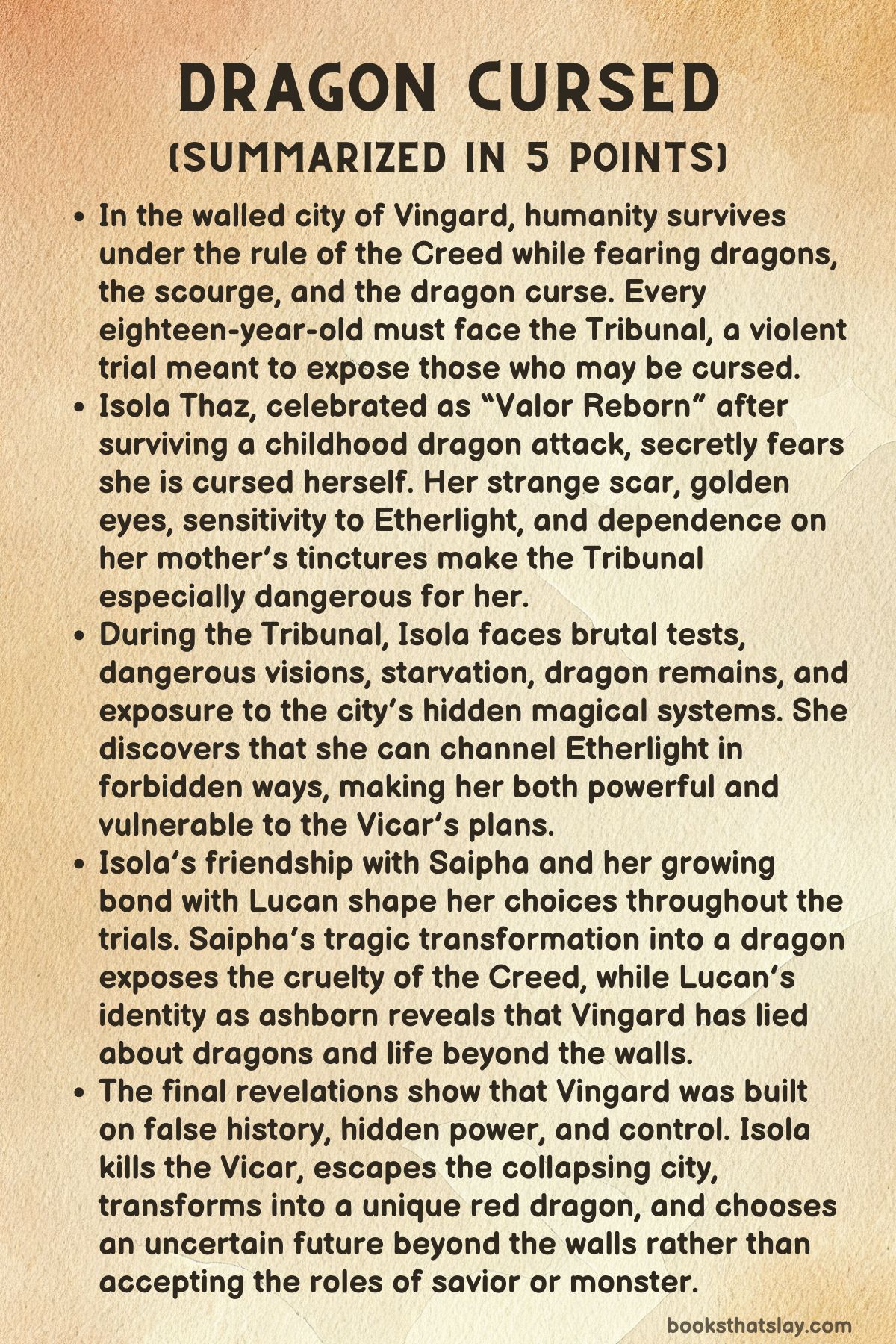
In the walled city of Vingard, the last bastion of humanity, citizens live in constant fear of dragons and the scourge—a red, rotting blight that consumes the land beyond the walls. Even worse is the dragon curse: a slow, excruciating transformation that turns humans into mindless, destructive beasts.
To root out the cursed, every eighteen-year-old must endure the Tribunal, a brutal three-week rite of physical and psychological trials in a secluded monastery. Those who show signs of the curse are executed by the Mercy Knights under the authority of the Creed, the city’s religious and governing body led by the ambitious Vicar Darius.
Isola Thaz, marked as “Valor Reborn” after surviving a dragon attack at age twelve—leaving her with golden eyes and a mysterious scar across her chest—carries the weight of prophecy.
The city hails her as the second coming of the legendary hero Valor, destined to slay dragons and save humanity. Secretly, Isola fears she is dragon cursed. She relies on mysterious tinctures brewed by her mother, an expelled researcher studying the scourge and curse, to suppress her symptoms. Her skin crawls near Etherlight (the magical energy powering the city through artificer sigils), and she dreads the Tribunal will expose her.
On the eve of the Tribunal, Isola and her best friend Saipha sneak through the alleys and forbidden areas of Vingard. They collect a sample of scourge dust for Isola’s mother, hoping it holds clues to a cure.
A green dragon attack interrupts them, unleashing acid and chaos. In the aftermath, Isola discovers her mother scavenging illegal dragon remains for research. They are arrested by Saipha’s father, a Mercy Knight, but Isola’s status as Valor Reborn helps secure their release after tense interrogation by the Vicar and her own father, Kassin Thaz (a key artificer). That night, Isola confesses her fears to her mother, who offers cryptic reassurance that she is “special,” not cursed.
The public Convening launches the Tribunal. Isola is paraded as the city’s hope, while roughly thirty supplicants, including Saipha and Lucan (the Vicar’s adopted son assigned to monitor her), enter the monastery. The trials are merciless: supplicants scramble for keys amid violence, face mechanical dragon automatons, endure rooftop exposure as dragon bait, starvation, hallucinations from green dragon vapor, and dismantling of dragon carcasses in sundering pits flooded with scourge.
Alliances form and fracture under pressure. Isola discovers she can channel raw Etherlight without gilding (the ritual linking citizens to the Font, the city’s underground power source), a forbidden ability that both saves her and marks her as dangerous.
Lucan, initially a source of irritation and suspicion, becomes a reluctant ally and romantic interest. He reveals fragments of his past: he was present during Isola’s childhood dragon attack and feels a deep connection to her.
Their slow-burn bond deepens through shared survival, near-kisses, and confessions amid the trials. Saipha remains a steadfast friend, though her own health deteriorates. Isola’s father secretly aids her, revealing the Vicar’s plan to steal her power, believing himself the true Valor Reborn. Her mother sneaks warnings into the monastery.
As trials escalate, Isola and her allies uncover cracks in the Creed’s doctrine. In the cleansing springs and the Font itself—a vast lake of liquid Etherlight—visions and explosions reveal hidden truths.
Scourge and dragons are tied to imbalances in Etherlight and Ethershade. Isola draws immense power at great personal cost, neutralizing threats and manifesting abilities like fire from her palms. The Vicar tortures her to harness this power, but she endures.
In the final arena test, tokens must be secured to exit. Isola excels but sacrifices her progress to help Saipha. As they near escape, Saipha’s eyes turn blue with slit pupils. She horrifically transforms into a blue dragon before the crowd. In a gut-wrenching scene, Marius (Saipha’s father) attempts to mercy-kill her.
Isola approaches, drawing Etherlight in a desperate bid to reach her friend’s remaining humanity. A powerful rifle—Kassin’s invention—ultimately kills the dragon. Devastated, Isola is imprisoned in Mercy Spire, accused of treason for showing compassion.
Lucan, revealed as part of the ashborn (humans who live beyond the wall and can transform into dragons), stages a rescue with allies including his sister (infiltrating as the prelate) and others.
They expose more lies: no humans are supposed to survive outside Vingard, yet the ashborn do. Isola’s mother has long collaborated with them. The group attempts escape, but the Vicar intercepts them in the Grand Chapel. He stabs Isola with the Sword of Valor, intending to transfer her power through a city-wide sigil built into Vingard’s foundations (constructed on human bones and the Font).
Etherlight surges, destabilizing the city and granting Isola visions of the true history: the original Valor built Vingard as a colossal sigil for power, became the Elder Dragon, and the Creed’s teachings are built on lies and control. Enraged and empowered, Isola pulls the sword free (her wound healing instantly), kills the Vicar, and triggers the city’s collapse.
Lucan transforms into a copper dragon—the same one that attacked years ago, his mark left on Isola’s chest as a bond. The group flees on his back, but cannon fire downs him. Plummeting, Isola finally embraces her power. Crimson wings erupt; she becomes a unique red dragon (a type never seen before), emitting scourge-like haze. She saves her companions and reaches safety, roaring in a mix of terror and triumph as the old world crumbles.
The story ends on a bittersweet note of liberation and uncertainty. Isola rejects the binary of savior or monster, choosing her own path beyond the walls with Lucan and the ashborn. Losses—Saipha, her father, and the only home she knew—weigh heavily, but she steps into an unknown future, subverting the prophecy and the corrupt systems that defined her.
The novel explores identity, institutional power, the cost of truth, and what it means to be human in a world of monsters.
Characters
Isola Thaz
Isola Thaz is the emotional and moral center of Dragon Cursed, a heroine shaped by fear, public expectation, bodily transformation, and the burden of a prophecy she never asked to carry. To the citizens of Vingard, she is “Valor Reborn,” a symbol of hope and divine destiny after surviving a dragon attack as a child. Yet her public image is painfully different from her private reality.
Her golden eyes, scarred chest, sensitivity to Etherlight, and dependence on her mother’s tinctures make her fear that she is not humanity’s savior but one of the cursed. This tension creates the core of her character: she is constantly forced to perform certainty while living in terror of herself.
Her journey is not simply about gaining power; it is about learning to define herself outside the categories imposed on her. The Creed wants her to be a weapon. The city wants her to be a miracle. The Vicar wants her power. Even her mother, though loving, withholds truths that shape Isola’s life. Isola’s compassion repeatedly separates her from the brutal world around her.
She helps others during the Tribunal even when it costs her survival. Her attempt to reach Saipha after the transformation shows that she refuses to accept the city’s easy distinction between human and monster. By the end, her transformation into a red dragon does not represent defeat. It becomes an act of self-acceptance. Isola does not become what others feared or worshipped; she becomes something new, choosing agency over prophecy and truth over obedience.
Lucan
Lucan begins as a figure of suspicion, irritation, and guarded authority, but his character gradually reveals hidden loyalty, pain, and rebellion. As the Vicar’s adopted son, he appears to belong to the very system that threatens Isola. His assignment to monitor her positions him as a possible enemy, especially because he knows more than he initially admits. Yet his behavior during the Tribunal shows that he is not merely an agent of the Creed. He watches, protects, challenges, and draws closer to Isola in ways that suggest his loyalty is divided long before his true identity is revealed.
His connection to Isola is rooted in the past, particularly the childhood dragon attack that marked her. The later revelation that he is ashborn and that he can transform into a copper dragon changes the meaning of his earlier secrecy. He has been living between worlds: raised inside Vingard’s power structure while belonging to a people the city claims should not exist.
This makes him a mirror to Isola. Both are taught to fear what they are, both are tied to dragons, and both must reject the false history surrounding them. In Dragon Cursed, Lucan’s romance with Isola matters because it is built through shared danger and mutual recognition rather than simple attraction. He sees the parts of her that the city would condemn, while she sees in him proof that dragons and humans are not the fixed opposites the Creed claims they are.
Saipha
Saipha is one of the most tragic characters because she represents ordinary loyalty caught inside an inhuman system. Unlike Isola, she is not publicly marked by prophecy or extraordinary destiny.
She enters the Tribunal as one of many young people forced to prove that they are still acceptable to the city. Her friendship with Isola gives the story warmth and emotional grounding before the trials strip away safety. Saipha’s loyalty is practical, affectionate, and brave.
She sneaks into dangerous spaces with Isola, supports her fears, and remains emotionally present even when the Tribunal begins to destroy the supplicants physically and mentally.
Her decline during the trials is especially painful because it shows how the city’s rituals fail the people they claim to protect. Saipha is not saved by obedience, faith, or her father’s position among the Mercy Knights.
Her transformation into a blue dragon exposes the cruelty of the Creed’s worldview: the cursed are treated as problems to eliminate, not people to understand. Isola’s refusal to abandon Saipha in that moment gives Saipha’s role lasting power. Even after the transformation, Saipha is still emotionally present in the story as a test of what humanity means.
Her death becomes a turning point for Isola because it destroys any remaining illusion that the system can be reformed through compliance. Saipha’s tragedy reveals the personal cost of institutional fear.
Vicar Darius
Vicar Darius is the embodiment of corrupt religious and political authority. As the leader of the Creed, he presents himself as guardian of Vingard’s faith, order, and survival, but his actions reveal a man driven by ambition, control, and hunger for power. He understands the symbolic value of Isola and uses it to manipulate the public. To the city, she is a sacred sign. To him, she is a resource to be monitored, contained, and eventually exploited.
His belief that he is the true Valor Reborn exposes the depth of his arrogance. He does not merely want to preserve the city; he wants to own its mythology.
His cruelty is made more disturbing by the way it is disguised as duty. The Tribunal, the executions, the surveillance, and the torture all occur under the language of mercy, faith, and protection.
Darius understands that power is strongest when people believe it is holy. His attempt to steal Isola’s power through the Sword of Valor and the city-wide sigil shows how thoroughly he has turned doctrine into machinery. He is not just a villain who lies; he is a villain who builds an entire society around lies. His death at Isola’s hands is therefore more than revenge. It is the collapse of a false moral order. Darius represents the danger of leaders who use fear to make cruelty appear necessary.
Kassin Thaz
Kassin Thaz is a complicated father figure whose love for Isola is strained by his role within Vingard’s machinery of power.
As a key artificer, he helps maintain the technological and magical systems that keep the city alive. This places him close to the structures that endanger his daughter, especially the Etherlight-powered mechanisms and the hidden sigils tied to the Font. He is not presented as simply innocent or simply corrupt.
Instead, he reflects the moral compromise of people who serve dangerous institutions while trying to protect those they love from within them.
His secret assistance during the Tribunal reveals that his loyalty to Isola outweighs his obedience to the Vicar. He understands more than he can safely say, and his warnings show both courage and limitation. Kassin’s inventions, especially the powerful rifle that kills Saipha after her transformation, add further complexity to his character.
The weapon saves people from immediate danger, yet it also becomes part of the tragedy that breaks Isola.
Kassin’s role is therefore marked by painful contradiction: he creates, protects, conceals, and harms, often at the same time. His importance lies in showing how parental love can exist inside flawed choices. He is a man trapped in the city’s systems, trying too late to resist the consequences of what those systems have become.
Isola’s Mother
Isola’s mother is one of the story’s most secretive and morally layered characters. As an expelled researcher studying the scourge and the dragon curse, she stands outside official doctrine and becomes a quiet threat to the Creed’s control over knowledge.
Her work with tinctures, scourge dust, dragon remains, and the ashborn shows that she has long rejected the city’s approved explanations. She understands that the curse is not as simple as the Creed claims, and she knows Isola’s condition is not ordinary. Yet her love for Isola is inseparable from secrecy. She protects her daughter, but she also withholds the truth that might have helped Isola understand herself sooner.
Her cryptic reassurance that Isola is “special” rather than cursed shows both tenderness and evasion. She seems to believe that truth must be revealed carefully, perhaps because the wrong knowledge at the wrong time could get Isola killed. Still, her secrecy places emotional weight on Isola, who must face the Tribunal burdened by fear and partial information.
Her collaboration with the ashborn marks her as a bridge between Vingard and the world beyond the walls. She represents forbidden knowledge, maternal sacrifice, and scientific resistance against religious control. Her character suggests that love can be protective without being fully honest, and that even well-intentioned secrecy can leave deep wounds.
Marius
Marius is defined by the brutal conflict between duty and fatherhood. As Saipha’s father and a Mercy Knight, he belongs to the order responsible for identifying and executing the cursed. His role requires emotional discipline, obedience, and faith in the Creed’s definition of mercy.
Yet when Saipha transforms, that ideology becomes personally unbearable. The system he has served demands that he see his daughter as a monster, but his grief shows that no doctrine can fully erase human love.
His attempt to mercy-kill Saipha is one of the most devastating moments because it reveals the full horror of the world’s moral conditioning. Marius is not acting out of hatred. He acts from a belief that death is the only mercy left, which makes the scene even more tragic.
He has been trained to respond to transformation with violence, and when the cursed person is his own child, he becomes both victim and instrument of the system. His character exposes how institutions recruit ordinary people into cruelty by naming it compassion.
Marius also helps clarify Isola’s moral difference. Where he sees mercy as ending suffering through death, Isola tries to reach Saipha’s remaining humanity. Through Marius, the story shows how obedience can survive even inside grief, and how devastating that obedience can be.
Vicar Darius’s Creed
Although the Creed functions as an institution rather than a single person, it behaves like a powerful collective character. It shapes laws, rituals, public belief, punishment, education, and the meaning of humanity itself.
Through the Tribunal, the Creed turns fear into spectacle. It forces young people to prove their purity through suffering, then calls that suffering necessary. Its authority depends on controlling information: what dragons are, what the curse means, what lies beyond the walls, and who Valor truly was. By managing these stories, the Creed controls how citizens understand themselves.
The Creed’s most dangerous quality is that it makes violence feel righteous. Executions become mercy. Surveillance becomes protection.
The Tribunal becomes purification. The city’s dependence on Etherlight and hidden sigils further shows that the Creed’s spiritual language masks a material hunger for power. The institution does not merely protect Vingard from external threats; it manufactures internal enemies to maintain obedience. Its collapse is therefore essential to Isola’s liberation.
The Creed represents the way societies can preserve themselves through fear while claiming moral superiority. It is frightening because many of its followers may believe they are doing good, even as they uphold cruelty.
The Mercy Knights
The Mercy Knights are the armed extension of the Creed’s ideology. Their name carries bitter irony because their work often involves punishment, execution, and enforcement rather than compassion.
They patrol the boundary between accepted humanity and condemned monstrosity, deciding who must be controlled or killed. Through them, the city’s fear becomes physical force. They are not simply guards; they are symbols of how doctrine becomes violence when placed in the hands of an official order.
Their presence also shows how individuals can be absorbed into institutional roles. Marius is the clearest example, but the order as a whole reflects the danger of moral certainty. The Knights are trained to act decisively against the cursed, leaving little room for doubt, grief, or investigation.
This makes them effective tools of the Creed but poor judges of truth. Their authority depends on the assumption that transformation equals loss of personhood. Saipha’s fate challenges that assumption, especially through Isola’s response.
The Mercy Knights represent a society that has mistaken control for safety. They may defend the city from real threats, but they also preserve the lies that keep Vingard trapped.
Themes
Identity Beyond Fear and Prophecy
Isola’s struggle with identity is shaped by the labels forced onto her before she fully understands herself. She is called Valor Reborn, treated as a symbol of public salvation, suspected of being cursed, and feared as something that might destroy the city. Each label tries to reduce her to a single meaning.
The tragedy of her life is that she has no private space in which to become herself. Her body is watched, her power is interpreted by others, and even her fear is shaped by the city’s doctrine. Her golden eyes and scar are treated as signs, but signs are never neutral in Vingard. They become evidence for whatever story powerful people want to tell.
The theme gains force because transformation does not erase Isola’s humanity. The city teaches that becoming dragon means becoming monster, yet Isola’s final change reveals something more complex. She becomes powerful, terrifying, wounded, and free, but she does not become mindless.
Her red dragon form breaks the categories that have controlled her. In Dragon Cursed, identity is not discovered by choosing between savior and monster. It is claimed by rejecting the system that created those choices. Isola’s final roar carries fear because she does not know what she is becoming, but it also carries triumph because she finally owns the question.
Institutional Power and the Use of Fear
Vingard survives by teaching its citizens to fear everything beyond the walls and everything unstable within themselves. Dragons, the scourge, the curse, and the outside world are all presented as threats that justify the Creed’s authority. This fear is not entirely invented; dragons are dangerous, the scourge is real, and transformation can be violent.
The danger lies in how the Creed uses those realities to control knowledge and behavior. By turning fear into ritual, the city makes obedience feel like survival. The Tribunal is the clearest example. Young people are placed in violent, degrading trials under the claim that suffering will reveal truth. In reality, the trials reinforce the Creed’s power by making citizens accept cruelty as protection.
Vicar Darius understands that institutions do not need to eliminate fear; they need to direct it. Citizens fear dragons, so they trust the Creed. They fear the curse, so they accept executions. They fear exile, so they believe no life exists outside the wall. The hidden history of Valor and the city-wide sigil reveals that the foundations of Vingard are not only physical but ideological.
The city is built on bodies, power, and controlled memory. The collapse of the city is therefore not just destruction. It is the fall of a system that confused domination with order.
Friendship, Love, and Moral Courage
The emotional relationships in the story matter because they challenge the city’s logic of suspicion and self-preservation. The Tribunal is designed to isolate people, pushing supplicants to compete, betray, and prioritize survival over compassion. In that environment, friendship becomes a form of resistance.
Isola’s bond with Saipha is especially important because it is rooted in ordinary trust rather than prophecy or power. Saipha knows Isola’s fear before most others do, and Isola’s loyalty to Saipha remains strong even when the trials punish mercy. Their friendship gives emotional weight to the question of what people owe one another when survival becomes uncertain.
Lucan’s relationship with Isola develops differently, but it also challenges the world’s moral boundaries. Their connection grows through secrecy, danger, and recognition. He belongs to the ashborn, a people the city’s doctrine cannot honestly explain, while she carries a power the city wants to claim or destroy.
Their love is not an escape from conflict; it is a way of seeing beyond inherited fear. Isola’s attempt to reach Saipha after her transformation shows the deepest form of moral courage in the story. She refuses to let terror decide what another person is. Love does not save everyone, but it exposes the cruelty of a world that calls killing mercy too quickly.
Truth, Knowledge, and the Cost of Revelation
Truth in the story is dangerous because it threatens the entire structure of Vingard’s society. The Creed’s power depends on selective knowledge: citizens are taught a controlled version of history, a simplified explanation of dragons, and a false understanding of life beyond the walls. Isola’s mother becomes threatening because she studies what the city wants buried. Her research into the scourge, dragon remains, tinctures, and the ashborn challenges official doctrine.
Yet the story also shows that truth withheld for protective reasons can still cause harm. Isola suffers because she knows enough to fear herself but not enough to understand herself.
Revelation arrives through pain rather than comfort. The Font, the sigils, the visions, Saipha’s transformation, Lucan’s true nature, and the truth about Valor all break the world Isola thought she knew. Each discovery carries loss. The truth does not restore innocence; it destroys it. But it also creates the possibility of freedom. Once Isola understands that the city’s history is built on lies, she can no longer be used as its obedient symbol.
Knowledge changes her grief into action. The cost is enormous: friends die, family bonds fracture, and the city falls. Still, the story argues that a life built on lies is another form of imprisonment. Truth hurts, but it also opens the wall.