Everything to the Sea Summary, Characters and Themes
Everything to the Sea by Alicia Upano is a novel about love, disaster, memory, and the difficult meaning of home. It follows Jane Castillo Ito, an ambitious architecture student eager to leave Hilo, Hawai‘i, and Kenji Kawika Lee, a local construction worker whose identity is shaped by family duty and community responsibility.
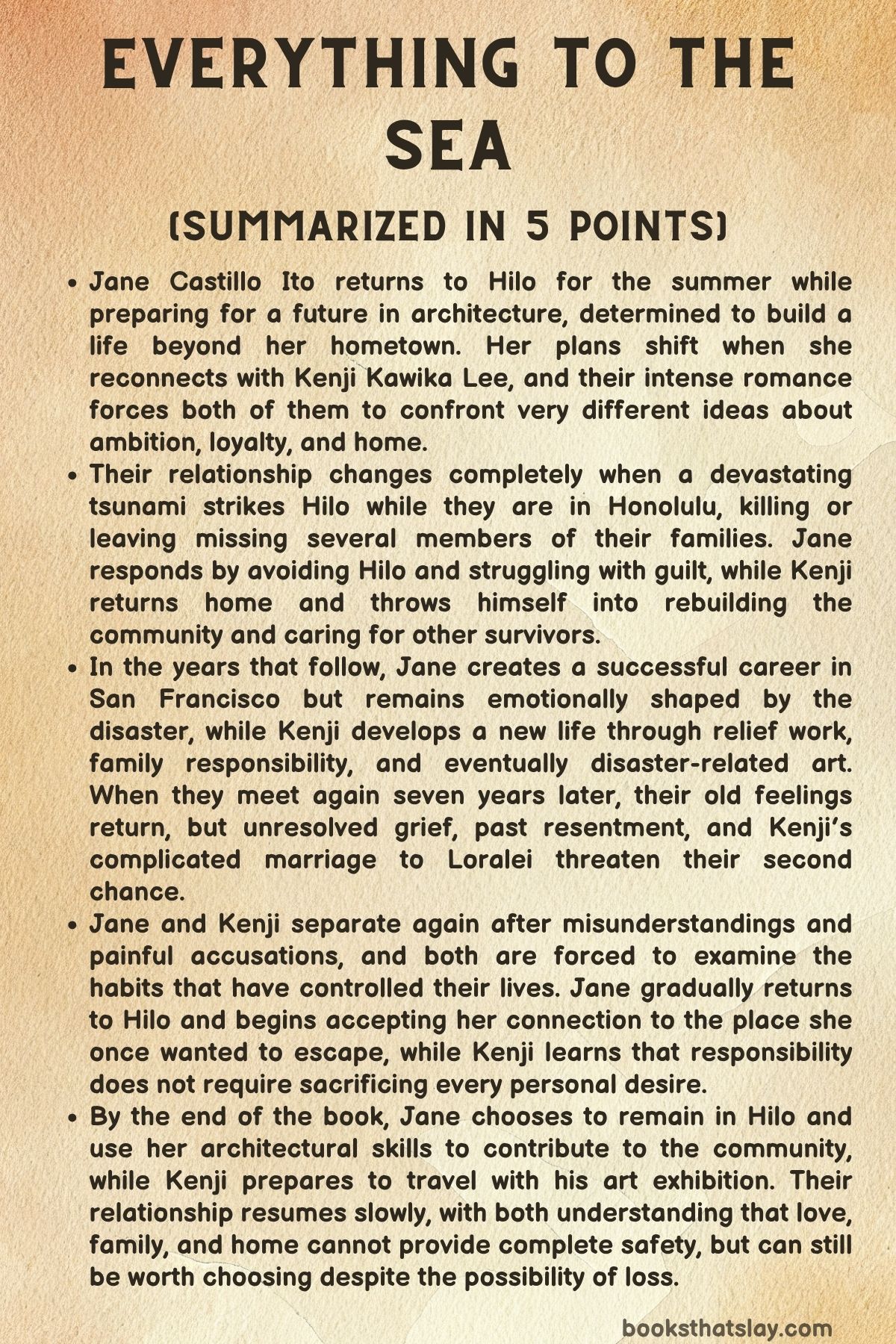
Their summer romance begins as an intense meeting between two people who want different futures, but a catastrophic tsunami changes the course of both lives. Over the years, grief, guilt, obligation, betrayal, and forgiveness repeatedly pull them apart and bring them back into each other’s orbit. The story asks whether love can survive not by preventing loss, but by accepting it.
Summary
Twenty-one-year-old Jane Castillo Ito returns to Hilo for another summer, working at the seaside restaurant owned by longtime family friends while preparing for a future in architecture. Although she recognizes Hilo’s beauty and history, she sees the town as limiting and dreams of graduate school, a prestigious career, and a life on the continental United States.
Her plans begin to lose their certainty when she reconnects with Kenji Kawika Lee, a former high-school classmate who works in construction. Jane is attracted to his confidence and practical relationship with the physical world, while Kenji is fascinated by her independence and her determination to pursue whatever she wants.
As they spend more time together, they discover that each had misunderstood the other in school. Kenji admits that he once admired Jane because she seemed fearless about other people’s opinions, while Jane begins seeing the uncertainty beneath his outwardly relaxed personality.
Their attraction quickly becomes a summer romance filled with late-night drives, beaches, camping trips, and stolen moments in Kenji’s SUV. Jane increasingly neglects her academic work, and what she originally treats as a temporary relationship begins to matter far more than she expected.
At the same time, fundamental differences between them become clearer. Jane wants a future defined by movement, ambition, and professional opportunity, while Kenji feels deeply connected to family, community, and Hilo itself.
Their relationship nearly collapses when Jane discovers that Kenji had previously been involved with Loralei Gonsalves and had never clearly explained the situation. Feeling deceived, Jane walks away, but neither can accept ending things that way, and they reconcile before Jane returns to Honolulu.
At the airport, Jane impulsively asks Kenji to come with her. In an unusual rejection of his normally cautious and dutiful nature, he buys a ticket without luggage or a plan and follows her to Honolulu.
For several days, they experience a version of ordinary life together. Kenji meets Jane’s closest friend Donnie, visits a museum with Jane, and discovers an interest in art and cultural objects that Jane believes might point toward an unexplored part of his identity.
Then a locally generated earthquake sends a tsunami toward Hilo with almost no warning. Jane and Kenji watch helplessly from Honolulu as live television footage shows streets, buildings, homes, and familiar places being destroyed, while repeated calls to their families go unanswered.
The disaster transforms their relationship to survival. Jane becomes psychologically frozen by the possibility that both of her parents have died, especially because her mother had tried to call shortly before the second wave and Jane had ignored the phone.
Kenji soon learns that his mother, Keiko, has died and that Uncle Roy, the man who helped raise him, is critically injured. When he decides to return to Hilo, Jane cannot overcome her fear enough to go with him, even after they finally tell each other that they are in love.
Kenji interprets her refusal as abandonment at the moment when he needs her most. Jane remains in Honolulu as her parents are eventually counted among the permanently missing, while Kenji returns to a devastated Hilo and later carries home the remains of both his mother and Uncle Roy.
In Hilo, Kenji finds purpose by becoming useful. He repairs damaged buildings, performs practical work around a high-school shelter, helps other survivors, and becomes especially close to Justin and Justin’s young nephew Logan, whose immediate family died in the tsunami.
Loralei has also become a major force in the relief effort. Although she and Kenji do not resume their former romantic relationship, disaster, responsibility, and their growing attachment to Logan gradually create a new kind of family around them.
Jane, meanwhile, struggles to function in Honolulu. She drinks, loses weight, neglects her academic life, develops compulsive behaviors, and becomes obsessed with architecture that might somehow withstand the force that erased her childhood home.
Kenji refuses most of her attempts to reconnect because her protected life in Honolulu seems impossibly distant from the destroyed world around him. His resentment grows even though he remains emotionally attached to her.
Months after the disaster, the shelter community suffers another loss when Justin dies by suicide. Logan is left without his final biological relative, deepening Kenji’s and Loralei’s responsibility for him.
When bureaucratic failures prevent food from reaching survivors, Loralei organizes an illegal effort to open shipping containers and distribute the supplies. Kenji joins her, and the two are arrested in front of television cameras, creating a public image that turns them into symbols of Hilo’s determination to care for itself.
Seven years later, Jane has achieved much of the life she once imagined. She works at a prestigious San Francisco architecture firm, yet the tsunami continues to govern her fears, habits, and emotional choices.
Her professional life brings Hawai‘i back into view when she is assigned to a major resort project proposed by billionaire Austin Zachary. At nearly the same time, Donnie takes her to a museum event where she unexpectedly sees Kenji, who has transformed his post-disaster experiences into a career working with art created in response to catastrophe.
Their meeting reveals that their old attraction has survived, but both have changed. Kenji eventually returns the orange mug Jane once gave her father, an object recovered from the wreckage in Hilo and kept by Kenji for years.
When they begin seeing each other again, they try to avoid simply recreating their youthful romance. Kenji admits that he once judged Jane too harshly for leaving, while Jane begins confronting the fact that her apparent success concealed years of self-destructive attempts to avoid grief.
Their renewed relationship becomes serious enough for Jane to imagine a shared home and future. Yet Kenji has withheld a major part of his life: Loralei is his wife, and together they adopted Logan.
The marriage was created so that Kenji and Loralei could secure guardianship of Logan after the tsunami. Although it became a genuine family partnership, it never developed into a satisfying romantic marriage, and both eventually had relationships with other people.
Jane experiences the revelation as another devastating betrayal. At the same time, Logan disappears, forcing Kenji and Loralei to search for him together and repeating the pattern in which Kenji leaves Jane to answer a family emergency.
Logan eventually contacts Jane himself after surviving a reckless night involving drugs, alcohol, speeding, and a car crash. His observations expose how each member of the older generation has allowed the tsunami to organize life differently: Loralei through endless service, Kenji through responsibility and memorialization, and Jane through avoidance and achievement.
Kenji decides that his marriage must end and returns to Jane intending to explain everything. Instead, a misunderstanding involving Jane’s colleague Harmon causes another brutal argument in which both Jane and Kenji attack the fears they know the other carries.
Kenji leaves California, convinced that Jane destroys relationships before they have the chance to abandon her. Jane is left once again with the consequences of using fear as protection.
About a year later, Kenji is rebuilding a house on his family’s former property in Hilo and preparing his disaster-art exhibition for wider travel. He has begun separating love from obligation, allowing Loralei to build a new life and accepting that he can care for Logan without controlling his future.
Jane also returns to Hilo for the first time since the tsunami, initially because of professional obligations and the sale of her parents’ abandoned property. Her arrival coincides with a landslide connected to the Zachary resort project, forcing her to confront both another local disaster and the ethical failures of the professional world she once idealized.
Instead of retreating, Jane helps displaced families and later begins clearing her parents’ overgrown lot. She initially believes the work is a private debt she must repay, but Maile, Walter, and others show her that belonging depends not only on helping but also on accepting help.
Jane finally recognizes that the home she spent years trying to escape had always mattered to her. She leaves her father’s orange mug on the cleared property as an offering and begins imagining a future in Hilo that does not require abandoning her professional ambitions.
Kenji remains suspicious of her return and initially treats it as temporary. His own emotional growth continues when he confronts his imprisoned father, Kawika, whose violence and abandonment had shaped Kenji’s lifelong determination to become the opposite kind of man.
The meeting allows Kenji to understand that forgiveness does not excuse what happened. Instead, it can prevent old injuries from controlling every future decision.
Jane eventually decides to remain in Hilo, establish her own architectural practice, and use her expertise to help the community. She also designs a new house for the property once owned by her parents, transforming architecture from a way of escaping Hilo into a means of contributing to it.
By the end of the year, Jane and Kenji meet again at a New Year’s celebration. Kenji is preparing to travel with his exhibition, while Jane is beginning the rooted life she once resisted.
Rather than forcing an immediate reunion, they acknowledge what they taught each other: Jane helped Kenji imagine a larger world, while Kenji helped Jane recognize the value of home. Their relationship continues through distance, postcards, patience, and the acceptance that loving anything means accepting the possibility of losing it.
Characters
Jane Castillo Ito
Jane is the central consciousness through which much of Everything to the Sea examines ambition, fear, belonging, and grief. At the beginning of the book, she defines herself by movement: Hilo represents familiarity and limitation, while architecture, graduate school, large cities, and the continental United States represent possibility.
Her confidence, however, contains a strong habit of avoidance. Jane is comfortable pursuing desire when the consequences remain under her control, but when emotional attachment becomes dangerous, she repeatedly finds ways to create distance.
The tsunami turns this pattern into something far more destructive. Her inability to return to Hilo is not simple indifference; the town has become inseparable from guilt over ignoring her mother’s final call, fear of confronting the deaths of her parents, and terror of seeing physical proof that the world of her childhood has disappeared.
Jane spends years building a successful professional identity while privately using alcohol, sex, obsessive work, medication, and compulsive behavior to suppress emotions she cannot control. Her architectural imagination even becomes part of this response, as she repeatedly redesigns her parents’ destroyed house as though better construction could retroactively defeat the disaster.
Her later growth comes from learning that strength does not mean eliminating vulnerability. Clearing her parents’ property, helping displaced residents, swimming again, remaining in Hilo without a fixed plan, and offering her professional skills to the community all require her to stop treating departure as the only expression of independence.
By the end of the book, Jane has not rejected ambition; she has redefined it. She discovers that choosing Hilo does not mean becoming trapped there, and loving Kenji does not require a guarantee that he will always remain beside her.
Kenji Kawika Lee
Kenji is Jane’s emotional counterpart and one of the most psychologically important figures in Everything to the Sea. Where Jane begins by idealizing freedom, Kenji begins by idealizing responsibility, and much of his development comes from understanding that duty can become as imprisoning as fear.
His childhood explains why being dependable matters so intensely to him. After watching his father abuse and abandon his mother, Kenji constructs his identity around being everything Kawika was not: loyal, useful, gentle, responsible, and available whenever other people need him.
The tsunami magnifies this instinct. Kenji returns to Hilo, works constantly, cares for Logan, supports Loralei, helps rebuild the community, and turns practical usefulness into both a moral code and a way of avoiding his own grief.
His anger at Jane partly grows from genuine hurt, but it also reflects his need to believe that staying is morally superior to leaving. If Jane can leave and still be a loving person, then Kenji must question whether all of his sacrifices were truly necessary.
His career in disaster art marks another stage of development because it allows him to transform experience rather than merely repair physical damage. Art gives him a language for memory, interpretation, and uncertainty that construction alone cannot provide.
Eventually Kenji learns to distinguish commitment from surrendering his entire identity. Ending his marriage, allowing Logan independence, refusing to answer every community crisis, traveling with his exhibition, and meeting his father all show him choosing rather than automatically obeying obligation.
Loralei Gonsalves
Loralei first appears as a source of tension in Jane and Kenji’s romance, but she develops into a far more complicated figure. She is forceful, practical, relentless, and exceptionally capable during crisis, turning her grief after the tsunami into organized service for other survivors.
Her response to devastation is action. Whether coordinating the shelter, obtaining supplies, forming Feed Our Families, protecting Logan, or challenging authorities, Loralei continually converts fear and loss into work that can produce visible results.
That strength also becomes one of her limitations. Loralei can make responsibility so central to life that need itself becomes a source of identity, leaving little room for people around her to make choices that do not support the larger mission.
Her marriage to Kenji demonstrates both the generosity and danger within this impulse. She marries him largely to create a stable legal family for Logan, but she also carries emotional hopes that Kenji cannot fully return.
Loralei eventually develops enough self-awareness to recognize that blame has kept her attached to old disappointments. Her later relationship with Wyatt, pregnancy, move to Maui, and friendship with Kenji show that she can finally pursue happiness without requiring suffering to justify her choices.
Logan
Logan enters the story as a child whose family has been almost completely erased by the tsunami. His attachment to Kenji and Loralei grows out of extraordinary loss, making their eventual adoption of him both an act of love and a continuation of the disaster’s influence over all three lives.
As he grows older, Logan resists becoming permanently defined as the child everyone saved. Drugs, theft, reckless driving, instability, and repeated confrontations with authority become destructive methods of proving that his life belongs to him rather than to the catastrophe that shaped his childhood.
His behavior is dangerous, but Logan is also unusually perceptive about the adults around him. He recognizes Kenji’s feelings for Jane, understands the emptiness in Kenji and Loralei’s marriage, and identifies how each survivor has built a different structure around unresolved trauma.
By the later part of the story, Logan begins moving toward a more productive version of independence. His interest in connecting community members with professional resources suggests that he can inherit Loralei’s sense of service without simply repeating her life.
Donnie
Donnie functions as Jane’s closest source of friendship, continuity, and uncomfortable truth. Unlike Kenji, Donnie belongs primarily to Jane’s life outside Hilo and therefore witnesses the version of Jane that appears successful while privately deteriorating.
Donnie offers support without allowing Jane to turn friendship into unconditional agreement. When Jane interprets her repeated conflicts with Kenji entirely through his failures, Donnie reminds her that she also has a history of disappearing, running, and allowing misunderstandings to survive because they protect her from greater emotional risk.
Donnie’s pregnancy and the emergency surrounding Henry’s birth also become important for Jane. The arrival of new life beside so much accumulated grief reminds Jane and Kenji that family does not exist only as something that has already been lost.
Maile
Maile represents a form of home that survives catastrophe and absence. As a longtime family figure connected to Jane’s childhood, she maintains a relationship with Jane that does not depend on Jane proving she deserves to return.
Her greatest contribution to Jane’s growth is her understanding of communal care. When Jane tries to clear her parents’ property alone as though suffering must be repaid through solitary effort, Maile teaches her that community requires receiving help as much as giving it.
Maile also challenges Jane’s claim that nothing remains for her in Hilo. By telling her that Jane herself remains, she shifts the meaning of home away from destroyed buildings and toward identity, relationship, and memory.
Walter, formerly Wally-Jun
Walter begins as Jane’s childhood friend and one of the people who understands both her family and the social world of Hilo. Early in the story, he warns Jane about Kenji and provides information that reminds her how difficult anonymity is in a town where personal histories are widely known.
Later, Walter represents continuity without stagnation. He has matured, invested in the neighborhood, and quietly purchased Jane’s former family property along with nearby lots, demonstrating a practical commitment to Hilo’s future.
His willingness to accept Jane’s architectural work without demanding proof of her intentions is especially meaningful. His trust tells Jane that family relationships can survive distance and disappointment rather than requiring her to earn her way back into belonging.
Jane’s Mother
Jane’s mother is central to Jane’s emotional life even though much of her importance emerges through absence. Before the tsunami, she expresses frustration that Jane rarely returns home, revealing the growing distance between Jane’s ambitions and her parents’ desire to remain connected to their daughter.
Her attempted phone call shortly before the second tsunami wave becomes one of the defining memories of Jane’s adulthood. Jane cannot know exactly what happened, which allows guilt to create a terrible imagined final scene that she repeats for years.
Jane’s eventual habit of speaking to her deceased parents and making room for them in ordinary life marks an important change. Her mother is no longer represented only by the unanswered call but becomes part of a continuing relationship with memory.
Jane’s Father
Jane’s father is associated with work, place, family history, and several of the novel’s most important surviving objects. His connection to Hilo becomes more meaningful to Jane only after his disappearance, when she begins reconsidering the local identity she once treated as something to outgrow.
The orange insulated mug Jane buys him after forgetting Father’s Day becomes the strongest material link between Jane, Kenji, and her father. Kenji later finds it in the wreckage associated with the displaced family boat and preserves it for years.
The mug changes meaning several times. It begins as a hurried gift, becomes evidence of loss, turns into an object Kenji carries while remembering Jane, and eventually returns to Jane as something that can belong to her future rather than existing only as debris from the past.
Keiko Lee
Keiko, Kenji’s mother, helps explain the emotional structure of her son’s adulthood. Having suffered abuse and abandonment from Kawika, she becomes part of the family environment in which Kenji learns to value loyalty and fear the possibility of becoming like his father.
Her suspicion of Jane reflects this history. Keiko worries that Jane will eventually leave Kenji, and after her death that warning becomes especially powerful because Kenji uses Jane’s refusal to return to Hilo as confirmation that his mother had been right.
Keiko’s death therefore affects Kenji beyond ordinary bereavement. Her memory becomes tied to his resentment, duty, and fear of abandonment until he gradually learns that honoring her does not require living permanently in opposition to everyone who leaves.
Uncle Roy
Uncle Roy is the positive masculine influence against whom Kenji measures himself. Where Kawika represents violence, abandonment, and failed responsibility, Roy represents patience, loyalty, and the possibility that fatherhood can be created through consistent care rather than biology.
Kenji’s later meeting with his father makes Roy’s influence especially clear. Kawika himself recognizes Roy’s qualities in Kenji, allowing Kenji to understand that he is not merely a man struggling not to become his father; he is also someone shaped by the better example Roy provided.
Roy’s death after the tsunami deepens Kenji’s survivor guilt, but his legacy remains constructive. The values Kenji inherits from him are valuable even when Kenji must eventually learn not to turn those values into compulsory self-sacrifice.
Justin
Justin is one of the most tragic figures in the story because his struggle demonstrates the limits of usefulness, community, and good intentions. A recovering addict living in the shelter, he contributes skills and knowledge while also carrying fear about what will happen when emergency assistance disappears.
His relationship with Logan reveals both love and instability. His attempt to give Logan a valuable baseball card becomes an emotional failure when Logan suspects him of stealing it, and the rejection deepens the sense that Justin cannot successfully repair his role within the family.
Justin’s suicide leaves Kenji and Loralei questioning what warning signs they missed. It also shapes Kenji’s later relationship with Logan, because Kenji becomes intensely afraid that failing to remain constantly available could lead to another irreversible loss.
Kawika Lee
Kawika, Kenji’s father, is physically absent through most of the story but psychologically present throughout Kenji’s life. His violence toward Keiko and his abandonment of the family become the negative model around which Kenji constructs his entire sense of masculinity.
For decades, Kenji believes that staying loyal, remaining useful, and never abandoning anyone are necessary protections against becoming like Kawika. This creates a painful irony: Kenji’s attempt to reject his father becomes another force allowing his father’s actions to control his life.
Their eventual prison meeting does not erase Kawika’s wrongdoing. Instead, it gives Kenji permission to stop defining every choice through opposition to a man who has already admitted the damage he caused.
Eli
Eli appears at a crucial stage in Kenji’s post-tsunami development. Connected with Hilo’s tsunami museum, he recognizes that Kenji notices shape, arrangement, meaning, and visual composition in ways that go beyond the practical instincts of a construction worker.
That recognition helps move Kenji toward museum work and disaster art. Eli therefore serves as an important bridge between Kenji’s old identity as someone who builds physical structures and his later identity as someone who constructs meaning from objects, images, and collective memory.
Sheryl Sisquell
Sheryl is a reporter whose presence connects private suffering with public representation. During the port incident, her involvement helps turn Kenji and Loralei’s illegal distribution of food into a public confrontation over whether authorities are serving survivors effectively.
She later interviews Kenji about his exhibition, placing him on the opposite side of the documentary process. Instead of merely becoming an image associated with disaster relief, he is now able to explain how catastrophe, memory, and artistic representation should be understood.
Olivia
Olivia represents the professional world Jane once believed would offer freedom from Hilo. As Jane’s supervisor, she recognizes Jane’s local knowledge as useful to the Austin Zachary resort project but approaches Hawai‘i primarily through the interests of the firm and its wealthy client.
The landslide exposes the ethical limits of that professional culture. Olivia’s pressure on Jane to gather information without admitting responsibility contributes to Jane’s growing realization that professional prestige does not automatically equal meaningful or responsible work.
Harmon
Harmon functions less as a genuine romantic rival than as a test of Jane’s tendency toward self-sabotage. His availability allows Jane to imagine using another relationship to regain emotional control whenever she feels abandoned or humiliated by Kenji.
The crucial point is that Jane does not actually sleep with Harmon. Yet she allows Kenji to believe the worst after their later confrontation, demonstrating how willing she can be to damage a relationship rather than expose herself to the vulnerability of correcting a painful misunderstanding.
Faith
Faith appears late in the story but has an important role in Jane’s changed understanding of architecture and professional expertise. Her struggle to protect a community garden shows Jane a local problem that cannot be solved merely by goodwill because ownership, planning rules, and permits stand in the way.
Jane immediately recognizes that she possesses useful knowledge. Through Faith’s problem, she begins seeing architecture and planning not simply as vehicles for personal achievement but as skills that can serve the place in which she now intends to live.
Reggie
Reggie, Maile’s partner, appears most significantly when Jane attempts to clear her parents’ property. He arrives with proper tools and practical knowledge, becoming part of the group effort that contradicts Jane’s belief that she must perform the work alone.
His role is small but thematically useful. Reggie belongs to the ordinary network of people whose willingness to show up demonstrates the communal values Jane once misunderstood as restrictive.
Wyatt
Wyatt represents Loralei’s opportunity to build a life beyond her complicated history with Kenji. By the time Kenji learns that Loralei is happy with Wyatt and later discovers that she is pregnant and moving to Maui, he is able to respond without jealousy or resentment.
Wyatt therefore helps reveal how much Kenji and Loralei have changed. Their divorce no longer has to be understood purely as failure because it has allowed both of them to pursue relationships built on desire rather than necessity.
Summer
Summer belongs to Jane’s adult social world in California and appears alongside Donnie during the period when Jane and Kenji begin seeing each other again. The source gives limited information about Summer’s independent personality, so her role is primarily contextual rather than deeply developed.
Her presence helps establish that Jane has built relationships and routines during the seven years away from Hilo. This matters because Kenji is not returning to the same isolated young woman he knew during their first summer together.
Brandon Gonsalves
Brandon, Loralei’s twin brother, first appears during the encounter that exposes Kenji’s earlier relationship with Loralei. His later death, along with his family, during the tsunami contributes to the enormous personal losses Loralei carries into her work at the shelter.
Because the book provides relatively little direct characterization of Brandon, his importance lies largely in Loralei’s history. His death helps explain why her relief work becomes so urgent and why rebuilding community becomes inseparable from her personal mourning.
Austin Zachary
Austin Zachary is less a psychologically developed individual than a representation of wealth, outside power, and development conducted without sufficient respect for local consequences. His planned eco-resort initially appears to Jane as an impressive professional opportunity.
The landslide associated with the project exposes the difference between branding a development as beneficial and behaving responsibly toward the land and surrounding community. Through Zachary’s project, Jane is forced to reconsider the professional values she once associated with success.
Manny
Manny, the cameraman accompanying Sheryl during the port confrontation, has a limited individual role but contributes to the creation of the famous public image of Kenji and Loralei. His camera helps transform a desperate local act into a widely visible symbol.
This emphasizes one of the story’s recurring questions about disaster: private suffering can become public material once it is photographed, reported, exhibited, or remembered by people beyond those who experienced it.
Will
Will appears during one of Jane’s lowest periods after the tsunami. Jane nearly uses a sexual encounter with him as another attempt to imitate her former carefree identity and escape from grief.
Her inability to follow through shows how completely the disaster has altered her relationship with her own body and desires. Will is therefore less important as an individual than as evidence that Jane cannot simply return to the person she was before the catastrophe.
Henry
Henry, Donnie’s baby, enters the story during a medical emergency that interrupts one of Jane and Kenji’s most difficult arguments. The safe birth temporarily redirects their attention from betrayal and anger toward vulnerability, family, and new life.
His presence also creates a quiet contrast with the children and relatives lost in Hilo. Birth does not cancel grief, but it demonstrates that family history continues to grow even after devastating loss.
Themes
Home, Belonging, and the Freedom to Leave
Home is treated as both a source of identity and a source of conflict throughout Everything to the Sea. Jane initially believes that becoming fully herself requires leaving Hilo, because the intimacy of the town feels like surveillance and its expectations seem to reduce the scale of the life she wants.
Kenji begins from the opposite position. To him, remaining close to family, keeping promises, knowing the community, and responding when people need help are signs of moral seriousness, so Jane’s desire to leave can look like rejection rather than aspiration.
The tsunami destroys the physical version of home for both characters and exposes the weakness in their assumptions. Jane discovers that distance cannot remove Hilo from her identity, while Kenji gradually recognizes that staying in one place does not automatically prove loyalty.
Their later development depends on separating belonging from confinement. Jane returns voluntarily and discovers that architecture, ambition, and service can exist inside Hilo, while Kenji becomes willing to travel and understand that leaving does not erase family.
The story ultimately presents home as something chosen repeatedly rather than something secured by permanent residence. A person can leave and still belong, stay and still feel trapped, return after years away, or carry home internally while moving through the wider world.
Grief, Memory, and the Problem of Survival
The tsunami does not end when the water withdraws. Its psychological consequences continue for years because surviving characters must live with missing bodies, unfinished conversations, recovered objects, destroyed buildings, photographs, public memorials, and unanswered questions.
Jane initially treats memory as something dangerous. She avoids Hilo, avoids tsunami footage, drinks, overworks, pursues distraction, and attempts to construct a life so different from her past that grief might lose access to her.
Kenji moves toward memory rather than away from it, but his response is not automatically healthier. He surrounds himself with disaster relief, recovered objects, community responsibility, museum work, and eventually an exhibition dedicated to catastrophe, allowing remembrance to become another structure around which his whole identity is organized.
The book refuses to suggest that healing requires forgetting. Jane improves only when she can watch the footage she once avoided, clear the property she refused to visit, speak to her dead parents, swim again, and keep the orange mug without treating it as an unbearable relic.
Kenji similarly begins to heal when survival no longer feels like evidence that he failed the dead. Memory becomes sustainable when it is allowed to exist beside ordinary living rather than controlling it.
Duty, Choice, and Personal Freedom
Responsibility is repeatedly presented as a virtue that can become destructive when it is separated from choice. Kenji’s entire personality is built around being dependable because he believes goodness means never behaving like the father who abandoned his family.
After the tsunami, this belief becomes stronger. Every damaged building, frightened survivor, community project, family crisis, and request from Loralei feels like something he is morally required to answer, making usefulness both his purpose and his prison.
Loralei experiences a similar problem. Her extraordinary ability to organize, provide, and protect saves people, yet continual crisis also gives her a clear identity, making it difficult to accept that other people may choose lives outside the structures she has created.
Jane initially appears to represent the opposite principle because she values individual desire. Yet her version of freedom is also incomplete, since escaping every threatening attachment becomes another kind of compulsion.
The characters mature when they learn that meaningful responsibility must contain genuine consent. Kenji can love Logan without directing his entire life, Loralei can continue serving others while building a new family, and Jane can contribute to Hilo without surrendering her ambitions.
Freedom therefore becomes more than the absence of obligation. It is the ability to decide which obligations are worth accepting.
Love, Forgiveness, and Rebuilding
Love in the story is never presented as protection from pain. Jane and Kenji hurt each other repeatedly through omissions, fear, resentment, withdrawal, false assumptions, and decisions made when each believes self-protection is necessary.
Their relationship fails whenever either expects love to remove uncertainty. Jane wants reassurance that she will not be abandoned, while Kenji wants evidence that the people he loves will remain loyal when he needs them, causing both to interpret complicated choices as proof of deeper betrayal.
Forgiveness gradually offers another possibility. Loralei stops organizing her unhappiness around Kenji, Kenji allows her to build a new life, Jane accepts her complicated love for Hilo, and Kenji finally meets the father whose violence has influenced almost every major choice he has made.
None of these acts erase what happened. Kawika remains responsible for abuse, Kenji remains responsible for hiding his marriage, Jane remains responsible for her own forms of avoidance, and the tsunami remains an irreversible catastrophe.
Rebuilding therefore means living with damage rather than pretending it can be restored to its previous state. Houses can be reconstructed, families can change form, careers can be redirected, and relationships can resume without becoming what they once were.
Jane and Kenji’s final connection succeeds because it is slow and uncertain. They no longer demand that love guarantee permanence; they accept that something can be worth choosing precisely because it can be lost.