Exit Party Summary, Characters and Themes
Exit Party by Emily St. John Mandel is a speculative literary novel about parallel realities, political collapse, regret, family, and the strange ways lives may echo across different worlds.
The story follows people displaced not only by war and authoritarianism but by an accidental passage between universes, forcing them to confront alternate versions of themselves and the lives they might have lived. At its center is Ari Waker, whose long existence is shaped by crime, imprisonment, love, survival, and remorse, while the painting Swan Dive quietly links generations and realities. The novel treats death, movement, memory, and art as different forms of transition.
Summary
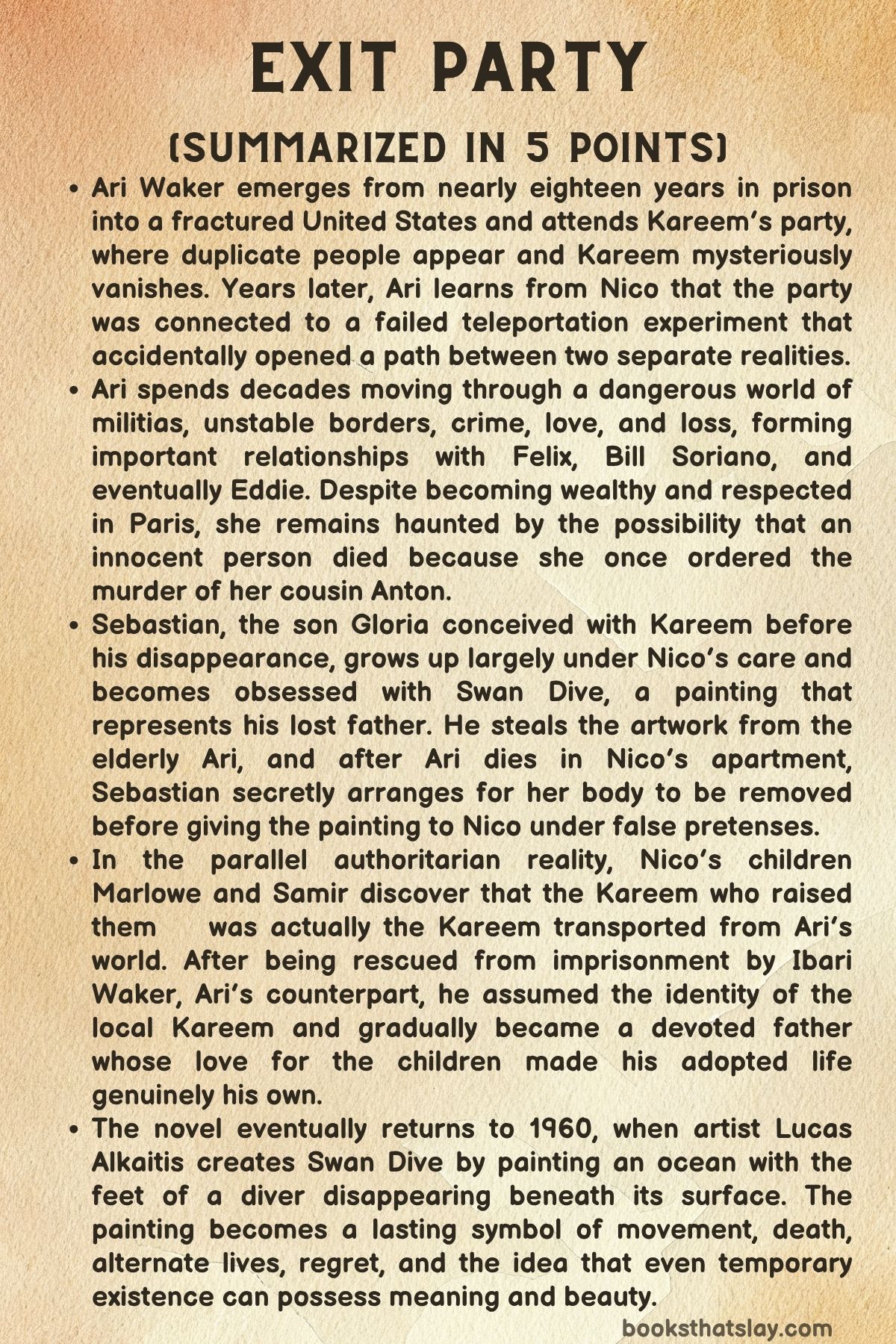
In 2031, the United States no longer exists as a unified nation. A coup, secessions, armed conflict, and political fragmentation have transformed the country into competing territories, and Ari Waker emerges from nearly eighteen years in prison into this unstable landscape.
Ari lives in Los Angeles with Gloria, who has been deeply affected by the violence around them. When the California Republic temporarily relaxes its curfew, Ari feels an unusually strong intuition that they should attend a party hosted by their friend Kareem, and Gloria reluctantly goes with her.
The party quickly becomes impossible to explain. Ari encounters a frightened woman who looks exactly like Saraya but behaves as though she has arrived from somewhere completely unfamiliar, while another Saraya continues moving through the party as if nothing unusual has happened.
The duplicate knows Ari by the name Ibari, a legal name Ari almost never uses, which makes the encounter even more disturbing. Meanwhile, Gloria tells Ari that she is pregnant with Kareem’s child, and before the night is over Kareem disappears without anyone understanding how he left.
Gloria takes Kareem’s painting Swan Dive, an artwork that will remain connected to the lives of several characters for decades. The disappearance becomes one of the central mysteries of Ari’s life, but she has no immediate way to understand that the party briefly connected two separate realities.
Years later, Ari has moved far from Los Angeles and works in surveillance for an Ohio militia. During this period she meets Nico, a woman who is physically identical to Gloria but clearly is not Gloria, and Nico confirms that she was present at Kareem’s party after arriving from somewhere else.
Nico also knew another Ibari Waker, a woman with instincts remarkably similar to Ari’s. The existence of this counterpart offers Ari unsettling evidence that another version of her life is possible somewhere beyond her own reality.
Ari becomes romantically involved with Felix, a former ballet dancer who now works as an arms dealer. When Ari senses that their situation in Ohio is becoming dangerous, the two flee south through hostile territory, eventually reaching Houston, where an unexplained message containing the word “run” confirms Ari’s belief that they are still being pursued.
Much later, Ari is an elderly, wealthy widow living in Paris with a severely damaged leg. Swan Dive is now part of her art collection, and a young man named Sebastian enters her life claiming to be an art-history student interested in studying her possessions.
Ari immediately suspects that Sebastian’s explanation is false. Her instincts tell her that his real interest is probably theft, and her suspicion is correct, although she does not yet understand why the painting matters to him so personally.
The intervening years have changed Ari dramatically. She and Felix survived dangerous borders, militias, false identities, and political disorder together, but Felix eventually died in Greece, leaving Ari to continue alone.
She later formed an alliance with Bill Soriano, a former mercenary whose international connections made him useful in the unstable world they inhabited. Their practical partnership developed into marriage, giving Ari another significant attachment despite her lifelong belief that dependence on others creates vulnerability.
Paris itself becomes increasingly threatened by unrest, eventually prompting authorities to build a protective dome. One night Ari and Soriano encounter armed figures and a suspicious boat near the Seine, and their conflicting instincts about what to do next cause them to separate.
Ari continues forward while Soriano retreats. Moments later, a massive explosion throws Ari through the street and destroys her leg, while Soriano is killed.
As Ari recovers in a hospital, Nico arrives and begins a series of conversations with her. Ari also sees Felix, although he is already dead, establishing the increasingly uncertain boundary between memory, grief, and the presence of the people Ari has lost.
During these conversations, Ari explains the criminal life that led to her imprisonment. She grew up among relatives involved in stolen antiques and later entered the forged-passport business when immigration restrictions created a profitable underground market.
Her operation expanded until her cousin Anton threatened to leave. Afraid that he might expose her, Ari hired someone to kill him, only to learn after her arrest that Anton had survived and that the killer may instead have murdered an innocent stranger.
This possibility remains one of Ari’s deepest sources of guilt. Much of her emotional distance can be understood as a defense against the knowledge that one irreversible decision may have destroyed a person who had nothing to do with her conflict.
Nico then explains what truly happened at Kareem’s party. In Nico’s original world, she was a physicist involved in a teleportation experiment, but the experiment unexpectedly carried her and Saraya into Ari’s reality rather than transporting them within their own universe.
Nico left behind her husband Kareem and her children, Marlowe and Samir. Unable to return, she eventually encountered Gloria, her counterpart in this reality, and later became deeply involved in raising Gloria’s son Sebastian when Gloria failed to provide him with sufficient care.
Ari and Nico consequently become philosophical opposites. Nico continues to believe that attachments remain worthwhile even when they expose people to terrible loss, whereas Ari insists that emotional dependence gives others too much power to hurt her.
Sebastian has meanwhile spent years researching Ari. Although she is publicly known as a wealthy Parisian philanthropist, he becomes fascinated by the hidden criminal history behind her respectable reputation.
His deeper interest, however, is Swan Dive. The painting is his strongest surviving connection to Kareem, the father who disappeared before Sebastian was born, and stealing it becomes an attempt to recover something from the past that was denied to him.
Sebastian enters Ari’s apartment under the false identity of a researcher and steals the painting. Ari follows him into the Vincennes forest, where a stranger attacks her and steals her handbag, leaving her seriously injured.
Instead of seeking hospital treatment, Ari orders Sebastian to take her to Nico’s apartment. There she weakens rapidly while speaking about pieces of her past, and when Nico eventually returns, Sebastian discovers that Ari has died after apparently seeing Eddie, Ari’s deceased wife.
Terrified that Ari’s death will expose his theft, Sebastian contacts criminals who can make the body disappear. He knows that asking for their help creates a future obligation, illustrating how quickly one frightened decision can create consequences that extend far beyond its original purpose.
Sebastian gives Swan Dive to Nico and lies that he bought it back. Nico is deeply moved because the painting reconnects her to Kareem and the world she lost, while Sebastian feels the painful contrast between the good person Nico believes him to be and the morally compromised person he knows himself to have become.
Ari’s final consciousness is filled with fantasies of escape, travel, and reversal. More than anything, however, she wants to move backward through time rather than forward through space.
She imagines returning to Kareem’s party and following him through the mysterious doorway, but her greatest desire reaches even further into the past. Ari wants to return to the moment before she ordered Anton’s murder and tell him that he is free to leave.
This wish reveals that the central wound of Ari’s life is not simply what others have done to her but what she herself has done. At the end, Eddie appears and tells Ari that she has come for her.
The image of Swan Dive expands into an actual ocean, and Ari is released from the damaged body that has carried her through decades of violence, imprisonment, love, wealth, and regret. She takes Eddie’s hand, walks onto a diving board, and enters the blue water, turning the painting into the symbolic passage through which her life finally ends.
The narrative then shifts to the other universe, an authoritarian United State where national collapse never occurred but surveillance and state control have become normal. Marlowe Li, Nico’s daughter, lives there as a physicist after surviving an emotionally abusive marriage to Hugo.
Hugo repeatedly manipulated Marlowe into distrusting her own perception of events. Even after leaving him, she experiences panic attacks, insomnia, trauma, and uncertainty about her memories, showing how deeply psychological domination can continue after the relationship itself ends.
Years later, Marlowe and Samir return home because their father Kareem is dying. Their mother Nico has officially been considered lost for decades after the failed teleportation experiment.
During Kareem’s final night, Samir sees another healthier Kareem enter the house. This man appears identical to their father but does not recognize Samir, and longtime intelligence officer Ibari Waker cryptically calls him a ghost.
Marlowe also briefly sees this unfamiliar Kareem before returning to the bedside of the man who raised her. She remains with him until he dies, understanding his death through the scientific concept that has shaped her career: life is movement through space and time, and death may simply represent another kind of transport.
Ibari Waker’s history explains the mystery. In this reality, Ibari became an intelligence operative for an authoritarian government, hiding her official work beneath an academic identity while participating in a system built on surveillance, disappearances, forced labor, and fear.
Her closest friend was Nico Li, who discovered that a teleportation experiment might offer a means of escape from the State. Before conducting it, Nico asked Ibari to protect Marlowe and Samir if anything happened to her.
The experiment carried Nico and Saraya into Ari’s universe. At another point, Kareem from Ari’s reality entered Ibari’s world, where authorities imprisoned him in a desert labor camp.
Through him, Ibari learned of another version of herself: Ari, a criminal woman with the same legal name and the same childhood phrase about “true diligence.” The discovery forces Ibari to recognize that identity may be shaped as much by circumstance and institutions as by personality.
Ibari eventually rescues the displaced Kareem and proposes an extraordinary solution. The Kareem native to her universe wants to abandon domestic life and join the resistance, so the displaced Kareem can assume his identity and raise Marlowe and Samir.
Kareem accepts. Though initially overwhelmed by suddenly becoming responsible for two neglected children, he begins performing ordinary acts of care: cooking for them, reading to them, untangling Marlowe’s hair, and taking them to the park.
These acts gradually transform obligation into genuine parenthood. Over the following decades, Kareem becomes the children’s true father emotionally, even though he comes from another universe and has taken the place of the man who originally occupied that role.
His earlier life in the fractured America never vanishes completely, but it becomes less important than the family he has gained. His pride in Marlowe’s accomplishments shows how thoroughly love can convert an accidental displacement into a meaningful life.
The final section moves backward to New York City in 1960. Painter Lucas Alkaitis is working late in his studio while Olivia, another painter and his complicated friend, poses for him.
After Olivia falls asleep, Lucas begins another canvas simply because he wants to work on something privately. Remembering a maritime image from childhood, he paints an ocean in black, green, blue, and white, focusing not on ships but on the movement of the water.
Feeling that the image needs a human presence, Lucas adds only the feet of a diver disappearing beneath the surface. That spontaneous decision creates Swan Dive, the painting that will eventually pass through multiple lives and connect people who do not yet exist.
Lucas remembers a poem his mother once used as a warning about unsustainable ways of living, but he interprets its message differently. Instead of concentrating on the certainty that light eventually disappears, he focuses on the fact that it can still be beautiful while it lasts.
Olivia wakes, examines the unfinished painting, and leaves. Lucas returns to his work, and the novel ends not with Ari’s death or the consequences of the teleportation experiment, but with the creation of the image that will later symbolize disappearance, passage, mortality, and the temporary beauty of existence.
Characters
Ari Waker
Ari Waker is the emotional center of Exit Party, a woman whose toughness is inseparable from the guilt and losses accumulated over the course of her life. Emerging from almost eighteen years in prison, she has learned to distrust dependence, rely on instinct, and treat survival as something that often requires distance from other people.
Her criminal history complicates any attempt to treat her only as a victim of circumstance. Ari knowingly ordered Anton’s murder because she feared losing control of her passport operation, and the possibility that an innocent person died instead becomes a private moral wound she can never completely escape.
At the same time, Ari is capable of profound attachment despite insisting otherwise. Felix, Soriano, and Eddie each occupy important places in her life, while the recurring appearances of the dead reveal how little success she has had in emotionally abandoning the people she loved.
Her final desire to stop the attack on Anton gives her character arc its moral conclusion. Ari has survived war, prison, political collapse, displacement, and physical injury, yet what she finally wants is not greater power or another escape but the chance to choose mercy at the moment when she once chose violence.
Nico Li
Nico is one of the strongest arguments in Exit Party for the value of attachment despite the pain it can produce. A physicist accidentally transported into another universe, she loses Kareem, Marlowe, Samir, her homeland, and virtually every familiar structure of her existence in a single catastrophic event.
Rather than allowing that loss to make her permanently detached, Nico builds new relationships. Her encounter with Gloria is especially unsettling because Gloria is physically identical to her, yet the differences between them demonstrate how two outwardly identical people can make radically different choices.
Nico’s relationship with Sebastian becomes her most important emotional role in the new reality. Because Gloria fails to give him dependable care, Nico effectively becomes the parent he needs, transferring some of the maternal devotion she can no longer give Marlowe and Samir into raising another child.
Her disagreement with Ari reflects their deepest philosophical difference. Nico accepts that love creates vulnerability but considers connection worth the risk, making her a quiet counterargument to Ari’s belief that safety comes from needing no one.
Kareem Fayed
Kareem becomes one of the clearest examples in Exit Party of identity being defined by care rather than biology or origin. At the Los Angeles party, he is suddenly removed from his world and deposited in an authoritarian reality, losing everyone and everything familiar to him in a moment.
His first experience there is imprisonment rather than wonder. After spending a year in a desert labor camp, he is rescued by Ibari and offered the chance to assume the life of his alternate self, including responsibility for Marlowe and Samir.
Kareem initially accepts an impossible situation because there are few better choices available, but his relationship with the children soon becomes genuine. Small acts of domestic care transform him from an accidental substitute into the person who actually performs fatherhood every day.
His later pride in Marlowe shows how fully the borrowed life becomes his own. Kareem loses one family through an impossible accident but creates another through years of patience, commitment, and ordinary responsibility.
Sebastian
Sebastian embodies the long-term damage caused by abandonment in Exit Party. He grows up without Kareem and with a deeply unsatisfactory relationship with Gloria, leaving Nico to provide much of the emotional security that his biological mother fails to give him.
Swan Dive becomes important to him because it represents a father he never knew. His decision to steal the painting from Ari is therefore not simple greed; it is an attempt to reclaim a physical connection to a missing parent and to a family history that has always felt incomplete.
Nevertheless, his motives do not excuse his choices. After Ari dies, Sebastian responds to fear by asking criminals to dispose of her body, knowingly entering a relationship of obligation that may endanger him later.
His final lie to Nico is particularly revealing. She sees him as generous and morally decent when he gives her the painting, while Sebastian understands that the story she believes is false, leaving him divided between the person Nico thinks she raised and the person his actions suggest he is becoming.
Gloria
Gloria is a damaged survivor whose resemblance to Nico creates one of the novel’s most revealing contrasts. She has endured severe political violence and displacement, and her trauma helps explain the fear and emotional instability that surround her early appearances.
Her pregnancy with Kareem’s child permanently connects her to the mysterious events at the party. After Kareem disappears, she takes Swan Dive, unknowingly preserving an object that will later become deeply important to Sebastian and Nico.
Yet Gloria’s later neglect of Sebastian prevents trauma from functioning as a complete moral excuse. The story allows suffering to explain some of her limitations while still showing that her son experiences those limitations as abandonment.
Her existence beside Nico is also a study in possibility. Two women with the same face can respond differently to loss, parenthood, and responsibility, reinforcing the idea that parallel selves are not interchangeable simply because they share the same appearance.
Felix
Felix represents one of Ari’s most meaningful challenges to her belief that attachment should be avoided. A former ballet dancer who becomes an arms dealer, he combines an earlier life associated with disciplined artistic expression with a later existence shaped by instability and violence.
His relationship with Ari develops while both are operating in dangerous territory. Their decision to flee Ohio together shows that Ari trusts him enough to connect her survival to his, a significant act for someone who claims dependence is dangerous.
Felix’s eventual death in Greece turns him into another of the absent figures Ari continues carrying with her. His later appearance after the Paris explosion suggests that the dead remain psychologically present even when Ari tries to structure her life around independence.
Bill Soriano
Bill Soriano enters Ari’s life after Felix’s death and initially appears as a practical ally. His background as a well-connected former mercenary gives Ari access to knowledge and protection in a world where normal political systems have become unreliable.
Their alliance eventually becomes a marriage, showing once again that Ari repeatedly forms attachments despite the philosophy of self-protection she expresses to Nico. Soriano therefore reveals the gap between Ari’s stated beliefs and the emotional reality of her life.
His death also demonstrates the uncertainty surrounding intuition. At the Seine, Ari believes they should move forward while Soriano believes retreat offers greater safety, and neither possesses enough information to know which interpretation of danger is correct.
Eddie
Eddie appears only briefly in the supplied material, but her importance lies in the position she occupies at the end of Ari’s life. She is identified as Ari’s deceased wife, indicating that Ari continued forming serious bonds even after the losses of Felix and Soriano.
When Ari is dying, Eddie appears as the person who comes to guide her away. Whether this moment is understood literally, spiritually, or as Ari’s final mental experience, Eddie represents reunion after a lifetime repeatedly defined by separation.
Her presence changes death from solitary extinction into companionship. Ari spends much of her life fearing the vulnerability created by loving others, yet her final movement is possible because she accepts Eddie’s hand.
Ibari Waker
The authoritarian-world Ibari is among the most morally complicated characters in Exit Party because her life reveals what Ari might have become under different circumstances. Rather than entering organized crime, Ibari fulfills a childhood ambition by joining the Internal Intelligence Service and becomes an effective participant in an oppressive government.
Her professional success therefore carries serious moral responsibility. She works within a structure built on surveillance, disappearances, labor camps, and social control, even as her awareness of the regime’s cruelty grows.
Nico provides the emotional pressure that gradually separates personal loyalty from institutional obedience. After Nico vanishes, Ibari protects Marlowe and Samir, rescues the displaced Kareem, and helps create the arrangement through which he can raise the children.
Learning about Ari is also deeply unsettling for Ibari. The shared legal name and childhood phrase suggest continuity between them, while their radically different lives show that circumstance can redirect the same underlying personality toward entirely different forms of wrongdoing and redemption.
Marlowe Li
Marlowe’s story gives Exit Party another perspective on control, trauma, and movement between states of existence. A talented physicist, she has nevertheless spent years recovering from an emotionally abusive marriage in which Hugo repeatedly encouraged her to doubt her own perceptions.
Leaving the marriage is therefore only the beginning of recovery. Panic, insomnia, PTSD, and uncertainty remain after Hugo is gone, demonstrating that coercive relationships can reshape the victim’s internal sense of reality.
Her scientific work on transport gives her story a larger philosophical dimension. The concept of movement through space and time becomes the framework through which she eventually understands Kareem’s death.
Marlowe also unknowingly grows up inside the novel’s central paradox. The man she believes to be her biological father actually comes from another universe, but the love and care he gives her are genuine enough that biological origin becomes less important than lived experience.
Samir Li
Samir shares Marlowe’s childhood loss but encounters the hidden truth of their family more directly. When Kareem is dying, Samir sees a healthier duplicate enter the house and follows him, forcing the strange history that has surrounded his family into immediate reality.
His confrontation with Ibari produces the deliberately ambiguous answer that the stranger is a ghost. The description captures the emotional truth of the situation even if it is not literally accurate: the man Samir sees belongs to another version of the family and represents a life that was displaced decades earlier.
Samir also serves as a link between private family experience and the political secrets Ibari has protected. His presence helps expose how decisions made by scientists, intelligence officers, and resistance figures shape children who had no role in creating those circumstances.
Saraya
Saraya is one of the first visible signs that the boundaries between realities have failed. At Kareem’s party, the simultaneous presence of two versions of her makes the impossible impossible to dismiss.
The displaced Saraya is frightened and disoriented because she has been transported alongside Nico from the authoritarian world. Her knowledge of Ari’s legal name further establishes that the two universes contain corresponding people whose lives developed differently.
Although the supplied material provides limited information about her later life, her role in the party is structurally crucial. Through Saraya, the story turns an unexplained disappearance into evidence of a larger collision between realities.
Hugo
Hugo represents coercive power at the intimate level. His abuse of Marlowe does not depend primarily on physical force; instead, he repeatedly manipulates her into questioning her behavior, judgment, and memory.
This makes him a domestic counterpart to the authoritarian State surrounding them. Both forms of control attempt to weaken independent perception until the person being controlled no longer feels confident enough to challenge the version of reality imposed on them.
Marlowe eventually leaves him, but Hugo’s influence remains visible in her trauma. His role demonstrates that escaping an abusive structure does not instantly erase the psychological habits created by living inside it.
The Authoritarian-World Kareem
The Kareem native to Nico’s original universe makes a choice very different from that of the displaced Kareem. Rather than continue raising Marlowe and Samir, he wants to disappear into the resistance against the State.
His decision creates the opening through which the other Kareem can assume his identity. Morally, this makes him difficult to judge in simple terms because resistance against an oppressive regime may be courageous, but his choice also means abandoning children who already lost their mother.
The contrast between the two Kareems therefore separates biological fatherhood from committed parenting. One shares the children’s origin but leaves, while the other begins as a stranger and ultimately becomes their dependable father.
Anton
Anton is central to Ari’s moral history even though he remains outside most of the present-day action. As Ari’s cousin and part of her criminal operation, his desire to leave threatens the secrecy and control on which her business depends.
Ari responds by arranging his death. The later discovery that Anton survived but another person may have been killed instead transforms the incident from calculated violence into a lifelong source of uncertainty and guilt.
Anton consequently represents the road Ari wishes she had not taken. Her final fantasy of freeing him and apologizing shows that their conflict becomes the moment she would change if given one genuine opportunity to rewrite her life.
James
James plays a limited but useful role during Kareem’s party. Alongside Kareem, he confronts the impossible appearance of duplicate people and helps establish that the disturbances cannot simply be explained as Ari’s private intuition or confusion.
His presence gives Kareem another witness to what is happening. The existence of people who jointly observe the duplicate Sarayas strengthens the reality of the event within the story’s speculative framework.
Lucas Alkaitis
Lucas is separated from the main events by decades, yet his artistic act becomes one of the novel’s most consequential creations. Working in New York in 1960, he begins Swan Dive almost casually after setting aside another painting.
His interest lies in the movement of the ocean rather than ships or narrative spectacle. By adding only the feet of a diver disappearing beneath the surface, Lucas creates an image that future viewers will associate with disappearance, transition, death, memory, and escape.
His interpretation of his mother’s poem is equally important. Where she emphasizes the danger of unsustainable living, Lucas focuses on the beauty produced while light still exists, making him the character who most clearly expresses the novel’s acceptance of impermanence.
Olivia
Olivia is Lucas’s fellow painter, model, friend, rival, and source of complicated attraction. Their relationship contains affection alongside artistic competitiveness, suggesting a connection in which professional comparison and personal intimacy cannot be fully separated.
She is present at the creation of Swan Dive but does not recognize the enormous significance the painting will eventually acquire. Her restrained reaction emphasizes how ordinary important beginnings can appear when they are actually happening.
Olivia therefore helps ground the novel’s final scene in everyday artistic life. The painting begins not as a sacred object or deliberate symbol but as one artist’s late-night experiment while another artist happens to be nearby.
Themes
Regret, Choice, and the Lives That Might Have Been
The existence of parallel realities turns regret into something almost physical in Exit Party. Ari and Ibari share a name, instinctive qualities, and even a childhood phrase, yet one becomes a criminal in a collapsed America while the other becomes an intelligence officer serving an authoritarian State.
Neither life is morally clean. Their differences suggest that alternative circumstances might change the form a person’s mistakes take without necessarily producing an ideal version of that person.
Ari’s final thoughts give this theme its strongest emotional expression. Although she briefly imagines returning to Kareem’s party and entering the doorway that might have taken her elsewhere, her deeper wish is much simpler: she wants to return to Anton and choose differently.
That desire shifts attention away from fantasies about perfect alternate worlds. Ari does not ultimately need another universe so much as she needs one moral decision to be undone.
The novel consequently treats regret as both painful and clarifying. The past cannot be changed, but recognizing exactly what one wishes had been different reveals what finally matters.
Family, Attachment, and Chosen Responsibility
Families repeatedly break apart through disappearance, political violence, death, neglect, and movement between realities. Yet the story consistently presents family as something that can be rebuilt through behavior rather than preserved only through biology.
Kareem provides the clearest example. Transported into a world where two children need a parent, he initially assumes another man’s identity because circumstances leave few alternatives, but daily acts of care slowly make the role genuine.
Nico experiences a similar transformation with Sebastian. Having lost Marlowe and Samir, she does not replace them emotionally, but she gives Sebastian the dependable parental care that Gloria cannot provide.
These relationships challenge Ari’s belief that attachment is primarily a source of danger. Loss undeniably causes terrible suffering throughout the novel, but emotional isolation offers no comparable source of meaning.
The contrast becomes especially clear at Ari’s death. She has spent years arguing that dependence should be avoided, yet her final passage occurs when Eddie returns and takes her hand, suggesting that connection remains meaningful even when separation is ultimately unavoidable.
Political Control, Social Collapse, and Personal Freedom
The two realities present different political nightmares. Ari’s world has been fractured by coups, militias, secession, violence, unstable borders, and the disappearance of reliable national institutions, while Nico’s original world remains politically unified but achieves that unity through surveillance, labor camps, disappearances, and authoritarian control.
Neither model offers genuine security. Fragmentation produces lawlessness and constant physical danger, while centralized authoritarianism produces order by limiting freedom and making fear part of ordinary life.
Ibari’s career demonstrates how oppressive systems depend on individuals who gradually accept morally compromising roles. She does not begin by imagining herself as a defender of cruelty; she begins with childhood ambitions and professional discipline, then finds herself serving institutions whose practices become increasingly difficult to justify.
Marlowe’s marriage to Hugo mirrors this political structure on an intimate scale. Hugo weakens her confidence in her own perception just as authoritarian systems attempt to control the reality citizens are permitted to recognize.
Freedom in the novel therefore requires more than simply escaping one government or crossing one border. It also requires recovering the ability to judge, choose, remember, and act without surrendering those faculties to someone else.
Art, Mortality, and Movement
Swan Dive gives Exit Party its central visual language. The painting depicts the moment after a diver has entered the water, leaving only the suggestion of a body passing from one state into another, and that image becomes connected to characters whose lives repeatedly involve disappearance and transition.
Kareem passes from one reality into another. Nico and Saraya undergo a similar transition, while Ari eventually imagines the painted ocean becoming real as she moves from life toward death.
Marlowe’s concept of transport provides a scientific counterpart to the painting. She understands existence as continual movement through time and space, allowing death itself to be interpreted not simply as an ending but as one final transition.
Lucas’s philosophy gives the theme its final meaning. Remembering his mother’s warning that light cannot last forever, he focuses instead on the value of the light while it exists.
The novel ends with the creation of the painting rather than with catastrophe because art survives individual lives and gathers meanings its creator could never predict. Swan Dive outlasts governments, marriages, deaths, crimes, and even boundaries between realities, carrying the temporary lives of its owners forward through the simple permanence of an image.