Exit Strategy Summary, Characters and Themes
Exit Strategy by Lee Child and Andrew Child is a fast-paced thriller that centers on Jack Reacher, a former military police officer, as he navigates a complex web of crime, deceit, and betrayal. Set in Baltimore, the story begins with Nathan Gilmour, a port worker, who is dragged into a dangerous conspiracy involving smuggling and blackmail.
As Gilmour seeks Reacher’s help, the two become entwined in a mission to uncover the masterminds behind a large-scale heist while dealing with private military contractors, dangerous criminals, and corrupted figures within the government. The novel explores themes of justice, survival, and the blurred lines between right and wrong. It’s the 30th book in the Jack Reacher series.
Summary
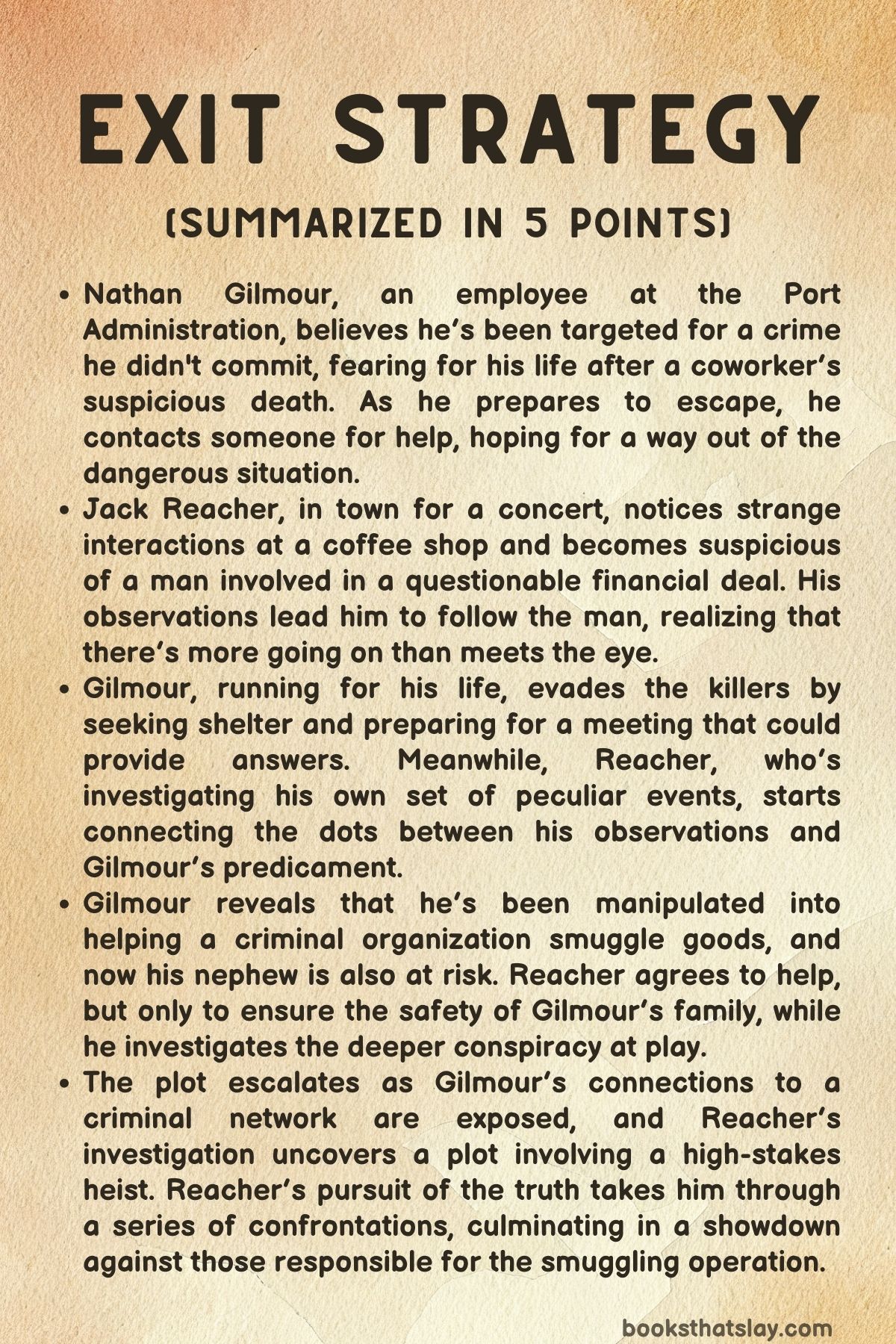
Nathan Gilmour works at the Port Administration in Baltimore and becomes increasingly certain that the death of his coworker wasn’t an accident. A shipping container fell from a crane, killing the man, and Gilmour believes that he was the intended victim.
He feels responsible for his coworker’s death and fears that the killers will come for him next. Realizing the danger he’s in, Gilmour decides to take action.
He sends an urgent text, hoping to connect with someone who can help him escape the threat hanging over his head.
At the same time, Jack Reacher, a former military police officer, is in Baltimore for a concert. While in a coffee shop, he overhears a suspicious conversation between a couple and a man who claims to have tripled their investment in a futures market.
Reacher’s instincts tell him something is off, but he doesn’t intervene, instead choosing to quietly observe the interaction. Soon after, Gilmour receives a response to his text, directing him to meet at a restaurant, and he prepares for what he hopes will be his chance to understand the danger he’s facing.
As Gilmour waits for his meeting, he is vigilant, knowing that anyone could be following him. He spends the hours before the meeting moving carefully through the city, trying to shake off any potential tail.
When he finally arrives at the location, he meets the man he was supposed to rendezvous with, who turns out to be the same individual Reacher had observed earlier in the coffee shop. Reacher, ever the watchful observer, continues following the man, noticing that he enters a warehouse, preparing for a confrontation.
When the man realizes no one is showing up for the meeting, Reacher decides to intervene, confronting the man and offering advice to leave town before any further harm comes his way.
Meanwhile, Strickland, the head of a private military contractor, is dealing with issues of logistics and internal challenges. His business is involved in high-level military operations, and he’s preparing for a contract in Turkey.
His concern grows as he faces complications with missing supplies and troubled recruits, all while dealing with personnel management issues.
Reacher, while still in town for the concert, finds himself drawn into a deeper situation when he is confronted by a group of men armed with chains. These men are part of a violent crew, likely sent after him because of his previous actions.
Reacher uses his combat skills to neutralize the group and intimidates a cab driver, leaving him with a message for those who sent the attackers.
As Reacher continues to deal with the fallout from his violent encounter, Gilmour seeks him out again, explaining that he’s been forced into assisting a man who is using him to gather sensitive shipping information. Gilmour reveals that the man has manipulated him using his financial desperation, and now his nephew’s life is at risk because of his involvement.
Reacher agrees to help Gilmour but is clear that his focus is solely on ensuring his nephew’s safety. Reacher advises Gilmour to contact the authorities, but Gilmour is reluctant, fearing further harm to his family.
The plot then shifts to Strickland’s high-security facility, where tensions rise as Strickland prepares for an upcoming operation. He’s concerned about a potential witness from Armenia who could derail his plans, and his stress increases when one of his guards goes missing.
Meanwhile, Reacher is called to another meeting, where he receives instructions from an unknown source. He heads to the warehouse, unsure of what to expect, but is ready for a potential ambush.
As Gilmour and Reacher continue their investigation, they uncover more information about the smuggling operation at the port. Gilmour is confirmed to have played a role in gathering information for a heist, but he remains unaware of many crucial details.
Reacher begins to suspect that someone in the port’s HR department could be involved in the operation, and they set their sights on Sabrina Patten, an HR employee. Through a series of tense interactions, they uncover that Gilmour’s mysterious benefactor is likely involved in the illegal activities.
Reacher and Gilmour’s investigation leads them to Patten’s house, where they confront her about her connection to the criminal enterprise. Patten admits to being manipulated by Dr. Alyssa Martin, a therapist who had been blackmailing her.
As they dig deeper, they find links to a broader conspiracy involving shipment robberies and illegal activities. Their investigation uncovers a trail leading to a dead body, a missing phone, and a possible cover-up involving a woman named Kathryn Kasselwood.
Reacher begins to suspect that Kasselwood is part of the operation and is working to sabotage the planned heist.
As Gilmour and Reacher continue to track down the criminals behind the operation, they encounter further danger. Gilmour reveals more about his involvement in the heist and his fear of the people controlling him.
The investigation culminates in a tense confrontation with Strickland, whose military contractor business has been linked to a larger conspiracy involving the U.S. government and private interests.
Strickland’s deceitful plans come to light as it becomes clear that he has been orchestrating a war for profit, manipulating the media and his employees to further his agenda. Reacher and his allies, including Gilmour, race to stop Strickland before he can carry out his plans.
In the final confrontation, Strickland’s criminal activities are exposed, but his fate remains uncertain. Despite the resolution of the immediate threat, the story ends on a somber note, with the characters reflecting on the larger systems of corruption they have fought against.
Characters
Nathan Gilmour
Nathan Gilmour is a man caught in a dangerous web of manipulation and desperation. Working at the Port Administration in Baltimore, Gilmour’s life takes a dark turn when he becomes involved in a smuggling operation.
Initially motivated by financial desperation due to his gambling problems, he ends up being coerced into assisting with illegal activities, putting both his life and the lives of his loved ones in jeopardy. Gilmour is portrayed as a man weighed down by guilt and fear, particularly over his role in a fellow worker’s death, which he believes was intended for him.
As the story progresses, his anxiety deepens, especially after his nephew is threatened by the same people who have used him for their smuggling operation. His internal struggle is evident—he wants to escape but is afraid of the consequences for his family.
Nathan is a man who has made mistakes and now must face them, and his partnership with Reacher is based on a fragile hope that he might still find redemption and safety. Gilmour’s complex emotions, from fear and guilt to a desire for atonement, make him a character who is both sympathetic and flawed.
Jack Reacher
Jack Reacher is a former military police officer whose methodical, no-nonsense approach to problems makes him a formidable figure. Unlike many protagonists, Reacher doesn’t seek out trouble, but it often finds him due to his keen observation skills and sense of justice.
He’s a solitary figure, drifting from town to town, and while he doesn’t form lasting attachments, he’s driven by a strong moral code. In Exit Strategy, Reacher’s role in the story is pivotal; he becomes involved with Nathan Gilmour’s troubles not out of sympathy, but because he sees a larger conspiracy unfolding that threatens innocent lives.
His calm, analytical mind helps him stay one step ahead of his adversaries, whether they are criminals or corrupt officials. Throughout the novel, Reacher’s ability to assess and neutralize threats, both physical and psychological, stands out.
He doesn’t hesitate to confront danger head-on, as evidenced by his encounters with men sent after him and his no-frills approach to violence. While Reacher is undoubtedly tough, his interactions reveal a deep-seated respect for human life and a desire to prevent unnecessary harm, making him a layered character whose actions are driven by both reason and instinct.
Strickland
Morgan Strickland is a complex character who embodies the darker side of the private military industry. A former soldier, Strickland has transitioned into the world of private security, where he continues to grapple with the psychological aftermath of his traumatic experiences in Iraq.
This background, along with his struggles to regain control over his life and mission, makes him a cold, calculating individual. Strickland’s role in Exit Strategy grows more sinister as the story unfolds, revealing his manipulative and deceitful nature.
He is orchestrating a military operation under false pretenses, using fabricated stories to manipulate both his employees and the media to serve his profit-driven agenda. His involvement in a conspiracy to justify a war for personal gain shows the depths of his moral corruption.
Strickland’s psychological state is as unstable as his actions, and he consistently manipulates others, even going so far as to use bodies from previous operations to further his goals. Despite his manipulative tactics, Strickland is not entirely devoid of human emotions—his frustrations and psychological scars surface as he tries to navigate a world that seems to be spiraling out of control, making him a tragic character who is driven by both past trauma and the pursuit of wealth and power.
Violeta Vardanyan
Violeta Vardanyan is a woman caught in a dangerous game she initially doesn’t understand but becomes crucial to the unfolding events. Initially, she cooperates with Strickland and his plans, but she soon realizes that her involvement could have devastating consequences.
Throughout the novel, Violeta’s role shifts from a pawn in Strickland’s larger scheme to a more active participant in uncovering the truth. Her key importance lies in her potential as a witness, which Strickland plans to use to justify a military operation for profit.
As the story progresses, Violeta grapples with her own moral compass, questioning the path she has been led down and ultimately working to expose the deceit surrounding her. Despite the danger she faces, Violeta’s inner strength begins to emerge as she takes more control of her fate, attempting to foil Strickland’s plans and prevent the disastrous consequences of his manipulation.
Her evolution from victim to a force of resistance adds depth to her character, making her a compelling part of the novel’s intricate web of deceit and survival.
Sabrina Patten
Sabrina Patten is a character whose initial reluctance and hesitation gradually give way to a more active role in the novel’s conspiracy. Initially introduced as a member of the HR department at the port, Sabrina is soon revealed to be entangled in the illegal operations orchestrated by the criminals manipulating Gilmour.
Despite her fear, Sabrina becomes a crucial ally to both Gilmour and Reacher as they unravel the smuggling ring. Her reluctant cooperation underscores the human cost of the conspiracy she has become a part of, and through her, we see the vulnerability of people forced into dangerous situations through blackmail and coercion.
Patten’s character grows over time, and her interactions with Reacher and Gilmour reveal her struggle to regain control over her life. While not as hardened as some of the other characters, her ability to navigate her fears and ultimately assist in exposing the conspiracy makes her an important player in the larger narrative of deception and corruption.
Dr. Alyssa Martin
Dr. Alyssa Martin is a character whose involvement in the story becomes increasingly pivotal as her connections to the central conspiracy come to light. As a therapist, she is in a position of trust, yet she is revealed to have been manipulating her patients and leaking information about them to others.
Her actions are motivated by personal gain, and she becomes a key figure in the blackmail operation that drives much of the plot. Dr. Martin’s willingness to sell out her patients and her role in the larger scheme demonstrate her moral decay, as she is not above exploiting others for her own benefit.
Her actions lead to significant consequences, including the murder of someone who had been trying to stop the heist. In the grand scheme of things, Dr. Martin represents the dark side of people who take advantage of others’ vulnerabilities, making her a necessary, if unsympathetic, character in the story.
Kathryn Kasselwood
Kathryn Kasselwood plays a crucial role in the novel’s conspiracy, as her involvement in the heist is gradually uncovered. Initially, she is an elusive figure, with her name erased from key records, suggesting a deliberate attempt to cover her tracks.
As the investigation progresses, it becomes clear that Kasselwood is involved in the illegal shipment and is working to sabotage the operation from within. Her actions are calculated and self-serving, revealing a character who is willing to betray anyone, including her own colleagues, to protect her interests.
As Gilmour and Reacher close in on her, it becomes apparent that Kasselwood is not just an accessory to the crime but an active participant in the cover-up, making her one of the most dangerous and cunning figures in the novel.
Themes
Deception and Betrayal
In Exit Strategy, deception plays a pivotal role in shaping the lives of the characters, with its effects reverberating throughout the plot. Nathan Gilmour is drawn into a dangerous situation through a web of lies and manipulation, particularly when his involvement in illegal activities is used to further the agenda of unknown but powerful figures.
His decision to help someone who claims to be paying off his gambling debts reveals the darker side of desperation and the way people can be manipulated when they feel cornered. Gilmour’s realization that he is being used comes too late, as he finds himself entangled in a much larger conspiracy.
The theme of betrayal is further explored through the character of Strickland, who betrays both his employees and the government for financial gain. His actions are designed to profit from war and exploitation, manipulating individuals like Violeta and using them for his own ends, while covering his tracks with lies and a manufactured narrative.
Reacher’s encounters with various characters also shed light on how betrayal can occur on multiple levels, from personal relationships to professional duties. The careful plotting and execution of betrayal in the story create a sense of unease, where no one can be trusted, and every character must constantly question their motives and those around them.
Morality and Responsibility
The book explores the complexities of morality, especially when characters are placed in situations that force them to make difficult decisions. Nathan Gilmour is initially portrayed as someone struggling with his own moral compass.
His involvement in a smuggling operation, fueled by his desperation to settle gambling debts, highlights the gray area between right and wrong. Reacher, on the other hand, is presented as a man with a strong sense of justice, though his methods of achieving it are often harsh and uncompromising.
His intervention in Gilmour’s life is driven by a need to ensure that innocent people are protected, but he makes it clear that he is not in the business of saving everyone. This sense of detachment from the emotional aspects of morality is mirrored by Strickland, whose actions are driven by profit rather than any moral code.
His willingness to manipulate people and fabricate military operations for personal gain questions the true nature of responsibility in a world where people are often pawns in a larger game. The book raises important questions about how far individuals should go to protect themselves and others, and whether the end justifies the means when faced with moral dilemmas.
Personal Struggles and Identity
The theme of personal struggle and identity is particularly significant in the character arcs of both Reacher and Strickland. Reacher’s life as a former military police officer who is now a drifter reflects his ongoing internal battle.
He is constantly evaluating his own identity, finding purpose in situations that demand justice, yet remaining detached from long-term commitments or attachments. His search for meaning often centers on his desire to right wrongs, but he struggles with the isolation that comes with living a life free from emotional ties.
Strickland’s internal conflict is more pronounced, as he grapples with the trauma of his military past and his disillusionment with the systems he once served. His inability to reconcile his former identity as a soldier with his current role as a contractor for profit-driven motives leads him to make morally questionable decisions.
Both characters represent the ongoing internal battles that individuals face when their identities are tested by external circumstances. The book delves into the ways that past experiences shape one’s sense of self and the pressures that drive people to either compromise their values or uphold them in the face of overwhelming adversity.
Corruption and Abuse of Power
Corruption is a recurring theme in Exit Strategy, particularly in how power is misused for personal and financial gain. Strickland’s character is a prime example of someone who exploits both people and systems for his own advantage.
His manipulation of military operations and deception about the existence of weapons of mass destruction in Armenia is a clear commentary on how those in positions of power can create crises to justify their actions and increase their wealth. This abuse of power is not confined to Strickland alone, as several other characters, including the blackmailers and the individuals behind the smuggling operations, exploit their influence to control others and further their own interests.
The story reveals how corruption can manifest in various forms, from the highest levels of government and military contractors to the everyday lives of ordinary individuals like Gilmour, who is manipulated by those with more power. The book illustrates the pervasive nature of corruption and the lengths to which people will go to maintain control and secure their own interests, regardless of the consequences for others.
The Price of Redemption and Justice
As much as Exit Strategy explores the darker aspects of human behavior, it also deals with the idea of redemption and justice, especially through the actions of Jack Reacher. Throughout the narrative, Reacher takes on the role of a figure who administers justice outside the bounds of formal systems, often resorting to physical force to resolve situations.
This approach to justice is shown to be effective in certain situations but also reveals the personal cost involved. Reacher’s refusal to let go of his moral code and his desire to right wrongs are central to his character.
However, his actions are not without consequence, and the book suggests that the pursuit of justice—especially in a world where rules are often bent or broken—can come at a significant personal cost. Gilmour’s search for redemption is another focal point in the story, as he tries to escape the web of deceit he’s entangled in.
His struggles highlight the difficulty of finding true redemption when faced with constant threats, manipulation, and the fear of retribution. The theme of redemption ultimately reflects the characters’ internal conflicts as they seek to atone for their past mistakes and find a path to a better future, even if that path is fraught with danger and uncertainty.