Fade by Lisa McMann Summary, Characters and Themes
Fade by Lisa McMann is the second book in the Wake trilogy, a young adult paranormal thriller about Janie Hannagan, a girl who is unwillingly pulled into other people’s dreams. In this story, Janie is not only dealing with school, love, and a difficult home life, but also the dangerous use of her strange ability in police work.
Her relationship with Cabel gives her strength, yet it also exposes how much fear both of them carry. The book mixes crime, trauma, romance, and supernatural tension while showing Janie’s growing awareness of the heavy cost of her gift.
Summary
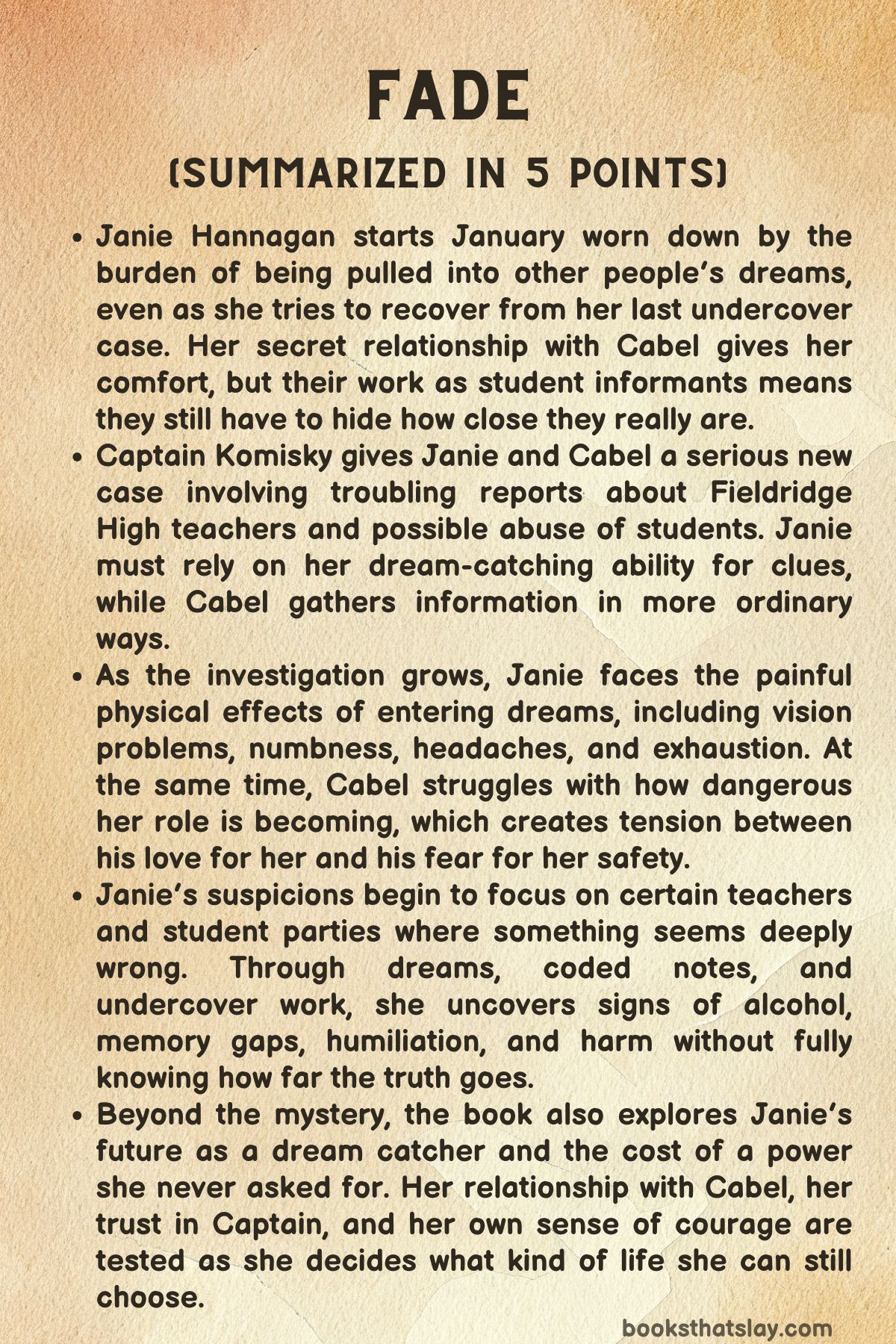
Janie Hannagan begins the new year worn down by the strange and painful power that has shaped her life for years. She cannot stop herself from being dragged into other people’s dreams, and each dream leaves its mark on her body.
Sometimes she goes blind for a short time. Sometimes her limbs go numb.
She comes out hungry, weak, aching, and shaken by things she never asked to see. Even at home, she has no peace.
Her mother, trapped in alcoholism and bitterness, keeps dreaming about an easier past and about baby Janie, whom she seems to resent. Janie is surrounded by dreams, but rarely by comfort.
She is also still recovering from the dangerous drug-bust case at Fieldridge High, where she and Cabel Strumheller secretly worked for Captain Fran Komisky. Janie and Cabel are now together, but their relationship must remain hidden.
Since they are both still acting as student informants, no one at school can know the truth between them. Their secret romance gives Janie something steady, yet it also creates pressure.
They want to be open with each other, but nearly every part of their lives is built on silence.
Captain soon gives them another assignment. Two anonymous Crimebusters calls suggest that teachers at Fieldridge may be sexually exploiting students.
The situation is disturbing and unclear, and Captain needs Janie and Cabel to help uncover what is happening. Janie’s job is to use her ability to enter dreams and gather clues that no ordinary investigation could find.
Cabel’s job is to collect information in more traditional ways. Captain also gives Janie files left behind by Martha Stubin, an older dream catcher who had tried to guide Janie before her death.
These files become important as Janie starts to understand that her ability is not only useful but also deeply dangerous.
At school, Janie and Cabel are placed in different classes so they can observe more teachers and students. Janie watches carefully, takes coded notes, and studies the behavior of everyone around her.
She tries to notice patterns: which teachers seem too friendly, which students seem afraid, and which dreams reveal memories that people will not say aloud. The work is exhausting.
Her eyesight keeps worsening, and every dream episode leaves her more aware that her body is paying a price. Cabel notices too.
He becomes protective, especially when Captain suggests that Janie may need to put herself in danger to draw out the suspect.
Their relationship grows more serious as the investigation continues. They argue, make up, train together, and admit how much they love each other.
But Cabel’s fear is never far away. He has seen Janie hurt before, and the thought of sending her into another dangerous situation terrifies him.
Janie wants his love, but she does not want to be treated as fragile. This tension follows them through the case.
Janie begins to suspect Mr. Durbin, her chemistry teacher. His behavior starts as slightly uncomfortable, then becomes more troubling.
He offers her a ride, touches her in a way that feels too intimate during a private lab redo on her birthday, and later invites students to a party at his house. Janie reports her concerns to Captain, who increases support around her.
Janie is given a cell phone, self-defense training, and instructions on how to protect herself while gathering evidence. Still, the plan requires her to get closer to Durbin.
To draw him out, Janie flirts with him and acts more interested than she feels. Cabel researches current and former Chemistry 2 students, trying to find links between the parties and the anonymous calls.
They discover that Durbin’s parties often happen around the same times as the Crimebusters tips. Mr. Wang and Coach Crater also seem connected.
Through dreams, especially those of Stacey O’Grady and other students, Janie learns that past parties involved alcohol, missing memories, sexual humiliation, and possible assault. The case becomes more horrifying as the clues become clearer.
A chemistry-fair trip gives Janie more chances to gather evidence. She is pulled into Lauren Bastille’s nightmare, which shows a party at a house like Durbin’s.
In the dream, students are drunk or drugged, unable to protect themselves, and sexually violated by adults they should have been able to trust. The nightmare confirms that the danger is real and that the teachers may be using parties to trap students.
The investigation reaches its breaking point at Durbin’s March party. Janie attends undercover, knowing she may be walking into a dangerous situation.
She tries to stay alert and tests the punch, but Durbin has drugged the food instead. The meatballs contain GHB, and the students begin to lose control.
As the drug spreads through the party, the atmosphere turns chaotic and frightening. Durbin, Wang, and Crater take advantage of the students’ helplessness and assault or attempt to assault girls.
Janie’s own memory becomes fragmented as the drug affects her. She struggles to hold on to what is happening around her.
In the middle of the confusion, Martha Stubin’s guidance echoes in her mind, helping her focus and fight. Janie manages to defend herself and disables Coach Crater on the deck.
She also finds a way to signal for help. The police raid the party, stopping the attack and arresting those involved.
Afterward, Janie wakes in the hospital. She is shaken, injured, and afraid, but she remembers enough to help the investigation.
She tells Captain and Cabel about the GHB, the poisoned meatballs, and the urgent need to test everyone quickly before the drug leaves their systems. The tests confirm that many people at the party were drugged.
Durbin, Wang, and Crater are arrested, and the truth about the parties begins to come out.
The case is solved, but Janie and Cabel are badly damaged by what happened. Cabel pulls away, overwhelmed by fear, guilt, and helplessness.
Janie feels abandoned when she needs him most. She wonders whether he sees her differently because of what happened at the party.
His distance hurts her deeply, especially after everything they have survived together.
At the same time, Janie reads Martha Stubin’s green notebook and learns the full truth about being a dream catcher. There is no cure.
The dreams will continue to damage her body. Driving will become dangerous because she can be pulled into a dream at any moment.
Her eyesight will fail. Eventually, her hands will stop working properly.
The future Martha describes is frightening and lonely. Janie is forced to face the fact that her gift may take away her independence piece by piece.
That danger becomes real when Janie nearly causes an accident after being pulled into a child’s dream while driving. She realizes she cannot safely keep her beloved car, Ethel, and sells it to Carrie.
Giving up the car is more than a practical decision. It is one of the first clear losses caused by her ability, and it makes the future feel unavoidable.
Captain helps Janie face what is coming. Rather than pushing her away from police work, Captain treats her as someone capable of making her own choices.
Janie decides she still wants to help people, even knowing the cost. Her gift hurts her, but it can also expose crimes that might otherwise stay hidden.
She chooses purpose, even when that purpose comes with pain.
Finally, Janie and Cabel confront each other honestly. Cabel admits that he pulled away not because of what happened to Janie at the party, but because loving her scares him.
He cannot bear the thought of losing her or watching her suffer. Janie tells him the full truth about her future: that she will go blind, lose the use of her hands, and never drive again.
The conversation is painful, but it clears away the misunderstanding between them. They reconcile, and for the first time, they are allowed to be seen together openly.
At graduation, the damage from the case is still visible. Durbin, Wang, and Crater’s chairs are empty.
Stacey has returned. Janie receives her diploma, carrying both victory and uncertainty with her.
She has helped stop dangerous men and protect other students, but her own future remains frightening. The story ends with a glimpse of Janie later caught in the nightmare of a man who cannot wake up, suggesting that her work as a dream catcher is far from over.
Characters
Janie Hannagan
Janie Hannagan is the emotional and moral center of Fade, and she is one of the most burdened characters in the book. Her ability to enter other people’s dreams makes her powerful, but it also makes her deeply vulnerable because the power is not something she can control without consequences.
She begins the story already exhausted, not only from the physical effects of dream catching but also from the emotional weight of seeing private pain, fear, desire, and trauma inside other people’s minds. Janie is brave because she keeps choosing to act even when her gift damages her body and exposes her to danger.
Her work in the investigation shows her intelligence, discipline, and willingness to sacrifice her own comfort for justice. At the same time, she is not shown as invincible.
She is frightened by what Martha Stubin’s notebook reveals, hurt by Cabel’s withdrawal, and devastated by the realization that her future may include blindness, useless hands, and the loss of independence. This makes Janie a tragic but resilient figure.
She is not simply a girl with a supernatural ability; she is a young woman forced to grow up quickly and decide what kind of life she can still build despite knowing that her body may betray her.
Cabel Strumheller
Cabel Strumheller is Janie’s boyfriend, partner, and emotional anchor, but he is also a character shaped by fear. His love for Janie is sincere, protective, and intense, yet that same love often becomes the source of conflict between them.
Cabel wants to keep Janie safe, especially when Captain’s plan places her in dangerous situations, but his protectiveness can also make Janie feel controlled or misunderstood. He struggles because he sees the danger more clearly from the outside than Janie sometimes allows herself to feel.
After the party, his withdrawal is one of his most important character moments because it reveals his helplessness and terror rather than a lack of love. He does not know how to face the thought of Janie being harmed, and instead of supporting her properly, he retreats into silence.
This makes him flawed but not cruel. His eventual honesty shows that his love is real, but love alone is not easy for him.
In the book, Cabel represents the difficulty of loving someone whose life is dangerous, unpredictable, and physically declining.
Captain Fran Komisky
Captain Fran Komisky is a strong authority figure who guides Janie and Cabel through their undercover work. She is practical, strategic, and deeply committed to justice, but she also carries the moral complexity of asking teenagers to do dangerous work.
Captain recognizes Janie’s unusual ability and treats it as a serious investigative tool, yet she also understands that Janie is still young and physically vulnerable. Her decision to give Janie Martha Stubin’s files shows that she is not only focused on solving the case; she also wants Janie to understand the truth about her own future.
Captain’s role is important because she acts as a bridge between the adult world of law enforcement and Janie’s private supernatural burden. She can be firm and demanding, but she is not careless.
Her support after the party and her willingness to help Janie face the truth make her one of the more dependable adult figures in the story.
Janie’s Mother
Janie’s mother is a painful presence in Janie’s life because she represents neglect, resentment, and emotional abandonment. Her alcoholism keeps her trapped in a cycle where she cannot properly care for Janie or even recognize the depth of Janie’s suffering.
Her recurring dream about a happier past and the baby Janie she resents reveals a great deal about her inner life. She is not simply careless on the surface; she is someone who carries regret, disappointment, and bitterness so deeply that it damages her relationship with her daughter.
For Janie, her mother is both a responsibility and a wound. The dreams make Janie see the sadness inside her mother, but understanding that sadness does not erase the harm caused by years of neglect.
In the book, Janie’s mother helps explain why Janie has learned to survive on her own and why love, safety, and trust are so difficult for her to fully accept.
Martha Stubin
Martha Stubin is not physically present in the main events, but her influence is extremely important. She represents Janie’s possible future and serves as a warning about the cost of being a dream catcher.
Through her files and notebook, Martha becomes a mentor from the past, giving Janie knowledge that no one else can provide. Her guidance is both comforting and terrifying.
On one hand, she helps Janie understand her ability and even gives her strength during the dangerous party. On the other hand, her notebook reveals that Janie’s condition has no cure and that the dreams will continue damaging her body.
Martha’s character adds tragedy to the story because she proves that Janie’s gift is not temporary or easily manageable. She also gives Janie a kind of inherited wisdom, showing that Janie is not completely alone even though her path is frightening.
Mr. Durbin
Mr. Durbin is one of the most disturbing figures in the book because he hides predatory behavior behind the image of a trusted teacher. His position gives him authority, access, and the ability to manipulate students who should have been safe around him.
His actions toward Janie begin with subtle boundary-crossing, such as inappropriate touching and private attention, and gradually reveal something much darker. Durbin’s parties expose his true nature: he uses charm, alcohol, drugs, and power to exploit vulnerable students.
What makes him especially dangerous is that he understands how to disguise abuse as friendliness, popularity, or harmless socializing. He is not an impulsive villain but a calculated predator.
His character shows how abuse can operate inside institutions when authority figures are trusted automatically and victims are left confused, ashamed, or unable to remember clearly.
Mr. Wang
Mr. Wang is part of the corrupt group of teachers involved in the exploitation of students. Although he may not receive the same level of attention as Durbin, his presence is important because it shows that the abuse is not the work of one isolated person.
He represents complicity, secrecy, and the way predators can protect each other within a system. His connection to the parties and his participation in the assaultive environment make him morally guilty.
Wang’s character expands the danger of the story by showing that Janie is not facing one suspicious teacher but a network of adults who have betrayed their roles as educators. His arrest helps confirm the seriousness of the crimes and the importance of Janie’s undercover work.
Coach Crater
Coach Crater is another adult who abuses power and trust. As a coach, he should represent guidance, discipline, and protection, but instead he becomes part of the threat surrounding the students.
His behavior at the party reveals his violence and predatory nature. Janie’s confrontation with him on the deck is one of the clearest examples of her courage under extreme pressure.
Crater’s character is important because he adds physical danger to the investigation. He is not only morally corrupt but also immediately threatening.
Through him, the story shows how frightening it is when adults who are supposed to protect young people become the people young people must survive.
Stacey O’Grady
Stacey O’Grady is significant because her dreams and experiences help Janie uncover the truth about the parties. She represents the students who have been harmed, confused, or silenced by what happened to them.
Her role is emotionally important because the investigation is not abstract; through Stacey, the reader sees that real students have suffered from blurred memories, humiliation, and violation. Stacey’s return near graduation also suggests survival and the possibility of moving forward, though it does not erase what happened.
She helps give the case emotional weight by showing the human damage behind the crimes.
Lauren Bastille
Lauren Bastille is another key student connected to the investigation. Her nightmare gives Janie crucial evidence about what has been happening at the parties.
Lauren’s dream reveals fear, helplessness, and the horror of being violated in a situation where students are drugged or intoxicated. Her character matters because she shows how trauma can remain buried in fragments, especially when victims cannot fully remember or explain what happened to them.
Lauren is not just a clue in the case; she represents the hidden suffering of students whose experiences have been covered by confusion, shame, and manipulation.
Carrie
Carrie plays a smaller but meaningful role in Janie’s life. She is connected to Janie’s ordinary world outside the investigation, and her purchase of Ethel becomes symbolically important.
When Janie sells her beloved car, it marks a painful acceptance of the limits caused by her dream-catching condition. Carrie’s role in that moment shows how Janie’s life is changing in practical, visible ways.
The sale is not just about a car; it is about Janie losing a piece of independence. Carrie therefore becomes part of one of Janie’s hardest personal transitions.
Themes
The Burden of a Gift
Janie’s ability is not presented as a magical advantage but as a painful responsibility that takes a serious toll on her body and mind. In Fade, entering dreams leaves her blind, numb, hungry, weak, and increasingly frightened about her future.
What makes this theme powerful is that Janie cannot simply ignore her gift, because other people’s dreams often reveal danger, trauma, or hidden crimes. Her ability gives her access to truths that others cannot see, but it also steals her privacy, safety, and physical independence.
The discovery of Martha Stubin’s notebook makes the burden even heavier, because Janie learns that her condition will worsen and that there is no easy cure. This changes the gift from a temporary struggle into a lifelong sentence.
Still, Janie’s response shows courage. She does not pretend the cost is small, but she also does not abandon her sense of duty.
Her gift becomes both a source of suffering and a test of character, forcing her to decide how much of herself she is willing to sacrifice to protect others.
Trust, Fear, and Love
Janie and Cabel’s relationship shows that love is not only about affection, but also about fear, honesty, and learning how to stay present during pain. Their bond grows stronger because they understand each other’s loneliness, but it is also strained by secrecy, danger, and Cabel’s protective instincts.
He loves Janie deeply, yet his fear often turns into distance or control, especially when her undercover work puts her at risk. Janie, meanwhile, wants support without being treated as fragile.
Their conflict after the party is especially important because both characters are hurting in different ways. Cabel withdraws because he feels helpless and terrified, while Janie feels abandoned at the moment she needs him most.
Their reconciliation matters because it depends on truth rather than romance alone. Janie tells him about the future she may face: blindness, loss of movement in her hands, and the end of driving.
Cabel’s willingness to hear this truth shows that love must make room for fear without allowing fear to destroy trust.
Exploitation and the Abuse of Power
The investigation exposes how dangerous authority becomes when trusted adults use their positions to harm the young people they are supposed to protect. The teachers involved are not strangers outside the school community; they are figures students are expected to obey, respect, and trust.
This makes their abuse even more disturbing. Their crimes depend on access, reputation, and the assumption that students may not be believed.
The parties, the alcohol, the drugged food, and the blurred memories all show how exploitation often works by confusing victims and weakening their ability to speak clearly about what happened. Janie’s role in uncovering the truth highlights how hard it can be to prove abuse when the victims are ashamed, afraid, or unable to remember fully.
The empty chairs at graduation carry strong meaning because they mark the public removal of corrupt authority. The story shows that justice requires more than suspicion; it requires listening, evidence, courage, and adults like Captain who are willing to act when students are in danger.
Identity and Choosing a Future
Janie’s struggle is not only about solving a crime; it is also about deciding who she wants to be when her future seems unfairly limited. In Fade, she learns that her ability will likely take away basic freedoms most people expect, including clear sight, control of her hands, and the ability to drive safely.
Selling Ethel is more than losing a car; it represents the loss of independence and the painful acceptance that her life will not follow an ordinary path. Yet Janie is not defined only by what she loses.
She makes choices, sets boundaries, faces danger, and continues working even after learning the truth. Her identity forms through action rather than comfort.
She is a daughter neglected by her mother, a student hiding a secret life, a girlfriend learning vulnerability, and a dream catcher carrying knowledge no one else has. The theme becomes especially moving because Janie’s future is uncertain, but her sense of purpose becomes clearer.
She cannot control everything that will happen to her, but she can decide what kind of person she will be.