Fallen City by Adrienne Young Summary, Characters and Themes
Fallen City by Adrienne Young is a captivating tale set in a world teetering on the edge of collapse. The city of Isara is embroiled in chaos, its political and social structures unraveling due to a devastating rebellion.
At the heart of the story are Luca, a disillusioned soldier of the New Legion, and Maris, a young woman thrust into the role of Magistrate, inheriting her mother’s dangerous legacy. As their paths cross, both face monumental choices that intertwine their fates with the future of Isara. Themes of power, loyalty, love, and survival drive this compelling narrative of a city on the brink of destruction.
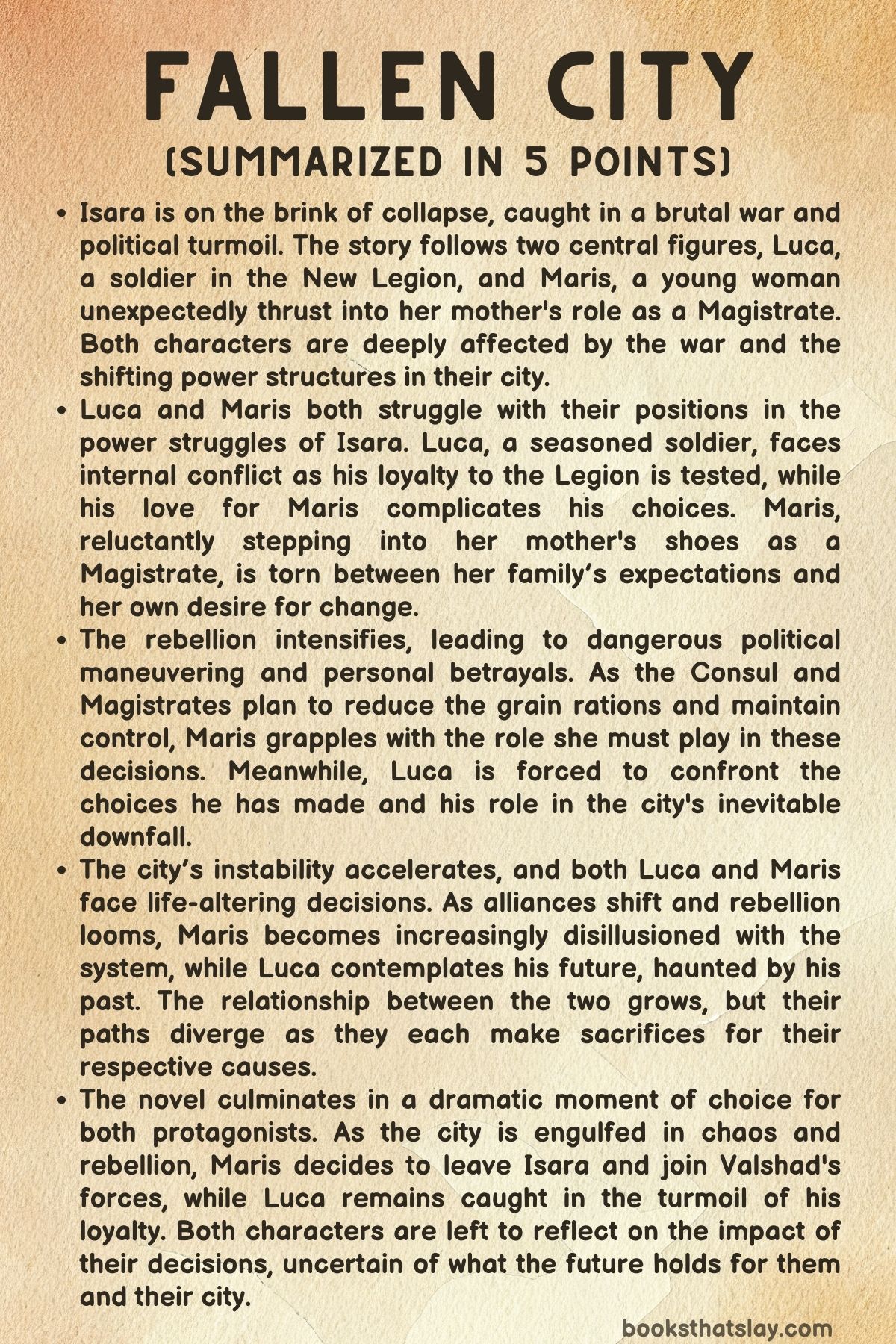
Summary
The story of Fallen City begins in a crumbling world, where the city of Isara is on the brink of destruction. Casperia, a figure in the city, reflects on the origins of the conflict, beginning her narrative at a temple where she had believed her fate was sealed.
As the city descends further into turmoil, the lives of Luca and Maris become pivotal in shaping the city’s fate.
Luca, a centurion in the New Legion, is burdened by the knowledge of death. He is haunted by the belief that Kali, the goddess of death, takes lives in threes.
Two of his tribunes have already died, and Luca anticipates his own death is imminent. He is assigned a third tribune, a young man who reminds Luca of his past.
Despite the dread he feels, Luca notices the young man’s skill in handling his armor. He reflects on his past life as a soldier, his growing sense of isolation, and the brutality of the war.
The city, which Luca once fought for, is now in the midst of a rebellion, and he questions the purpose of his involvement in the conflict. As tensions rise, Luca gives his tribune a vital task: to keep an eye on a particular light that signals the safety of a woman, Maris, someone Luca holds dear.
Maris, on the other hand, is thrust into a world she never asked for. The daughter of a powerful Magistrate, Maris finds herself in an uncomfortable position, expected to carry on her mother’s legacy.
Her mother’s political power has shaped Maris’s life, but Maris doesn’t share the same ambitions. The city’s failing grain harvest and growing unrest among the lower classes add to the pressure.
As Maris prepares for her first tribunal, she is forced to confront her role in the power structures of Isara. Her mother, ambitious and ruthless, had raised her with the expectation of continuing the family’s influence.
Yet, Maris is uncertain about her place in this cutthroat world. She struggles with her growing disillusionment as the political factions around her vie for control.
As Isara’s crisis deepens, both Luca and Maris grapple with their roles. The Consul, a powerful figure, makes a bold move by framing the city’s failing crops as a divine punishment.
In response, he implements drastic measures, reducing the grain rations and using military strength to further his own agenda. The political landscape becomes more volatile, and Maris is caught in the middle, torn between loyalty to her mother’s faction and the desire for change.
As the rebellion gains momentum, Maris meets Luca again. The two share a brief conversation, and despite their shared past, the political tensions between them make their connection fraught with difficulty.
Maris realizes that the power she once believed in is crumbling, and her family’s role in the city’s decline is becoming clearer.
The situation worsens as Maris’s mother becomes more ruthless, and the rebellion grows stronger. As the city faces the impending collapse of its power structures, both Luca and Maris must make choices that will shape their futures.
Maris, in particular, faces the painful decision of whether to continue in her mother’s footsteps or forge her own path. The Consul’s manipulation of religion and politics further compounds the chaos.
Maris is tasked with overseeing a sacred blood ritual that she finds deeply unsettling, symbolizing the political manipulation at play. Despite her discomfort, she is forced to comply, symbolizing her unwillingness to break free from the power system.
In the midst of these events, Luca makes a crucial decision. He rejects the position his uncle held, signaling his desire to break free from the oppressive structures that have defined his life.
This choice leads him to join forces with Maris, both of them united by their desire for change. However, their plans to change the city’s future are fraught with danger.
The New Legion, a group of rebels, prepares to make their move, and the city teeters on the edge of war. Maris, torn between loyalty to her mother and the desire for a better future, struggles to reconcile her position within the Magistrate system.
As the conflict intensifies, both Luca and Maris become more isolated from their pasts. Maris finds herself questioning her allegiance to the gods, symbolized by the golden cuff she cannot remove from her arm.
Luca, meanwhile, is torn between his loyalty to the New Legion and his love for Maris. The two are separated by the shifting political landscape, but their paths are destined to cross again.
The city is on the brink of collapse as both internal and external forces converge. Maris, unable to escape the political game, is forced to confront the reality of her family’s legacy.
The tension between the factions rises as the Consul’s control over Isara slips away. Maris becomes more disillusioned with her role and begins to consider escaping the city.
However, her connection to Luca remains strong, and despite the chaos, she resolves to find him.
In a moment of desperation, Maris flees the Tribunal Hall, throwing off her Magistrate robes and medallion in a bid to escape. The city is falling apart around her, and she is consumed by fear for her future.
Meanwhile, Luca is imprisoned after a violent confrontation, and Vale, the Consul’s son, warns him of the growing rebellion. Despite the warning, Luca remains steadfast in his beliefs, haunted by the role he has played in the city’s destruction.
As Maris flees the city, she encounters Vale, who informs her that Luca has made his choice to stay. Maris is forced to leave the city without him, but she resolves to align herself with Valshad’s forces and reclaim what has been lost.
As the gates of Isara open, she steps forward, determined to shape her own destiny, even if it means leaving behind the city and everything she once knew.
The story ends with both Luca and Maris facing an uncertain future, their fates irrevocably tied to the collapse of Isara. Their choices, shaped by love, loyalty, and a desire for change, will ultimately determine the future of the city and their place within it.
Characters
Luca Matius
Luca Matius is a seasoned and battle-hardened centurion in the New Legion, a man shaped by war and loss. His deep internal conflict is driven by the haunting belief in Kali’s divine pattern of death in threes.
Luca’s life has been marked by violence and tragedy, having witnessed the deaths of two of his tribunes and now, facing the possibility of his own imminent demise. This belief both burdens and defines him, especially as he forms a deep connection with a new tribune who reminds him of his past self.
Despite the fatalistic shadow that looms over him, Luca is still capable of tenderness and attachment, particularly when it comes to Maris, whom he deeply cares about. His loyalty to his cause, however, is increasingly tested as the war escalates and his personal relationships become more complex.
Torn between duty to the New Legion and his love for Maris, Luca becomes a figure of tragic heroism, constantly grappling with the futility of war, the choices that define his future, and his ultimate sense of alienation. His journey is not just about survival but about finding meaning in a fractured world where alliances are ever-shifting and death is a constant companion.
Maris
Maris is a young woman thrust into a political world she never sought to inhabit. As the daughter of a powerful Magistrate, she faces the crushing weight of her family’s legacy.
Her mother’s suicide has left Maris with the heavy responsibility of stepping into a role she feels ill-prepared for, both emotionally and morally. Initially, she is uncomfortable with the political games being played around her, especially the cutthroat environment of the tribunal, where her mother’s influence lingers even after her death.
Maris struggles with the expectations placed upon her, constantly questioning the value of power and whether it is worth the personal sacrifices it demands. Her internal conflict deepens as she realizes that her political ascent, though inevitable, comes with severe consequences for those she loves.
Her bond with Luca, a member of another prominent family, adds another layer of complexity to her life. Though they share a deep connection, Maris must navigate a world where loyalty is a currency easily traded, and survival is often achieved through ruthless actions.
Throughout the story, Maris grapples with the challenge of reconciling her desire for a different kind of life with the demands of the political system she is now part of. She finds herself at a crossroads, torn between loyalty to her family and the realization that change may be necessary for the survival of Isara.
Magistrate Casperia
Magistrate Casperia, a powerful and ambitious figure in Isara’s elite political structure, is a force to be reckoned with. As a rival to Maris’ mother, Casperia is both a symbol of the corrupt political system and a reflection of the cutthroat world Maris is now navigating.
Casperia’s role in the story is significant not only because of her own political ambitions but also because of her influence over the events unfolding in Isara. She serves as a catalyst for Maris’ growing disillusionment with the system, especially as Maris sees firsthand the manipulative and often morally bankrupt nature of the politics that define her world.
Despite her outward power, Casperia is also a woman shaped by the very same ruthless forces that drive Maris’ family. As the story unfolds, Casperia’s role becomes more complex, her actions embodying the tension between power and corruption, as well as the personal sacrifices she makes to maintain her position.
Vale
Vale is a close ally of Luca and a pivotal figure in the rebellion that seeks to overthrow the established order in Isara. A person of strength and determination, Vale’s allegiance lies with the New Legion and the insurgent forces fighting for a new future.
Though his actions may initially seem motivated by loyalty to the cause, Vale is also driven by a personal connection to Luca, whom he respects deeply. However, as the city fractures, Vale’s role becomes increasingly significant as he navigates the shifting alliances among the lower city citizens and other factions.
His warning to Luca about the rebellion’s potential impact on Isara is a moment of clarity in an otherwise chaotic period, underscoring his foresight and understanding of the broader picture. Vale represents the voice of reason amidst the chaos, often helping guide Luca through moral and strategic dilemmas.
His bond with Luca adds depth to the narrative, particularly as the two face off against the growing power of the Consul.
Consul
The Consul is a deeply strategic and manipulative figure whose actions drive much of the political conflict in Fallen City. He is a master of language and power, using his position to manipulate the masses and maintain control over Isara.
The Consul’s decision to frame the city’s failing harvest as divine retribution for sins exemplifies his ability to twist the truth to suit his agenda. As the rebellion escalates, the Consul becomes more of a puppet master, pulling strings behind the scenes to maintain his power.
His plans for the future of Isara are both drastic and ruthless, including his willingness to sacrifice individuals for the greater political good. Though he appears confident in his control, the Consul’s position becomes increasingly precarious as the rebellion gains momentum.
His complex relationship with Maris, as both a mentor and a potential adversary, adds further intrigue to his character. The Consul’s manipulation and unyielding grip on power make him a central antagonist in the story, embodying the oppressive forces that the characters must challenge.
Nej
Nej is Maris’ uncle and a political figure deeply enmeshed in the power struggles of Isara. He plays a significant role in grooming Maris for her position as a Magistrate, though his methods and motivations are often ambiguous.
Nej is a man driven by ambition and the desire to preserve his family’s position within the political hierarchy, even at the cost of his niece’s personal desires. His actions are often cold and calculating, particularly when it comes to forcing Maris into her new role.
As the story progresses, Nej’s true nature is revealed, especially in his treatment of Maris, which highlights the complexities of familial loyalty and power. His cruelty and lack of empathy for Maris underscore the harsh realities of the political world, where personal relationships are often sacrificed for the sake of ambition.
Nej’s influence over Maris and his role in the broader conflict make him a key figure in the unraveling of Isara’s political structure.
Themes
Power and Political Intrigue
The political landscape in Fallen City is one of constant upheaval, where loyalty is a fragile commodity and power is in perpetual flux. The city’s elite class, represented by the Magistrates, is deeply entrenched in a game of manipulation, alliances, and betrayal.
Maris, thrust into the role of Magistrate due to her mother’s death, becomes a symbol of both the legacy and burden of power. The tension within her grows as she is forced to navigate the complex and often dangerous political web that binds the fate of Isara.
Her mother’s ambition has set a precedent for the family, one that Maris is reluctant to follow. However, her realization of the magnitude of political power in Isara forces her into a world where every move she makes could shift the balance.
This theme is not only embodied through Maris but also through Luca, who finds himself at a crossroads between the power structures of the legion and his desire for change. The Consul, once a mentor to Luca, manipulates the city’s political crisis to his advantage, showcasing how power can corrupt and manipulate even the most well-intentioned individuals.
The fragmentation of Isara’s political system mirrors the personal turmoil of characters like Maris and Luca, who must choose between loyalty to their respective positions or rejecting them for something greater. Ultimately, the city’s political chaos is both a backdrop and a driving force for the characters’ decisions, emphasizing the danger of unchecked ambition and the collapse of societal structures.
Loyalty and Betrayal
In Fallen City, loyalty is continually tested and redefined. Luca’s internal struggle revolves around his deep loyalty to the New Legion and his evolving feelings for Maris.
His position as a Centurion within the Legion makes him a key player in the rebellion, yet his personal ties to Maris complicate his choices. This theme of loyalty extends to Maris, who is torn between her familial obligations and her desire for personal agency.
Her mother’s expectations weigh heavily on her, pushing her into a role she does not want, making her question whether loyalty to her family and their power is worth the cost of her own freedom.
Betrayal runs parallel to loyalty, particularly as characters are forced to make decisions that shift alliances and trust. Maris’ loyalty to her mother and her family’s legacy is put to the test when she starts to question the system they support.
Her growing disillusionment with the political machine she is a part of mirrors Luca’s own alienation from his past. As their paths converge, the potential for betrayal looms large, not just between them but also within their broader circles.
Maris’ ultimate decision to align with Valshad’s forces signals a break from her past loyalties, cementing her place in the chaotic struggle for Isara’s future. The theme highlights the personal costs of loyalty and the inevitable sense of betrayal that accompanies the collapse of old power structures.
Identity and Personal Struggle
Identity is central to the characters’ development in Fallen City. Both Maris and Luca are shaped by the legacies of their families, yet they struggle to reconcile who they are with what they are expected to become.
For Maris, the weight of her mother’s political ambitions is a constant reminder of the role she must assume. She is expected to embody the legacy of a Magistrate, yet her personal desires conflict with the expectations placed upon her.
Her journey is one of self-discovery as she comes to terms with her role in a fractured society, ultimately choosing to forge her own path, separate from her mother’s influence.
Luca, on the other hand, is marked by the trauma of war and the violence he has witnessed. As a seasoned soldier, he is deeply aware of the cost of loyalty to his legion and the destructive nature of the rebellion.
His identity is increasingly fractured as he contemplates the meaning of the war he fights and the choices he must make. His relationship with Maris further complicates his internal struggle, as he is torn between his past life in the Legion and the future he imagines with her.
Both characters are shaped by their external circumstances, but they must also confront their own internal battles, questioning not only who they are but who they wish to become in a city on the brink of collapse.
Loss and Redemption
Fallen City explores the theme of loss as both a personal and collective experience. The city of Isara itself is a character in its own right, a place that has suffered repeated hardships, including the failure of its harvests and the breakdown of its political and social systems.
This external decay mirrors the internal losses experienced by the characters. Maris loses her mother and the life she once knew, while Luca grapples with the loss of his comrades in the Legion and the sense of purpose he once derived from his military role.
These losses serve as catalysts for both characters’ development, pushing them to confront their pasts and determine what they are willing to sacrifice for redemption.
Redemption is not easily achieved in this world, as characters must face difficult choices and accept the consequences of their actions. For Luca, redemption is tied to his relationship with Maris and the realization that his loyalty to the Legion has led to the destruction of everything he once valued.
For Maris, redemption lies in her ability to choose a different path from her mother’s, one that allows her to break free from the cycle of power and manipulation that has defined her family. Ultimately, Fallen City is a story about the possibility of redemption in a world where the past cannot be undone, and the future is uncertain.
War and Its Consequences
War is a constant presence in Fallen City, shaping the lives of its citizens and the choices of its characters. The war in Isara is not just a backdrop but a driving force, pushing individuals like Luca into positions of moral conflict.
As a soldier, Luca is directly involved in the violence, and his reflections on his past actions demonstrate the heavy toll war takes on the individual soul. The city’s collapse is mirrored by the physical and emotional destruction of those who are caught in the conflict, as alliances shift, lives are lost, and the ideals that once motivated individuals are shattered.
For Maris, the war presents an opportunity for both power and destruction. She watches as the rebellion escalates and realizes that the war is not just a battle for territory but for the soul of the city.
The struggle between the New Legion and the Magistrates is emblematic of the larger war for control, with each side believing that their vision for Isara’s future is the only one worth fighting for. In the end, Fallen City portrays the devastating consequences of war—not just on the battlefield, but in the lives it ruins and the futures it consumes.
The characters’ personal wars, whether internal or external, are shaped by the larger conflict, and their ultimate decisions reflect their struggles to reconcile with the realities of violence and loss.