Fallen Gods Summary, Characters and Themes
Fallen Gods by Rachel Van Dyken is a modern fantasy romance that drops Norse myth into a secret war hiding in plain sight. Rey Stjerne turns eighteen under her father Odin’s control, raised as a weapon and sent to a strange university built on wards and old runes.
Her target is Thor’s hammer, Mjölnir—and the boy who seems tied to it, Aric Erikson. What looks like campus politics is really a power struggle between Gods and Giants, with memory tampering, sleeper forces, and a countdown toward Ragnarök. Rey and Aric are pulled toward each other while trying to survive the people using them.
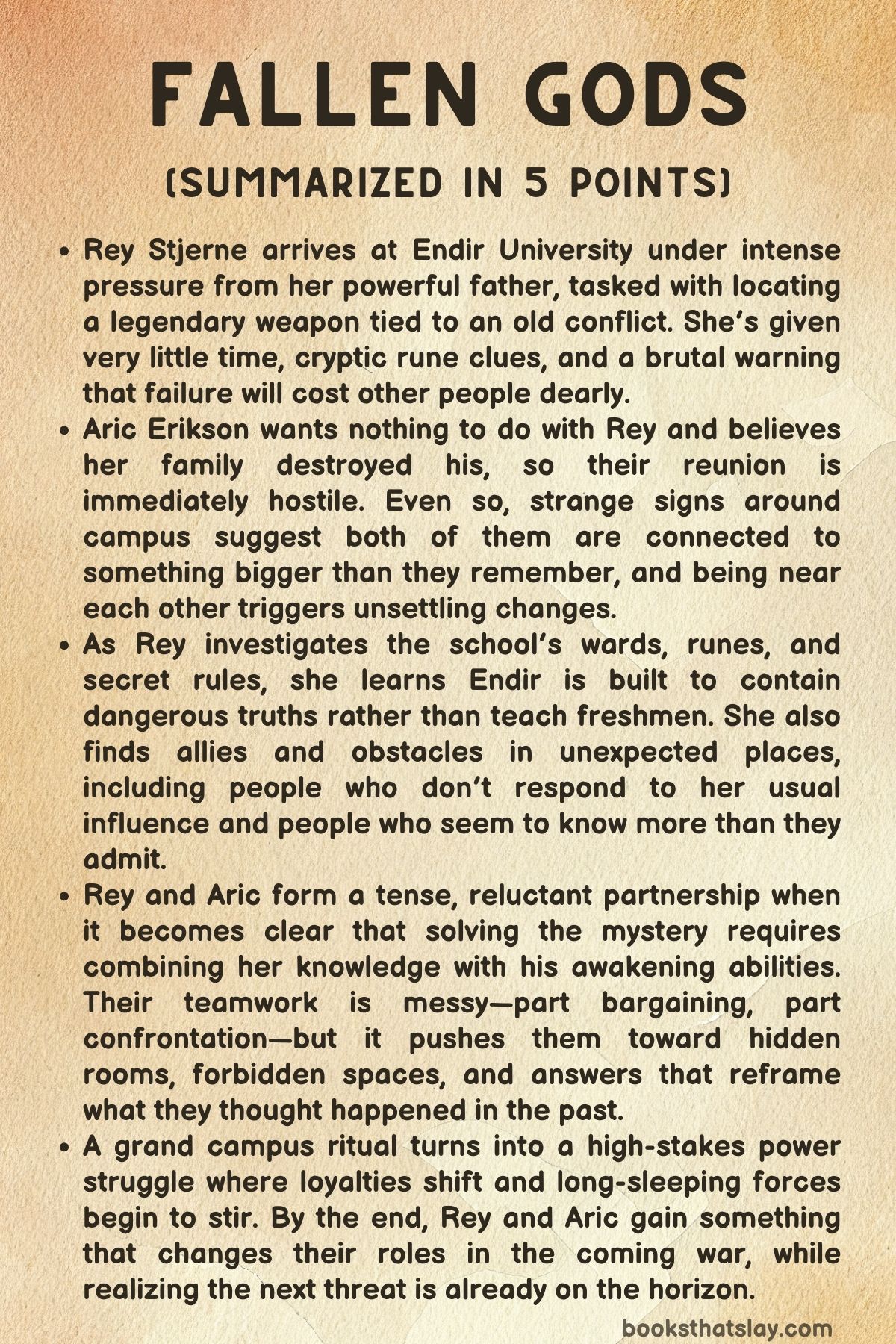
Summary
Rey Stjerne arrives at Endir University with a deadline hanging over her head. Her father—Odin in truth, though the world sees him as a ruthless power broker—has given her one week to recover Mjölnir, Thor’s hammer.
He doesn’t ask; he orders. Failure won’t just cost Rey her place in his household.
He makes it clear that others will pay, and he names the Eriksons as people he wants to see hurt. Rey’s stepmother, Laufey, begs her not to do it, breaking down in fear, but Odin is unmoved.
Rey leaves home carrying a bag of information and the weight of being called “worthy,” a title that feels more like a brand.
On the drive to campus, Rey clings to the small comfort of Rowen, the driver and bodyguard who has been her closest friend in Odin’s house. Their bond comes from shared survival rather than choice.
Rowen tries to be steady, but Rey can hear the dread underneath. Before parting, Rey urges him to keep his distance and stay alive, and they speak with the careful tenderness of people who know goodbyes can become permanent.
Endir feels wrong in a way Rey can’t fully explain—ancient stone, rune-marked architecture, and rules that sound like superstition but land like warnings. She moves through the dorms dressed in expensive black as if it can pass for armor.
A student bumps into her, and Rey uses her Aethercall, a kind of glamour that makes people comply. It works instantly, and she hates how easy it is.
Reeve Erikson, the dorm’s resident advisor, greets Rey with mocking politeness and sharp edges. He recites campus rules—don’t go to the lake after midnight, don’t enter the Hall of Ormir without an invitation, don’t drink the lake water—then warns her to stay away from his brother Aric.
Reeve’s taunts hit close to truths the rest of the world doesn’t know: Gods and Giants have been locked into a hidden conflict, and memories of that war were wiped from most minds. Rey has lived inside that secret her whole life.
The first time Rey sees Aric, it’s a collision in an elevator that turns the air brittle. Aric recognizes her immediately and looks at her like a threat he’s been waiting to face.
Two years earlier, he’d shown her kindness, and afterward his parents died. He believes Rey betrayed him by taking what she learned back to Odin.
Rey doesn’t correct him. She can’t.
Her assigned room is next door to his, and the closeness feels like another trap set by Odin.
Alone, Rey opens the note Laufey slipped her. It isn’t a message in plain language.
It’s five runes: Raido, Dagaz, Hagalaz, Othala, and Thurisaz. Rey recognizes at least one from campus stonework and suspects the runes are a map, a warning, or both.
A bright disruption arrives in the form of Ziva Morales, a bold, flamboyant student who declares herself the floor’s gossip engine and decides Rey is now her project. Rey tests her Aethercall, expecting the usual shift in behavior, but Ziva doesn’t change.
The immunity startles Rey, and for once she doesn’t feel like a monster for simply being in the room with someone.
Rey digs into Odin’s notebook about Mjölnir and quickly realizes how little it actually helps. There are details on Aric and Reeve, but almost nothing concrete about the hammer’s location.
Rey begins to suspect Odin is withholding information to keep her dependent. She also realizes something worse: even if Aric knows where Mjölnir is, he may not remember.
Odin’s memory suppression and forced sleep have left people walking around with holes inside their minds. If Rey wants the hammer, she may have to make Aric wake up.
Rey confronts Aric directly. He drags her into his room, pins her, and makes his hatred clear.
He blames her for his parents’ deaths and warns her to survive the semester by staying out of his way. When he leaves, Rey switches tactics.
She breaks into his room through the window, searches his carefully kept space, photographs three pill bottles, and steals a T-shirt to keep his scent. She learns little she can use, but she confirms one thing: Aric is managing something inside him with medication, and whatever it is, it scares him.
Their next encounter in the dining hall crackles with hostility and attraction. Aric challenges her motives and insists she’s only there to serve Odin.
Rey pushes back, refusing to hand him the satisfaction of seeing fear. Ziva briefly appears, insults Aric with casual confidence, and vanishes, leaving Rey more curious about what history ties them together.
Campus traditions begin to reveal the truth hiding beneath Endir’s surface. Under an ancient archway, freshmen test candles to see if the Gods “remember” them.
Rey’s flame dies instantly. Aric’s candle freezes into ice.
He crushes the evidence and calls it a cold snap, but Rey sees the panic behind his control.
Rey follows Aric into the woods to a spring where he tries to calm himself. Their confrontation turns reckless: threats, dares, and physical closeness that feels like both warfare and relief.
For Aric, Rey’s presence seems to steady the storm in him even as it provokes it. For Rey, Aric is the first person who feels dangerous in a way that isn’t controlled by Odin.
Aric’s family pressure tightens. His grandfather Sigurd warns him that he is awakening while Reeve is still “sleeping,” and orders him to keep control at any cost.
Sigurd frames Rey as an enemy to be used. Aric decides to let Rey get close—not because he trusts her, but because he needs to know why she’s there.
Rey’s search draws her toward the Hall of Ormir, a rune-covered temple built over dark water. Inside, she finds a rune above an obsidian mirror—Raido.
She and Aric speak its name at the same time, and the room reacts violently. The door slams.
The mirror flips. Rey is struck and begins bleeding, and when Aric touches her, the pool ripples as if something beneath it wakes.
Cold and heat surge through Aric, and both of them understand they’ve triggered more than a coincidence.
Rey and Aric clash over stories from the past, especially the legend of the Nightfrost Ring—an artifact linked to Thor and love, tied to the power of Mjölnir. Rey has always loved the romantic version.
Aric insists the truth ends in betrayal and warns her that caring about the story should be proof she needs to stay away from him. He’s trying to push her back to safety, but Rey isn’t sure safety exists for either of them anymore.
During a chaotic campus event, Rey sneaks into Sigurd’s office and finds rune paperweights arranged in a circle. The runes match Laufey’s note—Raido and Dagaz among them—and she finds a key and a file marked with attention on Aric.
Aric catches her. Professor Higgins interrupts, and her insults toward Aric’s dead parents trigger his power.
Rey can’t control him with Aethercall, so she throws it at Higgins to break the pressure and then kisses Aric to pull him back from the edge. Ice cracks through the ground.
Lightning hammers the forest. Aric bleeds silver and heals.
Rey sees glowing rune marks on his back that weren’t there before.
Afterward, they finally choose cooperation. Rey shows Aric Laufey’s runes and explains her theory: Aric carries five runes, and each one unlocked pulls him closer to full awakening—and closer to remembering what Odin erased.
They go to the tree marked with Hagalaz, cut their palms, and press blood to the rune. It flares.
Pain rips through Aric as another rune unlocks along his back. A shadowy watcher flees, confirming they aren’t alone.
The bond between them deepens in strange ways. Rey sleepwalks into Aric’s room and falls asleep with him, and Aric realizes her presence quiets the chaos inside him.
Reeve discovers them and reacts with humor that quickly turns to alarm when he sees Aric’s runes. He warns that Sigurd is always watching, and waking what’s inside Aric will bring consequences.
Aric takes Rey to Sigurd’s warded lake property, past a burial ground filled with the bones of fallen Giants. At a waterfall, their touch triggers another rune to reveal itself.
Aric’s control slips as his Giant side pushes closer to the surface. Rey kisses him anyway, choosing proximity over caution, and Aric warns her that if he loses control, she may be the one who pays.
Aric is then pulled back under Sigurd’s authority. Sigurd confirms what Aric has begun to sense: Aric was born a Giant, and his parents sealed power into him.
Sigurd orders him to awaken fully, find Mjölnir, let Rey claim it, and then betray and kill her. Aric masks his disgust and pretends loyalty while privately questioning everything Sigurd has said about his parents’ deaths.
The campus erupts into the Hunt, a lavish ritual festival full of costumes, speeches, and eerie choreography. Wealthy families and alumni watch as if it’s theater.
Odin arrives in person, and the air changes. Sigurd challenges him publicly in ritual language, ravens are released, and the Hunt begins, with masked students playing parts in something older than a game.
Rowen appears again, and Rey expects him to be her support. Instead, he insists the plan is moving forward: distractions will be made while Rey unlocks the final rune and uses Aric to locate Mjölnir.
Rey leads Aric to the last rune, Thurisaz, carved into the cobblestone near their dorm. They cut their palms and press blood to it.
The rune crumbles, and Aric’s awakening hits like a storm. Lightning strikes.
The forest is devastated. Aric transforms with white eyes and crown-like ice, and memory floods back—visions of Odin burning worlds, including Aric’s home.
Laufey’s note reveals hidden writing when Aric freezes it: a warning to trust Aric, a promise that Giants will rise and Gods will fall, and an order not to fail. Aric remembers where Mjölnir is hidden: beneath the lake in the Hall of Ormir.
He creates an ice bridge for Rey to reach it.
Before he can follow, runed chains trap him. A spear drives into him from behind.
The attacker is Reeve. Rey is captured and wakes bound inside the Hall, with Odin and guards waiting.
Laufey is dragged in as leverage. Rowen stands at Odin’s side in a mask.
Odin threatens to kill Aric unless Rey retrieves the weapon.
Rey is forced to approach the dark pool and dive. She notices a glowing serpent rune-stone and takes it with her.
The current pins her, but the stone’s green light guides her to an object. She fights for it, nearly losing consciousness, and Rowen swims in to pull her back.
When the box is opened, it doesn’t hold Mjölnir. It holds the Nightfrost ring.
Rowen slides it onto his finger and transforms into Thor. Odin calls him “son.” The betrayal lands hard: Rowen was never only Rey’s friend.
Odin has been moving pieces the entire time.
Thor tries to take Mjölnir, and the truth is revealed: the hammer is embedded inside Aric’s back, hidden beneath runes and sealed power. Odin forces Rey forward, claiming only her untainted blood can make the hammer respond.
Aric refuses to break. He calls to Mjölnir and declares himself worthy because he would die for Rey.
Lightning floods him. The hammer erupts from his spine, shatters his chains, and he attacks.
The fight is violent and fast. Aric uses frost and lightning against Odin’s guards.
Odin summons ravens. Thor shields Odin with the Nightfrost ring’s power.
Rey ends up holding Mjölnir, and she uses it—demanding Laufey’s release and then driving the hammer into Odin’s chest, wounding him badly. Thor grabs Odin and vanishes.
Laufey is freed.
Sigurd arrives, restores runes and orders everyone to maintain the cover story as sleeping Gods and Giants begin waking across campus. Mjölnir heals Rey’s injuries and moves between her and Aric, suggesting the weapon belongs to both in different ways—hers by bloodline, his by proven worth.
Reeve wakes, apologizes in a way that keeps him useful, and insists they will need him because Ragnarök is coming.
Two days later, Rey and Aric meet at a hidden cabin across a frozen lake. Aric has filled it with flowers, offering a rare moment of quiet.
They agree they’ve told Sigurd they can control Mjölnir, buying time. Rey believes the Bifrost must eventually be opened to restore what was taken, even if it risks giving Odin power again.
Aric’s visions of war sharpen, and together they plan for what comes next: threats on Earth first, then whatever waits beyond the sealed bridge—because the world is already moving toward the burn Rey feared from the start.
Characters
Rey Stjerne
Rey Stjerne is introduced as someone who has been trained to survive inside a gilded cage, and the tension between her outward polish and her inward exhaustion shapes nearly every choice she makes. Raised under Odin’s control, she has learned to weaponize composure the same way she weaponizes her Aethercall—both are tools built from fear, necessity, and years of being treated like a chess piece rather than a daughter.
Her mission to find Mjölnir forces her into a cruel double-bind: she must become the kind of ruthless instrument her father demands while trying not to lose the last fragments of softness that make her feel human. Rey’s inner conflict is not simply about right and wrong; it is about agency—whether she can act without becoming an extension of Odin’s will, and whether love can be something other than a vulnerability that gets people killed.
Her relationship with Aric exposes the deepest part of that struggle, because she is drawn to him as both a person and a key to her mission, and she hates that those truths coexist. Over the course of the story, Rey evolves from a controlled infiltrator into someone willing to gamble on a bigger truth than obedience: she starts choosing risk for the sake of liberation, even when liberation may also unleash catastrophe.
Aric Erikson
Aric Erikson is built around restraint—an intense, simmering control that exists not only because he fears himself, but because the people around him have made control synonymous with survival. He carries grief, rage, and betrayal in a way that makes him appear cold, yet his coldness is less indifference and more containment, as if any crack in the dam will flood the world.
Rey’s arrival triggers that dam immediately, awakening sensations, memories, and powers that he cannot fully explain, and his body becomes the battlefield where suppression and awakening collide. His hatred of Rey is complicated because it is rooted in perceived betrayal and real loss, but his response to her is also visceral, magnetic, and disorienting—she becomes both threat and anchor, the one presence that calms the storm inside him even as she provokes it.
As Aric’s runes unlock, his identity fractures and reforms: he is no longer just an heir carrying family legacy, but a being whose nature was engineered, sealed, and manipulated by forces that profited from his ignorance. What makes Aric compelling is that his growing power does not make him freer—it initially makes him more trapped, because every awakening increases the stakes of losing control.
By the time Mjölnir is revealed as literally embedded within him, the symbolism becomes unavoidable: Aric has been turned into a living vault for divine power, and his fight is not merely against Odin, but against a lifetime of being used as a weapon without consent. His declaration of worthiness—rooted in sacrifice rather than domination—marks a key shift: he becomes dangerous not because he is unstoppable, but because he chooses love and defiance in a world that expects him to choose cruelty.
Odin
Odin functions as the story’s central architect of suffering, the figure who treats people like instruments and calls it order. His power is not limited to strength or magic; it is political, psychological, and systemic, built on memory manipulation, forced sleep, and the deliberate control of information.
He maintains dominance by making everyone’s reality unstable—if memories can be erased and rewritten, then truth becomes whatever serves him in the moment, and resistance becomes difficult to organize. The most chilling aspect of Odin is his paternal framing: he calls Rey his “most worthy” child, but the praise is a brand, not affection, because worth to him equals usefulness.
Odin’s cruelty is strategic rather than impulsive; he threatens others to control Rey, withholds key details about Mjölnir to keep leverage, and orchestrates public ritual and spectacle to normalize fear as tradition. Even when he is wounded, his presence lingers like a poison in the system—he is the kind of villain who does not rely on a single plan, because the world itself has been shaped into his contingency.
Odin embodies the corruption of leadership into possession: he cannot imagine a cosmos in which power is shared, restored, or healed unless it remains his.
Reeve Erikson
Reeve Erikson is a character defined by duality, performing humor and ease while orbiting trauma and suspicion. On the surface, he plays the role of the charming antagonist: the mocking RA, the one with sharp rules and sharper jokes, the person who seems to know how to move through Endir’s rituals without flinching.
Underneath that mask, he is shaped by loss, fear of awakening, and a deep investment in keeping Aric stable—though that concern often comes out as control rather than care. Reeve’s relationship with Aric is emotionally loaded, because he positions himself as a protector and translator of danger, yet he also resents how Aric’s existence reshapes their world and draws the attention of people like Sigurd and Odin.
His choices ultimately reveal an opportunistic survival instinct: when pressure peaks, he aligns with whoever appears most likely to win, then reframes his betrayal as necessity. The story uses Reeve to show how fear corrodes loyalty—how someone can genuinely love another person and still harm them when self-preservation feels more urgent than trust.
Even his later apologies carry a calculating undertone, because Reeve’s defining skill is adapting his story to the room he’s in.
Sigurd
Sigurd is the quiet engine of institutional menace, a figure whose control is colder and more methodical than Odin’s public tyranny. He embodies legacy as a weapon: the way families, systems, and traditions can be engineered to produce obedient heirs and disposable enemies.
Sigurd’s obsession with runes, wards, and awakening reveals his worldview—he treats supernatural power like a resource to be managed, extracted, and deployed, and he views people primarily as containers of potential. His interactions with Aric are particularly predatory because he speaks the language of duty and “blood over pity,” framing betrayal as maturity and cruelty as responsibility.
Sigurd does not merely want Aric awakened; he wants Aric shaped into a tool that will accomplish Sigurd’s goals while believing it is acting freely. Even when he appears to restore order, it is the order of a controlled narrative, a cover story that keeps the campus functioning as a controlled arena for gods and giants to wake on his terms.
Sigurd represents the kind of villainy that thrives inside structure: he does not need chaos, because he knows how to turn rules, ceremonies, and “safety” into chains.
Laufey
Laufey stands out as a rare moral counterforce within Odin’s household, someone who has survived proximity to tyranny without fully surrendering her conscience. Her breakdown on Rey’s birthday is revealing because it shows how long she has been holding fear in her body, and how urgently she wants Rey to escape the fate Odin has designed.
Laufey’s love is not soft or naïve; it is expressed through covert action, warnings, and rune-coded messages, because tenderness in Odin’s world must disguise itself to live. She also represents memory—both in the literal sense of knowing truths others have forgotten, and in the emotional sense of remembering who Rey was before she became a weapon.
When she reappears as leverage during the confrontation in the Hall of Omrir, her vulnerability becomes a testament to her importance: Odin does not threaten people who do not matter, and the fact that he uses Laufey proves she is one of the few who can still reach Rey’s humanity. Laufey’s role reinforces a central theme of Fallen Gods: that resistance sometimes survives not through open rebellion, but through small, dangerous acts of care that preserve the possibility of a different future.
Rowen
Rowen is initially positioned as Rey’s closest ally under Odin’s roof, the one relationship that feels like genuine companionship amid shared fear. That bond makes his later reveal devastating, because it reframes every earlier tenderness as either performance or conflict he concealed.
His transformation into Thor exposes how identity in this world is layered and unstable—people can be sleepers, masks can be bodies, and loyalty can be pre-programmed by lineage and divine politics. Rowen’s betrayal is particularly cruel because it weaponizes trust: he stays close enough to understand Rey’s emotional seams, then becomes the instrument that tightens Odin’s trap at the most critical moment.
As Thor, he embodies a different kind of threat than Odin—less the mastermind and more the empowered enforcer, someone who can be both son and weapon, carrying the ring’s power while acting as the arm of Odin’s agenda. Yet even then, there is an eerie sense that Rowen is not entirely free, which makes him symbolic of the story’s larger tragedy: gods and giants alike are being moved around a board, and even powerful figures may be playing roles they did not choose.
Ziva Morales
Ziva Morales functions as a disruptive spark in an environment that runs on secrecy, intimidation, and controlled narratives. She is flamboyant, loud, and socially fearless, which makes her feel like a source of comic relief at first, but her deeper function is more important: she punctures the atmosphere of dread by refusing to be controlled.
The fact that Rey’s Aethercall does not affect her creates immediate intrigue, because it marks Ziva as either protected, resistant, or simply too self-possessed to be easily bent. Ziva’s friendliness toward Rey is aggressive in the best way—she claims space in Rey’s life before Rey can retreat into isolation, offering connection without demanding confession.
Her history with Aric, and the way Sigurd severed that childhood bond, shows that Ziva is not just a bystander; she has been collateral damage in the Eriksons’ strategy of containment. Ziva represents the possibility of chosen family and ordinary warmth inside a mythic war zone, and her presence keeps reminding Rey that life can be more than survival and mission parameters.
Eira
Eira operates as part of Rey’s operational orbit during the Hunt, aligned with Rowen in a plan designed to create distractions and push Rey toward the final unlock. Even with limited direct focus, Eira’s role matters because she illustrates how many people are functioning as moving parts inside larger schemes—participants in rituals and strategies that may be presented as tradition or necessity rather than coercion.
By standing alongside Rowen in the plan, she also highlights how betrayal and manipulation are rarely solitary acts; they are networks, often involving people who rationalize their participation as duty, survival, or inevitability. Eira’s presence helps broaden the story’s sense of scale: Rey and Aric are central, but the machinery around them requires many hands.
Professor Higgins
Professor Higgins serves as an institutional face of hostility, a reminder that Endir is not simply a school but a controlled environment where authority often protects the powerful and provokes the unstable. Her confrontation with Aric reveals how easily adults in the system weaponize grief and reputation, using his parents as a tool to shame and destabilize him.
She is important not because she is the greatest threat, but because she shows how cruelty can be normalized through “professional” power—how someone can trigger dangerous consequences while claiming moral superiority. Higgins also becomes a measuring stick for Rey’s limits: Rey is willing to manipulate her with Aethercall and do whatever it takes to stop Aric from tipping into catastrophic loss of control.
In that moment, Higgins is less a person and more a spark introduced into a room full of gasoline—proof that small antagonisms can have huge consequences when the world is already built on suppressed violence.
Thor
Thor’s presence arrives as a revelation rather than a steady character arc, and that entrance is precisely what makes him feel mythic and terrifying. Revealed through Rowen, Thor becomes the embodiment of inherited power and divine entitlement, stepping into the story at the moment when Mjölnir’s truth is finally exposed.
The Nightfrost ring in his possession reframes the romance-laced legend Rey loves into a weaponized artifact of balance and control, suggesting that even love stories have been turned into political technology. Thor’s function in the climax is to demonstrate how hard it is to separate family from tyranny in the world of Fallen Gods: Odin calls him “son,” and the intimacy of that word is inseparable from domination, expectation, and ownership.
Thor is not simply a fighter; he is a symbol of how gods perpetuate themselves—through lineage, through objects, through the assumption that power belongs to them by right.
Themes
Power used as control and power reclaimed
Rey’s life inside Odin’s household shows power operating less like strength and more like a system of enforcement. She is praised as “most worthy” in a way that functions like branding: the compliment is designed to keep her obedient, separate her from tenderness, and convince her that harm is the cost of survival.
The mission to find Mjölnir is framed as a deadline with punishment attached, so every choice Rey makes at Endir is influenced by the knowledge that failure will hurt other people. That structure turns her into a weapon long before she ever touches a weapon.
The story keeps returning to how authority protects itself by limiting information. Odin withholds details about the hammer, uses memory suppression as a political solution, and depends on confusion to keep both enemies and allies manageable.
Against that pressure, reclaimed power looks like clarity and refusal. Rey slowly stops accepting the versions of history handed to her, notices where the “official” narrative doesn’t fit, and begins acting from her own judgment rather than pure fear.
Aric’s awakening runs in parallel: his power first presents as uncontrollable storms, medication, and dread, but it becomes something else once he understands what is inside him and what others want from him. When Mjölnir responds in the Hall of Omrir, it does not reward status or birth alone; it responds to the moment someone chooses sacrifice over obedience.
The hammer’s behavior becomes a statement that legitimacy is not inherited from a tyrant, and that real authority is tied to what a person is willing to protect.
Identity as inheritance, curse, and self-definition
Rey enters Endir dressed like armor because she has learned that appearance can be a shield and a performance requirement. She is treated as “daughter of Odin” in the human sense and also, beneath the surface, as something much more dangerous.
That double meaning captures how identity in the story is imposed by reputation, bloodline, and myth. Aric’s identity is similarly split.
He is seen as an Erikson heir, a quiet predator, a problem to manage, and eventually as a Giant awakening inside a carefully maintained mask. The revelation that he was born a Giant reframes every earlier moment where his body resisted control.
What looked like mood, illness, or temperament becomes evidence of an internal truth that others tried to seal away. The runes etched into skin and stone act like labels that are both factual and confining, because they unlock power but also mark someone as a target.
The narrative keeps asking whether blood determines fate. Odin believes it does, which is why he thinks Rey’s “untainted” blood can force Mjölnir to respond and why he treats her as a chess piece.
Sigurd believes it does in a different way, framing betrayal as duty and heritage as law. Rey and Aric push back by defining themselves through choices that contradict expectations.
Rey’s refusal to accept Odin’s history as complete, and Aric’s claim of worthiness grounded in protection rather than conquest, suggest that ancestry may shape capacity but does not have to dictate purpose. The hammer’s final positioning—moving between them—supports the idea that identity can be shared and remade rather than owned by a single lineage.
Desire as a destabilizing force and a source of agency
At Endir, attraction is never purely personal; it is treated as dangerous because it breaks routines of control. Rey’s Aethercall can manipulate most people, which makes desire look like a weapon she has been trained to use.
Yet her relief when Ziva is unaffected reveals how exhausting it is to interact through control all the time. With Aric, Rey cannot rely on that power, and the story makes that limitation meaningful.
It forces her into honesty, risk, and negotiation rather than simple dominance. Aric’s desire is tied to fear of losing control.
He experiences Rey as a trigger for awakening, for storms, for instincts that he does not fully understand. Their encounters carry a constant edge of threat, not because the story romanticizes harm, but because both characters know how quickly power can turn physical and irreversible.
What complicates it is that desire also becomes a place where each of them briefly experiences agency. Rey chooses provocation not just to tempt Aric but to test whether she can be something other than Odin’s obedient instrument.
Aric’s pull toward Rey disrupts Sigurd’s agenda, making him harder to program. Their night together in the ice cave is important because it is one of the few moments not fully orchestrated by an elder’s plan, even though consequences still arrive afterward.
Desire here functions like a crack in a controlled environment. It exposes what each character genuinely wants—safety, recognition, freedom, connection—and it creates decisions that cannot be explained away as “orders.” That is precisely why the authority figures treat closeness as a liability: it produces loyalties and values they cannot easily predict.
Prophecy, inevitability, and resistance to a scripted ending
The looming approach of Ragnarök hangs over the story like a deadline that makes every alliance feel temporary and every peace feel borrowed. Characters speak and act as if the end has already been scheduled, and that belief can become a trap.
Odin uses the language of destiny to justify cruelty: if worlds burn anyway, then people are resources, not lives. Sigurd uses destiny differently, pushing awakening and betrayal as “necessary,” as though morality is irrelevant beside the coming war.
The runes, the visions, and the repeated warnings create an atmosphere where the future feels heavy and close. Aric’s visions of bridges, monsters, and dead bodies suggest that knowledge of catastrophe does not guarantee the power to prevent it; sometimes it just increases dread.
Against that, the most meaningful resistance in the story is the refusal to treat prophecy as permission. When Rey decides that opening the Bifrost may be necessary even if it risks empowering Odin, she is not surrendering to fate; she is trying to choose a future rather than accept a managed collapse.
The ending does not promise safety. It shows two characters deciding to act before the next wave hits, prioritizing threats on Earth while knowing that enemies and allies could be waiting beyond.
That choice matters because it frames Ragnarök not as a story that happens to them, but as a crisis they plan to meet with strategy, trust, and a willingness to challenge the people who claim to be inevitable.