Falling for Peachtree Bluff Summary, Characters and Themes
Falling for Peachtree Bluff by Kristy Woodson Harvey is a family-centered novel about love, change, sacrifice, and the complicated ways people remain connected across generations.
Set between Peachtree Bluff and New York, the story follows Ansley Murphy and the women of her family as they face pregnancies, weddings, romantic upheaval, professional decisions, and threats to the community they consider home. Beneath the humor and domestic chaos is a thoughtful examination of what happens when people who have survived enormous losses finally have to decide what happiness should look like. Family remains the constant, even as nearly every character is forced to reconsider the future they once imagined. It’s the 5th book in the Peachtree Bluff series by the author.
Summary
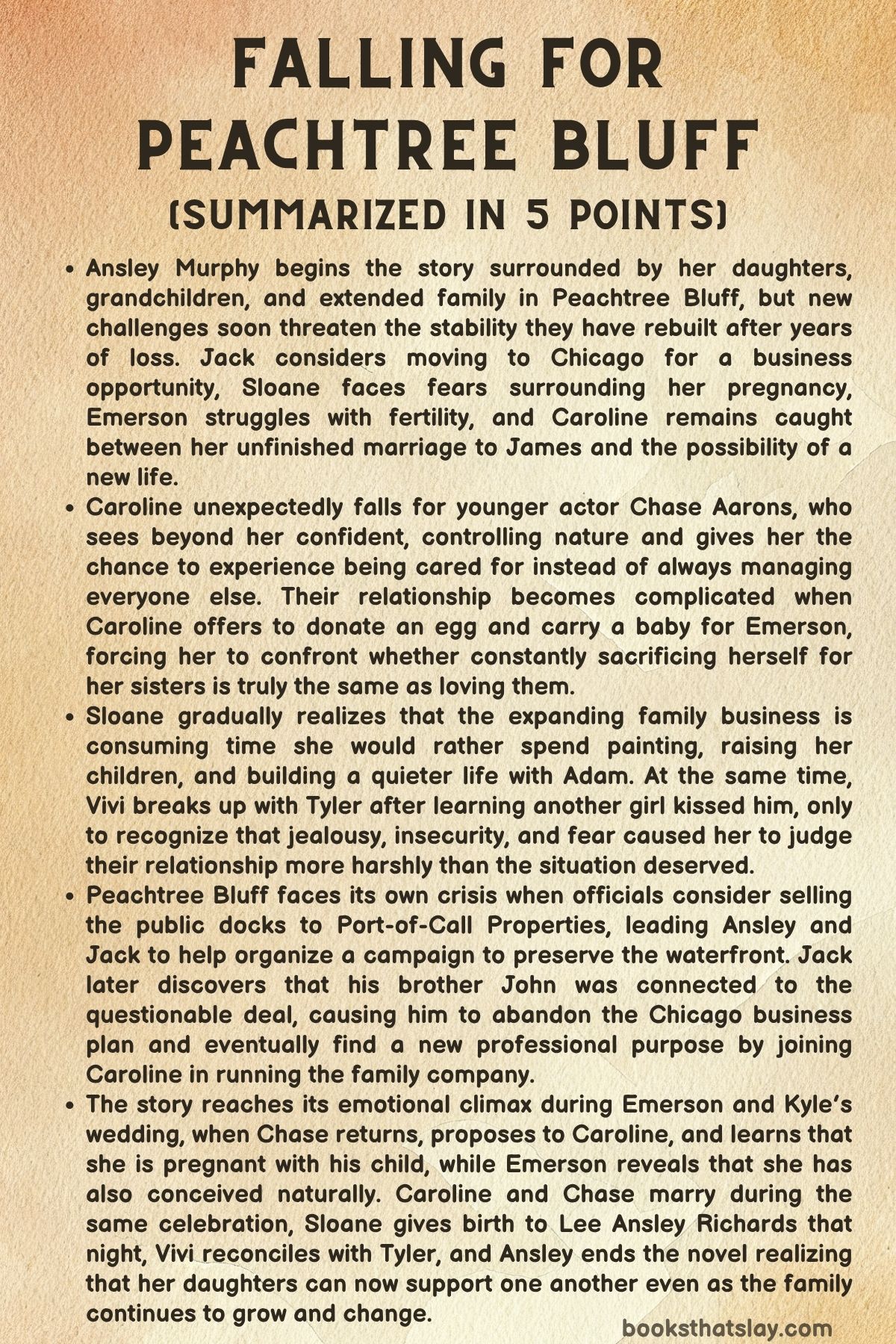
Falling for Peachtree Bluff begins with Ansley Murphy surrounded by the people she loves at the family dock in Peachtree Bluff. Years of tragedy have shaped them, including Carter Murphy’s death on September 11, Adam’s military disappearance and trauma, and Vivi’s experiences during Hurricane Pearl, yet Ansley recognizes that time has gradually allowed joy to exist alongside painful memories.
Peace does not last for long. Sloane, pregnant after suffering two miscarriages, experiences spotting and fears she is losing another baby. Caroline immediately leaves New York to be with her, while Emerson joins her after learning what has happened.
Sloane’s doctor confirms that the baby is healthy, but the scare reminds her how difficult it has become to experience pregnancy without fear. At the same time, her unfinished house is months behind schedule, leaving her family crowded into Ansley’s guesthouse while she also struggles with responsibilities connected to the expanding Sloane Emerson business.
Caroline arrives carrying her usual determination to solve whatever is wrong. She remains legally married to James despite their long separation following his affair, and their relationship has developed into an unusual mixture of friendship, resentment, coparenting, and emotional familiarity.
Caroline’s life also begins changing romantically when she meets actor Chase Aarons through Emerson. Their first interaction is playful, but the attraction is immediate, and Chase soon asks Caroline on a date.
Emerson has her own hopes about expanding her family with Kyle. Although her acting career is thriving and their wedding is approaching, she desperately wants another child and begins interpreting fatigue and other symptoms as possible signs of pregnancy.
Meanwhile, Ansley has gone to Chicago with Wes to consider another Sloane Emerson franchise. Her trip becomes far more significant when she discovers Jack is considering coming out of retirement to help his brother John expand a brewery business.
The real shock comes when Ansley learns that Jack expects the opportunity to require living in Chicago. She is furious, not simply because she does not want to move but because Jack has begun making plans involving their shared future without fully discussing them with her.
Jack eventually explains that retirement has left him restless and uncertain about his purpose. He has spent years becoming part of Ansley’s world and now wants her to consider supporting a dream of his, forcing Ansley to confront the tension between the place that defines her and the man she loves.
Vivi faces a different kind of relationship crisis. She returns to Peachtree excited to reunite with Tyler, her long-distance boyfriend, only to discover that another girl, Katelyn Jacobs, kissed him during a party game.
Tyler insists he did not return the kiss and told Katelyn that he had a girlfriend, but he kept the incident from Vivi. Already sensitive to infidelity because of James’s affair, Vivi sees the secrecy as betrayal and impulsively ends their relationship.
Her family supports her while also questioning whether Tyler truly cheated. James, in particular, encourages Vivi to recognize that her humiliation and jealousy toward Katelyn may be affecting her judgment more than Tyler’s actual behavior.
After another confrontation with Tyler, Vivi realizes he may be right when he accuses her of using the kiss to express fears she already had about their long-distance relationship. She still loves him, but pride prevents her from immediately repairing the damage.
Another crisis begins when Peachtree residents learn that the town may sell its public docks and boardwalk to Port-of-Call Properties. The company could commercialize the waterfront with rental equipment and tourist attractions, threatening the quiet character of the community.
The situation becomes personally frightening for Ansley when she discovers Port-of-Call is connected to Jack’s former business activities. Her past with Carter, who died leaving financial secrets behind, makes her deeply anxious about the possibility that another man she loves could be concealing something important.
Jack eventually learns about Ansley’s suspicions and immediately proves them unfounded. He is furious about the proposed waterfront deal, joins the effort to prevent it, and uses both his money and business experience to help develop an alternative funding plan.
The conflict restores some of Ansley’s faith in Jack while also demonstrating how deeply Peachtree matters to both of them. Together with Mrs. McClasky and other residents, they organize opposition to the sale and persuade the mayor to reconsider the agreement.
While Ansley battles for Peachtree, Caroline begins an intense romance with Chase. What initially seems like an amusing relationship with a much younger celebrity quickly becomes emotionally serious.
Chase tells Caroline about his father abandoning him and the ambition that grew from that rejection. Caroline responds by sharing difficult parts of her own history, including Carter’s death and the discovery that Jack is her biological father.
For Caroline, Chase becomes significant because he does not simply admire her competence. He recognizes how exhausting it is to be the person who plans, protects, organizes, and rescues everyone around her, and he begins offering Caroline something she rarely allows herself to receive: care.
At the same time, James realizes that Caroline may genuinely move on without him. He admits to Emerson and Kyle that he wants his wife back and later refuses to sign their divorce papers, telling Caroline directly that he still loves her.
Caroline is shaken because James has remained emotionally central to her even after their marriage collapsed. Their familiar routines make reconciliation tempting, particularly because restoring their family would seem simpler than beginning again.
Sloane, meanwhile, reaches a turning point professionally. Caroline rescues the disastrous house project by recruiting workers to finish it, but Sloane herself finally gains enough confidence to fire the contractor who has repeatedly failed her.
She also recognizes that the family business no longer gives her the life she wants. During a painting event beside the waterfront protest, she rediscovers how fulfilled she feels when she is creating art and spending time with her children rather than constantly resolving franchise problems.
Emerson receives devastating news when her fertility treatment produces no viable eggs. She initially treats this result as the destruction of her dream of another biological child, but Kyle reminds her that their family is already meaningful and that they have many possible paths forward.
Caroline responds to Emerson’s disappointment in her characteristic way: she tries to solve it personally. She offers Kyle the possibility of donating an egg and carrying a baby for him and Emerson.
The decision creates a serious conflict with Chase. He had imagined having a child with Caroline, and because her fertility window is limited, becoming pregnant for her sister could eliminate that possibility.
Caroline refuses to choose a romantic partner over Emerson. She moves forward with the insemination plan even while recognizing that her willingness to sacrifice herself may partly be a way of escaping from the frightening possibility of lasting happiness with Chase.
They break up, leaving both devastated. Emerson and Vivi later confront Chase and make him understand that his relationship with Caroline had affected the entire family because they had already begun imagining him as part of their future.
Then the situation changes completely. Emerson discovers that she has naturally conceived a child with Kyle, despite having believed another biological pregnancy might be impossible.
Before Caroline learns this, her own insemination produces an unexpected result: she is pregnant, but the baby is Chase’s rather than the child she intended to carry for Emerson. The timing creates confusion among nearly everyone until the truth eventually emerges.
Caroline must also make a final decision about James. Although she still loves him as someone who has shared much of her adult life, she realizes that the romantic part of their marriage never truly recovered from his affair.
She tells James she does not want reconciliation. He finally accepts her decision and agrees to sign the divorce papers, ending the emotional uncertainty that has allowed both of them to remain partly attached to their former marriage.
As Thanksgiving passes, Ansley and Jack also reach a compromise. Ansley decides that staying with Jack matters more than remaining permanently in Peachtree, and she becomes willing to give Chicago a genuine chance.
The family then gathers for Emerson and Kyle’s wedding. Sloane enters labor shortly before the ceremony but hides her contractions because she refuses to miss her sister’s marriage.
During the wedding, Emerson experiences another major emotional moment with Jack. Although Jack is the biological father of Caroline and Sloane rather than Emerson, she finally realizes that biology no longer determines their relationship and calls him Dad before he walks her down the aisle.
Emerson has also secretly arranged for Chase to appear at the ceremony. Chase apologizes to Caroline for forcing her into a choice and proposes, only for Caroline to announce that she is pregnant.
The revelations come rapidly. Emerson announces her own pregnancy, Caroline explains that her baby is Chase’s, and Chase becomes delighted that the future he thought impossible has unexpectedly returned.
Ansley proposes an immediate solution: since the family, flowers, venue, priest, and celebration are already assembled, Caroline and Chase should marry that day as well. Caroline agrees, and Jack receives the extraordinary privilege of walking two daughters down the aisle during the same celebration.
Vivi finally resolves her relationship with Tyler after reading a letter he sends through Carter. She admits that jealousy and fear drove much of her reaction to Katelyn, while Tyler reassures her that he still loves her.
They reconcile on the dock. Vivi accepts that loving someone does not guarantee protection from future pain, but fear alone is not a good reason to abandon a relationship that matters deeply to her.
The extraordinary wedding day becomes even more memorable when Sloane gives birth to a daughter, Lee Ansley Richards. The name honors both Ansley and Jack, symbolizing how completely Jack has become part of the family he once watched from a distance.
At the hospital, the family finally shares all of its secrets. Emerson is expecting a baby, Caroline is expecting Chase’s child, Sloane has just delivered Lee, and the Murphy family realizes it is entering another period of rapid growth.
The remaining conflicts also settle into new forms. Peachtree’s docks remain public, while Jack discovers that John secretly helped connect the mayor with Port-of-Call in hopes of profiting from the transaction.
Jack therefore abandons the Chicago business plan. Ansley does not have to choose between him and Peachtree after all.
Professional changes follow. Ansley admits that she wants to return her attention to interior design, while Sloane wants more time for painting and motherhood and Emerson wants to focus on acting and her growing family.
Caroline remains the one sister eager to continue expanding Sloane Emerson. Jack offers to become her business partner, giving him the professional challenge he misses and giving Caroline the experienced partner she needs.
Months later, the family gathers again for Lee’s baptism. Sloane is settled next door with Adam and their three children, Vivi and Tyler remain together, and Caroline and Emerson are both heavily pregnant with daughters whose due dates are close together.
Ansley looks at her daughters and understands something fundamental. She spent years believing it was her responsibility to hold everyone together, but they have grown into women capable of holding one another up.
Houses, towns, relationships, and generations inevitably change. What remains is the family created through birth, history, forgiveness, choice, and repeated acts of showing up for one another, which is why Peachtree Bluff ultimately represents far more than a physical place to Ansley.
Characters
Ansley Murphy
Ansley is the emotional center of Falling for Peachtree Bluff, a woman whose sense of identity is inseparable from her daughters, grandchildren, home, and community. Much of her life has been defined by maintaining continuity after loss, particularly after Carter’s death and the later revelations surrounding Jack.
Her resistance to Chicago initially appears stubborn, but it reflects something deeper than attachment to geography. Peachtree represents stability after decades in which death, secrets, romantic disappointments, and danger repeatedly disrupted the family she worked so hard to preserve.
Ansley nevertheless has to recognize that loving Jack means acknowledging his needs rather than expecting him to fit permanently into the world she has built. Her eventual willingness to move demonstrates real growth because she chooses partnership over absolute control of her circumstances.
The dock controversy exposes another side of her personality. She can be defensive, suspicious, commanding, and occasionally irrational, but her determination becomes valuable when something she genuinely loves is threatened.
Her greatest development comes through accepting change without seeing it as abandonment. By the end, she understands that her daughters do not need constant management from her because the family bond she helped build is now strong enough to survive beyond her direct supervision.
Caroline Murphy
Caroline is one of the most dynamic figures in Falling for Peachtree Bluff because strength functions as both her greatest asset and her most effective defense mechanism. She is decisive, intelligent, professionally ambitious, fiercely protective, and almost compulsively prepared for every possible problem.
Her response to emotional danger is usually action. When Sloane’s house fails, Caroline fixes it; when Emerson struggles with fertility, Caroline offers her own body; when the family business needs leadership, Caroline assumes responsibility.
This instinct makes her extraordinarily dependable, but it also reveals her difficulty believing that her own needs deserve equal importance. Sacrifice allows her to remain in control because helping others is easier than admitting how much she wants something she cannot guarantee.
James’s affair fundamentally damaged Caroline’s understanding of romantic safety. Although she has remained attached to him through familiarity, parenting, and shared history, she never fully regains the trust required to rebuild their marriage.
Chase challenges her because he offers a relationship that does not depend on her being invulnerable. He wants to protect her, make plans with her, and imagine a future alongside her rather than simply relying on her competence.
Her decision to close the door on James is therefore about more than choosing Chase. Caroline finally acknowledges that history and love are not always enough to restore a marriage once its foundation has changed.
Her pregnancy and sudden marriage complete a transformation she never could have scheduled. The woman who plans everything discovers that some of her greatest happiness arrives precisely when life refuses to follow her plans.
Sloane Richards
Sloane’s development in Falling for Peachtree Bluff centers on the difference between responsibility and fulfillment. She is loving, capable, thoughtful, and deeply committed to her family, yet she has gradually accepted professional responsibilities that do not reflect the life she most wants.
Her pregnancy intensifies this conflict. After two miscarriages, carrying another child makes her grateful but anxious, while the unfinished house and expanding franchise obligations create constant pressure around her.
Sloane initially depends on Caroline whenever circumstances require confrontation or decisive action. Firing Steve becomes important because it proves she can defend herself without borrowing someone else’s authority.
Painting offers the clearest expression of her authentic identity. When she becomes absorbed in recording the waterfront protest, she realizes creativity is not an indulgence she should fit around more serious work but an essential part of the person she wants to be.
Her relationship with Adam also reflects mature love shaped by adversity. They have survived deployment, injury, PTSD, parenting pressures, and periods of genuine uncertainty, giving their marriage an emotional depth that comes from endurance rather than fantasy.
Lee’s birth represents a new stage for Sloane. She ends the story with a completed home, three children, a recovering and supportive husband, and the confidence to reduce her involvement in a business that no longer fulfills her.
Emerson Murphy
Emerson undergoes one of the most emotionally complicated journeys in Falling for Peachtree Bluff, especially through her struggle with fertility. She has professional success, a loving partner, Carter, and an approaching wedding, yet her desire for another child becomes so powerful that it temporarily obscures everything she already possesses.
Her fertility results initially make her interpret biological limitation as personal failure. Kyle repeatedly helps her separate disappointment from catastrophe, reminding her that their family is already complete in meaningful ways even if it grows differently from what she imagined.
The natural pregnancy therefore becomes significant not because it validates Emerson as a woman but because it arrives after she has begun learning that happiness cannot depend entirely on achieving one specific outcome. Her gratitude is heightened by the fact that she had started accepting uncertainty.
Emerson also plays an important role in Caroline’s romantic life. She recognizes both James’s lingering attachment and Chase’s ability to make Caroline happier, and she becomes increasingly protective of the sister who normally protects everyone else.
Her wedding allows another unresolved relationship to heal. Calling Jack “Dad” shows that Emerson has moved beyond the biological distinction that once made her feel excluded from the connection he shares with Caroline and Sloane.
By marrying Kyle and preparing for another baby, Emerson ends the novel with greater confidence in the family she has created rather than the one she once imagined she needed.
Vivi
Vivi’s story in Falling for Peachtree Bluff examines young love, jealousy, inherited fear, and the uncomfortable process of becoming emotionally responsible for one’s own choices. She has grown up observing the damage caused by her father’s affair, which makes even the possibility of betrayal especially threatening.
Her breakup with Tyler reveals how quickly fear can transform uncertainty into certainty. Although Tyler insists he did not return Katelyn’s kiss, Vivi focuses on secrecy, public embarrassment, and Katelyn’s attractiveness until those emotions become indistinguishable from evidence in her mind.
Lake offers an appealing alternative because he belongs naturally to Vivi’s New York life. Yet her inability to stop comparing him with Tyler demonstrates that compatibility on paper cannot automatically replace emotional attachment.
Vivi also matures through Caroline’s relationship with Chase. She initially resists seeing her mother as a woman with romantic needs separate from motherhood, but observing Caroline’s happiness forces her to become more generous.
Her eventual reconciliation with Tyler requires something earlier Vivi struggled to provide: accountability. She admits that jealousy and fear shaped her behavior instead of forcing Tyler to carry all responsibility for their breakup.
By the end, Vivi has not suddenly become perfectly mature. She has simply begun recognizing that trust requires accepting uncertainty rather than demanding guarantees that another person will never hurt her.
Jack
Jack is defined by second chances. His renewed relationship with Ansley has allowed him to become part of a family he once watched from outside, yet retirement leaves him questioning who he is beyond being Ansley’s partner and the belated father of Caroline and Sloane.
His interest in the Chicago brewery is therefore understandable even when his communication is flawed. Jack wants meaningful work again, and he wants an achievement that belongs partly to him rather than existing only within Ansley’s established world.
The dock dispute demonstrates his loyalty to Peachtree and immediately destroys Ansley’s fear that he has betrayed the town. More importantly, he responds to her suspicion with empathy because he understands that Carter’s financial secrets created lasting emotional consequences.
Jack’s most moving role is paternal. Walking Emerson down the aisle and being called Dad gives him a relationship based on love rather than biology, while walking Caroline down the aisle and attending Lee’s birth allows him to participate in milestones he once believed he had permanently lost.
His eventual business partnership with Caroline provides an elegant solution to his crisis of purpose. Jack discovers that he does not need to leave the family in order to build something meaningful because his professional instincts can become part of his relationship with his daughter.
Chase Aarons
Chase initially appears to represent excitement, celebrity, and the thrill of Caroline dating a younger movie star, but his importance quickly becomes more emotional. His childhood abandonment explains why success matters so intensely to him and gives him an unexpected point of connection with Caroline.
He is attracted not merely to Caroline’s beauty or confidence but to the person hidden underneath her competence. Chase understands that someone who spends her life taking care of others may deeply want to experience being cared for herself.
His conflict over Caroline’s surrogacy plan is understandable even when his reaction becomes damaging. He wants children and recognizes that Caroline’s decision could close a narrow window for the family he imagined building with her.
His mistake lies in turning that legitimate concern into a choice between himself and Emerson. Returning to apologize demonstrates that he has learned partnership requires accepting the priorities that make Caroline who she is rather than loving only the parts of her that fit his preferred future.
His joy over Caroline’s pregnancy confirms that his desire for family was never superficial. His vows to love Vivi and Preston also demonstrate that he understands marrying Caroline means joining an existing family rather than replacing its history.
James
James represents the difficult reality that a person can genuinely regret betrayal without being entitled to restoration. He clearly loves Caroline and remains deeply connected to her through children, habits, memories, and years of shared life.
His affair nevertheless created a permanent fracture. Even after becoming supportive and dependable during their separation, he cannot simply accumulate enough good behavior to return their marriage to its earlier state.
James’s jealousy of Chase finally forces him to admit that he wants Caroline back. His refusal to sign the divorce papers initially appears like another attempt to control the situation, but it also brings long-avoided honesty into their relationship.
His eventual acceptance of Caroline’s decision shows maturity. He is devastated, but he recognizes that love sometimes requires allowing another person to leave rather than using shared history as a reason they must stay.
Kyle
Kyle is the emotional stabilizer in his relationship with Emerson. Where Emerson responds intensely to fertility fears and future possibilities, Kyle consistently redirects attention toward what they already possess.
He never dismisses her longing for another child, but he refuses to let that longing define the value of their current family. His response to Caroline’s surrogacy offer is similarly thoughtful because he understands both the generosity behind it and the enormous physical and emotional consequences involved.
Kyle’s calmness is not emotional detachment. His reaction to Emerson’s positive pregnancy test reveals that he has carried his own fears throughout their fertility struggle but has often placed Emerson’s emotional needs first.
He works well with Emerson precisely because he does not compete with her intensity. His steadiness creates room for her ambition, emotion, and spontaneity without requiring her to become a quieter version of herself.
Adam Richards
Adam’s presence carries the history of earlier hardship even though his life has become considerably more stable. His military experiences and PTSD remain part of him, but therapy, routine, family, and time have helped him build a healthier daily life.
His relationship with Sloane is marked by genuine attentiveness. When work begins consuming her, he recognizes what she cannot yet admit and actively pushes her to attend the painting event that eventually clarifies what she wants from her future.
Adam therefore supports Sloane without defining her. His role demonstrates how a long marriage can evolve from surviving crisis toward helping each person reclaim the individual interests that make life meaningful.
Tyler
Tyler is initially judged through Vivi’s fear rather than his actual behavior. He makes a mistake by concealing Katelyn’s kiss, but the book consistently supports his claim that he rejected her and remained committed to Vivi.
His frustration with Vivi is also understandable. He recognizes that the kiss has become symbolic of broader insecurities about distance, different social worlds, and whether their relationship can survive college.
Tyler nevertheless remains patient enough to leave the door open. His letter eventually makes reconciliation possible because it combines apology with a direct expression of love.
Their reunion does not guarantee they will remain together forever. Instead, Tyler represents the possibility that young relationships can deserve seriousness without requiring certainty about an entire lifetime.
Wes
Wes functions as a contrast to Chase and as a test of Caroline’s ability to establish boundaries. Professionally, he and Caroline are effective together because they share ambition and enthusiasm for expansion.
Personally, however, Wes repeatedly imagines a romantic commitment that Caroline does not share. When she chooses Chase, his decision to withdraw from the franchise partnership exposes the extent to which he had allowed personal expectations to affect professional judgment.
His departure creates practical problems, but it also clears space for Caroline to build a healthier partnership with Jack. Wes therefore becomes useful to the story less because of who he becomes and more because of what his departure reveals about the difference between professional compatibility and romantic love.
John
John is primarily important through the consequences of his ambition. Ansley distrusts his judgment from the beginning, making Jack’s desire to enter business with him one of the reasons Chicago feels dangerous.
That distrust eventually proves justified when Jack discovers John helped connect Port-of-Call with Peachtree officials while positioning himself to profit. His actions transform the dock controversy from an abstract business dispute into a family betrayal.
John also helps resolve Jack’s conflict. Discovering his brother’s behavior gives Jack a clear reason to abandon the brewery project and reconsider where his abilities can be used more responsibly.
Mrs. McClasky
Mrs. McClasky embodies the eccentric communal spirit of Peachtree Bluff. She is opinionated, intrusive, traditional, and frequently exhausting, yet those same qualities become valuable when the town’s identity is threatened.
Her alliance with Ansley over the docks demonstrates that community bonds can survive constant disagreement. Their arguments over small traditions resume almost immediately after the larger crisis, suggesting that conflict itself is part of how Peachtree functions.
She also contributes much of the novel’s humor, especially through her insistence that wedding guests participate in local hosting traditions. Beneath the comedy, however, she represents a community in which people feel entitled to interfere precisely because they also feel responsible for protecting one another.
Keith
Keith often appears at the edges of major family situations, but his role is quietly important. He gathers information during the dock controversy, helps Ansley understand what the council is doing, and participates in the practical defense of the community.
He also provides Caroline with unusually simple relationship advice when nearly everyone else has turned her romantic life into an elaborate emotional puzzle. His perspective suggests that excessive analysis can sometimes hide an obvious truth: people should pay attention to where genuine happiness exists.
Lake
Lake represents the attractive alternative Vivi believes she should want after breaking up with Tyler. He belongs naturally to her New York environment and offers glamour, familiarity, and clear interest.
Nothing is fundamentally wrong with him, which is precisely why his role matters. Vivi cannot dismiss him as unsuitable, so she must admit that choosing Tyler is not merely about rejecting a bad option but acknowledging where her emotions genuinely remain.
Katelyn Jacobs
Katelyn is less developed as an independent character than as the focus of Vivi’s insecurity. Her beauty and proximity to Tyler transform her into a threat long before Vivi has enough evidence to determine what actually happened.
The homecoming parade later renews the same jealousy when Tyler and Katelyn appear together as king and queen. Through Katelyn, the story shows how easily fear can convert another person into a rival even when much of the conflict exists inside the observer.
Carter Murphy
Although Carter Murphy died years before the central events, his presence continues to influence nearly every branch of the family. His death shaped Ansley’s life, Caroline’s understanding of loss, Emerson’s memories of childhood, and the broader emotional identity of the Murphy family.
His financial secrecy also helps explain Ansley’s suspicion during the dock controversy. Carter’s legacy is therefore loving but complicated: he remains deeply missed, yet the consequences of what he concealed continue affecting Ansley’s ability to trust.
Carter, Preston, AJ, Taylor, and Lee
The children collectively represent the future toward which so many adult decisions are directed. Carter strengthens Emerson and Kyle’s family, Preston remains one of the central links between Caroline and James, and AJ and Taylor remind Sloane why she wants a life with greater space for motherhood and creativity.
Lee’s arrival becomes especially symbolic because she is born on the same extraordinary day as two family weddings. Her name honors Ansley and Jack, joining multiple generations and confirming how completely the family has expanded beyond its earlier definitions.
Themes
Family as an Active Choice
Family in Falling for Peachtree Bluff is not treated as something guaranteed by blood. The strongest relationships survive because people repeatedly choose to appear for one another, forgive one another, intervene when necessary, and remain present through moments that are inconvenient, frightening, or emotionally difficult.
Caroline immediately travels south when Sloane fears she is miscarrying, the sisters leave a wedding reception so Sloane will not give birth without them, and the entire family becomes involved in each other’s romances, pregnancies, homes, and careers. Their involvement can be intrusive, but it comes from the conviction that no person should face an important crisis alone.
Jack’s position in the family develops this theme further. Biology makes him Caroline and Sloane’s father, yet history prevented him from raising them, while Emerson has no biological connection to him at all.
Emerson calling him Dad therefore becomes especially meaningful because it defines parenthood through relationship rather than genetics. Jack earns belonging through years of showing up rather than through biological entitlement.
Chase follows a similar path when he promises to love Vivi and Preston as his own. The novel repeatedly expands the meaning of family until it includes biological relatives, spouses, former spouses, stepparents, children, friends, and even the larger community of Peachtree.
What holds these relationships together is not perfection. It is the repeated decision to remain involved after circumstances change.
Change, Home, and the Fear of Losing Stability
Peachtree Bluff represents emotional permanence for Ansley, which explains why the possibility of leaving it feels almost like losing a part of herself. Her resistance to Chicago reflects the fear that changing one’s surroundings might somehow weaken relationships built there.
Yet nearly every character discovers that stability cannot mean keeping life permanently unchanged. Children grow older, marriages end, babies arrive, careers shift, businesses evolve, and relationships require new forms.
Sloane moves from a cramped guesthouse into her completed home while simultaneously moving away from the professional identity she has reluctantly maintained. Caroline ends her marriage formally, then enters another one in circumstances she never could have planned.
Emerson accepts Jack as a father while building a future with Kyle. Vivi confronts the possibility that even a relationship she loves may eventually face distance and uncertainty.
The dock conflict makes the theme physical. Residents fight to preserve the public waterfront because development threatens something central to Peachtree’s identity, yet saving the docks requires new financing and a different plan rather than simply refusing all change.
The story therefore distinguishes preservation from stagnation. Home remains meaningful not because nothing changes there, but because people carry their shared history forward while adapting to whatever comes next.
Sacrifice, Self-Worth, and the Right to Be Happy
Caroline provides the clearest exploration of self-sacrifice in Falling for Peachtree Bluff. Her instinct is to prove love by giving something up, whether that means time, professional energy, emotional safety, or even her own body.
Her willingness to carry a child for Emerson initially appears completely generous. Yet the novel gradually raises a more uncomfortable question: when does generosity become a way of avoiding one’s own desires?
Caroline is accustomed to being useful. If Sloane has a broken house, she repairs the problem; if Emerson cannot become pregnant, she tries to become the solution.
Ansley eventually tells Caroline that she has already done enough, which becomes one of the most important lessons she receives. Loving her sisters does not require giving away every opportunity for personal happiness.
Sloane experiences a quieter version of the same conflict. She continues handling franchise responsibilities because she believes stepping back might disappoint her family, even though the work prevents her from painting and enjoying the life she actually values.
Both women ultimately learn that choosing themselves does not mean abandoning others. Sloane can remain loving while prioritizing art and motherhood, just as Caroline can remain devoted to Emerson while wanting a future with Chase.
The theme rejects the idea that suffering proves devotion. Healthy love requires generosity, but it also requires believing that one’s own happiness deserves protection.
Trust, Forgiveness, and Living Without Guarantees
Trust repeatedly becomes difficult because the characters carry memories of earlier betrayals. Caroline cannot completely rebuild her marriage after James’s affair, Vivi interprets Tyler’s secrecy through what she witnessed happen to her parents, and Ansley fears Jack may be hiding something because Carter once concealed serious financial problems.
These reactions are emotionally understandable, but they also show how past pain can reshape the interpretation of present events. A person may believe they are responding to what is happening now while actually responding to something that happened years earlier.
Forgiveness does not have a single meaning in the story. Caroline eventually stops defining James entirely by his affair, but forgiving him does not require remarrying him.
Vivi forgives Tyler because she concludes that the relationship remains worthy of trust. Ansley forgives Jack for excluding her from the early Chicago discussions, but only after they establish a more honest approach to making decisions together.
The novel also rejects the idea that trust can eliminate risk. Tyler cannot promise Vivi that distance will never create problems, Chase cannot guarantee Caroline a perfect marriage, and Ansley cannot know that future changes will never threaten the family’s closeness.
Maturity lies in accepting that love always contains uncertainty. Trust means choosing a person with clear eyes, knowing disappointment remains possible, and refusing to let fear of future pain prevent every opportunity for present happiness.