Family of Liars Summary, Characters and Themes
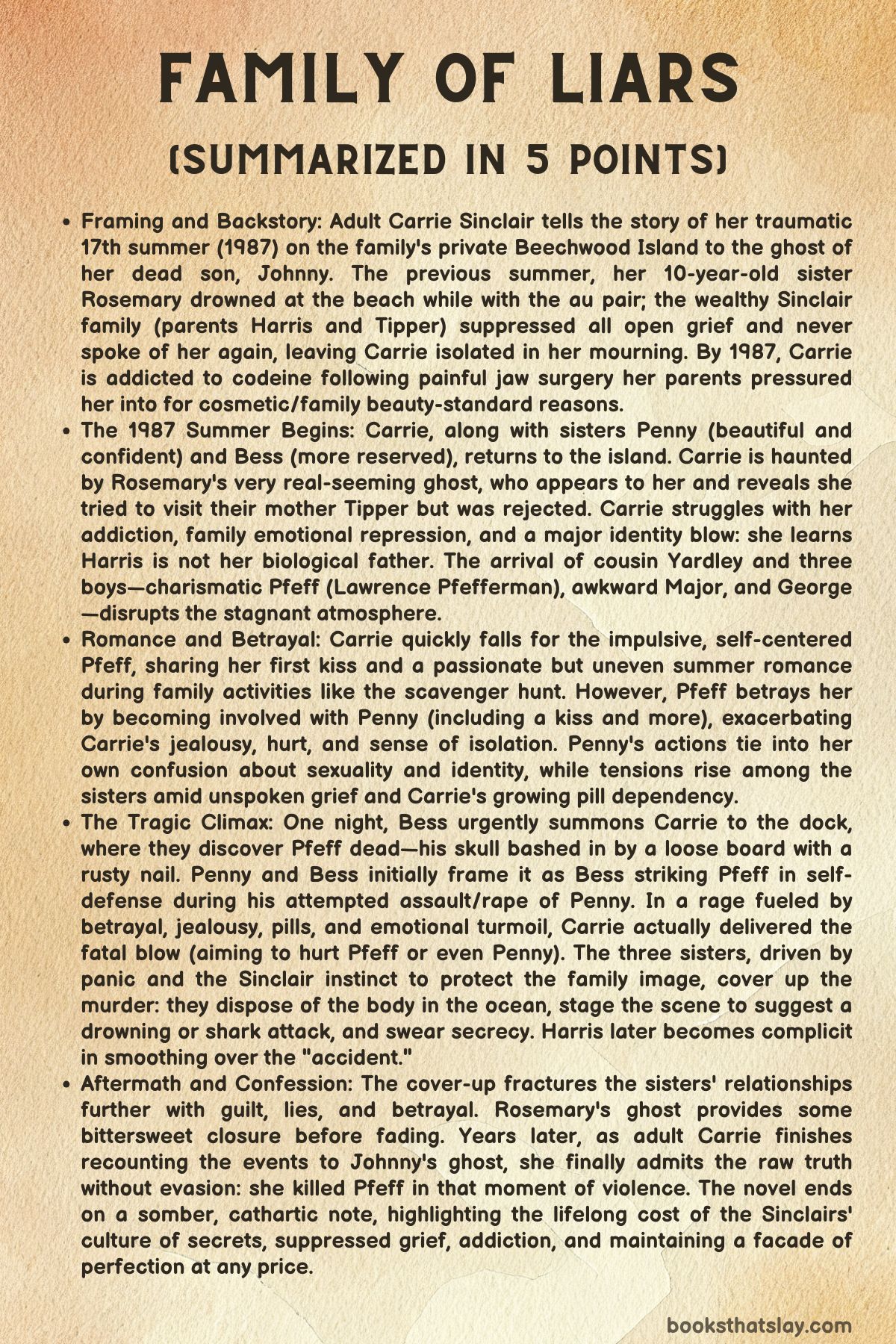
Family of Liars by E. Lockhart is a prequel to We Were Liars, set primarily during the summer of 1987 on the Sinclair family’s private Beechwood Island, off the coast of Massachusetts. The novel is narrated by Caroline “Carrie” Sinclair as an adult, speaking directly to the ghost of her fifteen-year-old son, Johnny, who died in a house fire years earlier.
Johnny visits her nightly, pressing her for stories about her youth. Reluctantly, Carrie recounts the pivotal summer of her seventeenth year—the summer she first saw a ghost, fell in love, and committed an unforgivable act.
Summary
The story opens with a brief look at the Sinclair family’s outwardly perfect life. Harris Sinclair, a powerful and emotionally distant patriarch obsessed with image and legacy, and his wife Tipper, who maintains the family’s social facade through lavish parties and traditions, preside over Beechwood.
The island features multiple houses (including the grand Clairmont), beaches, docks, and staff quarters. Their four daughters—Carrie (the responsible oldest), beautiful and confident Penny, studious and somewhat insecure Bess, and lively youngest Rosemary—spend idyllic summers there.
The previous summer (1986), tragedy strikes. Ten-year-old Rosemary drowns while swimming alone at the Tiny Beach near Goose Cottage.
Rosemary, a strong swimmer wearing her favorite green bathing suit with silly denim pockets, ventures beyond the rocks and never returns. The family suppresses all open mourning.
They do not speak of Rosemary, hold no funeral on the island, and continue summer routines as if nothing happened. This emotional repression devastates Carrie, who feels isolated in her grief while the others maintain the Sinclair code of stoic perfection.
The surgery is painful, with complications, and leaves Carrie dependent on prescription codeine and other painkillers. By the start of the 1987 summer, she is addicted, using the pills to numb both physical pain and her overwhelming grief and sense of inadequacy.
The 1987 summer begins with the three surviving sisters returning to Beechwood. Everything feels wrong without Rosemary.
Rosemary reveals she tried to appear to their mother Tipper, who told the ghost to “go away.” Carrie desperately tries to help her little sister’s spirit find peace, even as the rest of the family pretends Rosemary never existed. Tipper hosts her usual social events, while Harris focuses on maintaining control and the family’s image of success.
Mid-summer, the atmosphere shifts with new arrivals. Carrie’s cousin Yardley (daughter of Harris’s brother Dean) comes to the island with three teenage boys to keep her company: her boyfriend George, the awkward and seasick Major, and the charismatic, impulsive Lawrence “Pfeff” Pfefferman.
Uncle Dean, a more easygoing lawyer than Harris, joins with his family, bringing some levity but also underscoring the contrasts in the brothers’ personalities. Tipper is displeased by the extra guests disrupting her carefully curated summer.
Carrie, still grieving and medicated, finds herself drawn to Pfeff. He is charming, spontaneous, forgetful, and self-centered—qualities that both attract and frustrate her.
During a family scavenger hunt (the Lemon Hunt or similar tradition), Pfeff kisses Carrie for the first time. She falls hard and fast, experiencing her first real romance amid the emotional chaos.
Their relationship is passionate but uneven; Pfeff often pressures her physically and seems more focused on his own desires. Carrie, vulnerable from her addiction and loss, overlooks red flags, including his tendency to flirt and seek attention elsewhere.
Family tensions simmer. Carrie overhears or learns deeper secrets.
One major revelation shakes her identity: Harris Sinclair is not her biological father. Her real father is a man named Buddy Kopelnick (or similar), a detail tied to Tipper’s past that explains why Carrie has always felt slightly “off” in the family’s golden mold.
Meanwhile, the black pearls—a family heirloom symbolizing beauty and status—are lent by Tipper to Penny, further wounding Carrie.
The sisters’ dynamics strain under the weight of unspoken grief and new distractions. Penny, outwardly perfect and confident, harbors her own confusions, including questions about her sexuality.
Bess looks to Carrie for guidance but grows frustrated with her sister’s pill use and emotional distance. The boys bring energy and chaos—games, parties, and flirtations—but also highlight the Sinclairs’ privilege and emotional repression.
As the summer progresses, betrayal strikes. Pfeff becomes involved with Penny (they kiss, and there are implications of more).
Penny’s actions stem partly from her own identity struggles—she may have kissed Pfeff to provoke jealousy in a crush on a girl or navigate confusing feelings. The rift between the sisters widens, with Carrie feeling abandoned and alone.
One night, the tensions explode. Bess urgently wakes Carrie and leads her to the dock.
There, they find Pfeff dead—his head bashed in by a loose board from the pier, a rusty nail protruding, covered in blood and hair. Penny and Bess explain that Pfeff had been assaulting or attempting to rape Penny.
In the panic and horror, the sisters—driven by fear, loyalty, and the Sinclair instinct to protect the family’s reputation—decide to cover it up. They dispose of the body in the ocean, staging the scene to suggest a boating accident or disappearance.
They fabricate a story and swear secrecy.
Carrie, however, carries a darker truth. In a fit of rage, jealousy, and emotional turmoil (exacerbated by pills and the fresh betrayal), she grabbed the board and delivered the fatal blow—intending harm, possibly targeting Pfeff or even in a moment of blurred violence toward Penny.
What Bess and Penny present as self-defense was, for Carrie, something far more intentional and unforgivable. She has killed the boy she loved.
The cover-up deepens. Harris discovers elements of the truth and becomes complicit, helping to smooth over the “accident” to shield the family from scandal.
The Sinclairs close ranks, lying to outsiders, staff, and even each other in service of their image. Uncle Dean and others sense something is wrong but the facade holds.
Yardley, dealing with her own father’s financial misconduct, distances herself, providing a partial mirror to Carrie’s disillusionment.
Throughout, Rosemary’s ghost lingers, offering moments of tenderness and closure. She assures Carrie she does not blame her for anything and eventually seems to move on, though the haunting underscores Carrie’s unresolved guilt.
The pills continue to fuel Carrie’s detachment and poor decisions.
In the aftermath, the sisters’ relationships fracture further. Guilt, secrets, and betrayal create irreparable cracks.
Carrie grapples with the moral weight of her actions, her addiction, and her family’s toxic loyalty. The once-tight bond among the sisters erodes under the burden of what they have done and hidden.
The novel concludes with adult Carrie finishing her confession to Johnny’s ghost. She admits the full, unvarnished truth: “I killed Pfeff.” No metaphors, no more evasion.
The story ends on a somber, cathartic note. Carrie reflects on the lifelong pattern of lies in her family, the illusion of perfection, and the ghosts—literal and figurative—that never fully leave.
The Sinclair legacy of suppressing truth to preserve image has claimed another victim, shaping the dysfunctional family dynamics that will echo into the next generation (as seen in We Were Liars).
Characters
Carrie Sinclair
Carrie stands at the center of Family of Liars as both narrator and subject, and her voice shapes every other character through memory, guilt, and self-judgment. As a seventeen-year-old, she is caught between the Sinclair demand for elegance and the private reality of grief, bodily pain, and emotional instability.
Her reconstructive jaw surgery becomes more than a medical event; it turns into proof that her family sees her as a problem to be corrected. That experience deepens her sense of being less beautiful, less wanted, and less authentically Sinclair than her sisters.
Her pill dependency grows from this wound, but it also reflects her need to mute sorrow that nobody around her is willing to name honestly.
What makes Carrie compelling is that she is neither innocent victim nor simple villain. She is deeply sensitive, hungry for love, and capable of real tenderness toward Rosemary and Johnny, yet she is also jealous, impulsive, and morally compromised.
Her romance with Pfeff exposes how vulnerable she is to male attention because she wants to feel chosen. At the same time, her adult narration reveals an intelligence sharpened by hindsight.
She understands the lies that shaped her and eventually refuses to protect herself with softer language. Her confession is not only about murder; it is about accepting that she has inherited her family’s habits of secrecy and image management, even while she despises them.
Johnny Sinclair Dennis
Johnny appears as a ghostly listener rather than an active participant in the summer being remembered, yet his presence is emotionally decisive. He functions as the person to whom Carrie can finally speak without disguise.
Because he is dead, he exists outside social performance, outside Sinclair respectability, and outside the ordinary rules that kept Carrie silent for years. His role gives the narration its confessional tone.
Carrie is not telling this story to excuse herself before the living; she is telling it to someone whose death has already taught her that love cannot prevent catastrophe.
Johnny also matters because he links one generation’s damage to the next. Carrie’s memories are not sealed in the past; they continue through the child she raised and lost.
His ghost suggests that grief in this family never leaves cleanly because truth is never handled cleanly. He presses for honesty not as a judge but as a beloved son who makes evasion impossible.
Through him, Carrie’s story becomes more than a recollection of adolescence. It becomes a reckoning with how inherited silence, emotional repression, and unresolved guilt can echo into the lives of children who never caused those original wounds.
Rosemary Sinclair
Rosemary is physically absent for most of the story, yet she remains one of its most powerful presences. Her drowning shatters the family, but the greater damage comes from the refusal to mourn her openly.
As a ghost, Rosemary becomes a visible form of grief that the adults would prefer to banish. She represents innocence interrupted, but she also represents truth that will not stay buried.
Her appearances to Carrie are not simply supernatural episodes; they show that loss has become more real than the polished social world the family continues to maintain.
Rosemary’s character is defined by contrast. In life, she seems lively, beloved, and childlike, the youngest sister whose existence softens the family structure.
In death, she becomes the measure of everyone else’s failure. Tipper cannot bear to see her.
The family cannot name her. Carrie, however, continues speaking to her, which marks Carrie as the one person unwilling or unable to seal grief behind etiquette.
Rosemary’s forgiveness matters because it gives Carrie a form of grace that the living world never offers. Yet even that tenderness does not erase the damage left by her death.
Rosemary remains the silent center of the family’s collapse, showing that what is suppressed does not disappear; it changes form and continues to shape every relationship.
Harris Sinclair
Harris is the controlling force behind the family’s values, and his power comes less from open cruelty than from the system of priorities he enforces. He is devoted to appearance, bloodline, prestige, and discipline, and he teaches everyone around him that public perfection matters more than private truth.
His authority governs the island, the family rituals, and the emotional atmosphere in which his daughters are raised. Even when he is not the speaker in a scene, his standards determine what can and cannot be said.
That makes him the architect of the family’s inner damage.
His influence is especially destructive because it turns love into conditional approval. Carrie’s insecurity about beauty, belonging, and legitimacy grows under his gaze.
The revelation that he is not her biological father exposes how much of the family identity depends on performance rather than emotional honesty. Yet Harris does not lose power when this truth emerges; instead, the secrecy around it proves how fully everyone has adapted to his model of control.
His complicity in covering up Pfeff’s death confirms the real nature of his morality. He is not committed to truth or justice but to preserving the Sinclair image at any cost.
In that sense, he is less a father than the embodiment of a family code that rewards silence, punishes vulnerability, and converts love into loyalty to reputation.
Tipper Sinclair
Tipper is the guardian of elegance, ritual, and social polish, and her role differs from Harris’s in method but not in effect. Where Harris rules through authority, Tipper rules through atmosphere.
She keeps parties running, traditions intact, and surfaces lovely enough to hide emotional ruin. Her femininity appears softer and more graceful, yet it serves the same system of repression.
She helps create the illusion that a well-arranged life can contain sorrow without acknowledging it, and that belief becomes devastating after Rosemary’s death.
Her treatment of Carrie reveals how beauty functions as a moral category within the family. The pressure around the jaw surgery shows that Tipper values correction over acceptance.
Carrie is not simply encouraged to heal; she is subtly instructed to become more presentable, more fitting, more acceptable within the family image. Tipper’s inability to welcome Rosemary’s ghost is one of the most revealing details about her character.
It suggests not only fear of grief but rejection of anything that disrupts the household performance she has spent years perfecting. She is tragic because she is also a prisoner of the standards she maintains, but that does not reduce her responsibility.
Her refinement protects no one. It teaches her daughters to smile inside pain and to confuse composure with strength.
Penny Sinclair
Penny initially appears to fit the family ideal more comfortably than Carrie does. She is beautiful, assured, and socially fluent, and she seems to move through the Sinclair world with a natural ease that Carrie envies.
Yet her outward confidence conceals uncertainty, experimentation, and emotional complexity. She benefits from the family hierarchy of beauty, but she is not fully at peace within it.
Her actions toward Pfeff and toward Carrie suggest someone trying to test power, identity, and desirability without fully understanding the consequences.
Her betrayal wounds Carrie so deeply because Penny is not only a sister but also a symbol of everything Carrie believes she herself is not. Penny’s possible confusion about her sexuality adds another layer to her character.
She may be acting from curiosity, displacement, jealousy, or the desire to provoke a reaction, but the important point is that she is also struggling beneath her polished surface. That does not excuse the harm she causes.
Her intimacy with Pfeff becomes part of the chain of humiliation, rage, and fracture that drives the story toward violence. Afterward, her participation in the cover-up shows how quickly even the apparently radiant sister can conform to the family code of silence.
She is both privileged and trapped, and her character reveals that beauty within this family brings status but not emotional clarity.
Bess Sinclair
Bess often occupies a quieter position among the sisters, yet she is crucial because she shows how damage can take the form of anxious obedience. She is studious, observant, and less socially commanding than Penny, which allows her to notice tensions others might ignore.
She looks to Carrie for steadiness, but Carrie’s addiction and emotional absence leave that need unmet. This dynamic deepens Bess’s frustration and contributes to the erosion of sisterly trust.
She is not the boldest figure in the family, but she is often the one trying to manage chaos after others have created it.
Her role in the night of Pfeff’s death is especially important because it reveals both loyalty and fear. Whether she is protecting Penny, protecting Carrie, protecting herself, or all three at once, she becomes part of the machinery of concealment.
Her version of events offers a morally easier explanation, one grounded in defense rather than rage, and that instinct shows how quickly she reaches for a survivable story. Bess is shaped by the same Sinclair training as the others: maintain the structure, contain the scandal, move forward.
She is therefore not merely secondary support within the family but evidence of how thoroughly repression has been normalized. Her intelligence does not free her from that system; it simply makes her more aware of what must be hidden.
Lawrence “Pfeff” Pfefferman
Pfeff enters the story with charm, spontaneity, and the disruptive energy of someone who seems unlike the controlled world of Beechwood. For Carrie, he represents escape from grief, from self-consciousness, and from the humiliations she associates with her family.
He makes her feel visible in a way that is immediately intoxicating. That is why his flaws are so dangerous.
He is careless, self-involved, and often more interested in appetite than responsibility. His charisma invites idealization, especially from someone as emotionally starved as Carrie.
As the relationship develops, his selfishness becomes harder to ignore. He pressures boundaries, enjoys attention, and fails to understand the seriousness of the emotional terrain he has entered.
The later revelation involving Penny transforms him from disappointing first love into a figure connected to violation, betrayal, and mortal violence. Even then, the story resists turning him into a flat monster.
He remains a teenage boy whose thoughtlessness, entitlement, and desire become catastrophic in a setting already primed by secrecy and instability. His death matters not only because it is shocking but because it exposes how love, humiliation, fear, and male aggression collide under the pressure of a family that already knows how to hide the truth.
Yardley Sinclair
Yardley brings an outsider-insider perspective that subtly unsettles the family order. As a cousin rather than a daughter of the central household, she belongs to the Sinclair orbit without being fully absorbed into its strictest rituals.
Her arrival with the boys introduces motion, messiness, and a social life less controlled by Tipper’s design. She helps create the atmosphere in which Carrie’s romance begins, but she also serves as a contrast to the main branch of the family.
Through Yardley, the story suggests that all Sinclairs are shaped by privilege, yet not all of them perform it in the same way.
Her significance increases because of the troubles surrounding her own father. Those problems mirror, in another form, the moral failures of the main household.
Yardley’s distance from the later cover-up reflects both her limited involvement and her clearer view of how corruption can spread through family loyalty. She does not occupy the emotional center of the novel, but she broadens its portrait of inherited dysfunction.
Her presence reminds the reader that the family’s polished myth extends beyond one household and one scandal. She is close enough to expose its instability and far enough to show that not everyone is equally committed to maintaining the illusion.
Dean Sinclair
Dean functions as a contrast to Harris, and that contrast helps define both men more clearly. He appears more relaxed, less rigid, and less invested in absolute control, which gives him an air of relative warmth.
Yet his presence also reveals that moral weakness within the family does not always look like domination; sometimes it looks like passivity, compromise, or imperfect resistance. He is easier to like than Harris, but he is not strong enough to alter the family structure in any meaningful way.
His role matters because he shows that alternatives to Harris exist within the family, though they are limited and unstable. Dean’s household carries its own burdens, and the legal and financial issues linked to him or his branch of the family suggest that looseness is not the same as integrity.
He is part of a wider Sinclair pattern in which appearances still matter, even if he enforces them less aggressively. As a result, he becomes an important secondary figure in the moral landscape: not the source of the harshest damage, but not a true refuge from it either.
Agata
Agata’s role in Rosemary’s drowning places her at the edge of the family’s tragedy, where class and blame intersect. As the au pair, she is responsible for care but not truly granted the power or status of the family she serves.
After Rosemary dies, Agata becomes an implicit container for guilt and discomfort. Even if the family does not openly accuse her in every scene, the social structure makes it easy for responsibility to settle around her because she is not one of them.
That imbalance reveals how privilege protects itself.
Her character also exposes the limits of Sinclair empathy. The family’s focus remains overwhelmingly on preserving its own emotional and social order, not on the experience of the young woman who was present during a child’s death and could not prevent it.
Agata therefore becomes more than a minor figure linked to an accident. She reveals the hierarchy that supports the household: workers are necessary, visible in service, and disposable in grief.
Her presence sharpens the critique of a family that wants beauty, order, and devotion from others while refusing equal human recognition.
Major
Major may not occupy much emotional depth compared with Carrie or Pfeff, but his presence contributes to the social atmosphere that defines the summer. He is part of the male group that arrives with Yardley, and he helps create the sense of adolescent possibility, awkwardness, and shifting loyalties that surrounds Carrie’s first romance.
His more uncomfortable or seasick qualities make him less magnetic than Pfeff, but that very difference is useful. He reminds the reader that attraction is not rational and that Carrie is drawn not to safety or reliability but to danger disguised as glamour.
As a secondary figure, he also helps show how the island becomes a stage for performance. The boys are not just individuals; they are mirrors in which the sisters test identity, desirability, and maturity.
Major’s relative ordinariness makes Pfeff’s appeal stand out more sharply, and it also emphasizes how quickly the social games of summer can become emotionally consequential. He matters less for his personal arc than for the structure he helps create around the main conflict.
George
George, like Major, operates as part of the teenage social circle that changes the tone of the summer. As Yardley’s boyfriend, he helps establish a world of pairings, flirtations, and emotional alliances that disrupt the family’s enclosed grief.
He contributes to the impression that life is continuing, that summer still contains parties and desire, even though the island is haunted by loss. That contrast is central to the novel’s emotional tension.
His significance is mostly relational. He gives Yardley social grounding, helps define the group dynamic, and heightens the sense that Carrie is entering a wider world of adolescent romance and sexual experience.
Because George remains more stable and less central than Pfeff, he also reinforces the idea that catastrophe does not emerge from teenage presence alone. It emerges from a specific combination of entitlement, vulnerability, suppression, and family pressure.
George’s quieter role therefore supports the larger design by helping distinguish background social energy from the particular emotional intensity that destroys Carrie’s summer.
Themes
Grief and Emotional Repression
Grief in Family of Liars is not treated as a private feeling that quietly fades with time. It becomes the force that exposes how fragile the Sinclair world actually is.
Rosemary’s death is painful on its own, but the family’s refusal to mourn her openly turns sorrow into something corrosive. No one is allowed to speak honestly, ritualize loss in a meaningful way, or acknowledge that daily life has been broken.
That silence isolates each family member inside a separate version of suffering, and Carrie feels that isolation most sharply. Her dependence on pills grows in part because the emotional environment offers her no language, no comfort, and no permission to grieve.
The ghost story elements make this theme even stronger. Rosemary returns because the family has not made room for the truth of her death.
Her presence gives shape to what everyone else is trying to deny. The emotional cost of repression appears across generations as well, especially in Carrie’s conversations with Johnny’s ghost.
Loss does not disappear when it is hidden; it remains active, altering memory, behavior, and love. The novel suggests that grief becomes most destructive when families try to convert it into silence rather than shared mourning.
Family Image and the Corruption of Truth
The Sinclair family treats image as something almost sacred, and this priority distorts every moral decision they make. Beauty, composure, wealth, and social grace are presented not merely as advantages but as obligations.
Within that structure, truth matters only when it can support the family’s self-concept. When truth threatens the image, it is softened, buried, or rewritten.
Carrie’s jaw surgery is one example of this logic: the language of care hides a deeper obsession with correcting anything that does not match the family ideal. The same pattern governs the concealment of paternity, the handling of grief, and finally the cover-up after Pfeff’s death.
What makes this theme powerful is that deception is not presented as an occasional failure. It is the operating system of the family.
The lies are often dressed as protection, loyalty, or sophistication, which makes them easier to justify and harder to resist. Children learn very early that belonging depends on performance.
By the time the crisis arrives, the sisters are already trained to think in terms of containment rather than truth. The result is a family culture in which morality is subordinated to reputation, and where preserving appearances can seem more urgent than confronting violence, guilt, or trauma.
Identity, Beauty, and Belonging
Carrie’s struggle with identity runs through the story as both a personal wound and a critique of the values around her. She does not feel securely placed within the family mythology, and that insecurity is intensified by constant comparisons with her sisters.
Beauty in this world is not superficial; it functions as evidence of worth, legitimacy, and inclusion. Carrie’s jaw surgery reveals how physical appearance becomes tied to family acceptance.
The message she absorbs is that love must be earned by becoming more correct, more polished, more Sinclair. When she later learns the truth about her parentage, that fear of not truly belonging gains even greater force.
This theme extends beyond Carrie. Penny’s beauty grants her power but not peace, showing that conformity to the ideal does not eliminate confusion or pain.
The black pearls, the summer rituals, and the constant attention to presentation all reinforce the idea that identity is managed through symbols approved by the family. Yet the characters’ inner lives repeatedly exceed those symbols.
Desire, grief, jealousy, uncertainty, and shame resist clean packaging. The novel therefore presents belonging as unstable when it is based on appearance rather than acceptance.
The more rigid the standard becomes, the more deeply the characters doubt their own place within it.
Love, Desire, and Moral Damage
Romantic longing in the novel is inseparable from vulnerability, power, and self-deception. Carrie’s love for Pfeff begins as awakening, but it quickly becomes entangled with her grief, insecurity, and craving for affirmation.
She does not simply desire him as a person; she desires what being desired by him seems to promise. That emotional dependency clouds her judgment and makes it difficult for her to see his selfishness clearly.
Desire here is not purely tender or liberating. It can distort perception, lower resistance to harm, and turn humiliation into obsession.
The story also shows how sexual tension and betrayal can trigger buried emotional violence. The conflict surrounding Pfeff and Penny is painful not only because of disloyalty but because it strikes directly at Carrie’s deepest fears of inadequacy and replaceability.
When the final violent act occurs, it comes from a space where love, rage, shame, and disorientation have become impossible to separate. The novel does not treat passion as inherently corrupt, but it does insist that love formed in an atmosphere of repression and emotional neglect can become dangerous.
Without honesty, boundaries, and self-knowledge, desire becomes another force that exposes rather than heals the damage already present.