Field Guide for the Formerly Villainous Summary, Characters and Themes
Field Guide for the Formerly Villainous by Autumn K. England is a cozy fantasy about guilt, recovery, community, and the difficult process of reclaiming a life after coercion.
The story follows Oaklin Nettlewood, a former cult member who was magically controlled for six years and now fears both their own power and the judgment of others. Hoping to disappear, Oaklin purchases an isolated farm and discovers that it comes with enchanted land, demanding animals, welcoming neighbors, and the ghost of its former owner. What begins as an attempt to hide gradually becomes a journey toward friendship, love, forgiveness, and a new understanding of what magic can accomplish.
Summary
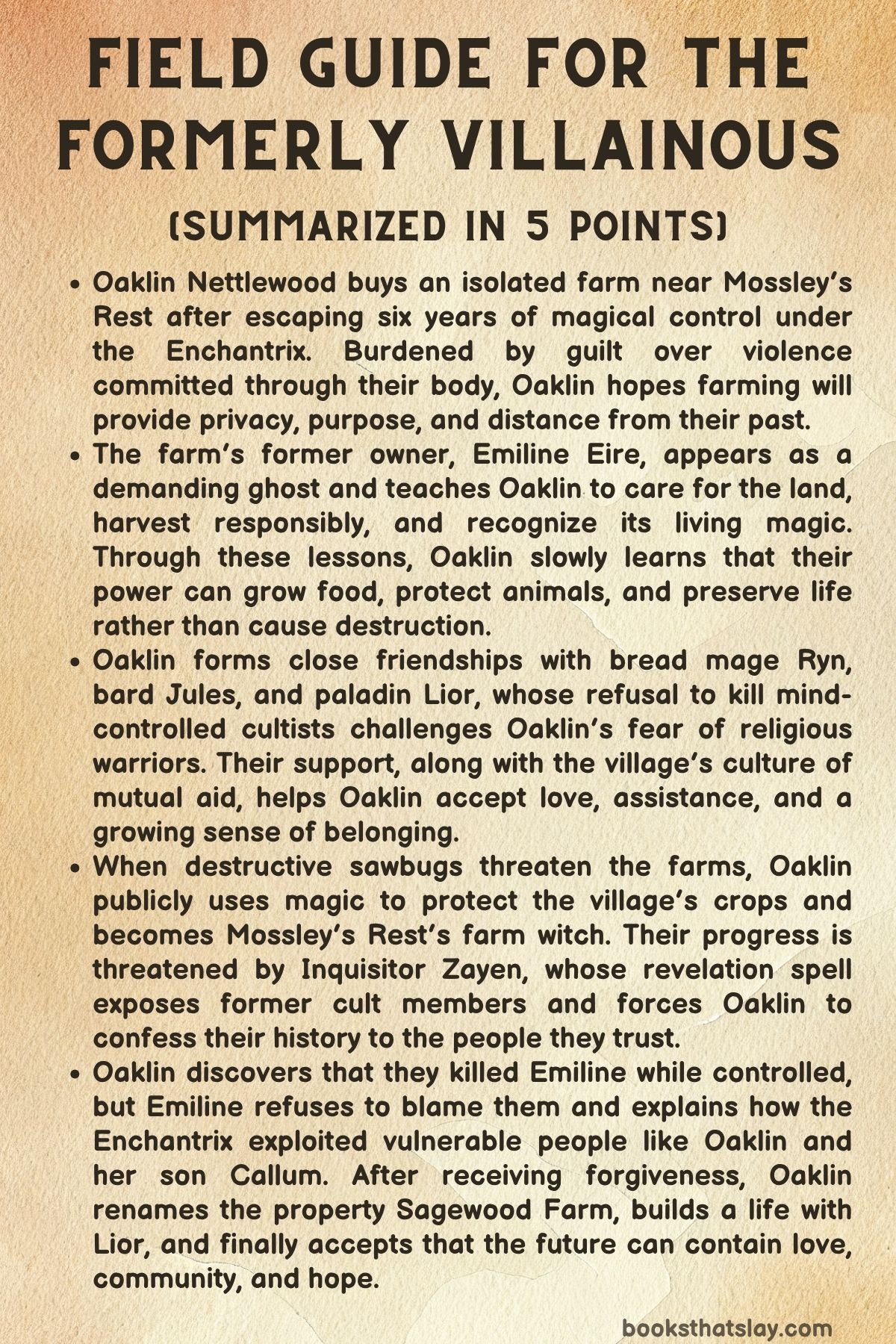
Two months after escaping the Enchantrix’s cult, Oaklin Nettlewood uses almost all their compensation money to purchase a secluded farm near Mossley’s Rest. Although the courts accepted that Oaklin committed violence while under magical mind control, they remain burdened by shame, damaged memories, and fear of their own abilities.
Oaklin hopes farming will let them avoid questions and build an identity unconnected to the cult. The property contains fields, an orchard, livestock, a cottage, a hostile horse Oaklin calls Grumpy Horse, and an affectionate guardian dog named Daffodil.
During Oaklin’s first visit to Mossley’s Rest, they enter a magical bakery owned by Ryn, a generous bread mage. Ryn and his bard friend Jules welcome Oaklin, offer food, and express interest in buying future produce, though both react strangely when they learn which farm Oaklin has purchased.
Back at the cottage, Oaklin discovers that tea tins appear mysteriously in the cupboards. They are then confronted by the ghost of an irritable elderly woman who claims to be the farm’s former owner but refuses to reveal her name.
The ghost insists that Oaklin care for Daffodil and learn to manage the farm’s unusual magic. She explains that the land could only have accepted a magical buyer, making Oaklin’s denials useless, and warns that the property’s protections cannot function unless Oaklin eventually reawakens their power.
Oaklin refuses because their magic was used to kill people during the cult years. The ghost argues that magic is not naturally violent and promises to teach Oaklin how to use it for growing food, protecting animals, and supporting the surrounding community.
Oaklin’s first trip to the local library introduces them to Lior, a witty and attractive librarian who also serves as a paladin of the Three Above. Their immediate attraction turns to terror when Oaklin notices Lior’s sword and uniform, since paladins fought the Enchantrix’s followers during the war.
Outside the library, Oaklin suffers a severe flashback in which the Enchantrix’s voice seems to seize their mind again. They collapse in the street and awaken surrounded by Lior, Ryn, and Jules, who believe Oaklin is an ordinary survivor whose family and homeland were destroyed.
Lior escorts Oaklin home, and the journey begins to weaken Oaklin’s assumptions about paladins. She reveals that she was sent to Mossley’s Rest as punishment after challenging the Order’s actions during the war, though she initially avoids explaining what she opposed.
The ghost begins teaching Oaklin how to harvest vegetables planted before her death. While tasting spinach, Oaklin unexpectedly remembers their father sharing the same vegetable with them, proving that their damaged past still contains moments of warmth unrelated to the cult.
Oaklin also learns ethical foraging in a magically saturated forest. When the strength of the surrounding power causes panic, the ghost teaches them to hold their hands over their heart, breathe, and remind themself that they are safe.
By opening only their magical senses, Oaklin identifies enchanted mushrooms without casting spells. That night, they listen to the living magic of the farm and experience power as something calm, natural, and beautiful rather than a force of domination.
Oaklin prepares produce for their first market and receives enthusiastic support from Ryn, Jules, and Lior. The hopeful beginning is interrupted by Inquisitor Zayen, who announces that former followers of the Enchantrix should never have been released and promises to expose and execute them.
Terrified that Zayen has come for people like them, Oaklin begins planning to flee. They remain long enough to sell their vegetables and mushrooms, meet other farmers, and accept an invitation to the tavern, intending to leave afterward without telling anyone.
At the tavern, Oaklin learns why Lior was punished by the Order. Once she discovered that the Enchantrix’s followers were mind-controlled, Lior refused to kill them and encouraged other paladins to disobey the same commands.
Knowing that Lior deliberately tried to protect people like them changes Oaklin’s view of her. The evening of music, drinking, humor, and companionship persuades Oaklin that Mossley’s Rest may be worth the risk of remaining.
Oaklin gradually becomes connected to the village through farming meetings, temple gardens, shared meals, and practical help. Sibling Kell gives them flower seeds to support pollinators, while Ms. Chanda and the Farmer’s Union explain that unusually hot weather could bring destructive sawbugs and crop disease.
The village once relied on the farm’s resident witch to prevent such disasters. Although Oaklin denies possessing magic, Ms. Chanda privately reveals that she knows the truth and gently warns that the community may eventually need Oaklin’s abilities.
Rather than threatening Oaklin, the villagers develop alternative plans based on resistant seeds, traps, rationing, and mutual aid. Their cooperation is unfamiliar to Oaklin, who grew up believing that hardship had to be survived alone.
Lior further challenges this belief when she helps Oaklin repair the cottage and explains the village’s food bank and financial support system. Oaklin is overwhelmed to learn that a failed crop would not leave them abandoned or starving.
Their friendship becomes romantic during a picnic beside a magically vibrant creek. Oaklin and Lior share a gentle first kiss, but Oaklin panics when Lior senses the farm’s powerful magic and realizes that Oaklin has been hiding their abilities.
The emotional strain contributes to a physical collapse that leaves Oaklin feverish and bedridden. During their recovery, dreams of the village, the farm, their friends, and the land’s gentle energy make them understand that they no longer want merely to escape the past.
Oaklin finally takes up the arcane focus they had regarded as a murder weapon. Under the ghost’s supervision, they retrain their magic and learn to cast precise agricultural protections that preserve crops without harming beneficial insects.
When a villager named Grer discovers Oaklin using magic, he does not reject them. He protects their privacy, offers his fields for practice, and helps Oaklin imagine becoming the community’s farm witch rather than remaining hidden.
The expected sawbug infestation soon destroys Grer’s squash crop and threatens every farm near Mossley’s Rest. Despite feeling unprepared, Oaklin casts powerful wards across the village and experiences the natural connections among soil, insects, plants, animals, magic, and people.
The enormous effort leaves Oaklin exhausted, but it saves the region’s food supply. The farmers, tavern workers, and Oaklin’s friends care for both Oaklin and the farm, allowing them to recognize that their power has now protected life rather than ended it.
Oaklin becomes publicly accepted as the farm witch and begins selling enchanted vegetables, magical mushrooms, herbs, and spellwork. They also grow closer to Lior and invite her to attend the Midsummer Festival as their date.
During the festival, Lior explains that the Three continue granting her divine power despite her disagreement with the church. Their private rooftop celebration is interrupted when Inquisitor Zayen casts a revelation spell intended to identify former cultists.
Oaklin’s hands glow red, exposing their connection to the Enchantrix. Believing that the village is condemning those who were revealed, Oaklin runs home while flashbacks and the Enchantrix’s commands overwhelm their awareness.
Oaklin hides for a week, convinced that their touch is corrupt and that everything they built has been destroyed. The ghost eventually persuades them that their friends deserve to hear the truth before Oaklin disappears.
Oaklin invites Lior, Ryn, and Jules to the farm and confesses that they joined what seemed to be an inclusive magical guild at seventeen. The Enchantrix trapped them, stole six years of their life, and used their body and magic to commit violence.
Instead of rejecting Oaklin, the friends explain that the villagers drove Zayen away. Another former cult member, the ranger Dara, was exposed during the festival, but the community defended her and removed the spell placed upon her.
Oaklin seeks out Dara and reveals their own glowing hands. Their shared experiences allow them to speak honestly about coercion, responsibility, fear, and the possibility that they may have harmed people whose families now live in Mossley’s Rest.
Dara mentions that a local woman named Emiline Eire died at the Enchantrix’s fortress. The name unlocks Oaklin’s memory of restraining and stabbing an elderly prisoner while controlled, forcing them to realize that Emiline was the farm’s former owner and the ghost who had been teaching them.
Oaklin returns home and confronts the ghost, who finally confirms her identity. Emiline explains that she went to the fortress to rescue her estranged son, Callum, after he was drawn into the Enchantrix’s movement.
Emiline refuses to blame Oaklin for her death. She insists that Oaklin’s body was used as someone else’s weapon and that joining a group built upon lies did not make them cruel, foolish, or deserving of permanent punishment.
Oaklin also comforts Emiline by acknowledging her attempt to save Callum. After they share forgiveness, grief, and affection, Emiline’s ghost finally departs, leaving Oaklin to carry forward her knowledge and care for the land.
As autumn approaches, Oaklin organizes a memorial attended by Lior, Ryn, Jules, Dara, and Sister Talla. The farm is renamed Sagewood Farm in honor of Emiline, Callum, the land’s history, and the new life Oaklin is building there.
Lior confesses that she killed cultists before learning they were controlled. Oaklin helps her understand that institutional pressure and incomplete knowledge shaped her actions, just as Lior helps Oaklin accept that they no longer need the Inquisitor’s red mark as punishment.
Their relationship deepens at the Autumn Harvest Festival, where each offers the other a leaf crown symbolizing companionship through winter. Lior resigns from the paladin Order, choosing to serve the gods and the village without remaining loyal to an institution that demanded violence and obedience.
Oaklin invites Lior to live at Sagewood Farm, and they confess their love. Through the winter they build a shared life filled with preserving food, reading, visiting friends, caring for the farm, and supporting one another through nightmares.
Emiline does not visibly return, though Oaklin occasionally senses her presence in a sudden gust of wind or an imagined scolding. Surrounded by love, meaningful work, and a community that knows the truth, Oaklin finally believes that survival can become a life rather than a sentence.
Characters
Oaklin Nettlewood
Oaklin is the emotional center of Field Guide for the Formerly Villainous, and their development is shaped by the conflict between legal innocence and personal guilt. Although the courts recognize that the Enchantrix controlled Oaklin’s body and mind, Oaklin continues to judge themself according to actions they had no freedom to prevent.
Their fear of magic reflects a deeper fear of identity. Oaklin does not simply believe that their spells are dangerous; they worry that the violence committed through them revealed something hidden within their nature.
Farming gives Oaklin a way to challenge that belief through action. Each crop they protect, animal they care for, and person they feed creates evidence that their hands can sustain life rather than only cause suffering.
Oaklin’s recovery is never presented as a smooth return to normality. Flashbacks, illness, avoidance, memory loss, social panic, and physical exhaustion repeatedly interrupt their progress, showing how trauma affects the mind, body, work, relationships, and ability to trust.
Their greatest transformation comes when they stop treating isolation as responsibility. Oaklin initially believes hiding protects others, but they eventually understand that secrecy prevents friends from offering informed love, assistance, and forgiveness.
Oaklin becomes neither innocent in a simplistic sense nor permanently defined by victimhood. They grow into a person capable of accepting a complicated past while choosing generosity, community, romance, ethical magic, and a meaningful future.
Emiline Eire
Emiline first appears as an unnamed, demanding ghost whose sharp manner prevents Oaklin from retreating completely into fear. Her constant instructions may seem controlling at first, but she carefully distinguishes guidance from domination by repeatedly forcing Oaklin to observe, decide, and act independently.
Her farming lessons are also lessons in agency. She teaches Oaklin how to trust their senses, take only what nature can replace, recognize their physical limits, and use magic without surrendering their judgment.
Within Field Guide for the Formerly Villainous, Emiline represents forgiveness grounded in a clear understanding of coercion. She knows exactly how she died, yet she refuses to place moral responsibility upon the person whose body was controlled.
Her relationship with Callum adds another dimension to her compassion. Emiline carries regret over failing to understand her lonely son before he entered the cult, and her final journey to the fortress was an attempt to repair that failure before death.
Emiline does not use forgiveness to erase pain or excuse the Enchantrix. Instead, she directs blame toward the person who designed the system of deception, control, and violence while releasing Oaklin from punishment that cannot restore the dead.
Her departure becomes possible only after she and Oaklin recognize that neither must remain trapped in endless suffering. By entrusting Oaklin with the farm, Emiline turns the site of her death into a place where care, memory, and renewal can continue.
Lior
Lior is a paladin whose moral courage places her in conflict with the religious institution that trained and housed her. She initially followed the Order’s commands, but once she learned that the cultists were controlled, she refused to continue killing them.
Her punishment in Mossley’s Rest reveals how institutions can protect authority by isolating those who question harmful orders. Lior nevertheless retains her faith, showing that belief in the divine can remain separate from obedience to religious leadership.
Her relationship with Oaklin develops through patience rather than rescue. She provides books, healing, repairs, meals, companionship, and reassurance, but she also apologizes when her curiosity about Oaklin’s magic causes fear.
Lior’s willingness to accept Oaklin’s confession is connected to her own unresolved guilt. She understands the difference between choice and coercion, yet she also struggles to forgive herself for the cultists she killed before she knew the truth.
Romantically, Lior helps Oaklin experience desire without pressure. Their kisses, dates, conversations, and later intimacy are built upon asking permission, respecting boundaries, and treating vulnerability as something worthy of care.
Her resignation from the Order completes her personal development. Lior chooses to continue serving the Three and the community while rejecting an identity that required unquestioning loyalty, proving that ethical conviction can survive the loss of institutional status.
Ryn
Ryn is the village bread mage and one of the first people to offer Oaklin unconditional kindness. His decision to provide food to a nearly penniless stranger establishes Mossley’s Rest as a place where generosity is treated as ordinary rather than exceptional.
His magical baking also helps Oaklin reconsider their fear of enchantment. Cakes that provide confidence, muffins that restore strength, and scones that ease social anxiety show that magic can nourish without invading or controlling another person.
Ryn combines warmth with quiet emotional intelligence. He notices when Oaklin is uncomfortable, protects them from unwanted attention, challenges their attempts to isolate themself, and recognizes when practical assistance is more useful than interrogation.
He also has his own insecurities, particularly regarding the bakery and whether an outsider could become a genuine part of village life. Oaklin’s encouragement helps him recognize that belonging is created through participation rather than determined by origin.
Ryn’s friendship is valuable because it is not based on Oaklin’s magical usefulness. He supports Oaklin before knowing the truth, after learning it, during illness, and after their public success as the farm witch.
His food becomes a recurring symbol of community memory. Through carefully created recipes, Ryn helps Oaklin recover good experiences from childhood and demonstrates that healing can involve pleasure, appetite, creativity, and shared meals.
Jules
Jules brings humor, music, and social ease into Oaklin’s life. As a bard, he uses performance not merely for entertainment but to encourage customers, lighten tense situations, and make communal spaces feel welcoming.
He understands when magic would be uncomfortable for Oaklin and offers nonmagical music at the market. This sensitivity shows that he does not assume his talents should override another person’s emotional needs.
Jules also helps create the relaxed friendship shared among Oaklin, Ryn, and Lior. His teasing contributes to the group’s intimacy while never turning Oaklin’s trauma into a joke.
Although he receives less personal focus than several other characters, his consistency matters. Jules is present during markets, tavern evenings, festivals, confessions, memorials, and celebrations, becoming part of the dependable structure surrounding Oaklin.
His music represents expression without coercion. In contrast with the Enchantrix’s commands, Jules influences people through invitation, mood, and enjoyment, leaving listeners free to respond as they choose.
Jules therefore supports one of Oaklin’s most important discoveries: people can affect one another deeply without taking away freedom. His friendship helps make Mossley’s Rest feel lively rather than merely safe.
Dara
Dara is a ranger and fellow survivor whose exposure forces Oaklin to confront the possibility of living openly. Before the Midsummer Festival, she appears mainly as a quiet customer, suggesting that she has also learned to survive through caution and limited contact.
The revelation spell marks Dara publicly, yet the villagers defend her rather than surrendering her to the Inquisitor. Her experience becomes proof that Oaklin’s assumption of universal rejection does not match the community’s actual values.
Dara’s hidden camp reflects her continued uncertainty about that protection. Even after the village chooses her, she retreats to the forest because years of danger have taught her not to trust acceptance immediately.
Her first meeting with Oaklin is tense because shared victimhood does not automatically create safety. Dara verifies Oaklin’s glowing hands before lowering her weapon, showing how survivors may need evidence before risking emotional openness.
Dara’s fear that she killed Emiline reveals the cruelty of incomplete memory. Former cultists must live not only with what they remember but also with uncertainty about actions their controlled bodies may have committed.
Her friendship with Oaklin allows both characters to be understood without explanation or simplification. Together, they create a small community within the larger village for people whose experiences cannot be fully understood by those who were never controlled.
The Enchantrix
The Enchantrix remains the central destructive presence even after her physical defeat. Her power continues through Oaklin’s flashbacks, damaged memories, fear of magic, and belief that personal happiness would somehow excuse past violence.
She is dangerous not only because she controls bodies but because she corrupts identity. By making victims act against their values, she leaves them uncertain about whether their actions revealed secret desires or merely reflected her commands.
Her cult recruits through false promises of free magical education, inclusion, and belonging. This method shows that exploitation often begins by recognizing real unmet needs and offering an apparently supportive answer.
The Enchantrix also benefits from the violence of her enemies. When heroes kill controlled followers without distinguishing victims from willing participants, their actions reinforce the fear, confusion, and dehumanization upon which her power depends.
Even after Oaklin knows she is dead, the Enchantrix’s voice feels present. This lasting influence demonstrates how an abuser’s commands can become internalized and continue shaping behavior long after direct control has ended.
Oaklin’s final victory is therefore psychological and ethical rather than military. By using magic to protect life and accepting love without punishment, they remove the Enchantrix’s authority over the meaning of their future.
Inquisitor Zayen
Inquisitor Zayen represents punishment disguised as justice. She rejects the courts’ recognition that the Enchantrix’s followers lacked control and instead treats execution as the only acceptable response to their actions.
Her public speeches rely upon fear, spectacle, and social pressure. By encouraging neighbors to report one another, she attempts to turn community relationships into instruments of surveillance.
The revelation spell is especially cruel because it reduces complex histories to a visible red mark. It offers no distinction between willing participation, deception, imprisonment, resistance, and magical control.
Zayen believes guilt can be identified through association alone. Her approach resembles the Enchantrix’s methods because both deny individual agency and impose an identity upon people without allowing them to define themselves.
Her failure in Mossley’s Rest is significant because the villagers do not defeat her through greater violence. They remove her authority by refusing to cooperate, protecting Dara, and using communal and bureaucratic power against her.
Zayen therefore exposes the village’s values more clearly than any speech could. Faced with an official demand for cruelty, Mossley’s Rest chooses evidence, compassion, shared responsibility, and resistance.
Sister Talla
Sister Talla initially appears as a harsh authority figure who treats Lior with contempt and reacts cruelly to Dara’s exposure. Her behavior reflects loyalty to religious hierarchy and unresolved grief over Emiline’s death.
Her connection to Emiline explains, though does not excuse, her hostility toward former cultists. Talla knows that someone from Mossley’s Rest died at the fortress, and she directs her pain toward people whose bodies may have been involved.
Talla also maintained the farm after Emiline’s death, suggesting that her character has always contained loyalty and care alongside judgment. Her support of the property’s enchantments helped ensure that Emiline’s intended successor could eventually arrive.
The memorial gives Talla information she had previously lacked. Hearing Oaklin’s confession, Emiline’s forgiveness, and the truth about magical control forces her to reconsider the moral certainty she used against Dara.
Her later apology to Dara marks an important movement toward accountability. Talla does not erase the harm she caused, but she admits wrongdoing and attempts to change her conduct.
Her forceful letter to the High Temple also reveals that her knowledge of institutional systems can protect the village. Once she directs that strength against the Inquisitor’s abuse, she becomes an imperfect but useful ally.
Sibling Kell
Sibling Kell presents a nurturing expression of religious life. Their gardens, beekeeping, and concern for pollinators show that service to the Three can involve cultivation, patience, beauty, and ecological responsibility.
Oaklin’s visit to Kell’s gardens complicates their fear of the temple. The flowers and thriving insects provide physical evidence that sacred work can support life rather than enforce punishment.
Kell offers seeds without demanding immediate payment, accepting a future exchange of clary sage instead. This flexible generosity introduces Oaklin to an economy based on trust and continuing relationships.
Their warning about attending the second market is practical rather than controlling. Kell understands that consistency builds customer confidence and encourages Oaklin to participate in village life despite anxiety.
Kell also demonstrates how small acts can influence recovery. A handful of seeds helps Oaklin improve the farm, attract beneficial insects, and feel connected to traditions established by Emiline.
Through Kell, the novel shows that institutions contain individuals whose values may differ greatly from their leaders. Their quiet work provides Oaklin with an alternative vision of faith based on care.
Ms. Chanda
Ms. Chanda is a forceful leader within the Farmer’s Union and quickly recognizes that Oaklin possesses magic. Instead of exposing them, she offers information, assistance, and time to decide how much they are prepared to reveal.
Her leadership style is direct but communal. She does not wait passively for Oaklin to solve the sawbug threat, instead guiding the farmers toward traps, resistant crops, rationing plans, and shared resources.
Chanda understands that Oaklin’s hesitation comes from more than simple inexperience. By recognizing their homeland and cultural background, she sees that Oaklin has learned to associate need with failure and dependence with danger.
Her statement that Mossley’s Rest takes care of its people challenges Oaklin’s entire view of survival. She presents mutual aid not as charity but as a basic obligation shared by every member of the community.
Chanda’s importance lies in the balance she maintains between need and consent. She makes clear that the village may require Oaklin’s magic, yet she does not threaten or manipulate them into using it.
This respectful pressure helps Oaklin act from choice rather than fear. Chanda treats Oaklin as a capable adult whose abilities matter while also acknowledging that capable people still deserve support.
Grer
Grer is one of the first villagers outside Oaklin’s close friendship group to discover their magic. His response becomes an important test of Oaklin’s belief that exposure will inevitably lead to rejection.
Rather than demanding an explanation, Grer accepts that Oaklin has private reasons for hiding. He promises discretion and offers his own fields as a place where Oaklin can practice agricultural spells.
His generosity becomes even more meaningful when sawbugs destroy his squash crop. Although his family suffers the first major loss, Grer asks Oaklin to protect the remaining farms instead of placing his own needs above the village.
Grer’s trust helps Oaklin take on the role of farm witch. He does not require perfection, and his willingness to accept help from someone still learning allows Oaklin to act despite feeling unprepared.
After Oaklin saves the fields, Grer and the other farmers participate in caring for them. The relationship becomes reciprocal rather than placing Oaklin in the position of an endlessly available magical servant.
Grer embodies practical community ethics. He offers labor, land, trust, and assistance according to what is needed, demonstrating that belonging is maintained through repeated acts of cooperation.
Elder Varron
Elder Varron offers an alternative to the rigid authority represented by Zayen and the harsher members of the Order. His leadership emphasizes rest, mutual care, celebration, and the spiritual value of ordinary community life.
His support of Lior is especially important. He recognizes that her conflict with the institution does not make her faithless and later helps her consider a future beyond the formal paladin role.
During the Midsummer Festival, his speech presents rest as necessary rather than indulgent. This message directly challenges Oaklin’s habit of proving their worth through constant labor and exhaustion.
Varron also helps remove the revelation curse from Dara, using religious authority to protect someone condemned by the Inquisitor. His actions show that divine service can oppose unjust religious enforcement.
When Lior resigns, Varron does not treat the decision as betrayal. He supports her choice to serve the Three and the village outside the structure that caused her moral injury.
His character demonstrates that reform and resistance can sometimes arise from within a faith community. He cannot erase the Order’s violence, but he uses his position to create space for conscience, compassion, and change.
Callum Eire
Callum never appears directly, yet his life shapes Emiline’s final journey and the farm’s eventual identity. He was lonely and searching for purpose when the Enchantrix’s movement offered him belonging and magical possibility.
His story prevents the cult’s followers from being treated as a single category. Callum’s recruitment appears connected to emotional isolation and a strained family relationship rather than an attraction to cruelty.
Emiline’s regret shows how surviving relatives may blame themselves for missing signs of vulnerability. She believes she failed to support him after his father’s death, though the Enchantrix remains responsible for exploiting that pain.
Callum also connects Oaklin and Emiline. Both were young people drawn toward an apparently welcoming magical community, making Emiline capable of recognizing the deception that trapped Oaklin.
The renaming of the farm honors Callum alongside his mother. This choice refuses to remember him only as a cult member and restores his place within a history of family, land, and care.
Although his fate remains tragic, Callum is not reduced to a warning. His memory encourages the living characters to notice loneliness, provide community, and question organizations that demand obedience in exchange for belonging.
Daffodil
Daffodil is the farm’s livestock guardian dog and the first living creature to make Oaklin feel immediately wanted. Her affection requires no explanation of Oaklin’s past and creates an early emotional bond with the new home.
Caring for Daffodil also gives Oaklin responsibility that is simple and immediate. Feeding, protecting, and loving her pulls Oaklin away from abstract guilt and into the practical needs of the present.
Daffodil functions as a quiet measure of character. Lior’s affection for her increases Oaklin’s trust, while Emiline’s insistence that Daffodil is the farm’s most important resident reveals the ghost’s values.
Unlike human relationships, Daffodil’s companionship does not initially demand confession or vulnerability through language. She offers physical warmth and steady presence during a period when Oaklin finds conversation difficult.
Her role also reinforces the idea that the farm is a living community rather than a private possession. Oaklin becomes responsible for beings that existed there before their arrival and whose needs shape the land’s routines.
Daffodil therefore supports Oaklin’s recovery through companionship, structure, and uncomplicated devotion. She helps turn the farmhouse from an isolated hiding place into a home.
Grumpy Horse
Grumpy Horse provides both practical difficulty and comic relief. Oaklin’s immediate nickname for the hostile animal reveals their dry humor, which survives despite years of trauma.
The horse also represents the realities of farming that cannot be solved through emotion alone. Oaklin must work with an animal that does not instantly trust or adore them, requiring patience and persistence.
Grumpy Horse becomes part of markets, transportation, and the daily responsibilities that anchor Oaklin in ordinary life. These routines give Oaklin problems unrelated to the cult and therefore help expand their identity.
The horse’s stubbornness also reflects Oaklin’s own resistance. Both respond to unfamiliar situations defensively, and neither becomes cooperative through force.
Although Grumpy Horse does not carry the emotional importance of Daffodil, the animal adds texture to the farm. Its difficult personality makes Sagewood feel inhabited, imperfect, and real.
The Farming Community of Mossley’s Rest
Farmers such as Alin, Bram, Ulana, and the other members of the union represent the collective strength of Mossley’s Rest. Individually, many have limited roles, but together they create the social structure that makes Oaklin’s new life possible.
Alin welcomes Oaklin into the union and warns them about village gossip. Bram identifies the approaching environmental threat, while Ulana brings urgent news when the sawbugs attack Grer’s fields.
The farmers respond to danger by sharing information, labor, equipment, shelter, food, and plans. Even before Oaklin agrees to use magic, they prepare to survive through coordinated effort.
Their acceptance of Oaklin after the magical wards save the crops is not based solely on gratitude. Many had already offered support, advice, repairs, and friendship before knowing what Oaklin could provide.
The community also teaches Oaklin how to exchange magical services without becoming exploited. Labor, produce, expertise, and care can all serve as fair forms of payment.
Together, the farmers demonstrate that resilience does not come from one powerful savior. Oaklin’s magic succeeds because it operates within a network of observation, preparation, trust, and shared responsibility.
Themes
Reclaiming Power After Coercion
Oaklin’s relationship with magic reflects the difficulty of reclaiming any ability associated with abuse. Their power once belonged to them, but the Enchantrix transformed it into an instrument of murder, leaving Oaklin unable to separate personal talent from imposed violence.
In Field Guide for the Formerly Villainous, recovery does not require Oaklin to forget what their magic was forced to do. Instead, they develop new experiences strong enough to prove that the meaning of an ability can change when choice is restored.
The ghost’s farming lessons are important because they begin with observation and restraint. Oaklin learns to sense mushrooms, protect plants, support pollinators, regulate temperature, and defend crops without dominating the natural world.
Each spell becomes an act of consent because Oaklin chooses its purpose, limits, and method. This stands in direct opposition to the cult, where choice was removed and the body was treated as property.
Reclaiming magic also requires Oaklin to accept that avoidance cannot undo the past. Refusing power may feel like accountability, but it allows the Enchantrix to continue determining what Oaklin can become.
When Oaklin saves the village from sawbugs, the victory is not simply magical. It proves that the same hands associated with death can protect food, land, animals, families, and a future.
Guilt, Responsibility, and Forgiveness
The story carefully separates guilt from responsibility without dismissing the emotional reality of either. Oaklin feels responsible for every action committed through their body, even though magical control made refusal impossible.
Their guilt persists because memory provides images of harm without restoring the missing experience of choice. Oaklin sees victims, spells, and blood, but cannot fully feel the force that controlled them, making self-condemnation seem more believable than innocence.
Emiline’s forgiveness challenges the idea that suffering is a form of repayment. Oaklin believes misery honors the dead, while Emiline argues that continued self-punishment does nothing for her, Callum, or anyone else who was harmed.
Lior’s guilt creates an important contrast. She was not magically controlled, but she acted under institutional authority, incomplete information, religious training, and the pressures of war.
Neither character receives a simple declaration that nothing matters. Instead, Oaklin and Lior examine degrees of agency, knowledge, coercion, and resistance, then choose to help each other live responsibly without demanding endless punishment.
Forgiveness becomes an active ethical process rather than an erasure of consequences. It allows people to remember harm, oppose the systems that caused it, support survivors, and build lives that do not reproduce the same violence.
Community as a Form of Healing
Oaklin arrives at the farm believing isolation is both safer and more responsible. They fear that closeness will expose their history, create opportunities for rejection, or place innocent people near dangerous magic.
Mossley’s Rest gradually disproves this belief through ordinary acts. Ryn provides food, Lior brings books and repairs, Kell offers seeds, Chanda explains mutual aid, farmers share labor, and friends care for Oaklin during physical and magical exhaustion.
These acts are powerful because they are not reserved for moments of dramatic crisis. Community exists in markets, taverns, meals, gossip, festivals, farm meetings, flirtation, home repairs, and preserved food.
Oaklin also learns that receiving help does not make a person a burden. Assistance circulates through the village, with each resident offering what they can and trusting that support will return in another form when needed.
The response to Dara’s exposure proves that communal care can become political resistance. By refusing to cooperate with Zayen, the villagers protect vulnerable residents from an authority that treats punishment as moral purity.
Healing does not occur because the community removes every symptom of trauma. It occurs because Oaklin no longer faces illness, fear, flashbacks, work, grief, or uncertainty entirely alone.
Ethical Faith and Resistance to Authority
The Order of the Three contains both genuine spiritual care and institutional violence. Paladins once killed controlled cultists, Sister Talla responds harshly to survivors, and Zayen uses religious authority to threaten public executions.
At the same time, Lior, Kell, and Elder Varron demonstrate forms of belief centered on protection, cultivation, conscience, and service. Their presence prevents the story from treating faith and religious institutions as identical.
Lior’s divine power remains even after she challenges the Order. The continuation of that power suggests that her moral resistance is not a rejection of the Three but a more honest expression of their values.
Kell’s gardens offer another model of sacred work. Flowers, bees, seeds, and pollination connect spirituality with the patient support of living systems rather than the enforcement of obedience.
Elder Varron uses his position to defend Dara and support Lior’s resignation. His leadership shows that authority can be exercised responsibly when it remains accountable to compassion and the needs of ordinary people.
Lior ultimately chooses faith without institutional submission. By removing her armor and leaving the Order, she establishes that moral identity must come from examined convictions rather than rank, uniform, tradition, or command.