Five Broken Blades Summary, Characters and Themes
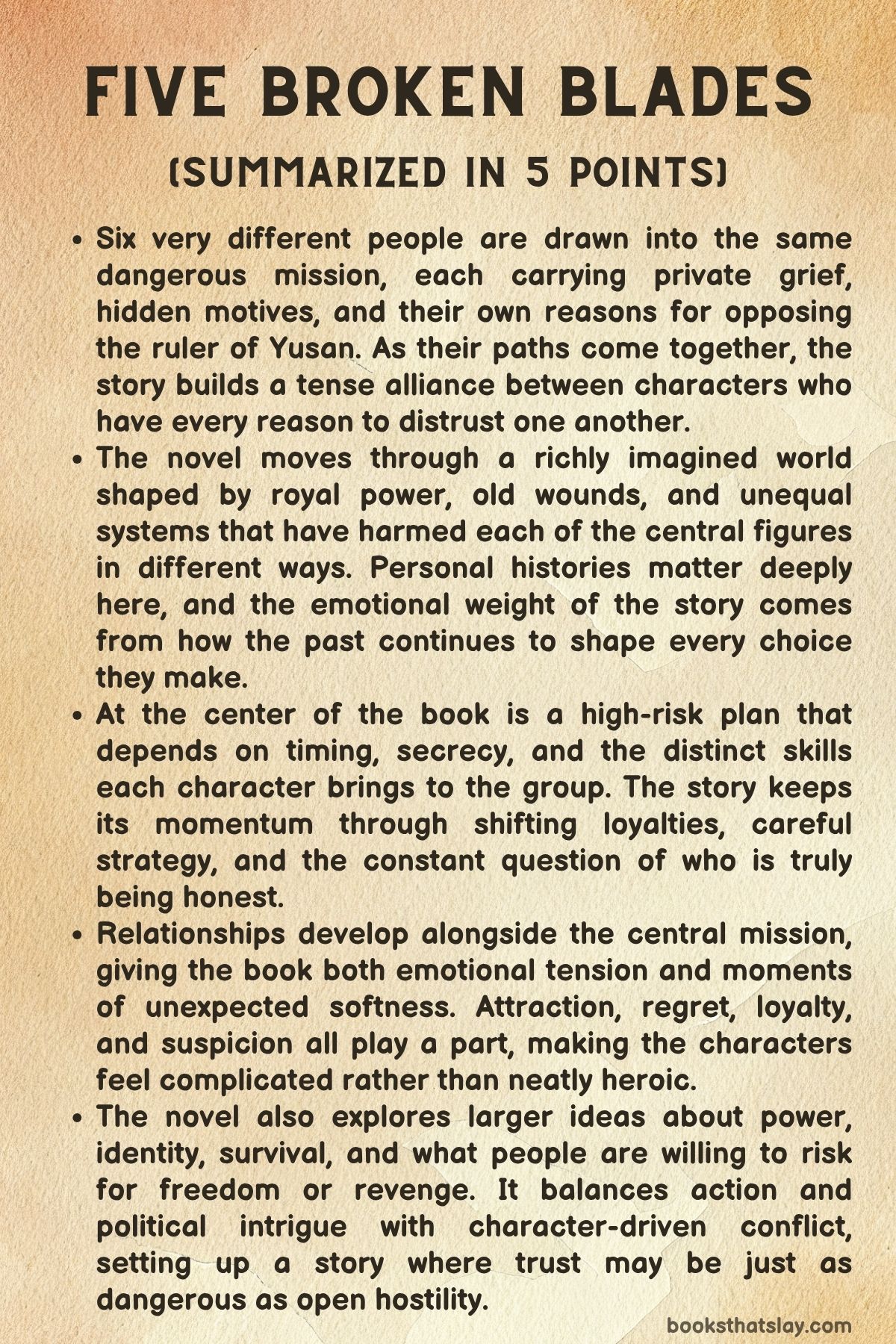
Five Broken Blades by Mai Corland is a fantasy novel built around six dangerous people who are pushed into the same mission: kill an immortal king. Each of them carries a private wound, a hidden motive, and a reason to hate the ruler they are meant to destroy.
The story moves through shifting loyalties, political pressure, and uneasy attraction as these strangers travel toward the capital and slowly become tied to one another. What begins as an assassination plan grows into something larger—a story about power, survival, family, and the cost of trusting the wrong person in a kingdom shaped by fear.
Summary
The story opens across several cities in Yusan and beyond, introducing people whose lives have been twisted by King Joon’s rule. Royo is a fighter from Umbria who takes rough work to earn money, all while secretly trying to save enough to free Hwan, a man imprisoned for a crime Royo believes he did not commit.
He is approached by Aeri, a clever and polished young woman who offers him a job as her bodyguard on a journey to the capital. She claims she wants revenge against the king and has the money to prove she is serious.
Though suspicious, Royo accepts.
Elsewhere, Prince Euyn lives in exile under a false name. Everyone believes he is dead, and he survives through caution, traps, and violence.
When Mikail, the royal spymaster and Euyn’s former lover, finds him, Euyn assumes he has come to finish the job. Instead, Mikail proposes an alliance to kill Joon.
Euyn initially refuses because Joon wears the Dragon Lord’s crown, which is said to make him immortal. But when Mikail says Euyn’s sister supports the plan, Euyn starts to listen.
Sora lives under the control of Count Seok, who trained girls as poison maidens and keeps her sister Daysum captive. Sora is forced to kill on command in exchange for brief visits with Daysum.
When Seok orders her to join a plot against the king, she understands that refusal is impossible. He also sends his son, Tiyung, with her.
Sora despises him because of his role in her painful past, and she plans to kill him when the chance comes.
As these people travel, the novel fills in the damage the kingdom has done to them. Euyn and Mikail cross dangerous country together, surviving brigands and monstrous samrocs.
During the journey, old feelings return between them, but so do old betrayals. Euyn once hunted prisoners for sport as a prince, a brutal practice that helped define his reputation and eventually led to his exile.
Mikail, though loyal in some ways, once stood by while Euyn was condemned. Their bond is still strong, but it is unstable and full of unresolved hurt.
Royo and Aeri travel by river toward the capital. Pirates attack their boat, and Royo fights to keep her alive.
Aeri proves harder to read than he expects. She can lie smoothly, slip out of danger, and somehow do things that seem impossible.
Their attraction grows, but so does his suspicion. Royo is a man shaped by guilt, especially over the death of Lora, the woman he loved and failed to save.
Protecting Aeri begins as paid work, but it starts to feel deeply personal.
Sora’s road with Tiyung is equally tense. He does not behave like the cruel noble she expects.
He is careful with servants, thoughtful in some moments, and more decent than his father. Sora does not trust this side of him, especially because she knows what he has done before.
Yet the distance between them slowly shifts. At the same time, Sora learns that Daysum is sicker than she realized, and her mission becomes tied not just to survival, but to saving her sister before it is too late.
The separate threads finally converge in Rahway, where Royo, Aeri, Euyn, Mikail, Sora, and Tiyung are brought together. The counts supporting the conspiracy reveal more of the plan.
Sora learns that Joon is not a god, only a man protected by a magical crown. She also learns that the poison school was part of a wider system of abuse created by powerful men.
Euyn recognizes Sora as the daughter of Chul, one of the prisoners he once hunted and spared. This link adds another layer of guilt and secrecy to the group.
Aeri then demonstrates her talent as a thief in front of the others, stealing from Euyn without anyone noticing. This convinces them she may truly be able to take the crown from Joon during a public event.
A six-person plan forms. Sora will get close enough to poison the king once the crown is removed.
Aeri will steal it. Euyn is meant to claim the throne after Joon dies.
Mikail coordinates everything. Royo and Tiyung help protect the operation.
Though there is tension, the group slowly becomes something like a team.
As they travel toward Tamneki, they begin sharing their motives. Royo wants the king’s order against prisoners undone.
Sora wants freedom and a future for Daysum. Euyn is pushed toward reclaiming power, though he is haunted by who he used to be.
Tiyung wants to protect Sora. Aeri speaks less openly, but her reasons seem bound to family.
Mikail appears most committed to killing Joon, and others assume it is because of Euyn, though his true motives go deeper.
Their growing trust is tested in Oosant, where Sora is kidnapped by gang members. The rescue becomes a brutal fight, showing how effective the six are when forced to rely on each other.
They save Sora, destroy a large cache of illegal laoli, and leave with a stronger sense of loyalty. Yet even then, something feels wrong.
There are hints that information is leaking and that unseen forces are moving around them.
At a count’s estate, a palace assassin is found dead, though none of them admits to killing him. Suspicion spreads.
Soon after, the count they hoped to use dies suddenly, and Mikail pushes the plan forward with increasing desperation. By the time they reach the capital, every relationship is under strain.
Royo does not trust Mikail. Euyn feels Mikail is still hiding too much.
Sora considers stealing the crown for herself to save Daysum. Tiyung burns Sora’s indenture papers and tells her she is legally free, trying to convince her not to betray the others.
Aeri and Royo finally admit their feelings, while Sora and Tiyung also move closer, each knowing the future is uncertain.
The day of the Millennial Championship arrives. Their assassination attempt unfolds in the arena during a tuhko match, where nobles and royals gather in public.
Tiyung and Sora gain access through Bay Chin, the northern count. Mikail waits near Joon, anxious for the timing to work.
Euyn hides below, preparing for the moment he is meant to step forward. Royo watches from a guard position, tense and unable to help directly.
Aeri takes her place near Joon as a valet.
At the critical moment, Aeri uses an amulet taken from Prince Omin’s body. It is one of the lost relics of the Dragon Lord and allows her to freeze time long enough to steal the crown.
The effort has a terrible cost, aging her in the process. She passes the crown to Mikail.
Sora kisses Joon with poisoned lips, expecting him to die now that he is unprotected. But Joon survives.
Mikail destroys the crown he received, only to realize too late that it was a decoy. Guards close in.
The entire plot collapses at once.
Capture follows, and the truth begins to break open. Royo sees Aeri call Joon “father” and learns she is tied to the royal family under the name Naerium Lin Baejkin.
He feels completely betrayed. Euyn is equally shaken, because the official story of Naerium’s death and Aeri’s age do not fit together.
Mikail understands that Joon was not merely waiting for an attack. He had designed the entire situation, using the assassination plot to identify, trap, and test the people around him.
Bay Chin receives a pardon, proving he was part of the arrangement but not the true mastermind.
Then Joon reveals the real purpose behind all of it. He wants the group to steal the Ring of Khitan from Queen Quilimar, Euyn’s sister.
The failed assassination was, in effect, an audition. Each member is offered a reward tailored to their deepest desire.
Sora is promised safety for Daysum and a home. Royo is promised Hwan’s freedom.
Mikail is promised power in the capital. Aeri is promised recognition as a princess and honor for her mother.
Euyn is offered restoration. The task must be completed within weeks, and if Quilimar learns who sent them, Joon will punish not only them but the people they love.
By the end, the six leave the palace alive but shattered. Their trust in one another has been badly damaged.
Aeri’s secret has changed how the others see her. Euyn realizes how little he knows about Mikail.
Sora understands that Joon is afraid of Quilimar, and from that fear she draws a new possibility. Rather than remain pieces in Joon’s game, she suggests they use his weakness against him.
The book closes with the group forced into a new mission, no longer united by simple revenge, but by the chance to strike back at the king who manipulated every step they took.
Characters
Royo
Royo begins as the kind of man others read too quickly. His physical strength, blunt speech, and work as a hired strongman make him easy to mistake for a simple weapon, but his inner life is defined by guilt, restraint, and a stubborn moral code.
He is haunted by Lora’s death, not only because he loved her, but because he failed her in the one moment that mattered most. That failure shapes nearly every choice he makes afterward.
His secret plan to save Hwan before execution shows that he is not driven by money for its own sake. He is trying to correct a wrong that has lived inside him for years.
This gives him a strong emotional core: he is a man who believes action is the only honest form of remorse.
His role in the group is especially important because he brings a direct, practical ethics into a plot full of deception. While others lie, conceal, and calculate, Royo tends to judge situations in the clearest possible terms.
He knows cruelty when he sees it, and he has little patience for the refined language powerful people use to excuse violence. That clarity is why he pushes Euyn to reverse the king’s order against prisoners.
He does not care about royal theory or political symbolism. He cares about whether human beings are being thrown away by the state.
This makes him one of the clearest moral centers in Five Broken Blades, even though he is far from innocent himself.
His relationship with Aeri exposes another layer of his character. At first he treats her as a suspicious employer, then as someone he must protect, and finally as a woman he cannot separate from his own future.
What makes this relationship compelling is that his care for her grows alongside distrust. He senses that she is hiding something, and he is right, but his emotional investment keeps deepening anyway.
This creates a tension between instinct and devotion that defines much of his later arc. Even when he feels betrayed, his first response is not indifference but pain.
That pain matters because it proves he has allowed himself to hope again after years of living under the shadow of failure.
Royo also represents a particular kind of masculinity that the story treats with unusual seriousness. He is violent, capable, and feared, but he is not emotionally numb.
He worries, remembers, protects, and longs for tenderness even when he tries to suppress it. He does not speak in polished terms, yet he understands loyalty in a way that many more sophisticated characters do not.
By the end, his anger at betrayal is intense, but it comes from the same source as his love: once he gives his trust, he means it fully. That makes him both dangerous and deeply human.
Aeri
Aeri enters the story as a mystery and remains one for a long time, but what makes her compelling is not secrecy alone. She is built from contradiction.
She can seem bright, impulsive, and almost playful, yet underneath that surface she is controlled, observant, and capable of astonishing precision. Her skills as a thief are not simply useful plot devices; they reveal how she has learned to live in spaces where visibility is dangerous and performance is necessary.
She knows how to charm, distract, soften tension, and redirect attention. These are survival methods as much as talents.
Her emotional life is more complicated than her polished exterior suggests. Aeri wants connection very badly, but she has been shaped by a world in which affection is conditional and family is entangled with power.
Her developing attachment to Royo shows this clearly. With him, she experiences a form of care that is protective without being transactional, and that changes her.
She begins to imagine a future not organized around obedience to her father or the role assigned to her by birth. The fact that she asks Royo to stay with her forever is especially revealing.
Beneath all her skill, she is a lonely person trying to imagine permanence in a life built on secrecy.
Her eventual revelation as Joon’s daughter recasts much of her behavior. What looked like evasiveness becomes the burden of someone moving between two worlds at once.
She is neither a simple traitor nor a straightforward victim. She is someone raised within the orbit of royal power, expected to serve it, yet emotionally drawn away from it by the very people she was meant to deceive.
This makes her one of the novel’s most tragic figures. She is not merely hiding a secret identity; she is trying to decide whether identity itself can be chosen.
Is she the daughter her father claims, the weapon he shaped, or the person she becomes with the group?
Aeri’s use of the amulet during the assassination attempt is one of the clearest expressions of her character. She chooses action at terrible personal cost, which shows courage but also desperation.
Her body pays the price for an act meant to alter the future. This moment confirms that she is not ornamental, not secondary, and not simply clever.
She is willing to wound herself for a chance at freedom and for the people she has come to care about. Even after the truth about her lineage comes out, the emotional weight of her choices remains intact.
She is one of the book’s strongest studies in divided loyalty, and she embodies the painful fact that love does not erase the structures that formed a person.
Euyn
Euyn is written as both fallen prince and damaged survivor, and the tension between those two selves drives much of his characterization. On one level, he is the obvious political alternative to Joon: a royal exile who might reclaim the throne.
On another, he is a man whose past is stained by cruelty, entitlement, and unresolved rage. His history of hunting prisoners is not treated as a minor flaw or youthful error.
It is central to understanding him. He once participated in violence with the arrogance of someone protected by rank, and the consequences of that history continue to shape how he sees himself and how others respond to him.
What makes Euyn interesting is that exile has not turned him into a cleanly redeemed figure. It has changed him, but not purified him.
He is more careful, more thoughtful, more capable of empathy than he once was, yet his conscience remains unstable. He can recognize the horror of his past, but he also keeps looking for ways to explain it, soften it, or place it inside systems larger than himself.
That ambiguity gives him substance. He is not a hero who simply learned humility.
He is someone forced to live long enough with his own memory that self-knowledge becomes unavoidable.
His relationship with Mikail is central to his identity. Euyn wants to be known completely, but he is drawn to a man whose life is built on concealment.
That mismatch creates one of the most emotionally tense bonds in the novel. Euyn loves with intensity, possessiveness, and vulnerability, yet he also fears betrayal at every turn.
His longing is not only romantic. Mikail is the one person who seems to understand the worst parts of him and still remain close.
That makes every withheld truth feel unbearable. Their intimacy is therefore charged with desire, resentment, dependence, and political danger all at once.
Euyn’s illegitimacy adds another important dimension. The curse surrounding the crown exposes how fragile the entire restoration fantasy really is.
Even if Joon dies, Euyn may not be able to take his place. This turns his political arc into a crisis of identity.
He is not only asking whether he deserves power, but whether the bloodline itself is a fiction that can exclude him at the final moment. By the end, Euyn stands as a character caught between inheritance and self-invention.
He is capable of becoming better than he was, but he is still trapped by the systems, secrets, and old violences that made him.
Mikail
Mikail is perhaps the most difficult character to fully grasp, and that is exactly the point. He is a spymaster, strategist, survivor, lover, and avenger, but none of these roles fully contains him.
He has spent much of his life turning opacity into protection. Others often read him through what he does for Euyn, but that interpretation is incomplete.
His deepest motives come from the destruction of his homeland, the slaughter of his family, and the long memory of what Joon did to Gaya. His desire to kill the king is therefore political, historical, and intensely personal.
Love may sharpen his commitment, but it is not its source.
His background explains why he is so difficult for others to know. Mikail learned early that truth can be lethal and that survival may require multiple selves.
Even his name marks reinvention. This does not make him emotionally empty; in fact, he is capable of deep attachment.
But he cannot afford the transparency that Euyn desires from him. Their conflict is built around that difference.
Euyn wants loyalty to mean mutual exposure, while Mikail treats loyalty as action under pressure, even if secrecy remains. Neither view is simple, and the tension between them gives Mikail much of his force.
He also represents one of the clearest examples of moral corrosion under tyranny. Mikail opposes Joon, but he has also learned methods that resemble the king’s world.
He manipulates, threatens, calculates casualties, and sometimes treats people as pieces on a board. During the rescue mission and later planning, he reveals how thoroughly violence has become part of his operating language.
The novel does not let him escape this by framing him as merely efficient. Instead, it suggests that living too long inside a brutal system leaves marks even on those trying to destroy it.
He is dangerous not because he lacks feeling, but because feeling has been fused with discipline and revenge.
His final unraveling is especially powerful because it exposes his limits. He believes himself to be the architect of events, yet Joon has been moving around him all along.
His realization that the crown was a decoy and that the assassination was an audition strikes at his pride as much as his plans. Mikail’s tragedy lies in the gap between his intelligence and his control.
He sees more than most people, but not enough. He can keep secrets from everyone, yet he cannot master the entire field.
That failure humanizes him. He is formidable, but he is also a man still shaped by grief so old that it has become the structure of his life.
Sora
Sora’s character is defined by endurance without surrender. She has been shaped by abuse, coercion, and the grotesque discipline of poison training, yet the remarkable thing about her is that she has not become emotionally blank.
She still feels horror, attachment, shame, tenderness, and hope. This is why powerful men in the story find her so unsettling.
They built a system meant to turn girls into instruments, but Sora remains unmistakably a person. Her spirit survives in ways they do not fully understand.
Her connection to Daysum is the center of her life. Nearly every decision she makes is measured against her sister’s survival.
This gives her choices a painful clarity. She is not pursuing freedom in the abstract.
She is trying to preserve one precious life in a world determined to use both sisters as expendable bodies. When she realizes how ill Daysum truly is, her motives sharpen further.
Stealing the crown becomes, in her mind, not greed or ambition but an act of rescue. This helps explain why she can bond with the group and still contemplate betraying them.
Love does not erase desperation.
Sora is also one of the most politically revealing characters because her body itself has been made into contested ground. Men attempt to define her as property, asset, assassin, seductress, or experiment.
She understands this and develops a sharp awareness of how she is seen. Yet she consistently resists being reduced to a function.
Her horror at the poisoned dog, her grief, her revulsion at manipulation, and her protective instincts all push back against the logic of the poison school. She carries death within reach, but she is not death itself.
That distinction matters greatly in her characterization.
Her relationships with Mikail, Aeri, and Tiyung all illuminate different sides of her. With Mikail, she finds someone who understands what it means to be formed by violence.
With Aeri, she recognizes another woman navigating danger through performance and concealment. With Tiyung, she encounters the hardest emotional challenge: the possibility that someone tied to her suffering may still love her sincerely.
By the end, Sora emerges as one of the story’s strongest moral and strategic minds. She is not naive, but neither is she fully hardened.
Her final insight about using Joon’s fear against him shows a woman no longer content to survive within other people’s plans.
Tiyung
Tiyung is one of the novel’s most morally complicated characters because he lives in the shadow of his father’s cruelty while benefiting from the structure that cruelty created. He is not innocent, and the narrative does not pretend that kindness can erase what he has done.
Sora has every reason to hate him. He has hurt her and Daysum, acted under his father’s rule, and traveled with secret orders to kill her after the mission.
Yet the novel insists on examining what it means for someone raised inside brutality to become different from it without ever being free of it.
Much of Tiyung’s character rests on performance. He has learned to look cold, detached, and useful because that is how he survives Seok.
This means that even his better qualities initially appear suspect. His care for servants, his strategic acts of mercy, and his discomfort with waste all seem too selective to be trusted.
Over time, though, his behavior reveals a genuine ethical divide between him and his father. He is not simply less cruel; he is actively trying to live in a way that preserves some space for decency within a world that punishes it.
His love for Sora is central, but it is made meaningful by guilt rather than purity. He does not arrive as a rescuer.
He arrives as someone implicated in harm who wants, perhaps impossibly, to be worthy of forgiveness. His confession about whipping Daysum to spare her worse punishment and following Sora to protect her does not erase the violence of those acts.
What it does is reveal the twisted moral economy of the world he grew up in, where mercy itself can take a brutal form. This makes his character painful rather than romanticized.
He loves Sora, but love here is burdened by history.
Tiyung’s development also tracks the cost of rejecting inherited cruelty. He becomes increasingly unable to treat his father’s commands as normal, and his bond with the group strengthens that change.
Their respect matters to him because it offers a version of selfhood not defined by Seok. His fear, nightmares, and hesitations show that he is not a polished fighter moving cleanly toward redemption.
He is a frightened man trying to become better while still trapped in structures built by his family. That struggle gives him surprising emotional depth.
King Joon
Joon functions as the central force of terror in the narrative, but he is more than a distant tyrant. He is a ruler whose greatest strength lies in his ability to turn people’s desires against them.
He governs not only through violence, but through design. The failed assassination proves this.
He does not simply crush dissent when it appears; he cultivates it, studies it, and repurposes it. By transforming an attempt on his life into an audition for another mission, he reveals a terrifying confidence in his own power.
He assumes that everyone can be bought, threatened, or arranged into usefulness.
His political authority is inseparable from spectacle. The crown, the arena, the public rituals, and the myths around his near divinity all help maintain his control.
He understands that power must be seen, not just exercised. Even immortality, or the illusion of it, is a theatrical tool as much as a magical one.
This is why the revelation of the decoy crown matters so much. Joon does not merely possess protection; he controls the story others tell about that protection.
His dominance depends on narrative management as much as force.
As a father, brother, and king, he treats relationships as strategic holdings. Aeri’s position shows how family under Joon becomes another arena of manipulation.
Euyn and Quilimar’s histories show the same pattern. He does not think in terms of loyalty freely given; he thinks in terms of leverage.
This makes him chillingly consistent. His cruelty is not chaotic.
It is organized, patient, and often emotionally detached. He can offer rewards tailored to each captive because he has already understood the fault lines in their lives.
At the same time, the ending suggests that his power is not absolute. Sora recognizes fear in him, particularly where Quilimar is concerned.
That matters because it reveals the first real crack in his image. He rules by making himself seem beyond challenge, but he is still vulnerable enough to act preemptively against threats he cannot fully control.
This makes him more dangerous, not less, because fear pushes him toward deeper manipulation. He is a tyrant sustained by brilliance and terror, yet already beginning to reveal the anxiety beneath his control.
Daysum
Daysum appears less often than the central conspirators, but her presence carries enormous emotional weight. She is the person for whom Sora endures humiliation, killing, and fear, and that fact alone gives her great importance.
Yet she is not simply a passive symbol of innocence. Even in limited scenes, she comes across as perceptive, resigned in some ways, and painfully aware of the burden her continued life places on Sora.
Her statement that things would be easier if she were dead is devastating because it reveals how thoroughly oppression has entered her imagination. She understands herself as a liability, not because that is true, but because tyranny teaches the vulnerable to think of themselves that way.
Her illness sharpens the urgency of the plot, but it also expands the novel’s emotional range. Daysum is not dying in a dramatic public way.
She is fading under conditions shaped by abuse, confinement, and neglect. This makes her suffering quiet, which in some ways is even more tragic.
She represents the many people damaged by power without ever being visible at the center of it. Through her, the story shows that cruelty is not only found in executions, wars, or royal decrees.
It is also found in letting the powerless decline while others decide what use they still have.
Daysum’s relationship with Sora carries a powerful mix of love and sorrow. She does not ask for heroics, and in some ways she seems to understand the cost of Sora’s mission better than Sora herself does.
Her cryptic message, later understood as a sign of dying rather than resignation, becomes one of the most heartbreaking moments in the story because it reveals how easily suffering can be misheard when everyone is already living under pressure. Daysum’s role may be quieter than others, but she is one of the clearest measures of what is at stake.
Count Seok
Seok represents institutional cruelty in concentrated form. He is not merely an abusive father or local noble.
He is a builder of systems designed to transform domination into routine. The poison school is his most horrifying legacy because it turns girls into instruments while allowing him to profit from fear and obedience.
He does not only harm individuals; he creates conditions in which harm can continue beyond his direct presence. That makes him especially dangerous.
He is a man who knows how to convert power into structure.
His relationship with Sora and Daysum exposes the logic of coercion at its most intimate. He understands that controlling one sister gives him control over the other.
He does not need constant force because he has already built dependency, dread, and surveillance into their lives. Even his offers of reward are extensions of violence, since they are always tied to impossible conditions or hidden threats.
The promise of freedom is, in his hands, another instrument of captivity.
Seok’s role also clarifies why Tiyung is such a conflicted character. To understand the son, one has to see the father’s world: affection distorted by fear, morality reduced to calculation, and power enforced through humiliation.
Seok is a man who has normalized monstrosity so thoroughly that lesser cruelties can begin to look like kindness by comparison. The novel treats this with care, showing how easy it is for corrupted systems to confuse judgment.
Though Seok is not the final antagonist, he is one of the most memorable local embodiments of the same order Joon oversees at the national level. He rules his domain through ownership, secrecy, and damage to the vulnerable.
In that sense, he is not separate from the crown’s violence. He is one of its many regional expressions.
Rune
Rune serves as an example of cultivated power stripped of moral illusion. He is intelligent, politically useful, and capable of reading situations quickly, but he lacks any comforting veneer of virtue.
His treatment of Sora during the dinner demonstration is revealing. He does not hesitate to sacrifice a living creature to make a point, nor does he pretend that this is anything other than practical.
His later apology is thin, almost procedural, which shows how thoroughly he has trained himself to treat cruelty as acceptable if it serves a larger design.
What makes Rune effective as a supporting character is that he speaks plainly about ugly truths others try to soften. He tells Sora about Tiyung’s orders.
He recognizes how Seok failed to break her. He understands that the conspiracy rests on expendable bodies and divided motives.
This makes him useful, but never trustworthy in any comforting sense. He embodies political realism without conscience.
Rune also helps frame the moral atmosphere of the noble class. He is not a cartoon villain.
He is competent, socially functional, and able to participate in sophisticated planning. Yet he has accepted a world in which human beings are resources, examples, or bargaining tools.
That acceptance matters because it shows that the kingdom’s evil is not carried only by extreme monsters. It is also maintained by intelligent men who treat brutality as governance.
Bay Chin
Bay Chin represents opportunism at the level of elite politics. He is willing to assist plots, host appearances, and shift loyalties whenever it benefits him most.
His importance lies not in emotional depth but in what he reveals about the structure of noble power. He is the kind of man who can participate in danger while expecting insulation from consequences.
That expectation is largely justified, which is why his pardon after the failed assassination is so bitterly effective. He survives not because he is honorable or especially brave, but because the system is designed to preserve people like him when they remain useful.
His interactions with Sora also show how entitled power can misread performance as submission. He believes he can possess access to her because he is accustomed to women being arranged around his desires.
Sora’s ability to manipulate him is a sign of her intelligence, but it also exposes how predictable men like Bay Chin can be. Their vanity creates openings.
In narrative terms, Bay Chin is a reminder that tyranny is not sustained by a single ruler alone. It depends on lesser men who calculate advantage, accept pardon, and continue operating within the same order.
He is not the engine of the story’s violence, but he is one of the lubricants that keeps that engine running.
Themes
Power Built on Control of Bodies
Bodies in this novel are never only personal. They are trained, disciplined, displayed, desired, imprisoned, bought, and weaponized.
This is especially clear through Sora and the poison maidens, whose bodies have been turned into instruments of political use. The horror of that system lies not only in what it teaches them to do, but in how completely it tries to erase the boundary between selfhood and function.
A person is reduced to capability. A girl becomes poison.
Once that transformation is socially accepted, abuse can masquerade as education, and coercion can masquerade as destiny.
This pattern extends far beyond Sora. Royo’s strength makes others see him as muscle before they see him as a person.
Euyn once treated prisoners’ bodies as objects for sport, a fact that permanently stains him and reveals the dehumanizing habits of royal power. Mikail’s body carries the history of empire and violence, from the wounds of battle to the discipline required by espionage.
Aeri’s body is shaped by secrecy, service, and the cost of using magic. Even Daysum’s fading health becomes part of a political economy, because her suffering is useful to those who want to control Sora.
The king’s rule depends on this logic. He governs through systems that decide who may move freely, who may be touched, who may be displayed, and who may be sacrificed.
Public games, palace rituals, prison edicts, indenture, and sexual exploitation all belong to the same structure. The body becomes the first site where authority is felt.
That is why moments of bodily choice carry such force in the novel. A kiss can be an assassination attempt.
A theft can age the thief. A fighter’s loyalty can become an ethical stand.
Bodies are where power becomes real, and also where resistance first begins.
The novel’s treatment of this theme is effective because it never isolates political violence from intimate violence. The same world that creates immortal kings also creates girls held in villas, prisoners hunted in forests, and women valued for how well they can be exchanged or concealed.
This continuity gives the story much of its force. It suggests that tyranny survives not just by controlling governments or armies, but by teaching everyone what kinds of bodies are allowed dignity and what kinds are meant to be used.
Trust as Both Need and Threat
Trust in Five Broken Blades is never simple comfort. It is a necessity that can at any moment become a weakness.
The central group cannot move toward their goal without relying on one another, yet every member arrives carrying secrets large enough to destroy that alliance. The novel therefore treats trust not as a moral default, but as a risk people take because isolation is no longer survivable.
This makes every bond feel unstable in a productive way. Affection and suspicion grow side by side.
Royo and Aeri provide one of the clearest examples of this tension. He is drawn to her even while recognizing that she is hiding major truths.
She wants his protection and emotional loyalty while knowing that her own history may later make him feel deceived. Their relationship is not built on innocent misunderstanding.
It is built on partial knowledge, instinct, and longing. That gives it emotional intensity because every act of closeness contains the possibility of collapse.
When the truth about Aeri comes out, the devastation feels earned precisely because trust had become real before it broke.
Euyn and Mikail present a different version of the same problem. They share history, intimacy, and desire, yet they cannot agree on what trust should look like.
Euyn wants disclosure and transparency, while Mikail believes secrecy can coexist with loyalty if the underlying commitment remains true. The novel does not fully validate either position.
Instead, it shows how people shaped by violence may define trust according to what survival once required from them. For one person, being known is safety.
For another, concealment is safety. Love does not erase that difference.
The group as a whole becomes emotionally compelling because they do, for a time, form a genuine collective. The rescue in Oosant, the conversations during travel, and their growing habit of defending one another all suggest the possibility of a chosen community.
That makes the later betrayals and revelations more painful. Yet the story is not simply arguing that trust is foolish.
It suggests something harder: trust is dangerous, but without it there can be no meaningful resistance, no intimacy, and no future larger than personal survival. The novel returns again and again to the fact that people who have been manipulated may still need one another, even when certainty is impossible.
The Long Afterlife of Violence
Violence in this story is not confined to spectacular moments of battle or assassination. It continues long after the event itself, shaping memory, desire, self-worth, and political imagination.
The characters are not simply people who have seen violence. They are people who have been reorganized by it.
Royo’s guilt over Lora, Euyn’s memories of the hunt, Mikail’s survival of massacre, Sora’s training, Tiyung’s upbringing under Seok, and Daysum’s bodily decline all show different forms of aftermath. The real subject is not only what happened, but what remains.
This theme is especially strong because the novel refuses clean separations between victim, perpetrator, and survivor. Euyn is both damaged and guilty.
Mikail is both avenger and manipulator. Tiyung is both caring and implicated.
Sora is both weaponized and morally resistant. These overlaps prevent the narrative from turning trauma into simple innocence.
Instead, it shows how violence reproduces itself through systems, habits, and emotional scars. People may hate what shaped them and still carry its methods inside themselves.
The political structure of the kingdom depends on this afterlife. Joon’s rule is sustained not just by what he currently does, but by what people remember he has done and fear he can do again.
Even when he is not physically present, his violence organizes behavior. Characters make choices around anticipated punishment, past examples, inherited terror, and private grief.
This gives the king a reach far beyond direct command. He exists in memory as much as in law.
What gives the theme additional depth is that the story also shows attempts to interrupt this cycle. Royo’s wish to free Hwan, Sora’s determination to save Daysum, Euyn’s promise to end the prisoner edict, and the fragile bonds among the group all suggest forms of response that are not identical with revenge.
Yet revenge remains powerful too, especially for Mikail. The novel does not propose a simple cure for violence’s aftermath.
It instead asks what kind of person one can become after being shaped by brutality for years. Some characters seek repair, others vengeance, and most carry both impulses at once.
Identity as Performance, Burden, and Choice
Few characters in this novel get to live as only one thing. Princes become exiles, daughters become thieves, lovers become spies, poison girls become political agents, and noble sons become reluctant inheritors of cruelty.
Identity is therefore never stable. It is performed for safety, imposed by others, and sometimes tentatively chosen.
This gives the narrative a strong interest in masks, names, roles, and hidden lineages. The question is not just who someone is, but who gets to decide that answer.
Aeri’s arc captures this beautifully. She moves through the story as a charming employer, skilled thief, possible lover, and then as someone tied by blood to the king himself.
Yet none of these roles fully contains her. Her secret lineage does not erase her emotional choices, just as her feelings do not erase the privileges and obligations attached to her birth.
She is caught between imposed identity and chosen attachment. The power of her character comes from watching her try to become legible to herself while others keep redefining her.
Euyn faces a related but distinct crisis. He is a prince, but also an exile, a possible king, and someone whose bloodline may not legally authorize the role he is meant to reclaim.
This turns kingship from inheritance into uncertainty. He cannot simply step back into a lost self because that self may have been unstable all along.
Mikail, too, lives through reinvention, carrying a false simplicity around a history of annihilation and survival. Sora and Tiyung both struggle against identities constructed by violent systems: poison maiden and count’s son.
Neither title captures the full person, yet both continue to shape how others treat them.
The novel’s treatment of identity is powerful because performance is never trivial. It can save a life, gain access, or conceal danger, but it also comes at psychological cost.
To perform constantly is to risk losing the distinction between strategy and self. At the same time, the story refuses the idea that people have pure hidden selves waiting untouched beneath circumstance.
Characters are made by what they perform repeatedly. The role changes the person, even when the person resists it.
By the end, this theme becomes politically important. If identity can be imposed, then power depends on naming others into place: traitor, princess, exile, maiden, weapon.
But if identity can also be chosen, even imperfectly, then resistance begins with refusing the role one has been assigned. That refusal is incomplete and dangerous, but it is real.
The characters are most alive when they start acting not as the kingdom has defined them, but as people imagining another future for themselves.