Forced Bonds Summary, Characters and Themes
Forced Bonds by J. Bree is a fantasy novel that delves into the intricacies of relationships, loyalty, and the heavy burden of war. Set in a world where individuals are part of powerful, emotionally charged bonds, the story follows the protagonist, Oli, and her team of “Bonded” individuals as they navigate dangerous missions, confront internal conflicts, and battle against an enigmatic and dangerous resistance.
With unique abilities and an undeniable connection to each other, the Bonded must face the consequences of betrayal, sacrifice, and the battle to uncover the truth behind a murder that shakes their world. It is the 4th book of J. Bree’s The Bonds That Tie series.
Summary
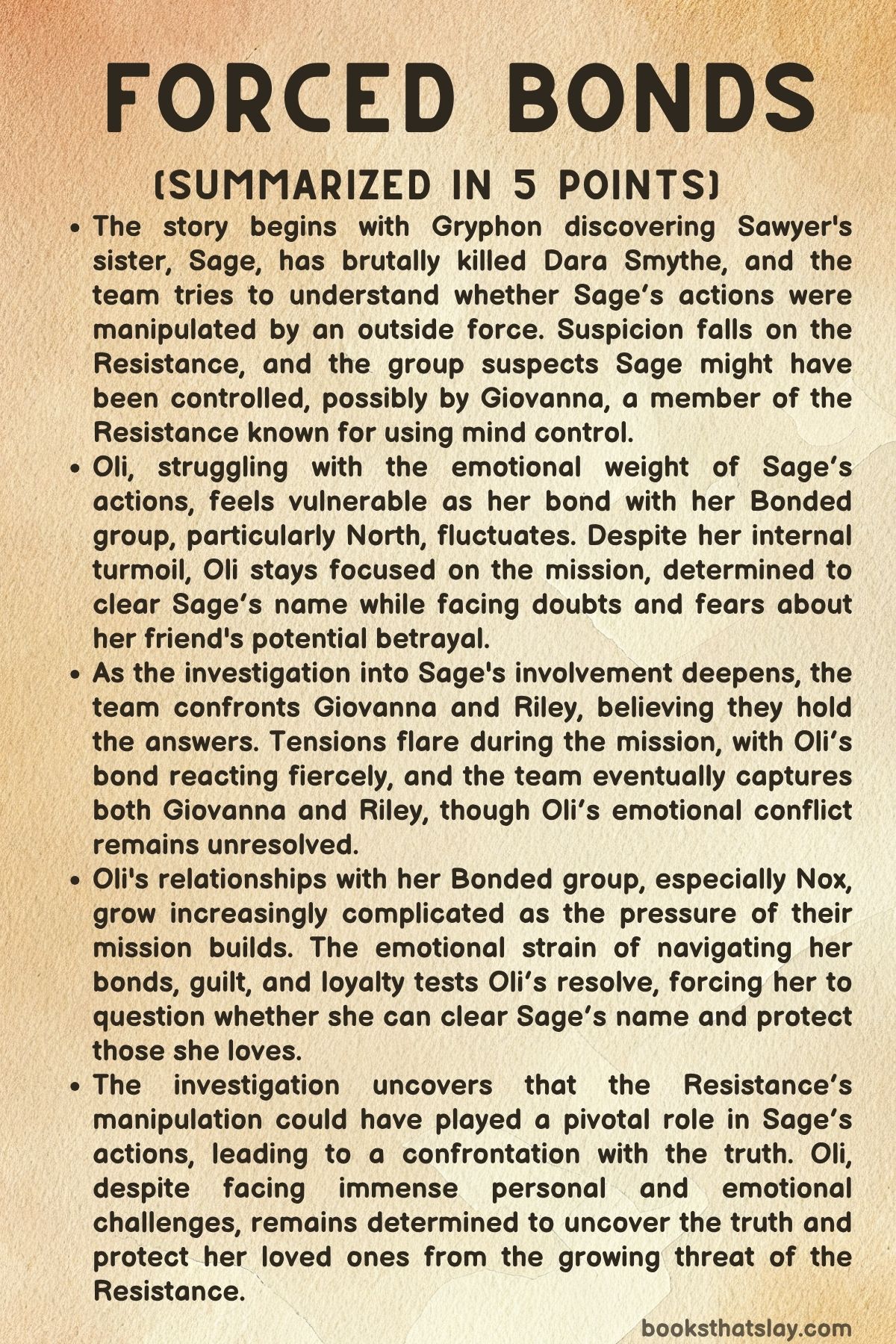
Forced Bonds picks up immediately after the shocking events at the end of the previous installment. The story opens with Gryphon discovering security footage in the Sanctuary showing Sage Benson—Oli’s best friend and Sawyer’s sister—brutally murdering Dara Smythe, a trusted Shield.
Sage’s eyes appear void-like, hinting strongly at mind control or compulsion rather than voluntary betrayal. This revelation shatters the fragile sense of safety in the Sanctuary, a hidden community meant to protect Gifted people from the Resistance.
Gryphon immediately checks on Oleander “Oli” Fallows, his Bonded, fearing she might be in danger from someone so close to her.
Oli is devastated. She refuses to believe Sage acted of her own free will and becomes determined to prove her friend’s innocence.
The group suspects involvement from Giovanna (part of Sage’s own Bond group and tied to the Resistance) or other manipulative Gifts like Neuro or compulsion powers. The infiltration of the Sanctuary raises broader fears: enemies may be hiding among allies, and trust is fracturing everywhere.
Amid this crisis, Oli continues navigating her complex relationships with her five Bonds: Gryphon (protective and steady, often the voice of reason), North (strategic, controlling, but deeply caring), Nox (traumatized and emotionally distant, still struggling with the concept of Bonding due to severe past abuse), Gabe (sweet, supportive, with a dragon-like Bond), and Atlas (loyal and strong). By this point in the series, Oli has completed her bonds with the group, significantly amplifying their collective powers.
The “creatures” or entities living inside them—later hinted to be ancient Gods—begin to play a larger role, granting enhanced abilities but also bringing overwhelming responsibility and vulnerability.
Oli’s personal growth is central. She learns to trust and embrace her own terrifying Bond more fully, accepting it as a separate entity rather than something to fear or suppress.
Her power is immense and destructive when unleashed, earning her the lingering label of “monster” from outsiders, yet she channels it fiercely to protect those she loves. The book features plenty of emotional intimacy, banter, and spicy scenes as the Bonds grow closer, including key moments with Gabe and finally a charged, complicated bonding experience with Nox (who often lets his own Bond take the lead due to his trauma).
Domestic moments—like the group fixing up a shared living space—provide brief calm before the storm, highlighting found-family dynamics in the reverse harem structure.
The plot shifts from investigation to active warfare. The team travels to a vacation town (largely populated by Resistance sympathizers) to rescue Sage’s abused Bonds, particularly Riley, who has been manipulated by Giovanna’s influence.
This mission yields revelations about mind control tactics used by the Resistance, including how they brainwash and deploy Gifted individuals. Oli’s unwavering loyalty to Sage drives much of the action, even as evidence mounts and tensions rise within the group.
They confront the reality that the Resistance’s schemes run deeper than simple rebellion—darker forces and long-standing manipulations are at play.
As the war escalates, Oli and her Bonds find themselves on the front lines. The Sanctuary recovers from prior attacks while resources dwindle and politics between Gifted factions add pressure.
Battles intensify against Resistance forces led by figures like Silas Davies. The group uncovers more about their unique Bonds and the ancient lore surrounding them: the entities inside Oli, North, Nox, Gabe, and others are far more powerful and interconnected than anyone realized, with hints of cyclical rebirths and godly conflicts spanning centuries.
This elevates the world-building, blending personal stakes with epic fantasy elements in an urban/paranormal setting.
Action sequences are intense and frequent. Oli’s Bond proves terrifyingly effective in combat, willing to destroy anyone who threatens her people.
The men display their individual Gifts—shadows, nightmares, strength, shifting, and more—now supercharged through the completed Bond. Yet power comes at a cost: emotional strain, near-death experiences, and the constant threat of loss.
Oli grapples with guilt, self-doubt, and the fear that she truly is the monster others claim, even as she fights to protect the vulnerable and turn the tide.
The investigation into Sage’s actions intertwines with larger Resistance plots. Suspicions around Giovanna and mind-control techniques deepen, forcing the team to question allies and deprogram captured individuals.
Loyalties are tested repeatedly—between friends, within the Bond group, and against the broader war. Themes of betrayal, trust, sacrifice, control (both external manipulation and internal emotional struggles), and the double-edged nature of their powerful Bonds run throughout.
The story builds to a climactic confrontation involving Silas Davies and stronger Gifted enemies. In the heat of battle, tragedy strikes.
Nox makes a selfless sacrifice to protect his brother North (and the group), stepping in during an ambush. He utters poignant final words to Oli—“I’ll see you in the next life, Bonded.
Maybe I can love you right there”—before dying. His death is sudden, heartbreaking, and leaves a profound void.
The book ends on a devastating cliffhanger, with the group reeling from the loss and the ongoing war far from over. No neat resolution arrives; instead, readers are left with the high personal cost of their fight and uncertainty about what comes next.
Characters
Oleander “Oli” Fallows
Oli stands at the center of the story as both its emotional anchor and its most destabilizing force. Her defining quality is not simply power, but the way she learns to live inside the fear that power creates.
She has spent much of the series being judged as dangerous, and here that judgment becomes part of her inner conflict rather than just an outside accusation. She is trying to protect her people, rescue her friend, hold together a fractured war effort, and still make peace with the entity inside her that others see as monstrous.
That combination makes her a compelling protagonist because her strength never feels clean or uncomplicated. Every act of protection carries the risk of destruction.
Her loyalty to Sage reveals one of her deepest traits: once Oli loves someone, she does not give up on them easily. Even when evidence points toward betrayal, she searches for coercion rather than accepting guilt at face value.
This does not come across as denial alone; it also shows her moral instinct to look beneath appearances and question systems of control. In a world full of manipulation, she refuses the easy story.
That refusal makes her admirable, but it also places pressure on everyone around her, because her hope demands action and risk.
Her relationships with her Bonds show another layer of her development. She is no longer merely reacting to them or surviving them; she is actively building a life with them.
The domestic scenes matter because they show that her emotional goal is not domination or even victory, but belonging. She wants a home strong enough to survive what the outside world keeps trying to do to them.
That desire gives her emotional clarity even when the war becomes chaotic.
What makes Oli especially effective as a character is that she is both feared and needed. She embodies the novel’s central contradiction: the same force that can save a community can also terrify it.
Her growth comes from recognizing that rejecting her nature will not make the world safer. Instead, she has to decide what kind of wielder of power she will be.
In that sense, her arc is about identity through responsibility. She does not become less dangerous; she becomes more conscious of why she fights and who she refuses to become.
Gryphon
Gryphon functions as the group’s stabilizing presence, but that steadiness should not be mistaken for passivity. He is often the first to register danger clearly, and his response to the Sanctuary footage establishes him as someone whose protective instincts are immediate, practical, and deeply tied to the safety of Oli.
He does not waste time on abstraction when threat becomes real. That quality makes him essential in a world where hesitation can be fatal.
He is one of the people who helps transform crisis into action.
Emotionally, Gryphon represents a form of care that is grounded rather than theatrical. He does not need grand displays to prove his devotion.
Instead, his importance comes from consistency, from being the person who remains reliable when trust across the wider community is collapsing. In a story increasingly shaped by mind control, infiltration, and uncertainty, a character like Gryphon becomes more valuable because he offers a model of protection that does not rely on control for its own sake.
He watches, assesses, and responds, but his care is not framed as possession.
He also helps define Oli’s emotional space by serving as a counterweight to more volatile personalities in the Bond group. Where others may respond through distance, strategy, or trauma-driven withdrawal, Gryphon often acts as a bridge between urgency and reassurance.
This is important because Oli’s world is not only threatened externally; it is constantly strained by the emotional complexity of the people closest to her. Gryphon’s steadiness gives that emotional world structure.
At a deeper level, Gryphon’s role highlights one of the story’s recurring ideas: strength can look quiet. He may not dominate every major emotional turning point, but he contributes to the group’s survival through dependability.
He stands for a kind of masculine care built on vigilance, not spectacle. That makes him one of the most emotionally grounding figures in Forced Bonds, especially when the story keeps testing whether love can remain stable under extreme pressure.
North Draven
North is one of the most controlled and strategically minded figures in the group, and his presence often carries an edge of authority that can feel both reassuring and oppressive. He thinks in terms of systems, risks, and outcomes, which makes him invaluable in wartime, but that same instinct can make him seem rigid or overly controlling in intimate situations.
What gives him depth is that his need for control does not come from cruelty alone; it comes from fear, responsibility, and the weight of knowing how fragile their safety really is.
His care for Oli is filtered through this strategic mentality. He wants her protected, but he also wants her power understood, managed, and placed where it can do the most good with the least catastrophic fallout.
That can create tension because Oli is not a weapon he can simply position on a battlefield. She is a person with emotional loyalties and moral instincts that do not always align with cold calculation.
North’s dynamic with her becomes powerful because it is built on real affection strained by different ways of surviving danger.
North is also crucial because his relationship with Nox exposes the emotional history beneath his controlled exterior. Their bond as brothers gives him vulnerability that he rarely shows elsewhere.
He is not just the calculating leader; he is also someone whose emotional world has been shaped by family pain, guilt, and the inability to protect the people he loves from suffering. That history gives his harder edges more meaning.
His control is partly an attempt to prevent chaos from taking more than it already has.
By the time the story reaches its devastating closing conflict, North’s character is defined by the terrible cost of leadership and survival. He is a planner living in a world where no plan can fully protect what matters most.
That tension makes him compelling. He is not softened into simplicity, nor is he reduced to coldness.
Instead, he becomes a portrait of a man whose love often expresses itself through structure, and who learns that structure cannot always stop grief.
Nox Draven
Nox is one of the most emotionally complicated figures because his distance is never mere detachment; it is the visible scar tissue of prolonged abuse and fear. His struggle with Bonding makes him especially compelling because it turns intimacy into something morally and psychologically difficult rather than automatically healing.
He does not move toward connection in a straightforward way. Even when affection exists, it is obstructed by trauma, self-protection, and the sense that closeness may cost him control over himself.
That makes his interactions with Oli charged with both desire and pain.
What distinguishes Nox from a simpler wounded-hero figure is that his trauma affects not only how he feels, but how he allows himself to exist in relation to his own Bond. The fact that he often lets that inner force take the lead suggests a fractured sense of self.
He cannot always safely occupy his own emotional life directly, so instinct, power, and distance become substitutes. This makes his romantic and sexual development especially significant, because it is not only about accepting Oli but about confronting whether he can inhabit love without being destroyed by vulnerability.
His gradual movement toward Oli carries enormous emotional weight because it feels earned rather than automatic. Every moment of tenderness or surrender matters more because it pushes against years of fear.
He is not simply resisting because the plot requires tension; he is resisting because trust has been made dangerous in his past. That history gives his eventual openness tragic intensity.
It arrives just as the story is moving toward greater violence and loss.
His death transforms him from a difficult, guarded presence into one of the story’s deepest wounds. His final words frame love as something unfinished, something denied by timing and circumstance rather than lack of feeling.
That is why his sacrifice hits so hard. It is not only the loss of a fighter.
It is the loss of a man who was only beginning to imagine a life beyond trauma. His arc becomes a powerful statement about interrupted healing, and about how war often destroys people at the very moment they begin to believe they might deserve more.
Gabe
Gabe brings warmth, emotional accessibility, and a kind of open-hearted devotion that balances the harsher energies within the Bond group. His sweetness is not superficial softness; it is a meaningful emotional function inside a narrative full of suspicion, violence, and guardedness.
He offers Oli a form of connection that feels supportive without being heavily burdened by control or emotional withholding. That matters because affection in this world is often entangled with power, strategy, and trauma.
Gabe gives that affection a gentler form.
His dragon-like Bond also adds an interesting contrast to his personality. There is a sense of grandeur and force associated with that power, yet Gabe himself is often characterized through care and emotional generosity.
This combination makes him more than the “nice” member of the group. He contains both strength and tenderness, and that pairing reinforces one of the story’s broader claims that dangerous power is not inherently opposed to love or gentleness.
His presence helps broaden the emotional vocabulary of the Bond dynamic.
The intimacy between Gabe and Oli is important because it deepens their connection in a way that feels affirming rather than fraught. In a story where many relationships are marked by resistance, damage, or complicated negotiations of trust, Gabe can represent a bond that offers rest.
That does not make him less significant; in fact, it makes him crucial. Emotional refuge is one of the rarest resources available to these characters, and Gabe helps create it.
At the same time, he is not disconnected from the wider stakes. He is part of the collective power that has become more intense after the completion of the Bond, and he stands alongside the others in a conflict growing larger and more dangerous.
His role shows that comfort and combat readiness can coexist. He embodies the possibility that care itself can be a source of strength rather than a distraction from survival.
Atlas
Atlas is defined by loyalty, physical strength, and a grounded form of devotion that helps hold the group together. He may not always dominate the emotional center of the narrative, but his significance comes from reliability.
In a story where betrayal and manipulation constantly threaten stability, a character who remains steadfast becomes deeply valuable. Atlas contributes to the sense that the Bond group is not only romantically linked but structurally supported by members who show up, endure, and protect without constant emotional drama.
His strength is more than a combat trait; it is part of his symbolic role in the group. Atlas often feels like an embodiment of endurance.
He is one of the figures who makes the found-family dynamic believable because he represents the practical side of shared survival. Homes are built, battles are fought, and safety is maintained not only by grand emotional confessions but by people willing to do the hard, steady work of presence.
Atlas fills that role with conviction.
What also matters is the way his loyalty reinforces Oli’s position. A protagonist as feared as Oli needs people around her whose faith does not collapse under pressure.
Atlas helps communicate that her identity is not solely defined by the labels outsiders place on her. His commitment becomes a kind of testimony that she is worth following and protecting, even when her power frightens others.
That emotional vote of confidence matters in a narrative shaped by stigma and fear.
Atlas may appear simpler than some of the more psychologically tormented characters, but simplicity here is a strength. He provides emotional and physical solidity in a group full of volatility.
That makes him indispensable, not because he overwhelms the page with complexity, but because he reinforces the group’s capacity to remain whole under attack.
Sage Benson
Sage is one of the most important absent-presence characters because the crisis surrounding her actions drives both the emotional stakes and the investigative momentum of the story. Although she is framed through shocking violence at the beginning, the narrative quickly encourages readers to question whether what they saw reflects her true will.
That uncertainty makes Sage more than a suspected traitor. She becomes the human face of a larger system of coercion, and through her, the story examines how identity can be violated from the inside.
Her connection to Oli is central to why the situation matters so much. Sage is not just another member of the community; she is Oli’s best friend, someone tied to memory, trust, and emotional history.
Because of that, the accusation against her is not merely a plot twist. It becomes an assault on Oli’s emotional world.
If Sage can be turned, used, or misread, then trust itself becomes unstable. Sage’s storyline therefore carries tremendous symbolic weight in a book obsessed with manipulation and fractured safety.
She also represents the vulnerability of Gifted people under systems of exploitation. The suggestion that her void-like eyes indicate compulsion strips away the simplicity of guilt.
She becomes evidence of how thoroughly enemies can invade personhood. That makes her both tragic and politically significant within the story.
Her case is not isolated; it suggests an entire machinery of abuse operating beneath the visible conflict.
Sage’s importance lies in how she forces the other characters to choose what kind of justice they believe in. Do they punish visible harm immediately, or do they search for the hidden structure behind it?
Through her, the narrative insists that betrayal may sometimes be a mask worn by victimization. That complexity gives her a powerful role even when she is not the most active figure on the page.
Giovanna
Giovanna functions as a deeply unsettling figure because she represents betrayal from within intimate structures. Her link to Sage’s Bond group makes her especially threatening.
She is not an obvious outside enemy storming the gates; she is someone embedded in the personal networks where trust is supposed to be strongest. That makes suspicion around her feel especially corrosive.
If she is involved in manipulation and resistance activity, then the danger is no longer simply external warfare but contamination of the most emotionally vulnerable spaces.
She is associated with influence, coercion, and the possibility that affection or connection can be weaponized. That gives her a chilling narrative role.
Characters like Giovanna are frightening because they distort the language of closeness. The people around her are not only endangered physically; they are also destabilized psychologically, unsure whether what they feel or remember can be trusted.
Through her, the story explores how power can invade consent and turn relationships into tools.
Giovanna also reflects the darker politics of the world. She is tied to structures larger than herself, to Resistance strategies that rely not only on force but on manipulation of minds and bodies.
This makes her important beyond personal villainy. She stands for a system that treats human beings as assets to be conditioned and deployed.
That systemic cruelty gives her more narrative weight than a simple antagonist driven by private malice.
At the same time, the suspicion around her contributes to the atmosphere of uncertainty that defines the story. She is threatening not only because of what she may have done, but because she embodies the idea that no relationship can be accepted at face value.
Her presence sharpens the novel’s distrustful emotional climate and raises the stakes of every act of loyalty.
Riley
Riley emerges as a significant figure through the rescue mission and the revelations about abuse and manipulation affecting Sage’s Bonds. Riley’s importance lies in his vulnerability.
He is one of the clearest examples of the personal damage caused by the conflict, not in abstract political terms but in intimate human suffering. The fact that he has been manipulated under Giovanna’s influence makes him a living consequence of the methods the Resistance uses.
Through him, the narrative shows what systematic control does to a person’s autonomy and dignity.
He also expands the moral frame of the story. The rescue effort is not only about proving Sage’s innocence or advancing strategy; it is about saving people whose pain might otherwise be treated as collateral.
Riley reminds the reader that these battles are not fought merely between powerful leaders and armies. They are fought over damaged bodies and coerced minds.
His suffering keeps the story emotionally grounded even as the mythology around gods and rebirth grows larger.
Riley’s presence also highlights Oli’s defining compassion. Her determination to act is not limited to those who are easiest to save or simplest to understand.
Characters like Riley matter because they test whether the protagonists’ values extend to the broken, manipulated, and traumatized. The answer, in Oli’s case, is yes.
That strengthens Riley’s role in the story because he becomes part of the proof of who the heroes are trying to be.
Though he may not dominate the narrative in the same way as the Bond group, Riley has thematic significance. He represents the people most endangered by systems of control and the human reason that the larger war cannot be reduced to strategy alone.
Silas Davies
Silas Davies represents the militarized and ideological face of the enemy. He is a figure through whom the conflict becomes direct, brutal, and inescapably lethal.
Unlike more ambiguous characters linked to coercion and internal betrayal, Silas stands closer to overt opposition. He is associated with escalating warfare, stronger enemies, and the force that pushes the protagonists from investigation into survival-driven confrontation.
His presence signals that the stakes are no longer limited to uncovering hidden schemes; the war has become immediate and bloody.
What makes Silas effective as an antagonist is not just his threat level, but what he represents within the broader conflict. He is part of the machinery trying to break Sanctuary, dominate the Gifted, and exploit power for violent ends.
In that sense, he stands opposite Oli and her Bonds not only in battle but in worldview. Where the protagonists are struggling to use immense power to protect and preserve connection, Silas is tied to systems that use power to subjugate and destroy.
He is also crucial to the emotional structure of the ending because the violence surrounding him contributes to the conditions in which Nox dies. That means his role extends beyond battlefield antagonism into personal devastation.
He becomes associated not only with danger in the abstract but with irreversible loss. Villains become more memorable when they leave emotional wreckage rather than merely pose a threat, and Silas fulfills that function.
As a result, he helps crystallize the story’s movement from suspicion to open war. Through him, the narrative shows what happens when hidden manipulations mature into direct attack.
He gives the conflict a face sharpened by cruelty, power, and consequence.
Dara Smythe
Dara Smythe appears only briefly in the described events, but her murder carries major narrative significance. As a trusted Shield, Dara represents the idea of Sanctuary as a place built on protection, order, and collective defense.
Her death is therefore more than an individual tragedy. It is a symbolic rupture.
When someone meant to embody safety is killed inside the very place designed to preserve it, the entire community’s sense of stability collapses.
Dara’s importance lies in what her death exposes. The Sanctuary is no longer a secure refuge but a compromised space where violence can appear from within.
Because the person shown killing her is Sage, someone personally connected to Oli, Dara’s death becomes the incident that fuses public crisis with private grief and suspicion. The murder destabilizes institutions and relationships at the same time.
She also serves an important structural role in the story’s treatment of trust. Before her death, the community could still imagine danger as something largely outside its walls.
Afterward, suspicion becomes internalized. Dara’s murder creates an atmosphere in which everyone must question what they know, whom they know, and whether visible behavior reflects genuine intent.
That transformation in emotional climate is one of the story’s most important shifts.
Even as a secondary figure, Dara matters because her loss sets the whole crisis in motion. She is the cost that forces the community to confront infiltration, coercion, and the fragility of refuge.
Her death echoes far beyond her page time because it destroys certainty itself.
Themes
Trust Under Conditions of Manipulation
Trust in this story is never presented as a simple emotional virtue. It exists under constant threat from compulsion, hidden allegiances, and the possibility that even the people closest to you can be used as weapons.
Sage’s apparent betrayal turns trust into a painful act of interpretation rather than instinct. Oli’s refusal to accept the obvious version of events shows that trust can also be an act of resistance against systems that depend on suspicion and fragmentation.
Believing in someone is no longer naïve here; it becomes morally difficult and politically dangerous.
The theme becomes especially powerful because manipulation is not limited to lies or propaganda. It reaches into the body and mind, altering action itself.
That creates a terrifying question: what does loyalty mean when a person’s will can be overridden? The story does not answer that easily.
Instead, it asks characters to hold two truths at once: terrible harm has been done, and the one who caused it may still be a victim. This pressure gives emotional depth to every relationship.
Trust must survive not certainty, but uncertainty. In that sense, the novel argues that real faith in another person is tested most when evidence becomes unstable and fear would be easier.
Power and the Fear of Becoming Monstrous
Oli’s journey gives this theme its strongest form. Her power is immense, violent, and visibly frightening, which means she cannot separate strength from stigma.
She is repeatedly placed in the position of needing to use destructive force for protective reasons while knowing that others already see her as something monstrous. The emotional weight of this theme comes from the fact that she is not afraid only of what others think.
She is afraid they may be partly right. That internal conflict turns power into a psychological burden rather than a fantasy of control.
The story also broadens the theme through the godlike entities inside the Bonded. Their abilities are gifts, but they also increase risk, responsibility, and vulnerability.
Greater power does not create freedom; it creates exposure. The characters become harder to defeat, but also more deeply entangled in ancient forces and larger consequences.
This makes power feel double-edged in a meaningful way. It can save a community, but it can also isolate the one who wields it.
The narrative’s strongest claim is that the real measure of power is not scale, but moral direction. The question is never simply who is strongest.
It is who can remain human while holding something terrifying.
Love as Shelter, Obligation, and Risk
The relationships at the center of the novel are not treated as decorative romance placed beside the main conflict. They are part of survival itself.
The domestic moments, emotional intimacy, and growing closeness within the Bond group create shelter in a world where institutions keep failing. Home is not a guaranteed place; it has to be built through mutual devotion, patience, and shared effort.
That is why the quieter scenes matter so much. They show what the characters are actually fighting for, beyond victory in battle.
At the same time, love is never reduced to comfort alone. It creates obligation, intensifies fear, and makes loss devastating.
Every bond gives the characters more reason to endure, but also more ways to be wounded. Nox’s arc captures this especially well.
His movement toward connection is beautiful precisely because it is so difficult, and that difficulty makes his death more painful. Love does not protect the characters from suffering; it makes suffering matter more.
The story presents connection as necessary but costly. To care deeply is to become vulnerable to grief, sacrifice, and impossible choices.
That does not weaken love’s value. It proves why it is worth defending.
The Human Cost of War
War in this narrative is not framed as an abstract struggle between opposing sides with clear symbolic roles. It is shown through infiltration, abuse, coercion, ruined safety, and the exhaustion of people trying to protect one another while larger systems keep escalating violence.
The conflict reaches into homes, friendships, and intimate bonds, showing that war destroys more than bodies. It breaks trust, rearranges identities, and forces moral decisions under unbearable pressure.
The rescue mission, the fear inside Sanctuary, and the desperate battles all emphasize that conflict changes how people relate to themselves and each other.
The theme becomes especially painful because the story refuses easy triumph. Victories never feel complete, and revelations do not restore innocence.
Instead, every step forward exposes deeper damage. Characters rescue others only to discover wider systems of brainwashing and exploitation.
They gain understanding of their power only as the burden of using it increases. Nox’s death becomes the clearest expression of the cost of this world: war takes not only lives, but futures that were just beginning to become imaginable.
By ending in grief rather than closure, Forced Bonds insists that survival in wartime is not the same as resolution. Some losses cannot be balanced by strategic success.