Forget You Saw Her Summary, Characters and Themes
Forget You Saw Her by Noelle W. Ihli is a suspenseful and emotionally charged novel that explores themes of grief, loss, and the pursuit of justice. Sabina Turpin, a woman who gave up her daughter, Andrea, for adoption when she was a teenager, is living in Oregon and anxiously awaiting news about her daughter.
The book follows Sabina’s relentless search for Andrea after discovering that the girl’s body was found, yet the investigation into her death raises more questions than answers. The novel unfolds with a tense blend of Sabina’s investigation and Andrea’s ghostly presence, revealing disturbing truths about Andrea’s adoptive family and the darkness lurking beneath their seemingly ordinary lives.
Summary
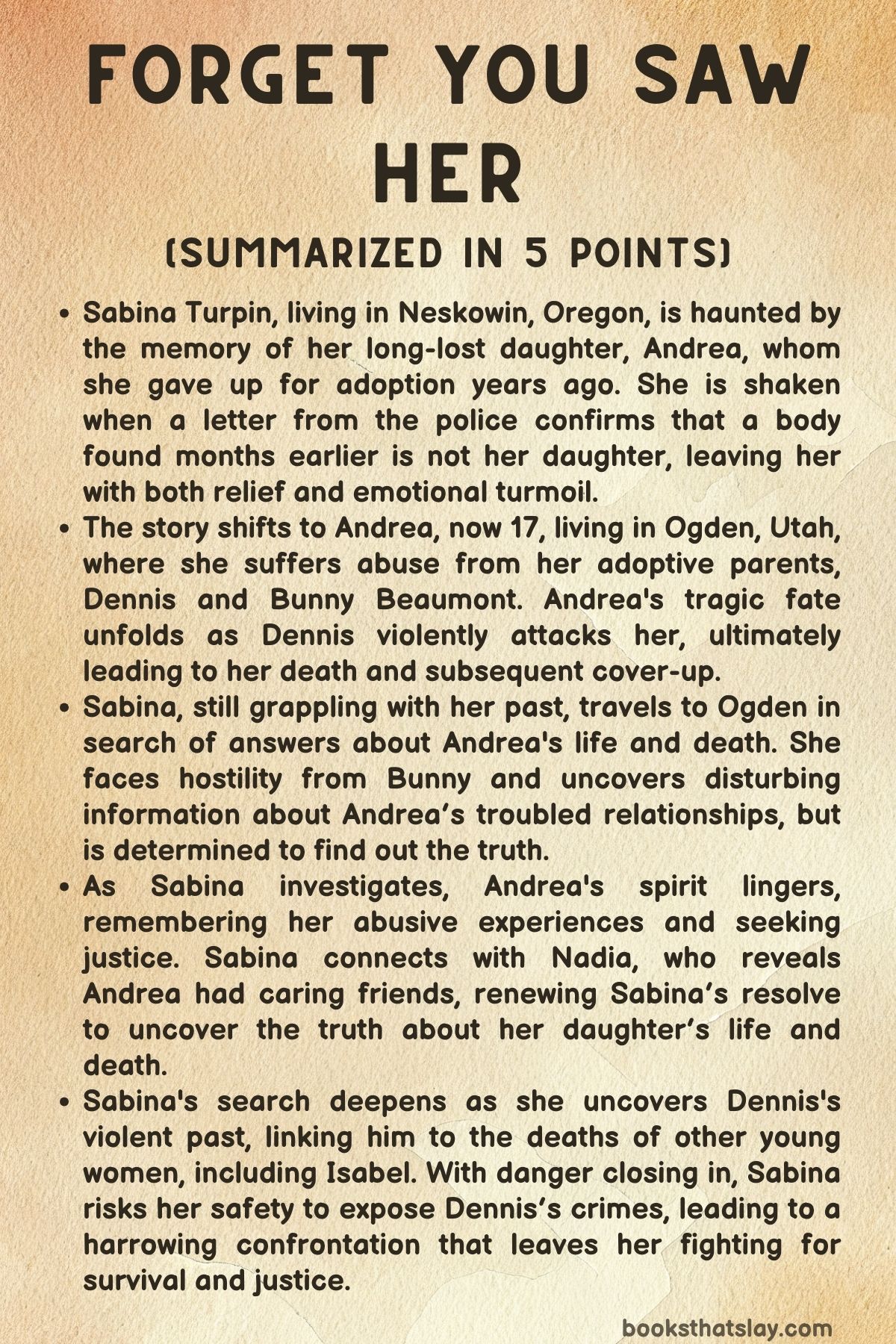
Sabina Turpin has spent years haunted by the memory of the daughter she gave up for adoption when she was just 16 years old. Living in Neskowin, Oregon, Sabina has always wondered what happened to Andrea, especially when she learns that Andrea’s body has been discovered three months prior, but the condition of the remains made identification impossible.
Sabina’s worst fear is confirmed when a letter from the Ogden, Utah police arrives, asking her to provide DNA to confirm her identity as Andrea’s mother. Upon receiving the test results, Sabina is relieved to learn that she is not the mother of the deceased girl.
However, despite the relief, she is left emotionally unsettled, struggling with the pain of having given her daughter up all those years ago.
As the story shifts to Andrea, it is revealed that she is 17 years old and has a troubled relationship with her adoptive parents, Dennis and Bunny Beaumont. Dennis, an abusive alcoholic, regularly mistreats Andrea, both physically and emotionally.
On her 17th birthday, Andrea receives a gift from her friend, Paloma, which brings her a brief sense of joy. However, this small moment of happiness is shattered when she returns home to find Dennis drunk and furious.
A confrontation escalates, and in a tragic accident, Andrea falls and hits her head. Dennis, enraged, kills her by strangling her with a dog leash and then covers up the crime by wrapping her body in a tarp.
Three months later, Sabina, still struggling with her emotional turmoil, decides to drive to Ogden, Utah, to search for answers. She drives through the night, reflecting on her past and wondering whether she made the right choice in giving up her child.
When she arrives in Ogden, she contacts Bunny Beaumont, who is initially hostile but agrees to meet. Sabina, unsure of what she will find or even if she will find Andrea, is determined to uncover the truth.
Upon reaching Bunny’s home, Sabina is struck by the coldness of Bunny’s demeanor. Inside the house, Sabina hears the cry of a baby, which briefly reminds her of Andrea.
Bunny is reluctant to discuss Andrea and becomes defensive, blaming Andrea for being rebellious and stealing from her. Sabina persists in her questions but is met with hostility.
Just then, Dennis returns home, and Sabina’s unease grows as she tries to press Bunny for more information. Meanwhile, Andrea’s ghost watches the interaction, her spirit lingering in the house.
She recalls the cruel treatment she endured from her adoptive parents and the trauma she suffered at their hands.
Sabina, frustrated and desperate for answers, heads to a local smoothie shop in search of clues. There, she meets Nadia, a woman who recognizes Andrea from a missing person’s poster.
Nadia reveals that her daughter, Paloma, had been friends with Andrea and had always been worried about her well-being, especially regarding Dennis’s behavior. Nadia shares her concerns about Dennis with Sabina, and Sabina’s determination to find out what happened to Andrea intensifies.
While Sabina listens to Nadia, Andrea’s ghost, still hovering nearby, comes to terms with the fact that there were people who cared about her. She is moved by Nadia’s words and the support she receives from Sabina.
Despite Bunny and Dennis’s continued hostility, Sabina refuses to give up. As the investigation progresses, Sabina stumbles across a comment online from a person named Jenny Johnson, claiming to have seen Andrea at a soup kitchen, looking “strung out.” Sabina quickly realizes that Jenny is likely a fake profile created by Dennis in an attempt to mislead the investigation.
Sabina’s investigation deepens as she uncovers disturbing information about Dennis’s violent past and his potential involvement in the deaths of other girls. Sabina becomes increasingly suspicious of Dennis, especially after a homeless woman named Marlie tells her about Isabel Palphreyman, another girl with a tragic history involving Dennis.
Marlie reveals that Isabel had been abused by Dennis, and Sabina begins to believe that Dennis may have killed her as well. The discovery of Isabel’s death leads Sabina to push forward with her search for justice, now convinced that Dennis is responsible for multiple deaths.
As Sabina continues to investigate, she meets Rita, a woman with a connection to Isabel. Rita reveals that Isabel had been involved with a man named “Wheezy,” who had a disturbing presence and was connected to Dennis.
Rita explains that she had told Dennis where Isabel had gone, which ultimately led to Isabel’s tragic death. Sabina is shaken by this revelation and realizes that Dennis is a direct threat to her own safety.
As she attempts to gather more evidence, Dennis begins following her, making her feel increasingly paranoid.
The tension escalates as Sabina is confronted by Dennis, who attacks her in an attempt to prevent her from exposing the truth. Isabel’s ghost, now more attuned to the situation, tries to warn Sabina and guide her to safety.
The confrontation between Sabina and Dennis reaches a dangerous climax, and it is unclear whether Sabina will survive. In the aftermath, Sabina reflects on her journey and the emotional toll it has taken on her.
She is determined to seek justice for both Andrea and Isabel, vowing to find closure and peace despite the horrors she has uncovered.
The novel ends with Sabina surviving the brutal attack, but the scars of her emotional and physical trauma remain. Detective Barker, who has been involved in the investigation, continues to uncover more of Dennis’s crimes.
The emotional toll of the ordeal lingers, but Sabina remains resolute in her pursuit of justice. The final moments of the story bring both sorrow and hope, as Sabina’s determination to find her daughter and bring justice to the victims continues, even after the darkest truths are revealed.
Characters
Sabina Turpin
Sabina Turpin is a central character in Forget You Saw Her, and her journey is marked by a deep emotional struggle and relentless determination. Sabina, a woman living in Neskowin, Oregon, carries the weight of giving up her daughter, Andrea, for adoption when she was only 16 years old.
Despite the years that have passed, Andrea remains a constant presence in Sabina’s mind, and she is haunted by the child she gave up. Her life is disrupted when she receives a letter from the police confirming that the body of a young girl, believed to be Andrea, has been found.
When the results show that the girl isn’t her daughter, Sabina feels a mix of relief and a profound, unsettling emptiness. Her maternal instincts drive her to travel to Ogden, Utah, to investigate Andrea’s disappearance further, even though she faces hostility and emotional barriers.
Sabina’s perseverance in the face of adversity and the depths of her emotional turmoil make her an unforgettable character, one whose pain, hope, and strength resonate throughout the story. Her quest for justice not only seeks to uncover the truth about her daughter’s past but also reflects her inner battle with the guilt and grief that have defined much of her life.
Andrea Beaumont
Andrea Beaumont is a tragic and complex character whose life was marred by abuse and neglect. She is introduced posthumously as a ghost, revealing the trauma she experienced at the hands of her adoptive parents, Dennis and Bunny Beaumont.
Andrea’s story is one of survival, though she faced relentless mistreatment from her adoptive father, Dennis, who was physically and emotionally abusive. Her adoptive mother, Bunny, was cold and unhelpful, and the love and care Andrea needed were absent.
Her birthday, which could have been a moment of joy, turns into another painful reminder of her broken existence. Andrea’s tragic end comes when Dennis, in a fit of rage, kills her after a violent altercation.
Throughout the story, Andrea’s spirit lingers, haunted by her own suffering and desperate for justice. As Sabina embarks on her journey to find answers, Andrea’s ghost offers both haunting memories and an emotional connection, guiding Sabina with her lingering presence.
Despite her untimely death, Andrea’s character is imbued with a deep sense of yearning for love, justice, and the recognition of her pain.
Dennis Beaumont
Dennis Beaumont is one of the most sinister figures in Forget You Saw Her. A man whose actions and motivations are steeped in cruelty and manipulation, Dennis is the adoptive father of Andrea and the perpetrator of her death.
His abusive behavior toward Andrea is extreme and unrelenting, with his alcoholism only adding to his volatile temperament. Dennis’s role in Andrea’s death is central to the plot, and it is revealed that he kills her in a violent outburst, strangling her with a dog leash after a confrontation.
Dennis’s character is marked by his cruelty and the way he manipulates those around him, particularly his wife, Bunny, and his daughter, Andrea. He is shown to be a master of deception, covering up his crimes and threatening anyone who dares to get in his way.
His malevolent influence extends beyond Andrea’s death, as he is linked to other mysterious disappearances, including Isabel Palphreyman. Dennis embodies the darkest traits of an abuser: controlling, dangerous, and capable of terrible violence.
His character serves as a reminder of the profound and lasting impact of abuse on its victims, even beyond death.
Bunny Beaumont
Bunny Beaumont, Andrea’s adoptive mother, is a complex character whose cold and indifferent nature makes her a difficult figure to understand. Though she is not as overtly violent as her husband, Dennis, Bunny’s emotional neglect and inability to show affection towards Andrea contribute to the girl’s suffering.
She is shown to be dismissive and uncooperative when Sabina approaches her in search of answers about Andrea’s disappearance. Bunny’s hostility towards Sabina reflects her own discomfort with the painful truth of Andrea’s life.
Throughout the story, Bunny remains an emotionally distant figure, and her reluctance to engage in any meaningful conversation about her adopted daughter suggests that she may have been complicit in the abuse that Andrea suffered. Bunny’s character highlights the chilling effect of emotional neglect and the way in which a lack of love and care can deeply affect a child’s sense of worth and safety.
Nadia
Nadia plays a crucial supporting role in Sabina’s search for answers regarding Andrea’s disappearance. A woman whose daughter, Paloma, was friends with Andrea, Nadia becomes an important ally for Sabina in the quest for justice.
Nadia reveals that Paloma had been concerned for Andrea long before her disappearance, particularly about the abusive behavior of Dennis. Her empathy and willingness to share what she knows about Andrea provide Sabina with crucial information that helps her understand the depth of the pain Andrea endured.
Nadia’s character embodies the theme of community and support, showing that even in dark circumstances, people who care can make a significant difference. Her involvement in the investigation also represents the idea that sometimes, it takes a village to bring truth to light, and her willingness to speak up adds a layer of hope and determination to the narrative.
Rita
Rita is a pivotal character who helps Sabina uncover crucial information about Isabel Palphreyman’s life, leading to the revelation that Dennis Beaumont may have been involved in more than one death. Rita, who has a personal history with Isabel, is deeply affected by the loss of her friend and feels responsible for her death.
She reveals how Dennis’s sinister influence reached Isabel and how, out of fear for her own safety, she informed Dennis of Isabel’s whereabouts. Rita’s character is one of guilt, fear, and reluctant bravery.
She plays an essential role in helping Sabina connect the dots between Isabel’s death and the larger pattern of abuse perpetrated by Dennis. Despite her hesitation, Rita’s eventual decision to help Sabina is a turning point in the investigation.
She represents the struggle between self-preservation and doing what’s right, highlighting the difficult choices individuals face when confronted with danger and moral responsibility.
Themes
Grief and the Search for Closure
Grief permeates the entirety of Forget You Saw Her, as Sabina Turpin’s journey is driven by a deep emotional need to find closure for the loss of her daughter Andrea. Though Sabina’s daughter was given up for adoption years earlier, the loss of the child has haunted her constantly.
This unresolved grief becomes the motivating force behind her decision to travel across the country in search of answers. The devastating news about Andrea’s death, combined with the emotional turmoil of potentially confirming her worst fear, leaves Sabina emotionally numb and lost.
Grief, in Sabina’s case, isn’t just an abstract feeling; it’s a consuming presence that impacts every decision she makes, pushing her further into her quest to uncover what happened to Andrea. As the story unfolds, Sabina wrestles with feelings of guilt and the haunting thought of whether she could have been a better mother.
In seeking closure, Sabina finds herself confronting not only the trauma of losing Andrea but also the painful realities of the dysfunctional and abusive environment Andrea grew up in. This theme reflects the broader human struggle of dealing with unresolved loss and the unrelenting need for answers, even when those answers may not bring the peace we hope for.
Abuse and the Cycle of Trauma
Abuse is a central theme in Forget You Saw Her, explored through the devastating effects of both physical and emotional violence that Andrea experiences at the hands of her adoptive parents. Her adoptive father, Dennis, embodies the cruelty of abuse, subjecting Andrea to a cycle of mistreatment that ultimately leads to her death.
Dennis’s abusive behavior is not limited to his interactions with Andrea; it also extends to his manipulation of those around him, including his wife Bunny and the people in their community. The story exposes how abuse, particularly in the context of a family, is not only devastating for the victim but also leaves lasting scars on those involved, often leading to feelings of powerlessness and complicity.
For Andrea, the abuse is not a solitary experience but part of a larger cycle of trauma that permeates her relationships and environment. Sabina, in her search for the truth, begins to uncover how deep the wounds of abuse run, not just in her daughter’s life but also in the lives of other women, such as Isabel, who are impacted by Dennis’s violent tendencies.
The book critiques the ways in which systemic abuse operates, perpetuating cycles of pain that are hard to escape, particularly when perpetrators work to cover up their actions.
Identity and the Struggle for Belonging
Throughout Forget You Saw Her, characters grapple with the theme of identity, particularly how it is shaped by family dynamics and personal history. For Sabina, the loss of Andrea is intertwined with a broader sense of unfulfilled maternal identity.
Having given Andrea up for adoption at a young age, Sabina is forced to contend with a lingering sense of incompleteness and regret. The search for Andrea is not just about finding the child she gave up but also about discovering a part of herself that she feels she lost.
Andrea, on the other hand, struggles with her own sense of self, living in an adoptive family that offers her little love or support. The abusive and neglectful environment she endures causes her to question her worth, and her sense of belonging is constantly in flux.
For both Sabina and Andrea, their identities are defined by a fractured sense of family, whether it is the loss of Andrea’s biological mother or the absence of love in her adopted home. The theme of identity in the story speaks to the broader human need to feel connected and accepted, to have a place in the world that feels like home.
Both women’s journeys reflect the painful yet universal process of trying to reconcile who they are with the circumstances they face.
Justice and Accountability
The quest for justice is an overarching theme in Forget You Saw Her, as Sabina’s search for answers about her daughter’s death becomes intertwined with her determination to hold those responsible accountable. Sabina’s pursuit of justice isn’t just about uncovering the truth; it is also about ensuring that those who have wronged Andrea, particularly Dennis, face the consequences of their actions.
Throughout the novel, Sabina faces numerous obstacles in her investigation, including resistance from Andrea’s adoptive mother, Bunny, and the manipulative efforts of Dennis to conceal his crimes. Sabina’s relentless pursuit represents the broader struggle for justice in the face of systemic silence and the abuse of power.
The idea of justice in the novel is explored in both legal and moral terms. While Sabina attempts to gather evidence that will expose Dennis’s crimes, the story also reflects on how justice is often delayed or denied, leaving victims’ families to carry the weight of unsolved mysteries and unresolved pain.
The theme emphasizes that justice, in its truest form, is not just about legal retribution but also about the acknowledgment of the trauma and suffering that has been caused.
The Impact of Secrets and Lies
Throughout the narrative of Forget You Saw Her, secrets and lies serve as a powerful force that shapes the actions of the characters. The truth about Andrea’s death is obscured by a series of deceptions, from Dennis’s attempts to cover up his involvement in her murder to Bunny’s refusal to acknowledge the abuse that Andrea endured.
These secrets are not just personal but are reflective of a broader societal tendency to hide uncomfortable truths, whether about abuse, neglect, or violence. The lies surrounding Andrea’s life and death create a web of confusion and misdirection, making it all the more difficult for Sabina to find closure.
The characters’ inability or unwillingness to confront these truths contributes to the continued suffering of those affected. Sabina’s journey involves peeling back these layers of deception, uncovering not only the truth of what happened to Andrea but also the lies that have kept the trauma hidden.
The novel shows that secrets and lies can trap individuals in cycles of denial, preventing healing and justice. As Sabina digs deeper, the unraveling of these lies becomes as much a part of the story as the search for the truth, emphasizing the destructive power of secrecy and the necessity of facing uncomfortable realities in order to move forward.