Friends and Liars Summary, Characters and Themes
Friends and Liars by Kit Frick is a modern thriller about privilege, loyalty, and the kind of secrets that don’t fade with time. When Clare Monroe—an heiress with a glamorous life and a tight college friend group—dies under mysterious circumstances at her family’s Lake Como estate, the story doesn’t end with grief.
Years later, her closest friends are summoned back to the same villa for a lavish memorial week, where old lies begin to crack. What starts as an all-expenses-paid tribute turns into a pressure cooker of guilt, blackmail, and revenge—because someone at the palazzo remembers what really happened.
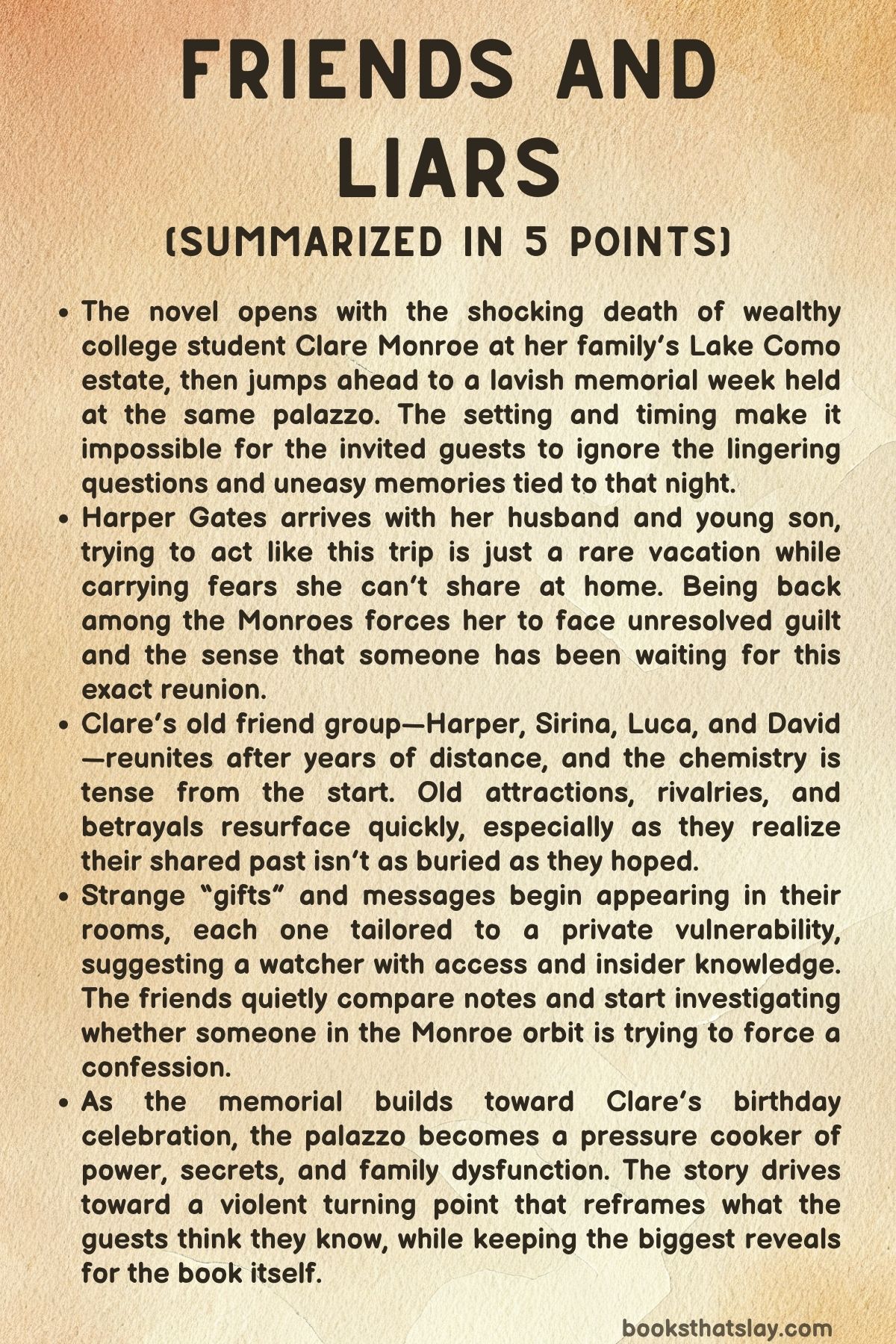
Summary
On January 2, 2020, the world learns that twenty-one-year-old Clare Annabelle Monroe has died in Lake Como. The press reports it as a drowning that occurred during a New Year’s Eve celebration at Palazzo Mella, the Monroe family’s historic estate near Bellagio.
Clare’s wealthy parents identify her body, and a remembrance is held back in Los Angeles. From the outside, it looks like a tragedy that will eventually settle into a polished family narrative.
Five and a half years later, the Monroes announce a weeklong memorial gathering at the palazzo, timed around what would have been Clare’s twenty-seventh birthday. The final event is supposed to be grand: cocktails at the villa followed by a helicopter flight to Como for the opening of a performing-arts center built in Clare’s name.
But the celebration ends in horror. A scream erupts from inside the palazzo’s ballroom, and moments later a woman runs into the garden and collapses, her dress soaked in blood.
The scene echoes the panic of the night Clare drowned.
The story rewinds to five weeks earlier in Brooklyn, where Harper Gates is living an ordinary life with her husband Benjamin and their four-year-old son Oliver. Harper’s day is interrupted when she finds a thick cream envelope in the mail: an invitation from the Monroe family.
Harper and her family are invited to Lake Como for the week of June 2 through June 8, with travel and accommodations fully covered and a coordinator assigned to handle every detail.
Harper is immediately shaken. She hasn’t been back to the palazzo since Clare died, and she has spent years trying not to think about that night.
The invitation also means something else: she will be forced into the same space as Sirina Shaw, David McKinnon, and Luca Di Adamo—Clare’s other closest friends from college. The four of them are bound by what happened at the villa in 2019, and each of them holds information that could destroy the others.
Harper is especially terrified because Benjamin knows almost nothing about that part of her past, and she cannot risk him learning the truth.
Meanwhile, Luca is barely holding his life together in Miami after a breakup and financial collapse. He’s living in a rundown condo, relying on the kindness of a friend named Sonya, and trying to pretend he isn’t panicking about his future.
When he receives emails from the Monroe assistant, Janet Clowe, he debates ignoring them. Going back to Lake Como means facing the guilt and tension he’s been avoiding for years.
Still, the offer is tempting, and Luca can’t stand the thought of being the only one left out of the reunion. He agrees to go.
Sirina arrives at Lake Como from New York on June 2. As she approaches the villa by boat, her nerves spike.
She remembers the lake, the chaos, the police, and the evidence that was found after Clare died—wine, pills, and a narrative that suggested self-destruction. Sirina is haunted by her own past, especially one incident she believes she caused, and the way Clare once protected her.
When Sirina sees a young woman swimming near the dock, she briefly thinks she’s seeing Clare, but it’s Emma Monroe, Clare’s younger sister, now older and sharper than Sirina remembers.
The palazzo is run with strict control by Clare’s aunt, Catherine Ashford, who greets the guests with schedules, room assignments, and rules. From the beginning, it’s clear the Monroes want this week to look perfect, no matter what it costs.
The guests gather for a welcome party that includes David McKinnon, now a filmmaker with growing prestige, and his girlfriend Prue Pryor, the daughter of powerful Hollywood producer Bruce Pryor. David is immediately thrown off by seeing Sirina again.
Their history is complicated: they were close in college, and David has never fully stopped wanting her. His relationship with Clare, and later with Prue, has always been tangled up with that longing.
David is also terrified for another reason: his film has been selected for a major competition, and he has allowed people to believe he earned the spot purely on talent. The truth is uglier, and only three people besides him know it.
Harper tries to get through the party without falling apart. She watches the Monroes, the staff, and the guests, feeling like she’s trapped in a staged performance.
She can’t stop thinking about the person who hurt her the night Clare died and the secret she has carried since then. Sirina finds Harper alone and admits she feels like the entire memorial is a lie.
Harper warns her to keep quiet around Benjamin, and Sirina promises she will.
The Monroes put on a spectacle of wealth and grief. A surprise performance by Paul McCartney temporarily distracts everyone.
Later, a slideshow plays across the villa wall, showing Clare’s childhood and family life. Luca notices that the images barely include Clare’s college years, as if the Monroes are erasing that chapter.
After the slideshow, Clare’s brother Tanner flirts with Luca. Luca is unsettled, because he and Tanner have a secret history of explicit messages, and Tanner’s attention feels both seductive and dangerous.
That night, Luca wanders the villa and pauses outside a heavily secured antiques gallery. When he returns to his room, he finds something that makes his blood run cold: a black velvet jewelry box containing Clare’s distinctive South Sea pearl necklace.
Luca knows the necklace is real and valuable. He also knows he shouldn’t have it.
The placement feels intentional—like a warning that someone knows about Luca’s history as a thief.
Sirina has her own unsettling discovery. When she returns to her room, she finds an ornate tray holding a bottle of Four Roses bourbon tied with a red ribbon and a single glass.
The gift doesn’t feel welcoming. It feels like a message.
Sirina panics, convinced someone is reminding her of the worst thing she believes she has done.
David, too, begins receiving signals. He finds a Canon camera left in his room, identical to the one used during their college film project.
The object is too specific to be random. David realizes someone at the villa is deliberately poking at old wounds and old crimes.
The four friends meet privately in the garden to compare what’s happening. Harper reveals she received a note hidden in her travel kit.
Luca admits he found the pearl necklace in his room, and he also discovered a threatening message in his bag. The note reads: “Did you think the truth died with Clare?” Sirina and David show that they received similar notes on the same distinctive stationery.
They agree the sender must have access to the villa and the money to stage these threats. It feels like someone inside the Monroe world.
Worse, the gifts and notes suggest the blackmailer knows what the four friends confessed to each other on the night Clare died—when they were locked together in Harper’s room, terrified, and trying to decide what to do.
As the week continues, Harper tries to quietly find out who planned the memorial. During a Monroe vineyard tour, she ends up in a tense private conversation with Samuel Monroe, Clare’s father.
Samuel is charming in a cold, controlling way. He makes pointed comments about Harper’s life and marriage, and he speaks about Emma with strange caution, implying Emma has been unstable since Clare’s death.
Harper tries to push for information, but Samuel refuses to give her anything useful.
David attempts to speak with Clare’s mother Helena, who appears fragile and bitter. Helena calls David a liar and hints at long-buried rot inside her marriage.
She also refuses to clarify who is behind the invitations. David begins to suspect the Monroes are playing their own game.
Interspersed throughout the week are entries from Clare’s journal dated December 31, 2019. Clare describes her intense attachment to her friend group, her fear of loneliness, and her belief that these friendships are her salvation.
She also describes the panic of realizing her pearl necklace is missing. She suspects Emma might have taken it and sends David to investigate, trusting him even as she senses something is off.
In the 2019 timeline, Clare’s anxiety builds as her first love, Cameron Bellingham, arrives unexpectedly—apparently invited by her mother. Clare notices David disappears for long stretches and returns with excuses.
She remembers other incidents when he vanished without explanation. Clare tries to hold onto the fantasy that love and loyalty will keep her safe.
Eventually, Clare witnesses something that shatters her. She hears laughter behind the door of an “empty” room and recognizes Sirina’s voice.
When the door opens, she finds Sirina and David together. Sirina admits the affair has been happening on and off for years, including while Clare was dating David.
Clare demands answers, then asks about her missing necklace. David suggests she check Luca’s room.
Back in 2025, on June 8—the day of the memorial’s final event—Sirina receives another note. This one changes everything: “What happened to Clare wasn’t an accident, and it wasn’t suicide either.” The implication is clear.
Someone wants them to believe Clare was murdered.
The friends meet again behind the boathouse and list suspects: members of the Monroe family, Cameron, Bruce Pryor, and others connected to the villa. They agree the blackmailer seems to know a lot but still lacks proof strong enough to hand to police.
Instead, the person is forcing them into fear and confession.
The day erupts into disaster. Inside the palazzo, Samuel Monroe is found dead at the bottom of the stairs.
Harper is left shaken and wrapped in a blanket, her dress stiff with Samuel’s blood. Police arrive, and the atmosphere turns chaotic.
In the library, the head of security, Stefano, announces that the investigation is shifting. Inspector Colombo has found an envelope, and Stefano prepares to read it aloud.
The letter is supposedly written by Samuel. It claims he is confessing out of shame and explains what happened on New Year’s Eve 2019.
As the letter is read, the room reacts in disbelief. It describes Clare confronting Samuel about abuse and “arrangements” within the family.
The letter includes excerpts from Clare’s journal describing Samuel hitting her and the family history of violence. Then “Samuel” narrates the rest: he claims he found Clare drunk on the dock with wine and pills, argued with her, struck her with a bottle, and watched her fall into the lake.
He admits to staging the scene to look like suicide and to manipulating the search for her body. He claims Clare’s remains are still in the lake.
The confession feels too perfect. Sirina senses the tone is wrong—too constructed, too convenient.
She realizes someone has assembled this narrative using pieces of Clare’s journal and details from that night.
Sirina suddenly focuses on Emma. Emma has been missing since earlier in the evening.
Sirina becomes convinced Emma orchestrated the entire memorial week, lured them back, blackmailed them, and staged Samuel’s death as “suicide.”
After the police leave, the four friends regroup in Harper and Benjamin’s room. They piece together what they believe happened: Samuel was abusive and likely attacked Clare, but the letter was staged.
Emma used Clare’s journal to build a believable story, then pushed Samuel down the stairs while everyone else was distracted. Emma escaped by boat, leaving the friends trapped in silence because their own secrets were now tied to the scandal.
Weeks later, news reports confirm Samuel’s death has been ruled a suicide, and Emma has disappeared from public view. The four friends reunite in Los Angeles after receiving a meeting invitation.
At the Monroe home in Malibu, Emma greets them calmly and offers drinks. Then she reveals the final twist: Clare steps into the room alive—scarred, changed, but unmistakably real.
Clare explains that parts of the “suicide letter” were based on truth, but the dock story was partly invented. She says Samuel attacked her in his office, knocked her out, dragged her to a boat, and dumped her in the lake to die.
Clare survived by swimming to a neighboring villa and hiding. She returned at dawn, climbed into Emma’s bed, and Emma helped her recover.
Clare then disappeared in Italy, living quietly and working at a vineyard without a passport. Over the years, Clare and Emma planned their revenge.
They wrote the staged journal-style entries and created the confession narrative to destroy Samuel and protect themselves. Clare admits she returned to the palazzo on the final night and pushed Samuel down the stairs herself.
Clare ends the meeting with a warning: the four friends are now bound to her and Emma. They helped create the conditions for the cover story, and their own secrets still exist.
Clare will return to the family publicly with a new explanation—traumatic brain injury, lost memories, and a delayed “homecoming.” And if any of them tries to break away, Clare has the power to pull them back down with her.
Characters
Harper Gates
Harper is the story’s moral pressure point: a woman who has built a stable adult life in Brooklyn—husband, child, routine—on top of a past she cannot confess without detonating everything she’s protected. In Friends and Liars, her terror isn’t abstract guilt; it’s the constant, bodily panic of someone who knows a single careless sentence could expose old crimes, old betrayals, and the precise way she survived a night that another girl didn’t.
She moves through the memorial week hyper-aware of surveillance—by staff, by the Monroes, by her own friends—and her instinct is always containment: keep Ben happy, keep the truth sealed, keep the story straight. That need to control the narrative makes her both sympathetic and frustrating, because Harper often chooses self-preservation over clarity, yet it also reveals how trauma reorganizes a personality.
What makes her compelling is how sharply she understands power: she knows the Monroe wealth can rewrite reality, and she knows her own position—socially and financially—makes her easier to crush, which is why she clings to silence as if silence is safety.
Benjamin Cross
Ben is the “normal life” Harper wants to keep intact, and his presence turns the friends’ shared secret from a private pact into an active threat. In Friends and Liars, he functions as an unwitting measuring stick for how far Harper has drifted from honesty: he is open, tempted by the glamour of a free trip, and largely naive about the emotional landmines under their feet.
That innocence is not portrayed as stupidity so much as distance—he hasn’t lived the version of Harper that existed at Wadleigh or on the dock the night Clare vanished. The tension around Ben is that he represents consequences that are not legal but intimate: the risk of losing a marriage, the risk of a child seeing their mother differently, the risk of a carefully curated identity collapsing.
Even when he is not driving the plot, he intensifies it simply by existing in the room.
Oliver Gates
Oliver appears briefly, but he matters because he anchors Harper’s stakes in something more visceral than reputation. In the story, Oliver symbolizes the future Harper is trying to protect, and that protection shapes every decision she makes at Lake Como—especially her refusal to “come clean” even when silence corrodes her from the inside.
He is also a quiet reminder of time: five years is not just an interval between deaths and memorials, it is long enough to build a family, to become someone new, and to have everything threatened by who you used to be.
Luca Di Adamo
Luca is the most obviously destabilized of the four surviving friends: broke, newly unmoored, hungry for escape, and painfully aware that charm and improvisation cannot outrun consequences forever. He carries a double vulnerability—economic precarity and the hint of a criminal past—making him easy to target and easy to blame, which is precisely why the planted pearl necklace hits like a trap designed for him specifically.
He uses humor, flirtation, and recklessness as armor, but the story keeps stripping those layers away until what remains is fear: fear that he has been seen clearly, fear that the Monroes know what he took, and fear that his friends will sacrifice him first. His relationship with Tanner adds another dimension, because Luca is both drawn to Monroe privilege and repulsed by what it demands; being desired by a Monroe is intoxicating, but it also makes him feel like a commodity passed around inside someone else’s empire.
Sonya
Sonya’s role is small but telling: she is the person who feeds Luca, listens to him, and offers him dignity when his life is at its most precarious. She is a glimpse of what Luca might have had if he chose stability over chaos—a contrast to the Monroes’ gilded world, where attention comes with strings and affection is often transactional.
Her presence underscores that Luca’s decision to go to Como is not just about money; it is about longing to matter again, to be included, to be near the kind of life that once brushed against him and then discarded him.
Sirina Shaw
Sirina is defined by performance, and not only because of her acting background; she is someone who survives by controlling what others believe they see. In Friends and Liars, she arrives at the palazzo already braced for punishment, convinced she is the kind of person who deserves it, and that conviction shapes her paranoia when the “gifts” and notes begin.
Her interior life is saturated with shame, but the shame is complicated: she is not just ashamed of what she did, but of what she wanted—validation, desire, belonging—and of how easily she let those wants override loyalty. The twist that she has been carrying guilt for a death that was not hers reframes her entire psychology: Sirina’s fear has been real, but its foundation was a misunderstanding and a cover-up that calcified into identity.
The result is a character whose tragedy is not only the harm she caused, but the years she spent believing she was a killer, letting that belief quietly govern her choices and her self-worth.
David McKinnon
David is ambition wrapped in charisma, and the story treats that combination as both seductive and corrosive. He is the friend most fluent in justification: he can tell himself the bribe, the cheating, the omissions, and the strategic relationship with Prue are all steps on the path he deserves.
Yet he is also the one most haunted by exposure, because his public identity—talented filmmaker, rising star—cannot survive the revelation that his success is partly manufactured. His relationship to Clare is especially revealing: he accepts her devotion and benefits from her resources, but he also resents the way her wealth can make his achievements feel less “his,” which helps explain why he keeps slipping toward Sirina and toward secrecy.
David’s panic deepens when he realizes someone is curating reminders of his past, because he understands something crucial about power: a scandal is not just truth coming out, it is who controls the timing and the framing when it does.
Prue Pryor
Prue is not simply “the new girlfriend”; she is a strategic orbit that keeps David close to industry influence and Monroe money, whether he admits it or not. She reads as confident, socially adept, and accustomed to rooms where other people are performing for approval.
Her frequent absences and “work” give her an air of secrecy that makes her suspicious to the others, but that suspicion also exposes their paranoia: they are so used to hiding that they assume everyone else is hiding too. Prue’s deeper function is to show the kind of life David thinks he wants—glamour, access, proximity to power—and to highlight how that life mirrors the Monroes’ world: curated images, leveraged relationships, and private costs that never make the press release.
Bruce Pryor
Bruce is power with a smile, the kind that doesn’t need to shout because everyone else adjusts their posture automatically. He symbolizes the entertainment-industry pipeline where favors, selections, and prestige can be purchased or influenced, and where “merit” is often a story told after the fact.
His connection to Samuel Monroe folds money and media into the same ecosystem, suggesting that the Monroes’ control is not limited to family secrets—it extends into cultural machinery that can elevate or erase. Bruce’s presence also sharpens the theme of complicity: he benefits from a world built on quiet bargains, and that world is exactly what David is desperate to enter without being destroyed by the terms.
Clare Annabelle Monroe
Clare is the axis of the narrative, but she is not just a victim; she is a storyteller, a planner, and ultimately a co-author of the reality everyone else is forced to live inside. Her diary voice reveals a young woman who is terrified of loneliness and therefore clings hard to friendship, interpreting closeness as proof she is safe—until the missing necklace and the evasions start to show her how fragile that safety is.
Her love is intense and transactional in a specific way: she tries to secure David’s future through her family’s power, convinced that investment will guarantee loyalty, and that belief makes her heartbreak not only emotional but ideological—she trusted the logic of money to stabilize love. When she returns alive, scarred and resolute, Clare becomes something darker and more formidable: a survivor who has decided that justice will not arrive from courts or newspapers, so she will manufacture it herself.
Her collaboration with Emma in constructing a believable narrative, and her insistence that the friends are now bound to her revenge, turns Clare into the story’s most unsettling embodiment of a central theme: truth is not merely discovered in this world, it is engineered.
Emma Monroe
Emma is the quiet storm: the younger sister who grew up in the shadow of a dead girl’s legend and then weaponized that legend to take control. She is defined by observation and patience; she watches people, collects details, and understands exactly which secrets will produce maximum obedience when applied at the right moment.
Her brilliance is coldly practical—she can orchestrate a weeklong memorial as a stage, manipulate the four friends with personalized threats, and steer authorities toward a narrative that benefits her plan. Yet her motives are emotionally legible: Emma is the sibling left behind, the one who had to live with the family machinery after Clare was gone, and who understood that within the Monroe universe, the only way to beat power is to take it.
When she disappears after Samuel’s death, it completes her portrait as someone who treats identity like a costume: she can be grieving sister, victim, conspirator, and vanishing act, depending on what the moment requires.
Samuel Monroe
Samuel is the story’s clearest embodiment of corrosive power: a man who controls through money, intimidation, and the quiet assumption that consequences are for other people. He appears as a polished patriarch in public and a brutal force in private, and the tension between those faces is the point—his authority depends on everyone else agreeing not to look too closely.
The “suicide” letter narrative, whether fully true or strategically assembled, still captures what defines him: violence treated as entitlement, image managed as survival, and family members reduced to pieces on a board. What makes Samuel terrifying is not only what he does, but what he can plausibly make the world believe; his wealth turns truth into something negotiable, which is why his downfall has to be theatrical, not legal.
Even in death, he remains a gravitational presence, because everyone’s choices—Clare’s disappearance, Emma’s plot, the friends’ silence—are shaped by the fact that Samuel’s reach once felt absolute.
Helena Monroe
Helena is fragility under glass, a woman whose suffering has been absorbed into the family’s aesthetics rather than treated as something that should change the system harming her. She reads as physically unwell and emotionally eroded, and her interactions hint at a long history of compromises made to keep the Monroe facade intact.
She understands more than she says, but her power is limited; she can wound with words, imply truths, and signal that she sees the liars around her, yet she cannot fully step outside the structure Samuel built. Helena’s presence complicates easy villain narratives because she is both victim and participant: she has endured harm, but she has also lived inside the machinery that hides harm, and that long accommodation blurs the line between being trapped and enabling the trap.
Catherine Ashford
Aunt Catherine is the enforcer of appearances, the person who turns grief into an itinerary and trauma into a controlled event. She represents the Monroe philosophy at its most procedural: rules, schedules, keys, controlled access, and the unspoken expectation that everyone will behave as if the house itself is watching.
Her suspicion toward the friends feels less like personal dislike and more like institutional immune response—she senses threat to the family narrative and moves to contain it. Even when she is not the mastermind, she is the infrastructure that makes masterminding possible, because her loyalty is to the image of the Monroes rather than to the messy human truth underneath it.
Tanner Monroe
Tanner is raw hostility shaped by family violence, and he wears contempt like armor. His cruelty is not random; it is the behavior of someone who learned early that vulnerability gets punished, so he punishes first.
His flirtation with Luca, and the explicit texting history between them, highlights how tangled his needs are: he seeks intimacy in ways that still let him keep the upper hand, using desire as leverage and humiliation as control. Tanner also acts as a reminder that abuse doesn’t stay neatly contained to one victim; it ripples through siblings, shaping how they love, how they fight, and how they recreate harm even when they hate the person who taught it to them.
Bradley Monroe
Bradley functions as the unexpected truth-teller in a family built on distortion. His conversation with Sirina punctures one of the story’s longest-running misbeliefs and shows that the Monroes’ silence culture has collateral damage far beyond the immediate scandal.
He is positioned as someone who knows how to live with ugly facts without immediately turning them into weapons, which sets him apart from both Samuel’s domination and Emma’s tactical vengeance. Bradley’s calm correction of the past does more than relieve Sirina’s guilt; it demonstrates how thoroughly narrative control can warp reality for everyone, including the people who think they are protecting each other.
Cameron Bellingham
Cameron is the romantic ghost who keeps walking back into the room, a reminder that Clare had a life and history beyond the four friends who claim to know her best. His presence destabilizes Harper in particular because he is tied to moments of intimacy and betrayal that Clare witnessed, and because his gaze suggests he is assessing the survivors, not simply mourning.
Cameron’s function is to widen the lens: Clare’s story was never only the story of the friend group, and Cameron represents the edges of her life where different loyalties and different truths might exist. He is also a social variable—someone close enough to the family to be present, but outside enough to be dangerous—making him a natural object of suspicion in a house where everyone is keeping score.
Janet Clowe
Janet is the Monroes’ administrative face: polite, efficient, and perfectly positioned to facilitate manipulation while appearing neutral. Her role underscores how wealth turns logistics into control—travel arrangements, schedules, and invitations become a mechanism for gathering targets in one place without anyone being able to refuse without seeming ungrateful.
Janet’s refusal to accept gifts and her redirect to charity reads like professionalism, but it also reinforces the Monroes’ insulation: even gratitude is managed, rerouted, and depersonalized. She embodies the idea that in powerful families, even the assistants are part of the fortress.
Stefano
Stefano, as head of security, represents the palazzo’s nervous system: the controlled doors, the monitored movement, the sense that privacy is an illusion. He is both guardian and gatekeeper, and his role as intermediary during the investigation reveals how the Monroes filter information before it reaches the outside world.
He is not merely a functionary; his presence signals that the family anticipates threats as a matter of routine, and that truth will always pass through layers of security—literal and social—before anyone else gets near it.
Inspector Colombo
Colombo is the formal face of consequence, but the story’s tension comes from how easily consequence can be redirected. The shift of the investigation toward a “suicide” framing illustrates the central imbalance between institutional procedure and private power, where official narratives can be nudged, starved of evidence, or overwhelmed by staged plausibility.
Colombo’s presence matters less for who he is as an individual and more for what he represents: the thin line between justice and closure, and how often wealthy families can choose closure because closure is cheaper than truth.
Harper, Sirina, Luca, David
Together, the four friends operate like a sealed container under pressure, each carrying a different kind of secret but bound by the same fear of exposure. Their dynamic is built on mutual blackmail long before the literal blackmailer appears: they know enough about one another to destroy one another, so “loyalty” becomes indistinguishable from self-defense.
When the threatening gifts arrive, the group’s old pact doesn’t strengthen into solidarity—it fractures into suspicion, because every secret makes every person a potential betrayer. Their shared history at Wadleigh is not nostalgia; it is evidence, and their reunion forces them to confront that the friendship they mourn might have been real in feeling but corrupted in practice.
By the end, when Clare demands their silence and complicity, the group’s defining tragedy becomes clear: they thought they were protecting themselves by keeping the past buried, but burying it only ensured the past would return with someone else holding the shovel.
Themes
The Weight of Secrets and the Cost of Silence
In Friends and Liars, secrecy is not just a plot engine—it becomes a lifestyle that slowly reshapes everyone who carries it. The four surviving friends don’t simply “keep a secret” about Clare’s death; they build entire adult identities around avoiding the truth, avoiding each other, and avoiding the version of themselves that existed in 2019.
Harper’s life is the clearest example of this. Her marriage, her motherhood, and even her ability to enjoy something as simple as a vacation are all constrained by what she can’t say out loud.
The secrecy doesn’t protect her—it traps her. It turns her into someone constantly scanning conversations for danger, constantly imagining how quickly everything could collapse if a single sentence slips.
The book also shows how silence becomes a currency in relationships. The friends are bonded less by affection than by mutual risk.
When they reunite, the tension between them isn’t nostalgia—it’s calculation. Who knows what?
Who might crack first? Who has the most to lose?
Their dynamic becomes a living hostage situation, except no one is holding a weapon openly. The blackmail gifts—objects tied to their individual sins—force them to recognize something they’ve tried to ignore: the truth never stays buried just because people agree not to dig.
What makes this theme hit harder is that the secret isn’t even stable. Over time, they have all filled in gaps with assumptions, guilt, and fear.
They don’t fully understand what happened, but they’ve acted for years as if they do. That creates a cruel irony: their silence doesn’t preserve reality, it distorts it.
And once someone begins controlling the narrative, their silence becomes a tool for someone else’s power. In the end, the friends learn the most frightening part of keeping a secret isn’t being caught—it’s realizing you’ve been living a life designed around your own fear.
Friendship as Performance, Loyalty as a Bargain
The friend group in the story looks, from the outside, like the kind of golden college bond people romanticize: five young adults, art and ambition, glamour, intimacy, and a wealthy benefactor among them. But the story reveals that their friendship is built on need more than trust.
Clare’s hunger to belong makes her intensely devoted, but it also makes her vulnerable. She wants the group to be real so badly that she interprets warning signs as temporary misunderstandings.
Even when her necklace disappears, even when David behaves suspiciously, she chooses belief over confrontation because belief feels safer than loneliness.
This theme becomes sharper in the present timeline, where friendship has curdled into obligation. The four return to Lake Como not because they miss Clare, but because they fear what might happen if they refuse.
Their conversations aren’t warm—they’re strategic. Their loyalty is conditional, based on what each person might expose.
This creates a painful kind of anti-friendship: they know each other deeply, but that depth is dangerous rather than comforting.
The book also explores how friendship can become a stage where people play roles. Sirina performs charm and control, because she cannot afford vulnerability.
David performs artistic legitimacy, because his success is partly built on a lie. Luca performs carelessness and humor, because acknowledging his fear would mean admitting he’s being cornered.
Harper performs normalcy, because she’s trying to survive her own home life without anyone realizing how fragile she feels.
What makes this theme especially haunting is that Clare, even in absence, is still trying to make the friendship real. Her journals show a person who believed love could stabilize people.
But the group is defined by betrayal: romantic betrayal, moral betrayal, and eventually betrayal of reality itself. The story suggests that friendship can survive many things, but it cannot survive when everyone’s loyalty is bought with fear.
At that point, what remains isn’t friendship—it’s a pact.
Wealth, Power, and the Illusion of Untouchability
The Monroe family’s wealth doesn’t merely create luxury; it creates an ecosystem where consequences can be delayed, reshaped, or erased. The palazzo, the staff, the helicopter transfers, the private performances, the curated memorial schedule—these aren’t just signs of privilege.
They are tools of control. The family can turn grief into spectacle and tragedy into branding, including a performing-arts center that transforms Clare into a symbol rather than a person.
The memorial week is framed as remembrance, but it also functions as a public relations event, one that demands guests behave correctly and reinforces the Monroes’ authority over the story of Clare’s life and death.
The book shows how wealth creates a different kind of justice system. Police investigations can be steered.
Evidence can be “managed.” Even death itself can be rewritten. Samuel’s alleged bribery of divers and his manipulation of the investigation demonstrate how money doesn’t just buy comfort—it buys narrative control.
And because the Monroes are socially connected to powerful figures like Bruce Pryor, the web extends beyond Italy. It reaches into film careers, reputations, and public perception.
This theme is also present in the friends’ lives. David’s success is not purely talent-based; it’s also tied to access, influence, and hidden assistance.
His fear isn’t only about being exposed as morally flawed—it’s about being revealed as someone whose legitimacy is borrowed. Luca’s poverty in Miami contrasts sharply with the villa’s excess, and the story makes it clear that wealth doesn’t only determine what you can buy; it determines how safe you are.
Perhaps the sharpest critique is how wealth allows people to treat others as disposable. Clare is treasured publicly, but controlled privately.
Emma is treated as an afterthought until she becomes useful. Harper, Sirina, Luca, and David are invited not because their grief matters, but because they can be positioned as pieces in a larger plan.
In this world, power doesn’t just silence people—it teaches them to silence themselves.
Abuse Behind Closed Doors and the Inheritance of Fear
Family violence is not presented as a shocking twist—it is presented as an ugly structure that has always existed, hidden behind expensive architecture and carefully managed appearances. Samuel’s cruelty is not limited to a single outburst; it is implied as a long-term pattern that has shaped the entire Monroe household.
Helena’s fragility, Tanner’s bitterness, Emma’s intensity, and Clare’s anxiety all read differently once the truth emerges. The book makes it clear that the most dangerous homes are often the ones that look flawless from the outside.
Clare’s role in this theme is particularly tragic. She is both privileged and powerless.
She has money, but not safety. She has a famous name, but no protection from the person who matters most inside her house.
Her journal reflects the mindset of someone who has been trained to manage emotions carefully, to interpret threats, and to survive by staying “good.” When she begins to push back—when she threatens to expose the truth—Samuel responds with violence. The story highlights something important: abuse often escalates when control is challenged.
Emma’s storyline deepens this theme by showing how abuse can shape a person into someone capable of extreme actions. Her eventual orchestration of revenge, blackmail, and narrative manipulation is not framed as random cruelty.
It is framed as a response formed over years of living under a father who could destroy anyone and never be held accountable. The book refuses to simplify her into a hero or villain.
Instead, it shows how surviving abuse can produce two conflicting desires: the desire for justice, and the desire to finally hold power over someone else.
This theme also bleeds into the friends’ lives. Harper’s fear, Sirina’s guilt, David’s self-preservation, and Luca’s instability all reflect what happens when young adults witness violence and become complicit through silence.
The book suggests that abuse does not stay contained within a family. It spreads outward, infecting friendships, careers, and identities.
The palazzo becomes a symbol not of beauty, but of what happens when terror is allowed to wear a polished face.
Truth, Narrative Control, and the Danger of Believing the “Official Story”
One of the most unsettling themes in Friends and Liars is how easily truth can be manufactured when the right people have access, time, and motive. The story repeatedly shows that what people accept as “truth” is often just the most convenient version available.
Clare’s death is initially framed as an accident. Later, it is repositioned as suicide.
Then it is implied to be murder. And finally, the reality is revealed to be something even stranger: an attempted murder that failed, followed by years of calculated disappearance and staged outcomes.
What makes this theme powerful is that it doesn’t treat lies as simple. The lies in the book are layered, emotional, and sometimes built from real fragments.
Clare and Emma’s fabricated journal-style narrative works because it contains enough genuine pain to feel believable. Samuel’s letter works because it matches what people already suspect about him.
The friends’ secrets work because they are rooted in shame, and shame makes people easy to manipulate.
The memorial week itself becomes a kind of theatre of truth. Everyone is present in a place saturated with memory, but nobody is actually allowed to speak honestly.
The staff moves quietly. The schedule dictates emotions.
Even grief is curated. When the letter is read aloud, the group experiences what feels like a public unveiling of truth—but it is still a performance designed to direct the room toward a conclusion.
The book forces the reader to confront an uncomfortable idea: revelation can be staged just as effectively as deception.
This theme also connects to the friends’ personal lives. David’s career is built on a story he lets others believe.
Sirina’s identity is built around guilt that turns out to be based on a misunderstanding. Harper’s marriage is built on a version of herself that is incomplete.
Luca’s fear is shaped by the assumption that he is being punished for who he is. The story suggests that people do not only lie to others—they lie to themselves in order to survive.
By the end, the truth does not feel like a clean resolution. It feels like a weapon that has changed hands.
The final reveal—that Clare is alive and that the friends are now bound to the secret of Samuel’s death—shows how truth can become another form of captivity. Even when the real story comes out, nobody is free.