Funny Story by Emily Henry Summary, Characters and Themes
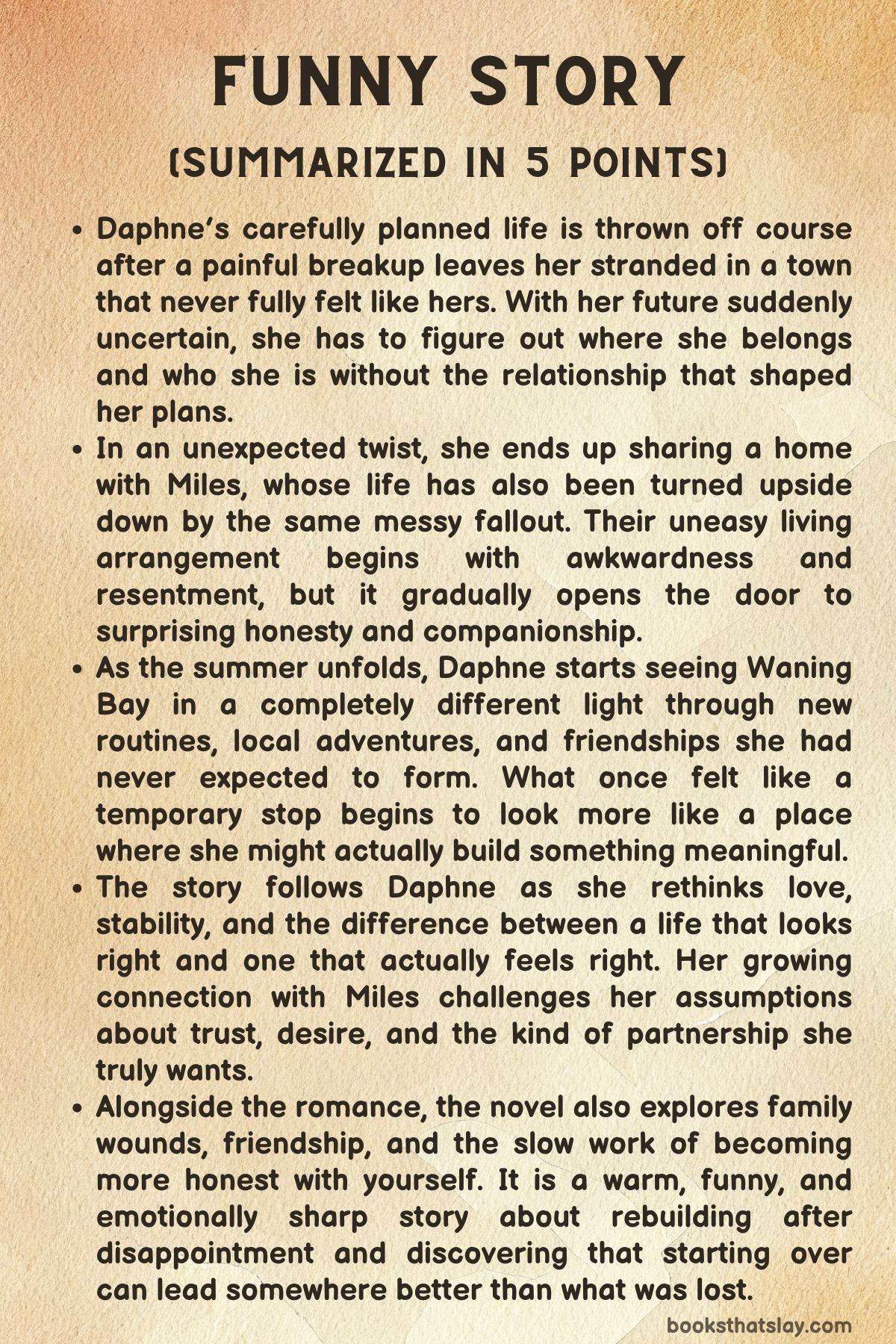
Funny Story by Emily Henry is a contemporary romantic novel about reinvention, heartbreak, and the strange ways a life can open up after it falls apart. At its center is Daphne, a children’s librarian whose fiancé leaves her for his longtime friend, setting off a chain of humiliating and unexpected changes.
Stranded in his hometown, she ends up living with Miles, the ex of the woman who replaced her. What begins as an awkward arrangement slowly becomes a turning point. With humor, tension, and emotional honesty, Funny Story follows Daphne as she rebuilds her sense of self, learns how to trust again, and decides what kind of future she actually wants.
Summary
Daphne thought she had finally found stability. She fell hard for Peter, a man who seemed dependable, polished, and committed to the kind of family life she had always wanted.
Their relationship moved quickly. They built a home together, got engaged, and settled in his hometown of Waning Bay, Michigan, where Daphne found meaningful work as a children’s librarian.
For someone raised in an unstable world of divorce, moving, and disappointment, that life looked like safety. Then everything collapsed.
After his bachelor party, Peter told Daphne he was in love with Petra, his lifelong best friend. The wedding was off, Petra was moving in, and Daphne needed somewhere else to go.
Since Petra had been dating Miles, Daphne ends up in the most unlikely place possible: Miles’s apartment. He is messy, inconsistent, emotional, and nothing like Peter.
At first, they are simply two people left behind by the same betrayal. Daphne sees him as chaotic but harmless, while Miles seems to accept the whole disaster with a mix of pain, sarcasm, and numbness.
Their shared misery creates an uneasy bond. When Peter and Petra send them a wedding invitation, the insult pushes them into a reckless idea.
In a moment of anger, Daphne tells Peter that she and Miles are together. Instead of objecting, Miles embraces the lie.
What begins as a fake relationship meant to annoy their exes becomes the frame for something far more real.
As Daphne settles into her new life, she starts seeing Waning Bay differently. Before, the town had always felt like Peter’s world, full of his people and his routines.
Through Miles, it becomes its own place. He shows her wineries, local farms, hidden beaches, roadside diners, and corners of town she had never experienced.
These outings are not just dates in disguise. They wake her up.
She starts trying things she once would have avoided, from spontaneous adventures to letting herself relax, get messy, and stop performing the role of the organized, agreeable partner. Around Miles, she begins to notice how much of herself she had edited down while she was with Peter.
Their chemistry grows quickly, but so does the confusion. They flirt, kiss, and circle each other with increasing intensity.
Daphne is drawn to Miles’s warmth, humor, and easy way with people. He makes room for discomfort instead of trying to control every detail.
He also sees her more clearly than she expects. He notices her loneliness, her habits of self-protection, and the fear that sits underneath her need to be careful.
For Daphne, who has spent much of her life bracing for disappointment, being seen this directly is both exciting and frightening.
At the same time, Daphne’s world expands beyond romance. She forms an important friendship with Ashleigh, a fellow librarian whose blunt honesty pushes Daphne to open up.
Through Ashleigh, Daphne begins to experience friendship as something active rather than accidental. She also becomes more grounded in her work at the library, especially through the children she serves and the large Read-a-thon she is organizing.
Her job is no longer just a bright spot that helps her endure her private life. It becomes one of the clearest signs that Waning Bay might truly be home.
Miles, too, becomes more complicated as Daphne gets to know him. Beneath his social ease is a history of pain.
He grew up in an abusive home and carries deep guilt about what his younger sister Julia lived through. Julia’s arrival in Waning Bay adds energy and chaos, but it also reveals how much Miles still defines himself through shame and responsibility.
He loves fiercely, but he does not trust himself to build a healthy future. He worries that whatever damaged his parents will somehow damage him too.
His history gives shape to his hesitation with Daphne. Even when the attraction between them becomes impossible to ignore, he keeps pulling back, afraid of hurting her or becoming the wrong kind of partner.
Daphne’s own family history keeps surfacing as well. Her father has been unreliable for most of her life, appearing just often enough to stir hope and disappearing again before he can be counted on.
Her mother, by contrast, has always been the steady center of her world, even when their life was difficult. These early experiences explain why Daphne clings to order, why she expects abandonment, and why she is so easily pulled toward men who seem like they might finally offer permanence.
As she grows closer to Miles, she starts to understand that her old patterns are shaping her choices. She is not just deciding between two men or two towns.
She is deciding whether to keep living defensively.
After a period of tension, false starts, and restraint, Daphne and Miles finally begin a physical relationship. Their time together feels joyful, intimate, and alive in a way Daphne has not experienced before.
But happiness does not erase old fears. When Miles disappears at a crucial moment and fails to explain himself, Daphne is thrown back into the emotional logic of her childhood: people leave, people disappoint, people choose someone else.
At the same time, Peter resurfaces and tries to win her back after his relationship with Petra falls apart. His return clarifies something important.
Daphne does not want the life she once thought she wanted. Peter represents an image of safety, but not the kind of love she now understands she deserves.
The real crisis comes when Daphne misunderstands Miles’s absence and assumes the worst. He has, in fact, been pulled into unfinished business with Petra and later goes after Daphne’s father in anger over the way he treated her.
But because both Daphne and Miles are still reacting from old wounds, they fail each other just when honesty matters most. Daphne also pulls away from Ashleigh, briefly damaging one of the few friendships she has chosen for herself.
These fractures force her to confront a pattern she can no longer ignore: when things become uncertain, she prepares to leave.
Daphne almost accepts a new library job near her mother in Maryland, a move that would let her retreat to something familiar. Yet the closer that option gets, the more she sees that leaving is not always strength.
Sometimes it is fear wearing the mask of practicality. Encouraged by her mother’s insight, Ashleigh’s honesty, Julia’s loyalty, and the community she has slowly built, Daphne begins to choose differently.
She repairs her friendship with Ashleigh, stands up to her father, and lets herself imagine a life in Waning Bay that belongs to her, not to Peter and not even to Miles.
The Read-a-thon becomes the emotional proof of that new life. When the event runs into trouble, people from across town show up to help.
Daphne sees, in one room, the network of care she has built without realizing it. Miles comes too, and his presence is not about drama or performance.
It is about showing up. Later, when they finally speak honestly, the last misunderstandings fall away.
Miles admits that he loves her. Daphne tells him she loves him too.
Peter and Petra are no longer the center of the story. The real question is what Daphne wants her life to look like now.
Her answer is both romantic and independent. She decides to stay in Waning Bay and be with Miles, but she also insists on getting a place of her own first.
She wants their relationship to grow from choice, not dependency. That decision marks the clearest change in her.
She is no longer someone waiting to be chosen or rescued. She is building a life from the inside out.
In the end, Daphne creates exactly what she had been longing for all along: not a perfect fairy tale, but a home made of love, friendship, work, and self-respect. Later, she and Miles share a house, her mother visits, old friendships begin to heal, and the community around her feels like family.
When asked how they met, Daphne tells the story of their improbable beginning. It is a funny story, but it is also the story of how losing one life allowed her to finally claim a better one.
Characters
Daphne
Daphne begins as someone who has built her identity around steadiness, restraint, and emotional caution. She is intelligent, observant, responsible, and deeply attached to order, which makes sense given her unsettled childhood.
Because her father was unreliable and her mother had to carry so much on her own, Daphne learned early that safety often depends on self-control. That instinct shows in nearly every area of her life.
She is careful with money, careful with feelings, careful with friendships, and careful not to ask too much from other people. Even when her engagement falls apart, she initially responds less with outward collapse than with stunned containment.
Her pain is real, but it is filtered through habits of endurance.
What makes her such a strong central figure is that her emotional journey is not just about getting over one man and falling for another. It is about learning that a well-managed life is not the same thing as a full life.
At the start, she has mistaken predictability for intimacy. She thought being chosen by someone stable would heal the instability of her past, but she gradually realizes that Peter offered an image of security rather than the deeper kind built on truth, mutual recognition, and freedom.
Her time with Miles pushes her to test the limits of the person she has been. She becomes more spontaneous, more socially open, more willing to take pleasure seriously, and more able to admit what she wants.
These changes do not erase her essential nature. She remains thoughtful and deliberate, but by the end she is no longer ruled by fear of embarrassment, rejection, or abandonment.
Daphne is also interesting because she is both vulnerable and defensive in ways that often contradict each other. She longs for closeness, yet she withholds parts of herself because exposure feels dangerous.
She wants community, yet she tends to enter social spaces through someone else rather than claiming space on her own. Her friendship with Ashleigh becomes important because it forces her to practice reciprocal honesty instead of simply being pleasant and guarded.
Her work at the library reveals another core truth about her character: she is nurturing, imaginative, and genuinely invested in giving others the sense of refuge that books once gave her. That is why her final decisions matter so much.
She does not just choose love. She chooses herself as someone worthy of building a life on her own terms.
Miles
Miles first appears as a messy, unserious contrast to the polished men Daphne has trusted before, but he quickly proves to be one of the most emotionally layered characters in the novel. He is socially gifted, warm, funny, and instinctively good at putting people at ease.
He can talk to anyone, charm strangers, and move through a room with the kind of confidence Daphne finds both baffling and attractive. Yet beneath that ease is a person carrying deep pain.
He grew up in a home marked by cruelty and instability, and that history has shaped the way he sees himself. He has a generous nature, but he also has a damaged sense of worth.
He assumes that love can be felt but not safely held.
One of the strongest aspects of Miles’s characterization is the gap between how others read him and who he actually is. From the outside, he looks unserious, impulsive, and unserveilled by ordinary standards of success.
Peter dismisses him as a stoner who drifts through life. But that judgment misses his actual strengths.
Miles works hard, knows his town intimately, maintains broad social ties, and pays attention to people in ways more conventionally respectable characters do not. He may not perform adulthood in the polished style Peter does, but he understands care, service, and emotional presence on a much deeper level.
The town’s affection for him quietly confirms that he has built a meaningful life even if he does not fully know how to value it.
His greatest internal conflict comes from guilt and fear. He loves his sister fiercely and still feels that he failed her by not being able to save her completely from their parents’ abuse.
That guilt feeds a broader belief that he is not built for healthy commitment. When his feelings for Daphne deepen, he does not respond with indifference but with panic.
He wants her intensely, admires her deeply, and feels seen by her in a way that unsettles him. Yet he repeatedly hesitates because he believes that loving someone well may be beyond him.
This makes him more than the easygoing romantic lead. He is a man trying to reconcile tenderness with self-doubt, devotion with shame.
His eventual confession of love matters because it represents not just desire but a hard-earned act of self-belief.
Peter
Peter is not simply the wrong man for Daphne. He represents a whole emotional framework that the story critiques.
On the surface, he is attractive, polished, successful, and highly legible as a good partner. He values structure, family, health, and outward maturity.
These traits help explain why Daphne fell for him so quickly. To someone with her background, Peter would appear to promise adulthood without chaos.
Yet his defining flaw is not that he changed his mind. It is that he consistently centers his own emotional comfort above honesty, accountability, and the dignity of others.
His treatment of Daphne after leaving her exposes the limits of his character. He seems to believe that if he can frame events in a calm, rational, socially acceptable way, then the cruelty of his actions becomes less important.
He wants to be seen as decent even while behaving selfishly. That is why he invites Daphne to the wedding, speaks to her in a patronizingly reasonable tone, and later tries to win her back as though his renewed preference is a form of generosity.
He cannot fully understand that what broke the relationship was not just desire for someone else but his own entitlement. He assumes that his sincerity in the present can erase the damage he caused in the past.
As a character, Peter is effective because he is not a cartoon villain. He likely did love Daphne in the way he was capable of loving.
But his love was shaped by self-regard, comfort, and a need for things to make sense according to his version of events. He is drawn to ideal arrangements, and when one no longer fits, he rearranges people around his needs.
In that sense, he is a man of appearances who mistakes coherence for integrity. His role in the story is crucial because he shows Daphne the difference between being chosen as part of someone’s life plan and being truly known.
Petra
Petra could easily have been written as a flat rival, but she is more complicated than that. She is charismatic, magnetic, socially fluid, and hard to dislike even when she has behaved badly.
Her appeal is part of what makes the betrayal so sharp. She is not cold or calculating in a simple way.
Instead, she has the kind of force that can reshape a room and alter people’s choices around her. Peter and Miles are both drawn to her, and Daphne herself has to admit that Petra is likable.
That complexity keeps her from becoming a one-note antagonist.
At the same time, Petra’s emotional style contrasts sharply with Daphne’s. Petra seems to move toward what feels intense or alive in the moment, even if doing so causes damage.
She does not appear governed by the same caution, guilt, or self-scrutiny that define Daphne. This gives her a certain freedom, but it also makes her dangerous in intimate relationships.
She can step into a life that is already built and alter its course without fully reckoning with the wreckage. Her relationship with Peter suggests that she, too, may be searching for something she cannot quite name, but she does not seem especially skilled at understanding the consequences of her choices until after they land.
Her importance in the novel lies partly in what she reveals about the men around her and partly in what she forces Daphne to confront. Petra is the woman Daphne believes she is not: easy, vivid, socially gifted, naturally central.
For a while, that comparison intensifies Daphne’s insecurity. But as the story moves forward, Petra becomes less significant as a rival and more significant as a mirror for false desire.
Neither Peter nor Miles is ultimately meant to define himself through Petra, and Daphne no longer has to measure herself against her. By the end, Petra’s presence has helped expose which relationships were based on fantasy and which ones can survive truth.
Ashleigh
Ashleigh is one of the most important supporting characters because she gives the story its strongest portrait of female friendship after loss. She first appears intimidating, sharp, and slightly hard to read, but that impression quickly opens into something richer.
She is direct, funny, perceptive, and unwilling to tolerate emotional vagueness for very long. Where Daphne tends to soften, avoid, and overthink, Ashleigh names things.
She pushes for honesty not out of cruelty but because she knows what it costs to live half-engaged with your own life. Her friendship becomes one of the forces that helps Daphne grow from a person who reacts to life into a person who actively chooses it.
Ashleigh’s own story gives her depth and credibility. She is divorced, raising a son, and still trying to make sense of how her marriage failed.
She is not written as someone who has solved herself. She is still angry in places, still vulnerable, still capable of setting emotional tests for other people without fully realizing it.
That self-knowledge makes her especially valuable as a friend. She can call out Daphne’s patterns because she has her own.
Their relationship develops through confession, awkwardness, disappointment, and repair, which makes it feel earned rather than decorative.
She also broadens the emotional world of the novel. Without Ashleigh, the story might remain too tightly focused on romantic tension.
With her, the novel becomes equally interested in chosen friendship, adult reinvention, and the difficult pleasure of being known by another woman. She gives Daphne language for habits that might otherwise remain invisible, such as always functioning best as part of a pair.
She also offers a model of imperfection that is not defeat. Her life has not turned out neatly, but she is still building something vivid and honest.
That example matters deeply to Daphne.
Julia
Julia brings urgency, humor, and emotional clarity whenever she appears. She is younger than many of the other characters, but she often sees through them faster than they see through themselves.
Her personality is lively, bold, impulsive, and affectionate, and she enters scenes with the kind of energy that forces hidden tensions into the open. What makes her more than comic relief, though, is the seriousness beneath that momentum.
She shares Miles’s painful family history and understands the damage he carries better than almost anyone. Because of that, her presence reveals parts of him that he would never explain so plainly on his own.
Her relationship with Miles is central to her characterization. She loves him deeply and is grateful for the care he has given her, but she also wants to free him from the belief that his whole life must be organized around making up for their childhood.
That gives her a strong moral role in the story. She does not just support him; she tries to correct the way he sees himself.
She knows that his self-sacrificing instincts are rooted in love, but she also knows they can become another form of damage if he keeps denying himself happiness. In that sense, Julia is one of the few people capable of directly challenging the story he tells about his own limitations.
She also helps bring Daphne further into the emotional life of the household. Julia’s openness, teasing, and quick intimacy make it harder for Daphne to stay detached.
She treats Daphne less like a temporary roommate figure and more like someone whose choices matter to the family dynamic already forming around them. Her bluntness about Daphne’s feelings becomes especially important near the end, when Daphne is still trying to intellectualize what is already emotionally obvious.
Julia acts as a catalyst, but she does so from a place of hard-earned wisdom rather than mere meddling.
Daphne’s Mother
Daphne’s mother is one of the quiet anchors of the novel. Though she is not physically present for much of the action, her influence shapes Daphne’s emotional life from beginning to end.
She is loving, hardworking, sacrificial, and deeply devoted to her daughter. In Daphne’s memory, she is the one permanent figure in an otherwise shifting childhood.
That reliability explains why Daphne is so bonded to her and why the possibility of moving back near her holds such emotional power. Home, in Daphne’s mind, has often meant her mother rather than a place.
At the same time, the novel does not present her as a perfect saint. She made difficult choices, moved often, and lived under pressure that affected Daphne’s childhood.
What makes her portrayal strong is that she can admit this. She does not turn motherhood into a performance of flawlessness.
Instead, she offers the kind of love that includes humility. Her conversations with Daphne later in the story matter because they help loosen the old equation between leaving and safety.
She gently points out that escape is not always growth and that discomfort is sometimes the necessary condition for building a real life.
Her role is therefore both emotional and thematic. She represents constancy, but she also represents the possibility of learning from pain rather than being ruled by it.
Daphne wants to make her mother a grandmother and to build the kind of stable family life she herself did not fully have. Yet one of the novel’s subtler insights is that Daphne has already inherited something precious from her: resilience paired with care.
Her mother may not have given her a perfect childhood, but she gave her the emotional vocabulary to recognize genuine love when it finally appears.
Jason
Jason, Daphne’s father, is one of the clearest sources of her emotional wounds, and the novel uses him to show how abandonment can shape adult desire long after childhood ends. He is not monstrous in an obvious way.
He is inconsistent, self-involved, charming when it suits him, and perpetually just convincing enough to keep hope alive. That combination makes him especially painful.
If he were entirely absent, Daphne might have stopped expecting anything. Instead, he returns in bursts, offering gestures that suggest interest or affection, only to disappear again when steadiness is required.
His role in the story is not simply to explain Daphne’s trust issues. He embodies a pattern she has unconsciously repeated in her romantic life: being drawn toward men whose love always feels somewhat conditional, partial, or unstable.
When he reappears with his new wife and performs warmth, curiosity, and family feeling, Daphne briefly allows herself to imagine that he may finally have changed. That hope is painful because it is so understandable.
She does not need extravagance from him. She needs follow-through.
When he leaves again, the wound is not new, but it is freshly reopened.
What makes Jason effective as a character is that the story ultimately refuses to let his inconsistency define Daphne forever. Her confrontation with him near the end is powerful because it is not a plea for reform.
It is a declaration of truth. She names him as a bad father and stops arranging her feelings to preserve his comfort.
That moment marks a major shift in her character. She is no longer the child waiting to be chosen.
Jason remains who he is, but his power over her emotional future weakens because she finally sees him clearly.
Harvey
Harvey serves as a stabilizing presence in Daphne’s professional world and in the broader community she slowly learns to claim as her own. He is older, kind, observant, and quietly supportive, with the sort of gentle wisdom that does not need to announce itself.
At the library, he sees more of Daphne than she initially realizes. He notices her sadness, her recovery, and the pride she takes in her work, but he does not invade her privacy.
Instead, he offers the kind of support that respects competence while still making room for human vulnerability.
As a character, Harvey matters because he helps represent the local network that gradually becomes Daphne’s chosen community. He is one of the people who confirm, through action rather than speech, that she belongs in Waning Bay independently of Peter.
His presence in poker nights, community gatherings, and library life helps connect Daphne to a world that is not built around romance. That is essential to the story’s emotional balance.
Her decision to stay only works because the town has become hers in multiple ways, and Harvey is part of that transformation.
He also reinforces one of the novel’s quiet values: that meaningful lives are often sustained by ordinary generosity. Harvey is not a dramatic figure, but he is deeply important because he shows up, encourages people, and treats Daphne like someone with a place in the world.
That kind of recognition becomes one of the foundations on which she rebuilds herself.
Sadie
Sadie is less present than other characters, but her importance lies in what her absence reveals. She represents the kind of friendship Daphne once relied on, one formed in a context where Daphne could attach herself to someone more socially fluent and move through the world with borrowed ease.
In college, Sadie became a gateway to belonging, much as romantic partners often do later. That pattern helps explain why losing Sadie hurts Daphne so much.
It is not just the loss of one friend. It is the collapse of a structure in which closeness came bundled with social safety.
Her narrative function is subtle but meaningful. The contrast between Sadie and Ashleigh shows how Daphne’s approach to friendship evolves.
With Sadie, there seems to have been real affection, but also an unevenness in dependence and agency. With Ashleigh, Daphne must participate more actively, reveal more honestly, and withstand more friction.
By the end, the fact that Sadie and Daphne begin repairing their friendship suggests growth rather than regression. Daphne no longer needs the old friendship in the same way she once did.
That makes reconciliation possible on healthier terms.
Sadie therefore stands for an earlier version of Daphne’s relational life, one in which belonging often came through attachment rather than self-possession. Her reduced but lingering presence reminds the reader that not every important bond has to dominate the page to matter.
Elda, Barb, Lenore, and the Wider Community
The wider community matters so much in Funny Story because it turns what could have remained a private romantic recovery into the story of a person finding a social world. Characters like Elda, Barb, Lenore, and others are not developed with the same depth as the leads, but they contribute something essential: they make Waning Bay feel inhabited by people rather than scenery.
Through farm stands, poker nights, library events, and casual local rituals, these figures create the texture of belonging that Daphne has long been missing.
Barb and Lenore, in particular, help establish an intergenerational warmth around Daphne. They are part of the practical, observant, no-nonsense care that small communities can sometimes offer.
Elda and others tied to the winery and town businesses expand that sense of mutual recognition. They do not need dramatic arcs to matter.
Their significance lies in the fact that they remember names, show up to events, give advice, support local causes, and make space for one another. By the time the Read-a-thon arrives, their collective presence proves that Daphne’s life has become rooted in something much larger than romance.
This wider circle also deepens the novel’s central idea of family. Family here is not limited to blood or marriage.
It includes the people who help carry the load, witness change, and turn up when something matters. For Daphne, who began the story feeling stranded in someone else’s town, this community becomes one of the greatest signs that she has finally found a place where she is not temporary.
Themes
Reinvention After Emotional Collapse
Daphne’s life does not simply change after her engagement ends; it loses the structure she had built her identity around. That collapse gives this theme its emotional force.
She had attached meaning not only to Peter, but to everything their relationship seemed to promise: stability, adulthood, family, and a permanent home. When that future disappears, she is left with more than heartbreak.
She is left with the unsettling question of who she is when the role she has been performing no longer exists. This is why her recovery feels deeper than a standard romantic reset.
She is not just replacing one partner with another. She is slowly reconstructing a self that has been organized around caution, pleasing others, and fitting into a life already designed by someone else.
What makes reinvention so meaningful here is that it happens through ordinary acts rather than dramatic declarations. Daphne starts forming friendships on her own, exploring the town from a new angle, participating more fully in her work, and trying experiences she once might have avoided.
Her growth is shown in choices that seem small at first but signal major internal movement. She stops treating herself like a temporary guest in her own life.
Her job at the library becomes central to this process because it reflects the parts of her that are most authentic: care, imagination, intelligence, and commitment. The more grounded she becomes in her work and her community, the less she sees herself as someone who must leave in order to survive disappointment.
The novel is especially strong in showing that reinvention is not a smooth, empowering transformation with no setbacks. Daphne remains reactive in painful ways.
She still assumes abandonment, still retreats when uncertainty rises, and still needs time to understand that fear and practicality are not always the same thing. That tension gives the theme emotional truth.
Change here is not presented as becoming a brand new person. It is about uncovering a fuller version of the self that was always there but often constrained by old wounds.
By the end, Daphne’s choice to stay and build a life on her own terms reflects the fullest expression of this theme. She does not choose reinvention because it is glamorous.
She chooses it because continuing to live through old expectations would mean betraying her own growth.
The Difference Between Stability and Genuine Intimacy
A central emotional tension in the novel lies in Daphne’s early confusion between a controlled life and a deeply shared one. Peter represents outward steadiness.
He is polished, organized, future-oriented, and easy to imagine as a reliable long-term partner. For Daphne, whose childhood was shaped by inconsistency and disappointment, those traits are naturally appealing.
They look like protection. Yet the story gradually reveals that stability without emotional honesty can become its own kind of emptiness.
Peter may offer a tidy life, but he does not offer the form of intimacy that requires vulnerability, mutual recognition, and respect for another person’s full inner life.
That distinction becomes clearer through Daphne’s growing connection with Miles. At first, Miles appears to be the opposite of what she has always thought she should want.
He is messy, socially loose, emotionally complicated, and far less invested in appearing conventionally successful. But with him, she experiences something more sustaining than neatness.
She is allowed to be awkward, angry, confused, desirous, and unfinished. He notices things about her that Peter either missed or quietly absorbed into his own preferred version of who she should be.
With Miles, the relationship feels less like fitting into a structure and more like being encountered as a person. That difference changes Daphne’s understanding of love.
This theme also shapes the novel’s treatment of romantic fantasy. Peter and Petra seem to embody the sort of pairing that can dominate a room.
Their history, chemistry, and glamour make them look convincing from the outside. But the novel repeatedly questions whether powerful attraction or social coherence actually lead to emotional depth.
By contrast, the connection between Daphne and Miles grows in a more unstable but more honest space. They make mistakes, misread each other, and carry unresolved pain into the relationship.
Still, what they build has the potential for truth because neither can fully remain hidden from the other.
The result is a strong argument that real intimacy is not about being impressive together or maintaining a life that looks enviable. It is about whether two people can make room for each other’s fears, histories, desires, and imperfections without reducing one another to roles.
That is why Daphne’s final decision matters so much. She does not return to the polished illusion of safety Peter once offered.
She chooses a relationship that feels riskier because it is real, and she pairs that choice with her own independence so that intimacy does not become dependency. In Funny Story, love becomes meaningful not when it removes uncertainty, but when it makes honesty worth the risk.
The Lasting Reach of Family Wounds
The novel treats family history not as background information but as an active force shaping adult behavior. Daphne and Miles are both carrying damage from childhood, and that damage explains much of what they fear, desire, and misunderstand in their relationships.
Daphne’s father has been unreliable for most of her life, appearing often enough to keep hope alive but rarely enough to prove that he can be counted on. That pattern leaves her with a nervous relationship to expectation itself.
She wants closeness, but she braces for disappointment. She wants permanence, but she often seeks it in forms that look secure rather than in relationships that are truly trustworthy.
Her caution, self-containment, and tendency to leave before she can be left all grow from that emotional history.
Miles’s wounds come from a different but equally painful place. His childhood was marked by abuse, and he has never fully escaped the belief that he failed to protect his sister.
That guilt hardens into a broader conviction that he may not be suited for healthy love. Even though he is warm, attentive, and emotionally generous, he distrusts his own capacity for lasting partnership.
The damage in him is not expressed through cruelty but through hesitation, self-sabotage, and a fear that wanting something good does not mean he can safely keep it. His past shapes the way he sees himself long after the events themselves are over.
What gives this theme its depth is that the novel does not reduce either character to their trauma. Instead, it shows how early wounds create patterns that continue into adulthood unless consciously challenged.
Daphne is drawn to men who seem like they can fix instability, even if they do not really know her. Miles keeps himself at a distance from happiness because he sees his own needs as potentially dangerous or selfish.
Their relationship becomes compelling partly because each sees the other’s hidden logic. They recognize not only attraction, but pain structured into habit.
The story also insists that family damage can be confronted without being neatly erased. Daphne’s confrontation with her father does not transform him into someone reliable.
Miles’s past with his parents does not suddenly lose its power. But both characters begin to loosen the hold those histories have over their choices.
Daphne names her father’s failures rather than endlessly adjusting herself around them. Miles begins to imagine that loving someone well might be possible for him despite what he learned at home.
That movement matters. In Funny Story, healing is not presented as forgetting or fully overcoming the past.
It is shown as the difficult work of refusing to let old injuries dictate every future decision.
Chosen Community as a Form of Home
Home in this novel is not treated as a fixed place or a guaranteed inheritance. It is something built through care, recognition, routine, and the willingness to remain present long enough for attachment to take root.
At the beginning, Waning Bay does not really belong to Daphne. It is Peter’s hometown, Peter’s circle, Peter’s version of settled life.
Even after moving there and finding work she loves, she still experiences the town through her relationship to him. Once the engagement ends, that fragile belonging seems to vanish with it.
Her first instinct is to treat her time there as temporary and to count down the days until she can leave.
The novel slowly challenges that way of thinking by showing Daphne that community can be chosen and earned rather than inherited through romance or family. Her friendship with Ashleigh becomes one of the earliest signs of this shift.
That bond is not automatic or effortless. It requires honesty, conflict, apology, and mutual effort.
Because of that, it feels more substantial. The same is true of her growing connection to Harvey, the poker group, local business owners, the library patrons, and the wider network of people who begin to know her as herself rather than as Peter’s former fiancée.
These ties accumulate gradually, but together they change the emotional map of her life.
The library is especially important in shaping this theme. It is not only where Daphne works; it is where her values become visible in action.
Her investment in children, readers, and the Read-a-thon places her at the center of something larger than her private heartbreak. The Read-a-thon itself becomes a powerful expression of communal care.
When problems threaten the event, people from across town step in. Their support makes clear that Daphne has become part of the town’s living fabric.
She is no longer a displaced woman marking time. She is someone whose presence matters.
This understanding of home also changes the meaning of romance. Miles is part of Daphne’s new sense of belonging, but he is not allowed to be the whole of it.
That distinction is crucial. Her final choice to stay while also securing a place of her own shows that community and love are strongest when they do not erase selfhood.
Home becomes not the place where she has been chosen by a man, but the place where she has relationships, purpose, history, and room to become more fully herself. In Funny Story, that vision of home gives the ending much of its emotional satisfaction.
It suggests that the deepest form of belonging comes not from fitting into someone else’s life, but from building a life that can hold love, friendship, work, and self-respect all at once.