Funny You Should Ask Summary, Characters and Themes
Funny You Should Ask by Elissa Sussmann is a witty, sexy second-chance romance told in a dual-timeline structure that alternates between “Then” (ten years ago) and “Now” (the present). Chapters often mirror each other day-by-day across the two weekends, with occasional fictional news clippings, articles, and interviews providing context for how public perception shaped both characters’ lives.
The novel explores fame, the gap between persona and reality, the lasting impact of a single viral moment, and the “what if” of a missed connection.
Summary
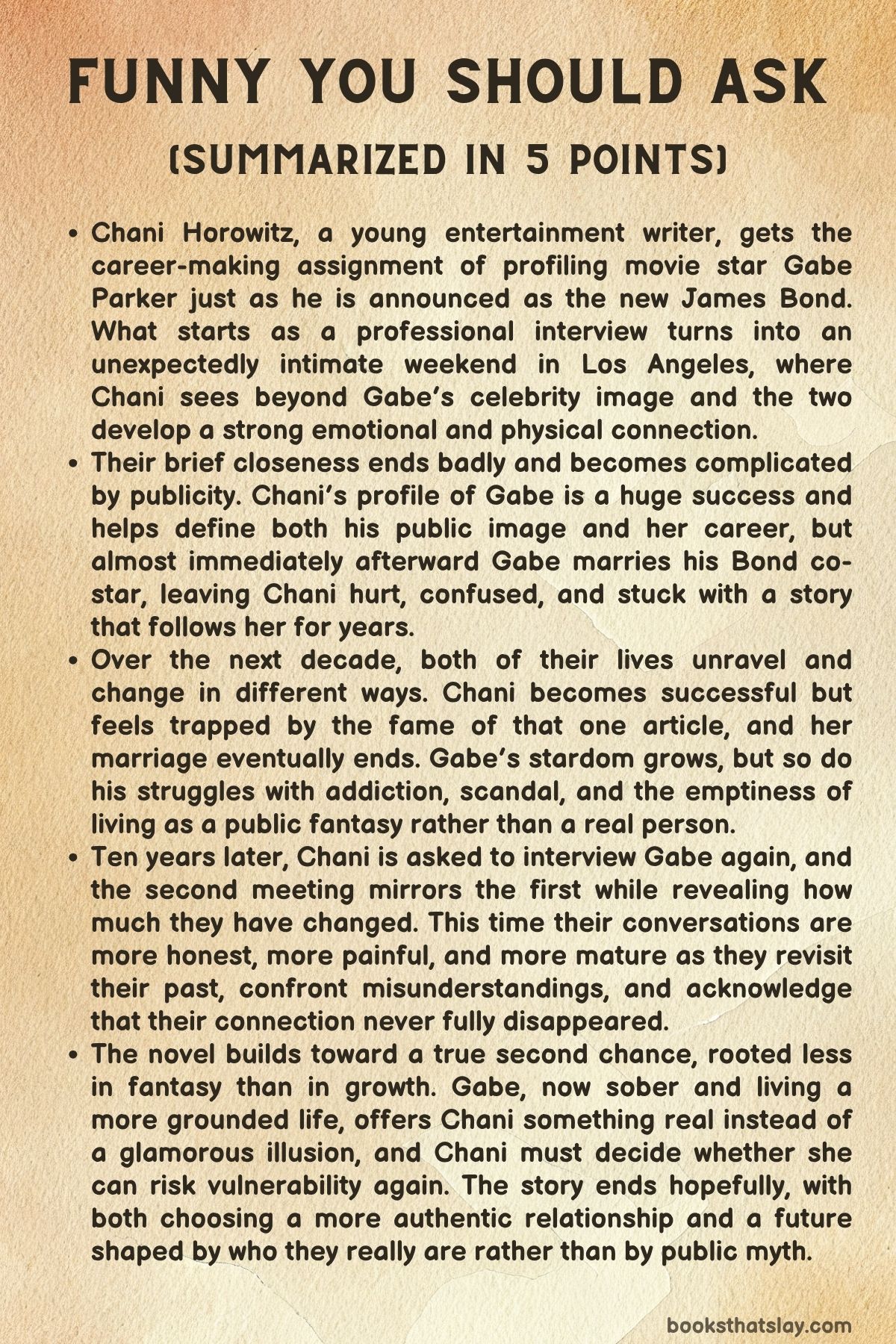
Twenty something Chani Horowitz is a struggling journalist in Los Angeles, writing puff pieces for an entertainment website. While her MFA classmates land book deals, she churns out celebrity profiles.
Her latest assignment thrills and terrifies her: profiling Gabe Parker, her longtime celebrity crush, who has just been cast as the new James Bond—the first American in the iconic role.
Chani arrives at Gabe’s rented house in Los Angeles for the interview and finds him shirtless, holding an adorable puppy. The easygoing, charming actor immediately disarms her.
What begins as a professional sit-down quickly turns into something far more personal. They go to a casual pub for lunch, where they talk over burgers and beer.
Gabe reveals glimpses of his grounded Montana roots, his family (including a close sister), and his insecurities about stepping into the massive shoes of James Bond. Chani, expecting a shallow heartthrob, discovers a thoughtful, funny, and vulnerable man beneath the Hollywood gloss.
The connection deepens as the weekend unfolds. Gabe invites Chani to the premiere of his upcoming movie the next night.
She attends as his guest, stepping into the glittering world of red carpets, after-parties, and celebrity houses. They spend more time together—talking late into the night, flirting, sharing laughs, and building undeniable chemistry.
There are kisses, intense emotional and physical closeness, and a charged intimate moment that stops short of full sex. It ends awkwardly, and Chani, overwhelmed and fearing she has crossed a professional line, sneaks out early the next morning without a proper goodbye, calling a cab home.
Chani writes the profile, which becomes a massive hit. It humanizes Gabe, helps audiences accept an American as Bond, and launches her career into a new stratosphere.
Tabloids buzz with speculation about whether they slept together. Chani never confirms or denies the full details, always giving coy answers like “I wish” when asked.
The article cements her as the journalist who “got” Gabe Parker.
But right after the piece publishes, Gabe elopes in Las Vegas with his beautiful Bond co-star, Jacinda Lockwood. The sudden marriage shocks Chani and crushes the private hopes she had allowed herself to entertain.
Publicly, it fuels more gossip about their weekend. Privately, it leaves Chani questioning everything.
In the years that follow, both lives diverge dramatically.
Chani moves between New York and Los Angeles, builds a successful career writing celebrity interviews and personal essays. She marries a fellow writer from her MFA days, but the relationship deteriorates.
Her husband resents her growing fame (which is still tied to the Gabe article) and accuses her of craving celebrity. The marriage ends in a painful divorce.
By the present, Chani is back in LA, wiser, in therapy, focused on her work, and promoting her second essay collection. Yet every interview or event circles back to “that Gabe Parker weekend.” She feels both grateful for and trapped by the piece that made her name.
Gabe’s trajectory is rockier. His Bond films bring massive fame, but the pressure, Hollywood lifestyle, and alcohol take a toll.
He struggles publicly, faces controversies, gets fired from the franchise, and goes to rehab (twice). His marriage to Jacinda—revealed later as more of a mutually beneficial PR arrangement/friendship than a deep romance—ends in divorce.
Sober and seeking authenticity, Gabe steps back from the spotlight. He spends time in his Montana hometown, where he finds peace running a small bookstore and theater.
He grows, confronts his issues (including family tensions, particularly with his father), and works on becoming a more grounded version of himself.
Ten years later, Gabe’s team reaches out for a follow-up interview with Chani as part of his comeback strategy for a new project. Chani’s agent encourages her to accept; it could be good for both.
Though reluctant—still haunted by the unresolved feelings and the way the first article defined her—Chani agrees. She wants answers and a chance to finally write the piece on her own terms.
They reunite at the same rented house in Los Angeles. The setup deliberately echoes the original weekend: same locations, similar outings.
But everything feels different. Both are older (Chani in her late thirties, Gabe in his early forties), divorced, and carrying baggage.
Gabe is sober, more introspective, and less performative. Chani is guarded, professionally sharper, and determined not to lose herself again.
They retrace steps—lunch at the pub, deeper conversations—but the chemistry remains electric and more complicated. Flirtation simmers beneath professional boundaries.
Gabe is disarmingly open about his struggles with addiction, fame’s toll, and his regrets. Chani confronts how the article shaped (and limited) her identity.
Old wounds surface: Gabe harbors some resentment that Chani published intimate details (even if softened), while Chani feels defined by a moment she can’t escape. They discuss the “what if” of that first weekend, the awkward ending, and the pain of his quick marriage afterward.
The mirrored structure heightens tension and reveals growth. Where the first weekend was fueled by youthful spark, alcohol, and excitement, the second is marked by honesty, vulnerability, and hard-won maturity.
Gabe invites Chani to see his real life in Montana, offering a glimpse beyond Hollywood.
As the reunion progresses, emotional walls crack. They acknowledge the deep bond that never fully faded.
There is physical intimacy this time, but more importantly, emotional reckoning. Chani grapples with her fear of repeating past mistakes and being swept up in public scrutiny again.
Gabe shows his transformed self—less “himbo” heartthrob, more authentic man seeking genuine connection.
A third-act conflict arises (as is common in the genre), forcing both to confront whether they have truly grown enough to choose each other without the distortions of fame or past regrets. Chani’s internal monologue delves into her career doubts, her divorce, and her lingering feelings.
Gabe opens up about his recovery and desire for a quieter, more meaningful life.
The story culminates in Montana, where Gabe has built a grounded existence. In a snowy, heartfelt moment, Gabe declares his love and his wish to build something real with Chani.
After reflection and growth apart, both realize their decade of separation allowed them to become people capable of a healthier relationship. Chani chooses vulnerability over fear, running into his arms and embracing the possibility of love beyond the spotlight.
The novel ends on a hopeful, optimistic note. Chani and Gabe commit to facing the future together—aware of public perception but prioritizing their authentic selves and connection.
Chani redefines success beyond viral fame, while Gabe finds balance between his career comeback and personal peace. Their bond, forged in a whirlwind weekend and tested by a decade, becomes something stronger and more intentional.
In essence, Funny You Should Ask is not just a romance about a journalist and an actor reuniting—it’s a story of two people who briefly touched each other’s lives, let the world reshape them, and finally find their way back to the real connection that was always there.
Characters
Chani Horowitz
Chani is the emotional and intellectual center of Funny You Should Ask, and her arc is built around identity, self-respect, and the cost of being seen only through one defining story. At the beginning, she is talented but professionally frustrated, caught between the literary life she imagined for herself and the celebrity journalism career she has actually built.
Her assignment to profile Gabe begins as an opportunity, but it quickly becomes the moment that alters the course of her personal and professional life. What makes her compelling is the tension between her sharp observational intelligence and her emotional vulnerability.
She understands performance, image, and public narrative better than most people around her, yet she is not immune to fantasy. Her attraction to Gabe is not just about celebrity worship; it is also about being recognized by someone she expected to be distant and unreachable.
As the story moves forward, Chani becomes a study in how success can become its own kind of trap. The profile gives her visibility, credibility, and influence, but it also reduces her public identity to the woman connected to one man and one explosive weekend.
That reduction shapes her marriage, her reputation, and even the way she evaluates her own career. She is deeply aware of how the world flattens women into labels, and she resists that flattening even while benefiting from the attention it created.
Her divorce and therapy further deepen her characterization because they show that she is not simply heartbroken or nostalgic; she is someone trying to understand how much of her life has been built in reaction to a moment she never fully processed. By the present timeline, she is more guarded, more articulate about boundaries, and less willing to romanticize what happened.
Her growth lies in learning to separate desire from self-erasure. In the earlier weekend, she is swept along by chemistry, excitement, and the glamour of being chosen.
In the later reunion, she insists on clarity. She wants to be seen not as the woman from the famous article, not as a projection, and not as a temporary emotional refuge, but as a full person with her own ambitions, hurts, and standards.
That insistence gives her power. She is not passive in the second chance romance; she becomes the person who tests whether love can exist without distortion.
Her final movement toward vulnerability matters because it is not a surrender of judgment. It is a conscious choice made by someone who has learned how to protect herself and decides, at last, that love is worth the risk when it no longer asks her to disappear.
Gabe Parker
Gabe is introduced through the gap between public fantasy and private reality, and that gap defines nearly everything about his role. At first glance, he seems to embody a familiar celebrity image: impossibly attractive, newly famous, and on the verge of becoming even more mythologized through his casting as James Bond.
Yet his real importance comes from the fact that he is never only that image. He is charming, yes, but also insecure, emotionally exposed, and clearly uneasy with the machinery of fame already forming around him.
His early openness with Chani gives him depth because it suggests that he is hungry for sincerity in a world that rewards performance. He is not simply using charisma to seduce her; he appears genuinely relieved to be with someone who sees him as a person rather than a commodity.
Over time, Gabe becomes an example of how fame can magnify existing weaknesses while rewarding a false version of the self. The pressure of public expectation, the demands of the franchise, and his access to excess all push him toward self-destruction.
His drinking, controversies, and repeated rehab stays are not written as random scandal points but as evidence of a man who lost any stable sense of who he was beneath the persona. Even his marriage to Jacinda reflects that instability.
It presents the appearance of success and desirability, yet it lacks emotional truth. That contrast makes his later life in Montana especially meaningful.
The bookstore and theater are not just picturesque details; they represent his attempt to rebuild a life based on substance, routine, and community rather than spectacle.
What makes Gabe effective as a romantic lead in the later timeline is that he returns changed, not polished. He is more honest, less theatrical, and far more aware of the damage he caused himself and others.
He no longer relies on magnetism alone. Instead, he offers accountability, emotional transparency, and the possibility of a grounded future.
His relationship with Chani grows stronger in the second timeline because he is finally capable of participating in love without hiding behind fame, intoxication, or impulsive decisions. His declaration of love carries weight because it comes from a man who has stopped chasing reinforcement from the world and started choosing a life that feels real.
He becomes convincing not because he remains idealized, but because he has been broken down and rebuilt with greater humility.
Jacinda Lockwood
Jacinda functions as a crucial figure in understanding how public narratives distort private realities. On the surface, she appears to be the glamorous Bond co-star who marries Gabe almost immediately after his connection with Chani, making her seem like the elegant rival who steps into the fantasy Chani briefly imagined for herself.
In a simpler story, she could remain in that role as the beautiful, inaccessible woman who “wins” the celebrity romance. Here, however, her significance comes from the later revelation that the marriage is less a sweeping love story than a mutually useful arrangement shaped by industry pressures and image management.
That revelation changes her from obstacle to commentary on the entertainment world itself.
Jacinda represents the ease with which women in public life are turned into symbols instead of people. To Chani, especially in the immediate aftermath of the wedding, she naturally becomes the face of rejection, the proof that Gabe chose a shinier and more suitable partner.
But the truth suggests a far more complicated emotional and professional situation. Her marriage to Gabe is structured around visibility and utility, not necessarily deep intimacy, which means she too is performing a role assigned to her by the world around her.
She is therefore not only part of the illusion but also trapped inside it. That gives her an understated tragic dimension.
Her presence also sharpens the novel’s treatment of envy and false comparison. Chani’s pain is real, but Jacinda’s life is not the perfect answer to that pain.
By existing as a person whose public image conceals private compromise, she reinforces the broader point that glamour often hides emptiness, negotiation, and emotional distance. Even when she is not at the center of the story, she matters because she exposes the danger of assuming that the visible story is the true one.
Jeremy
Jeremy, Chani’s ex-husband plays an essential role in revealing the personal cost of her professional success. Though he is not the central romantic figure, his importance lies in how he reflects the life Chani tried to build after the first Gabe weekend.
On paper, he seems like the safer, more respectable choice: a fellow writer from her MFA world, someone connected to the literary identity she once imagined for herself. That connection should have offered mutual understanding and intellectual companionship.
Instead, the marriage exposes a deep imbalance. As Chani becomes more visible and successful, he cannot fully celebrate her achievements because he sees them through the lens of competition, resentment, and perhaps disappointment with his own trajectory.
This relationship shows that Chani’s struggle is not limited to one unresolved celebrity romance. It extends into her broader fear of being misread and reduced.
Her husband does not seem to understand the complexity of her work or the emotional burden of having her entire career linked to one defining article. Rather than seeing her ambition and talent clearly, he interprets her public success as vanity or hunger for attention.
That judgment is especially painful because it comes from someone who should have known her best. In this sense, the failed marriage becomes proof that emotional safety cannot be built on shared credentials alone.
His role also deepens Chani’s eventual readiness for a healthier relationship. The divorce forces her to confront what she has tolerated, how often she has explained herself, and how exhausting it is to remain in relationships where her inner life is not fully respected.
He is therefore not just a failed partner but a narrative contrast. Through him, the story shows the difference between being with someone who resents your becoming and someone who genuinely wants to know who you are.
Gabe’s Father
Gabe’s father is important less for screen time and more for what he reveals about Gabe’s emotional formation. Family tension, especially with a father figure, often helps explain why a character struggles with worth, performance, and intimacy, and that seems true here.
Gabe’s public confidence sits alongside private insecurity, and his strained paternal relationship suggests a long history of feeling measured, misunderstood, or insufficient. Even without extensive direct scenes, this relationship helps explain why fame might have become both intoxicating and destabilizing for him.
External approval can feel irresistible to someone whose internal foundations were never solid.
The significance of Gabe’s father also lies in what this tension says about masculinity. Gabe is pushed into one of the most iconic masculine roles in popular culture, yet his actual emotional life is fragile and unresolved.
If his father represents a harsher or more traditional standard of manhood, then Gabe’s collapse under pressure becomes even more understandable. He is not failing simply as a celebrity; he is failing within an inherited framework that taught him to perform strength rather than build it honestly.
By the time Gabe creates a quieter life in Montana, the shadow of that relationship still matters. His grounded existence suggests a movement away from inherited expectations and toward self-definition.
In that sense, the father is part of the story’s deeper emotional structure. He helps explain the wound Gabe carries and, indirectly, the kind of healing he seeks.
Lauren
Lauren, Gabe’s sister is a small but meaningful presence because she connects him to a version of himself untouched by Hollywood mythmaking. When Gabe speaks about his family and roots, his sister becomes part of the emotional evidence that there has always been more to him than the celebrity persona.
A close sibling relationship often signals the capacity for loyalty, tenderness, and long-term emotional bonds, and that seems to be the function she serves in his characterization. Through her, he appears less like an isolated star and more like a son and brother who came from a real place with real attachments.
She also helps preserve the Montana identity that later becomes central to Gabe’s recovery. The more chaotic his public life becomes, the more important these family ties feel as reminders of stability and authenticity.
His sister represents continuity: the world that existed before Bond, scandal, addiction, and image control. That continuity matters because it suggests Gabe’s better self was never entirely invented during recovery; it had always existed, even if fame buried it.
Her role, then, is quietly restorative. She supports the idea that redemption is possible not because a person becomes someone entirely new, but because they return to values and connections that once made them whole.
Themes
Fame, Persona, and the Loss of Privacy
Public image controls the lives of both central characters long after the original interview weekend ends. A single article, a sudden marriage, and years of gossip create stories about them that become more powerful than the truth.
The novel shows how fame does not only affect celebrities; it also affects anyone who becomes attached to them in the public imagination. Gabe is packaged as a fantasy, then criticized, consumed, and discarded according to the needs of the culture around him.
Chani experiences a parallel version of this process. Her career success comes through her ability to humanize a famous man, yet she herself is reduced to a woman associated with that one act of access.
The damage lies in the fact that both are treated as fixed narratives rather than evolving people. The world wants symbols: the star, the journalist, the co-star wife, the viral almost-romance.
Their inner lives become secondary to what can be circulated. By returning them to each other years later, the story asks whether intimacy can survive after public interpretation has hardened around private experience.
The answer depends on whether they can reclaim authorship over themselves.
Missed Timing and Emotional Maturity
The connection at the center of the romance is shaped not by lack of feeling but by bad timing and emotional unreadiness. The earlier weekend is full of attraction, possibility, and real tenderness, yet neither character is stable enough to build something lasting from it.
Chani is young, overwhelmed, and uncertain of her own boundaries, while Gabe is standing at the edge of extreme fame and not yet capable of offering anything steady. Their separation hurts precisely because it is not caused by absence of love but by the inability to make sense of that love when it first appears.
The later reunion gives the story its emotional force because it revisits the same dynamic under different conditions. Both are older, bruised by experience, and less seduced by fantasy.
They can now ask harder questions about trust, regret, and what a real relationship would require. The second chance matters because it is not simply a return to an old desire.
It is a test of whether people who once failed each other through confusion and circumstance can meet again with enough self-knowledge to choose differently.
Recovery, Reinvention, and the Possibility of Change
Gabe’s arc places recovery at the center of the emotional landscape, but the novel treats change as something broader than sobriety alone. His addiction and public collapse are the clearest examples of a life spinning out of control, yet Chani also undergoes a quieter form of recovery.
She has to rebuild after a marriage that diminished her, after years of being trapped inside a public identity she did not fully choose, and after carrying unresolved feelings that shaped her sense of self. Both characters spend years learning how to live more honestly.
Reinvention here is not glamorous. It involves therapy, distance, accountability, embarrassment, and the slow acceptance that earlier versions of the self were unsustainable.
The Montana setting becomes important because it offers a physical image of that process: a life smaller in scale but fuller in meaning. Change is presented as hard-earned rather than dramatic.
The story insists that people can become better partners only after they have stopped performing for survival and started taking responsibility for their own inner damage.
Women, Work, and the Burden of Being Defined by One Story
Chani’s career raises questions about authorship, ambition, and the narrow ways women are often judged in public and private life. She is intelligent, skilled, and professionally successful, yet the world keeps returning her to one article and one man, as though her entire body of work exists in orbit around a single episode.
That pattern reveals how women’s achievements are often filtered through relationships, scandal, and desirability rather than evaluated on their own terms. Her marriage reinforces this pressure because even within an intimate partnership, her success is interpreted as evidence of superficiality instead of talent.
The novel shows how exhausting it is to keep proving depth in spaces eager to misunderstand female ambition. Chani’s development is therefore not just romantic.
It is also about reclaiming narrative control over her own life. She must decide what kind of writer she wants to be, what kind of recognition she values, and whether she is willing to live beyond the version of herself that others keep resurrecting.
Her eventual emotional clarity is tied directly to this professional clarity: she can only choose love well once she stops accepting reduction as inevitable.