Game On by Ki Stephens Summary, Characters and Themes
Game On by Ki Stephens follows two students at Whitland University who collide at the worst—and best—possible moment in their lives. Ella, a dedicated cheerleader rebuilding after heartbreak, and Hudson, a focused quarterback trying to protect his final season and his future, enter each other’s paths by accident.
What begins as a reckless night turns into something far more complicated as they fight expectations, team boundaries, and their own fears. The story explores growth, pressure, ambition, and the messy steps of figuring out who you want to be, with romance at its center.
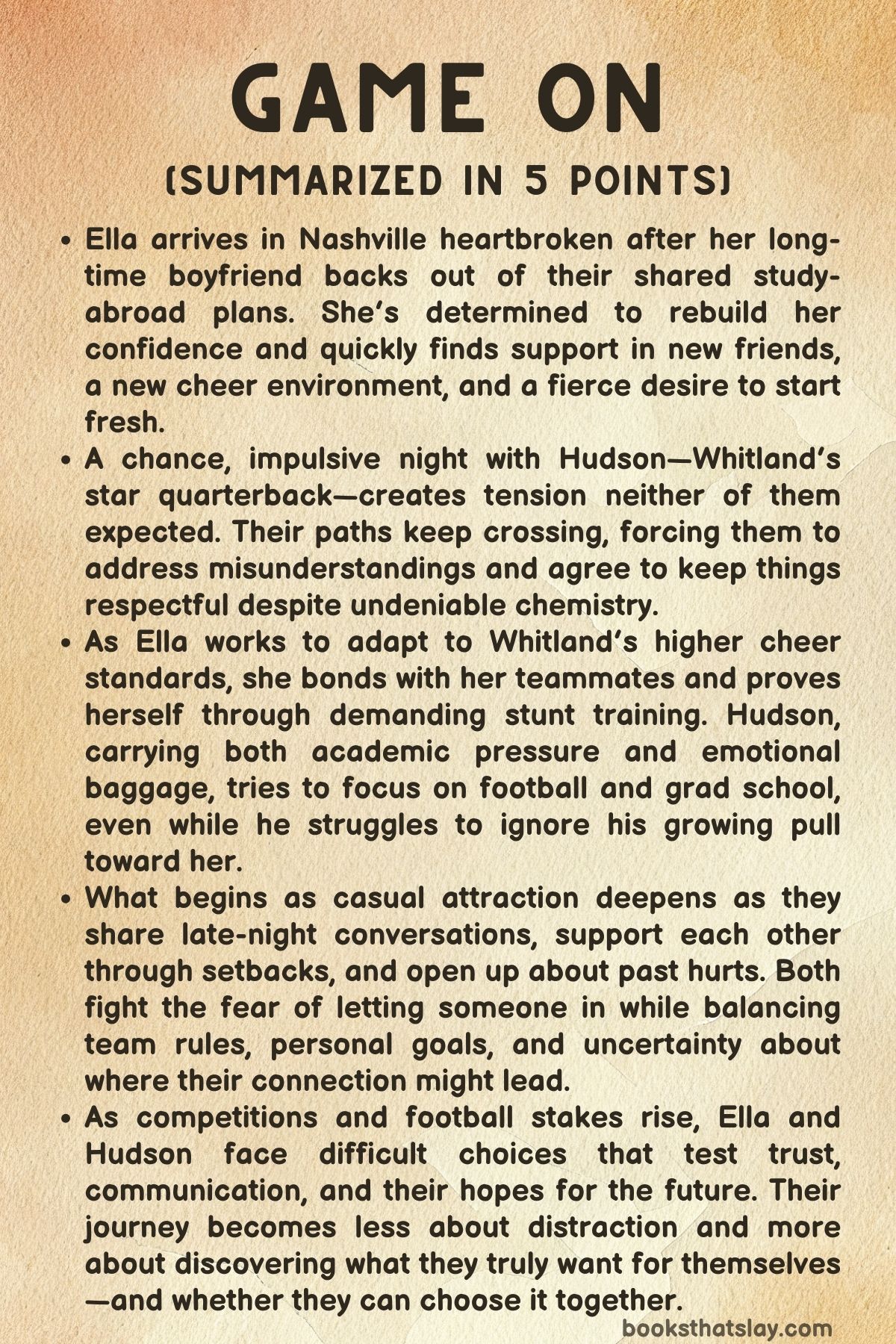
Summary
Ella leaves Oxford for a year abroad at Whitland University in Nashville, hoping for a fresh start. Her excitement is abruptly shaken when her longtime boyfriend, Jamie, announces he will not be joining her as planned.
Hurt and furious, she leaves England determined not to let him destroy her chance to build something new. Upon arriving in Nashville, she meets her energetic roommate, Gabi, who quickly introduces her to the other Whitland cheerleaders.
Some greet her with enthusiasm, while Claire, the team captain, studies her with cool appraisal. Despite the emotional chaos she carries, Ella agrees to join the group for a night out, thinking distraction might help.
At Sidetrack, the local bar, Ella steps outside to breathe and meets Hudson Fox, a striking stranger whose confidence and charm catch her off guard. Their quick banter and the mixture of heartbreak and alcohol nudge her into going home with him.
Their night together is impulsive and intense, leaving her shaken by her own boldness. In the morning, she learns he is Whitland’s star quarterback—a player with a reputation for effortless charisma.
He discovers she is a cheerleader, and since interactions between athletes and cheer team members are discouraged, he tries to downplay their night. Their awkward, defensive exchange ends with Ella leaving, embarrassed and overwhelmed.
Determined not to let her first misstep define her, she follows Gabi to Skyline Gym, where she meets more teammates and joins her first co-ed stunt session. Working with Ash as her base ignites her competitive spirit again, and she begins to believe Nashville might hold more for her than heartbreak.
Meanwhile, Hudson returns to football preseason training with a promise to stay sober and focused after a reckless past semester. His friend Levi urges him to loosen up, but Hudson is determined to build a better path.
When Ella appears at a team dinner with Gabi, the tension between them flares again, prompting Ella to confront him about ignoring her. They agree to act normal around each other, though neither seems capable of keeping things strictly neutral.
Ella leaves for a cheer camp led by the formidable Coach Morgan, where she pushes herself to match Whitland’s higher athletic standard. Her partnership with Ash strengthens, catching Claire’s notice.
Hudson works on graduate school applications during this time, grappling with his troubled family history and the shadow of his father’s failures. His resolve to avoid Ella weakens when they cross paths at an ice cream outing and later a drive-in movie with friends.
Quiet moments between them show a softness neither expected, though both remain guarded.
At Whitland’s preseason game, Hudson excels on the field. At the post-game party, he watches Ella from across the room with a mix of longing and frustration.
She confronts him again, insisting she does not play games and needs clarity. He tells her he “can’t” want her because they are off-limits and because his own life feels unstable.
The rejection stings, and she walks away hurt. Hudson regrets his decision almost immediately.
Classes begin, and even in their shared anthropology lecture, Ella keeps her distance. Still, their connection keeps pulling them back toward each other.
They eventually fall into a cycle of intimate encounters—private, consuming, and undefined. Ella tries to maintain emotional distance, believing they are only physical, but their bond keeps deepening.
Ash announcing their entry into partner stunt qualifiers heightens the pressure on her, and Hudson’s sudden appearances at the gym only complicate the feelings she tries to control.
At a Halloween party hosted by Hudson and Levi, another encounter follows a playful challenge upstairs. Matching costumes, arranged by their friends, unintentionally hint at how intertwined their lives are becoming.
Still, Hudson keeps his distance afterward, and Ella feels the strain of wanting something more stable.
During a football game soon after, Ash suffers a serious wrist injury while stunting on the sidelines. Ella is devastated—not only for him, but for losing her opportunity to compete at the level she worked so hard to reach.
Hudson finds her later and comforts her, taking her to a movie to give her a break from the pressure. She tries training with Luke, but it becomes clear she cannot qualify with him.
Seeing her discouragement, Hudson steps in and offers to base for her. With Ash’s support and Hudson’s determination, they train relentlessly until their routine improves beyond what Ella believed possible.
Their partnership tightens their emotional connection, and even while Hudson travels for away games, they stay in constant contact. They practice in the park upon his return, pushing their stunt to near perfection.
Realizing how close they’re growing, Ella brings up boundaries, unsure how to protect her heart while Nationals approach. Hudson admits he doesn’t want to stop anything between them, but he will respect whatever she needs.
A turning point comes one night when they rescue a drunk Claire from a group of aggressive baseball players. Later upstairs, they witness Claire breaking down in Levi’s arms, revealing hidden feelings and misunderstandings between them.
This moment deepens everyone’s connections and shifts the team dynamic.
When partner stunt bids for NCA are posted, Hudson and Ella earn a championship bid. The team celebrates at a Nashville club, where tension between them spills into a heated, hidden moment in their booth.
Over the following weeks, they train intensely for Daytona. Ella opens up to Hudson about her emotionally distant parents, her mother’s health, and her old relationship with Jamie.
Hudson worries he mirrors Jamie’s caution, but Ella assures him he is far more sincere.
Hudson receives acceptances to several Classics graduate programs, including Oxford. Tuition would be covered, but living costs scare him, so he hides the acceptance letter, unsure what to do.
When Ella finds the letter in his drawer and realizes he kept it secret for two weeks, she confronts him. Feeling betrayed that he hid such a big decision, she leaves in anger.
At Daytona, Molly and Olivia arrive to support Ella, but so does Jamie, who begs her to rekindle their relationship. She firmly refuses.
Right before partner stunts, Hudson encounters Jamie, who insults him and calls him unworthy of Ella. Shaken but determined, Hudson arrives just in time for their performance.
He and Ella hit every skill, placing second behind Claire and Evan. Ella and Claire share a newfound respect afterward.
The full team performs next, delivering a strong routine despite a minor error. That night, Ella sends Hudson a note asking to meet on the rooftop.
There, he opens up about his insecurities and admits he feared holding her back. She reassures him, tells him she loves him, and suggests they live together in Oxford.
He finally admits he wants Oxford more than anything and tells her he loves her too.
In finals, Whitland and Wyler enter tied. Whitland performs cleanly, and when results are announced, Whitland wins first place.
The team rushes into the ocean to celebrate, and Ella and Hudson kiss in the waves, laughing at the start of a future they’re finally ready to claim.
Months later, the epilogue finds them living together in Oxford. Hudson thrives in his program, they have steady routines, and their relationship has grown into a stable, affectionate partnership.
They speak often with Hudson’s family, support Levi’s rising football career, and prepare for holidays together. Their shared life is warm, grounded, and certain—proof that the risks they took led them exactly where they were meant to be.
Characters
Ella
Ella emerges as the emotional core of Game On, defined by her resilience, vulnerability, and a deep desire to both prove herself and finally choose a life that feels authentically hers. At the beginning, she is a girl whose world has revolved around predictability—her long-term boyfriend, her structured academic path, and her tight-knit cheer team in Oxford.
Jamie’s last-minute betrayal shatters that predictability and sends her into Nashville heartbroken, unsure of herself, and fearing she will be swallowed by her own insecurities. Yet throughout the story, Ella repeatedly chooses courage over fear.
She pushes herself to integrate into a new team, tries unfamiliar stunt skills, and begins to reclaim her sense of identity. Her relationship with Hudson complicates this growth: it challenges her, scares her, draws out her boldness, and forces her to confront what she truly wants.
She is not defined by perfection but by perseverance—falling apart, picking herself back up, and refusing to let heartbreak or setbacks ruin her dream. Her openness with Hudson later in the book—about her emotionally distant parents, her loneliness growing up, and her fear of being an afterthought—shows how much she grows from guarded to emotionally brave.
By the end, Ella transforms from a girl clinging to the life she thought she should want into a woman claiming a future built entirely on her own terms.
Hudson Fox
Hudson is introduced as a contradiction: a disciplined, celebrated quarterback who carries a reputation for casual hookups but secretly fights to rebuild his life after hitting emotional rock bottom. His sobriety, academic ambition, and self-imposed strictness reveal a young man terrified of repeating his father’s downfall—a former NFL star whose addiction and abandonment left deep scars.
This fear of becoming “another version of him” shapes Hudson’s guarded nature and reluctance to commit. Ella destabilizes that control immediately; she represents everything he both craves and fears—connection, vulnerability, and a distraction from the narrow path he set for himself.
His journey is one of learning to trust himself, to believe he deserves stability, love, and a future beyond football. His eventual acceptance into Oxford becomes symbolic: he can rewrite the trajectory of his life, step out of his father’s shadow, and build something rooted in his own merit.
With Ella, Hudson softens, jokes, lets himself be known, and allows someone to witness the parts of himself he keeps buried—his insecurity, his loyalty, and his capacity for deep love. His character arc is not just romantic; it is a reclamation of self-worth.
Jamie
Jamie functions as a pivotal force despite limited direct presence. He represents Ella’s old life—predictability, emotional safety, and routine.
The way he abandons her right before she leaves for Nashville exposes not only his immaturity but also the quiet imbalance in their relationship: Ella poured in stability while Jamie took comfort in it. His reappearance in Daytona, begging for another chance, reveals that his decision to “find himself” was less self-discovery and more fear of change.
Jamie is not a malicious character, but he is fundamentally passive, self-centered, and lacking the maturity to support Ella’s growth. His presence highlights what Ella must leave behind to evolve.
Gabi
Gabi is the first person in Nashville who embraces Ella without hesitation, becoming both her guide and her emotional anchor. She is warm, lively, and socially confident, but also deeply intuitive, knowing when Ella needs space, distraction, or blunt honesty.
Gabi’s easy friendship helps Ella integrate into the Whitland environment much faster, giving her a sense of belonging during a time of vulnerability. Her role in the story extends beyond friendship—she bridges the social worlds of cheer and football, drawing the two groups together.
Her growing closeness to Levi also subtly illustrates her own maturity and faith in real connection. Through Gabi, readers see what healthy, supportive female friendship should look like.
Levi
Levi is Hudson’s closest friend and emotional opposite—playful, charming, and outwardly carefree. Under his humor is unwavering loyalty; he pushes Hudson out of isolating habits, supports him through sobriety, and acts as the stabilizing presence Hudson desperately needs.
Levi’s subplot with Claire adds unexpected depth, showing he is capable of tenderness and seriousness when someone he cares about is hurting. His journey to the Titans mirrors Hudson’s arc in a different way: both men are redefining what success and stability mean for them.
Levi grows into someone who deserves the future he’s building.
Claire
Claire begins as the intimidating, strict team captain who scrutinizes Ella from the moment they meet. Her rigid exterior masks insecurity, pressure, and a fierce need to prove herself worthy—not just as a cheerleader, but as a leader.
The night when Ella and Hudson rescue her from the baseball players becomes a turning point, exposing Claire’s loneliness and self-doubt. Her emotional reaction to believing Levi was with Sammy underscores her vulnerability and the walls she hides behind.
As she competes alongside Ella and eventually shares a heartfelt moment after partner stunts, it becomes clear that her coldness came from fear, not arrogance. Claire’s growth is quieter but powerful: she learns to let people in, trust her teammates, and accept that leadership doesn’t require emotional detachment.
Ash
Ash represents stability, patience, and unwavering partnership. As Ella’s stunt base and one of the first people to treat her with unquestioned support, he becomes a grounding presence in her new environment.
His injury is devastating because it symbolically strips Ella of the confidence she was building, yet his selfless acceptance of Hudson stepping in shows his maturity and genuine care for the team’s success. Ash never displays jealousy, entitlement, or resentment; instead, he lifts Ella up emotionally even when he cannot do so physically in stunts.
He is the embodiment of a dependable teammate and a steady friend.
Luke
Luke plays a quieter role within the cheer team but represents the broader support system Ella finds in Nashville. When he steps in to spot and later attempts to base for her, his earnestness reveals the collaborative spirit of the team.
Though he cannot match Ash’s or Hudson’s ability, his willingness to try underscores the team’s loyalty to Ella. Luke symbolizes the community she gains—people willing to back her even if she’s still proving herself.
Sammy
Sammy is bubbly, observant, and always in the middle of team dynamics. Her innocent moment with Levi accidentally triggers Claire’s emotional spiral, but she immediately steps aside without drama, showing emotional intelligence and respect.
Sammy adds levity to group scenes and reflects the warmth and cohesion of the Whitland cheer family. She is a reminder that even secondary friendships can profoundly shape a character’s feeling of belonging.
Themes
Identity, Reinvention, and Personal Growth
Ella’s journey in Game On unfolds during a period of upheaval where she is forced to redefine herself outside the structures that once shaped her. Leaving behind her country, her long-term relationship, and her comfortable reputation as a top-tier cheerleader puts her in unfamiliar emotional territory.
Her identity had been tightly linked to predictability—Jamie, Oxford, routines she understood—until those foundations collapsed within hours of her departure. Nashville becomes the place where she confronts the version of herself she had been performing versus the version she could become.
Her loneliness, impulsive choices, and occasional guilt are less about moral conflict and more about navigating her own boundaries for the first time. Reinvention isn’t glamorous for her; it’s messy, driven by fear, bruised ego, and the sudden possibility that she is meant for more than stability.
Hudson’s arc echoes this theme from another angle. His desire for reinvention is rooted in self-correction—escaping his father’s shadow, repairing his academic record, and learning how to be accountable after years of bad decisions.
Both characters initially treat reinvention as a task to complete rather than an identity to inhabit. Only through setbacks, arguments, and forced vulnerability do they learn that self-growth isn’t linear; it demands compromise, self-awareness, and a willingness to confront uncomfortable truths about their pasts.
Together, they demonstrate that reinvention doesn’t erase who they were but expands the possibilities for who they can be.
Healing After Heartbreak
Heartbreak for Ella is less about losing Jamie and more about losing the illusion of safety he represented. His abrupt decision shatters her confidence, leaving her anxious that every choice she makes might be a mistake.
Her interactions with Hudson initially serve as distraction rather than comfort, and her guilt-laced attraction underscores how unsteady she feels in her own skin. Healing for her is a slow accumulation of small victories—nailing a stunt, surviving an awkward social encounter, forming new friendships, and learning that she can be wanted without being controlled.
Hudson’s heartbreak is older and deeper, rooted in abandonment and betrayal from family rather than romance. His father’s downfall taught him to expect loss and to avoid attachment.
When Ella challenges his avoidance, he feels threatened by how vulnerable she makes him. Their healing paths intersect not because they “complete” each other but because they learn to trust someone who doesn’t demand perfection.
Their eventual relationship isn’t a cure; it becomes a safe environment where healing can continue without shame or pressure.
Fear of Failure and the Pressure to Perform
Performance, in both physical and emotional terms, drives much of the conflict in the story. Ella enters Whitland aware that the team’s standards outpace anything she has done before.
Each practice exposes her insecurities, especially once she realizes that her place isn’t guaranteed. Her anxiety intensifies after Ash’s injury because failure suddenly carries the weight of letting down the one person who believed in her potential.
The pressure is magnified by the competitive culture around her, where a single bobble can define an entire season.
Hudson confronts similar pressures on the football field and in the classroom.
He is constantly under scrutiny—from scouts, coaches, professors, and the legacy of his father. Unlike Ella, his fear of failure is not about disappointing a team but about breaking a promise to himself.
His sobriety, discipline, and relentless work ethic stem from an internal fear that if he slips, he will repeat his father’s mistakes. Their shared performance pressure becomes a point of connection, allowing them to empathize with each other’s exhaustion and celebrate each other’s wins.
Success for both characters is earned through resilience rather than talent alone.
Connection, Intimacy, and Emotional Vulnerability
The relationship between Ella and Hudson is built on a physical attraction that carries emotional weight neither of them wants to acknowledge at first. Their early encounters are marked by miscommunication, assumptions, and an unspoken awareness that their connection is too strong to be casual.
Physical intimacy comes easily to them; emotional intimacy does not. Every moment they open up—about Ella’s distant parents, Hudson’s father, their insecurities, their ambitions—pushes them into unfamiliar vulnerability.
The story highlights how intimacy isn’t about grand declarations but about quiet moments: late-night conversations, shared routines, support after a bad practice, comfort after a loss. Their chemistry becomes a catalyst for honesty.
Over time, they stop hiding behind jokes and learn to articulate their fears, even when it leads to conflict. Their bond strengthens not because their attraction deepens, but because they realize they can trust each other with the truths they rarely share with anyone.
Ambition, Opportunity, and the Cost of Commitment
Ambition shapes many characters’ decisions, often pulling them in directions at odds with their relationships. Ella wants to qualify for Daytona and prove she deserves her spot.
Hudson wants graduate school, a future detached from football, and stability that doesn’t depend on fame. These goals complicate their relationship, especially when Hudson hides the Oxford letter.
His secrecy is tied to the fear that pursuing ambition will cost him Ella, while Ella interprets it as a sign that he doubts their future.
The theme underscores how ambition requires sacrifice, but not at the expense of personal relationships.
The resolution shows that ambition and love can coexist when partners choose honesty and teamwork. Ella’s suggestion that they live together in Oxford demonstrates her understanding that commitment isn’t only emotional; it’s practical, supportive, and intertwined with long-term planning.
The ending reinforces that ambition is not a barrier but a shared pathway when both partners are willing to support each other’s dreams.
Friendship, Support Systems, and Found Family
Ella and Hudson both rely heavily on the people around them as they navigate their respective challenges. Gabi provides Ella with grounding, companionship, and cultural orientation in a new environment, while Ash becomes a source of confidence and mentorship in cheer.
These friendships give her the psychological safety she lacks from family.
Hudson’s friendship with Levi is equally essential.
Levi stabilizes him during moments of self-doubt, holds him accountable, and reminds him that he doesn’t have to handle everything alone. Their bond becomes an anchor that steadies Hudson’s often chaotic internal world.
The novel illustrates that romantic relationships thrive when individuals are supported by strong platonic ones. Ella and Hudson learn that they do not have to face obstacles alone; they can rely on friends who celebrate their victories, share their burdens, and guide them through moments of confusion and heartache.
Their friendships become a form of found family, offering affection, loyalty, and emotional nourishment that help them grow into better versions of themselves.