Get Over It, April Evans Summary, Characters and Themes
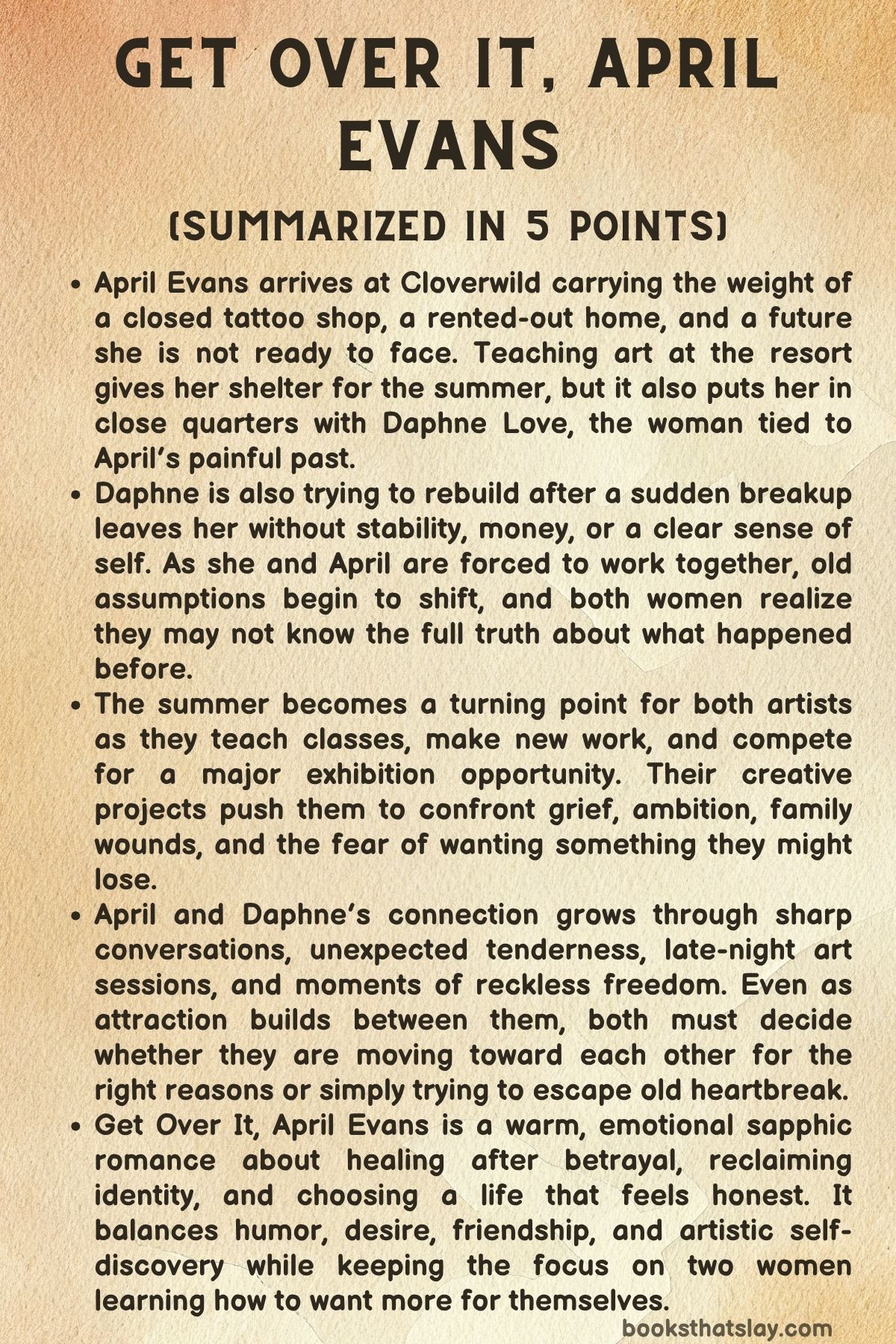
Get Over It, April Evans by Ashley Herring Blake is a contemporary queer romance about loss, reinvention, and the hard work of choosing yourself. The story follows April Evans, a former tattoo artist whose life has fallen apart, and Daphne Love, the woman connected to April’s deepest heartbreak.
Forced to share a cabin and teach art together at a lakeside resort, they begin as uneasy rivals with a painful history between them. As they confront betrayal, failed dreams, family rejection, artistic ambition, and unexpected desire, both women must decide whether love can be part of healing without becoming a hiding place.
Summary
April Evans leaves her mint-green bungalow in Clover Lake for the summer with a heavy heart. She can no longer afford the mortgage, so she rents the house to a woman named Trudy and her children.
With her cats, Bianca del Kitty and Bob the Drag Cat, packed into her overstuffed MINI Cooper, April drives away from the home she loves and from Wonderlust Ink, the tattoo shop she closed only weeks earlier. The shop had been failing for years, and after letting go of her only employee, April finally accepted that she could not save it.
Her new plan is to teach art classes at Cloverwild, a luxury lakeside resort that offers room and board with the job.
Before arriving, April stops at Clover Moon Café, where she runs into Penny Hampton, a local gossip who questions her about her summer plans, her best friend Ramona, and her romantic life. April admits she will teach at Cloverwild, but she hides the truth about her money problems and the closed shop.
At the resort, she meets the owner, Mia Gallagher, who gives her her cabin assignment and work materials. April is shocked to learn that her cabinmate and co-teacher will be Daphne Love, the woman she believes broke up her engagement to Elena Watson three years earlier.
Daphne is also starting over. In Boston, she has been sleeping on her friend Vivian’s couch after Elena suddenly ended their relationship.
Daphne had expected a proposal, but instead Elena left her heartbroken, broke, and without a clear future. The job at Cloverwild, arranged through Vivian’s aunt Mia, is her chance to survive the summer.
When she arrives at the cabin, April treats her with open hostility. Daphne does not understand why.
April soon realizes Daphne may not know who she is or what Elena did.
April remembers how she met Elena in a Boston lesbian bar, fell in love, and accepted her proposal. Elena later became distant and ended things over the phone, saying she had met someone else.
April has blamed Daphne ever since, assuming Daphne knew Elena was engaged. Their tense partnership becomes harder as they begin teaching together.
At the resort’s opening party, April speaks with Ramona, who urges her to learn the truth before judging Daphne. April also meets Nicola Reece, a curator from the Devon museum in London, who is considering April’s illustration work for an exhibition called Evolution if she can create new pieces over the summer.
After the party, Daphne follows April to the lake, and their argument leads them into a canoe. There, Daphne reveals Elena recently broke her heart.
April realizes Daphne and Elena are no longer together and that Daphne may never have known the truth. April admits her fiancée cheated on her, then names Elena.
Daphne is horrified and insists she never knew. In her panic, she falls into the lake, and April jumps in after her.
The scene ends in embarrassment, but it also begins a fragile honesty between them.
Daphne later tells April about her childhood in Crestwater, Tennessee. Her father was a Baptist pastor, and her family’s church community was deeply conservative.
When Daphne was fifteen, her mother found a private sketchbook that revealed Daphne’s queer identity. Her parents condemned her, and Daphne spent years trying to become the daughter they wanted.
Her art teacher, Ms. Hale, helped her return to honest painting and secretly apply to art schools. A full scholarship to Boston University gave Daphne a way out, but leaving meant losing her family.
Daphne begins painting again at Cloverwild, creating a powerful image of a girl in a wildflower field whose face is blurred. April praises it and suggests a series.
Daphne asks April to design a tattoo for her, and April admits she used to own Wonderlust. Daphne reminds her that closing the shop does not make her less of an artist.
Soon both women learn that Nicola is considering each of them for the Devon opportunity, turning them into competitors.
As they spend more time together, Daphne decides she wants to experience the freedom she never allowed herself. With April and bartender Sasha, she makes a list that includes dyeing her hair, skinny-dipping, kissing someone, getting a tattoo, and having a fling.
April dyes Daphne’s hair purple, and the two women begin sharing more about art, desire, and their pasts. At a dance party, their attraction becomes impossible to ignore.
Daphne sprains her ankle, and April helps her back through the rain. Their closeness grows through quiet care, late-night talks, movies, and unspoken longing.
April also reconnects with Ramona, who arrives at Cloverwild with her famous girlfriend, Dylan Monroe. April finally tells Ramona the truth about losing her shop, renting out her house, competing for the Devon, and feeling confused about Daphne.
At a solstice bonfire, Daphne, April, and Sasha draw tarot cards that suggest transformation, collapse, and suspension. April later begins shaping her Devon project around tarot images and her own emotional state.
The tension between April and Daphne turns romantic after they kiss in the woods. Soon after, April learns from a gossip alert that Ramona and Dylan are engaged.
She is hurt that she found out online instead of from Ramona. Daphne supports her quietly, then helps her process the pain by taking her to the art studio to throw paint at canvases.
Afterward, they go to Mirror Cove, a childhood refuge for April and Ramona. Covered in paint, they strip down and swim.
In the lake, they talk about family, sexuality, and the people they used to be. They kiss again, but April pulls away, using the Devon competition as an excuse.
At Ramona and Dylan’s engagement dinner, April’s parents arrive unexpectedly and respond coldly to the news that she closed her tattoo shop. Hurt, April retreats to the dock.
Daphne follows, and they speak honestly about parental rejection and wanting to belong. April says she wants to kiss Daphne, and they do, until Ramona interrupts.
Their panic shows how much the connection matters.
The next night, Sasha brings them to a play party. Daphne, who has recently blocked Elena after realizing she no longer loves her, explores a dominant side of herself with April.
The experience leads them back to the cabin, where they finally have sex. Afterward, they discuss Elena, the Devon, their age difference, and the uncertain shape of their relationship.
April and Daphne agree to choose what they feel in the present, even if they do not know what it will become.
For several weeks, Daphne’s life becomes full of painting, teaching, friendship, sex, and discovery. She works on an autobiographical series about leaving home and becoming herself, but she struggles with the ending.
April surprises her with a birthday celebration at Clover Moon Café, giving Daphne a sense of chosen family.
Then Elena returns. She finds Daphne in the studio and says she made a mistake.
She claims she got scared when their relationship had to move forward or end, then produces a ring and proposes. Daphne is shaken because Elena is offering the safety, family, and commitment she has always wanted.
She nearly accepts, even putting on the ring, but the moment forces her to see how easily she could still choose approval over herself.
April, believing Daphne has chosen Elena, stays with Ramona and prepares for Nicola’s decision. The next morning, she sees Daphne’s paintings displayed and knows they deserve the Devon.
Daphne tells April she only almost said yes to Elena. They embrace, relieved, but Nicola arrives before they can fully talk.
Nicola reviews both projects and chooses Daphne’s paintings. April is disappointed but sincerely congratulates her.
Moved by love, April says she wants to go to London with Daphne. Daphne refuses.
Daphne explains that almost accepting Elena’s proposal scared her because it proved she still had work to do. She has spent her life reshaping herself for her parents, her church, and Elena.
With April and Sasha, she has started discovering who she is, and she likes that person. She loves April, but she cannot enter a relationship until she learns not to disappear inside someone else.
April is hurt, but she understands.
April attends Ramona and Dylan’s wedding, happy for her best friend and heartbroken over Daphne. Sasha is leaving on a road trip, and April decides to join her in Los Angeles.
Daphne goes to London for the Devon residency, but she struggles to finish her series. Sasha later points out that April belongs in Daphne’s work because April helped her grow without taking that growth away from her.
Daphne realizes the series needs one more painting.
Three months later, April and Sasha reach Los Angeles. April has spent the road trip healing, missing Daphne, developing her tarot deck, and imagining a new future as an artist.
She reads an article praising Daphne’s Devon exhibition, including the six-piece series, Preacher’s Daughter. The final painting clearly shows April holding Daphne.
April texts Daphne, asking if she still loves her.
At a masquerade party, Daphne appears and answers yes in person. She tells April that the time apart taught her she is strong on her own, but also that she wants April.
They confess their love and choose to move forward together without needing every answer. Two months later, April and Daphne prepare to move to London with April’s cats.
Before they leave Clover Lake, April brings Daphne to Moon Lovers Trail, where they first kissed, and shows her a tarot sketch of them as The Lovers. Daphne loves it, and they step into their future together.
Characters
April Evans
April Evans is the emotional center of Get Over It, April Evans, and her character is shaped by loss, pride, artistic hunger, and a deep fear of being abandoned. At the beginning of the book, April is leaving behind almost everything that once made her feel rooted: her mint-green bungalow, her tattoo shop, her financial stability, and the version of herself who believed she had built a permanent life in Clover Lake.
Her decision to rent out her home and take a summer job at Cloverwild is practical, but emotionally it feels like defeat. She does not simply move for work; she retreats from the wreckage of a dream she can no longer afford to maintain.
April’s personality is sharp, defensive, and often prickly, especially when she feels exposed. Her hostility toward Daphne comes from years of believing that Daphne knowingly helped Elena betray her.
Because April never received proper closure from Elena, she has carried the pain as anger, and Daphne becomes the face of that old humiliation. What makes April complex is that her anger is understandable, but not always fair.
She lashes out before she knows the full truth, and the book allows her to be wounded without pretending that pain excuses cruelty.
Artistically, April is caught between endings and beginnings. Closing Wonderlust Ink makes her feel as if she has failed not only as a business owner, but as an artist.
Her tattoos, illustrations, and tarot-inspired work reveal that she still has a powerful creative voice, even when she doubts herself. Nicola’s interest in her art gives April hope, but it also forces her to confront the difference between making art for survival and making art as a declaration of self.
Her tarot series becomes a mirror of her emotional state: suspended, transforming, grieving, desiring, and eventually choosing.
April’s relationship with Ramona shows her longing for family and permanence. Ramona is not only her best friend but also a symbol of the life April wishes she could still fully belong to.
When April learns about Ramona and Dylan’s engagement through a gossip alert, her devastation is not selfishness alone; it comes from feeling left behind by one of the few people she thought would always keep her close. Her bond with Ramona reveals April’s tenderness beneath her sarcasm, and it shows how deeply she values being chosen.
April’s romance with Daphne forces her to grow beyond resentment. Daphne begins as the woman April blames, then becomes someone April protects, desires, understands, and loves.
Their relationship is intense because both women recognize pain in each other, but April must learn that love cannot be used to escape uncertainty. By the end of the book, April’s growth is visible in her willingness to leave Clover Lake, travel with Sasha, develop her tarot deck, and imagine a future not built around fear.
She becomes someone who can love Daphne without needing to possess her, and someone who can start over without treating reinvention as failure.
Daphne Love
Daphne Love is one of the most emotionally layered characters in the book because her journey is not simply about recovering from heartbreak; it is about learning how to exist as herself after years of living according to other people’s needs. When she first arrives at Cloverwild, she is newly abandoned by Elena, financially unstable, and emotionally dependent on a relationship that had given her structure.
Her tears when Bob climbs into her lap show how fragile she is beneath her polite surface. She is not weak, but she is exhausted from years of suppressing herself.
Daphne’s past in Crestwater, Tennessee, is central to understanding her character. Growing up in a conservative Baptist household taught her that love could be conditional and that authenticity could cost her family, home, and belonging.
Her mother’s discovery of her sketchbook becomes a turning point because it teaches Daphne to fear being seen. For years, she tries to become acceptable by hiding her queerness and her art.
This makes her later artistic awakening especially meaningful because painting is not just a skill for her; it is the language of the self she was forced to bury.
Her relationship with Elena reflects Daphne’s deepest wound. Elena offers her safety, domesticity, and the illusion of being chosen, which are things Daphne has craved since losing her family.
But Elena also becomes another person Daphne organizes herself around. Daphne’s realization that Elena built their relationship on a lie is devastating, not only because Elena hurt her, but because it shows Daphne how easily she had allowed someone else to define her life.
Her near-acceptance of Elena’s proposal is one of her most important moments because it proves that old patterns still have power over her.
Daphne’s art develops alongside her selfhood. Her paintings, especially the autobiographical series that becomes “Preacher’s Daughter,” transform private pain into visible truth.
The blurred girl in the wildflower field, the images of departure, and the eventual inclusion of April all show Daphne learning to look directly at her own story. Nicola’s recognition of Daphne’s work matters because it confirms that the parts of Daphne once condemned by her family are also the source of her artistic strength.
Daphne’s love for April is passionate and sincere, but her most important choice is refusing to disappear into that love. When she tells April she cannot immediately build a life with her, she is not rejecting April; she is choosing the self she has only just begun to know.
This makes Daphne’s ending powerful. By the time she returns to April, she has spent time alone, succeeded professionally, confronted her fears, and learned that wanting love is different from needing it for survival.
Her final choice of April is therefore freer, healthier, and more mature.
Elena Watson
Elena Watson functions as a catalyst for much of the emotional conflict in the story. She is the woman who broke April’s engagement, built a relationship with Daphne, and then abandoned Daphne when commitment became frightening.
Although she is not always physically present, her influence is everywhere. April’s guardedness, Daphne’s dependency, and the tension between the two women all trace back to Elena’s choices.
Elena is morally flawed because she avoids honesty when honesty would cost her comfort. She ends her engagement to April over the phone after becoming involved with Daphne, and she withholds the truth from Daphne about April’s place in her life.
This makes her betrayal double-sided. She hurts April by cheating and leaving, but she also hurts Daphne by making her unknowingly complicit in another woman’s heartbreak.
Elena’s actions show a pattern of choosing emotional convenience over accountability.
Her return later in the book reveals how she understands love through fear and possession. When she proposes to Daphne after losing her, the gesture appears romantic on the surface, but it is also desperate and self-centered.
Elena wants to restore what she lost without fully reckoning with how her choices damaged both women. Her proposal tempts Daphne because it offers the family and security Daphne has always wanted, but it also exposes the danger of returning to a life where Daphne’s needs are secondary.
Elena is not portrayed as a cartoon villain. She is capable of longing, regret, and possibly even love.
However, the book makes clear that regret is not the same as repair. Elena’s role is important because she represents a version of love built on secrecy, fear, and control.
By rejecting Elena, Daphne rejects not only an old relationship but also an old version of herself.
Sasha
Sasha is the book’s wild, sensual, and mysterious force of movement. As the bartender at Cloverwild, she initially appears flirtatious and playful, but she becomes much more than comic relief or temptation.
Sasha represents freedom without apology. She enters April and Daphne’s lives at a time when both women are trapped by grief, and she helps create spaces where they can experiment, laugh, desire, and loosen their grip on old pain.
Sasha’s role in Daphne’s transformation is especially important. Daphne wants to do wild things because she feels inexperienced and overly shaped by repression, and Sasha encourages that exploration without judgment.
She helps Daphne understand that desire, kink, pleasure, and adventure do not have to be shameful. The play party scene also reveals Sasha’s perceptiveness.
She recognizes the attraction between April and Daphne and deliberately creates conditions where they can confront what they want.
For April, Sasha becomes a bridge out of stagnation. After Daphne chooses time alone, April could easily collapse back into grief, but Sasha’s road trip offers her motion, friendship, and a way to imagine herself beyond Clover Lake.
Sasha does not replace Daphne; instead, she helps April heal without waiting passively for love to return. Her presence teaches April that starting over can be active, not merely something that happens after loss.
Sasha’s own backstory remains partly vague, which gives her a wandering, almost mythic quality. She is connected to collapse and change through the tarot reading, and her life seems built around leaving, arriving, and refusing fixed definitions.
Yet she is not careless. She is emotionally intelligent, loyal, and generous.
Sasha’s importance lies in how she helps others become braver while remaining unmistakably herself.
Ramona
Ramona is April’s best friend and emotional anchor, but she also represents one of April’s deepest fears: being left behind by the people she loves. Their friendship has the weight of childhood, shared memory, and chosen family.
Mirror Cove, their secrets, and Ramona’s family all belong to April’s idea of safety. Because of that, Ramona’s engagement becomes emotionally complicated for April, not because April resents Ramona’s happiness, but because she feels excluded from a life she thought she knew intimately.
Ramona is caring, grounded, and more emotionally direct than April. She urges April not to hate Daphne without knowing the whole story, which shows her ability to see beyond April’s defensiveness.
She also comforts April after the engagement revelation and after Daphne’s silence, helping April avoid spiraling into the worst possible interpretation of events. Ramona understands April’s pain but does not simply indulge her avoidance.
Her relationship with Dylan shows Ramona stepping into a new stage of adulthood. The engagement and wedding are joyful, but they also force April to accept that love changes shape.
Ramona can still love April deeply while building a life with Dylan. This is one of the quieter but meaningful emotional lessons in the book: chosen family can evolve without disappearing.
Ramona’s role is essential because she gives April a place to fall apart. Even when April hides financial failure, professional loss, and romantic confusion, Ramona remains someone she eventually tells the truth.
Their friendship is imperfect because April can feel wounded by Ramona’s choices, but it is also resilient. Ramona helps show that intimacy is not measured by knowing everything immediately, but by staying present when truth finally comes out.
Dylan Monroe
Dylan Monroe, Ramona’s famous girlfriend and later fiancée, is a supporting character whose presence adds both glamour and emotional pressure to April’s world. As a public figure, Dylan brings outside attention into Clover Lake, which is why the engagement becomes gossip before April hears it personally.
This publicness contrasts with April’s private sense of hurt, making the moment feel even more painful.
Dylan’s importance comes mainly through her relationship with Ramona. She is part of the future Ramona is choosing, and April must learn to accept that this future does not erase their friendship.
Dylan is not presented as an antagonist; April’s pain comes from timing, insecurity, and fear of exclusion rather than from anything cruel Dylan does. Her presence tests April’s ability to separate her own grief from someone else’s happiness.
Dylan also helps broaden the emotional world of the book beyond April and Daphne’s romance. Her engagement and wedding create a parallel vision of commitment: public, celebrated, stable, and shared with family and friends.
Against this backdrop, April and Daphne’s love appears more uncertain and unfinished, but not less real. Dylan’s role is subtle, yet she helps frame the story’s larger interest in what it means to choose a future with someone.
Mia Gallagher
Mia Gallagher is the owner of Cloverwild and the person who creates the setting where much of the story’s transformation occurs. By hiring April and Daphne as art teachers and placing them in the same cabin and studio environment, Mia unintentionally brings two emotionally wounded women into direct confrontation.
Her resort is not merely a workplace; it becomes the space where April loses control of her old story and Daphne begins building a new one.
Mia represents opportunity and transition. Cloverwild is new, luxurious, and still preparing to open, which mirrors the unfinished lives of the characters who arrive there.
April comes to the resort because she needs room and board after financial collapse, while Daphne comes because she has nowhere else to go. Mia’s resort gives both women practical shelter, but it also gives them the conditions for artistic and emotional renewal.
Although Mia is not deeply explored compared with the central characters, her function is important. She is connected to Vivian, the job opportunity, and the resort’s creative environment.
Through her, the story brings together work, art, healing, and romance in one contained summer setting.
Nicola Reece
Nicola Reece is the curator whose professional judgment changes the stakes for both April and Daphne. As a former tattoo client and a curator at the Devon museum in London, she represents the possibility of artistic validation beyond Clover Lake.
Her exhibition, Evolution, becomes a powerful external pressure because it offers both women a chance to transform private talent into public recognition.
Nicola is important because she sees artistic value in both April and Daphne. She does not dismiss April because Wonderlust has closed, and she does not reduce Daphne to her heartbreak.
Instead, she takes their work seriously. This makes her role more than that of a judge; she becomes a mirror of possibility.
Through Nicola’s attention, both women are forced to ask whether they are ready to claim themselves as artists.
Her final choice of Daphne’s paintings is painful for April but narratively meaningful. Nicola recognizes that Daphne’s series has reached the emotional and thematic depth needed for the exhibition.
April’s response to this decision reveals her growth. Rather than collapsing into jealousy, she sincerely congratulates Daphne because she knows the choice is right.
Nicola therefore becomes the character who tests whether April and Daphne can separate love, ambition, and self-worth.
Vivian
Vivian is Daphne’s old college friend and the person who helps her reach Cloverwild after Elena breaks up with her. Though Vivian appears mostly through the backstory of Daphne’s arrival, her role is meaningful because she represents one of the few supportive connections Daphne has outside Elena.
After losing her family and building her life around one romantic partner, Daphne’s ability to rely on Vivian shows that she is not entirely alone, even when she feels abandoned.
Vivian’s couch in Boston becomes a temporary refuge, but it is not a permanent solution. By helping Daphne get the job through Mia, Vivian gives her a path forward rather than simply a place to grieve.
This makes Vivian an important quiet force in the story. She helps move Daphne from collapse into possibility.
Penny Hampton
Penny Hampton represents the gossip and social scrutiny of Clover Lake. Her encounter with April at Clover Moon Café shows how difficult it is for April to hide failure in a small community where people notice everything.
Penny’s questions about April’s plans, Ramona, and April’s love life are intrusive, but they also reveal the pressure April feels to maintain appearances.
Penny’s function is to externalize April’s shame. April does not want people to know that her business has closed, that her finances are fragile, or that she is leaving her home because she cannot afford it.
Penny’s curiosity forces April to perform confidence when she feels anything but confident. In this way, Penny helps establish the social environment April is trying to survive.
Trudy
Trudy is the woman who rents April’s bungalow for the summer, and although she is not a major emotional presence, she symbolizes April’s displacement. By moving into April’s beloved mint-green home with her children, Trudy becomes part of the practical reality April cannot avoid: April has had to give up her own space in order to stay afloat.
Trudy is not portrayed negatively. Her role is not to take something from April maliciously, but to show how life continues inside the spaces people leave behind.
For April, knowing someone else is living in her home deepens the sense that her old life is no longer fully hers. Trudy therefore matters less as an individual personality and more as a sign of the painful transition April is undergoing.
Bianca del Kitty and Bob the Drag Cat
Bianca del Kitty and Bob the Drag Cat are April’s cats, but they function as more than pets in the book. They are part of April’s portable home, the living pieces of comfort she brings with her when everything else has become unstable.
Packing them into the overstuffed MINI Cooper emphasizes how chaotic and vulnerable April’s departure from her bungalow really is.
Bob’s immediate affection for Daphne is especially significant. When he climbs into Daphne’s lap and she bursts into tears, the moment reveals Daphne’s emotional hunger more gently than dialogue could.
Bob’s trust contrasts with April’s suspicion. While April sees Daphne through the lens of Elena’s betrayal, Bob responds to Daphne’s need for comfort.
The cats bring softness into tense scenes and help expose the characters’ hidden tenderness.
Olive
Olive is connected to Ramona’s family and represents the warmth April misses when she feels separated from her old sense of belonging. Her reunion with April at the engagement dinner reminds April of what it feels like to be folded into a family space.
This matters because April’s own parents are emotionally distant, and Ramona’s family has long offered her a different kind of home.
Olive also notices Daphne watching April, which shows her perceptiveness. She recognizes emotional currents that April and Daphne are still trying to deny or manage.
Olive’s presence adds warmth to the social world around Ramona, while also highlighting April’s longing to remain part of that world.
April’s Parents
April’s parents are emotionally restrained, disappointed, and unable to offer the kind of support April needs. Their arrival at Ramona and Dylan’s engagement dinner exposes one of April’s deepest wounds: the feeling that she is not truly seen or valued by her own family.
When they question her about teaching at Cloverwild and the closure of her tattoo shop, their politeness makes the interaction even colder. They do not rage or dramatically reject her; instead, they respond with distant disappointment.
Their lack of warmth helps explain April’s defensiveness. She has learned to protect herself from judgment by using sarcasm, avoidance, and emotional deflection.
Her parents’ reaction to Wonderlust’s closure reinforces her fear that failure makes her less worthy. In contrast, Daphne’s compassion on the dock becomes especially meaningful because Daphne does not treat April’s loss as proof that she is no longer an artist.
April’s parents also create a parallel with Daphne’s family. Both women carry parental wounds, though the forms are different.
Daphne’s rejection is overtly religious and severe, while April’s is colder and quieter. Together, these family histories help explain why April and Daphne recognize loneliness in each other.
Daphne’s Mother
Daphne’s mother is one of the most painful figures in Daphne’s past because she becomes the first person to punish Daphne for being truly visible. When she finds Daphne’s private sketchbook, she responds not with curiosity or love, but with condemnation.
This moment teaches Daphne that her inner life is dangerous and that honesty can lead to rejection.
Her influence shapes Daphne’s long struggle with self-erasure. Daphne stops making honest art, distances herself from queer expression, and tries to become the daughter her mother wants.
The tragedy of Daphne’s mother is that she turns home into a place where Daphne cannot safely exist. Even when she is absent from the present-day action, her judgment continues to echo in Daphne’s fear of choosing herself.
Daphne’s Father
Daphne’s father, a Baptist pastor, represents religious authority and conditional belonging. His rejection of Daphne before she leaves for Boston is devastating because it confirms that her family’s love has limits.
By telling her she will not be welcome back, he turns Daphne’s departure into exile. This is not simply a disagreement between parent and child; it is a severing of home.
His role is important because he helps explain why Elena’s promise of domestic safety becomes so seductive to Daphne. After being cast out by her father, Daphne longs for a family structure that will not abandon her.
However, the book shows that safety built on self-denial is not true safety. Daphne’s growth requires her to stop seeking approval from people who demand that she disappear.
Amelia
Amelia, Daphne’s sister, is a quiet but emotionally significant figure. When Daphne leaves home, Amelia watches silently, and that silence stays with Daphne.
Amelia does not actively condemn Daphne in the way their parents do, but she also does not protect or defend her. This makes her presence complicated.
She represents the family bond Daphne loses, but also the painful passivity of someone who witnesses harm without stopping it.
Daphne’s memories of Amelia show that family rejection is rarely simple. Daphne does not only mourn her parents; she also mourns the sister who remained behind.
Amelia’s silence contributes to Daphne’s sense of abandonment, and it deepens her longing for chosen family, romantic commitment, and a place where she can belong without hiding.
Ms. Hale
Ms. Hale, Daphne’s high school art teacher, is one of the most positive influences in Daphne’s life. She recognizes Daphne’s talent and encourages her to take advanced painting, but more importantly, she gives Daphne permission to make honest art again.
In a life shaped by repression, Ms. Hale becomes a rare adult who sees Daphne clearly and responds with support rather than judgment.
Her help with Daphne’s secret art school applications changes Daphne’s future. Without Ms. Hale, Daphne might not have had the courage or practical means to leave Crestwater for Boston.
Ms. Hale represents mentorship at its best: she does not rescue Daphne by taking over her life, but she gives her tools, encouragement, and a path toward freedom.
Ms. Hale’s influence continues into the present through Daphne’s instinct to paint when overwhelmed. When Daphne leads April to the studio after April is hurt by Ramona’s engagement news, she is passing on what Ms. Hale once gave her.
This makes Ms. Hale’s legacy deeply important. Her compassion becomes part of how Daphne later cares for someone else.
Leigh Reynolds
Leigh Reynolds appears through April’s memory as part of her understanding of her own sexuality. April’s realization that she was pansexual through Leigh is important because it shows that April, like Daphne, has had a process of self-discovery.
While April’s present conflict is more focused on career failure, abandonment, and fear of love, Leigh’s mention reminds the reader that April’s identity also has a history.
Leigh’s role is brief but meaningful. She represents one of the people connected to April’s awakening into desire and self-knowledge.
Through this memory, April’s queerness is not treated as a label alone, but as something lived, discovered, and remembered through relationships and attraction.
Ramona’s Father
Ramona’s father has a small but important role because he invites April’s parents to the engagement dinner, unintentionally creating a painful confrontation. His action places April’s strained family relationship directly inside a space where she had expected warmth and celebration.
This makes the dinner emotionally charged and pushes April toward one of her more honest conversations with Daphne.
He also represents the broader family network surrounding Ramona. For April, that network can feel comforting, but it can also remind her of what she lacks with her own parents.
His presence therefore contributes to the book’s exploration of family, belonging, and the complicated overlap between chosen family and biological family.
Themes
Rebuilding Identity After Loss
April and Daphne both arrive at Cloverwild after losing the lives they thought defined them. In Get Over It, April Evans, April’s closed tattoo shop, rented-out home, and financial instability leave her feeling as if her artistic identity has failed.
Daphne’s breakup with Elena exposes how much of her adult life was shaped around someone else’s needs, home, and approval. Their summer becomes less about escaping pain and more about learning what remains after old versions of themselves collapse.
April begins to see that closing Wonderlust does not mean she has stopped being an artist, while Daphne learns that being left by Elena does not mean she is unlovable or unfinished. Art becomes the clearest sign of this rebuilding: April turns toward tarot-inspired illustration, and Daphne creates paintings rooted in her hidden past.
Their growth shows that identity is not fixed by failure, rejection, or heartbreak; it can be remade through honesty, risk, and self-recognition.
Love Without Self-Erasure
Romance in the novel is treated as powerful, but also dangerous when it becomes a substitute for selfhood. Daphne’s history with Elena reveals how love can become a place of safety that quietly demands obedience.
After being rejected by her family, Daphne longs for belonging so deeply that Elena’s proposal almost tempts her back into a familiar pattern: being chosen by someone else instead of choosing herself. April also has to confront how quickly love can become fear, especially because Elena’s betrayal left her guarded and suspicious.
Her feelings for Daphne grow from anger into tenderness, but the relationship cannot become healthy until Daphne refuses to disappear inside it. The temporary separation is painful because both women love each other, yet it is necessary.
Daphne’s decision to be alone before returning to April shows that lasting love requires a full self, not a borrowed identity. The ending becomes hopeful because their reunion is based on choice, not need.
Art as Emotional Truth
Art is never just a career path in the story; it is the language the characters use when ordinary speech fails. April’s tattoos, sketches, and tarot drawings reveal desires and fears she often hides behind sarcasm or deflection.
Daphne’s paintings expose the parts of herself she was taught to bury: queer longing, religious rejection, loneliness, and the child who felt unseen. The Devon opportunity matters professionally, but it also forces both women to ask what kind of artists they are willing to become.
Nicola’s choice of Daphne’s work is not simply a career win; it validates the honesty Daphne spent years suppressing. April’s response is equally important because she recognizes the power of Daphne’s series without turning the loss into bitterness.
In Get Over It, April Evans, art becomes a form of survival, confession, and rebirth. It helps both women transform private pain into something visible, meaningful, and finally owned.
Chosen Family and Belonging
Belonging is complicated throughout the novel because biological families and romantic partners often fail to provide real safety. Daphne’s parents reject her queer identity, leaving her with a wound that shapes her hunger for commitment and acceptance.
April’s parents respond to her struggles with cold disappointment, making her feel judged rather than supported. Against these painful family histories, the story builds a softer idea of home through chosen connections.
Ramona, Dylan, Sasha, Mia, and the wider Clover Lake community create spaces where the characters can be seen without having to perform perfection. Ramona’s relationship with April is especially important because it carries childhood history, loyalty, hurt, and forgiveness.
Sasha also plays a key role by encouraging freedom without demanding explanations. The novel suggests that belonging is not always found where people are born or where they first seek approval.
Sometimes it is built through friends, lovers, art, shared meals, messy cabins, and people who stay present during change.