Give Me Everything You’ve Got Summary, Characters and Themes
Give Me Everything You’ve Got by Imogen Crimp is a psychologically tense novel about artistic ambition, mentorship, desire, and the unstable boundary between admiration and control.
Ruby, a filmmaker on the edge of professional success, accepts an invitation to stay with Ellen, a celebrated director she idolises, believing the visit will help her complete her first feature screenplay. Instead, she enters a household dominated by Ellen’s authority and by Ellen’s complicated relationship with her daughter, Lara. As Ruby becomes emotionally and sexually entangled with both women in different ways, her confidence in her work, her desires, and even her own judgment begins to weaken.
Summary
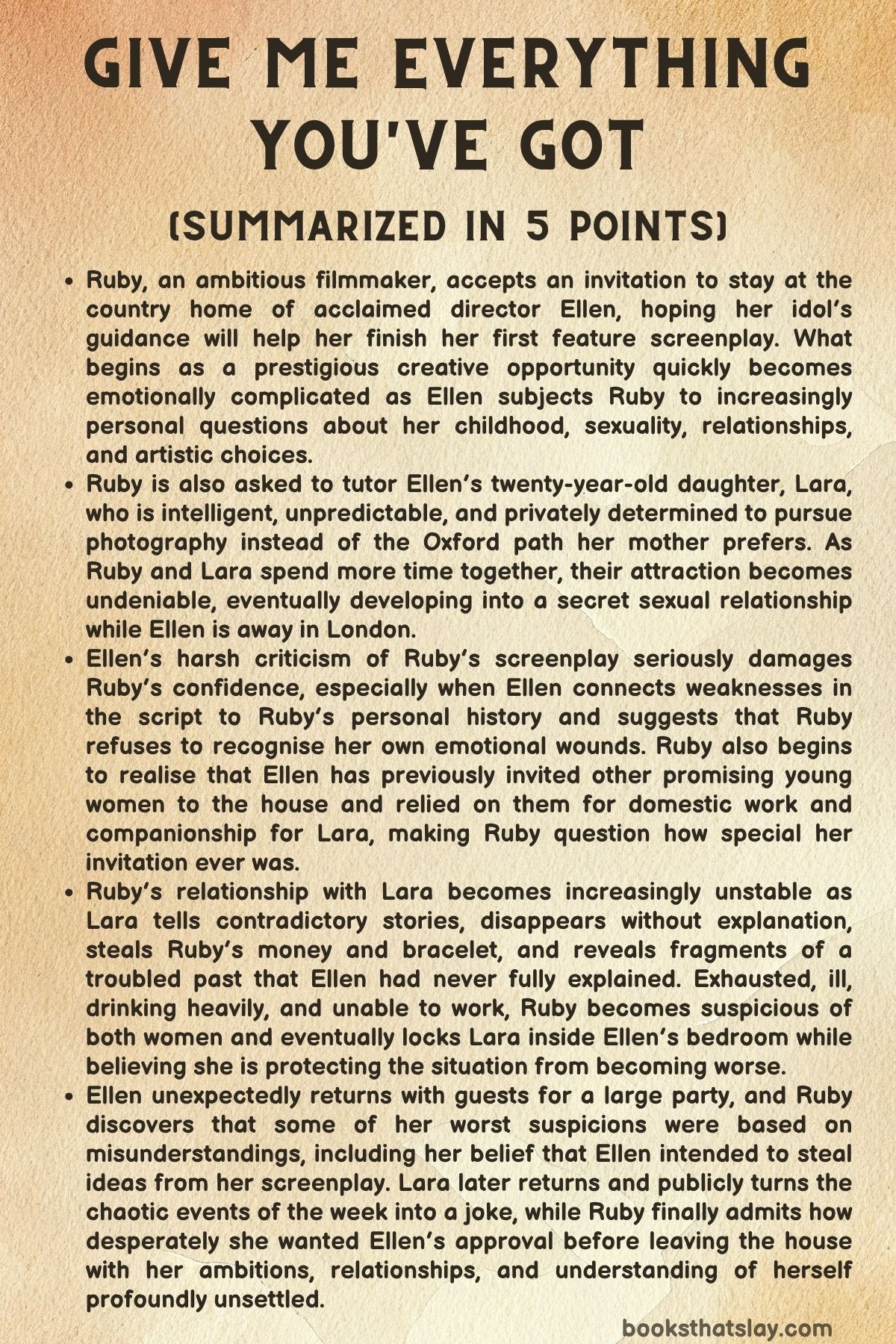
Ruby arrives at the country home of Ellen, an acclaimed filmmaker whose approval means an enormous amount to her. After attending one of Ellen’s workshops, Ruby has been invited to stay at the house while working on the screenplay for her first feature film, an opportunity that initially feels like proof that Ellen has recognised something exceptional in her.
The house itself seems to represent the life Ruby wants to enter: wealth, artistic achievement, beauty, confidence and professional authority. Yet almost immediately she becomes unsettled by Ellen’s twenty-year-old daughter, Lara, whose beauty and self-possession make Ruby feel awkward and unexpectedly jealous of the intimacy she shares with her mother.
Ruby’s fascination with Ellen began during a workshop for women filmmakers. Ellen challenged the participants to examine their earliest understanding of womanhood, and when Ruby described wanting boys to desire her as a girl, Ellen interpreted the memory through the language of internalised patriarchy.
Being singled out by Ellen made Ruby feel recognised at a crucial moment in her life. After years of financial insecurity, tutoring work and uncertainty about whether filmmaking would ever become a viable career, Ruby had recently won a Sundance prize and secured funding for a feature, making Ellen’s attention feel like confirmation that she had finally entered the professional world she had spent years trying to reach.
Once Ruby settles into Ellen’s house, however, the relationship becomes less clearly professional. Ellen repeatedly interrupts Ruby’s work to question her about sex, family, childhood and femininity, often treating ordinary memories as evidence of deeper wounds.
Ruby begins to sense that Ellen prefers certain versions of her experiences, particularly interpretations involving trauma or patriarchal conditioning. Wanting to satisfy her mentor, Ruby starts adjusting the way she presents herself, slowly allowing Ellen’s ideas about her identity to influence the way she understands her own past.
At the same time, Ruby grows closer to Lara. Ellen asks Ruby to help Lara with her Oxford application, supposedly because Lara’s anxiety has prevented her from completing it, and Ruby accepts partly because she wants to make herself useful within Ellen’s household.
Ruby soon discovers that Lara is highly intelligent and already capable of sophisticated academic work. More importantly, Lara confesses that she does not actually want to study English at Oxford; she wants to pursue photography, an ambition Ellen refuses to take seriously.
Lara’s photographs reveal a side of her life that neither Ellen nor Lara fully explains. Ruby becomes increasingly curious about the tension between the young woman Ellen describes as fragile and troubled and the more provocative, secretive Lara she encounters when they are alone.
Their attraction eventually becomes explicit when Lara asks what Ruby would do if she kissed her and then acts before Ruby can answer. Ruby does not resist, and the kiss creates a secret that separates her private relationship with Lara from her increasingly complicated dependence on Ellen.
Meanwhile, Ellen’s interest in Ruby becomes more invasive. During a family game known as the Confessional Chair, Ruby is pressured into revealing details about her former partner Seb, her sexual experiences and the fantasies that have both attracted and disturbed her.
Ellen responds to these confessions analytically, treating Ruby’s private life almost as evidence in a psychological case study. Ruby begins to feel that her experiences are being collected and interpreted by someone whose approval she still desperately wants.
The tension reaches a breaking point when Ellen finally discusses Ruby’s screenplay. Instead of restricting herself to the work, Ellen argues that Ruby’s film reproduces male sexual fantasies while claiming to represent female liberation, then connects what she sees as artistic weaknesses to Ruby’s childhood, relationships, abortion and sexual history.
Ruby becomes furious when Ellen insists that she is denying her own victimhood. She decides to leave, but Ellen apologises and persuades her to stay, largely because Ellen is about to return to London and does not want Lara left alone. Ruby realises that her supposed writing retreat has also turned her into a caretaker.
Once Ellen leaves, Ruby and Lara’s relationship changes rapidly. They drink heavily, spend hours together and talk about their deepest insecurities, with Ruby admitting that she has a habit of destroying stable situations when they begin to feel too settled.
Lara, in turn, exposes Ruby’s dependence on Ellen’s approval. Wearing Ellen’s clothes and mocking her mother, Lara tells Ruby that Ellen will never want her in the way Lara does, directly connecting Ruby’s attraction to Lara with her emotional fixation on Ellen.
Ruby and Lara sleep together in Ellen’s bed. Rather than feeling immediate regret, Ruby is excited by the intimacy and by the danger involved, and the two spend the following days behaving increasingly like lovers.
Lara describes the loneliness of growing up with an often-absent mother and reveals that Ruby is not the first promising young filmmaker Ellen has invited to stay at the house. Ruby begins to understand that the invitation she considered uniquely significant may be part of a repeated pattern in which Ellen combines professional mentorship with help caring for Lara.
The sexual relationship nevertheless continues. Lara photographs Ruby naked, directs her body with confidence and begins imagining a future in which she might live with Ruby, but Ruby retreats when the relationship starts to imply lasting responsibility.
At the same time, Lara’s behaviour becomes harder for Ruby to interpret. She seems to expose Ruby deliberately, disappears at night and denies having done so, tells stories that may be partly invented, and offers inconsistent accounts of her past. Ruby’s attraction gradually becomes inseparable from suspicion.
Ruby’s professional confidence also collapses. Ellen’s criticism has made her nearly incapable of writing, while the household itself begins to feel disordered and oppressive in Ellen’s absence.
Ruby discovers evidence that previous young women were also given unpaid tasks when staying with Ellen, and she becomes increasingly angry at how easily professional generosity can disguise exploitation. Her damaged screenplay, household responsibilities, heavy drinking and obsessive involvement with Lara begin to merge into one crisis.
The situation becomes more unstable when Ruby finds Ellen’s extensive notes on her screenplay and a list questioning Ruby’s supposed emotional intelligence. Sick from the heat, alcohol and stress, she experiences Ellen’s critical voice almost as a physical presence and later discovers that the water she has been drinking contains vodka.
Lara confronts Ruby about whether Ruby actually likes her and admits how desperately she has wanted Ruby’s affection. Ruby, however, is physically ill and emotionally overwhelmed, and when she sees Lara standing alone outside that night, she deliberately refuses to go to her.
The next day Ruby discovers a handwritten sheet among Ellen’s notes containing ideas connected to her screenplay. Convinced that Ellen intends to steal from her, she searches Ellen’s study and instead finds an email suggesting that Lara has previously spent time in some kind of institution.
When Lara suddenly disappears, Ruby panics. She searches the house and grounds, reads disturbing passages in Lara’s journal and spends the night terrified, yet somehow does not contact either Ellen or the police.
Lara eventually returns covered in mud but acts as though nothing important has happened. After another confrontation, Ruby locks Lara inside Ellen’s bedroom while she sleeps, believing she is containing a dangerous situation.
The next morning Lara suggests that Ruby may be the person who needs to be locked away. Ruby tries to telephone Ellen for help, but Ellen fails to recognise the seriousness of the situation and ends the conversation after reminding Ruby about Lara’s university application.
Ruby finally tears apart her screenplay, convinced that Ellen’s criticism has exposed its worthlessness. She also discovers that her tutoring money has disappeared, and Lara admits taking it, claiming she gave it to a male friend whose condition she describes in confusing and inconsistent terms.
Despite the mistrust between them, Lara collapses into Ruby’s arms and begs her not to let go. The women take sleeping medication, tell each other they are in love, and Ruby spends the night writing Lara’s entire personal statement while Lara sleeps.
By morning, however, Lara is distant again. She later disappears once more, and Ruby discovers both her stolen bracelet in Lara’s room and a photograph suggesting that Lara may have been involved with injectable drugs.
Lara finally messages Ruby to say that she is hiding because she is afraid of her. The reversal is devastating: Ruby, who has spent days interpreting herself as Lara’s protector, is forced to confront the possibility that Lara may experience her as threatening.
Ellen then returns unexpectedly with a large group from a film read-through and immediately turns the house into a party. Although Lara is still missing, Ellen initially maintains her public composure, asking Ruby to prepare rooms for guests before privately revealing her anxiety about her daughter.
Ruby confronts Ellen over what she believes is the theft of her screenplay ideas, only to be told that the notes were intended as suggestions for Ruby herself. The discovery humiliates Ruby and demonstrates how thoroughly suspicion has distorted her interpretation of Ellen’s actions.
During the party, Ruby discovers another entrance to the servants’ passage and realises that Lara could have escaped from the bedroom she had supposedly locked. Lara then suddenly reappears, composed and elegantly dressed, and turns the events of the week into material for a party game, joking publicly about sex, sleeping pills, the dead chicken and Ruby imprisoning her.
When Ruby is asked to speak, she considers exposing everything but instead confesses how badly she wanted Ellen’s approval and how profoundly the visit has unsettled her. She later attempts, unsuccessfully, to set fire to the house before sharing a final conversation with Lara about the inability to stop wanting what one wants.
Ellen ultimately arranges for Ruby to be driven back to London. Before leaving, Ruby sees Ellen and Lara once again joined in their intense mother-daughter intimacy, while Lara reaches across Ellen to touch Ruby’s hand.
Ruby leaves without professional triumph, romantic certainty or a stable interpretation of what has happened. Give Me Everything You’ve Got closes this part of her experience with the structures of admiration, desire and authority exposed as far less reliable than Ruby once believed them to be.
Characters
Ruby
Ruby is the central consciousness of Give Me Everything You’ve Got, and much of her complexity comes from the gap between the independence she wants to project and the approval she constantly seeks. Professionally, she has spent years fearing mediocrity and failure, so Ellen’s attention reaches her at precisely the moment when external recognition matters most to her.
Her ambition is therefore not simply a career goal but a source of vulnerability. Because Ruby has invested Ellen with enormous artistic authority, criticism of her screenplay quickly becomes criticism of her intelligence, politics, sexuality and identity, and Ruby struggles to defend the boundaries between her work and herself.
Ruby also resists fixed explanations of her past. Ellen repeatedly treats the departure of Ruby’s mother, her abortion, her relationships and her sexual experiences as evidence of buried injury, while Ruby initially insists that these experiences do not automatically make her a victim.
Yet Ruby gradually begins performing versions of herself that satisfy Ellen’s expectations. This willingness to reshape her memories shows both her need to be understood and her fear that her authentic experience will not be interesting, political or wounded enough to deserve attention.
Her relationship with Lara exposes another contradiction. Ruby is drawn to danger, secrecy and emotional intensity, but she becomes uncomfortable whenever Lara asks for stability or imagines a future beyond the immediate affair.
Ruby describes herself as someone who ruins settled situations, which suggests that disruption allows her to preserve the idea that she is free. Her attraction to Lara becomes strongest when the relationship is forbidden and uncertain, while the possibility of responsibility makes her retreat.
As conditions at the house deteriorate, Ruby becomes increasingly unreliable even to herself. Alcohol, illness, exhaustion, Ellen’s criticism and Lara’s inconsistent behaviour make it difficult for her to distinguish justified suspicion from paranoia, culminating in her decision to lock Lara inside Ellen’s bedroom.
The action reveals how quickly Ruby can move from feeling controlled to attempting control herself. By the time she leaves, she has been forced to confront not only Ellen and Lara’s behaviour but her own capacity for obsession, projection, jealousy and coercion.
Ellen
Ellen is the figure of authority around whom the emotional structure of Give Me Everything You’ve Got is organised. She is accomplished, wealthy, intellectually confident and capable of making younger artists feel that her attention has the power to validate their careers.
Her mentorship is attractive because it appears unusually intimate. Ellen does not simply discuss filmmaking with Ruby; she asks about childhood, family, sex, femininity and personal wounds, creating the impression that artistic truth requires complete psychological exposure.
This intimacy, however, creates a major imbalance of power. Ellen decides what Ruby’s experiences mean, which interpretations count as honest, and which artistic choices reveal political or emotional failure.
Even when some of Ellen’s criticism may be intellectually serious, her method leaves Ruby with little room to disagree without appearing defensive or insufficiently self-aware. Ellen’s authority therefore becomes difficult to challenge because resistance itself can be interpreted as further evidence that Ruby has not understood herself.
Ellen’s relationship with Lara complicates her character further. She clearly loves her daughter and worries intensely about her wellbeing, yet her attempts to protect Lara frequently take the form of directing her life.
She encourages Oxford rather than photography, recruits younger women to stay in the house and keep Lara company, and presents Lara’s difficulties to Ruby selectively. Ellen’s filmmaking instincts also seem to influence the way she understands her daughter, as though observation, interpretation and authorship have become inseparable from motherhood.
Ellen is not presented simply as a calculating exploiter. Her anxiety about Lara becomes visible when she returns, and her concern appears genuine even when she tries to conceal it in front of others.
That mixture of care and control is what makes her difficult to reduce to a single moral category. She can support young artists while using their labour, recognise real problems in Ruby’s screenplay while damaging Ruby’s confidence, and love Lara intensely while helping create the conditions against which Lara rebels.
Lara
Lara initially appears through Ruby’s insecure perception of her: beautiful, cool, confident and naturally close to Ellen in a way Ruby can never imitate. As Ruby spends more time with her, however, this surface gives way to a young woman who is intelligent, artistic, emotionally volatile and deeply frustrated by the life her mother has planned for her.
Her wish to study photography rather than English is especially important because it represents a desire to author her own identity. Ellen’s refusal to treat that ambition seriously makes Lara’s rebellion professional as well as personal.
Lara’s attraction to Ruby contains genuine longing but also a struggle over power. She recognises Ruby’s fascination with Ellen and uses that knowledge provocatively, even dressing in Ellen’s clothes and telling Ruby that Ellen will never desire her as Lara does.
At the same time, Lara becomes emotionally exposed when she asks whether Ruby truly likes her, imagines living with her and admits her fear of abandonment. Her provocations often seem inseparable from a need to test whether another person will remain present when she becomes difficult or demanding.
Lara is also deliberately difficult to interpret with certainty. She tells stories and then destabilises them, disappears and denies events, provides inconsistent accounts of her past and sometimes appears to manipulate Ruby’s perception of what has happened.
Yet the book also shows how dangerous it is to explain Lara too confidently. Ellen has already created one interpretation of her daughter, while Ruby gradually creates another, and both women risk treating Lara as a problem to be decoded rather than a person whose experience may resist their preferred explanations.
Her final return during Ellen’s party demonstrates her ability to seize control of the narrative around herself. By joking publicly about events that Ruby has experienced as frightening and intimate, Lara turns private crisis into performance and deprives Ruby of the authority to define what happened between them.
The gesture can appear cruel, defensive, strategic or all three simultaneously. Lara ends the story neither as a simple victim nor as a straightforward manipulator, but as someone fighting desperately against other people’s attempts to possess, protect, interpret and direct her.
Seb
Seb never occupies the country house directly, but his relationship with Ruby helps explain her ideas about intimacy, domesticity and desire. Ruby spent four years with him, meaning he represents a sustained form of commitment rather than the brief, unstable encounters that increasingly attract her during her stay with Ellen and Lara.
When Ruby describes the relationship during the Confessional Chair, her memories reveal the complicated connection she makes between desire and danger. Seb’s fantasy of impregnating her produces a bodily response in Ruby that she finds difficult to reconcile with her conscious beliefs, forcing her to confront the uncomfortable possibility that desire does not always follow one’s politics or self-image.
Seb also represents the conventional life Ruby fears she might secretly want. She speaks of destroying stability whenever it becomes too settled, suggesting that the end of their relationship belongs to a larger pattern in which she equates disruption with freedom.
His importance therefore lies less in his direct actions and more in what Ruby’s memory of him reveals. Through Seb, the book shows that Ruby’s conflict between independence and attachment existed before Ellen and Lara entered her life, even if the events at the house intensify it dramatically.
Martha
Martha is a minor character in terms of presence, but she plays an important role as Ruby’s professional rival and psychological foil. Ellen introduces Martha into conversation in a way that immediately activates Ruby’s competitiveness, then criticises Ruby for wanting to be the favoured student.
Ruby’s response shows how thoroughly she has accepted the competitive structure surrounding mentorship. She wants Ellen’s recognition to be exclusive because being chosen seems to prove that she possesses qualities other young filmmakers lack.
Ellen’s praise of Martha’s willingness to take artistic risks also touches one of Ruby’s deepest insecurities. Ruby fears that beneath her intelligence and technical ability she may be cautious, conventional or artistically mediocre.
Martha therefore matters less as a fully developed independent figure than as the person against whom Ruby imagines herself being measured. The comparison makes clear that Ruby’s dependence on Ellen involves not only admiration but a need to win, and that being mentored has become inseparable from being ranked.
Ruby’s Mother
Ruby’s mother is physically absent from the central events, yet her departure when Ruby was eight becomes one of the most contested facts of Ruby’s identity. Ruby does not deny that the abandonment affected her, but she strongly resists Ellen’s assumption that it must function as the central trauma explaining her adult personality.
That resistance is significant because it raises the question of who has the right to interpret a person’s past. Ellen views the mother’s departure as evidence that Ruby has unresolved wounds, whereas Ruby objects to having a complicated childhood converted into a neat psychological explanation.
The mother’s absence nevertheless echoes through Ruby’s behaviour. Ruby fears abandonment while also repeatedly leaving stable situations herself, creating a possible connection that she is unwilling to accept simply because Ellen insists upon it.
The story never forces a definitive explanation, which is important. Ruby’s mother functions not as a simple cause of Ruby’s adult difficulties but as an example of how personal history can become a struggle between experience and interpretation.
Ruby’s Father
Ruby’s father represents the household in which Ruby grew up after her mother left. Living with her father and brother made Ruby unusually conscious of her developing female body, and she remembers hiding bras and sanitary products during adolescence because femininity felt difficult to display openly within that environment.
These details help explain why questions of being looked at, desired and understood become so important to Ruby. Photography later gives her a way of controlling what enters the frame, suggesting that visual composition offers a kind of order that her early emotional environment did not always provide.
The father is not presented as overtly cruel or oppressive in the material provided, which makes Ruby’s discomfort more subtle. Her childhood illustrates how gender awareness can form through ordinary domestic arrangements rather than through one dramatic event.
His presence therefore contributes to Ruby’s development without offering a complete explanation for it. Like her mother’s absence, Ruby’s life with her father becomes material that Ellen wants to interpret more confidently than Ruby herself is willing to do.
Themes
Desire, Approval and the Need to Be Chosen
Desire in Give Me Everything You’ve Got is rarely limited to sexual attraction; it also appears as the need to be noticed, selected and declared exceptional. Ruby’s fascination with Ellen begins because Ellen possesses exactly the authority Ruby wants to impress, so professional recognition takes on the emotional force of seduction.
When Ellen singles Ruby out during the workshop and later invites her to the country house, Ruby interprets the attention as confirmation that she belongs among serious filmmakers. Learning that other promising young women have received similar invitations therefore hurts because it threatens the idea that Ellen identified something uniquely valuable in her.
Ruby’s relationship with Lara repeats this structure from a different direction. Lara recognises that Ruby wants Ellen’s approval and offers another form of being chosen, one based on erotic intimacy rather than professional authority.
Yet Ruby remains uneasy whenever desire produces responsibility. She wants the intensity of Lara’s attention but becomes frightened when Lara imagines a shared future, revealing that being desired is easier for Ruby than accepting the obligations that lasting intimacy may create.
The final scenes leave desire unresolved rather than conquered. Ruby, Lara and Ellen continue reaching toward one another even after mistrust, humiliation and conflict have exposed the harm their attachments can cause.
The story therefore treats wanting as morally complicated because people can understand that a desire is destabilising while still remaining unable to stop seeking its fulfilment.
Mentorship, Power and Exploitation
Ellen’s relationship with Ruby exposes how easily mentorship can become difficult to separate from control when one person possesses greater prestige, experience and professional access. Ruby initially experiences Ellen’s attention as generosity because Ellen offers advice, a place to work and the possibility of industry introductions.
The same arrangement gradually demands far more from Ruby than professional concentration. She tutors Lara, performs household tasks, provides companionship and becomes responsible for managing problems Ellen has not fully explained.
The imbalance becomes sharper because Ellen’s authority is psychological as well as professional. She does not simply tell Ruby what is weak in the screenplay; she presents artistic flaws as evidence of personal blindness, linking the script to Ruby’s childhood, sexuality and supposed refusal to recognise herself as a victim.
Such criticism becomes difficult to answer because disagreement can itself be treated as proof that Ruby lacks self-awareness. Ellen therefore occupies the position of both mentor and interpreter, allowing her professional authority to expand into Ruby’s understanding of her own identity.
The repeated presence of other young filmmakers suggests that Ruby’s experience is not entirely unique. Ellen’s household seems able to transform admiration into labour, with ambitious younger women accepting tasks because proximity to Ellen appears professionally valuable.
The novel does not reduce Ellen’s support to pure manipulation, but it repeatedly asks whether generosity remains generous when the recipient feels unable to refuse what is demanded in return.
Identity, Sexuality and Self-Invention
Ruby’s sense of identity is repeatedly challenged by the difference between what she believes about herself and what her desires appear to reveal. She considers herself independent, sexually liberated and essentially heterosexual, yet her attraction to Lara destabilises these categories without immediately replacing them with a new label.
Lara directly challenges Ruby’s insistence that she is “basically straight,” exposing Ruby’s tendency to preserve a familiar self-description even when her behaviour has complicated it.
A similar conflict appears in Ruby’s discussions of sex with Ellen. Ruby wants her politics, bodily responses and artistic choices to form a coherent identity, but memories involving pregnancy fantasies, danger and earlier sexual experiences resist that neat alignment.
Ellen tries to turn these contradictions into a psychological diagnosis, while Ruby resists the idea that desire must always communicate a single hidden truth about the person experiencing it.
Lara faces a parallel struggle over identity because Ellen has already imagined a future for her. Oxford represents the identity Ellen considers respectable and secure, while photography represents Lara’s desire to define herself through her own interests.
Both women therefore struggle against descriptions imposed from outside. At the same time, each also constructs versions of herself for other people, showing that identity is not only discovered but continually performed, defended, altered and sometimes contradicted.
Art, Truth and Ownership
Artistic honesty becomes a source of conflict because Ellen and Ruby do not agree about what truth in art requires. Ellen believes Ruby’s screenplay reproduces damaging assumptions about women and sexuality, and she argues that Ruby must confront her own experiences more directly if she wants to create serious work.
Ruby initially treats Ellen’s judgment as authoritative, but the effect is paralysis rather than liberation. Once every artistic decision seems connected to an unresolved personal wound, Ruby becomes almost incapable of writing without hearing Ellen’s criticism inside her own thoughts.
The book also questions the expectation that female artists must turn private experience into public material in order to be considered authentic. Ruby becomes suspicious of the demand for confession because Ellen repeatedly converts her memories, sexual history and emotional reactions into evidence that can be interpreted.
Her fear that Ellen has stolen ideas from her screenplay intensifies this concern about ownership. Although Ruby eventually learns that she misunderstood Ellen’s notes, the mistake grows from a genuine anxiety that intimacy with a more powerful artist may leave one uncertain about where influence ends and appropriation begins.
Lara’s photography introduces another version of the same problem. When she photographs Ruby naked, Lara controls the frame and Ruby becomes the observed subject, reversing Ruby’s earlier association of photography with control.
Across these relationships, creating art is inseparable from looking at other people, interpreting them and deciding which version of their experience will be preserved. The ethical question is therefore not only whether art tells the truth, but who is allowed to decide what that truth is.