Glint by Raven Kennedy Summary, Characters and Themes
Glint by Raven Kennedy is a dark and intricate tale set in a world where power, betrayal, and survival are at the forefront of every character’s journey. It intertwines the stories of two central figures—Malina, the disillusioned queen, and Auren, a captive prisoner—both trapped in worlds of manipulation and strife.
As Malina struggles to reclaim her lost power and identity, Auren battles against the harsh realities of her captivity and growing emotions for the enigmatic commander Rip. With a backdrop of political intrigue, hidden powers, and deep emotional conflict, Glint weaves a gripping narrative that keeps readers questioning loyalty, love, and the true meaning of freedom.
Summary
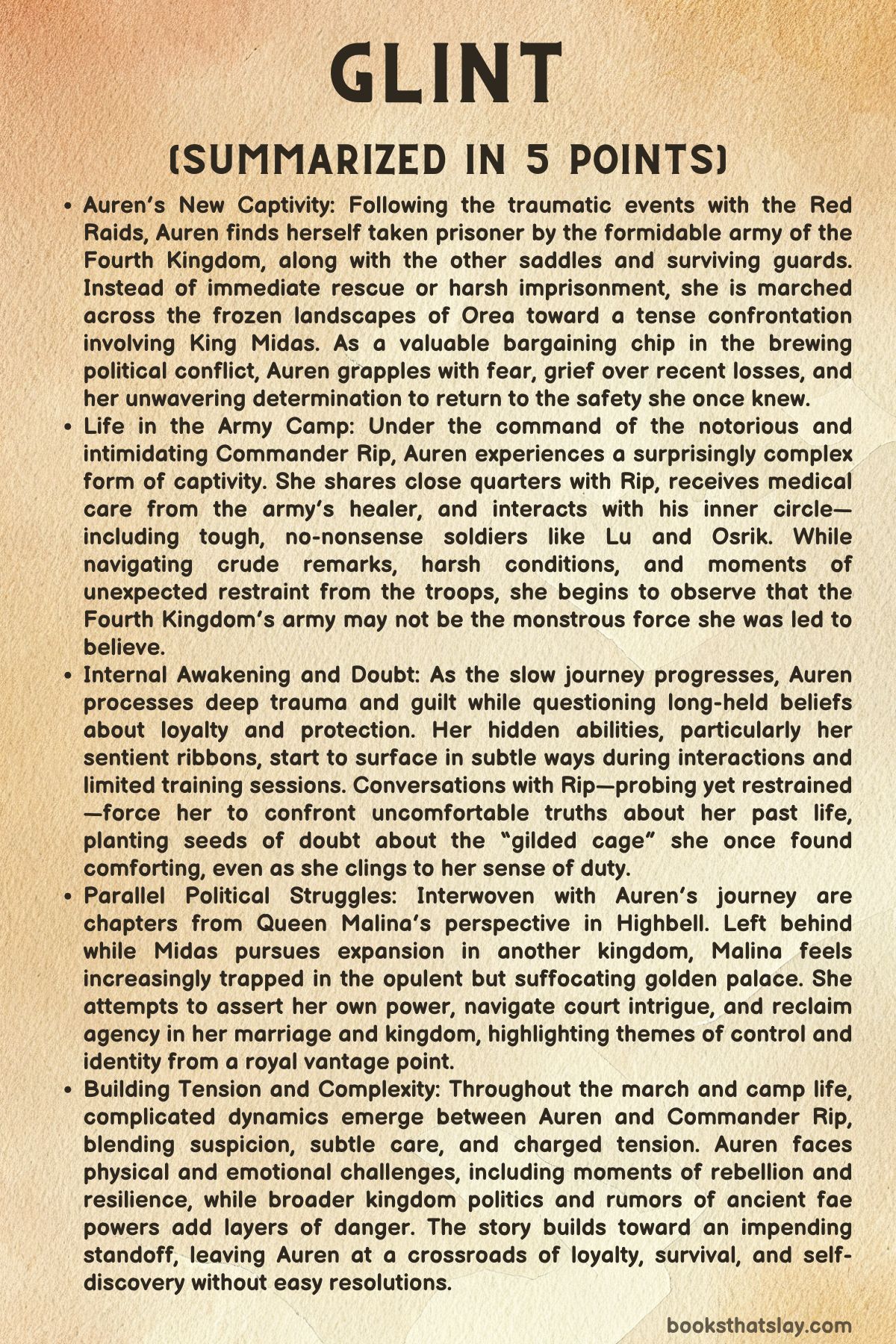
Glint picks up immediately after the events of Gild. Auren, King Midas’s favored “saddle” (concubine) with her gilded skin, has been taken captive by the army of the Fourth Kingdom following the brutal attack by the Red Raids pirates.
Instead of being returned to Midas right away, Auren and the surviving saddles and guards from Midas’s party find themselves marching with Commander Rip’s forces across the harsh, frozen landscapes of Orea toward the Fifth Kingdom (Ranhold), where Midas is currently attempting to expand his power. Auren is treated as a valuable bargaining chip in the brewing conflict between kingdoms—she could either prevent war or ignite it.
The story unfolds primarily through Auren’s first-person perspective, with occasional chapters from Queen Malina (Midas’s wife and queen of the Sixth Kingdom, Highbell) and a few from Midas himself. This multi-POV structure broadens the political intrigue while keeping Auren’s internal emotional journey at the center.
Auren begins her captivity terrified and defiant. She is determined to remain loyal to King Midas, whom she still views as her protector and the man she loves.
Rip himself is a towering, intimidating presence—ruthless on the battlefield, with black spikes along his spine, fae heritage, and an aura of barely contained power. Auren knows fae are dangerous betrayers who once nearly destroyed Orea by wiping out the Seventh Kingdom.
Despite her fears, Auren’s treatment as a prisoner is surprisingly nuanced. She is not thrown into chains or abused by the rank-and-file soldiers (Rip intervenes to punish crude comments or harassment, assigning offenders to latrine duty).
She shares a tent with Commander Rip because he does not fully trust her not to attempt escape. This arrangement creates intense tension: Auren lies awake the first night, expecting violence, but Rip maintains strict boundaries and even shows unexpected restraint.
A healer named Hojat tends to her injuries from the pirate attack, noticing her hidden ribbons—magical, sentient tendrils that extend from her spine, which she has long kept secret and suppressed. Auren slowly gains limited freedom to move around the camp.
These interactions expose Auren to a different side of military life—camaraderie, brutal training, and a strange sense of rough respect—contrasting sharply with the gilded isolation of Midas’s cage.
Throughout the slow, grueling march, Auren grapples with grief over Sail’s death, guilt, and her own sense of self-worth. Rip deliberately pushes her buttons.
He asks probing questions not about Midas’s secrets, but about her—her past, her happiness in the golden castle, and whether she truly felt free. These conversations unsettle Auren, planting seeds of doubt about the “protection” Midas offered.
She witnesses (and sometimes intervenes in) camp life, including a brutal fight circle where soldiers spar for sport. In one tense moment, she steps into the circle herself, only for Rip to end the fight before she is seriously harmed.
Auren trains with her ribbons under the guidance of Rip and the Wrath, learning to control and unleash them as a weapon rather than hiding them. This marks early steps toward embracing her own power.
In a moment of calculated risk, she manages to send a covert warning message to Midas via a messenger bird (or similar means), alerting him to the approaching army and their intentions.
Romantic and emotional tension builds steadily between Auren and Rip. Rip’s care—subtle protection, shared meals, and moments of quiet intensity—contrasts with his cold exterior and battlefield reputation.
Rip reveals he is more than a mere commander, but his full identity as King Slade Ravinger (also known as King Rot) is not yet fully unpacked for Auren in this book; the implications hover as a looming threat and mystery.
Auren’s arc is one of gradual awakening. She begins questioning the “gilded cage” she once found comforting, confronting how Midas shaped her worldview and isolated her.
Her ribbons symbolize her suppressed strength and fae-like nature, which she starts to accept.
While Auren travels, Queen Malina Colier (Midas’s wife, originally a princess of Highbell) seizes the opportunity created by her husband’s absence. Midas has covered the once-ice-and-snow palace of Highbell entirely in gold, erasing its history and Malina’s sense of identity.
She feels sidelined, childless, and reduced to a decorative queen while Midas pursues conquest and gold.
She holds court, attempts to win favor with nobles and commoners, and schemes to reclaim power in the Sixth Kingdom. Her efforts meet resistance—a public humiliation from a common woman in the crowd underscores how out of touch she has become.
A mysterious traveling merchant named Loth Pruinn appears, offering magical glimpses and promises of power, though Malina remains skeptical.
Malina’s growing resentment toward Midas fuels her determination to rule independently. Her chapters reveal the political maneuvering, betrayals, and isolation of court life, paralleling Auren’s themes of entrapment and self-reclamation on a royal scale.
She begins to see Midas’s obsession with gold and control as a cage for her as well.
Midas’s limited chapters show his ambition and possessiveness. He is in the Fifth Kingdom, expanding his influence and preparing for the confrontation with the Fourth Kingdom’s army.
His treatment of Auren has always been controlling—he views her gilded touch as the source of his power and wealth (a misconception that will be challenged later in the series). His concern for Malina mixes with dominance; he wants to keep both women in their assigned roles.
The army’s march builds toward a tense standoff. Political alliances, rumors of King Rot’s decay powers, and the fragile balance between the kingdoms create an atmosphere of impending conflict.
Auren must ultimately decide where her true loyalties lie— with the king who kept her “safe” in a cage, or with the dangerous freedom represented by Rip and his army.
As the journey nears its end, Auren’s internal conflict peaks. She faces moments of rebellion, including unleashing her ribbons more fully.
The book builds emotional and romantic tension without rushing into full resolution. It culminates in a shocking revelation that reframes everything Auren thought she knew about her own power and Midas’s “gift.” (This ties directly into the gold-touch myth and sets up major shifts for Gleam.)
Glint is slower-paced and more introspective than action-heavy, functioning as a character-driven “journey book.”
It excels at psychological depth: dismantling internalized abuse, exploring the cost of loyalty versus freedom, identity beyond one’s role, and the subtle ways power manipulates through kindness or control. The world expands with fae lore, kingdom politics, and hints of deeper magic, while the slow-burn tension between Auren and Rip simmers beneath layers of distrust and attraction.
Characters
In Glint, the characters are defined less by fixed identities and more by the pressure placed on them by power, fear, desire, and survival. Each one reveals a different response to control, whether that control comes from a kingdom, a relationship, a role at court, or a belief about who they are allowed to become.
Auren
Auren stands at the emotional center of the story because her conflict is not only external but deeply psychological. At the beginning, she still believes in the version of her life that King Midas built for her, even though the evidence around her keeps exposing how fragile and false that version is.
Her captivity with Rip’s army is important because it forces her into a position where she can no longer rely on the familiar language of devotion and protection. Removed from her golden cage, she has to face grief, fear, and confusion without the comforting structure that once gave her identity.
What makes her compelling is that her transformation is gradual. She does not suddenly become rebellious or self-aware.
She resists new truths because accepting them would mean admitting that much of her past was shaped by manipulation.
Her emotional depth comes from that hesitation. She mourns Sail, clings to her loyalty to Midas, fears Rip, and yet keeps noticing cracks in the story she has told herself.
Her ribbons symbolize this struggle perfectly. They are extensions of power, instinct, and selfhood that she has hidden for so long that embracing them becomes an act of personal recovery.
Her growing attraction to Rip is not only romantic tension; it also reflects her attraction to a different kind of life, one where she might exist as a person rather than as a possession. She is most interesting when she is uncertain, because that uncertainty shows the damage done by years of control.
Her arc is about learning that safety without freedom is another form of imprisonment.
Commander Rip
Rip is constructed as a figure of contradiction, and that contradiction gives him force throughout the narrative. He enters Auren’s life as an enemy commander, physically intimidating, politically dangerous, and surrounded by rumors that make him seem almost monstrous.
Yet his behavior continually disrupts the assumptions attached to him. He is harsh but controlled, threatening but disciplined, emotionally guarded yet observant in ways that reveal unusual care.
This tension between reputation and reality makes him more than a conventional love interest or warrior figure. He becomes the embodiment of uncomfortable truth, because he sees through the illusions that Auren still clings to and refuses to let her hide inside them.
His treatment of Auren matters because it is neither soft nor exploitative. He does not flatter her, and he does not treat her as decorative.
Instead, he engages her as someone capable of thought, anger, resistance, and power. That shift is crucial to her development.
Rip’s questions are often more destabilizing than his authority, since he presses on the places where her loyalty to Midas stops making emotional sense. At the same time, he is not simplified into a purely noble rescuer.
His secrecy, his battlefield reputation, and the hints about his true identity preserve a sense of danger around him. This balance keeps him compelling.
He represents freedom, but not comfort; honesty, but not ease. His role is to challenge Auren’s inherited beliefs while also carrying mysteries of his own.
Queen Malina Colier
Malina offers a parallel study of captivity from within privilege. Unlike Auren, she is not visibly imprisoned, but her role as queen has hollowed out her sense of self.
She has status, wealth, and ceremony, yet none of these provide authority in a meaningful sense. Midas has transformed Highbell into a monument to his own obsession, covering its history in gold and reducing Malina’s life to display and utility.
Her pain comes from erasure. She is not denied importance in public language, but she is denied real agency, and that gap between appearance and reality defines her character.
What makes Malina effective is her mixture of resentment, ambition, vulnerability, and calculation. She is not presented as purely sympathetic or purely cruel.
She wants power, but that desire comes from humiliation as much as from political instinct. Her attempts to hold court and win influence expose how disconnected she has become from the people around her, which gives her chapters a sharp sense of discomfort.
She wants control, yet she has lived too long within systems that taught her performance instead of leadership. This makes her rise uncertain and psychologically believable.
She is trying to reclaim herself, but she does not yet know what kind of ruler she would actually be. Her storyline expands the novel’s interest in entrapment by showing that a crown can function like a cage when authority belongs to someone else.
King Midas
Midas is the clearest representation of possessive power, but he is more effective as a character when understood through his worldview rather than simply through his cruelty. He sees people in terms of function.
Auren is valuable because he believes her gift sustains his power. Malina is useful because she fills the role of queen.
Kingdoms matter because they can be expanded, absorbed, and displayed. This way of seeing the world turns relationships into ownership and affection into control.
His greatest danger lies in how completely he confuses domination with care. He believes he is justified because he gives protection, luxury, and status, yet all of these gifts depend on obedience.
His chapters help clarify that his obsession is not limited to gold itself but extends to control over narrative. He wants to define what Auren is, what Malina should be, and what others are permitted to think of him.
That need for authority makes him both politically ambitious and emotionally suffocating. He is effective not because he is unpredictable, but because he is consistent in his entitlement.
He expects loyalty as a natural response to what he provides, and he cannot truly recognize the interior lives of the people he controls. This makes him a study in coercive power dressed up as devotion.
He is dangerous because he has built an entire moral logic around possession.
Sail
Sail’s role is brief in terms of physical presence, but his importance is enormous because his death becomes one of the clearest emotional wounds Auren carries. He represents companionship, loyalty, and the limited but genuine human connection she had within Midas’s world.
Because he is killed so brutally, his absence stays active in the narrative. Auren’s grief is not only sorrow for a friend; it is also the loss of one of the few relationships that felt personal rather than transactional.
His murder becomes a reminder that the structures surrounding her were never as safe as she believed.
He also matters symbolically. Sail’s death strips away any remaining illusion that status near power guarantees protection.
In a world structured by conquest and possession, even those close to privilege can be discarded violently. Through memory and trauma, he continues to shape Auren’s emotional state, especially her fear, guilt, and isolation.
His significance lies in how he sharpens the cost of the world she comes from.
Lu
Lu provides one of the most grounded and practical perspectives in the army. She is important because she shows Auren a model of female survival that has nothing to do with ornament, softness, or courtly containment.
Her bluntness cuts through illusion, and her presence complicates Auren’s assumptions about what life among soldiers must be like. Lu is not there to nurture Auren gently.
Instead, she offers the kind of hard-earned understanding that comes from existing in a male-dominated environment without surrendering competence or self-respect.
Her value as a character lies in contrast. Against the polished artificiality of palace life, Lu represents directness, physical capability, and social realism.
She helps expose how unprepared Auren is for a world where respect has to be negotiated differently. At the same time, Lu’s perspective broadens the social texture of the army by showing that female strength in this setting is not symbolic but lived.
She helps normalize a harsher, more honest framework for survival.
Osrik
Osrik contributes to the atmosphere of the Wrath through his size, roughness, and intimidating presence, but he also helps define the culture of Rip’s inner circle. He embodies martial toughness, yet his role is not only to appear threatening.
Through him, Auren encounters a world built on hierarchy, combat, and loyalty that functions according to rules very different from those of the golden court. He represents a kind of force that is open rather than disguised.
Unlike the polished manipulation of royal spaces, his power is visible, physical, and direct.
That distinction matters because it helps Auren recalibrate her understanding of danger. Osrik is frightening, but he is frightening in a way she can read.
This makes him part of the larger contrast between hidden control and visible hardness that runs through the story. As a member of Rip’s circle, he also reinforces the idea that this army is bound by mutual reliance rather than decorative allegiance.
Hojat
Hojat plays a quieter but meaningful role because healing in this story is tied to recognition. When he tends Auren’s injuries and notices the ribbons she has hidden, he becomes part of the process by which her concealed self begins to move into the open.
He does not carry the dramatic force of Rip or the political weight of Malina, but he contributes to the atmosphere of careful observation that surrounds Auren in captivity. He is one of the first people to engage with her physical reality without the possessive framework that defined her life under Midas.
His presence matters because it introduces a different form of power into the narrative: restorative rather than dominating. In a world shaped by conquest, bargaining, and command, a healer’s attention carries its own significance.
Hojat helps make visible the body that Auren has long treated as something to manage, hide, and preserve for someone else’s use. That subtle shift supports her movement toward bodily autonomy and self-acceptance.
Jeo
Jeo functions as a stabilizing presence in Malina’s political storyline. He is loyal, but his loyalty does not solve her deeper problems, and that limitation is what makes him useful as a character.
He reflects the constraints of court service in a kingdom where real authority has been distorted by Midas’s dominance. Jeo can advise, observe, and support, but he cannot give Malina the legitimacy or confidence she lacks.
His presence shows that loyalty alone is not enough to restore a broken political order.
He is also important because he reveals how isolated Malina truly is. Even with an adviser at her side, she remains emotionally and strategically exposed.
Through Jeo, the court scenes gain texture as spaces where support exists, but only within narrow boundaries. He helps underline the difference between assistance and power.
Loth Pruinn
Loth Pruinn introduces unease through ambiguity. As a traveling merchant who offers glimpses, promises, and the possibility of power, he functions as a destabilizing figure in Malina’s world.
He is intriguing because he appears at a moment when Malina is desperate for leverage, identity, and direction. This makes his presence psychologically significant.
Whether or not he can be trusted matters less at first than the fact that he enters precisely where vulnerability and ambition meet.
His role suggests that power rarely arrives in clean forms. It often comes attached to temptation, uncertainty, and hidden cost.
For Malina, he represents possibility tinged with threat. He does not simply offer help; he tests the shape of her desire.
That makes him an effective catalyst figure, someone who pushes her closer to choices that may redefine her position but also deepen her danger.
Themes
Freedom and the Psychology of Captivity
Freedom here is not treated as a simple physical condition. Auren’s journey shows that captivity can survive long after doors are opened, because control often becomes internal.
She has been taught to interpret restriction as love, dependence as loyalty, and silence as safety. That training shapes the way she responds to Rip, to the army, and even to her own powers.
Her struggle is not merely to escape a king or a cage but to recognize that her choices have been narrowed for years by fear and conditioning. Malina’s storyline expands this idea by showing a different form of confinement.
She is a queen with wealth and status, yet she is still trapped inside a role designed by someone else. Both women reveal that imprisonment can look glamorous from the outside while still destroying identity from within.
In Glint, freedom becomes painful because it requires the collapse of comforting lies. It asks the characters to live without the stories that once gave them stability, even when those stories were built on domination.
Power, Possession, and Control
Power in this story is rarely neutral. It is tied to ownership, performance, and the desire to define other people’s value.
Midas represents the most obvious version of this theme because he treats bodies, kingdoms, and relationships as things to acquire and arrange. His control is effective not only because he is powerful, but because he frames possession as protection.
That logic exposes how domination often survives by presenting itself as care. Rip offers a contrasting model of authority.
He is commanding and dangerous, yet he does not seek to reduce Auren into an object that confirms his status. Malina’s chapters further complicate the theme by showing someone who has been deprived of agency now trying to claim power for herself.
Her ambition raises difficult questions, because the desire for authority can emerge from justified anger without automatically becoming ethical. The narrative keeps returning to one central problem: who has the right to decide what another person is worth?
Every major conflict grows from attempts to answer that question through force, influence, marriage, conquest, or emotional pressure.
Identity and Self-Reclamation
Identity is shaped throughout the novel as something that can be suppressed, assigned, distorted, and gradually reclaimed. Auren has spent much of her life existing through labels given to her by others: favored, treasured, protected, owned.
Because of this, her development depends on learning to separate her inner self from the role she has performed. Her ribbons become the clearest sign of that buried self.
They are not just magical tools but physical proof of a truth she has long hidden, even from herself. Accepting them means accepting that she is larger than the version of herself that Midas permitted.
Malina faces a related struggle in a different register. The gold covering Highbell does not merely alter a palace; it erases history and replaces it with someone else’s vision.
Her resentment comes from living inside that erasure. Both arcs show that self-reclamation is difficult because it involves grief as much as empowerment.
To recover identity, the characters must first confront how much has been taken from them, how much they have surrendered for survival, and how uncertain the future becomes once they stop living according to assigned roles.
Loyalty, Desire, and Moral Realignment
Loyalty in the story is not presented as inherently noble. Instead, it is examined as something that can arise from love, fear, habit, gratitude, dependence, or manipulation.
Auren’s devotion to Midas is emotionally convincing because it was built over time through rescue, privilege, and isolation. That history makes her moral realignment slow and painful.
She cannot simply reject him without also reevaluating the meaning of her past. Her growing connection to Rip intensifies this conflict because desire becomes tied to a shift in worldview.
She is not only drawn to a man she once feared; she is drawn toward a different understanding of herself and of what a relationship might be. That emotional movement forces her to question whether loyalty should be measured by endurance or by truth.
Malina’s position reflects another dimension of the same theme. Her marriage to Midas binds her publicly even as resentment corrodes private allegiance.
Across these arcs, the narrative suggests that loyalty becomes dangerous when it is disconnected from ethics. Wanting to remain faithful to a person, a system, or a promise is not automatically honorable when that loyalty requires self-erasure.